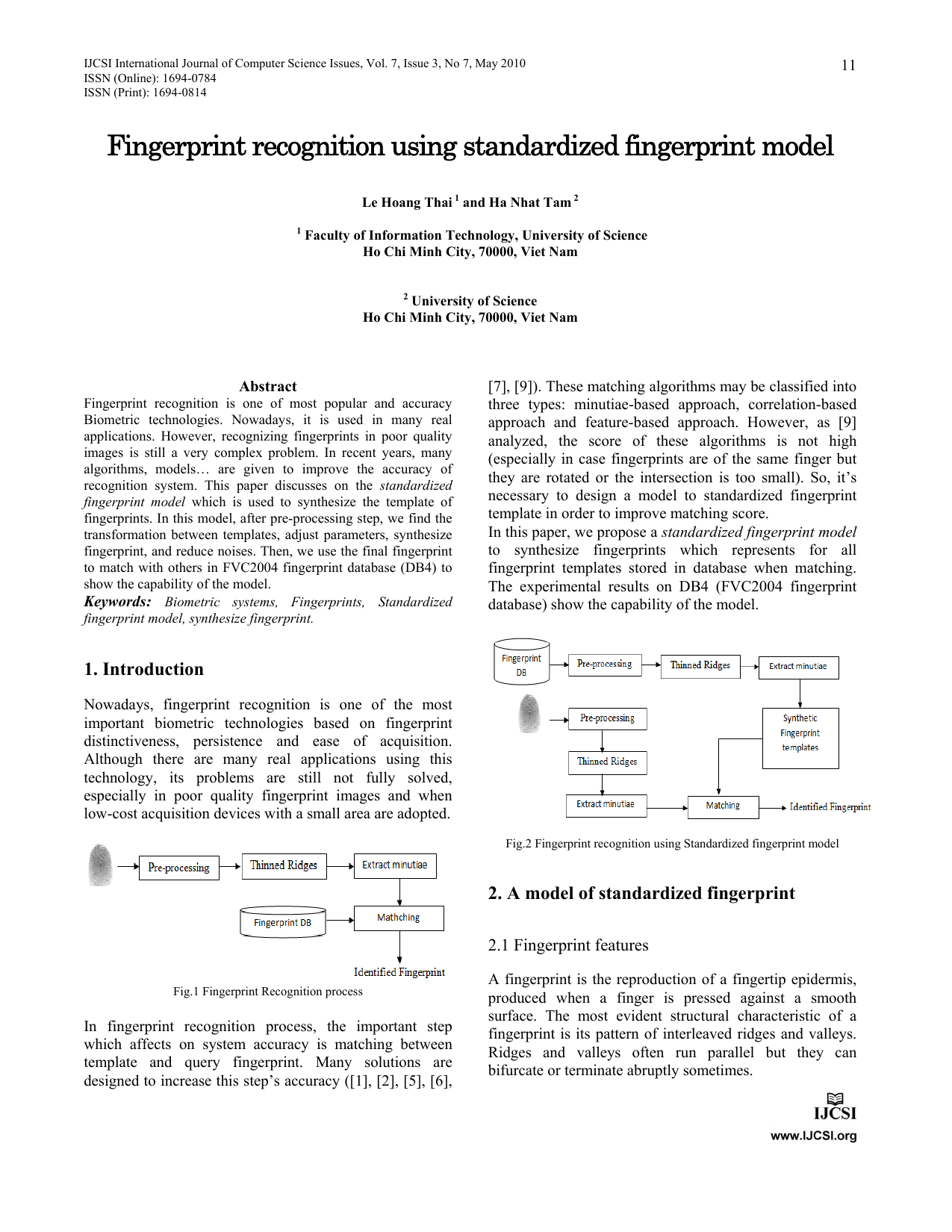
Fingerprint recognition is one of most popular and accuracy Biometric technologies. Nowadays, it is used in many real applications. However, recognizing fingerprints in poor quality images is still a very complex problem. In recent years, many algorithms, models...are given to improve the accuracy of recognition system. This paper discusses on the standardized fingerprint model which is used to synthesize the template of fingerprints. In this model, after pre-processing step, we find the transformation between templates, adjust parameters, synthesize fingerprint, and reduce noises. Then, we use the final fingerprint to match with others in FVC2004 fingerprint database (DB4) to show the capability of the model.
Nowadays, fingerprint recognition is one of the most important biometric technologies based on fingerprint distinctiveness, persistence and ease of acquisition. Although there are many real applications using this technology, its problems are still not fully solved, especially in poor quality fingerprint images and when low-cost acquisition devices with a small area are adopted. In fingerprint recognition process, the important step which affects on system accuracy is matching between template and query fingerprint. Many solutions are designed to increase this step's accuracy ( [1], [2], [5], [6], [7], [9]). These matching algorithms may be classified into three types: minutiae-based approach, correlation-based approach and feature-based approach. However, as [9] analyzed, the score of these algorithms is not high (especially in case fingerprints are of the same finger but they are rotated or the intersection is too small). So, it's necessary to design a model to standardized fingerprint template in order to improve matching score. In this paper, we propose a standardized fingerprint model to synthesize fingerprints which represents for all fingerprint templates stored in database when matching. The experimental results on DB4 (FVC2004 fingerprint database) show the capability of the model.
A fingerprint is the reproduction of a fingertip epidermis, produced when a finger is pressed against a smooth surface. The most evident structural characteristic of a fingerprint is its pattern of interleaved ridges and valleys. Ridges and valleys often run parallel but they can bifurcate or terminate abruptly sometimes. The minutia, which is created when ridges and valleys bifurcate or terminate, is important feature for matching algorithms. (2) Finding and adjusting parameter sets: at first, choose a fingerprint which has largest fingerprint area as mean image. Then, we use Genetic Algorithms in [9] to find the transformation between mean image and others. ( 3) Synthesizing fingerprint: with the transformations in previous step, we re-calculate parameters’ value (to get exact value for parameters), add supplement ridge lines and minutiae to mean fingerprint. ( 4) Post-processing: this step will help removing the noise of step 3.
For each input image, we find fingerprint area and thin ridge line whose width is 1 pixel. P is a point on processed fingerprint image and pixel(P) is value of pixel at P: Pixel(P) = 1 if P belong to ridge Pixel(P) = 0 if P belong to valley Each minutia, we get in this step, contains the x-and ycoordinates, the type (which is termination or bifurcation) and the angle between the tangent to the ridge line at the minutia position and the horizontal axis. Result of this step is a processed fingerprint called Flist
Base on the result of pre-processing step, we use the Genetic Algorithm which is proposed by Tan and Bhanu in [9] to find the transformation between meanF (a fingerprint which has the largest fingerprint area as mean fingerprint) and others in FList. And then, we re-calculate the exact value of these parameters.
Step 1: Find parameter set: In [9], Tan and Bhanu proposed a transformation:
Where s is the scale factor : angle of rotation between two fingerprints T= [t x ,t y ] is the vector of translation.
Synthesizing fingerprint step creates a fingerprint image that contains all features of fingerprint templates. However, some minutiae of the original fingerprint are not correct on meanF. For example, M is termination minutia on fingerprint template but in meanF, it is not correct because of ridge line connection. In this step, we re-check all meanF’s minutiae and remove wrong minutiae.
Output: meanF with minutiaeList which is removed wrong minutiae. 1. For each minutiae M in minutiaeList of meanF If type of M is termination minutia and pixel(M) = 1 and M is termination point then M is marked If type of M is bifurcation minutia and pixel(M) = 1 and M is not termination point then M is marked 2. Remove all un-marked minutiae from minutiaeList
Database used for experiment is DB4 FVC2004. Several fingerprint images in this database are low quality. Size of each fingerprint images is 288x384 pixels, and its resolution is 500 dpi. FVC2004 DB4 has 800 fingerprints of 100 fingers (8 images for each finger). Fingerprint images are numbered from 1 to 100 followed by a another number (from 1 to 8) which mean that the image fingerprint is first to 8 th impression of certain finger (Fig. 12).
Base on [9] and experiment results, threshold and value of parameter are chosen as below table:
In this paper, we proposed a fingerprint-matching approach, which is based on standardized fingerprint model to synthesize fingerprint from original templates.
From the fingerprint templates of finger in the database, we chose one as mean images and use Genetic Algorithms in [9] to find the transformation among them. Then, these transformations is used to synthesize fingerprints (add ridges and mi
This content is AI-processed based on open access ArXiv data.