Gravitational constant calculation methodologies
📝 Original Info
- Title: Gravitational constant calculation methodologies
- ArXiv ID: 1107.2156
- Date: 2011-07-13
- Authors: V. M. Shakhparonov, O. V. Karagioz, V. P. Izmailov
📝 Abstract
We consider the gravitational constant calculation methodologies for a rectangular block of the torsion balance body presented in the papers Phys. Rev. Lett. 102, 240801 (2009) and Phys.Rev. D. 82, 022001 (2010). We have established the influence of non-equilibrium gas flows on the obtained values of G.💡 Deep Analysis
📄 Full Content
arXiv:1107.2156v1 [physics.data-an] 11 Jul 2011
Gravitational constant calculation methodologies
V. M. Shakhparonov∗
Oscillation Department, Physical Faculty, Moscow State University, Moscow 119991, Russia
O. V. Karagioz and V. P. Izmailov
National Institute of Aviation Technology, 5–12 Pyrieva st., Moscow 119285, Russia
We consider the gravitational constant calculation methodologies for a rectangular block of the
torsion balance body presented in the papers Phys. Rev. Lett. 102, 240801 (2009) and Phys.Rev.
D. 82, 022001 (2010). We have established the influence of non-equilibrium gas flows on the obtained
values of G.
PACS numbers: 06.20.Jr, 04.80.Cc
The methodologies of calculating G are described in
[1]. In methodology 1, the periods of anharmonic oscil-
lations are determined by the Runge-Kutta method. In
methodology 2, calculations are carried out by analytic
formulas after expanding the attraction torques in series
in odd powers of the balance deflection angles ϕ. Compli-
cated shapes of the bodies prevent obtaining an analytic
representation of the attraction torques. In [2-4], the at-
tracting bodies have a spherical shape while the working
body is fabricated as a rectangular quartz block coated
with two thin metal layers. In the model system, the
block is changed for a thin rod of the same mass. In-
creasing the distance between the rotation axis and the
attracting bodies provided an adequacy of the model and
real systems at small ϕ. A three-position scheme of mea-
surements has been considered. In position 1, the attract-
ing bodies are placed at the ends of the block, in position
2 they are absent, and in position 3 they are rotated by
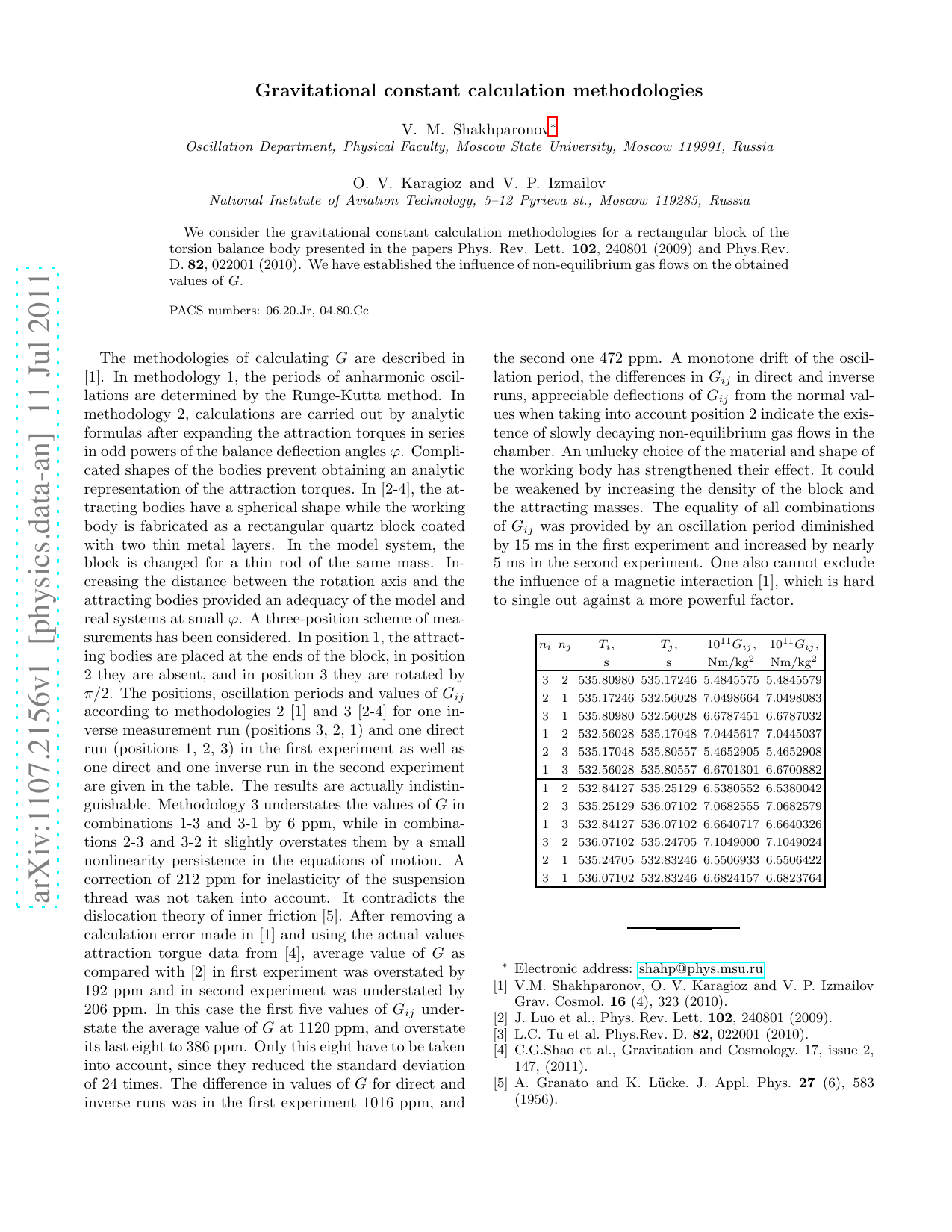
π/2. The positions, oscillation periods and values of Gij
according to methodologies 2 [1] and 3 [2-4] for one in-
verse measurement run (positions 3, 2, 1) and one direct
run (positions 1, 2, 3) in the first experiment as well as
one direct and one inverse run in the second experiment
are given in the table. The results are actually indistin-
guishable. Methodology 3 understates the values of G in
combinations 1-3 and 3-1 by 6 ppm, while in combina-
tions 2-3 and 3-2 it slightly overstates them by a small
nonlinearity persistence in the equations of motion. A
correction of 212 ppm for inelasticity of the suspension
thread was not taken into account.
It contradicts the
dislocation theory of inner friction [5]. After removing a
calculation error made in [1] and using the actual values
attraction torgue data from [4], average value of G as
compared with [2] in first experiment was overstated by
192 ppm and in second experiment was understated by
206 ppm. In this case the first five values of Gij under-
state the average value of G at 1120 ppm, and overstate
its last eight to 386 ppm. Only this eight have to be taken
into account, since they reduced the standard deviation
of 24 times. The difference in values of G for direct and
inverse runs was in the first experiment 1016 ppm, and
the second one 472 ppm. A monotone drift of the oscil-
lation period, the differences in Gij in direct and inverse
runs, appreciable deflections of Gij from the normal val-
ues when taking into account position 2 indicate the exis-
tence of slowly decaying non-equilibrium gas flows in the
chamber. An unlucky choice of the material and shape of
the working body has strengthened their effect. It could
be weakened by increasing the density of the block and
the attracting masses. The equality of all combinations
of Gij was provided by an oscillation period diminished
by 15 ms in the first experiment and increased by nearly
5 ms in the second experiment. One also cannot exclude
the influence of a magnetic interaction [1], which is hard
to single out against a more powerful factor.
ni nj
Ti,
Tj,
1011Gij,
1011Gij,
s
s
Nm/kg2
Nm/kg2
3
2 535.80980 535.17246 5.4845575 5.4845579
2
1 535.17246 532.56028 7.0498664 7.0498083
3
1 535.80980 532.56028 6.6787451 6.6787032
1
2 532.56028 535.17048 7.0445617 7.0445037
2
3 535.17048 535.80557 5.4652905 5.4652908
1
3 532.56028 535.80557 6.6701301 6.6700882
1
2 532.84127 535.25129 6.5380552 6.5380042
2
3 535.25129 536.07102 7.0682555 7.0682579
1
3 532.84127 536.07102 6.6640717 6.6640326
3
2 536.07102 535.24705 7.1049000 7.1049024
2
1 535.24705 532.83246 6.5506933 6.5506422
3
1 536.07102 532.83246 6.6824157 6.6823764
∗Electronic address: shahp@phys.msu.ru
[1] V.M. Shakhparonov, O. V. Karagioz and V. P. Izmailov
Grav. Cosmol. 16 (4), 323 (2010).
[2] J. Luo et al., Phys. Rev. Lett. 102, 240801 (2009).
[3] L.C. Tu et al. Phys.Rev. D. 82, 022001 (2010).
[4] C.G.Shao et al., Gravitation and Cosmology. 17, issue 2,
147, (2011).
[5] A. Granato and K. L¨ucke. J. Appl. Phys. 27 (6), 583
(1956).
📸 Image Gallery
Reference
This content is AI-processed based on open access ArXiv data.