Comment on 'A new exactly solvable quantum model in $N$ dimensions' [Phys. Lett. A 375(2011)1431, arXiv:1007.1335]

Reading time: 3 minute
...

📝 Original Info

  • Title: Comment on ‘A new exactly solvable quantum model in $N$ dimensions’ [Phys. Lett. A 375(2011)1431, arXiv:1007.1335]
  • ArXiv ID: 1106.4759
  • Date: 2011-06-24
  • Authors: B. L. Moreno Ley and Shi-Hai Dong

📝 Abstract

We pinpoint that the work about "a new exactly solvable quantum model in $N$ dimensions" by Ballesteros et al. [Phys. Lett. A {\bf 375} (2011) 1431, arXiv:1007.1335] is not a new exactly solvable quantum model since the flaw of the position-dependent mass Hamiltonian proposed by them makes it less valuable in physics.

💡 Deep Analysis

Figure 1

📄 Full Content

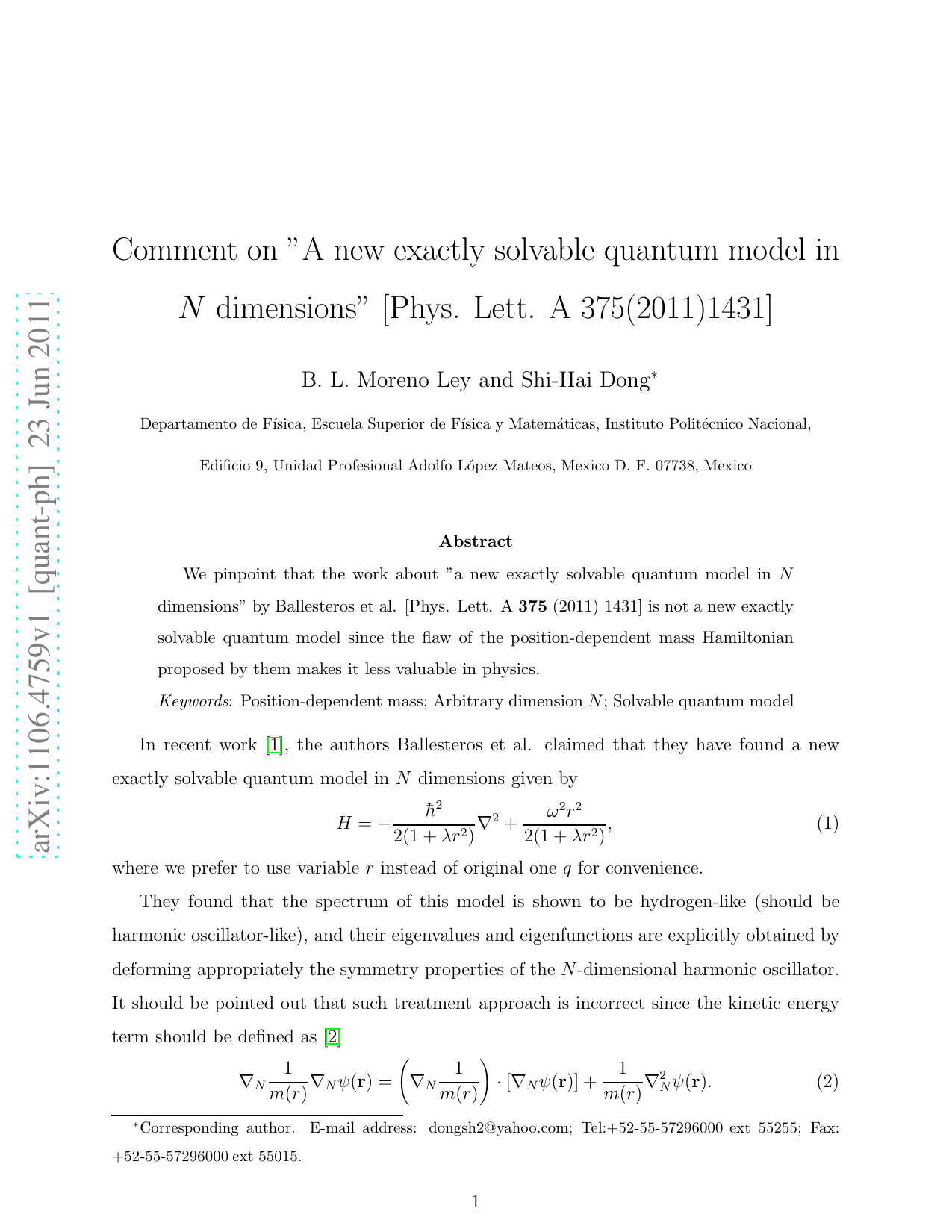
arXiv:1106.4759v1 [quant-ph] 23 Jun 2011 Comment on ”A new exactly solvable quantum model in N dimensions” [Phys. Lett. A 375(2011)1431] B. L. Moreno Ley and Shi-Hai Dong∗ Departamento de F´ısica, Escuela Superior de F´ısica y Matem´aticas, Instituto Polit´ecnico Nacional, Edificio 9, Unidad Profesional Adolfo L´opez Mateos, Mexico D. F. 07738, Mexico Abstract We pinpoint that the work about ”a new exactly solvable quantum model in N dimensions” by Ballesteros et al. [Phys. Lett. A 375 (2011) 1431] is not a new exactly solvable quantum model since the flaw of the position-dependent mass Hamiltonian proposed by them makes it less valuable in physics. Keywords: Position-dependent mass; Arbitrary dimension N; Solvable quantum model In recent work [1], the authors Ballesteros et al. claimed that they have found a new exactly solvable quantum model in N dimensions given by H = − ¯h2 2(1 + λr2)∇2 + ω2r2 2(1 + λr2), (1) where we prefer to use variable r instead of original one q for convenience. They found that the spectrum of this model is shown to be hydrogen-like (should be harmonic oscillator-like), and their eigenvalues and eigenfunctions are explicitly obtained by deforming appropriately the symmetry properties of the N-dimensional harmonic oscillator. It should be pointed out that such treatment approach is incorrect since the kinetic energy term should be defined as [2] ∇N 1 m(r)∇Nψ(r) =

∇N 1 m(r) ! · [∇Nψ(r)] + 1 m(r)∇2 Nψ(r). (2) ∗Corresponding author. E-mail address: dongsh2@yahoo.com; Tel:+52-55-57296000 ext 55255; Fax: +52-55-57296000 ext 55015. 1 For N-dimensional spherical symmetry, we take the wavefunctions ψ(r) as follows [3]: ψ(r) = r−(N−1)/2R(r)Y l lN−2,…,l1(ˆx). (3) Substituting this into the position-dependent effective mass Schr¨odinger equation ∇N

1 m(r)∇Nψ(r) !

  • 2[E −V (r)]ψ(r) = 0, (4) allows us to obtain the following radial position-dependent mass Schr¨odinger equation in arbitrary dimensions ( d2 dr2 + m′(r) m(r) N −1 2r −d dr ! −η2 −1/4 r2
  • 2m(r)[E −V (r)] ) R(r) = 0, (5) where m(r) = (1 + λr2), m′(r) = dm(r)/dr and η = |l −1 + N/2|. Since the operator ∇N does not commutate with the position-dependent mass m(r), then this system does not exist exact solutions at all. This can also be proved unsolvable to Eq.(5) if substituting the position-dependent mass m(r) into it. On the other hand, the choice of the position-dependent mass m(r) has no physical meaning since the mass m(r) goes to infinity when r →∞. Moreover, it is shown from Eq.(1) that the position-dependent mass m(r) in kinetic term is equal to (1 + λr2), but it was taken as 1/(1+λr2) for the harmonic oscillator term. Accordingly, the wrong expression of the Hamiltonian in position-dependent mass Schr¨odinger equation in arbitrary dimensions N, the flaw of the chosen position-dependent mass m(r) as well as its inconsistence between the kinetic term and the harmonic oscillator term make it less valuable in physics. Acknowledgments: This work was supported partially by 20110491-SIP-IPN, COFAA-IPN, Mexico. References [1] A. Ballesteros, A. Enciso, F. J. Herranz, O. Ragnisco, D. Riglioni, Phys. Lett. A 375(2011)1431. [2] G. Chen, Phys. Lett. A 329(2004)22. [3] S. H. Dong and Z. Q. Ma, Phys. Rev. A 65(2002)042717. 2

📸 Image Gallery

cover.png

Reference

This content is AI-processed based on open access ArXiv data.

Start searching

Enter keywords to search articles

↑↓
ESC
⌘K Shortcut