The Japan earthquake of March 11th, 2011 (Mw = 8.9R) as viewed in terms of local lithospheric oscillation due to M1 and K1 tidal components. A brief presentation
Title: The Japan earthquake of March 11th, 2011 (Mw = 8.9R) as viewed in terms of local lithospheric oscillation due to M1 and K1 tidal components. A brief presentation
ArXiv ID: 1103.2385
Date: 2011-03-15
Authors: ** - C. Thanassoulas – 은퇴, 지질·광물 탐사 연구소(IGME), 지구물리학부, 아테네, 그리스 - V. Klentos – 아테네 상수도·하수도 공사(EYDAP) - G. Verveniotis – 피르고스 제2고등학교 물리 교사, 부이사장 - N. Zymaris – 은퇴 전자공학자 (연락처와 웹사이트는 원문에 명시되어 있음) — **
📝 Abstract
The time of occurrence of the large EQ that occurred recently in Japan (March 11th, 2011, Mw = 8.9) is compared to the time of peak amplitude occurrence of the M1 and K1 tidal components. It is shown that the specific EQ occurred on the peak of the M1 tidal component, and deviates for only 45 minutes from the corresponding K1 tidal peak. Therefore, the specific seismic event complies quite well with the earlier proposed physical mechanism (lithospheric oscillation) that causes triggering of large EQs.
💡 Deep Analysis
📄 Full Content
1
The Japan earthquake of March 11th, 2011 (Mw = 8.9R) as viewed in terms of local lithospheric
oscillation due to M1 and K1 tidal components. A brief presentation.
The time of occurrence of the large EQ that occurred recently in Japan (March 11
th, 2011, Mw = 8.9) is compared to the time of peak
amplitude occurrence of the M1 and K1 tidal components. It is shown that the specific EQ occurred on the peak of the M1 tidal
component, and deviates for only 45 minutes from the corresponding K1 tidal peak. Therefore, the specific seismic event complies
quite well with the earlier proposed physical mechanism (lithospheric oscillation) that causes triggering of large EQs.
The aim of this very brief presentation is to show that the M1 and K1 tidal components play an important role concerning the time
of occurrence of a large EQ. Actually, they provide the last decisive bit of stress load required in order to trigger a large EQ at an
already critically stress charged seismogenic area. The physical mechanism that holds for the EQ triggering by the tidal waves has
been presented in detail by Thanassoulas (2007) while specific examples have been presented from the Greek seismogenic area by
Thanassoulas (2007), Thanassoulas and Klentos (2010), Thanassoulas et al. (2011) and from New Zealand (Thanassoulas et al. 2011).
In this brief presentation the time of occurrence of the very large EQ (Mw = 8.9) that occurred on 11
th of March, 2011 in Japan will
be compared to the local seismogenic area tidal conditions within a time window of some days before and after the EQ occurrence
time. The tidal data have been determined by the Rudman et al. (1977) method.
The large EQ (Mw = 8.9R) of Japan of the 11th of March, 2011.
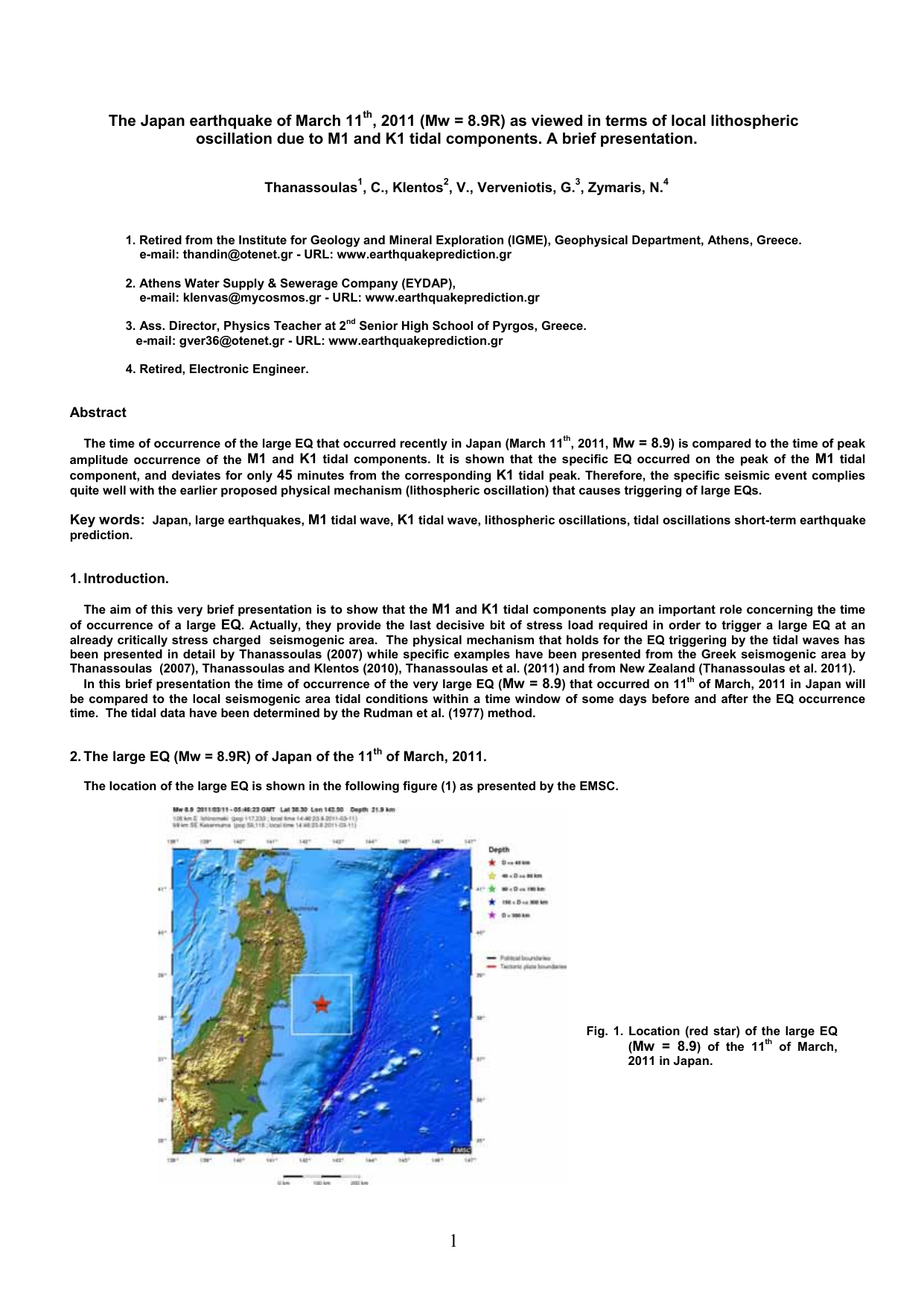
The location of the large EQ is shown in the following figure (1) as presented by the EMSC.
Fig. 1. Location (red star) of the large EQ
(Mw = 8.9) of the 11
th of March,
2011 in Japan.
The M1 tidal oscillating component will be compared to the time of occurrence of the corresponding large EQ. The comparison is
presented in the following figure (2).
Fig. 2. Comparison of the M1 tidal oscillation (black line, the lithosphere is forced to oscillate in the same mode) with
the time of occurrence (red bar) of the EQ of 11th of March, 2011 (Mw = 8.9). Vertical scale is in mgals.
In this case the EQ occurred, compared to the lithospheric tidal oscillation, exactly on the peak day of the M1 tidal wave
The corresponding K1 (T = 24 hours) tidal data.
Next, the lithospheric oscillating K1 component will be compared to the time of occurrence of the corresponding large EQ. The
comparison is presented in the following figure (3).
Fig. 3. Comparison of the K1 tidal oscillation (black line, the lithosphere is forced to oscillate in the same mode) with
the time of occurrence (red bar) of the EQ of the 11th of March, 2011 (Mw = 8.9). Vertical scale is in mgals.
The specific EQ deviated for only forty five (45) minutes from the corresponding lithospheric oscillating tidal peak of the K1
component.
Conclusions.
The inspection of figures (2) and (3) shows that:
a)
the recent large EQ (Mw = 8.9) of Japan occurred on the 11
th of March of 2011 when the tidal component of M1 achieves
an oscillation amplitude peak (minimum) and consequently, the corresponding seismogenic area reaches a maximum of
stress load on this specific day. Therefore the deviation (dt) of the time of the EQ occurrence from the M1 tidal peak time
is null. dt = 0 days in terms of M1 tidal component.
b)
the recent large EQ (Mw = 8.9) of Japan occurred on the 11
th of March of 2011 and closely when the tidal component of K1
achieves a daily oscillation amplitude peak (maximum) and consequently the corresponding seismogenic area reaches a
same day short-term maximum of stress load. The deviation (dt) of the time of the EQ occurrence from the tidal peak time
is determined from figure (3) as dt = 45 minutes from the K1 tidal peak time.
dt = 45 minutes in terms of K1 tidal component.
Consequently, the large EQ of Japan that occurred on 11
th