Can intelligence optimise Digital Ecosystems? How could a distributed intelligence interact with the ecosystem dynamics? Can the software components that are part of genetic selection be intelligent in themselves, as in an adaptive technology? We consider the effect of a distributed intelligence mechanism on the evolutionary and ecological dynamics of our Digital Ecosystem, which is the digital counterpart of a biological ecosystem for evolving software services in a distributed network. We investigate Neural Networks and Support Vector Machine for the learning based pattern recognition functionality of our distributed intelligence. Simulation results imply that the Digital Ecosystem performs better with the application of a distributed intelligence, marginally more effectively when powered by Support Vector Machine than Neural Networks, and suggest that it can contribute to optimising the operation of our Digital Ecosystem.
With a Digital Ecosystem, being the digital counterpart of a biological ecosystem for evolving software services in a distributed network, can we answer the following questions; Can intelligence optimise the evolutionary process? How could a distributed intelligence interact with the ecosystem dynamics? Can the software components that are part of genetic selection be intelligent in themselves, as in an adaptive technology? These are wide ranging questions, and we have started by considering a distributed intelligence based on a simple social interaction mechanism that leads to targeted migration. We will use a machine learning technique to power our distributed intelligence, considering both NNs and SVM. We will start with a brief reminder for our definition of Digital Ecosystems.
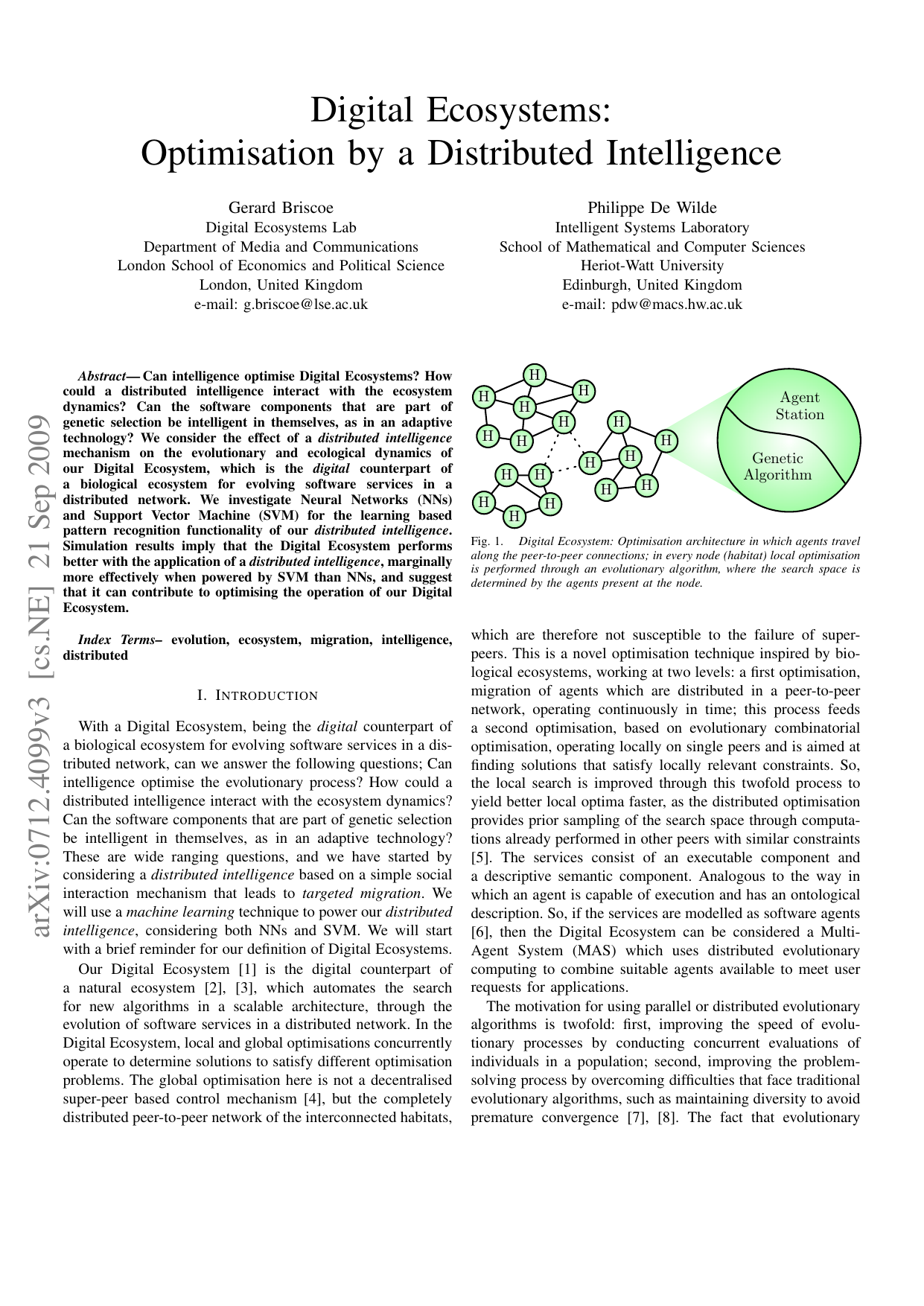
Our Digital Ecosystem [1] is the digital counterpart of a natural ecosystem [2], [3], which automates the search for new algorithms in a scalable architecture, through the evolution of software services in a distributed network. In the Digital Ecosystem, local and global optimisations concurrently operate to determine solutions to satisfy different optimisation problems. The global optimisation here is not a decentralised super-peer based control mechanism [4], but the completely distributed peer-to-peer network of the interconnected habitats, which are therefore not susceptible to the failure of superpeers. This is a novel optimisation technique inspired by biological ecosystems, working at two levels: a first optimisation, migration of agents which are distributed in a peer-to-peer network, operating continuously in time; this process feeds a second optimisation, based on evolutionary combinatorial optimisation, operating locally on single peers and is aimed at finding solutions that satisfy locally relevant constraints. So, the local search is improved through this twofold process to yield better local optima faster, as the distributed optimisation provides prior sampling of the search space through computations already performed in other peers with similar constraints [5]. The services consist of an executable component and a descriptive semantic component. Analogous to the way in which an agent is capable of execution and has an ontological description. So, if the services are modelled as software agents [6], then the Digital Ecosystem can be considered a Multi-Agent System (MAS) which uses distributed evolutionary computing to combine suitable agents available to meet user requests for applications.
The motivation for using parallel or distributed evolutionary algorithms is twofold: first, improving the speed of evolutionary processes by conducting concurrent evaluations of individuals in a population; second, improving the problemsolving process by overcoming difficulties that face traditional evolutionary algorithms, such as maintaining diversity to avoid premature convergence [7], [8]. The fact that evolutionary computing manipulates a population of independent solutions actually makes it well suited for parallel and distributed computation architectures [9]. There are several variants of distributed evolutionary computing, leading some to propose a taxonomy for their classification [10], with there being two main forms [9], [8]: multiple-population/coarse-grained migration/island models [11], [9], and single-population/fine-grained diffusion/neighbourhood models [12], [8]. Fine-grained diffusion models [12], [8] assign one individual per processor. A local neighbourhood topology is assumed, and individuals are allowed to mate only within their neighbourhood, called a deme 1 . The demes overlap by an amount that depends on their shape and size, and in this way create an implicit migration mechanism. Each processor runs an identical evolutionary algorithm which selects parents from the local neighbourhood, produces an offspring, and decides whether to replace the current individual with an offspring. In the coarse-grained island models [11], [9], evolution occurs in multiple parallel sub-populations (islands), each running a local evolutionary algorithm, evolving independently with occasional migrations of highly fit individuals among sub-populations. This model has also been used successfully in the determination of investment strategies in the commercial sector, in a product known as the Galapagos toolkit [14], [15]. However, all the islands in this approach work on exactly the same problem, which makes it less analogous to biological ecosystems in which different locations can be environmentally different [16].
The landscape, in energy-centric biological ecosystems, defines the connectivity between habitats [16]. Connectivity of nodes in the digital world is generally not defined by geography or spatial proximity, but by information or semantic proximity. For example, connectivity in a peer-to-peer network is based primarily on bandwidth and information content, and not geography. The island-models of distributed e
This content is AI-processed based on open access ArXiv data.