Travelling waves and conservation laws are studied for a wide class of U(1)-invariant complex mKdV equations containing the two known integrable generalizations of the ordinary (real) mKdV equation. The main results on travelling waves include deriving new complex solitary waves and kinks that generalize the well-known mKdV $\sech$ and $\tanh$ solutions. The main results on conservation laws consist of explicitly finding all 1st order conserved densities that yield phase-invariant counterparts of the well-known mKdV conserved densities for momentum, energy, and Galilean energy, and a new conserved density describing the angular twist of complex kink solutions
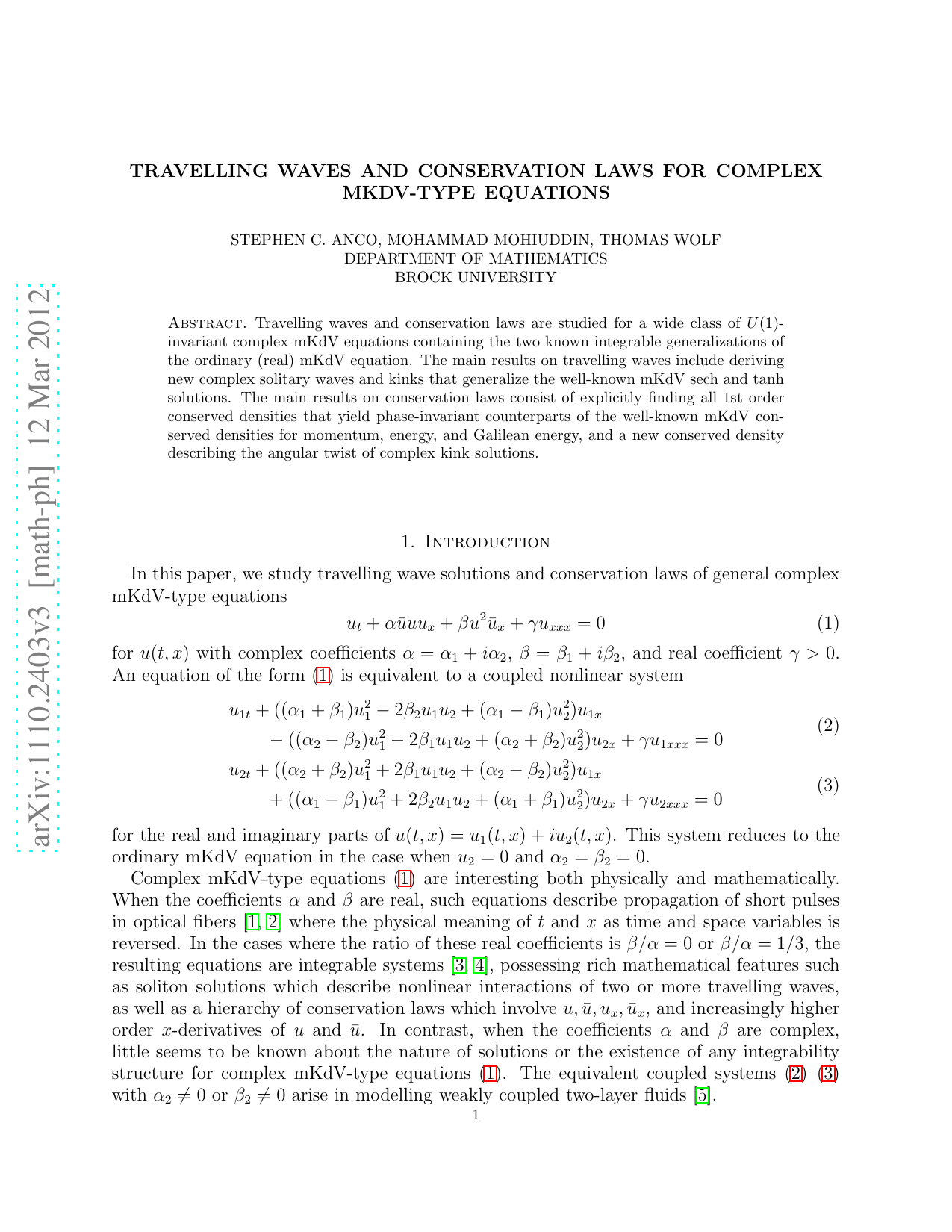
In this paper, we study travelling wave solutions and conservation laws of general complex mKdV-type equations u t + αūuu x + βu 2 ūx + γu xxx = 0
for u(t, x) with complex coefficients α = α 1 + iα 2 , β = β 1 + iβ 2 , and real coefficient γ > 0.
An equation of the form (1) is equivalent to a coupled nonlinear system
2 )u 2x + γu 1xxx = 0
(2)
for the real and imaginary parts of u(t, x) = u 1 (t, x) + iu 2 (t, x). This system reduces to the ordinary mKdV equation in the case when u 2 = 0 and α 2 = β 2 = 0. Complex mKdV-type equations (1) are interesting both physically and mathematically. When the coefficients α and β are real, such equations describe propagation of short pulses in optical fibers [1,2] where the physical meaning of t and x as time and space variables is reversed. In the cases where the ratio of these real coefficients is β/α = 0 or β/α = 1/3, the resulting equations are integrable systems [3,4], possessing rich mathematical features such as soliton solutions which describe nonlinear interactions of two or more travelling waves, as well as a hierarchy of conservation laws which involve u, ū, u x , ūx , and increasingly higher order x-derivatives of u and ū. In contrast, when the coefficients α and β are complex, little seems to be known about the nature of solutions or the existence of any integrability structure for complex mKdV-type equations (1). The equivalent coupled systems (2)-(3) with α 2 = 0 or β 2 = 0 arise in modelling weakly coupled two-layer fluids [5].
Travelling waves for the class of complex mKdV-type equations (1) are considered in section 2. By use of symmetry reduction and integrating factors, we first derive all smooth solutions of the form u(t, x) = U(x -ct) = a + bf (x -ct) (4) in which a = a 1 + ia 2 , b = b 1 + ib 2 are complex constants, and f (x) is a real valued function that either is single-peaked and vanishes for large x (i.e. a solitary wave), or has no peak and approaches different constant values for large positive/negative x (i.e. a kink). We next derive all smooth solutions having a linear phase u(t, x) = exp(i(kx + wt + φ))f (x -ct) (5) where k, w, φ are real constants, and f (x) is again a real valued function with the same general profile (i.e. either a solitary wave or a kink) as considered for the solutions (4). Both of these two classes of complex travelling waves (4) and ( 5) include the familiar sech and tanh profiles for f (x) in the case of the ordinary mKdV equation [6].
Conservation laws for the class of complex mKdV-type equations ( 1) are then considered in section 3. Specifically, by means of multipliers, we derive all conserved densities and fluxes of the form T (t, x, u, ū, u x , ūx , u xx , ūxx ) (6) X(t, x, u, ū, u x , ūx , u xx , ūxx , u xxx , ūxxx , u xxxx , ūxxxx ) (7) which satisfy
for all solutions u(t, x) that have vanishing flux at x = ±∞. The class of conserved densities (6) includes the well-known conservation laws for mass, momentum, energy and Galilean energy in the case of the ordinary mKdV equation [7], as well as the first of the higherderivative conservation laws in the hierarchy arising for the two known integrable cases of complex mKdV equations. In section 4, the conserved quantities (9) are used to explore some features of the travelling wave solutions (4) and (5). Finally, a summary of the main new results obtained in the previous sections is provided in section 5.
Hereafter, for convenience we will put γ = 1 (10) by scaling the time and space variables t → √ γt, x → √ γx.
Each complex mKdV equation in the class (1) has the following basic invariance properties:
phase rotation u → exp(iφ)u (14) where the parameters are given by λ = 0, -∞ < ǫ < ∞, 0 ≤ φ < 2π. Composition of these transformations ( 11)-( 14) yields a 4-parameter group of point symmetries admitted by all equations (1).
Travelling waves u = U(x -ct) arise naturally as group-invariant solutions [8] with respect to the combined space-time translation
where c is the speed of the wave. From equation ( 1), such solutions satisfy
which is a 3rd order, nonlinear, complex ODE for U(ξ), in terms of the invariant variable
Note this ODE (16) inherits invariance under phase rotations
When the coefficients α and β are real, we can find all real solutions U(ξ) straightforwardly by the use of integrating factors. In contrast, when the coefficients are complex or when we seek all complex solutions, the ODE (16) cannot in general be integrated explicitly. However, the class of solutions
given by a real function f (ξ) and complex constants a and b will by-pass these difficulties, as we now show.
2.1. Solitary waves and Kinks. For travelling wave solutions of the form (19), the ODE (16) is given by 0
where, under phase rotations (18),
Consequently, the ODE (20) for f (ξ) can be simplified by using a phase rotation (21) to put b = |b|, which then gives 0
Since f is real, these coefficients must be real, and hence we require the conditions
Solving these co
This content is AI-processed based on open access ArXiv data.