A direct and simple proof of Jacobi identities for determinants
📝 Original Info
- Title: A direct and simple proof of Jacobi identities for determinants
- ArXiv ID: 0712.1932
- Date: 2007-12-13
- Authors: – 저자 정보가 제공되지 않았습니다.
📝 Abstract
The Jacobi identities play an important role in constructing the explicit exact solutions of a broad class of integrable systems in soliton theory. In the paper, a direct and simple proof of the Jacobi identities for determinants is presented by employing the Pl$\ddot{u}$cker relations.💡 Deep Analysis
📄 Full Content
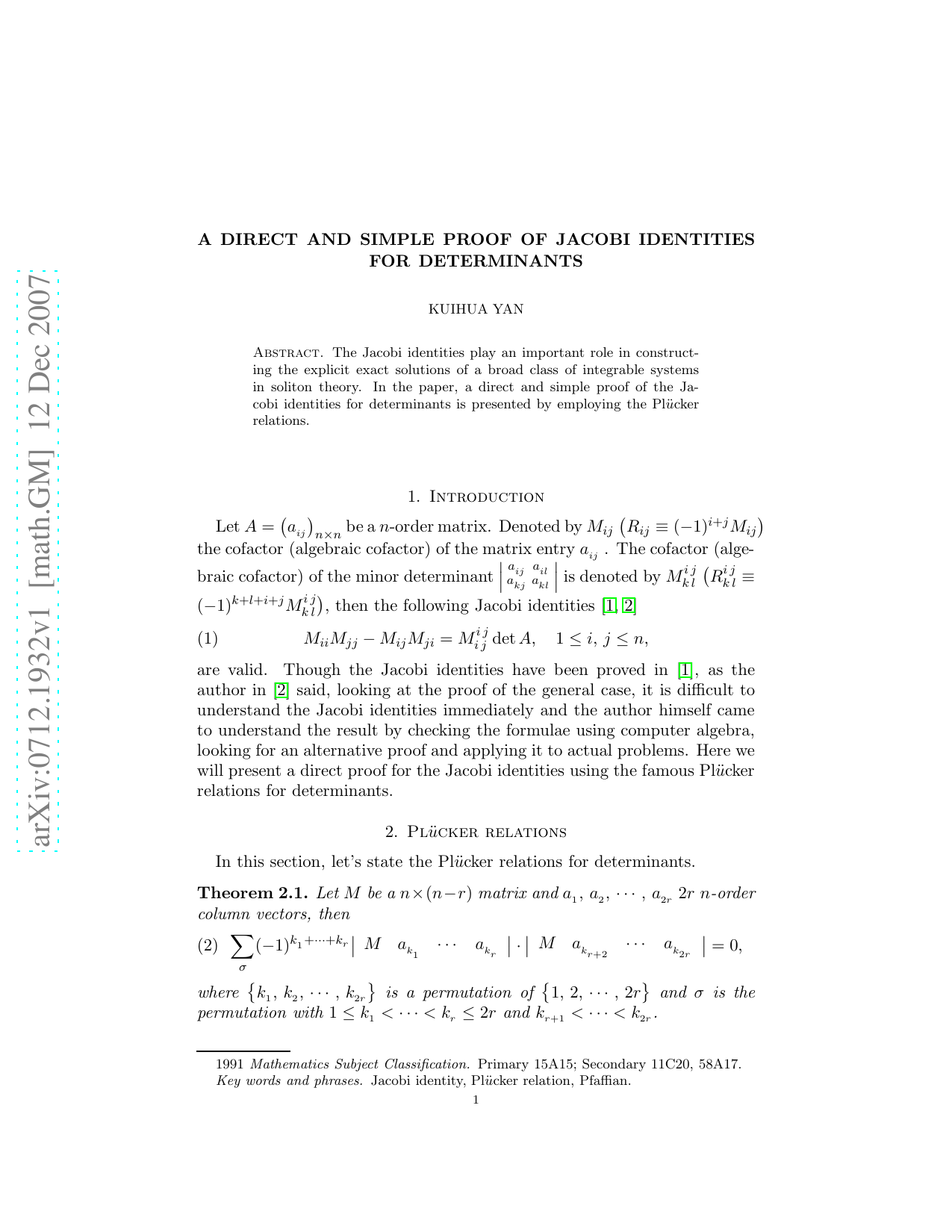
In this section, let’s state the Plücker relations for determinants.
where
On the other hand, by the classical Laplace expansion for determinants, it can be obtained that
Comparing the above two equations, we have
where
Corollary 2.2. Let M be a n×(n-2) matrix and a, b, c and d four n-order column vectors , then
Remark 2.3. The above equation (5) is the simplest case of the Plücker relations [2] which plays an important role in nonlinear dynamics and soliton theory due to Sato’s theorem [3,4]. It shows that many of the differential and difference equations in mathematical physics are merely disguised versions of the Plücker relations. For example, Sato [3,4] first discovered that the KP equation in bilinear form
was nothing but a Plücker relation, where the Hirota’s bilinear operators D t , D x and D y are defined by
Remark 2.4. The other forms of Plücker relations have been widely applied to algebraic geometry. For example, a projective embedding of the Grassmann variety Gr(p, n) can be defined by the quadratic polynomial equations called “the Plücker relations” (to see [5] and its references).
Remark 2.5. The Plücker relations are also exactly relational to the Maya diagrams and Young diagrams [2]. It makes them play a primary role in Combinatorics, Lie theory and Representation Theory (to see [6,7] and their references).
Theorem 3.1. Let A = a ij n×n be a n-order matrix. Denoted by M i j k l the cofactor of the minor determinant a ik a il a jk a jl , then
Proof. It is no less of generality to consider the case of i < j and k < l < s < r. Denoted by M the (n -2) × (n -4) submatrix obtained by eliminating the i-th and j-th rows and the k-th, l-th, s-th and r-th columns from A. The four (n -2)-order column vectors obtained by eliminating the i-th and j-th components from the k-th, l-th, s-th and r-th column vectors in A are denoted by a, b, c and d respectively. Then it is easy to see that
) k+r M a d ; M i j l s = (-1) l+s M b c . Consequently, by employing the Plücker relation (5), one has
Remark 3.2. Note that only the indices are important in the equation (7), so it can also be expressed as
which is nothing but a Plücker relation.
Theorem 3.3. Let A = a ij n×n be a n-order matrix. Denoted by
the cofactor of the minor determinant
. Choosing r rows and 2r columns from A, the according row and column indices are denoted by
where
Proof. It is completely similar to the proof of the above theorem 3.1 by employing the equation (2). So here we omit it.
Theorem 3.4. (Jacobi identity [1,2]) Let A = a ij n×n be a n-order matrix. Denoted by M ij the cofactor of the matrix entry a ij in A. The cofactor of the minor determinant a ij a il a kj a kl is denoted by M i j k l , then
Proof. It is no less generality to condider the special case with i = 1 and j = 2. Firstly, it is easy to see that
Then
On the other hand, by the equation ( 7), it can be obtained that
Therefore, by employing the Laplace expasion for determinants, one has
Remark 3.5. The Jacobi identities play an important role in soliton theory.
For example [2], if the solutions to the KP equation or the Toda lattice equation are expressed as Grammian determinants, their bilinear equations are nothing but the Jacobi identities.
Corollary 3.6. Let A = a ij 2n×2n be a 2n-order antisymmetric matrix, then det A is equal to a perfect square of a polynomial of its matrix entries
Proof. Following the above symbols, it is obvious that M 11 = M 22 = 0 and M 12 = -M 21 . Hence using the Jacobi identities, it can be obtained that
Note that det A = a 2
12 when n = 1, and M 1 2 1 2 is the determinant of a 2(n-1)-order antisymmetric matrix. Therefore, it can be deduced that det A is a perfect square of a polynomial of a ij (1 ≤ i, j ≤ n) by the recurrence relation (10). Remark 3.7. Recalling the definition of a Pfaffian, the square of a n-order Pfaffian is equal to the determinant of a 2n-order antisymmetric matrix. The above corollary in a sense ensures that a Pfaffian is well defined. On the other hand, by the Pfaffian expression for determinants, the terms of Jacobi identities (9) can be express
📸 Image Gallery