We show that the image of Connes-Karoubi-Chern character, restricted to the image of the Baum-Connes assembly map in the Bott-periodized topological K-theory of the complex group algebra, lies in the elliptic summand of the (periodic) cyclic homology of the group algebra. This implies that for any (weighted) ell-1 completion of the group algebra, rational surjectivity of the Baum-Connes assembly map implies the generalized Bass conjecture for that algebra.
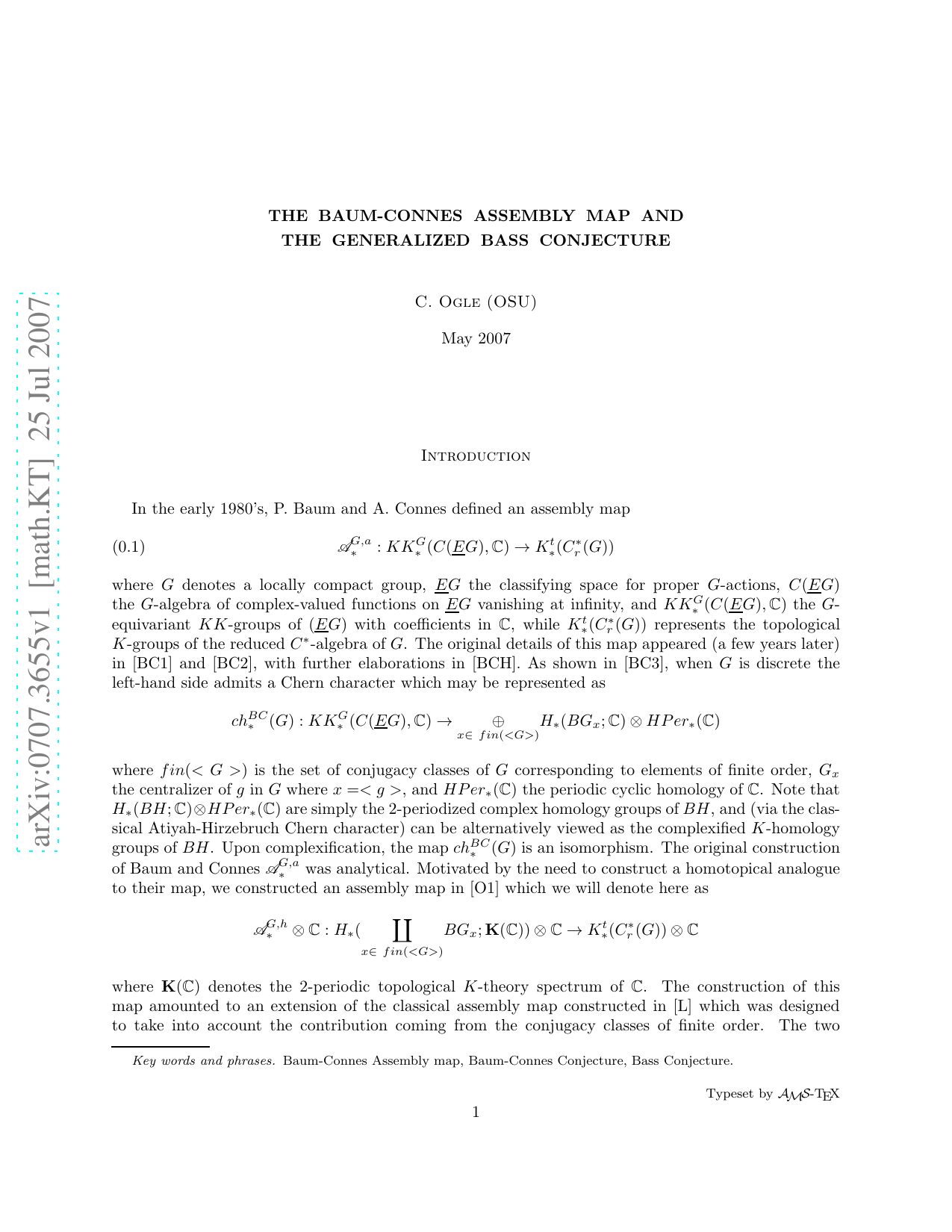
In the early 1980's, P. Baum and A. Connes defined an assembly map (0.1)
A G,a H * (BG x ; C) ⊗ HP er * (C)
where f in(< G >) is the set of conjugacy classes of G corresponding to elements of finite order, G x the centralizer of g in G where x =< g >, and HP er * (C) the periodic cyclic homology of C. Note that H * (BH; C)⊗HP er * (C) are simply the 2-periodized complex homology groups of BH, and (via the classical Atiyah-Hirzebruch Chern character) can be alternatively viewed as the complexified K-homology groups of BH. Upon complexification, the map ch BC * (G) is an isomorphism. The original construction of Baum and Connes A G,a * was analytical. Motivated by the need to construct a homotopical analogue to their map, we constructed an assembly map in [O1] which we will denote here as
Theorem 1. There is a commuting diagram
where A G,DL * is the homotopically defined assembly map of [DL],
) [JOR], the lower horizontal map is the obvious inclusion, and the Chern character ch ? * becomes an isomorphism upon complexification for * ≥ 0.
Let β denote a bounding class, (G, L) a discrete group equipped with a word-length, and H β,L (G) the rapid decay algebra associated with this data [JOR]. We write K t * (H β,L (G)) for the Bott-periodic topological K-theory of the topological algebra H β,L (G). The Baum-Connes assembly map for H β,L (G) is defined to be the composition
where the second map is induced by the natural inclusion C[G] ֒→ H β,L (G). In [JOR], we conjectured that the image of ch * :
and Theorem 1 implies
Since going down and then across is rationally injective, we also have (compare [O1])
We do not claim any great originality in this paper. In fact, Theorem 1, although not officially appearing in print before this time, has been a “folk-theorem” known to experts for many years. The connection between the Baum-Connes Conjecture (more precisely a then-hypothetical Baum-Connestype Conjecture for C[G]) and the stronger Bass Conjecture for C[G] discussed in [JOR] was noted by the author in [O2]. 2
There is some overlap of this paper with the results presented in [Ji]. A special case of Theorem 1 (for * = 0 and C[G] replaced by the ℓ 1 -algebra ℓ 1 (G)) appeared as the main result of [BCM].
We use the notation
where F * ( -) = HH * ( -), HN * ( -), HC * ( -) or HP er( -). To maximize consistency with [LR], we write S for the (unreduced) suspension spectrum of the zero-sphere S 0 , HN(R) resp. HH(R) the Eilenberg-MacLane spectrum whose homotopy groups are the negative cyclic resp. Hochschild homology groups of the discrete ring R, and K a (R) the non-connective algebraic K-theory spectrum of R, with K a * (R) representing its homotopy groups. By [LR,diag. 1.6] there is a commuting diagram (1.1)
where the top horizontal map is the composition
referred to as the the restricted assembly map for the algegraic K-groups of Z[G]. The other two horizontal maps are the assembly maps for negative cyclic and Hochschild homology respectively. The upper left-hand map is induced by the map from the sphere spectrum to the Eilenberg-MacLane spectrum HN, which may be expressed as the composition of spectra S → K a (Z) → HN. By [LR], the composition on the left is a rational equivalence. Let C δ denote the complex numbers C equipped with the discrete topology. Tensoring with C and combined with the inclusion of group algebras Z
Next, we consider the transformation from algebraic to topological K-theory, induced by the map of group algebras
which is the identity on elements. By the results of [CK], [W] and [T], there is a commuting diagram
where ch * (C[G]) is the Connes-Karoubi Chern character for the fine topological algebra C[G], and the bottom map is the transformation from negative cyclic to periodic cyclic homology.
We can now consider our main diagram
(1.4) .
This content is AI-processed based on open access ArXiv data.