HD0L-$omega$-equivalence and periodicity problems in the primitive case (to the memory of G. Rauzy)
📝 Original Info
- Title: HD0L-$omega$-equivalence and periodicity problems in the primitive case (to the memory of G. Rauzy)
- ArXiv ID: 1111.0650
- Date: 2000-09-01
- Authors: Frédéric Durand —
📝 Abstract
In this paper I would like to witness the mathematical inventiveness of G. Rauzy through personnal exchanges I had with him. The objects that will emerge will be used to treat the decidability of the HD 0 L $\omega$-equivalence and periodicity problems in the primitive case.💡 Deep Analysis
📄 Full Content
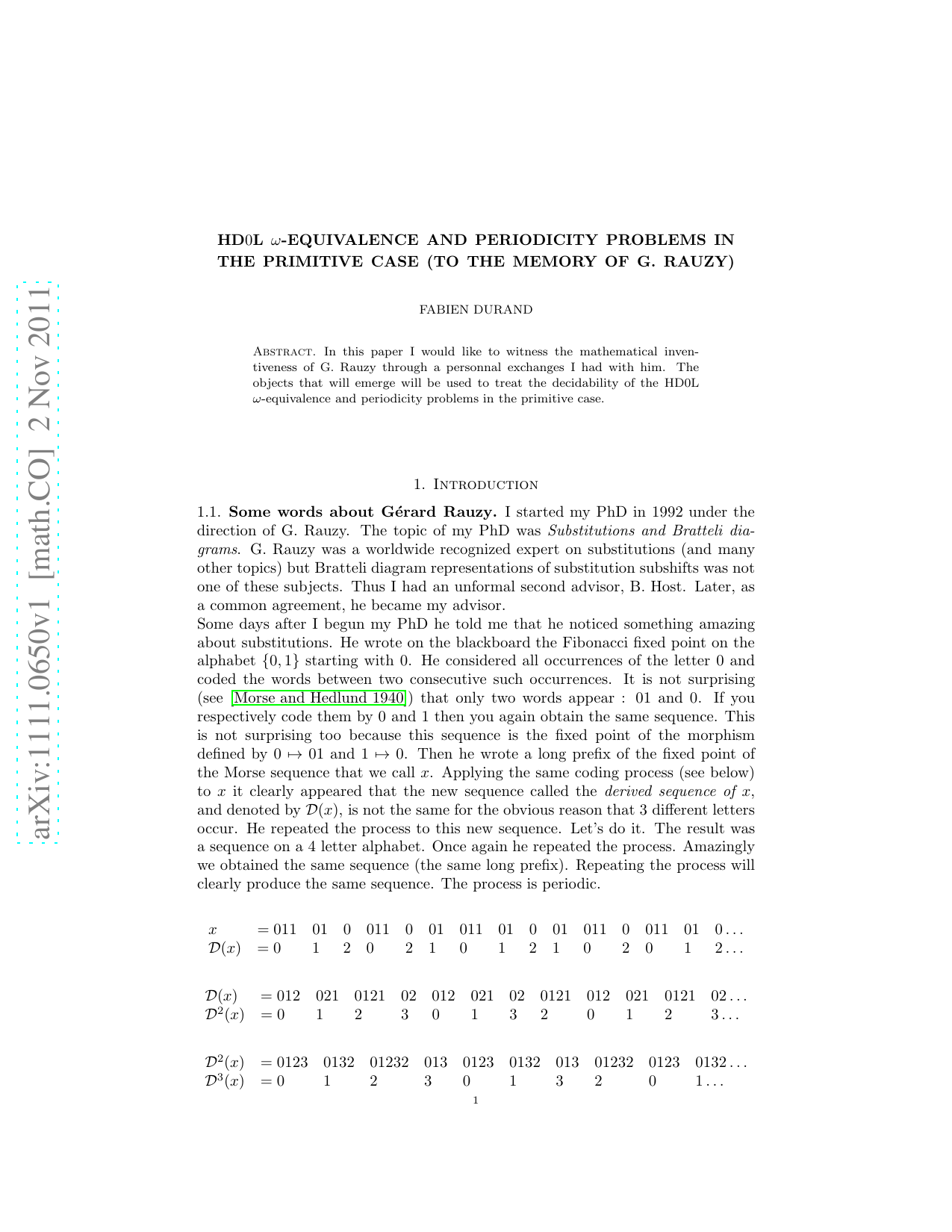
When he showed me this process I found curious to look at it. Why was it interesting ? In fact, at this time, I did not know much about the work of G. Rauzy and almost nothing about interval exchange transformations (iets) and what he did with. I realized quickly that this process was in fact the induction process defined on dynamical systems by the Poincaré first return map : the derived sequence D(x) generates a subshift that is conjugate to the induced dynamical system (X, T ) on the cylinder set [0], where (X, T ) is the subshift generated by x. Thus, this corresponds to the induction process he defined [Rauzy 1979] to study iets. He induced on the left most interval and showed that the induced tranformation is again an iet with the same permutation. This is also the case for primitive substitutions : derived sequences of purely primitive substitutive sequences are purely primitive substitutive sequences ( [Durand 1998a]). His goal was to tackle the Keane’s conjecture saying that almost all iets are uniquely ergodic. This was solved independently in [Masur 1982] and [Veech 1982]. Later M. Boshernitzan and C. R. Carroll [Boshernitzan and Carroll 1997] proved that, for an iet defined on a quadratic field, “every consistent method of induction is eventually periodic” (up to rescaling). This is what I obtained in [Durand 1998a] in the context of primitive substitutions and that was expected by G. Rauzy. Thus I imagine the intuition of G. Rauzy was certainly leaded by iet considerations. I am very grateful to Gérard Rauzy for the wonderful subject he gave me and for the opportunity he offered me to do research.
1.2. The HD0L ω-equivalence problem. In this paper we propose to apply what the author developped in [Durand 1998a] and [Durand 1998b] (to answer the question of G. Rauzy) to solve the following problems in the primitive case. To describe these problems we need some notations. Let σ : A * → A * and τ : B * → B * be morphisms, and, u and v be words such that lim n→∞ σ n (u) and lim n→∞ τ n (v) converge to respectively x ∈ A N and y ∈ B N . We also need two morphisms φ :
This problem is open for more than 30 years and ask whether it is decidable to know if two morphic sequences are equal. More precisely, Is the equality “φ(x) = ψ(y)” decidable?
In this paper we answer positively to this problem for primitive morphisms. The equality problem “x = y” (also called the D0L ω-equivalence problem) was solved in 1984 by K. Culik II and T. Harju [Culik and Harju 1984]. An other proof was given by J. Honkala in [Honkala 2007] (see also [Honkala 2009a]).
1.2.2. More on the equality of sequences generated by morphisms. Once the equality “φ(x) = ψ(y)” or “x = y” is satisfied, it is natural to look fo
📸 Image Gallery