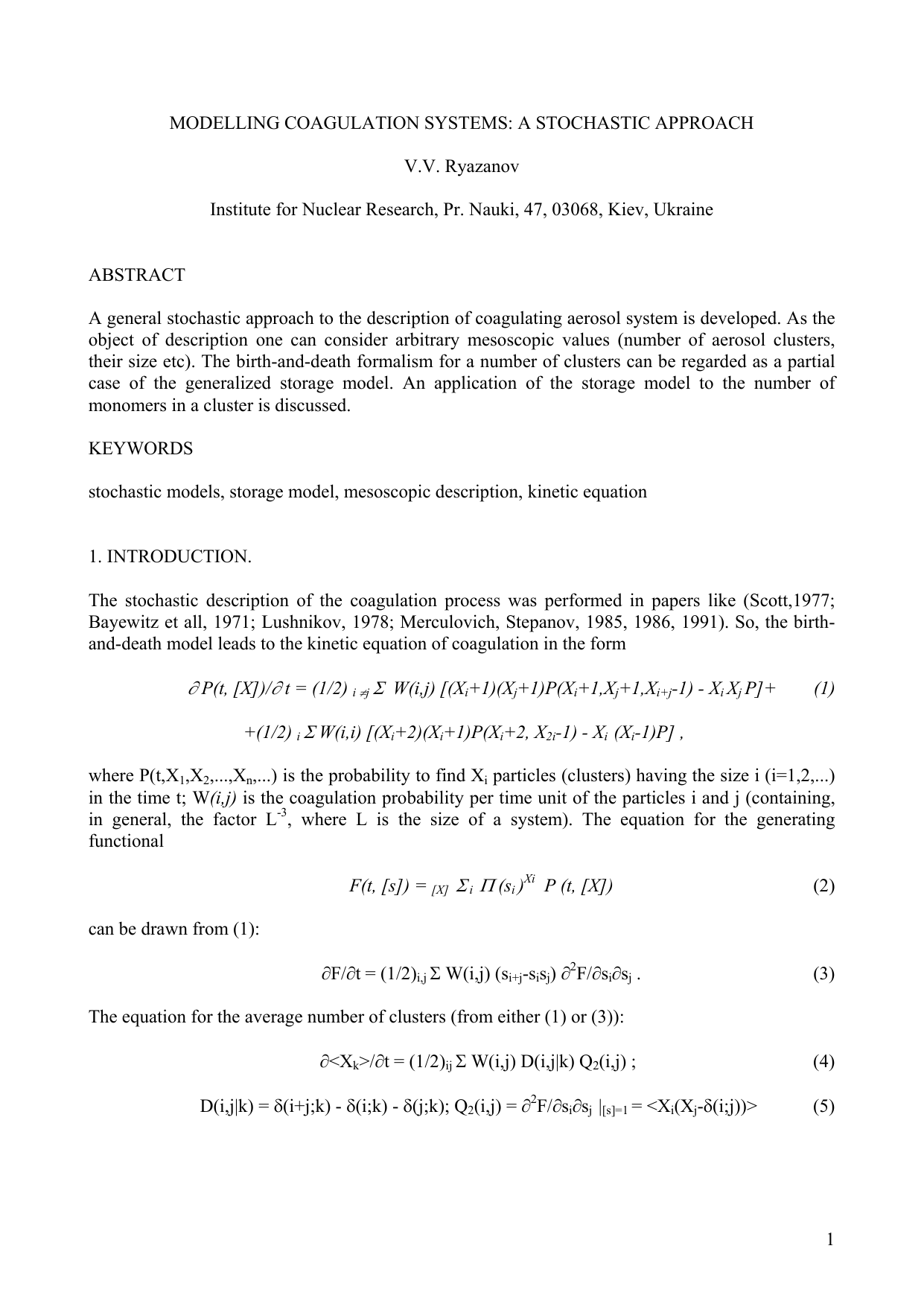
A general stochastic approach to the description of coagulating aerosol system is developed. As the object of description one can consider arbitrary mesoscopic values (number of aerosol clusters, their size etc). The birth-and-death formalism for a number of clusters can be regarded as a partial case of the generalized storage model. An application of the storage model to the number of monomers in a cluster is discussed.
The stochastic description of the coagulation process was performed in papers like (Scott,1977;Bayewitz et all, 1971;Lushnikov, 1978;Merculovich, Stepanov, 1985, 1986, 1991). So, the birthand-death model leads to the kinetic equation of coagulation in the form ∂ P(t, [X])/∂ t = (1/2) i ≠j Σ W(i,j) [(X i +1)(X j +1)P(X i +1,X j +1,X i+j -1) -X i X j P]+
(1) +(1/2) i Σ W(i,i) [(X i +2)(X i +1)P(X i +2, X 2i -1) -X i (X i -1)P] ,
where P(t,X 1 ,X 2 ,…,X n ,…) is the probability to find X i particles (clusters) having the size i (i=1,2,…) in the time t; W(i,j) is the coagulation probability per time unit of the particles i and j (containing, in general, the factor L -3 , where L is the size of a system). The equation for the generating functional
(2) can be drawn from (1):
∂F/∂t = (1/2) i,j Σ W(i,j) (s i+j -s i s j ) ∂ 2 F/∂s i ∂s j .
(3)
The equation for the average number of clusters (from either (1) or (3)):
∂/∂t = (1/2) ij Σ W(i,j) D(i,j|k) Q 2 (i,j) ; (4) D(i,j|k) = δ(i+j;k) -δ(i;k) -δ(j;k); Q 2 (i,j) = ∂ 2 F/∂s i ∂s j | [s]=1 = <X i (X j -δ(i;j))> (5) (δ(i;j) is the Cronecker symbol) is unclosed since higher momenta Q k are involved for which successive set of equations can be derived from (1), (3). If one makes an assertion that the random number of clusters of each size has the independent Poisson statistics then Q 2 (i,j) = <X i (X j -δ(i;j))> = , (6) and one arrives at the Smolukhovsky equation from (4):
∂/∂t = (1/2) ij Σ W(i,j) D(i,j|k) . ( 7)
In (van Dongen, 1987) the transition from ( 4) to ( 7) was performed basing on the method of van Kampen (van Kampen, 1984). In papers (Merkulovich, Stepanov, 1991, 1992) the spatially inhomogeneous coagulating systems were treated using the discretization operations both in space and time. The stochastic storage model for the random number of monomers in a cluster was introduced in (Ryazanov, 1991;Ryazanov, Shpyrko, 1994). In the present paper the general stochastic approach for describing arbitrary (random) macroscopic values characterizing an aerosol system is presented. The traditional stochastic storage model is generalized and the results are applied to the investigation of coagulating systems.
The mesoscopic stochastic description is generally meant as an intermediate description level between treating microscopic (molecular) quantities (such as the position and pulse of each molecule) and macroscopic (thermodynamic) ones. The mesoscopic level deals with the distribution function (or stochastic process) for the order parameters whose averages are to be treated macroscopically as thermodynamic quantities. For an aerosol system one could point out such values as number of clusters in a unit volume, size of a given cluster treating them as the order parameters. Denote such an order parameter as q(t) without its concretization for a moment (of cource, q(t) can be readily understood as multycomponent vector as well). In the assumption of the Markovian character of a process the distribution function ω(q,t) satisfies the master equation of the general type (see, for example, Stratonovich, 1992):
where the “kinetic operator” Φ is the contracted notation of the expansion of the Chapman equation; symbol N ∂,q orders the operations of differentiation and those of multiplication by functions of q. Thus the fundamental quantity of the mesoscopic approach is the matrix of transition probabilities (or kinetic operator which is nothing more or less than the generating function on these probabilities). The Laplace transform of the function ω(q,t)
resembles (2) up to the substitution s=exp{-θ}. The kinetic equation in this representation (that is for
We offer some common examples illustrating the specification of the transition matrix (kinetic operator). The diffusion process is by definition
where K 1 , K 2 are drift and diffusion coefficients respectively. Substituting ( 11) into (8) yields the Fokker-Planck equation. This approximation is quite common in many areas of physics and, faute de mieux, it was applied to various effects in the aerosol systems (Fuchs, 1964) -such as the spatial diffusion, filtration, coagulation, sedimentation processes. The value K 1 from (11) was thus V x -the projection of the velocity of the aerosol cluster onto axis x; K 2 /2=D=const, D is the diffusion coefficient. As the random value q one took the cluster coordinate x (which may be called some external coordinate). The description of a single (separate) cluster was thus performed. A single cluster description was also introduced in (Ryazanov, 1991;Ryazanov, Shpyrko, 1994). As the random number q we took the number m of monomers in a cluster, that is the internal coordinate.
The stochastic storage model was used in the kinetic equation for this value
where A(t) is a random input function, r[m] is the release rate. The input A(t) is given by specifying the cumulant function (Prabhu,1980)
where E(…) means averaging. In the abs
This content is AI-processed based on open access ArXiv data.