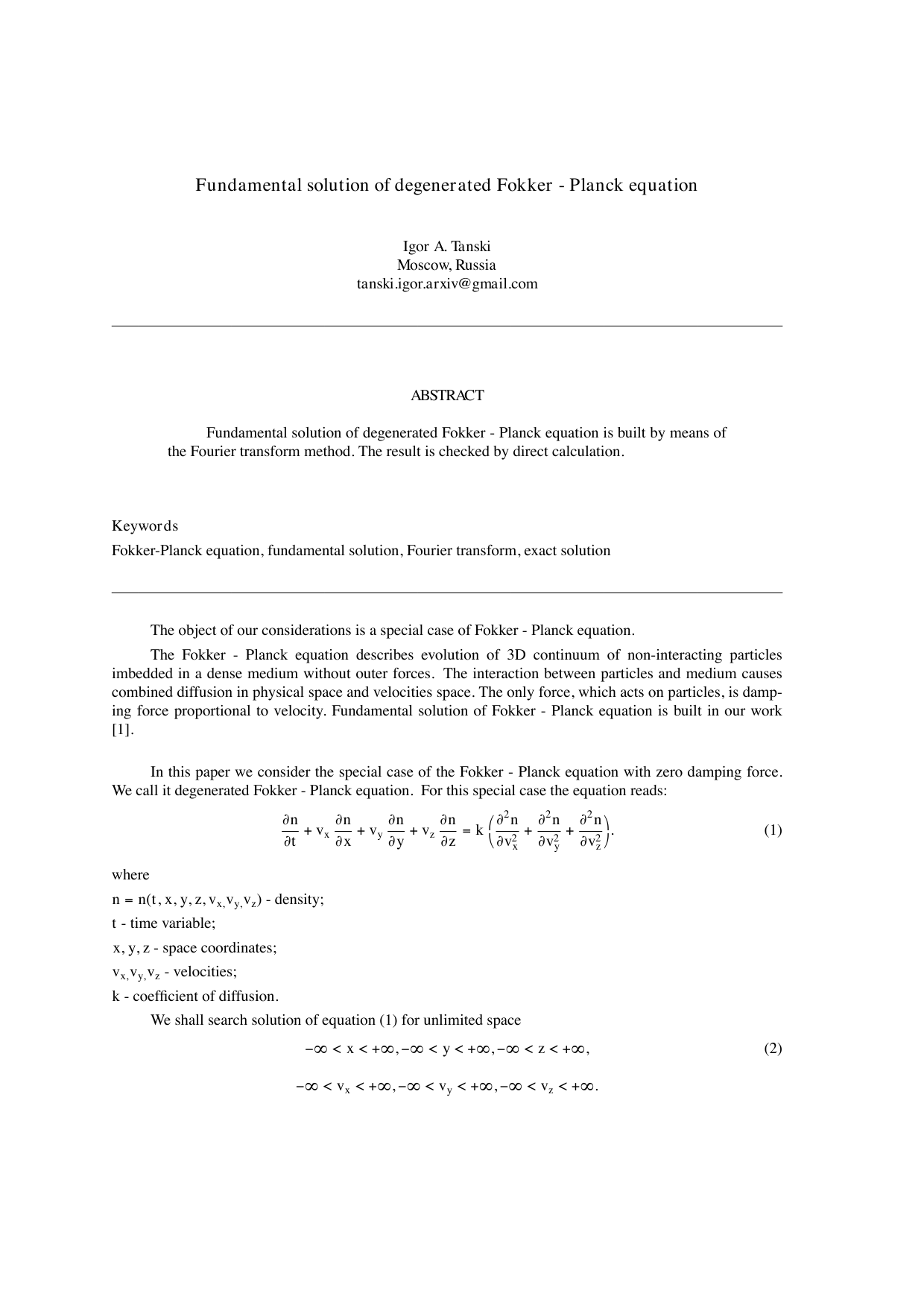
Fundamental solution of degenerated Fokker - Planck equation
Fundamental solution of degenerated Fokker - Planck equation is built by means of the Fourier transform method. The result is checked by direct calculation.
Nonlinear Sciences
All posts under tag "Nonlinear Sciences"
Fundamental solution of degenerated Fokker - Planck equation is built by means of the Fourier transform method. The result is checked by direct calculation.
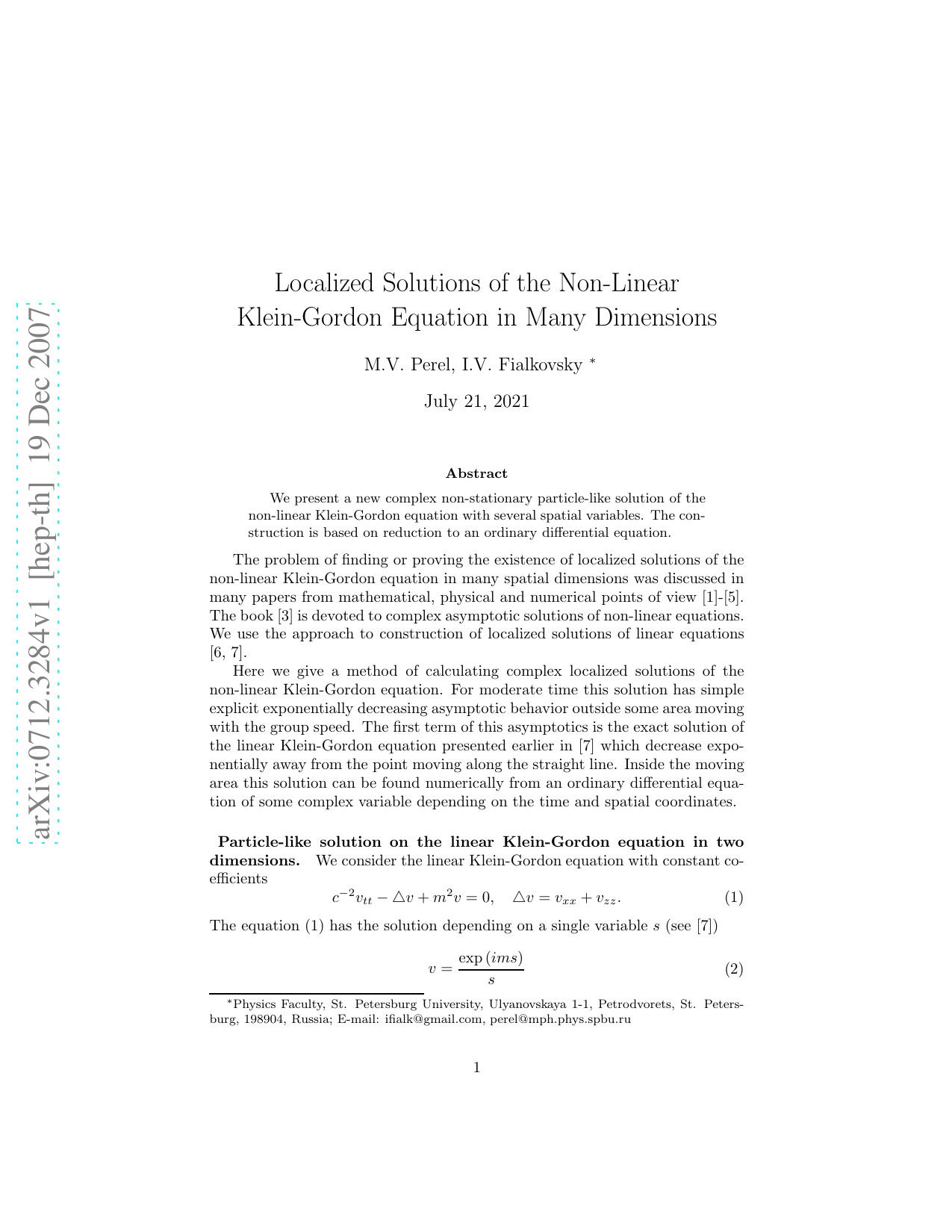
We present a new complex non-stationary particle-like solution of the non-linear Klein-Gordon equation with several spatial variables. The construction is based on reduction to an ordinary differential equation.
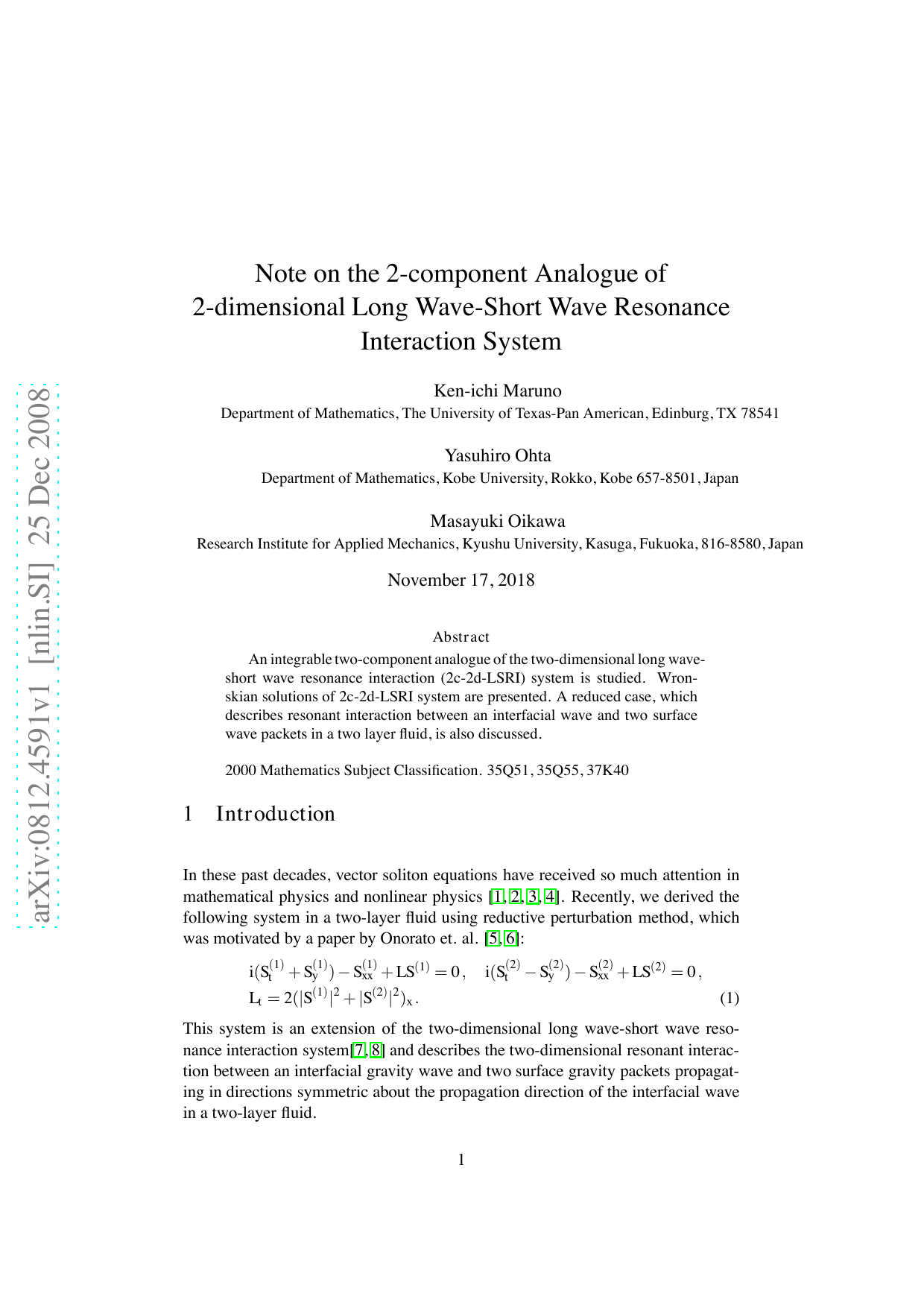
An integrable two-component analogue of the two-dimensional long wave-short wave resonance interaction (2c-2d-LSRI) system is studied. Wronskian solutions of 2c-2d-LSRI system are presented. A reduced case, which describes resonant interaction between an interfacial wave and two surface wave packets
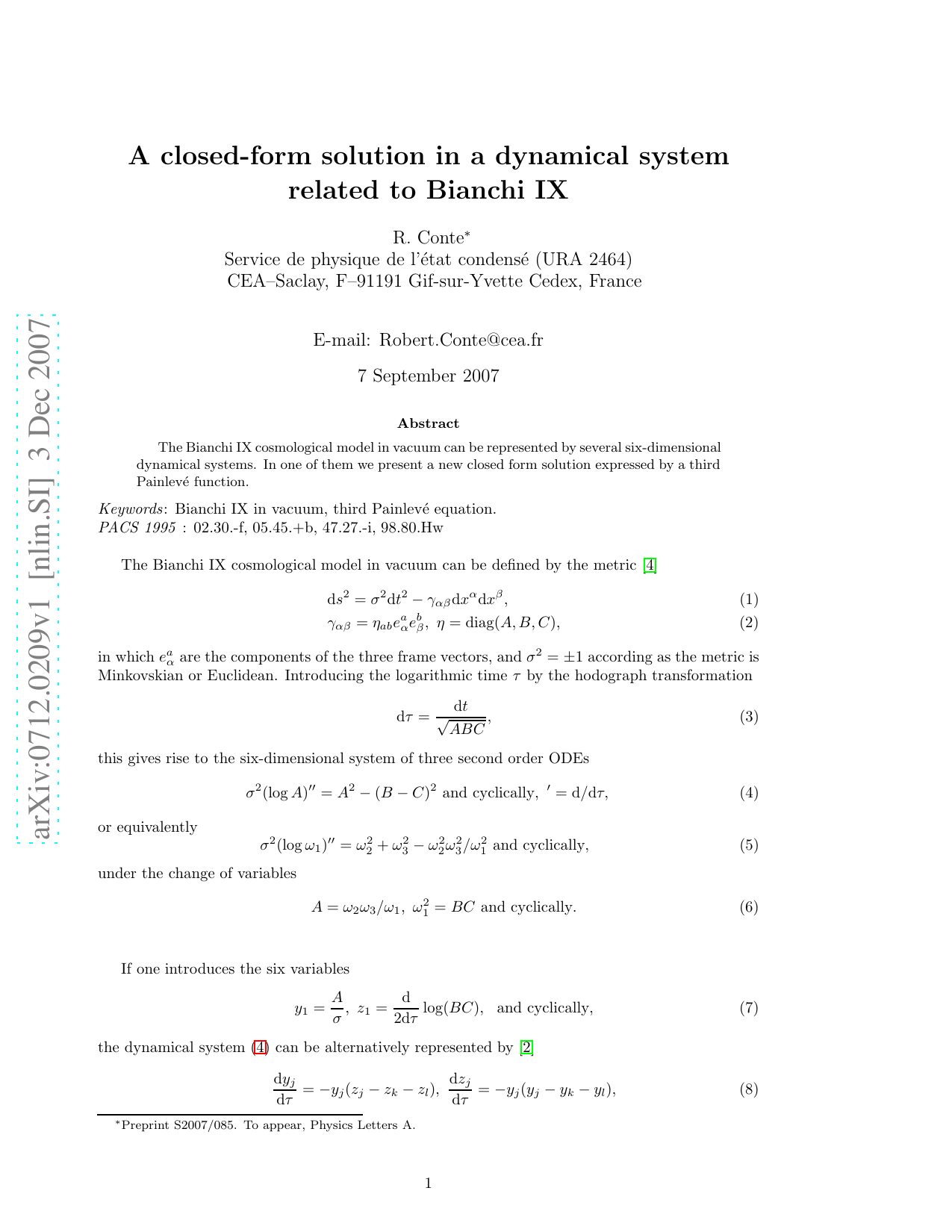
The Bianchi IX cosmological model in vacuum can be represented by several six-dimensional dynamical systems. In one of them we present a new closed form solution expressed by a third Painleve' function.
A new supersymmetric equation is proposed for the Sawada-Kotera equation. The integrability of this equation is shown by the existence of Lax representation and infinite conserved quantities and a recursion operator.
Chaotic systems have been broadly exploited through the last two decades to build encryption methods. Recently, two new image encryption schemes have been proposed, where the encryption process involves a permutation operation and an XOR-like transformation of the shuffled pixels, which are controll
The exchange operator formalism in polar coordinates, previously considered for the Calogero-Marchioro-Wolfes problem, is generalized to a recently introduced, infinite family of exactly solvable and integrable Hamiltonians $H_k$, $k=1$, 2, 3,..., on a plane. The elements of the dihedral group $D_{2
We present an explicit formula for integrals of the open 2D Toda lattice of type $A_n$. This formula is applicable for various reductions of this lattice. To illustrate the concept we find integrals of the Toda $G_2$ lattice. We also reveal a connection between the open Toda $A_n$ and Shabat-Yamilov

This work is devoted to an integrable generalization of the nonlinear Schr'odinger equation proposed by Fokas and Lenells. I discuss the relationships between this equation and other integrable models. Using the reduction of the Fokas-Lenells equation to the already known ones I obtain the N-dark so
By using Jackson's q-exponential function we introduce the generating function, the recursive formulas and the second order q-differential equation for the q-Hermite polynomials. This allows us to solve the q-heat equation in terms of q-Kampe de Feriet polynomials with arbitrary N moving zeroes, and

By factorization of the Hamiltonian describing the quantum mechanics of the continuous q-Hermite polynomial, the creation and annihilation operators of the q-oscillator are obtained. They satisfy a q-oscillator algebra as a consequence of the shape-invariance of the Hamiltonian. A second set of q-os
The cascade model generates a food web at random. In it the species are labeled from 0 to $m$, and arcs are given at random between pairs of the species. For an arc with endpoints $i$ and $j$ ($i<j$), the species $i$ is eaten by the species labeled $j$. The chain length (height), generated at random
The generalized Taylor expansion including a secret auxiliary parameter $h$ which can control and adjust the convergence region of the series is the foundation of the homotopy analysis method proposed by Liao. The secret of $h$ can't be understood in the frame of the homotopy analysis method. This i
A new integrable sixth-order nonlinear wave equation is discovered by means of the Painleve analysis, which is equivalent to the Korteweg - de Vries equation with a source. A Lax representation and a Backlund self-transformation are found of the new equation, and its travelling wave solutions and ge

We propose a nonperturbative approach to nonabelian two-form gauge theory. We formulate the theory on a lattice in terms of plaquette as fundamental dynamical variable, and assign U(N) Chan-Paton colors at each boundary link. We show that, on hypercubic lattices, such colored plaquette variables con

A method to construct both classical and quantum completely integrable systems from (Jordan-Lie) comodule algebras is introduced. Several integrable models based on a so(2,1) comodule algebra, two non-standard Schrodinger comodule algebras, the (classical and quantum) q-oscillator algebra and the Re
Considering a basic enzyme-catalysed reaction, in which the rate of input of the substrate varies periodically in time, we give a necessary and sufficient condition for the existence of a periodic solution of the reaction equations. The proof employs the Leray-Schauder degree, applied to an appropri
The financial rogue waves are reported analytically in the nonlinear option pricing model due to Ivancevic, which is nonlinear wave alternative of the Black-Scholes model. These solutions may be used to describe the possible physical mechanisms for rogue wave phenomenon in financial markets and rela
A new method for the construction of classical integrable systems, that we call loop coproduct formulation, is presented. We show that the linear r-matrix formulation, the Sklyanin algebras and the reflection algebras can be obtained as particular subcases of this framework. We comment on the possib
By using the Renyi entropy, and following the same scheme that in the Fisher-Renyi entropy product case, a generalized statistical complexity is defined. Several properties of it, including inequalities and lower and upper bounds are derived. The hydrogen atom is used as a test system where to quant
The inverse problem which arises in the Camassa--Holm equation is revisited for the class of discrete densities. The method of solution relies on the use of orthogonal polynomials. The explicit formulas are obtained directly from the analysis on the real axis without any additional transformation to
The large class of moving boundary processes in the plane modeled by the so-called Laplacian growth, which describes, e.g., solidification, electrodeposition, viscous fingering, bacterial growth, etc., is known to be integrable and to exhibit a large number of exact solutions. In this work, the boun
In this paper, we use various ansatzes with undetermined functions and the technique of moving frame to find solutions with parameter functions modulo the Lie point symmetries for the classical non-steady boundary layer problems. These parameter functions enable one to find the solutions of some rel
We study restricted multiple three wave interaction system by the inverse scattering method. We develop the algebraic approach in terms of classical $r$-matrix and give an interpretation of the Poisson brackets as linear $r$-matrix algebra. The solutions are expressed in terms of polynomials of thet
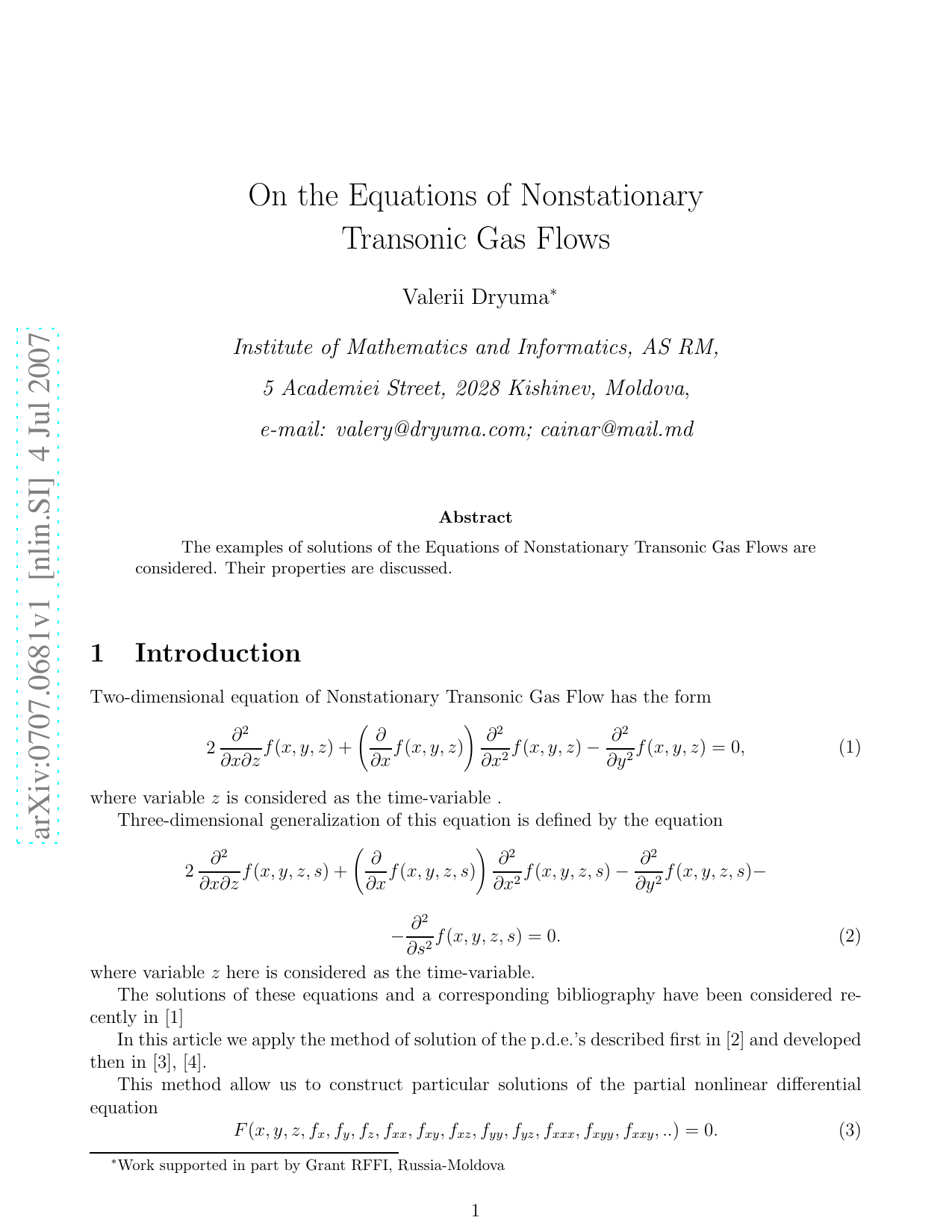
The method of point transformation of the functions and variables for construction of particular solutions of the Equations of Nonstationary Transonic Gas Flows is used.

We show that the equations of motion in one partial integrable case of Goryachev in the rigid body dynamics can be separated by the appropriate change of variables, the new variables x, y being hyperelliptic functions of time. The natural phase variables (components of coordinates and momenta) are e
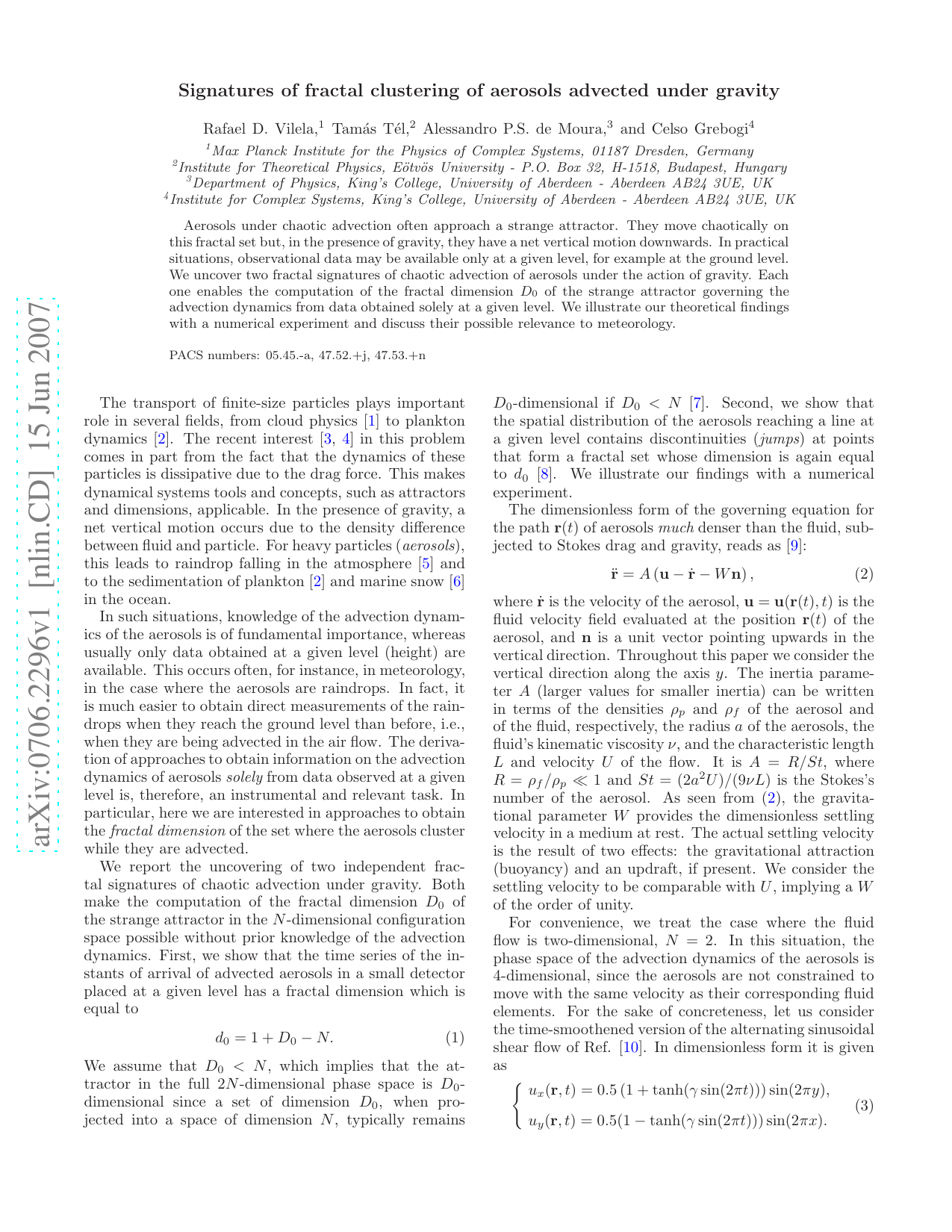
Aerosols under chaotic advection often approach a strange attractor. They move chaotically on this fractal set but, in the presence of gravity, they have a net vertical motion downwards. In practical situations, observational data may be available only at a given level, for example at the ground lev
We review a recently introduced set of N-dimensional quasi-maximally superintegrable Hamiltonian systems describing geodesic motions, that can be used to generate 'dynamically' a large family of curved spaces. From an algebraic viewpoint, such spaces are obtained through kinetic energy Hamiltonians
The purpose of our work is to extend the formulation of classical affine Toda Models in the presence of jump defects to pure fermionic Thirring model. As a first attempt we construct the Lagrangian of the Grassmanian Thirring model with jump defect (of Backlund type) and present its conserved modifi
In this paper, we numerically study energy dissipation caused by traffic in the Nagel-Schreckenberg (NaSch) model with open boundary conditions (OBC). Numerical results show that there is a nonvanishing energy dissipation rate Ed, and no true free-flow phase exists in the deterministic and nondeterm

The degenerate third Painleve' equation, $u'(t)=(u'(t))^2/u(t)-u'(t)/t+1/t(-8c u^2(t)+2ab)+b^2/u(t)$, where $c=+/-1$, $b>0$, and $a$ is a complex parameter, is studied via the Isomonodromy Deformation Method. Asymptotics of general regular and singular solutions $u(t)$ as $t -> +/-infty$ and $t -> +

This paper considers the propagation of shallow-water solitary and nonlinear periodic waves over a gradual slope with bottom friction in the framework of a variable-coefficient Korteweg-de Vries equation. We use the Whitham averaging method, using a recent development of this theory for perturbed in
We investigate non-degenerate Lagrangians of the form $$ int f(u_x, u_y, u_t) dx dy dt $$ such that the corresponding Euler-Lagrange equations $ (f_{u_x})_x+ (f_{u_y})_y+ (f_{u_t})_t=0 $ are integrable by the method of hydrodynamic reductions. We demonstrate that the integrability condit

We find an interpretation of the complex of variational calculus in terms of the Lie conformal algebra cohomology theory. This leads to a better understanding of both theories. In particular, we give an explicit construction of the Lie conformal algebra cohomology complex, and endow it with a struct
The basic ideas of a homotopy-based multiple-variable method is proposed and applied to investigate the nonlinear interactions of periodic traveling waves. Mathematically, this method does not depend upon any small physical parameters at all and thus is more general than the traditional multiple-sca

A set of traveling wave solution to convection-reaction-diffusion equation is studied by means of methods of local nonlinear analysis and numerical simulation. It is shown the existence of compactly supported solutions as well as solitary waves within this family for wide range of parameter values.
We consider N=2 supersymmetric extensions of the Camassa-Holm and Hunter-Saxton equations. We show that they admit geometric interpretations as Euler equations on the superconformal algebra of contact vector fields on the 1|2-dimensional supercircle. We use the bi-Hamiltonian formulation to derive L
![Reflection matrices for the $U_{q}[osp(r|2m)^{(1)}]$ vertex model](/images/papers/0809.0421/cover.png)
The graded reflection equation is investigated for the $U_{q}[osp(r|2m)^{(1)}]$ vertex model. We have found four classes of diagonal solutions with at the most one free parameter and twelve classes of non-diagonal ones with the number of free parameters depending on the number of bosonic ($r$) and f

The KdV-Sawada-Kotera equation has single-, two- and three-soliton solutions. However, it is not known yet whether it has N-soliton solutions for any N. Viewing it as a perturbed KdV equation, the asymptotic expansion of the solution is developed through third order within the framework of a Normal
We review the free field realization of the deformed Virasoro algebra $Vir_{q,t}$ and the deformed $W$ algebra $W_{q,t}(hat{gl_N})$. We explicitly construct two classes of infinitly many commutative operators ${cal I}_m$, ${cal G}_m$, $(m in {mathbb N})$, in terms of these algebras. They can be rega
The algebraic structure of the integrable mixed mKdV/sinh-Gordon model is discussed and textit{}extended to the AKNS/Lund-Regge model and to its corresponding supersymmetric versions. The integrability of the models is guaranteed from the zero curvature representation and some soliton solutions are

The question how social norms can emerge from microscopic interactions between individuals is a key problem in social sciences to explain collective behavior. In this paper we propose an agent-based model to show that randomly distributed social behavior by way of local interaction converges to a st
We discuss the complex dynamics of a non-linear random networks model, as a function of the connectivity k between the elements of the network. We show that this class of networks exhibit an order-chaos phase transition for a critical connectivity k = 2. Also, we show that both, pairwise correlation

Given a nonlinear evolution equation in (1+n) dimensions, which has spatially extended traveling wave solutions, it can be extended into a system of two coupled equations, one of which generates the original traveling waves, and the other generates structures that are localized in the vicinity of th
Enter keywords to search articles