Brouwers fixed point theorem with sequentially at most one fixed point
We present a constructive proof of Brouwer's fixed point theorem with sequentially at most one fixed point, and apply it to the mini-max theorem of zero-sum games.
All posts under tag "Game Theory"

We present a constructive proof of Brouwer's fixed point theorem with sequentially at most one fixed point, and apply it to the mini-max theorem of zero-sum games.

In the famous Three-Door-Game Monte cannot help to win all the time by signaling location of the prize, using only the freedom he allowed to use. No matter which strategies played, there is always at least one door where the prize will not be found. However, already in the game with four doors coope

We study the emph{Submodular Welfare Problem} (SWP), where items are partitioned among agents with monotone submodular utilities to maximize the total welfare under emph{bandit feedback}. Classical SWP assumes full value-oracle access, achieving $(1-1/e)$ approximations via continuous-greedy algorit

We propose a new approach to testing conformance to a nondeterministic specification, in which testing proceeds only as long as increased test coverage is guaranteed.

The classical model of signaling games assumes that the receiver exactly know the type space (private information) of the sender and be able to discriminate each type of the sender distinctly. However, the justification of this assumption is questionable. It is more reasonable to let the receiver re

In the theory of social choice the research is focused around the projection of individual preference orders to the social preference order. Also, the justification of the preference order formalism begins with the concept of utility i.e. an alternative is preferred to another one if the utility ove
A boolean formula in a conjuctive normal form is called a (k,s)-formula if every clause contains exactly k variables and every variable occurs in at most s clauses. We prove the existence of a (k, 4 * (2^k/k))-CNF formula which is unsatisfiable.

One possible escape from the Gibbard-Satterthwaite theorem is computational complexity. For example, it is NP-hard to compute if the STV rule can be manipulated. However, there is increasing concern that such results may not re ect the difficulty of manipulation in practice. In this tutorial, I surv

This paper provides a tutorial overview of game theoretic techniques used for communication over frequency selective interference channels. We discuss both competitive and cooperative techniques. Keywords: Game theory, competitive games, cooperative games, Nash Equilibrium, Nash bargaining solutio

Recent mobile equipment (as well as the norm IEEE 802.21) now offers the possibility for users to switch from one technology to another (vertical handover). This allows flexibility in resource assignments and, consequently, increases the potential throughput allocated to each user. In this paper, we

We propose an abstract approach to coalition formation that focuses on simple merge and split rules transforming partitions of a group of players. We identify conditions under which every iteration of these rules yields a unique partition. The main conceptual tool is a specific notion of a stable pa

Interpretation of animal behavior, especially as cooperative or selfish, is a challenge for evolutionary theory. Strategy of a competition should follow from corresponding Darwinian payoffs for the available behavioral options. The payoffs and decision making processes, however, are difficult to obs

Several notions of game enjoy a Nash-like notion of equilibrium without guarantee of existence. There are different ways of weakening a definition of Nash-like equilibrium in order to guarantee the existence of a weakened equilibrium. Nash's approach to the problem for strategic games is probabilist

The quest for optimal/stable paths in graphs has gained attention in a few practical or theoretical areas. To take part in this quest this chapter adopts an equilibrium-oriented approach that is abstract and general: it works with (quasi-arbitrary) arc-labelled digraphs, and it assumes very little a

In this paper, we model the various wireless users in a cognitive radio network as a collection of selfish, autonomous agents that strategically interact in order to acquire the dynamically available spectrum opportunities. Our main focus is on developing solutions for wireless users to successfully

In this contribution, the performance of a multi-user system is analyzed in the context of frequency selective fading channels. Using game theoretic tools, a useful framework is provided in order to determine the optimal power allocation when users know only their own channel (while perfect channel

We study a class of games in which a finite number of agents each controls a quantity of flow to be routed through a network, and are able to split their own flow between multiple paths through the network. Recent work on this model has contrasted the social cost of Nash equilibria with the best pos

In a society of completely selfish individuals where everybody is only interested in maximizing his own payoff, does any equilibrium exist for the society? John Nash proved more than 50 years ago that an equilibrium always exists such that nobody would benefit from unilaterally changing his strategy

Enormous successes have been made by quantum algorithms during the last decade. In this paper, we combine the quantum game with the problem of data clustering, and then develop a quantum-game-based clustering algorithm, in which data points in a dataset are considered as players who can make decisio

This paper introduces a model based upon games on an evolving network, and develops three clustering algorithms according to it. In the clustering algorithms, data points for clustering are regarded as players who can make decisions in games. On the network describing relationships among data points

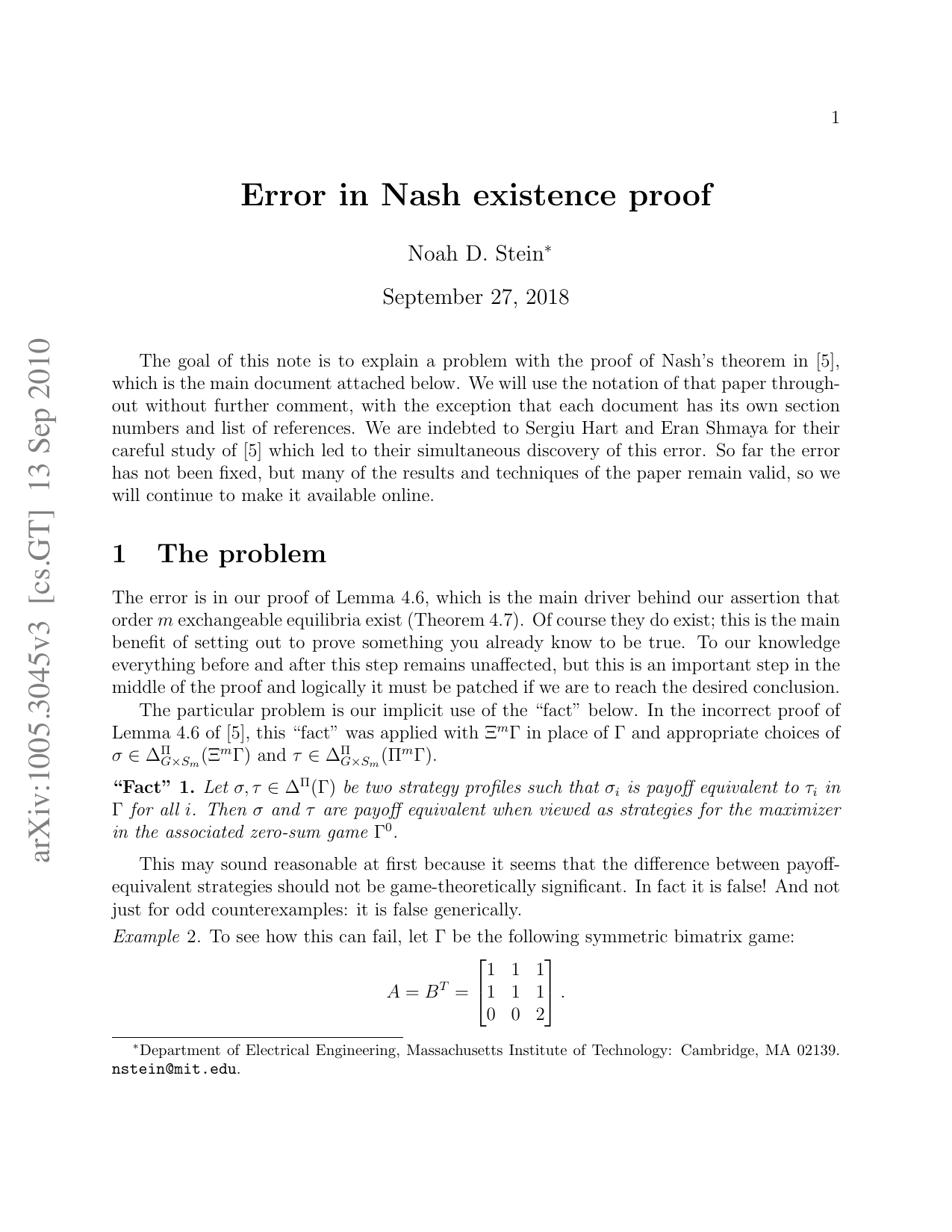
This document consists of two parts: the second part was submitted earlier as a new proof of Nash's theorem, and the first part is a note explaining a problem found in that proof. We are indebted to Sergiu Hart and Eran Shmaya for their careful study which led to their simultaneous discovery of this

One natural constraint in the sponsored search advertising framework arises from the fact that there is a limit on the number of available slots, especially for the popular keywords, and as a result, a significant pool of advertisers are left out. We study the emergence of diversification in the adw

We study competition between wireless devices with incomplete information about their opponents. We model such interactions as Bayesian interference games. Each wireless device selects a power profile over the entire available bandwidth to maximize its data rate. Such competitive models represent si

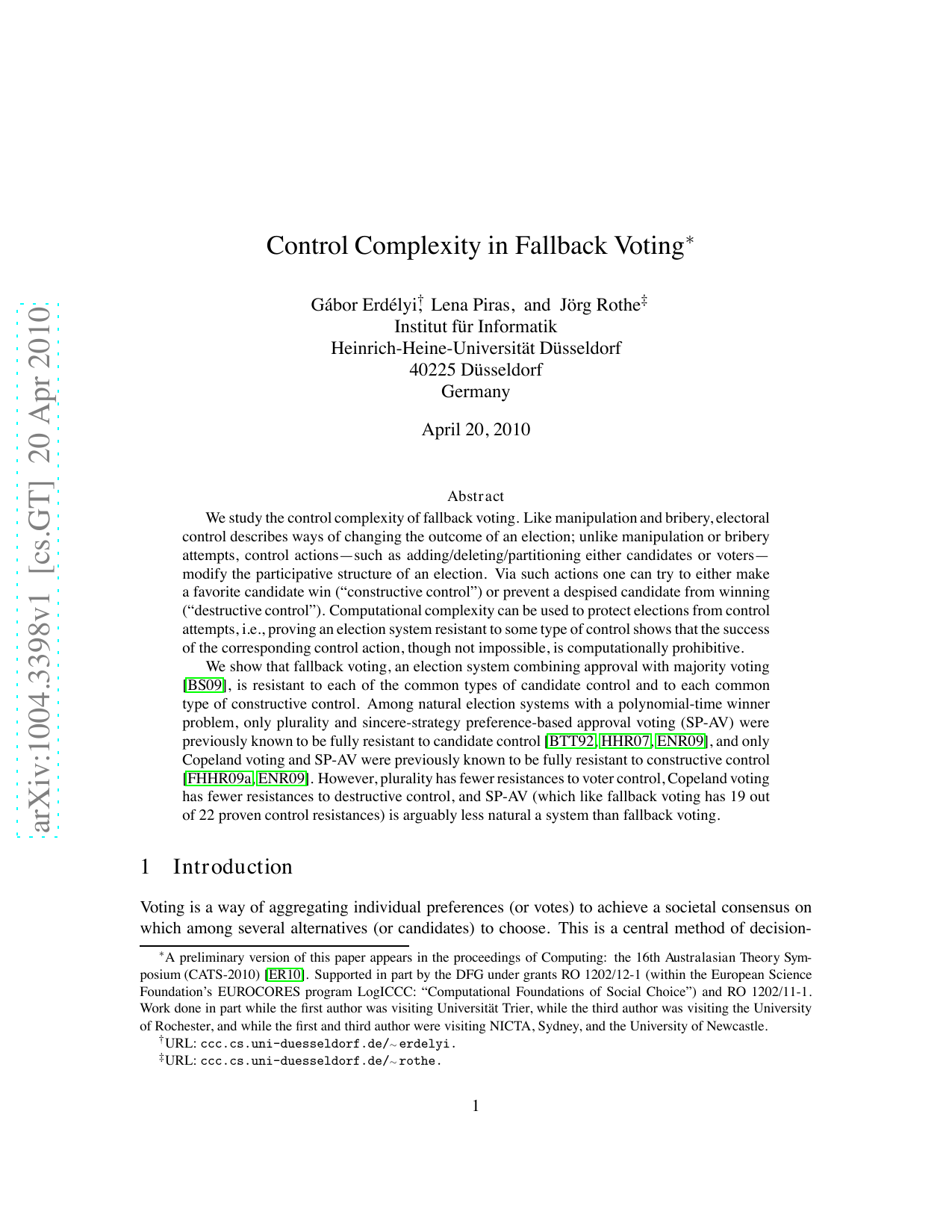
We study the control complexity of fallback voting. Like manipulation and bribery, electoral control describes ways of changing the outcome of an election; unlike manipulation or bribery attempts, control actions---such as adding/deleting/partitioning either candidates or voters---modify the partici

We present several new characterizations of correlated equilibria in games with continuous utility functions. These have the advantage of being more computationally and analytically tractable than the standard definition in terms of departure functions. We use these characterizations to construct ef

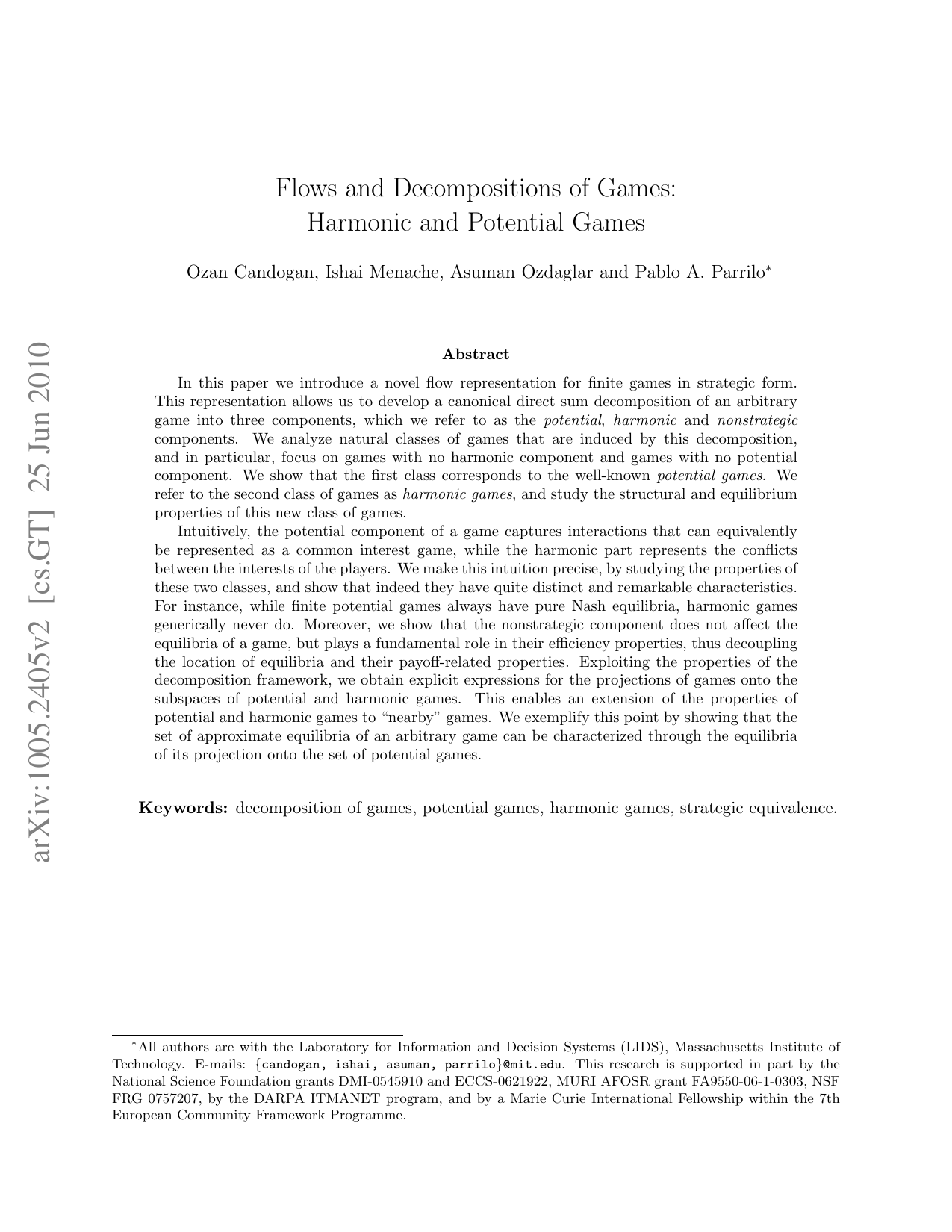
In this paper we introduce a novel flow representation for finite games in strategic form. This representation allows us to develop a canonical direct sum decomposition of an arbitrary game into three components, which we refer to as the potential, harmonic and nonstrategic components. We analyze na

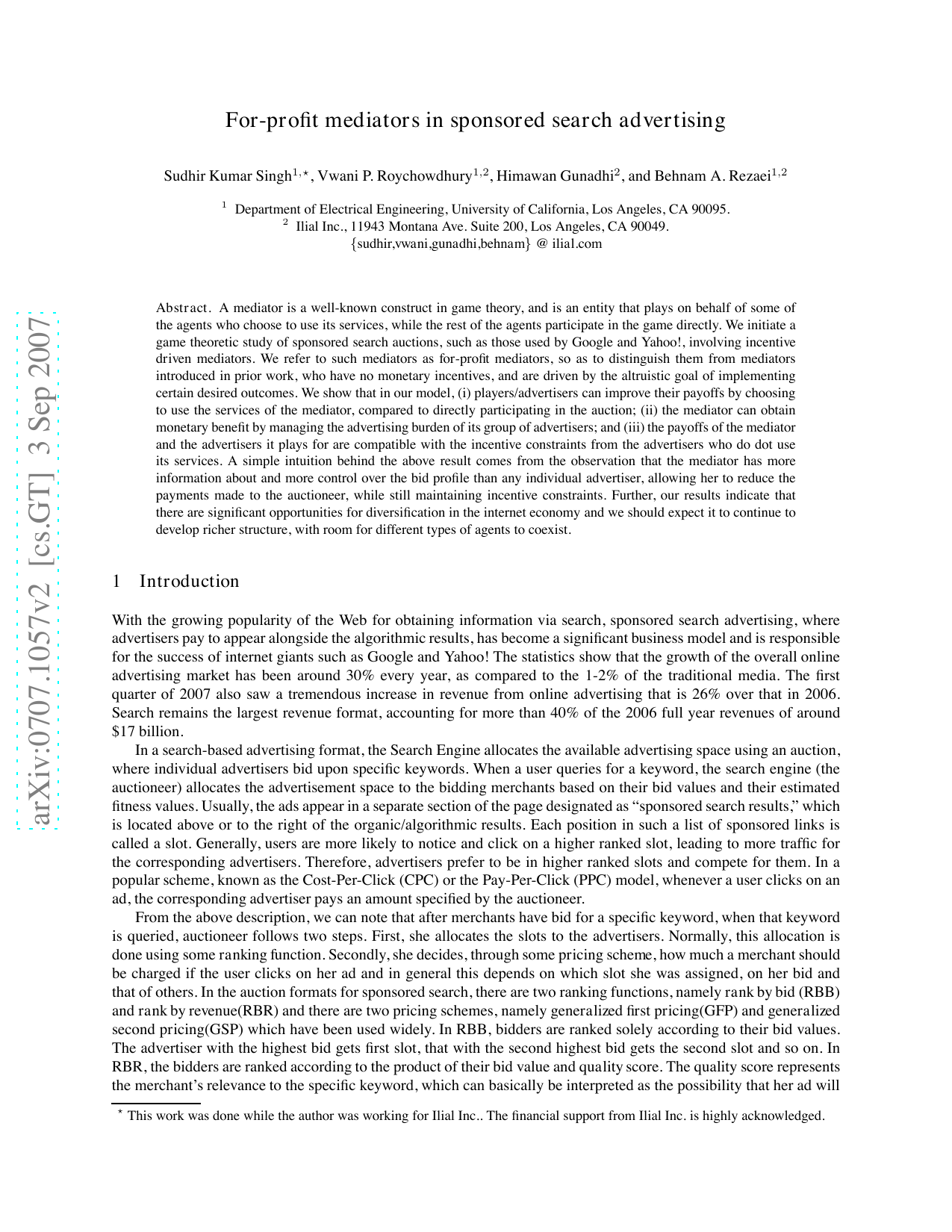
A mediator is a well-known construct in game theory, and is an entity that plays on behalf of some of the agents who choose to use its services, while the rest of the agents participate in the game directly. We initiate a game theoretic study of sponsored search auctions, such as those used by Googl

The Sudoku puzzle has achieved worldwide popularity recently, and attracted great attention of the computational intelligence community. Sudoku is always considered as Satisfiability Problem or Constraint Satisfaction Problem. In this paper, we propose to focus on the essential graph structure under

In this work we introduce hierarchy in wireless networks that can be modeled by a decentralized multiple access channel and for which energy-efficiency is the main performance index. In these networks users are free to choose their power control strategy to selfishly maximize their energy-efficiency

This paper focuses on the cross-layer issue of joint multiuser detection and resource allocation for energy efficiency in wireless CDMA networks. In particular, assuming that a linear multiuser detector is adopted in the uplink receiver, the case considered is that in which each terminal is allowed

There are p heterogeneous objects to be assigned to n competing agents (n > p) each with unit demand. It is required to design a Groves mechanism for this assignment problem satisfying weak budget balance, individual rationality, and minimizing the budget imbalance. This calls for designing an appro

In this work we study of competitive situations among users of a set of global resources. More precisely we study the effect of cost policies used by these resources in the convergence time to a pure Nash equilibrium. The work is divided in two parts. In the theoretical part we prove lower and upper

We experimentally study how redistribution choices are affected by positive and negative information regarding the behaviour of a previous participant in a dictator game with a taking option. We use the strategy method to identify behavioural 'types', and thus distinguish 'conformists' from 'counter

It is widely believed that computing payments needed to induce truthful bidding is somehow harder than simply computing the allocation. We show that the opposite is true: creating a randomized truthful mechanism is essentially as easy as a single call to a monotone allocation rule. Our main result i

We study competitive equilibria in the classic Shapley-Shubik assignment model with indivisible goods and unit-demand buyers, with budget constraints: buyers can specify a maximum price they are willing to pay for each item, beyond which they cannot afford the item. This single discontinuity introdu

Using Sperner's lemma for modified partition of a simplex we will constructively prove the existence of a Nash equilibrium in a finite strategic game with sequentially locally non-constant payoff functions. We follow the Bishop style constructive mathematics.

This paper focuses on the cross-layer issue of resource allocation for energy efficiency in the uplink of a multiuser MIMO wireless communication system. Assuming that all of the transmitters and the uplink receiver are equipped with multiple antennas, the situation considered is that in which each

One of the Multi-Agent Systems that is widely used by various government agencies, buyers and sellers in a market economy, in such a manner so as to attain optimized resource allocation, is the Combinatorial Auctioning System (CAS). We study another important aspect of resource allocations in CAS, n

We investigate the degree of discontinuity of several solution concepts from non-cooperative game theory. While the consideration of Nash equilibria forms the core of our work, also pure and correlated equilibria are dealt with. Formally, we restrict the treatment to two player games, but results an

This paper focuses on a one person game called Indian policeman's dilemma (IPD). It represents the internal conflict between emotion and profession of a typical Indian police officer. We have 'split' the game to be played independently by different personality modules of the same player. Each module

We exhibit incentive compatible multi-unit auctions that are not affine maximizers (i.e., are not of the VCG family) and yet approximate the social welfare to within a factor of $1+epsilon$. For the case of two-item two-bidder auctions we show that these auctions, termed Triage auctions, are the onl

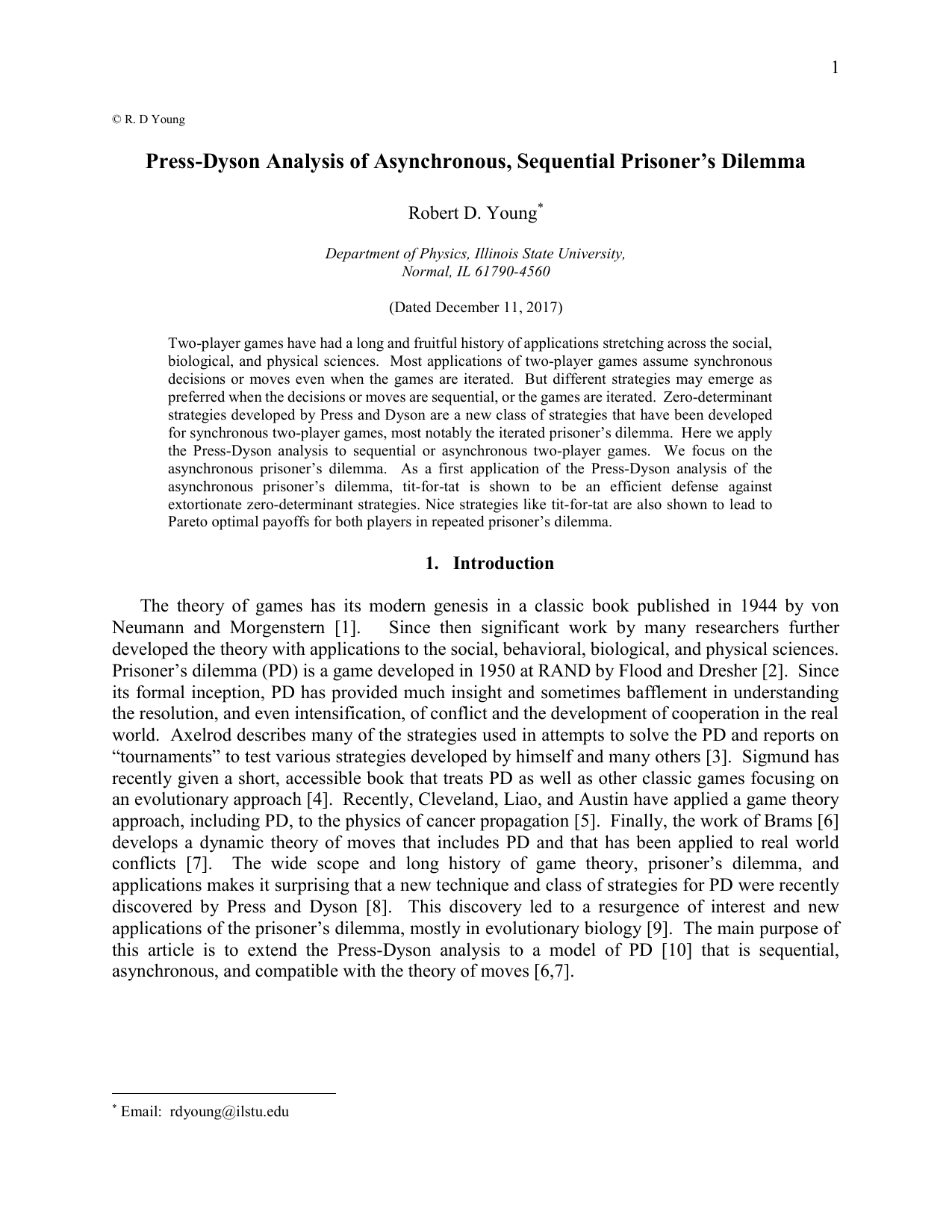
Two-player games have had a long and fruitful history of applications stretching across the social, biological, and physical sciences. Most applications of two-player games assume synchronous decisions or moves even when the games are iterated. But different strategies may emerge as preferred when t

We give polynomial-time algorithms for computing the values of Markov decision processes (MDPs) with limsup and liminf objectives. A real-valued reward is assigned to each state, and the value of an infinite path in the MDP is the limsup (resp. liminf) of all rewards along the path. The value of an

We consider dominant strategy implementation in private values settings, when agents have multi-dimensional types, the set of alternatives is finite, monetary transfers are allowed, and agents have quasi-linear utilities. We show that any implementable and neutral social choice function must be a we

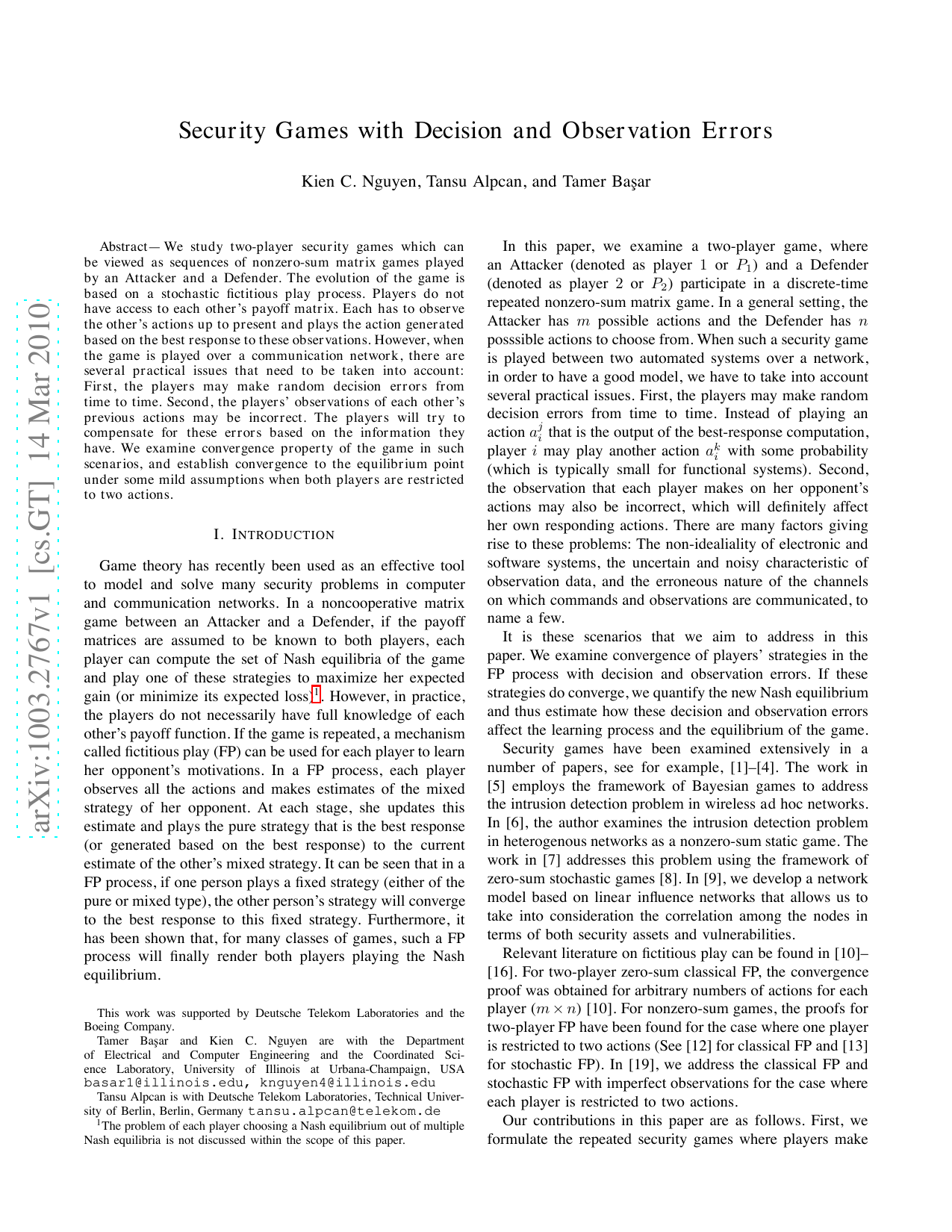
We study two-player security games which can be viewed as sequences of nonzero-sum matrix games played by an Attacker and a Defender. The evolution of the game is based on a stochastic fictitious play process. Players do not have access to each other's payoff matrix. Each has to observe the other's

Market-based conservation instruments, such as payments, auctions or tradable permits, are environmental policies that create financial incentives for landowners to engage in voluntary conservation on their land. But what if ecological processes operate across property boundaries and land use decisi

We address the problem of fair division, or cake cutting, with the goal of finding truthful mechanisms. In the case of a general measure space ('cake') and non-atomic, additive individual preference measures - or utilities - we show that there exists a truthful 'mechanism' which ensures that each of

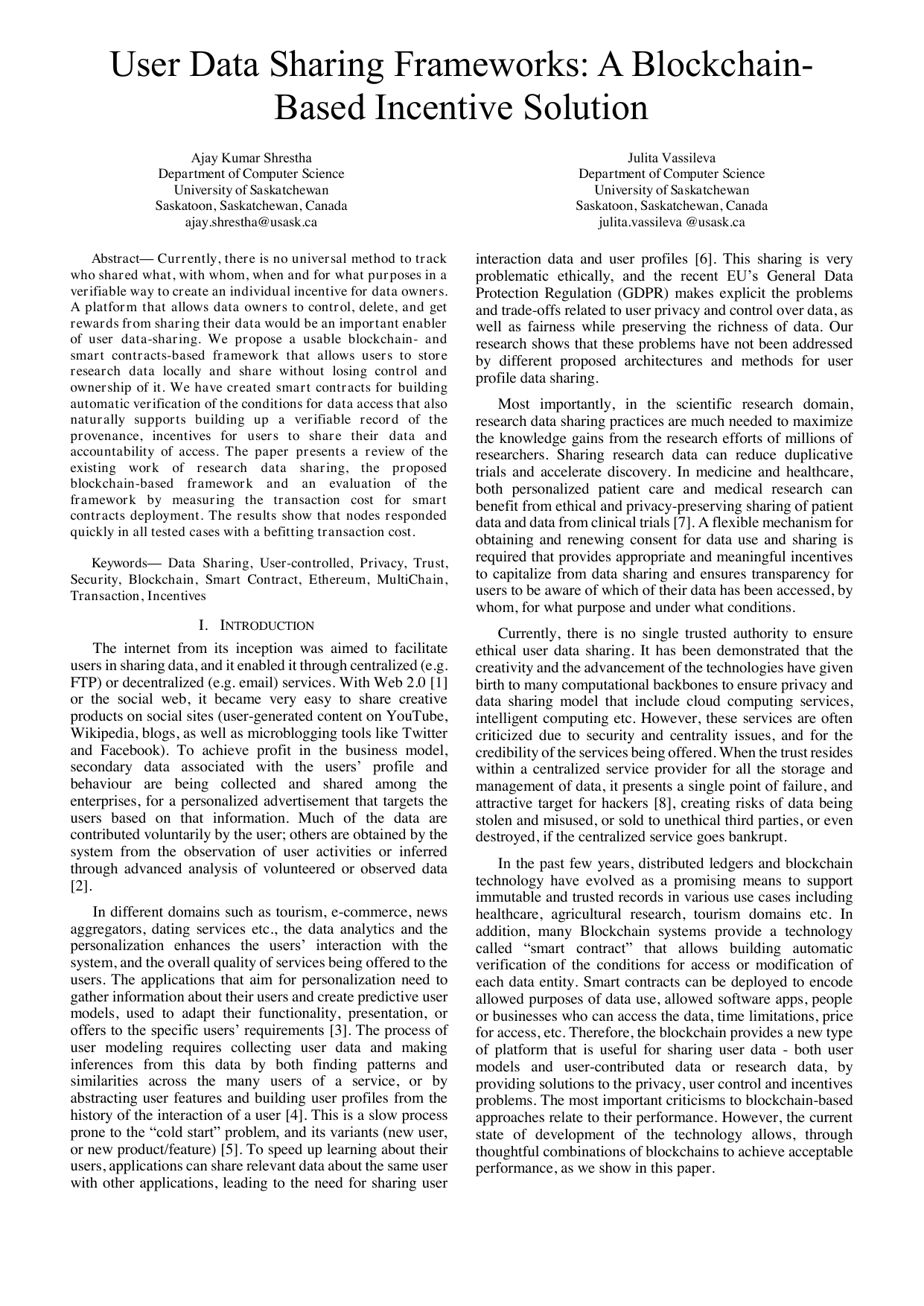
Currently, there is no universal method to track who shared what, with whom, when and for what purposes in a verifiable way to create an individual incentive for data owners. A platform that allows data owners to control, delete, and get rewards from sharing their data would be an important enabler

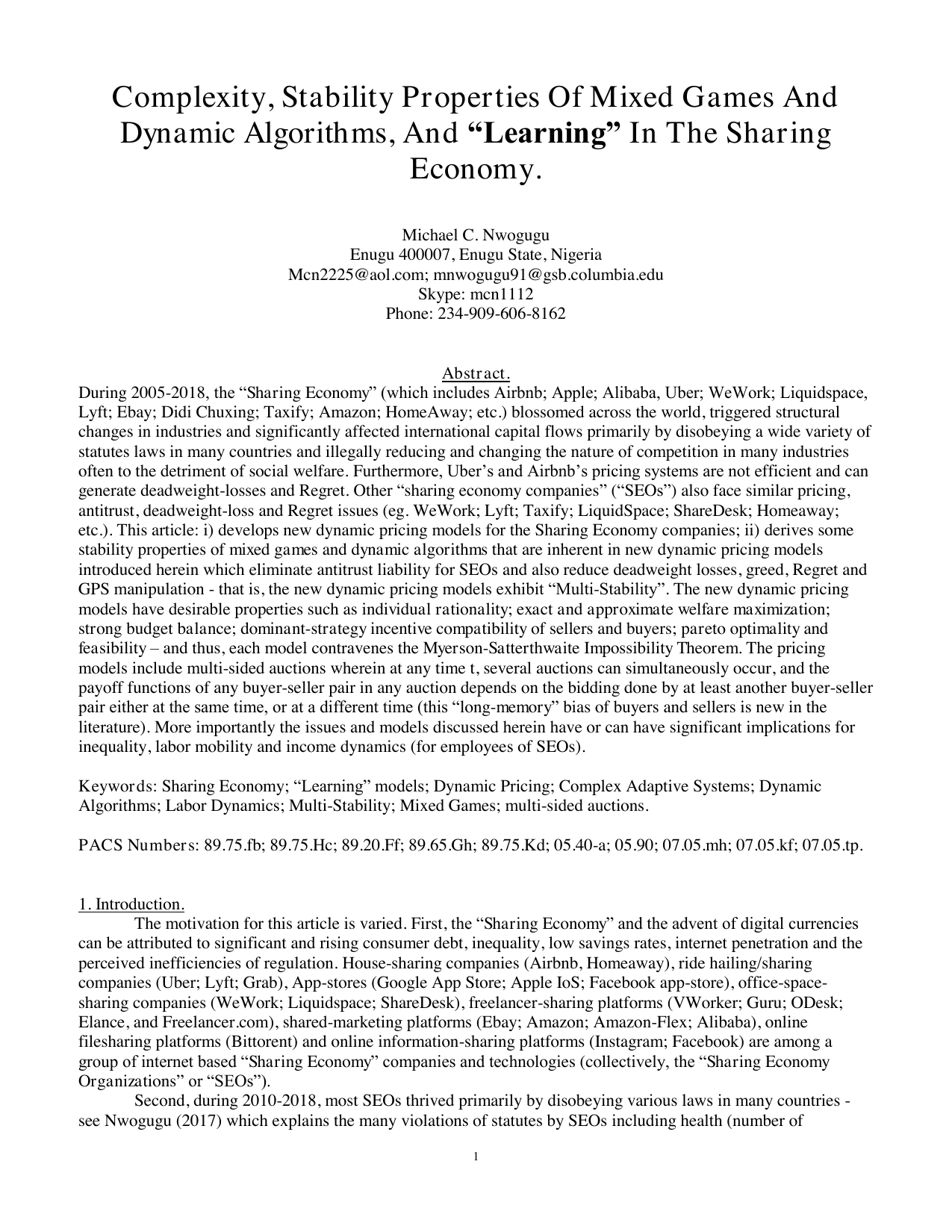
The Sharing Economy (which includes Airbnb, Apple, Alibaba, Uber, WeWork, Ebay, Didi Chuxing, Amazon) blossomed across the world, triggered structural changes in industries and significantly affected international capital flows primarily by disobeying a wide variety of statutes and laws in many coun

In this paper we discuss the use of cooperative game theory for analyzing interference channels. We extend our previous work, to games with N players as well as frequency selective channels and joint TDM/FDM strategies. We show that the Nash bargaining solution can be computed using convex optimiz
Enter keywords to search articles