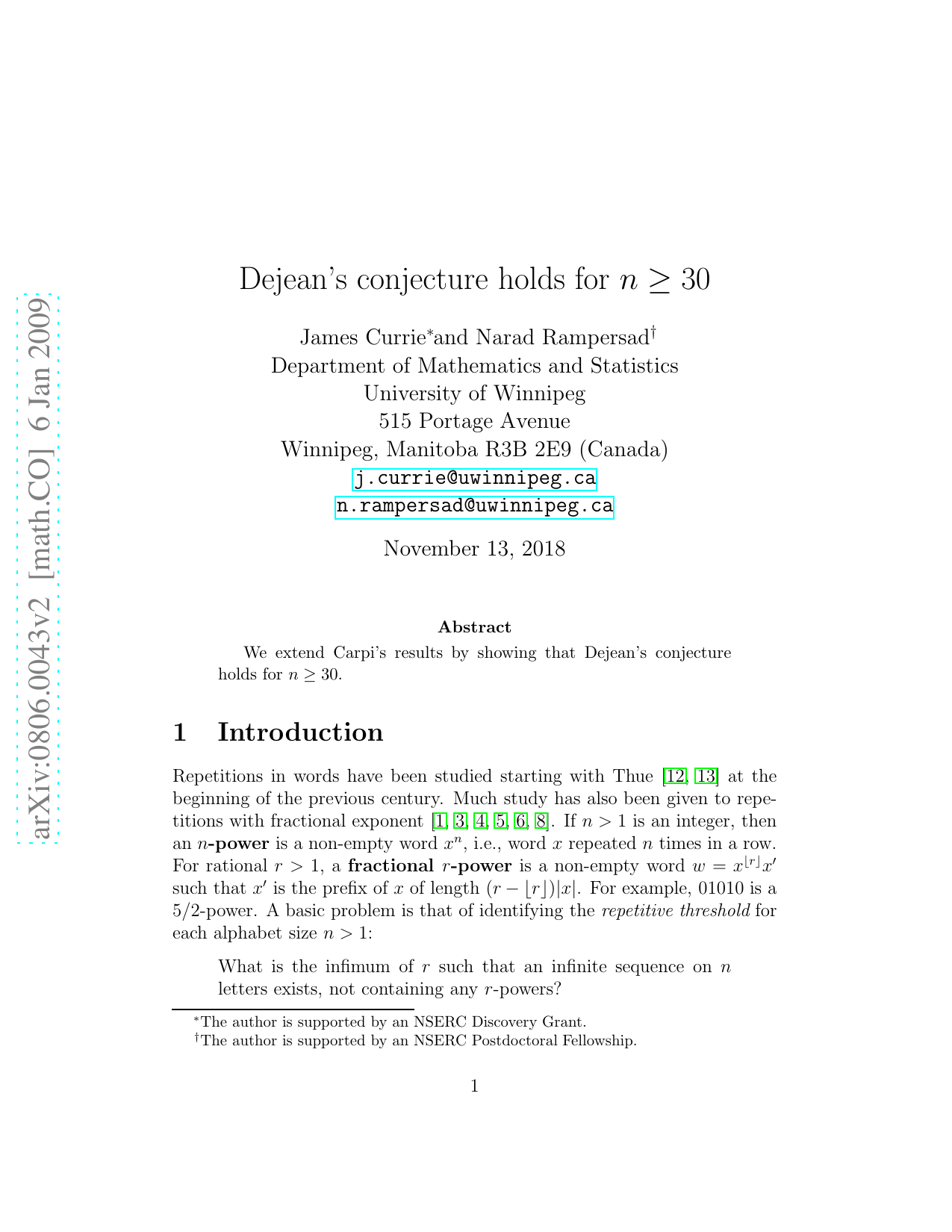
Dejeans conjecture holds for n >= 30
We extend Carpi's results by showing that Dejean's conjecture holds for n >= 30.
Mathematics
Formal Languages
Computer Science
All posts under tag "Formal Languages"
We extend Carpi's results by showing that Dejean's conjecture holds for n >= 30.
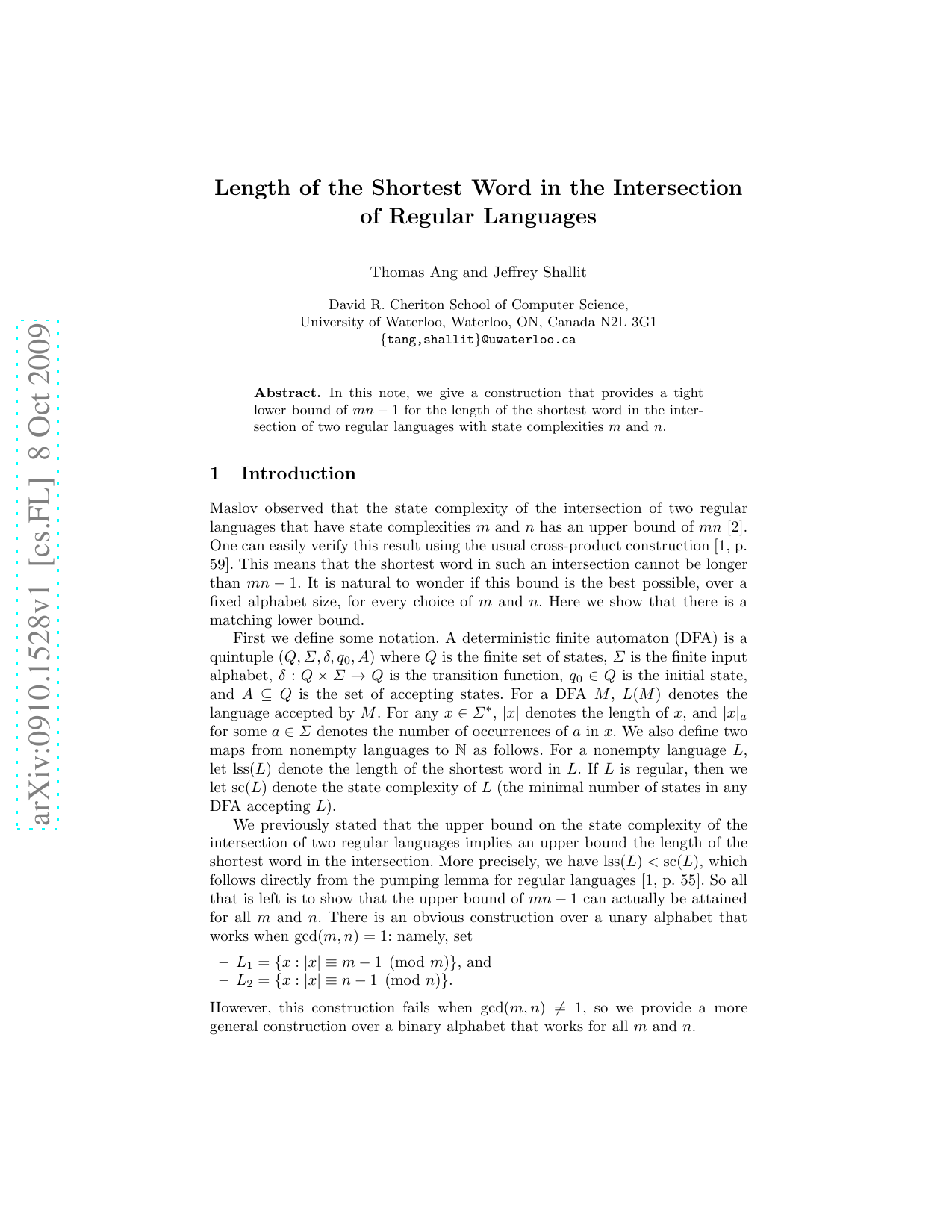
In this note, we give a construction that provides a tight lower bound of mn-1 for the length of the shortest word in the intersection of two regular languages with state complexities m and n.
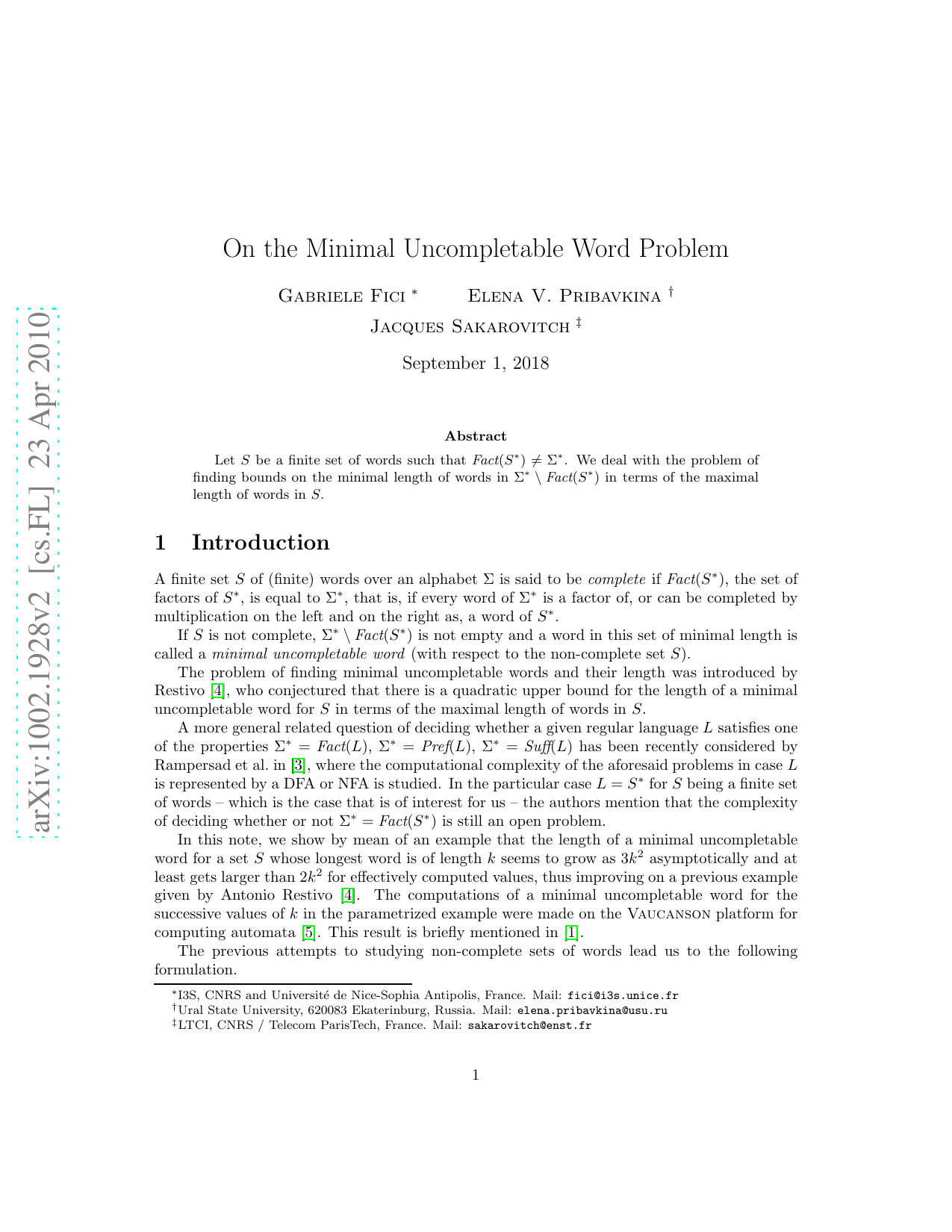
Let S be a finite set of words over an alphabet Sigma. The set S is said to be complete if every word w over the alphabet Sigma is a factor of some element of S*, i.e. w belongs to Fact(S*). Otherwise if S is not complete, we are interested in finding bounds on the minimal length of words in Sigma*
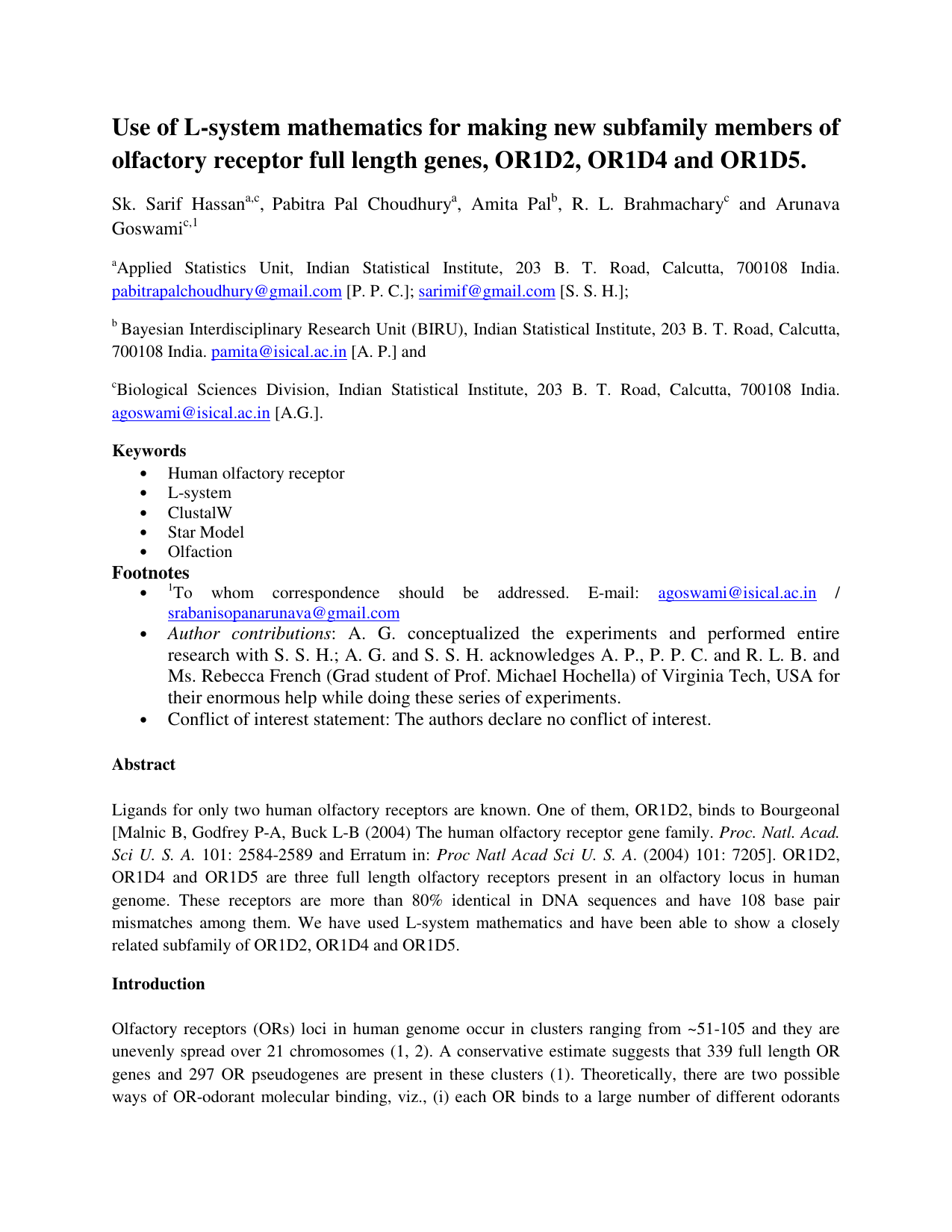
Ligands for only two human olfactory receptors are known. One of them, OR1D2, binds to Bourgeonal [Malnic B, Godfrey P-A, Buck L-B (2004) The human olfactory receptor gene family. Proc. Natl. Acad. Sci U. S. A. 101: 2584-2589 and Erratum in: Proc Natl Acad Sci U. S. A. (2004) 101: 7205]. OR1D2, OR1D
In this paper, we construct a new weakly universal cellular automaton on the ternary heptagrid. The previous result, obtained by the same author and Y. Song required six states only. This time, the number of states is four. This is the best result up to date for cellular automata in the hyperbolic p
This talk advocates intrinsic universality as a notion to identify simple cellular automata with complex computational behavior. After an historical introduction and proper definitions of intrinsic universality, which is discussed with respect to Turing and circuit universality, we discuss construct
A language L is closed if L = L*. We consider an operation on closed languages, L-*, that is an inverse to Kleene closure. It is known that if L is closed and regular, then L-* is also regular. We show that the analogous result fails to hold for the context-free languages. Along the way we find a ne
The recently confirmed Dejean's conjecture about the threshold between avoidable and unavoidable powers of words gave rise to interesting and challenging problems on the structure and growth of threshold words. Over any finite alphabet with k >= 5 letters, Pansiot words avoiding 3-repetitions form a
In this paper, we have compared r.e. sets based on their enumeration orders with Turing machines. Accordingly, we have defined novel concept uniformity for Turing machines and r.e. sets and have studied some relationships between uniformity and both one-reducibility and Turing reducibility. Furtherm
The aim of this paper is to build a new family of lattices related to some combinatorial extremal sum problems, in particular to a conjecture of Manickam, Mikl'os and Singhi. We study the fundamentals properties of such lattices and of a particular class of boolean functions defined on them.

For several semirings S, two weighted finite automata with multiplicities in S are equivalent if and only if they can be connected by a chain of simulations. Such a semiring S is called 'proper'. It is known that the Boolean semiring, the semiring of natural numbers, the ring of integers, all finite
Using combinatorial properties of incomplete sets in a free monoid we construct a series of n-state deterministic automata with zero whose shortest synchronizing word has length n^2/4+n/2-1.
In this talk we are concerned with the intrinsic similarities and differences between Petri nets on the one hand, and membrane systems and reaction systems on the other hand.
The (-beta)-integers are natural generalisations of the beta-integers, and thus of the integers, for negative real bases. They can be described by infinite words which are fixed points of anti-morphisms. We show that they are not necessarily uniformly discrete and relatively dense in the real number
In this paper we consider a general way of constructing profinite struc- tures based on a given framework - a countable family of objects and a countable family of recognisers (e.g. formulas). The main theorem states: A subset of a family of recognisable sets is a lattice if and only if it is defi
In this paper, we review some recent results about the use of dynamic observers for fault diagnosis of discrete event systems. Fault diagnosis consists in synthesizing a diagnoser that observes a given plant and identifies faults in the plant as soon as possible after their occurrence. Existing lite
We construct an example of proof within the main formal system from arXiv:1010.4760v3, which is intended to capture the bisimulation equivalence for non-deterministic first-order grammars, and show that its conclusion is semantically false. We then locate and analyze the flawed argument in the sound
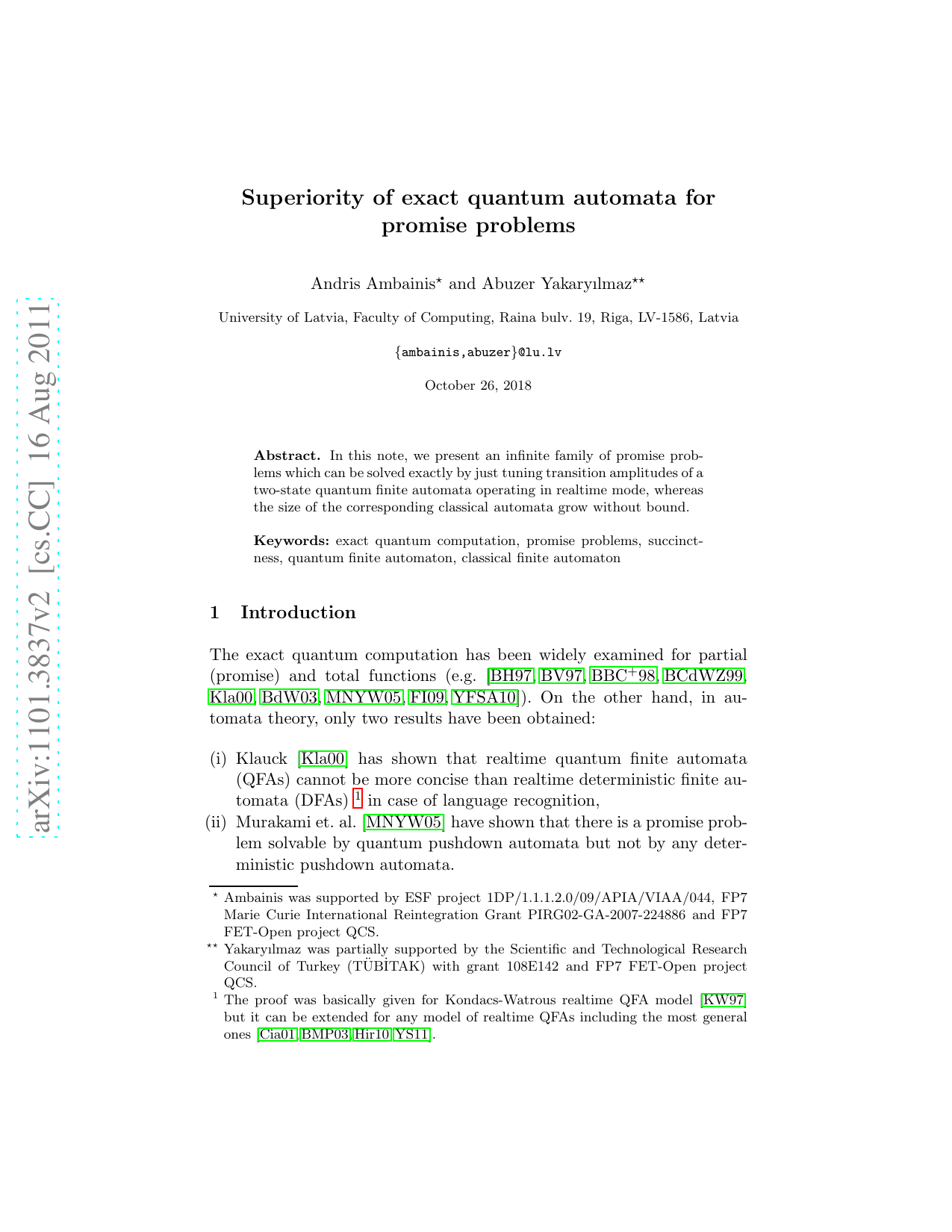
In this note, we present an infinite family of promise problems which can be solved exactly by just tuning transition amplitudes of a two-state quantum finite automata operating in realtime mode, whereas the size of the corresponding classical automata grow without bound.
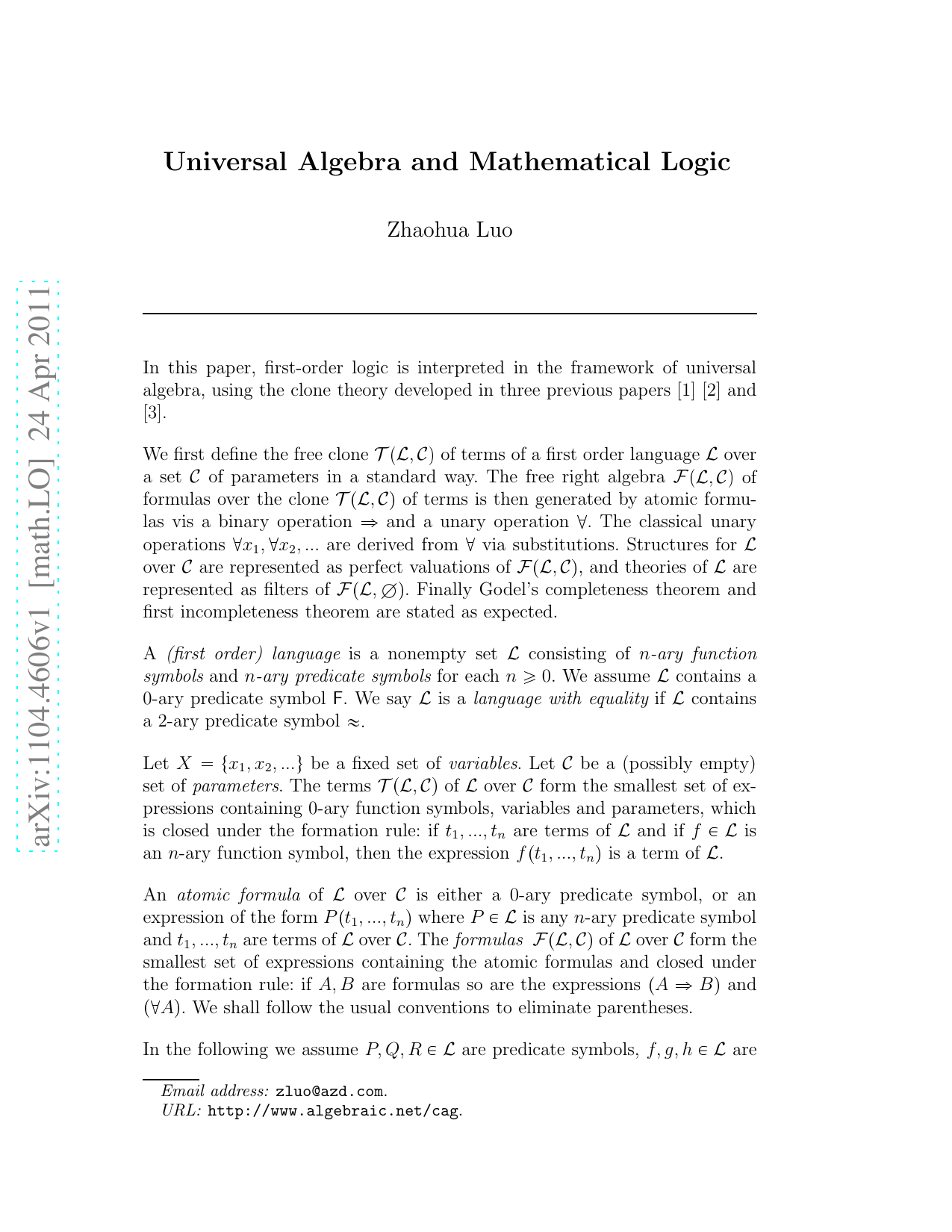
In this paper, first-order logic is interpreted in the framework of universal algebra, using the clone theory developed in three previous papers. We first define the free clone T(L, C) of terms of a first order language L over a set C of parameters in a standard way. The free right algebra F(L, C) o
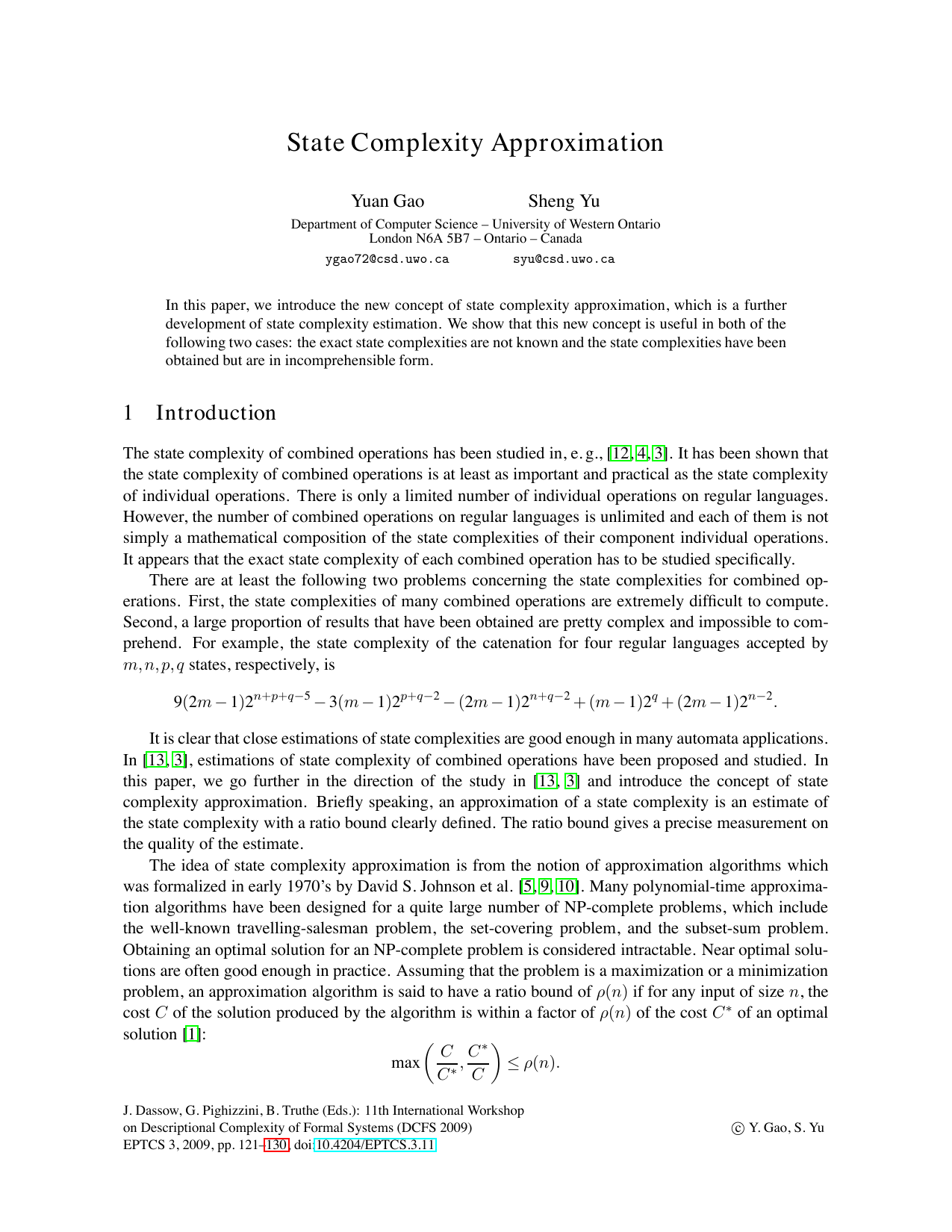
In this paper, we introduce the new concept of state complexity approximation, which is a further development of state complexity estimation. We show that this new concept is useful in both of the following two cases: the exact state complexities are not known and the state complexities have been ob
Enter keywords to search articles