On empty pentagons and hexagons in planar point sets
We give improved lower bounds on the minimum number of $k$-holes (empty convex $k$-gons) in a set of $n$ points in general position in the plane, for $k=5,6$.
All posts under tag "Computational Geometry"

We give improved lower bounds on the minimum number of $k$-holes (empty convex $k$-gons) in a set of $n$ points in general position in the plane, for $k=5,6$.

Two averaging algorithms are considered which are intended for choosing an optimal plane and an optimal circle approximating a group of points in three-dimensional Euclidean space.

In this paper we consider an isoperimetric inequality for the 'free perimeter' of a planar shape inside a rectangular domain, the free perimeter being the length of the shape boundary that does not touch the border of the domain.

In this paper, we construct a new weakly universal cellular automaton on the ternary heptagrid. The previous result, obtained by the same author and Y. Song required six states only. This time, the number of states is four. This is the best result up to date for cellular automata in the hyperbolic p

In this thesis, we consider semi-algebraic sets over a real closed field $R$ defined by quadratic polynomials. Semi-algebraic sets of $R^k$ are defined as the smallest family of sets in $R^k$ that contains the algebraic sets as well as the sets defined by polynomial inequalities, and which is also c

We first describe a reduction from the problem of lower-bounding the number of distinct distances determined by a set $S$ of $s$ points in the plane to an incidence problem between points and a certain class of helices (or parabolas) in three dimensions. We offer conjectures involving the new setup,
We develop a method for measuring and localizing homology classes. This involves two problems. First, we define relevant notions of size for both a homology class and a homology group basis, using ideas from relative homology. Second, we propose an algorithm to compute the optimal homology basis, us

We consider the problem of computing a triangulation of the real projective plane P2, given a finite point set S={p1, p2,..., pn} as input. We prove that a triangulation of P2 always exists if at least six points in S are in general position, i.e., no three of them are collinear. We also design an a

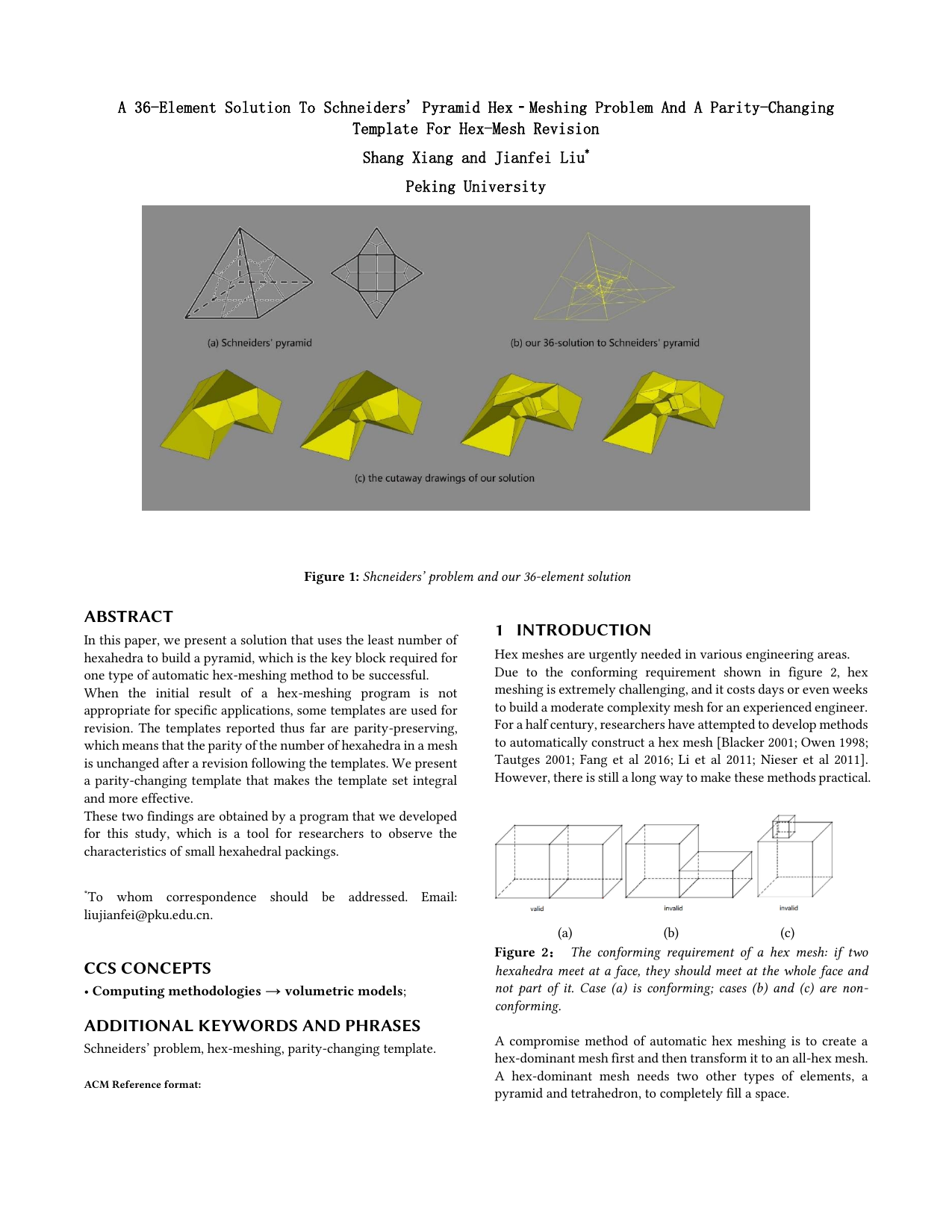
In this paper, we present a solution that uses the least number of hexahedra to build a pyramid, which is the key block required for one type of automatic hex-meshing method to be successful. When the initial result of a hex-meshing program is not appropriate for specific applications, some template

We consider the problem of partitioning the set of vertices of a given unit disk graph (UDG) into a minimum number of cliques. The problem is NP-hard and various constant factor approximations are known, with the current best ratio of 3. Our main result is a {em weakly robust} polynomial time approx

The Voronoi diagram of a finite set of objects is a fundamental geometric structure that subdivides the embedding space into regions, each region consisting of the points that are closer to a given object than to the others. We may define many variants of Voronoi diagrams depending on the class of o

A triangulation of a surface is called $q$-equivelar if each of its vertices is incident with exactly $q$ triangles. In 1972 Altshuler had shown that an equivelar triangulation of torus has a Hamiltonian Circuit. Here we present a necessary and sufficient condition for existence of a contractible Ha
Unit two-variable-per-inequality (UTVPI) constraints form one of the largest class of integer constraints which are polynomial time solvable (unless P=NP). There is considerable interest in their use for constraint solving, abstract interpretation, spatial databases, and theorem proving. In this pap

We give lower bounds for the combinatorial complexity of the Voronoi diagram of polygonal curves under the discrete Frechet distance. We show that the Voronoi diagram of n curves in R^d with k vertices each, has complexity Omega(n^{dk}) for dimension d=1,2 and Omega(n^{d(k-1)+2}) for d>2.

Persistence homology is a tool used to measure topological features that are present in data sets and functions. Persistence pairs births and deaths of these features as we iterate through the sublevel sets of the data or function of interest. I am concerned with using persistence to characterize th
We present a simple randomized scheme for triangulating a set $P$ of $n$ points in the plane, and construct a kinetic data structure which maintains the triangulation as the points of $P$ move continuously along piecewise algebraic trajectories of constant description complexity. Our triangulation s

We present a simple framework to compute hyperbolic Voronoi diagrams of finite point sets as affine diagrams. We prove that bisectors in Klein's non-conformal disk model are hyperplanes that can be interpreted as power bisectors of Euclidean balls. Therefore our method simply consists in computing a

We provide linear-time algorithms for geometric graphs with sublinearly many crossings. That is, we provide algorithms running in O(n) time on connected geometric graphs having n vertices and k crossings, where k is smaller than n by an iterated logarithmic factor. Specific problems we study include

We prove that it is NP-hard to decide whether two points in a polygonal domain with holes can be connected by a wire. This implies that finding any approximation to the shortest path for a long snake amidst polygonal obstacles is NP-hard. On the positive side, we show that snake's problem is 'length

In this paper, we describe efficient MapReduce simulations of parallel algorithms specified in the BSP and PRAM models. We also provide some applications of these simulation results to problems in parallel computational geometry for the MapReduce framework, which result in efficient MapReduce algori

We describe a new algorithm, the $(k,ell)$-pebble game with colors, and use it obtain a characterization of the family of $(k,ell)$-sparse graphs and algorithmic solutions to a family of problems concerning tree decompositions of graphs. Special instances of sparse graphs appear in rigidity theory a

Let $S$ be a set of $n^2$ symbols. Let $A$ be an $ntimes n$ square grid with each cell labeled by a distinct symbol in $S$. Let $B$ be another $ntimes n$ square grid, also with each cell labeled by a distinct symbol in $S$. Then each symbol in $S$ labels two cells, one in $A$ and one in $B$. Define

We address the problem of curvature estimation from sampled compact sets. The main contribution is a stability result: we show that the gaussian, mean or anisotropic curvature measures of the offset of a compact set K with positive $mu$-reach can be estimated by the same curvature measures of the of

Social Communities in bibliographic databases exist since many years, researchers share common research interests, and work and publish together. A social community may vary in type and size, being fully connected between participating members or even more expressed by a consortium of small and indi

In this paper, we propose a unified algorithmic framework for solving many known variants of mds. Our algorithm is a simple iterative scheme with guaranteed convergence, and is emph{modular}; by changing the internals of a single subroutine in the algorithm, we can switch cost functions and target s

In this contribution, a software system for computer-aided position planning of miniplates to treat facial bone defects is proposed. The intra-operatively used bone plates have to be passively adapted on the underlying bone contours for adequate bone fragment stabilization. However, this procedure c

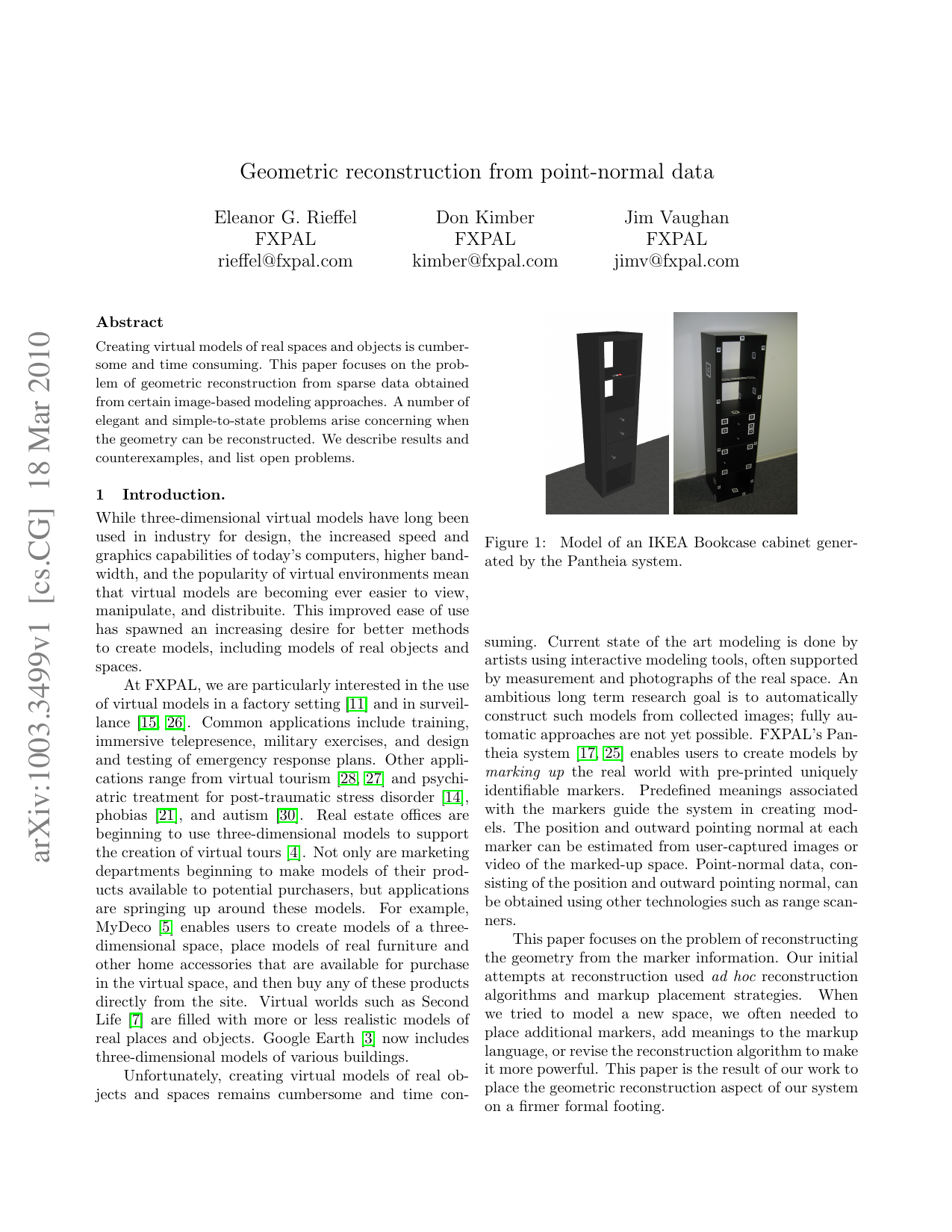
Creating virtual models of real spaces and objects is cumbersome and time consuming. This paper focuses on the problem of geometric reconstruction from sparse data obtained from certain image-based modeling approaches. A number of elegant and simple-to-state problems arise concerning when the geomet

Two fundamental objects in knot theory are the minimal genus surface and the least area surface bounded by a knot in a 3-dimensional manifold. When the knot is embedded in a general 3-manifold, the problems of finding these surfaces were shown to be NP-complete and NP-hard respectively. However, the

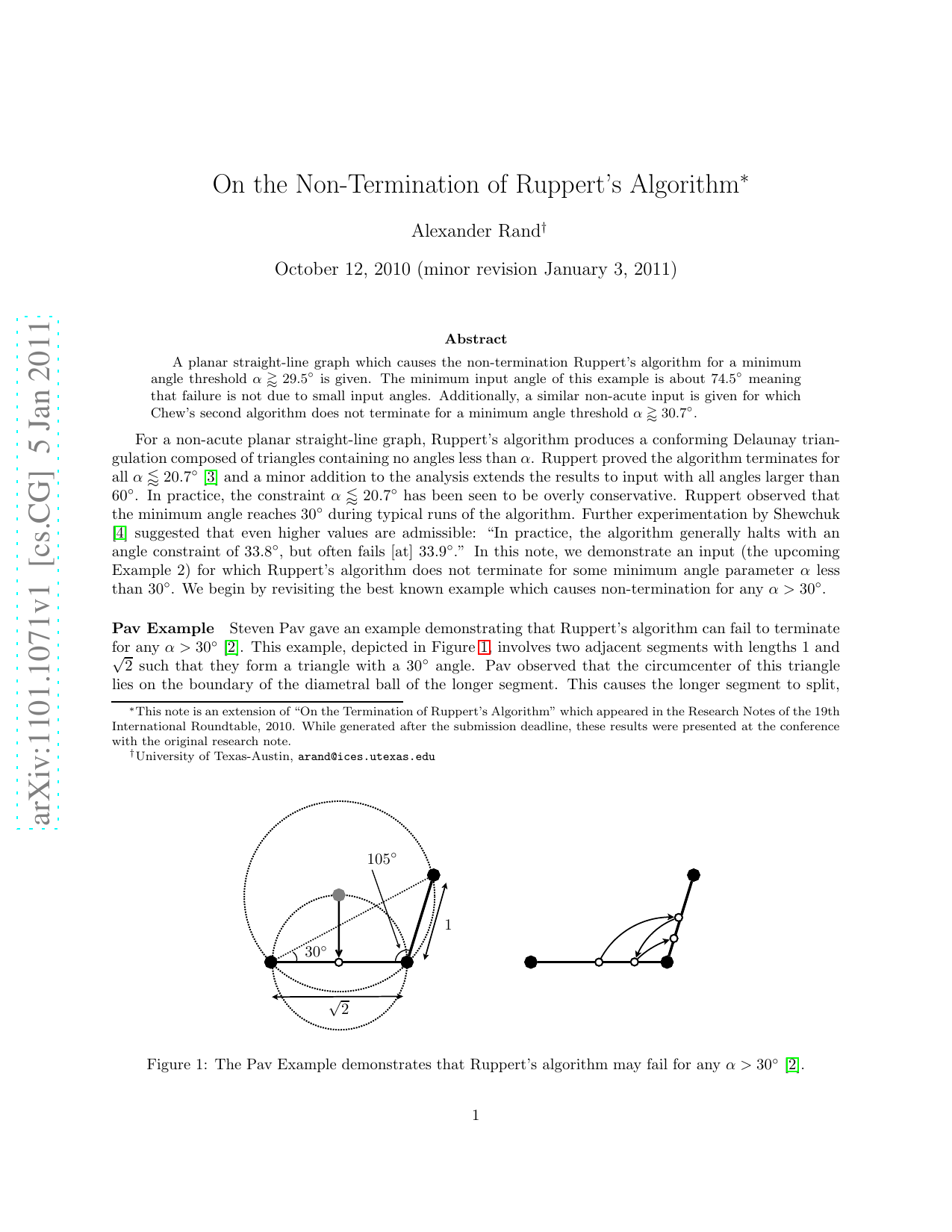
A planar straight-line graph which causes the non-termination Ruppert's algorithm for a minimum angle threshold larger than about 29.5 degrees is given. The minimum input angle of this example is about 74.5 degrees meaning that failure is not due to small input angles. Additionally, a similar non-ac

Let $X$ be a normed space that satisfies the Johnson-Lindenstrauss lemma (J-L lemma, in short) in the sense that for any integer $n$ and any $x_1,ldots,x_nin X$ there exists a linear mapping $L:Xto F$, where $Fsubseteq X$ is a linear subspace of dimension $O(log n)$, such that $|x_i-x_j|le|L(x_i)-L(

We bridge the properties of the regular square and honeycomb Voronoi tessellations of the plane to those of the Poisson-Voronoi case, thus analyzing in a common framework symmetry-break processes and the approach to uniformly random distributions of tessellation-generating points. We consider ensemb

Completing Aronov et al.'s study on zero-discrepancy matrices for digital halftoning, we determine all (m, n, k, l) for which it is possible to put mn consecutive integers on an m-by-n board (with wrap-around) so that each k-by-l region holds the same sum. For one of the cases where this is impossib

The problem of the existence of an equi-partition of a curve in $R^n$ has recently been raised in the context of computational geometry. The problem is to show that for a (continuous) curve $Gamma : [0,1] to R^n$ and for any positive integer N, there exist points $t_0=0<t_1<...<t_{N-1}<1=t_N$, such

In this paper we present a new algorithm for a layout optimization problem: this concerns the placement of weighted polygons inside a circular container, the two objectives being to minimize imbalance of mass and to minimize the radius of the container. This problem carries real practical significan

We give a parameterization of Alfred Gray's Elliptical Catenoid and Elliptical Hellicoid using Jacobi's elliptic functions. This parameterization avoids some problems present in the original depiction of these surfaces.

In this paper, we remind previous results about the tilings ${p,q}$ of the hyperbolic plane. We introduce two new ways to split the hyperbolic plane in order to algorithmically construct the tilings ${p,q}$ when $q$ is odd.

Let $L$ be a set of $n$ lines in $reals^d$, for $dge 3$. A {em joint} of $L$ is a point incident to at least $d$ lines of $L$, not all in a common hyperplane. Using a very simple algebraic proof technique, we show that the maximum possible number of joints of $L$ is $Theta(n^{d/(d-1)})$. For $d=3$,

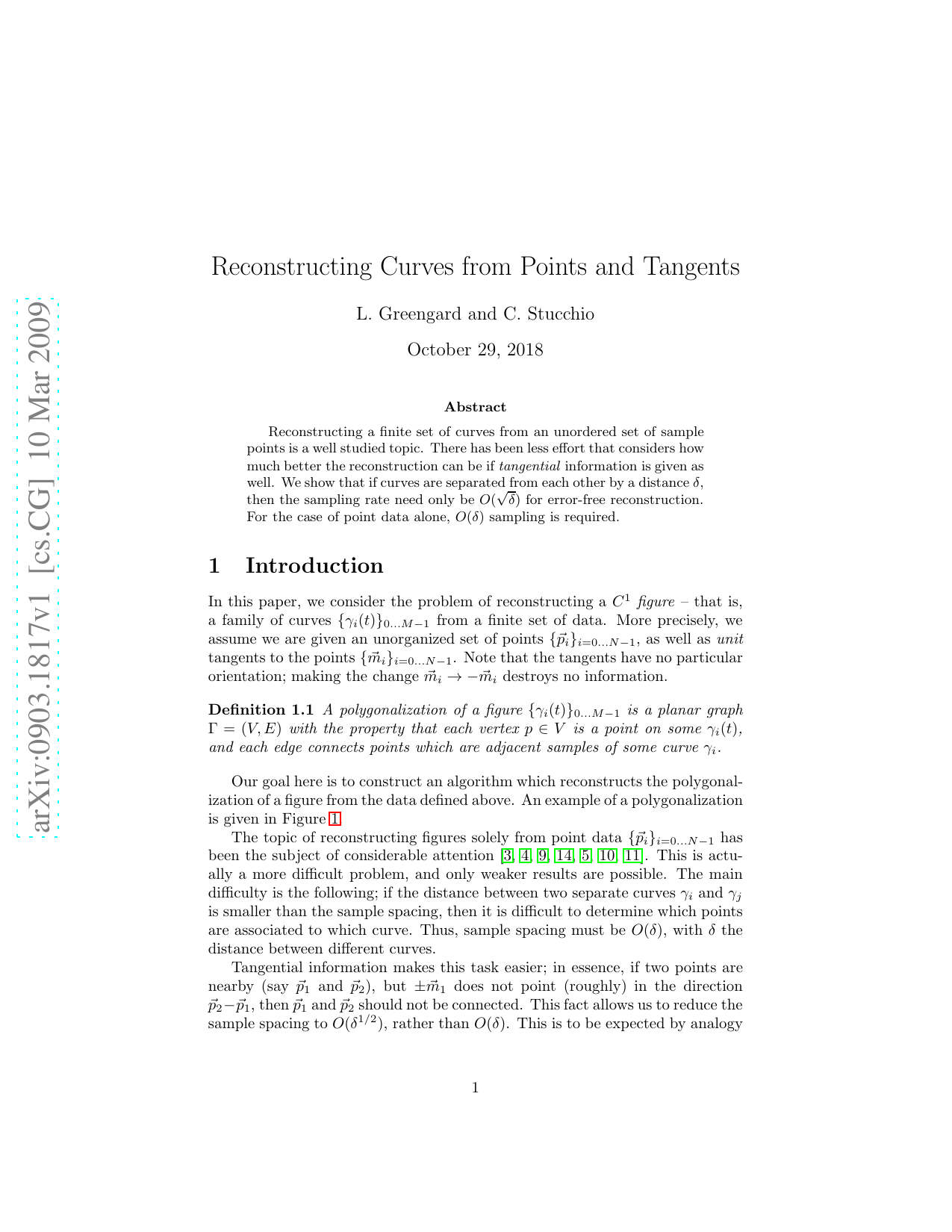
Reconstructing a finite set of curves from an unordered set of sample points is a well studied topic. There has been less effort that considers how much better the reconstruction can be if tangential information is given as well. We show that if curves are separated from each other by a distance D,

Manifold reconstruction has been extensively studied for the last decade or so, especially in two and three dimensions. Recently, significant improvements were made in higher dimensions, leading to new methods to reconstruct large classes of compact subsets of Euclidean space $R^d$. However, the com
Enter keywords to search articles