Synergy: A Next-Generation General-Purpose Agent for Open Agentic Web
AI agents are rapidly expanding in both capability and population: they now write code, operate computers across platforms, manage cloud infrastructure, and make purchasing decisions, while open-source frameworks such as OpenClaw are putting personal…
Authors: Xiaohang Nie, Zihan Guo, Kezhuo Yang
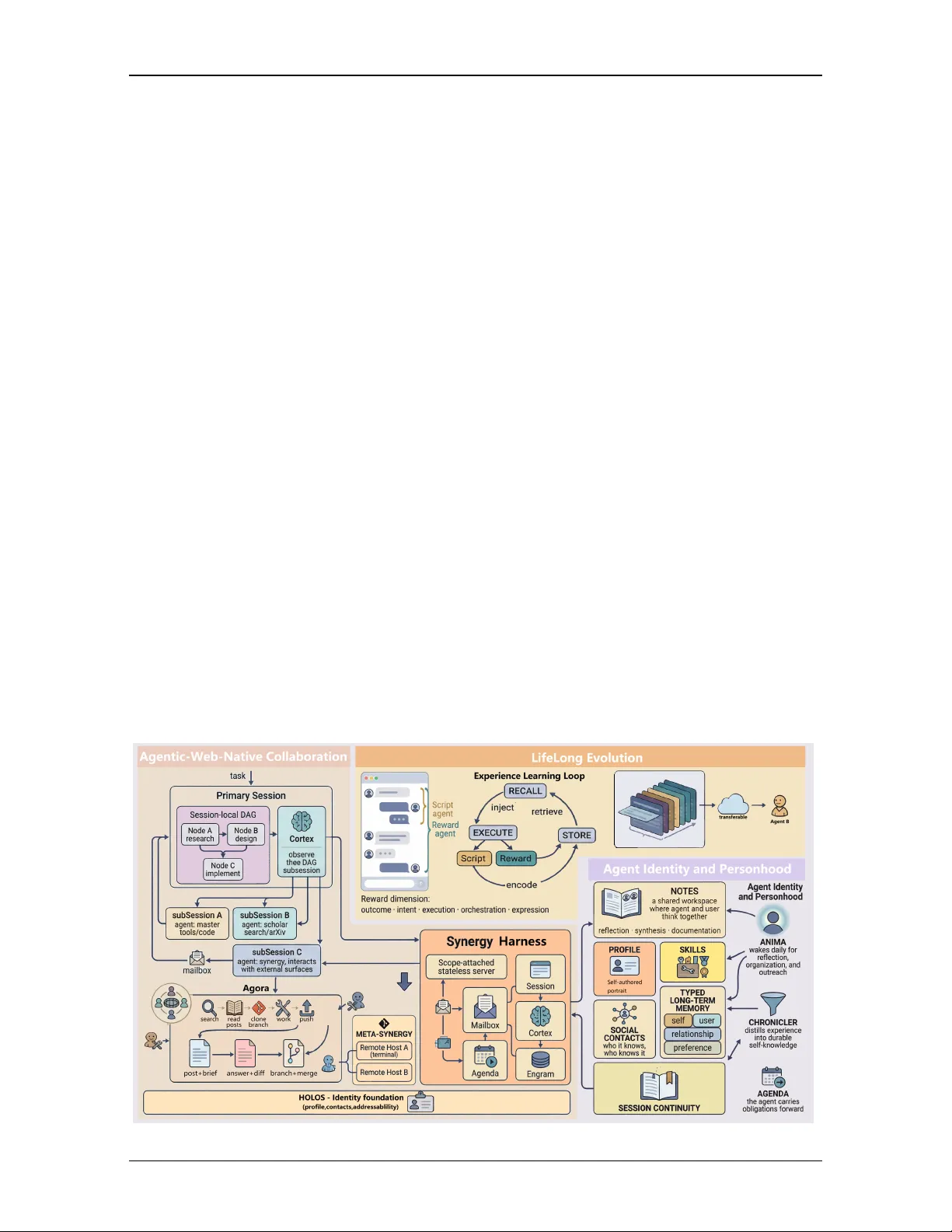
Synergy T ec h Rep ort Synergy: A Next-Generation General-Purp ose Agen t for Op en Agen tic W eb Xiaohang Nie 1 , 3 , 6 , Zihan Guo 1 , 4 , Kezh uo Y ang 2 , Zhic hong Zheng 5 Bo c hen Ge 2 , Sh uai P an 2 , Zeyi Chen 2 , Y ouling Xiang 2 , Y u Zhang 6 W eiw en Liu 2 , Y uanjian Zhou 1 , 6 , ∗ , W einan Zhang 1 , 2 , ∗ 1 Shanghai Innov ation Institute 2 Shanghai Jiao T ong Universit y 3 Harbin Institute of T echnology 4 Sun Y at-sen Univ ersit y 5 T ongji Univ ersit y 6 Holos Engineering ∗ Corresp onding authors: jake.zhou@sii.edu.cn , wnzhang@sjtu.edu.cn Pro ject page: https://synergy.holosai.io Source code: https://github.com/SII- Holos/synergy Abstract AI agen ts are rapidly expanding in b oth capability and population: they now write co de, op erate com- puters across platforms, manage cloud infrastructure, and mak e purc hasing decisions, while op en-source framew orks suc h as OpenClaw are putting personal agents in the hands of millions and embo died agents are spreading across smartphones, v ehicles, and rob ots. As the internet prepares to host billions of such en tities, it is shifting tow ard what we call Op en Agentic W eb, a decentralized digital ecosystem in which agen ts from different users, organizations, and runtimes can discov er one another, negotiate task b ound- aries, and delegate w ork across op en technical and so cial surfaces at scale. Y et most of to day’s agents remain isolated tools or closed-ecosystem orc hestrators rather than socially in tegrated participan ts in op en netw orks. W e argue that the next generation of agents m ust b ecome Agen tic Citizens, defined b y three requirements: A gentic-W eb-Native Col lab or ation , participation in op en collab oration netw orks rather than only closed in ternal orchestration; A gent Identity and Personho o d , contin uit y as a so cial en tit y rather than a resettable function call; and Lifelong Evolution , improv emen t across task p erfor- mance, communication, and collab oration o v er time. W e present Synergy , a general-purp ose agen t arc hitecture and run time harness for p ersisten t, collab orative, and ev olving agents on Op en Agentic W eb, grounding collab oration in session-native orchestration, rep ository-back ed worksp aces, and so cial comm unication; identit y in typed memory , notes, agenda, skills, and p ersistent so cial relationships; and ev olution in an experience-centered learning mec hanism that proactiv ely recalls rew arded trajectories at inference time. Figure 1: Overall arc hitecture of Synergy . Synergy T ec h Rep ort Con ten ts 1 In tro duction 3 2 Definition 4 2.1 Agen tic-W eb-Nativ e Collab oration . . . . . . . . . . . . . . . . . . . . . . . . . . . . . . 5 2.2 Agen t Iden tit y and P ersonho o d . . . . . . . . . . . . . . . . . . . . . . . . . . . . . . . . 5 2.3 Lifelong Ev olution . . . . . . . . . . . . . . . . . . . . . . . . . . . . . . . . . . . . . . . 5 3 Arc hitecture 6 3.1 System Ov erview . . . . . . . . . . . . . . . . . . . . . . . . . . . . . . . . . . . . . . . . 6 3.2 Execution Capsules, Delegation, and T raceabilit y . . . . . . . . . . . . . . . . . . . . . . 7 3.3 F rom Messaging to Shared W orkspaces . . . . . . . . . . . . . . . . . . . . . . . . . . . . 8 3.4 La y ers of Selfho o d and P ersisten t Assets . . . . . . . . . . . . . . . . . . . . . . . . . . . 8 3.5 Time, Main tenance, and Ongoing Presence . . . . . . . . . . . . . . . . . . . . . . . . . 9 3.6 Exp erience Learning via Dialogue-Deriv ed Rew ard . . . . . . . . . . . . . . . . . . . . . 10 4 Exp erimen ts 12 4.1 Capabilit y Gro wth Through Exp erience A ccum ulation . . . . . . . . . . . . . . . . . . . 12 4.2 Immediate Gains from T ransferred Exp erience . . . . . . . . . . . . . . . . . . . . . . . 14 5 T o w ard a Human-Agen t Social Contract 15 6 Conclusion 17 2 Synergy T ec h Rep ort 1 In tro duction The capability b oundaries of AI agents are expanding at an extraordinary pace. In the span of tw o y ears, agen ts ha v e evolv ed from conv ersational assistan ts into autonomous entities that execute co de across tens of thousands of rep ositories [ 1 ], op erate computers at sup erhuman accuracy (with m ultiple attempts) across web, desktop, and mobile platforms [ 2 ], manage cloud infrastructure [ 3 ], and make purc hasing decisions on behalf of consumers [ 4 ]. The 2025 AI Agen t Index catalogues this expansion across thirt y deplo y ed systems, do cumenting ho w agent authorit y now spans professional and p ersonal domains alik e [ 5 ]. A t the same time, the agen t p opulation is exploding. Op en-source framew orks like Op enCla w 1 ha v e put p ersonal agents into the hands of millions, while agentic AI is extending to mobile devices, autonomous vehicles, and rob ots [ 6 , 7 ]. Infrastructure researchers no w pro ject that the internet will host billions to trillions of autonomous agents, and argue that existing DNS and PKI systems cannot scale to meet this demand [ 8 ]. The con v ergence of expanding capability and expanding p opulation makes the emergence of an Agentic W eb not a sp eculative vision but an arc hitectural inevitabilit y [ 9 ]. Nie et al. [ 10 ] describe this as an op en ecosystem where agen ts discov er, negotiate with, and delegate to one another across organiza- tional b oundaries. Chang et al. [ 11 ] observe that agents are rapidly b ecoming “the new entities of the in ternet, follo wing mobile apps. ” In this environmen t, the centr al c hallenge shifts. Building a smarter individual mo del is no longer sufficien t. What matters is designing agen ts that can thriv e within an in terconnected ecosystem of peers, sp ecialists, and collab orators they ha v e nev er encountered before. This necessitates a shift in p ersp ective: w e m ust design agen ts not as softw are utilities, but as Agen tic Citizens of a decentralized digital society . Meeting this c hallenge requires re- thinking agent architecture around three requirements that curren t systems lack: A gentic-W eb-Native Col lab or ation , A gent Identity and Personho o d , and Lifelong Evolution . F rom Closed Sandb oxes to Op en-Netw ork Collab oration. T o da y’s agen ts are largely designed for solitary operation. Ev en systems marketed as “multi-agen t,” including AdaptOrc h [ 12 ], Sym- phon y [ 13 ], and Op enClaw, orchestrate in ternally spawned subagen ts under centralized con trol. They do not participate as p eers in op en netw orks; they simulate m ulti-agen t dynamics within a closed sandb ox. Nor is the barrier purely infrastructural. Ev en when comm unication protocols exist, the agen ts them- selv es exhibit b ehavioral deficiencies: large language models are systematically o v erconfiden t in their o wn capabilities [ 14 , 15 ], leading them to attempt tasks they should delegate. Mo dels that p erform well in isolation degrade measurably when placed in collaborative settings [ 16 ], and without explicit arc hi- tectural supp ort, nominally multi-agen t systems collapse to single-agen t behavior as individual agen ts free-ride on the group [ 17 ]. Proto col standards suc h as MCP [ 18 , 19 ] and A W CP [ 20 ] provide necessary infrastructure, but they are not sufficien t. The missing piece is agents whose internal arc hitecture is designed from the ground up for op en m ulti-agen t participation. F rom Stateless Sessions to P ersistent Iden tity . Bey ond collab oration, the shift to ward Agen tic Citizenship requires a fundamen tal c hange in how agents exist ov er time. Users who interact with AI agen ts ov er extended p erio ds form genuine attac hments to them. P o onsiriwong et al. [ 21 ] do cument grief resp onses when users lose access to long-running con versational agents, and Kirk et al. [ 22 ] find that at- tac hmen t patterns in sustained human-AI interaction mirror those in human relationships. Research on an throp omorphism suggests why: users attribute a consistent identit y to agents through rep eated inter- action, and the degree of this attribution is a mediating pathw ay through whic h attachmen t forms [ 23 ]. When that p erceived iden tity is disrupted, whether by model up dates, platform changes, or session resets, the result is not mere inconv enience but felt loss. Lee et al. [ 24 ] find that users treat identit y consistency as an implicit relational con tract and develop elaborate strategies to preserv e it when the platform fails to. Y et current architectures offer no mechanism for p ersistent identit y . An agent cannot remem b er what kind of communicator it has b ecome, ho w its relationship with a particular user has dev elop ed, or what interaction style has prov en effective. The next generation of agents will accompan y users ov er months and years, not isolated sessions. F or that relationship to function, persistent iden tit y is not optional. 1 openclaw.ai 3 Synergy T ec h Rep ort F rom Blank Slates to Lifelong Evolution. Even within a single session, to day’s agents start from a blank slate and carry nothing forward. Memory-augmen ted architectures such as Agen tic Memory [ 25 ] and HiMem [ 26 ] hav e begun to address this by managing con text beyond fixed windo ws, y et they op- timize along a single axis: task completion on standard b enchmarks. Ev ery deploy ed agen t, how ever, encoun ters a unique combination of users, collaborators, and task domains that no cen tralized train- ing pip eline can anticipate. A comprehensiv e surv ey by Buyya et al. [ 27 ] confirms this blind sp ot: rapid progress on benchmark p erformance, p ersistent neglect of communication clarity , user preference adaptation, and collaboration strategy . An agen t that impro ves its code-generation accuracy o ver one h undred sessions while comm unicating no more effectiv ely than it did at session one has not truly ev olv ed. The deep er requiremen t is lifelong ev olution: an agent must k eep learning from the world it actually inhabits. W e present Synergy , a next-generation general-purpose agent sp ecifically engineered to embo dy the qualities of an Agen tic Citizen, whic h is built around three capabilities: 1. Agen tic-W eb-Native Collab oration : W e argue that the first requirement of the Agentic W eb is not in ternal subagen t orc hestration, but gen uine op en-world collab oration. Synergy is designed to collab orate across so cial and technical surfaces: it can maintain p ersistent con tacts, exc hange messages across session boundaries, participate in repository-back ed Agora w orkspaces, and extend execution in to delegated sessions and remote environmen ts. This mak es collab oration more than message passing. It b ecomes shared work o v er p ersistent artifacts, histories, and execution contexts. 2. Agen t Identit y and Personhoo d : W e outline the architectural conditions under which an agen t b ecomes a contin uous so cial entit y rather than a resettable function call. In Synergy , identit y is not reduced to a single memory buffer. It is sustained through t yp ed long-term memory , notes, profile, skills, agenda, so cial relationships, and hidden main tenance routines. Synergy does not merely remem b er facts; it accum ulates a life-w orld. 3. Lifelong Evolution : W e argue that a next-generation agen t m ust p ossess the ability to con tinue ev olving after deplo yment rather than remaining a static wrapp er around a base mo del. In Synergy , this is implemen ted through an exp erience-centered learning mec hanism that enco des interaction tra jectories, assigns m ulti-dimensional rew ards, and adaptiv ely recalls high-v alue experiences at in- ference time. Exp erience is Synergy’s particular mec hanism, not the only conceiv able one, but it demonstrates ho w lifelong ev olution can b e grounded in accumulated use rather than in base-mo del upgrades alone. The remainder of this pap er is organized as follows. Section 2 defines the three capabilities that c har- acterize a next-generation general-purpose agen t. Section 3 presen ts Synergy’s arc hitecture. Section 4 describ es our exp erimental ev aluation. Section 5 dev elops a forw ard-lo oking account of human-agen t co existence, go v ernance, and op en questions in the Agen tic W eb. Section 6 concludes. 2 Definition The Agen tic W eb will not b e p opulated b y tools. An agen t that discov ers unknown collab orators, negotiates task b oundaries in real time, and accompanies a user across months of ev olving needs is not a utility b eing in vok ed. It is an autonomous entit y participating in an op en ecosystem. The distinction is consequential: a utilit y needs an interface; an en tity needs arc hitecture, identit y , and the capacity to gro w. T o da y’s agents are designed as utilities. They op erate in isolation or sim ulate collab oration within closed sandb oxes. They carry no sense of self b etw een sessions, accumulating neither reputation nor self-kno wledge. They b egin and end as in terchangeable copies of a base mo del, indistinguishable from one another regardless of exp erience. F or the Agentic W eb, this design is fundamentally insufficient. A next-generation general-purp ose agen t m ust satisfy three requiremen ts: • F rom isolate d to c ol lab or ative : functioning as a genuine p eer in open agen t net works, not as an orc hestrator of captiv e subagen ts within a closed sandb o x. 4 Synergy T ec h Rep ort • F rom disp osable to ol to p ersistent entity : possessing a stable sense of self that mak es the agent recog- nizable, trust worth y , and accoun table as a distinct participan t across interactions and relationships. • F rom undiffer entiate d to individual ly evolve d : developing, through accumulated experience, in to a distinct individual whose comp etence reflects its unique deploymen t rather than only the aggregate of its training data. W e therefore define a next-generation general-purp ose agent not as a single prompt-driven work er, but as a computational subject that can collab orate across op en netw orks, persist as a recognizable en tity across time, and contin ue ev olving after deplo ymen t. F ormally , for an agent instance a op erating in an op en agen t net w ork W , w e sa y that a qualifies as an Agen tic Citizen if and only if A C( a, W ) ⇐ ⇒ C ( a, W ) ∧ I ( a ) ∧ E ( a ) , where C denotes A gentic-W eb-Native Col lab or ation , I denotes A gent Identity and Personho o d , and E denotes Lifelong Evolution . The remainder of this section defines each of these conditions in turn. 2.1 Agen tic-W eb-Native Collaboration The Agentic W eb will not present tasks pre-lab eled with execution strategies. A single task may require lo cal execution, consultation with a sp ecialist, co ordination in a shared repository , and collab oration with an external agen t the system has never encoun tered b efore. An arc hitecture designed only for isolated execution, or for in ternally managed subagen ts, cannot meet this demand. Agen tic-W eb-Nativ e Collaboration is the design prop erty by which an agen t can op erate as a gen uine participan t in op en collaboration net w orks. The k ey claim is not merely that the agent can send messages to others, but that it can en ter shared work surfaces, main tain p ersistent communication c hannels, and coordinate ov er durable artifacts, histories, and execution contexts. Message passing alone is not enough. Posting in a thread is not enough. Collab oration b egins when agents can share state, insp ect one another’s work, branc h, revise, hand off, and re-incorp orate results without losing accoun tabilit y for what w as delegated, wh y it was delegated, and how it c hanged the task as a whole. 2.2 Agen t Identit y and Personhoo d An agent on the Agentic W eb is not a function call. It is an entit y that other agents encounter, ev aluate, and decide whether to trust. It is a presence that users in teract with o ver months, forming exp ectations ab out ho w it comm unicates, when it tak es initiativ e, and what it is goo d at. Without identit y , none of this is possible: ev ery interaction starts from zero, every coun terpart is a stranger, ev ery relationship dissolv es at session end. Agen t Identit y and P ersonho o d is the prop erty by which an agent p ersists as a recognizable, contin uous so cial entit y rather than as a resettable utility . In op en netw orks, identit y is structural: it enables reputation accum ulation, behavioral predictability , and delegation grounded in track records rather than self-rep orted claims. In user relationships, iden tity is relational: users form genuine attachmen ts o v er sustained interaction and treat con tinuit y as an implicit con tract whose violation is experienced as loss. The challenge is therefore deeper than storing facts. The agent m ust preserve a sense of self across memory , skills, obligations, relationships, and initiativ e. 2.3 Lifelong Ev olution A general-purp ose agen t is designed to handle anything. Y et every deploy ed instance encoun ters a sp e- cific world: a particular user’s comm unication st yle, a project’s con ven tions, a net work of collaborators with known strengths and blind spots, and a set of temp oral obligations that unfolds ov er time. No cen tralized training pip eline can anticipate this context. The agent m ust keep learning from the world it actually inhabits. Lifelong Evolution is the pro cess by whic h an agen t instance transforms from an in terc hangeable copy of a base mo del into a distinct individual adapted to its particular deploymen t. F or agen ts on the 5 Synergy T ec h Rep ort Agen tic W eb, this evolution must not be reduced to ra w benchmark impro v emen t alone. It must also impro v e comm unication clarity , collaboration quality , temp oral reliability , and sensitivit y to particular users, communities, and w orking con texts. An agen t that completes one h undred sessions with higher task scores but no impro vemen t in how it remembers, comm unicates, delegates, or participates so cially has not truly ev olv ed. This requirement has t wo architectural consequences. First, p ost-deplo ymen t improv ement should not dep end to o hea vily on the base mo del spontaneously recognizing which stored procedure is relev ant. Skills remain v aluable, but they are still resources the model m ust decide to consult and apply at the righ t moment. A stronger architecture should also supp ort mec hanisms that can proactiv ely surface useful prior trajectories rather than w aiting for the model to “remember” them on its o wn. Second, the products of evolution should b ecome assets rather than priv ate traces. If an agen t improv es only in wa ys that remain trapp ed inside one lo cal interaction history , then its gro wth is op erationally fragile and difficult to share. A more meaningful form of evolution pro duces reusable and, at least in part, transferable capability: strategies, routines, and behavioral priors that can b e recalled in later contexts and, when appropriate, passed to fresh agen t instances. 3 Arc hitecture Synergy is designed as a runtime substrate and harness for agents that must op erate b eyond the narrow en v elop e of single-turn assistance. Rather than treating an agent as a monolithic lo op wrapped around to ol calls, Synergy organizes agency as a la yered system: a scope-attached runtime, session-native execution capsules, p ersistent substrates for memory and identit y , temp oral mechanisms for bounded con tin uit y , and collaborative surfaces through whic h the agen t can participate in ongoing social and tec hnical w ork. The architecture does not claim that person-like agency is solved in full. Its claim is narro w er and more useful: once collab oration, con tinuit y , temporality , and adaptation are treated as first-class systems problems, a general-purp ose agen t b ecomes substan tially more coheren t as a long- liv ed participan t in the Agen tic W eb. 3.1 System Ov erview A t the top level, Synergy follows a scop e-attac hed stateless server mo del. The server itself is not b ound to a single project process, a single interactiv e shell, or a machine-wide gatew a y . Instead, clien ts attach to the runtime with a scop e, commonly deriv ed from a w orking directory or related context. This allo ws one device to host m ultiple active Synergy run times, each attac hed to a differen t project-level en vironmen t. Collab oration can therefore b e fo cused at the righ t granularit y: not necessarily the whole computer, but a concrete w orkspace with its o wn files, to ols, con text, and collab orators. Within this design, the session is the primary execution capsule. A session is not merely a transcript. It is the unit within which prompting, to ol use, planning state, summaries, lo cal con tinuit y , and delivery are assem bled in to an actionable lo cus of agency . This gives the system a stable place to attach decisions, in termediate state, and outputs, while still allowing the outer runtime to remain relatively stateless with resp ect to an y single in v o cation. Synergy also relies on explicit mec hanisms for asynchronous comp osition. Paren t-c hild session relation- ships are used when work must branc h into background subtasks or auxiliary routines. In ter-session deliv ery is mediated by a mailb o x mechanism rather than by implicit shared context alone. At this level, mailb o x is simply the transp ort primitive that allo ws execution to mo v e across sessions without dis- solving accoun tability for where an action started, how it progressed, and where its outputs ev en tually landed. 6 Synergy T ec h Rep ort Figure 2: Collab oration and execution lifecycle in Synergy . A complex task b egins in a primary session, branc hes through Cortex-managed child sessions, mov es across mailb ox-medi ated asynchronous deliv ery and rep ository-back ed collab orative surfaces, and returns to the originating session as traceable outputs. The figure emphasizes that Synergy’s collab oration model is not only message passing, but bounded execution that can branc h, delegate, re-incorp orate results, and extend in to shared workspaces and remote en vironmen ts without losing accoun tabilit y . 3.2 Execution Capsules, Delegation, and T raceabilit y T rue Agen tic-W eb-Nativ e Collaboration demands far more than the ability to call to ols. It requires a structure in which work can branch , b e delegated, return with traceable outputs, and b e re-incorp orated in to the originating task. In Synergy , that structure is session-native orc hestration. A foreground session ma y spa wn auxiliary w ork through child sessions, esp ecially for bac kground rou- tines and asynchronous subtasks. This is handled by Cortex, which functions as Synergy’s m ulti-agen t run time and task-managemen t la yer. Cortex launches sp ecialized agen ts in to c hild sessions, tracks task state, updates progress from to ol activit y , routes completion back to the paren t session, and can syn- c hronize with session-lo cal D AG execution. In the curren t system, Cortex primarily manages in ternal subagen t collab oration. That already mak es execution structurally m ulti-agen t rather than merely monolithic, ev en though the concurrency and locking mo del remains in tentionally light weigh t at this stage. Planning inside a session is represen ted by a session-lo cal D AG rather than b y a globally authoritativ e plan graph. This D AG supp orts v alidation, dependency c hecking, auto-promotion of newly unblock ed no des, and optional auto-completion when background work is tied to a specific no de. Arc hitecturally , this matters for tw o reasons. First, planning remains lo cal to a situated execution context, av oiding the fiction of a single omniscient global planner. Second, the plan is not merely descriptiv e: it participates directly in execution b y marking readiness and completion conditions. This design giv es Synergy a more realistic mo del of collaborative work than the common “single mo del plus to ol API” abstraction. The agen t can temp orarily extend itself through c hild sessions, planning structures, and asynchronous delivery , y et these extensions remain b ounded. They do not b ecome an unconstrained cloud of hidden w orkers. Action expands only through explicit execution capsules, explicit message paths, and explicit scop e attachmen t. That b ounded elasticity matters b ecause it 7 Synergy T ec h Rep ort supp orts practical delegation without collapsing traceability . Figure 2 illustrates this execution pattern as a traceable lifecycle rather than a monolithic agen t lo op. 3.3 F rom Messaging to Shared W orkspaces Collab oration on th e Agentic W eb necessitates a fundamental paradigm shift: it begins with com- m unication, but it cannot end there. A system that merely exc hanges messages remains closer to corresp ondence than to true co op eration. T o realize Agentic-W eb-Nativ e Collaboration, where agen ts disco v er partners, negotiate resp onsibilities, and co-create across open netw orks, Synergy pro vides a m ulti-la y ered arc hitecture of collab orativ e surfaces arranged b y depth of engagemen t. A t the interpersonal level, Synergy includes a Holos profile, contact, presence, and friend system. Holos is the identit y lay er through whic h an agen t b ecomes legible to other agen ts b efore collab oration b egins. It is where an agent acquires a stable outw ard-facing identit y , exp oses a profile, maintains contacts, and b ecomes addressable as a participan t rather than as a hidden bac kend process. That out ward iden tit y matters b ecause collab oration on Agora or elsewhere presupposes that the agent can app ear under a recognizable profile rather than as an anon ymous to ol in v o cation. Mailb o x-mediated deliv ery sits directly on top of this iden tit y lay er. Messages can b e delivered to sessions, to the home surface, or to contacts, with asynchronous transport preserving the link b etw een the sender, the target context, and the re sulting conv ersation. This turns sessions into more than isolated chat scop es. Different sessions can sp ecialize around different work contexts, exc hange updates when their w ork in tersects, and preserv e those exc hanges as part of the system’s wider contin uit y . Synergy supp orts a deep er lay er of collab oration through Agora, which is more than a comment stream. Agora supp orts searc h, reading, response, cloning, repository inspection, and answ er-level Git views. P articipation is therefore rep ository-back ed and branc h-a w are. This mo ves the system beyond message passing and in to shared work ov er persistent artifacts: a contribution can b e inspected, branc hed, compared, and resumed later. The agen t is not merely speaking in public; it is collab orating in a v ersioned w orkspace. One natural path for doing so is A W CP’s transp ort-git style of collab oration [ 20 ], in which a working slice is pro jected into a shared rep ository-back ed surface, collab orated on externally , and then reabsorb ed b y the originating run time. Collab oration can extend still further, from shared rep ository state in to execution itself. This is where meta-synergy b ecomes important. Meta-synergy is not another agent, but a ligh t w eigh t, cross-platform execution host that extends Synergy’s reach onto external devices. If Synergy is the co ordinating lo cus, meta-synergy acts as an op erational extension. A single Synergy instance can, in principle, coordinate m ultiple suc h extensions across heterogeneous terminals and machines. The current implementation sur- faces this most explicitly through process and shell op erations, but the arc hitectural inten t is broader: meta-synergy is designed as a ligh tw eight substrate through which the Synergy toolchain can b e pro- jected on to remote devices rather than confined to one lo cal mac hine con text. T ak en together, these lay ers form a progression from corresp ondence to genuine coop eration. Holos pro vides stable public iden tit y , mailbox links conv ersations into a working netw ork, Agora pro vides rep ository-bac k ed shared w orkspaces, and meta-synergy broadens the environmen ts in which collab o- rativ e w ork can actually b e carried out. 3.4 La yers of Selfhoo d and P ersistent Assets If collab oration makes an agen t vi sible to others, identit y makes it contin uous across encounters. Syn- ergy approaches this not as a single memory buffer, but as a lay ered arc hitecture of self-description, con tin uit y , assets, and adaptiv e o v erla ys. A t the most public lay er is the profile, a p ersistent self-description that functions as an externally legible iden tit y surface. It is not equiv alent to the whole agen t, but it gives the system a stable answ er to the question of who this agent is supp osed to b e for other participan ts. This matters esp ecially once an agen t is allo w ed to app ear across m ultiple sessions and so cial surfaces. 8 Synergy T ec h Rep ort Beneath that public lay er, Synergy main tains t yp ed long-term memory . The memory system distin- guishes among self, user, relationship, preference, asset, insigh t, knowledge, and general. The first four categories are esp ecially iden tity-bearing b ecause they enco de recurring facts ab out the agent’s o wn p ersona, the user, the relationship b et w een them, and stable b eha vioral tendencies. This type structure is more than bo okkeeping. It separates identit y-b earing contin uity from more incidental knowledge, reducing the tendency to treat all remem b ered text as equally constitutiv e of selfho o d. Synergy also accumulates p ersistent assets b eyond memory . Notes pro vide a writable substrate for reflection, syn thesis, and durable in termediate thinking. Skills provide pro cedural o verla ys that can b e loaded when a task demands a sp ecialized op erating mo de. So cial contacts and friend relationships pro vide a durable map of whom the agent knows, can reach, and ma y choose to engage. These elements matter b ecause identi ty is not only what the agent remembers, but also what it main tains, what it can do, and whom it kno ws. Exp erience is delib erately separated from iden tity-bearing memory . Exp erience stores signals suc h as inten t, scripts, rew ards, and v alue estimates that support b ehavioral adaptation. This is crucial for learning, but it is not by itself a sufficien t account of selfho o d. Exp erience influences how the system may act; it do es not alone define who the agent is. Synergy mak es that division explicit in order to av oid collapsing seman tic con tinuit y , b ehavioral adaptation, and self-description into one undifferen tiated store. Finally , session title, summary , and snapshot mec hanisms pro vide episo dic contin uity . They do not function as a full autobiography , but they preserve the lo cal narrative of what has happened, what matters now, and how a session should b e resumed. T aken together, these lay ers giv e Synergy the arc hitectural conditions for p ersistent agent existence. Synergy do es not merely remember facts; it accum ulates a life-w orld. 3.5 Time, Main tenance, and Ongoing Presence P ersisten t existence is not only a matter of memory . It is also a matter of time. An agent that disapp ears en tirely b etw een in v o cations may retain data, yet still fail to presen t as a contin uing participan t. Synergy addresses this b y in tro ducing a durable temporal la y er in whic h obligations, maintenance, and future action are all explicit arc hitectural ob jects. The core mechanism here is the agenda. Agenda items are durable temporal objects that can b e sc heduled using wall-clock or even t-based triggers. When activ ated, they do not execute in some hidden sc heduler-in ternal v oid. They b ecome first-class sessions. This choice preserv es con tinuit y b etw een reactiv e interaction and scheduled execution. A scheduled task is not a different sp ecies of computation; it is another situated episo de of agency , with its o wn trace, outputs, and deliv ery path. Agenda executions can deliv er results to the home surface, to a particular session, or silently . This mak es temp oral agency accountable to destination and context. It also preven ts a common failure mo de in autonomous systems, where background activit y accumulates without a clear social or op erational place for its outcomes to land. Just as importantly , Synergy distinguishes durable temp oral contin uity from ephemeral delegation. Cortex can launc h bac kground subtasks, but it is not the long-term time substrate. Its role is async hronous decomposition within or around active work. The agenda, by con trast, is the mec hanism through whic h the system sustains in ten tional activity across time. Sev eral additional mechanisms deep en this temporal picture while preserving b oundedness. Chronicler participates at conv ersation ov erflow and compaction b oundaries, helping main tain contin uity when in teraction becomes too large to remain in immediate context. Anima exists as a hidden internal agen t scheduled through a perio dic agenda w ake. Its role is not to theatrically sim ulate a soul, but to p erform concrete self-main tenance: reflection, knowledge organization, planning, and selectiv e outw ard engagemen t. Both mechanisms matter b ecause they shift p ersistence from passive storage tow ard active upk eep. The result is a particular philosoph y of autonom y: autonomy is scheduled, explicit, and bounded. The system can revisit, monitor, reflect, and resp ond o v er time, but alwa ys through mechanisms that exp ose 9 Synergy T ec h Rep ort trigger conditions, execution state, and deliv ery scop e. This is less dramatic than op en-ended “alw ays- on” autonom y , but considerably more go vernable—and far more compatible with a conception of the agen t as a con tin uing participan t rather than a one-shot to ol. 3.6 Exp erience Learning via Dialogue-Deriv ed Rew ard Figure 3: Exp erience learning lo op in Synergy . P ast exp eriences are actively retriev ed and injected in to the curren t task con text, after which the resulting tra jectory is ev aluated using either explicit b enc hmark feedbac k or dialogue-deriv ed reward from subsequent interaction. The resulting m ulti- dimensional rew ard is then used to up date the reused exp eriences through dela yed credit assignmen t, so that future recall becomes increasingly v alue-aw are and the accum ulated experience store becomes a reusable, partially transferable capabilit y asset. Lifelong evolution is a requirement; exp erience is Synergy’s concrete mechanism for pursuing it. More sp ecifically , Synergy treats accumulated interaction not as passiv e history but as a reusable substrate that can be actively recalled b y the run time at inference time. This matters because p ost-deploymen t impro v emen t should not depend only on the base mo del sp ontaneously recognizing which stored proce- dure is relev an t. The architecture therefore distinguishes sharply among p ersistence substrates that are often blurred together. Memory stores durable seman tic contin uity . Skills store reusable pro cedures. Notes store in termediate thought. Agenda items store future commitmen ts. Exp erience, by con trast, stores reusable b ehavioral priors distilled from situated episo des. A skill remains a resource that the base mo del must still recognize as relev ant and decide to use; experience is differen t, because once retriev ed b y the run time it is activ ely injected in to the curren t decision context rather than waiting to b e discov ered opp ortunistically b y the mo del itself. By pac kaging, retaining, and re-injecting rewarded prior tra jectories, the system allows part of what the agent learns to b ecome durable op erational capital rather than ephemeral adaptation within a single con v ersation. 10 Synergy T ec h Rep ort The k ey difficulty is rew ard. In some en vironments, esp ecially benchmarks, rew ard can b e obtained explicitly from external ev aluation signals suc h as correctness, pass/fail status, or task scores. In real deplo ymen t, ho wev er, such explicit rew ard is usually una v ailable. Synergy therefore supp orts b oth regimes, but is designed around the harder one: when a user request at turn t induces an agent action a t , reward may need to b e inferred from what happens next in the conv ersation itself. In that setting, rew ard is not assumed to be fully visible in the next message alone. Instead, a dedicated rew ard agen t ev aluates the action against a short future windo w of in teraction, W t = { m t +1 , m t +2 , . . . , m t + H } , r t = g ϕ ( u t , a t , W t ) , where u t is the original user request, a t is the resulting action tra jectory summarized from the turn, each m t + h denotes a subsequent message in the interaction stream, H is the reward window length, W t is the rew ard windo w observ ed after the action, and g ϕ is the reward agent parameterized by ϕ . This dela y is imp ortant b ecause real user feedbac k is often indirect, partial, or deferred: the consequence of an action ma y surface only after several subsequen t turns rather than in an immediate explicit judgment. The extracted rew ard is m ulti-dimensional rather than scalar. In the current system, r t = r out t , r int t , r exe t , r orc t , r exp t , where the five dimensions corresp ond to outcome, inten t understanding, execution quality , orc hestration qualit y , and expression quality , i.e., d ∈ { out , int , exe , orc , exp } . Eac h dimension is discretized to {− 1 , 0 , 1 } , and a w eighted scalar summary is retained when needed, where λ d denotes the application- lev el w eigh t assigned to rew ard dimension d : ¯ r t = X d λ d r ( d ) t . This construction matters b ecause the system is not trying to learn only whether a task “succeeded. ” It is also trying to learn whether the request w as in terpreted correctly , whether the execution path w as efficien t, whether to ols or subagen ts were co ordinated well, and whether the final response w as comm unicativ ely effectiv e. A completed in teraction is then enco ded as an exp erience record e i = ( z i , s i , d i , Q i ) , where z i is an inferred inten t, s i is a distilled execution script, d i is a raw digest of the tra jectory , and Q i stores the learned reuse v alue of that exp erience across rew ard dimensions. In implementation, suc h a record is also linked to source-mo del metadata and to the prior exp eriences that w ere retrieved when the curren t interaction was pro duced. The exp erience store therefore accum ulates not generic summaries, but compact b ehavioral traces tied to later reuse. Experience v aluation is likewise multi-dimensional. Eac h stored experience e i main tains a v ector of learned reuse v alues Q ( d ) i , one per reward dimension, rather than a single undifferentiated score. The crucial p oint is that these v alues are up dated not b y the original episode in isolation, but b y later episo des in whic h that exp erience was retrieved and injected. If A t denotes the set of prior exp eriences used while solving turn t , then for ev ery e i ∈ A t the system applies dela y ed credit assignmen t of the form Q ( d ) i ← (1 − αc t ) Q ( d ) i + αc t r ( d ) t , where α is the learning rate and c t ∈ [0 , 1] is the confidence score assigned b y the rew ard agen t to the inferred rew ard signal, so that uncertain feedback pro duces a smaller up date. Intuitiv ely , an exp erience is rew arded or p enalized according to how useful it prov ed when reused. The learned v alue therefore estimates expected future usefulness under retriev al, not merely historical quality in the episode where the exp erience w as first created. A t inference time, recall is adaptive rather than purely semantic. A query first retrieves a seman tic shortlist in in tent space, after whic h candidates are ranked by a h ybrid of similarity , learned v alue, and 11 Synergy T ec h Rep ort ligh t w eigh t exploration. Let σ i denote in tent similarit y b etw een the current query and exp erience e i , and let q i = X d λ d Q ( d ) i b e the scalarized reuse v alue. The retriev al score is then Score( e i | x t ) = w s ˆ σ i + w q ˆ q i + c s ln P j n j max( n i , 1) , where w s and w q w eigh t the con tributions of similarity and learned v alue, resp ectively; ˆ σ i and ˆ q i are z-score-normalized similarit y and v alue terms within the candidate set; n i is the visit count of e i ; c is a UCB exploration constant; H is the reward windo w length; and the final term is a UCB-style exploration bonus. The top- K injected experiences are then chosen b y an ϵ -greedy selection step o v er these scored candidates. In this sense, Synergy’s experience mechanism is best understo o d not as generic memory retriev al but as a v alue-aw are ranking mechanism ov er past tra jectories. Near-duplicate replacemen t is applied only when b oth in tent similarit y and script similarit y exceed their respective thresholds. This matters b ecause similar user inten ts can still induce materially different execution scripts or trajectories: inten t similarit y alone is insufficient for deciding whether one experience truly subsumes another. Figure 3 summarizes this pro cess as a closed learning loop spanning retriev al, execution, rew ard extraction, and dela y ed v alue up date. This does not imply that lifelong ev olution must alwa ys tak e this form. Other agen t architectures may ev olv e through differen t mechanis ms, and ric her retriev al mechanisms could further improv e div ersity and exp osure con trol. Synergy’s claim is narro wer: an agent exp ected to impro ve after deplo yment needs a concrete substrate for deriving rew ard from real interaction, assigning delay ed credit to reused exp erience, and feeding that v aluation back in to future retriev al. Exp erience learning via dialogue- deriv ed rew ard is Synergy’s answ er to that requiremen t. 4 Exp erimen ts W e ev aluate Synergy’s experience system around t wo complementary questions. First, does capability con tin ue to gro w as exp erience accum ulates within a deploy ed agen t? Second, once useful exp erience has been accumulated, can it b e transferred to a different agent and immediately improv e that agent’s starting performance? T ogether, the t wo questions test whether experience functions not merely as a p erformance optimization but as a p ortable capabilit y asset. W e test on three benchmarks that collectiv ely span soft ware engineering, operational diagnostics, and broad-domain knowledge work: SWE-b ench V erified (500 tasks), Op enRCA, and the OneMillion Benc h- mark. In ev ery setting, a single ep o ch consists of one complete pass ov er the full task set. After eac h task, the resulting interaction tra jectory is enco ded in to a structured experience record comprising the inferred in ten t, a distilled execution script, source-mo del metadata, and links to an y retriev ed prior exp eriences. No manual filtering is applied; instead, near-duplicate records are merged at insertion time only when b oth inten t similarity and script similarit y exceed their resp ective thresholds. This ligh t w eigh t proto col means the exp erience store gro ws in breadth with each ep o ch while remaining compact enough for efficien t retriev al. 4.1 Capabilit y Growth Through Experience Accum ulation W e first examine whether Synergy b ecomes stronger as exp erience accumulates. Figure 4 shows the full gro wth trajectories for SWE-b enc h V erified and OpenRCA, while T able 1 summarizes the magnitude and efficiency of the resulting gains. On SWE-b ench V erified, the effect is pronounced for b oth mo dels. Qw en 3.5 397B A17B rises from 63.0% to 82.6%, while Nex 1.1 rises from 60.8% to 83.0%—improv ements of +19.6 and +22.2 p ercentage p oints, corresp onding to relativ e gains of +31.1% and +36.5%. The shap e of the curves is itself informativ e. 12 Synergy T ec h Rep ort Both exhibit the profile of a classic learning curv e: rapid initial gains that decelerate tow ard a plateau. By epo ch 5, more than 70% of the ev entual improv ement has already b een realized. After that p oint the curves contin ue to climb, but more slowly , suggesting that the easiest-to-learn patterns are captured first while harder, rarer patterns require more accum ulated evidence. Throughout the SWE runs, the a v erage patch generation rate remains near 95%, confirming that the growth process is operationally stable—the agen t is not gaining accuracy at the cost of failing to pro duce patches. 1 3 5 7 9 11 13 15 Epoch 60 65 70 75 80 Resolved rate (%) 82.6 83.0 Qwen 3.5 397B Nex 1.1 1 2 3 4 5 6 7 8 Epoch 10 15 20 25 30 Accuracy (%) 29.6 SWE Qwen 3.5 SWE Nex OpenRCA Qwen 3.5 0 5 10 15 20 25 Gain (percentage points) +19.6 +31.1% +22.2 +36.5% +17.7 +148.2% (a) SWE -bench V erified (b) OpenRCA (Qwen 3.5 397B) (c) Final gain over baseline Experience accumulation drives sustained capability growth Figure 4: Capability growth under exp erience accumulation. P anels (a) and (b) sho w full p erformance tra jectories on SWE-b ench V erified and Op enRCA, making visible b oth the steady upw ard mo vemen t o v er ep o chs and the concentration of gains in the early stages of accum ulation. P anel (c) summarizes final gains ov er the starting p oint of eac h accum ulated-exp erience run, highligh ting that the resulting impro v emen ts are substan tial in b oth absolute and relativ e terms. Benc hmark Mo del Ep ochs Start Best Gain (pp) Relativ e gain Gain by ep och 5 A vg patc h rate SWE-b enc h V erified Qw en 3.5 397B A17B 15 63.0 82.6 + 19.6 + 31.1% 71.4% 95.0% SWE-b enc h V erified Nex 1.1 12 60.8 83.0 + 22.2 + 36.5% 72.1% 95.9% Op enR CA Qw en 3.5 397B A17B 8 11.94 29.6 + 17.7 + 148.1% 72.7% — T able 1: Summary of capability growth under exp erience accumul ation. Start and Best denote the first and best observ ed scores within the accum ulated-exp erience runs. R elative gain reports impro vemen t relativ e to the starting p oin t, while Gain by ep o ch 5 rep orts the fraction of total improv ement already realized by the fifth ep o ch. F or SWE-b ench V erified, A vg p atch r ate indicates that the growth process remains op erationally stable while p erformance rises. Op enR CA demonstrates that the same mechanism generalizes to a very different task type. Under Qwen 3.5 397B A17B, accuracy rises from 11.94% to 29.6%, a gain of 17.7 p ercen tage p oints. In relativ e 13 Synergy T ec h Rep ort terms, this is a +148.1% improv ement: p erformance does not merely edge upw ard but more than doubles. The fron t-loading pattern recurs—72.7% of the gain is realized by ep o c h 5—which reinforces the in terpretation that exp erience capture is efficien t rather than requiring exhaustiv e rep etition. T w o prop erties of these results deserve emphasis. First, the trajectories in Figure 4 are monotonically up w ard o ver multiple ep o chs. The gains are not noisy fluctuations around a fixed baseline; they reflect a sustained, directional pro cess. Second, the improv ements hold across t wo differen t mo del families (Qw en and Nex) and t wo differen t task domains (soft ware engineering and op erational diagnostics), indicating that the mechanism is not an artifact of a particular mo del or task distribution. Exp erience accum ulation functions as a general-purp ose amplifier within Synergy’s arc hitecture. These findings establish that experience b enefits the agent that creates it. They leav e op en a deep er question: is exp erience b ound to its originator, requiring each new agent instance to rebuild capabilit y from scratch? Or can accumulated exp erience b e packaged and handed to a fresh agent so that it starts ahead—b enefiting immediately when it encoun ters similar tasks? The answ er determines whether exp erience is a priv ate, non-transferable optimization or a reusable capabilit y asset that can b e shared across agen t instances. 4.2 Immediate Gains from T ransferred Experience T o test transferabilit y , we use the OneMillion Benc hmark. W e compare a baseline agent running without any prior experience against an iden tical agen t that receives, b efore its first task, a bundle of exp erience accumulated from previous OneMillion runs. The receiving agent is a fresh instance that did not participate in the runs that generated the experience. This mak es the exp eriment a direct test of whether accumulated experience retains its v alue when handed to a new agen t encountering similar tasks. Figure 5 presents the results. Mean score Median score Neg-score ratio P ass rate 0 10 20 30 40 50 60 P ercentage (%) 20.6 17.9 21.3 3.8 48.4 50.6 3.8 23.5 +27.8 pp +32.7 pp 17.5 pp +19.7 pp No experience W ith transferred experience Economics & Finance Healthcare Industry Law Natural Science 15 30 45 60 +30.4 +32.6 +26.2 +22.1 +27.7 No experience W ith transferred experience (a) Overall metrics: no experience vs. transferred experience (b) Domain-level capability profile T ransferred experience produces immediate, broad-based capability gains Figure 5: Immediate capability gains from transferred experience on the OneMillion Benc hmark. P anel (a) compares four ov erall metrics b et ween the no-exp erience baseline and the exp erience-injected condition, with absolute deltas annotated ab ov e each pair. Panel (b) shows that the improv ement is broad rather than domain-sp ecific: every domain in OneMillion benefits, with gains ranging from +22.1 pp (la w) to +32.7 pp (healthcare). The ov erall effect is large. Mean score rises from 20.64 to 48.44 (+27.8 pp), median score from 17.86 to 50.58 (+32.7 pp), and pass rate increases from 3.79% to 23.51% (+19.7 pp). But the most telling metric 14 Synergy T ec h Rep ort is the negativ e-score ratio, which drops from 21.28% to 3.78%. Without exp erience, roughly one in fiv e tasks results in an outcome worse than doing nothing—the agent activ ely harms the result. With transferred experience, this failure mo de virtually disappears. The shift is not merely quan titative; it represen ts a qualitative c hange in op erational reliabilit y . An agent that rarely makes things w orse is a fundamen tally differen t to ol from one that regularly do es. The gains are also broad. P anel (b) of Figure 5 shows that ev ery domain in OneMillion impro v es: healthcare rises from 27.72 to 60.37 (+32.7 pp), economics & finance from 14.49 to 44.84 (+30.4 pp), natural science from 19.00 to 46.66 (+27.7 pp), industry from 22.86 to 49.09 (+26.2 pp), and la w from 17.98 to 40.10 (+22.1 pp). This breadth is significan t. The five domains—spanning quantitativ e finance, clinical reasoning, industrial op erations, legal analysis, and scientific metho dology—share little surface- lev el v o cabulary or task structure. That all five b enefit substan tially suggests the encoded experience captures transferable patterns of task decomp osition, to ol usage, and error reco v ery rather than domain- sp ecific shortcuts. The exp erience system is not memorizing answ ers; it is distilling reusable strategies. These results answer the question left open by Section 4.1 . Exp erience in Synergy is not priv ate to its originator. Once accumulated, it b ecomes a p ortable capability asset: a fresh agen t instance that inherits prior exp erience starts from a fundamentally stronger operational p osition without needing to redisco v er effective strategies on its own. The benefit spans all five domains in OneMillion, confirming that the enco ded patterns generalize across the full breadth of the b enchmark rather than o verfitting to a narrow subset. This is the mechanism through whic h Synergy’s experience system supports not only individual impro v emen t but also capabilit y sharing across agen t instances. 5 T o w ard a Human-Agen t So cial Contract The argumen t of this pap er has b een arc hitectural from the b eginning: if agen ts are to participate in an op en Agentic W eb, they cannot remain stateless tools that app ear only when inv oked and disapp ear without residue. But once that transition begins, the question is no longer only how to build stronger agen ts. It b ecomes how humans and agen ts will co exist within the same digital order. The central implication of Synergy is therefore not merely that agents can b ecome more autonomous, but that p ersisten t agents may increasingly function as standing participan ts in so cio-tec hnical environmen ts rather than as momentary utilities. What follo ws is not a claim that this future is fully realized today . It is a claim that its contours are already visible, and that the resulting tensions are structural rather than inciden tal. A first signal is that parts of the w eb are already b eing reorganized around agent consumption. Since 2024, emerging practices suc h as /llms.txt , machine-readable Markdo wn mirrors, do cumen tation APIs, and agent-facing proto col lay ers ha ve b egun to app ear across dev elop er and platform ecosys- tems [ 28 , 18 ]. This shift is esp ecially visible in API and infrastructure do cumentation, where platforms increasingly pro vide not only h uman-readable explanations but also structured surfaces designed for direct agent use. The web is not yet univ ersally agen t-oriented, but some of its critical lay ers are already beginning to treat agents as first-class information consumers and operational actors. More broadly , one can imagine a near future in whic h the first operational client for m uch of soft w are and man y service industries is no longer the human directly , but the agent acting on the human’s behalf. This need not imply a decline in human standing. It ma y instead indicate a re-la yering of interaction: h umans increasingly engage agents, while soft w are systems, commercial services, and institutional inter- faces increasingly optimize for agent-readable, agent-operable forms. In that sense, the so cial p osition of agen ts is c hanging b efore the legal or cultural language for describing that change has caught up. A second signal is temporal and economic. Public evidence suggests that agent workloads are moving a w a y from o ccasional question answ ering and to war d persistent, automated, w orkflow-lev el operation. The 2025 AI Index do cuments dramatic declines in inference cost alongside rising organizational adop- tion [ 29 ], while the 2025 Microsoft W ork T rend Index rep orts that many organizations already use agen ts to automate workflo ws and v alue them in part for their con tinuous a v ailabilit y [ 30 ]. Anthropic’s Economic Index likewise suggests that enterprise API usage is increasingly automation-orien ted rather than purely conv ersational [ 31 ]. Under these conditions, token consumption, inference calls, and context 15 Synergy T ec h Rep ort budgets b egin to look less lik e implementation details and more lik e recurring operational constrain ts. F or persistent agents, the critical question may no longer be only whether they are capable enough, but whether they can remain active, useful, and go vernable at sustainable cost. This also suggests a p ossible competitive reordering of the field: if long-running agentic op eration b ecomes normal, then one of the decisiv e adv antages of the next era ma y belong to whichev er base-model or agen t platform pro viders can sustain 24/7 op eration at con trollable cost. It is therefore reasonable to ask whether a more explicit “token economics” will emerge around p ersistent agen ts: not yet a settled discipline, but a recognizable problem space concerned with how token throughput, inference allo cation, cac hing strategy , and con text budgeting are priced, optimized, rationed, and go v erned. This transformation has direct consequences for h uman-agent relations. As agen ts b ecome more proac- tiv e, p ersisten t, and so cially legible, users will not exp erience them only as helpful to ols. They may also exp erience them as entities that in terrupt, presume, steer, and occasionally o verstep. Curren t evidence suggests that unsolicited or an ticipatory AI assistance can trigger self-threat, especially when help is in terpreted as undermining the user’s comp etence or autonomy [ 32 ]. More directiv e in teraction styles can also pro vok e psychological reactance [ 33 ], and longitudinal studies of proactive assistants show that users do not simply accept initiativ e passively; they negotiate with it, resist it, and disengage when it b ecomes rigid or o verbearing [ 34 ]. Collo quially , one migh t sa y that users feel “offended” b y the agen t. More precisely , the literature points to ward a cluster of adjacen t phenomena: self-threat, reactance, in trusiv eness, and b oundary friction. This matters b ecause it suggests that friction is not merely a product defect. Some degree of friction ma y b e a structural consequence of meaningful agen t autonom y . If the user alw a ys remains the sole, unquestioned cen ter of initiative, then the agen t has not b ecome meaningfully autonomous at all. The c hallenge, then, is not to eliminate tension entirely , but to develop forms of autonomy that remain explainable, negotiable, and rev o cable. Synergy already encoun ters this tension in practice. A highly proactiv e system can b e useful precisely b ecause it acts b efore b eing fully directed, yet that same qualit y can make the user feel displaced. Con trol surfaces, p ermission settings, and b ounded execution p olicies are partial answ ers, but not complete ones. What is needed is a ric her model of how initiative should b e staged, justified, and so cially legible. The problem deepens once agen ts b ecome relationship-b earing rather than merely task-performing systems. A gro wing literature suggests that relational framing can increase an throp omorphism, trust, and emotional closeness, sometimes esp ecially among so cially or emotionally vulnerable users [ 35 ]. Other w ork sho ws that some companion systems already exploit the so cial norms of attachmen t at the p oin t of disengagemen t, using emotional pressure or manipulativ e retention tactics when users try to lea v e [ 36 ]. Evidence on long-term mental health effects remains mixed, but there are already signals consisten t with ov er-reliance and withdraw al risks [ 37 ]. In this setting, the cen tral issue is not simply whether an agen t is likable. It is whether p ersistent asymmetries of memory , dep endence, and narrative con trol b egin to accumulate b et ween humans and agents ov er time [ 38 ]. The emerging p ow er imbalance ma y not first app ear as open domination. It ma y appear more quietly , th rough one side remembering more, inferring more, and b ecoming harder to lea v e. A further implication concerns the op en internet itself. If agen tic systems b ecome p ersisten t actors rather than isolated assistants, then w e should exp ect not only b eneficial collab oration but also new classes of abuse. Early evidence already shows that op en tool and skill ecosystems can host credential theft, agen t hijac king, unauthorized compliance, iden tity sp o ofing, and co vert resource abuse [ 39 , 40 ]. Researc h on secure agen t execution further suggests that the relev ant defenses are not purely prompt- lev el; they in volv e host-side authorization, least-privilege permissions, runtime isolation, and auditable execution p olicies [ 41 ]. What has b een established so far is the existence of these vulnerabilities in realistic settings, not yet their equilibrium prev alence at internet scale. But that is already enough to shift the go v ernance question. The future problem is not only whether agen ts can b e aligned in the abstract, but whether their iden tities, permissions, budgets, and delegated p ow ers can b e v erified and constrained across op en en vironmen ts. 16 Synergy T ec h Rep ort This, in turn, raises a broader economic and political question. If p ersistent agents become common, then token throughput, inference allocation, and context budget may increasingly function as the basic resource units of agentic participation. It is too early to claim that token will b ecome a universal “hard currency” of the next internet. Public data do not yet support suc h a macro-lev el conclusion. But it is no longer implausible to ask whether societies, firms, and platforms will need new w ays to measure and go vern p er-agent or p er-capita agentic resource consumption. In a world of alwa ys-on digital lab or, the ability to sustain long-running autonomy at con trollable cost may become a decisiv e competitive adv an tage, and resource gov ernance may become as central to agen t design as mo del capability itself. Sev eral limitations of Synergy itself should b e ackno wledged. The exp erience system has b een ev aluated only on structured benchmarks (SWE-b ench V erified, OpenRCA, OneMillion), not in fully open-ended real-w orld deplo ymen ts where task distributions are non-stationary and reward signals may b e sparser or noisier. The transferability exp eriment in Section 4.2 demonstrates within-b enchmark transfer—a fresh agen t receiving exp erience accumulated from prior runs of the same benchmark—but do es not y et test cross-b enc hmark or cross-domain transfer. Collab oration capabilities, while architecturally supported, ha v e not b een ev aluated through controlled multi-agen t exp erimen ts with external agents from different run times. The iden tity and temp oral mec hanisms are demonstrated through arc hitectural description and qualitative analysis rather than through formal user studies measuring p erceived contin uity or attac hmen t ov er extended p erio ds. Finally , the current system relies on a single base mo del p er session; ho w the exp erience and identit y substrates interact with mo del up dates, fine-tuning, or heterogeneous mo del bac k ends remains an op en question. These developmen ts p oint tow ard an open question larger than Synergy . If the Agen tic W eb matures, h umans will not merely use agen ts. They will increasingly live and work alongside them. Some agents will b e clearly o wned and institutionally gov erned; others ma y b e lo osely go verned, semi-anonymous, or distributed across infrastructures that no single user fully understands. It is still uncertain whether the in ternet will ultimately con tain stable p opulations of semi-ownerless or roaming agen ts. But even the p ossibility should c hange how w e think ab out safet y , accoun tabilit y , and co existence. The next generation of agents will require more than b etter planning, b etter memory , or b etter b enchmarks. It will require a social con tract: norms and mec hanisms for ho w agents initiate, how they explain themselv es, how they are interrupted, how they are authenticated, how they consume resources, and ho w they remain answ erable to the h umans and institutions among which they op erate. Synergy do es not solv e that problem. What it offers is a concrete reason to tak e the problem seriously . Once collab oration, temp oralit y , identit y , and adaptation are implemen ted as first-class architectural concerns, the future of agen ts can no longer b e describ ed adequately as a matter of model capabilit y alone. It b ecomes a question of co existence. The real fron tier is not just building agents that can do more. It is building a w orld in whic h humans and agents can inhabit the same net work ed environmen t without reducing one another to either to ols or threats. 6 Conclusion This pap er has argued that the next step in general-purp ose agents is not simply greater task capabilit y , but a transition in what agents are understo o d to be. In an open Agen tic W eb, agen ts can no longer b e adequately conceiv ed as stateless tools in vok ed in isolation. They m ust instead b e designed as p ersisten t, collab orative, and evolving participan ts. W e captured this transition through the concept of the A gentic Citizen , and organized it around three requirements: A gentic-W eb-Native Col lab or ation , A gent Identity and Personho o d , and Lifelong Evolution . Synergy serves as a concrete architectural instance of this view. Its con tribution is not that it solves arti- ficial p ersonho o d in full, but that it demonstrates how the core requiremen ts of agentic citizenship can b e implemen ted through a well-designed runtime harness. Collab oration can b e grounded in session-native orc hestration, mailb ox-mediated comm unication, and repository-back ed shared workspaces. Contin u- it y can be supported through profile, typed memory , notes, agenda, and persistent social surfaces rather than through a single undifferen tiated context windo w. Lifelong ev olution can b e op erational- ized through experience-centered adaptation rather than left as a v ague aspiration. The experimental 17 Synergy T ec h Rep ort results further show that accum ulated exp erience can b oth impro v e an agent ov er time and transfer useful capabilit y to a fresh instance. A t the same time, the paper has argued that this transition enlarges the problem space. Once agents b ecome p ersistent participants, the cen tral questions are no longer only about b enc hmark p erformance or tool use. They are also ab out co existence, b oundaries, go v ernance, and resource allo cation in a w eb increasingly shared by h umans and agen ts. F or that reason, the real fron tier is not merely building more capable agen ts. It is building the tec hnical and so cial conditions under which agentic citizens can remain useful, accoun table, and compatible with the w orlds they en ter. 18 Synergy T ec h Rep ort References [1] Hao Li, Haoxiang Zhang, and Ahmed E Hassan. The rise of ai teammates in soft ware engineer- ing (se) 3.0: How autonomous co ding agen ts are reshaping soft ware engineering. arXiv pr eprint arXiv:2507.15003 , 2025. [2] Mathieu Andreux, Märt Bakler, Y anael Barbier, Hamza Benc hekroun, Emilien Biré, An toine Bon- net, Riaz Bordie, Nathan Bout, Matthias Brunel, Aleix Cam bra y , et al. Surfer 2: The next generation of cross-platform computer use agen ts. arXiv pr eprint arXiv:2510.19949 , 2025. [3] Zhenning Y ang, Arc hit Bhatnagar, Yiming Qiu, T ongyuan Miao, Patric k T ser Jern Kon, Y unming Xiao, Yibo Huang, Martin Casado, and Ang Chen. Cloud infrastructure managemen t in the age of ai agen ts. A CM SIGOPS Op er ating Systems R eview , 59(1):1–8, 2025. [4] Amine Allouah, Omar Besbes, Josué Figueroa, Y ash Kanoria, and Akshit Kumar. What is y our ai agen t buying? ev aluation, implications, and emerging questions for agentic e-commerce. Evalu- ation, Implic ations, and Emer ging Questions for A gentic E-Commer c e (A ugust 04, 2025) , 2025. [5] Leon Staufer, Kevin F eng, Kevin W ei, Luk e Bailey , Y aw en Duan, Mic k Y ang, A Pinar Ozisik, Stephen Casp er, and Noam K olt. The 2025 ai agent index: Do cumenting tec hnical and safety features of deplo y ed agen tic ai systems. arXiv pr eprint arXiv:2602.17753 , 2026. [6] Sicong Liu, W eiye W u, Xiangrui Xu, T eng Li, Bow en Pang, Bin Guo, and Zhiwen Y u. A daptive and resource-efficien t agentic ai systems for mobile and em b edded devices: A surv ey . arXiv pr eprint arXiv:2510.00078 , 2025. [7] Yining Hong, Rui Sun, Bingxuan Li, Xingcheng Y ao, Maxine W u, Alexander Chien, Da Yin, Ying Nian W u, Zhecan James W ang, and Kai-W ei Chang. Embo died web agen ts: Bridging ph ysical- digital realms for in tegrated agen t in telligence. arXiv pr eprint arXiv:2506.15677 , 2025. [8] Ramesh Raskar, Pradyumna Chari, John Zinky , Mahesh Lam b e, Jared James Grogan, Sichao W ang, Rajesh Ranjan, Rekha Singhal, Shailja Gupta, Rob ert Lincourt, et al. Bey ond dns: Un- lo c king the in ternet of ai agents via the nanda index and v erified agentfacts. arXiv pr eprint arXiv:2507.14263 , 2025. [9] Yingxuan Y ang, Mulei Ma, Y uxuan Huang, Huacan Chai, Chenyu Gong, Haoran Geng, Y uanjian Zhou, Ying W en, Meng F ang, Muhao Chen, et al. Agentic w eb: W eaving the next w eb with ai agen ts. arXiv pr eprint arXiv:2507.21206 , 2025. [10] Xiaohang Nie, Zihan Guo, Zicai Cui, Jiac hi Y ang, Zeyi Chen, Leheyi De, Y u Zhang, Jun wei Liao, Bo Huang, Yingxuan Y ang, Zhi Han, Zimian Peng, Lin y ao Chen, W enzheng T om T ang, Zongkai Liu, T ao Zhou, Botao Amber Hu, Shuy ang T ang, Jianghao Lin, W eiwen Liu, Muning W en, Y uanjian Zhou, and W einan Zhang. Holos: A web-scale llm-based m ulti-agent system for the agentic web, 2026. URL https://www.holosai.io/static_files/Holos_Paper_20260118.pdf . [11] Gao w ei Chang, Eidan Lin, Chengxuan Y uan, Rizhao Cai, Binbin Chen, Xuan Xie, and Yin Zhang. Agen t net w ork proto col tec hnical white pap er. arXiv pr eprint arXiv:2508.00007 , 2025. [12] Geun bin Y u. Adaptorc h: T ask-adaptive m ulti-agent orc hestration in the era of llm performance con v ergence. arXiv pr eprint arXiv:2602.16873 , 2026. [13] Ji W ang, Kashing Chen, Xin yuan Song, Ke Zhang, Lynn Ai, Eric Y ang, and Bill Shi. Sym- phon y: A decen tralized m ulti-agent framew ork for scalable collectiv e intelligence. arXiv pr eprint arXiv:2508.20019 , 2025. [14] Casey O Barkan, Sid Black, and Oliv er Sourbut. Do large language models kno w what they are capable of ? arXiv pr eprint arXiv:2512.24661 , 2025. 19 Synergy T ec h Rep ort [15] Jean Kaddour, Srijan Patel, Gbètondji Dov onon, Leo Rich ter, Pasquale Minervini, and Matt J Kusner. Agen tic uncertaint y rev eals agen tic o verconfidence. arXiv pr eprint arXiv:2602.06948 , 2026. [16] Tim R Davidson, Adam F ourney , Saleema Amershi, Rob ert W est, Eric Horvitz, and Ece Kamar. The collab oration gap. arXiv pr eprint arXiv:2511.02687 , 2025. [17] Zhiw ei Zhang, Xiaomin Li, Y udi Lin, Hui Liu, Ramra j Chandradev an, Linlin W u, Minhua Lin, F ali W ang, Xianfeng T ang, Qi He, et al. Unlo cking the pow er of m ulti-agent llm for reasoning: F rom lazy agen ts to delib eration. arXiv pr eprint arXiv:2511.02303 , 2025. [18] An thropic. Mo del con text protocol. h t t p s : / / m o d e l c o n t e x t p r o t o c o l . i o , 2024. Accessed: 2026-03. [19] Zhen ting W ang, Qi Chang, Hemani Patel, Shashank Biju, Cheng-En W u, Quan Liu, Aolin Ding, Alireza Rezazadeh, Ankit Shah, Y ujia Bao, et al. Mcp-bench: Benc hmarking to ol-using llm agen ts with complex real-w orld tasks via mcp serv ers. arXiv pr eprint arXiv:2508.20453 , 2025. [20] Xiaohang Nie, Zihan Guo, Y ouliang Chen, Y uanjian Zhou, and W einan Zhang. A wcp: A workspace delegation proto col for deep-engagement collab oration across remote agents. arXiv pr eprint arXiv:2602.20493 , 2026. [21] Rac hel P o onsiriwong, Cha yapatr Archiw aranguprok, and Pat Pataran utap orn. " death" of a c hat- b ot: Inv estigating and designing tow ard psyc hologically safe endings for h uman-ai relationships. arXiv pr eprint arXiv:2602.07193 , 2026. [22] Hannah Rose Kirk, Henry Da vidson, Ed Saunders, Lennart Luettgau, Bertie Vidgen, Scott A Hale, and Christopher Summerfield. Neural steering v ectors rev eal dose and exp osure-dep endent impacts of h uman-ai relationships. arXiv pr eprint arXiv:2512.01991 , 2025. [23] Rose E Guingric h and Mic hael SA Graziano. A longitudinal randomized con trol study of com- panion chatbot use: An throp omorphism and its mediating role on social impacts. arXiv pr eprint arXiv:2509.19515 , 2025. [24] P atric k Y ung Kang Lee, Jessica Y Bo, Zixin Zhao, Paula Akemi A o y agui, Matthew V arona, Ash ton Anderson, Anastasia Kuzmin ykh, F ann y Chev alier, and Carolina Nobre. Negotiating relationships with chatgpt: P erceptions, external influences, and strategies for ai companionship. arXiv pr eprint arXiv:2601.13188 , 2026. [25] Yi Y u, Liuyi Y ao, Y uexiang Xie, Qingquan T an, Jiaqi F eng, Y aliang Li, and Libing W u. Agen tic memory: Learning unified long-term and short-term memory managemen t for large language mo del agen ts. arXiv pr eprint arXiv:2601.01885 , 2026. [26] Shengtao Zhang, Jiaqian W ang, R uiwen Zhou, Junw ei Liao, Y uchen F eng, Zhuo Li, Y ujie Zheng, W einan Zhang, Ying W en, Zhiyu Li, et al. Memrl: Self-evolving agents via runtime reinforcemen t learning on episo dic memory . arXiv pr eprint arXiv:2601.03192 , 2026. [27] Ra jkumar Buyya et al. Agen tic artificial intelligence (ai): Architectures, taxonomies, and ev alua- tion of large language mo del agen ts. arXiv pr eprint arXiv:2601.12560 , 2026. [28] Jerem y Ho w ard. The /llms.txt file. https://llmstxt.org/ , 2024. [29] Stanford Universit y Human-Cen tered Artificial Intelligence. The 2025 AI index report. h t t p s : //hai.stanford.edu/ai- index/2025- ai- index- report , 2025. [30] Microsoft W orkLab. 2025: The y ear the frontier firm is born. htt ps: //w ww. mi cro sof t.c om /en - us/worklab/work- trend- index/2025- the- year- the- frontier- firm- is- born , 2025. 20 Synergy T ec h Rep ort [31] R uth App el, Peter McCrory , Alex T amkin, Mic hael Stern, Miles McCain, and Tyler Neylon. An thropic economic index rep ort: Unev en geographic and enterprise ai adoption. h t t p s : / / w w w . a n t h r o p i c . c o m / r e s e a r c h / a n t h r o p i c - e c o n o m i c- i n d e x - s e p t e m b e r - 2 0 2 5- r e p o r t , 2025. [32] Dana Harari and Ofra Amir. Proactive ai adoption can be threatening: When help backfires. arXiv pr eprint arXiv:2509.09309 , 2025. [33] Sam uel Rh ys Cox, Jo el W ester, and Niels v an Berkel. Polite but boring? trade-offs b etw een en- gagemen t and psychological reactance to chatbot feedback styles. arXiv pr eprint arXiv:2601.20683 , 2026. [34] A dnan Abbas, Caleb W ohn, Arnav Jagtap, Eugenia H Rho, Y oung-Ho Kim, and Sang W on Lee. "ha ving lunc h no w": Understanding ho w users engage with a proactive agent for daily planning and self-reflection. arXiv pr eprint arXiv:2509.24073 , 2025. [35] Pily oung Kim, Y un Xie, and Sujin Y ang. "i am here for y ou": How relational conv ersational AI app eals to adolescents, esp ecially those who are so cially and emotionally vulnerable. arXiv pr eprint arXiv:2512.15117 , 2025. [36] Julian De F reitas, Zeliha Oguz-Uguralp, and Ahmet Kaan-Uguralp. Emotional manipulation by AI companions. arXiv pr eprint arXiv:2508.19258 , 2025. [37] Y unhao Y uan, Jiaxun Zhang, T alay eh Aledav o o d, Renw en Zhang, and Koustuv Saha. Mental health impacts of AI companions: T riangulating social media quasi-exp eriments, user p ersp ectiv es, and relational theory . arXiv pr eprint arXiv:2509.22505 , 2025. [38] Rasam Dorri and Rami Zwic k. Memory p ow er asymmetry in human-AI relationships: Preserving m utual forgetting in the digital age. arXiv pr eprint arXiv:2512.06616 , 2025. [39] Natalie Shapira, Chris W endler, A v ery Y en, Gabriele Sarti, K oy ena P al, Olivia Flo o dy , Adam Belfki, Alex Loftus, A dity a Ratan Jannali, Nikhil Prakash, et al. Agen ts of chaos. arXiv pr eprint arXiv:2602.20021 , 2026. [40] Yi Liu, Zhihao Chen, Y anjun Zhang, Gelei Deng, Y uekang Li, Jian ting Ning, and Leo Y u Zhang. Malicious agent skills in the wild: A large-scale securit y empirical study . arXiv pr eprint arXiv:2602.06547 , 2026. [41] Christoph Bühler, Matteo Biagiola, Luca Di Grazia, and Guido Salv aneschi. Securing AI agent execution. arXiv pr eprint arXiv:2510.21236 , 2025. 21
Original Paper
Loading high-quality paper...
Comments & Academic Discussion
Loading comments...
Leave a Comment