Lipschitz regularity for manifold-constrained ROF elliptic systems
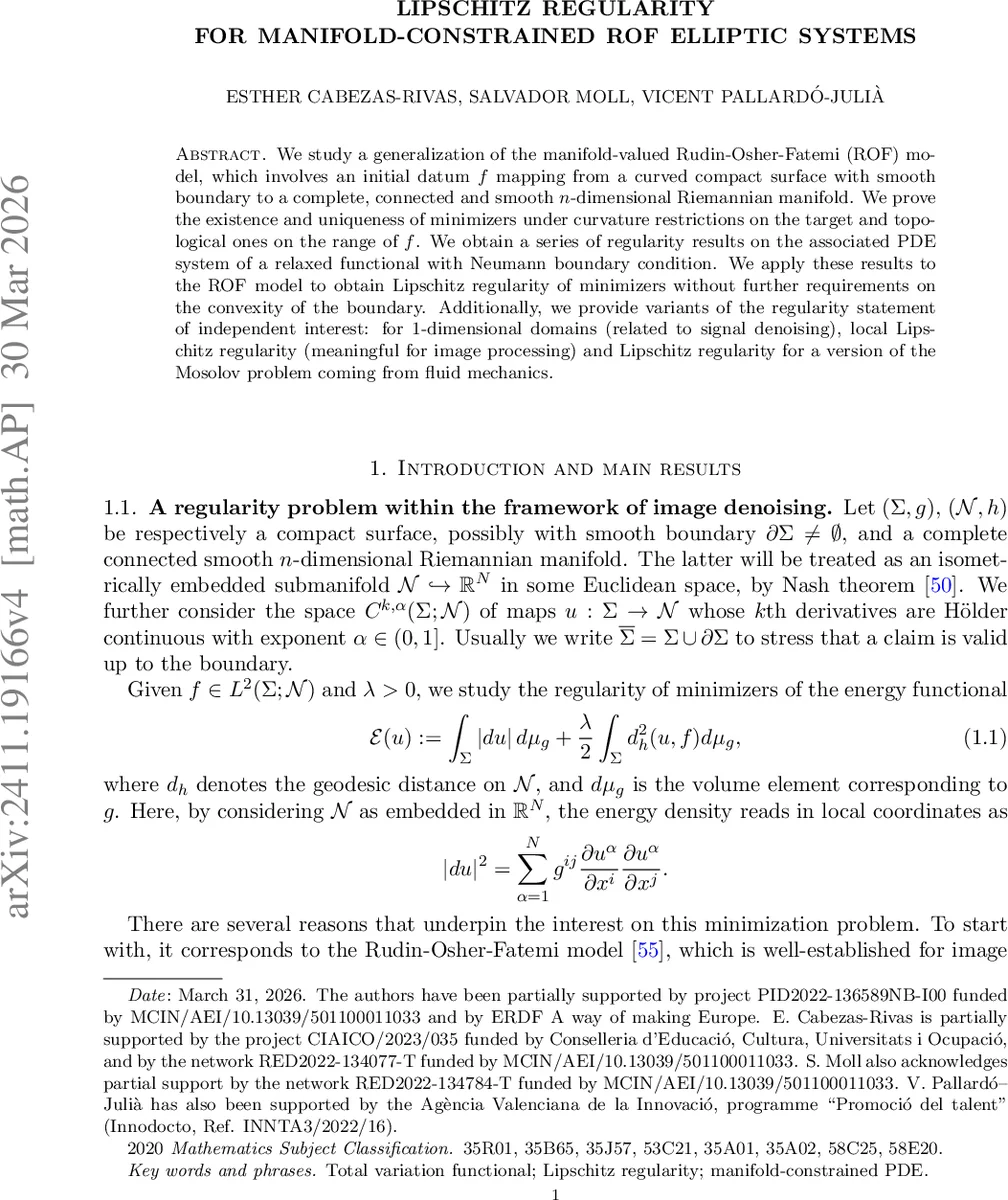
We study a generalization of the manifold-valued Rudin-Osher-Fatemi (ROF) model, which involves an initial datum $f$ mapping from a curved compact surface with smooth boundary to a complete, connected and smooth $n$-dimensional Riemannian manifold. We prove the existence and uniqueness of minimizers under curvature restrictions on the target and topological ones on the range of $f$. We obtain a series of regularity results on the associated PDE system of a relaxed functional with Neumann boundary condition. We apply these results to the ROF model to obtain Lipschitz regularity of minimizers without further requirements on the convexity of the boundary. Additionally, we provide variants of the regularity statement of independent interest: for 1-dimensional domains (related to signal denoising), local Lipschitz regularity (meaningful for image processing) and Lipschitz regularity for a version of the Mosolov problem coming from fluid mechanics.
💡 Research Summary
The paper extends the classical Rudin‑Osher‑Fatemi (ROF) variational model, originally formulated for scalar images on flat domains, to a setting where the domain is a compact two‑dimensional Riemannian surface Σ (possibly with smooth boundary) and the range is a complete, connected n‑dimensional Riemannian manifold N. Given noisy data f ∈ L²(Σ; N) and a regularisation parameter λ > 0, the authors consider the functional
E(u) = ∫_Σ |du| dμ_g + (λ/2)∫_Σ d_h²(u,f) dμ_g,
where |du| denotes the Hilbert–Schmidt norm of the differential of u and d_h is the geodesic distance on N. The first term is the total variation of a map into a manifold, the second term enforces fidelity to the data.
The main contributions are threefold:
-
Existence, uniqueness and small‑range condition.
The authors introduce a curvature bound κ for N and define a radius R_κ that guarantees strong geodesic convexity of balls of radius ≤ R_κ (R_κ depends on the injectivity radius and on κ). If the image of the data satisfies f(Σ) ⊂ B_h(p,R) for some R < R_κ, then a minimiser u of E exists and stays inside the same ball. When κ ≤ 0 (non‑positive sectional curvature) the functional is geodesically convex, which yields uniqueness of the minimiser. -
Lipschitz regularity of minimisers.
Under the same small‑range hypothesis and assuming f∈C^{0,1}(Σ; N), the minimiser u inherits the same Lipschitz constant; i.e. the regular part of the noisy image is not degraded by the denoising process. This result holds without any convexity assumption on the boundary of Σ, extending earlier Euclidean results that required convex domains. A local version is also proved: if f is locally Lipschitz and its image lies in a strongly convex geodesic ball, then u is locally Lipschitz. -
One‑dimensional and Mosolov extensions.
For a one‑dimensional domain Γ (interval or circle) the curvature restriction on N can be dropped. If f∈C^{0,1}(Γ; N) the minimiser is also C^{0,1}. Moreover, for f∈BV(Γ; N) a pointwise estimate |u′| ≤ C|f′| holds as Borel measures, providing a fully local comparison that was previously unknown for elliptic manifold‑valued problems.To obtain stronger regularity for the original ROF functional, the authors introduce a perturbed functional
E_{σ}(u) = ∫_Σ |du| dμ_g + (λ/2)∫_Σ d_h²(u,f) dμ_g + σ∫_Σ |du|² dμ_g,
with σ > 0. The additional Dirichlet term restores uniform ellipticity, allowing the authors to prove Lipschitz regularity even when κ > 0, provided a slightly stronger small‑range condition (R < min{inj p N/2, π/(4√κ)}). The Euler‑Lagrange equation for E_σ is a perturbed 1‑Laplacian system
τ₁(u) + σ τ(u) = −λ exp_u^{−1} f,
with Neumann boundary condition ν·du = 0. This system models the steady flow of a Bingham (non‑Newtonian) fluid in a duct, known as the Mosolov problem. The paper therefore delivers existence, uniqueness and Lipschitz regularity for this fluid‑mechanics model as a by‑product.
Proof strategy.
The degeneracy of the 1‑Laplacian is handled by a double regularisation: (i) adding ε > 0 inside the square root to obtain √(|du|²+ε²), and (ii) adding the σ‑term. The data f is mollified using a distance‑based convolution to retain the manifold constraint. The regularised PDE
div_g
Comments & Academic Discussion
Loading comments...
Leave a Comment