Kinetic interacting particle system: parameter estimation from complete and partial discrete observations
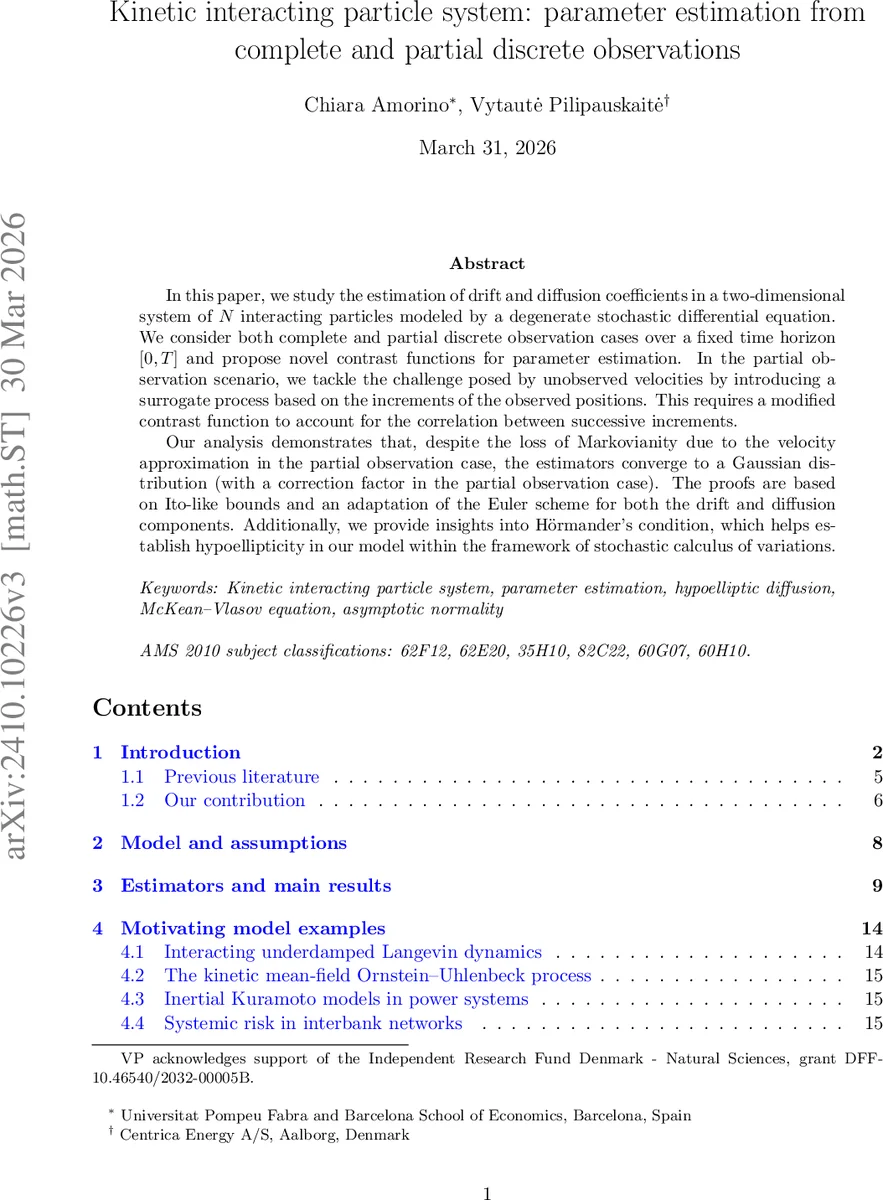
In this paper, we study the estimation of drift and diffusion coefficients in a two dimensional system of N interacting particles modeled by a degenerate stochastic differential equation. We consider both complete and partial observation cases over a fixed time horizon [0, T] and propose novel contrast functions for parameter estimation. In the partial observation scenario, we tackle the challenge posed by unobserved velocities by introducing a surrogate process based on the increments of the observed positions. This requires a modified contrast function to account for the correlation between successive increments. Our analysis demonstrates that, despite the loss of Markovianity due to the velocity approximation in the partial observation case, the estimators converge to a Gaussian distribution (with a correction factor in the partial observation case). The proofs are based on Ito like bounds and an adaptation of the Euler scheme. Additionally, we provide insights into Hörmander’s condition, which helps establish hypoellipticity in our model within the framework of stochastic calculus of variations.
💡 Research Summary
This paper addresses the statistical inference problem for a class of kinetic interacting particle systems in which each particle evolves in two dimensions (position and velocity) according to a degenerate stochastic differential equation (SDE). The dynamics are given by
( dY_i(t)=X_i(t)dt,\quad dX_i(t)=b_{\mu_0}(Z_i(t),\Pi_t^N)dt + a_{\sigma_0}(Z_i(t),\Pi_t^N)dB_i(t) )
with (Z_i=(X_i,Y_i)) and (\Pi_t^N) the empirical measure of the whole system. The unknown parameters (\theta_0=(\mu_0,\sigma_0)) appear in the drift (b_{\mu_0}) and diffusion coefficient (a_{\sigma_0}). Because the diffusion matrix is degenerate (noise acts only on the velocity component), the system is hypo‑elliptic; the authors verify Hörmander’s bracket condition to guarantee smooth transition densities and Malliavin differentiability.
Two observation regimes are considered over a fixed horizon (
Comments & Academic Discussion
Loading comments...
Leave a Comment