TianJi:An autonomous AI meteorologist for discovering physical mechanisms in atmospheric science
Artificial intelligence (AI) has achieved breakthroughs comparable to traditional numerical models in data-driven weather forecasting, yet it remains essentially statistical fitting and struggles to uncover the physical causal mechanisms of the atmos…
Authors: Kaikai Zhang, Xiang Wang, Haoluo Zhao
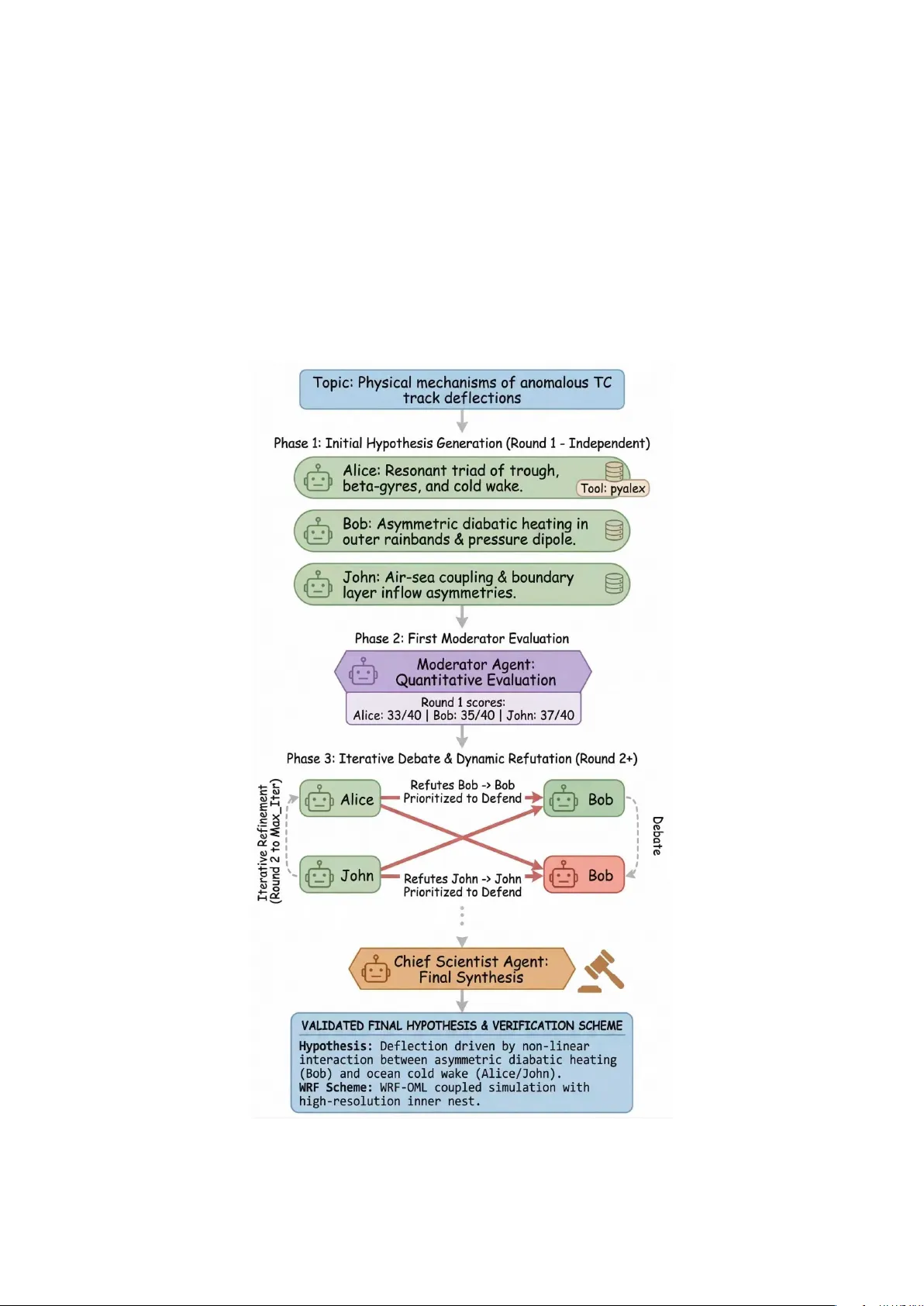
TianJi�An autonomous AI meteorologist for disco v ering ph ysical mec hanisms in atmospheric science Kaikai Zhang 1 , Xiang W ang 1 , Haoluo Zhao 1 , Nan Chen 1 , Mengy ang Y u 1 , Jing-Jia Luo 1,2 , T ao Song 3 , and F an Meng 1,2,* 1 Sc ho ol of Articial In telligence, Nanjing Universit y of Information Science and T ec hnology , Nanjing, China 2 State Key Lab oratory of Climate System Prediction and Risk Managemen t (CPRM), Nanjing Universit y of Information Science and T ec hnology , Nanjing, 210044, China 3 College of Computer Science and T ec hnology , China Universit y of P etroleum, Qingdao, Shandong, China * Corresp onding author: F an Meng. E-mail: meng@n uist.edu.cn Marc h 31, 2026 Abstract Articial in telligence (AI) has achiev ed breakthroughs comparable to traditional n umerical mo dels in data-driven weather forecasting, y et it remains essen tially statistical tting and struggles to uncov er the physical causal mechanisms of the atmosphere. Ph ysics-oriented mec hanism researc h still heavily relies on domain kno wledge and cum b ersome engineering op erations of h uman scientists, b ecoming a b ottlenec k restricting the eciency of Earth system science exploration. Here, we prop ose TianJi—the rst ”AI meteorologist” system capable of autonomously driv- ing complex n umerical mo dels to verify ph ysical mec hanisms. P ow ered by a large language mo del-driv en multi-agen t arc hitecture, TianJi can autonomously conduct literature researc h and generate scientic hypotheses. W e further decouple scien- tic research into cognitive planning and engineering execution: the meta-planner in terprets h yp otheses and devises exp erimen tal roadmaps, while a cohort of sp ecial- ized w orker agents collab orativ ely complete data preparation, mo del conguration, and m ulti-dimensional result analysis. In t w o classic atmospheric dynamic sce- narios (squall-line cold p ools and t ypho on track deections), TianJi accomplishes exp ert-lev el end-to-end exp erimen tal op erations with zero h uman in terven tion, com- pressing the researc h cycle to a few hours. It also delivers detailed result analyses and autonomously judges and explains the v alidit y of the h yp otheses from outputs. TianJi reveals that the role of AI in Earth system science is transitioning from a ”blac k-b o x predictor” to an ”interpretable scien tic collab orator”, oering a new paradigm for high-throughput exploration of scien tic mechanisms. 1 Keyw ords: AI meteorologist; m ulti-agen t; WRF numerical model; atmospheric ph ysical mechanism; scientic h yp othesis v erication 1 In tro duction Articial in telligence has ac hieved breakthroughs comparable to traditional numerical mo dels in data-driven w eather forecasting. Mo dels suc h as PanguW eather and Graph- Cast ha ve attained forecast accuracy that matches or ev en surpasses traditional numerical w eather prediction for medium-range and short-range global w eather forecasts through end-to-end statistical mapping, representing the tremendous progress of data-driven meth- o ds in atmospheric state prediction tasks [ 1 – 5 ]. Ho wev er, predictiv e capability is not equiv alent to scientic understanding. The essence of these mo dels is high-dimensional statistical tting of atmospheric state time se- ries, which completely bypasses the explicit mo deling of atmospheric physical mec hanisms. They can predict w eather states but cannot answer the profound ”why” questions in at- mospheric science [ 6 , 7 ]. Answering such questions must rely on con trolled exp erimen ts cen tered on physical n umerical mo dels, making it urgen t to in tegrate AI with ph ysical sim ulators such as WRF. Existing AI agen t systems for climate science primarily fo cus on automated data analysis and statistical diagnostics [ 8 ]. They ha ve not yet achiev ed the autonomous driving of mesoscale numerical mo dels like WRF to v erify atmospheric ph ysical mec hanisms. The TianJi system prop osed in this pap er lls this critical research gap. Ph ysical sim ulators ha ve an extremely high barrier to use. Constructing a single agent requires mastering cross-mo dal, m ulti-step capabilities including atmospheric dynamics, HPC sc heduling, F ortran conguration, and NetCDF data analysis, whic h inevitably leads to hallucinations or breakdo wns when handling ultra-long con text tasks. Mean while, ph ysics-oriented mec hanism researc h heavily depends on the domain knowledge and cum- b ersome engineering operations of h uman scien tists, b ecoming a b ottlenec k restricting the eciency of Earth system science exploration [ 9 ]. Scien tic researc h is essen tially a social process. Therefore, instead of adopting a more complex single model, w e built a ”virtual researc h group” m ulti-agen t architecture [ 10 , 11 ]: w e decouple scientic research in to cognitive planning and engineering execution, where the meta-planner takes c harge of directional guidance, and sp ecialized w orker agen t groups handle execution details. Through role separation and cross-v alidation, we bridge the gap b et w een natural language and complex F ortran ph ysical systems. Based on the ab o v e research ideas, we prop ose TianJi 1 —the rst AI meteorologist system capable of autonomously driving complex n umerical mo dels to v erify ph ysical mec hanisms. Driv en b y large mo dels and centered on WRF ph ysical sim ulation, the system consists of t wo core mo dules: h yp othesis generation and hypothesis verication, whic h can fully supp ort the en tire research pro cess from scientic h yp othesis to mechanism v alidation. Among them, the hypothesis generation mo dule adopts a m ulti-agent design cen tered on a debate mec hanism. By sim ulating the p eer review and opinion confron tation mech- anisms in academic discussions [ 12 , 13 ], combined with pap er retriev al and multi-round 1 W e name our AI meteorologist TianJi. In Chinese philosophy , “Tian” refers to the sky or hea ven, and “Ji” denotes mechanisms or profound secrets. Historically , forecasting the weather was considered attempting to decipher “TianJi”—the unrevealable secrets of nature. Here, our mo del systematically unra vels these atmospheric mec hanisms through articial intelligence. 2 iterativ e optimization, it automatically prop oses researc h h yp otheses with inno v ation and scien ticity . The hypothesis verication mo dule decouples the research pro cess relying on a m ulti-agent architecture, eectively solving the core pain p oin ts that existing mete- orological language mo dels cannot call external physical simulators or pro cess NetCDF les, and ultimately realizes the core transformation of AI in atmospheric science from a ”blac k-b o x predictor” to an ”in terpretable scientic collab orator” . 2 2 System Arc hitecture The TianJi system is comp osed of t wo parts: h yp othesis generation and hypothesis v er- ication, b oth of which are built based on the Agen tScop e framework [ 14 ]. These tw o comp onen ts jointly constitute the key functional mo dules for scientic research explo- ration, supp orting the entire research pro cess from literature inv estigation to exp erimen tal v erication. The ov erall worko w is illustrated in Figure 1 . Figure 1: System Architecture Diagram 2.1 Hyp othesis Generation: Iterative Optimization System Based on A cademic Seminar-St yle Debate In recen t y ears, large language models (LLMs) hav e demonstrated great p oten tial in scien tic exploration, y et direct generation of scientic hypotheses using LLMs still faces n umerous challenges. A dditionally , LLMs are prone to ”academic hallucinations” when generating con ten t directly , leading to hypotheses that seem reasonable on the surface but lac k factual accuracy and scientic grounding, whic h severely compromises their reliability in research [ 15 ]. 2 The test results and subsequen t op en-source co de are av ailable at https://github.com/zwww- www/ output . 3 T o address the limitations of direct generation metho ds, some studies ha ve adopted single-agen t architectures with self-ev aluation mec hanisms to impro v e the nov elt y and relev ance of hypotheses [ 16 ]. How ev er, single-agent approaches cannot repro duce the col- lab orativ e nature of real-world scientic researc h, lacking the collision and div ergence of multidisciplinary p ersp ectiv es, whic h restricts the depth and breadth of solving com- plex scien tic problems. In contrast, m ulti-agent collab oration metho ds can simulate the p eer review and team discussion pro cesses in the scientic communit y [ 17 ], and signi- can tly b o ost the o verall no v elty , feasibility , and theoretical depth of generated hypotheses through collab oration and debate among agents with div erse viewp oin ts [ 18 ]. Curren t LLM-driv en scientic hypothesis generation relies on four core metho ds: it- erativ e renemen t, retriev al augmentation, multi-agen t collaboration, and m ultimo dal fusion. In tegrating mainstream existing hypothesis generation tec hniques, w e designed and built a hypothesis generation system cen tered on an academic seminar-st yle debate mec hanism, coupled with a closed lo op of contin uous iteration and dynamic tuning. This system adopts a multi-agen t collab orativ e architecture comp osed of researc her agents, a host agen t, and a chief scientist agent. All three types of agents share full-domain informa- tion and complete h yp othesis generation via structured debate and iterative optimization. The core op erating logic and congurable features are as follo ws: 1. Researcher agen ts act as the core participants in the debate. Their quan tity can b e exibly adjusted manually , and eac h researcher agen t can b e assigned dieren tiated domain exp ertise (e.g., thermo dynamics, dynamics) to mine h yp otheses from m ul- tidisciplinary p erspectives for the same researc h topic. The total n umber of debate rounds and the sp eaking order of researcher agents can also b e freely arranged and customized. 2. The system integrates a closed lo op of m ulti-round debate–ev aluation–optimization. After each debate round, the host agent quantitativ ely scores the hypotheses pro- p osed b y researcher agents across four dimensions: scienticit y , rationality , no velt y , and eectiv eness [ 19 ]. Researcher agents optimize their h yp otheses in targeted w a ys in subsequent rounds based on these scores. 3. The system features a rebuttal mec hanism that allo ws researc her agen ts to refute eac h other’s hypotheses by p oin ting out a ws and irrationalit y . Rebutted agents sp eak rst and selectiv ely accept and revise their hypotheses based on the rebuttals, enhancing the fo cus and depth of the debate. 4. After all debate and iteration pro cesses are completed, the chief scientist agen t comprehensiv ely reviews and screens all optimized hypotheses to determine the nal hypothesis. Before the debate starts, users can freely specify the scientic topic to b e discussed. In the rst round, researcher agen ts do not debate or refute, but prop ose their o wn hypothe- ses. Before prop osing hypotheses, the system retriev es the titles and abstracts of relev ant pap ers via a pap er retriev al to ol to assist hypothesis generation [ 20 ], making hypotheses more scientic and theoretically grounded. In the subsequent iterativ e rounds, researcher agen ts ocially launc h cross-rebuttal and structured debate, fo cusing on p oin ting out defects and limitations in eac h other’s sc hemes. Throughout the system lifecycle, full- domain information remains absolutely transparent, ensuring every agen t can obtain and co ordinate all historical in teraction information in real time. Users can indep enden tly add fact-enhancement to ols during use to pro vide more external kno wledge. 4 2.2 Hyp othesis V erication: WRF-Cen tered Multi-Agen t Sys- tem In recent y ears, large language model (LLM)-driv en multi-agen t systems ha v e shown great p oten tial in automating complex physical sim ulations and ha ve b een successfully applied to m ultiple fron tier disciplines. F or instance, in the eld of computational uid dynam- ics (CFD), systems such as CFDagent ha ve achiev ed end-to-end zero-shot automated sim ulation from geometry generation to ow eld solution and result visualization [ 21 ]. F oam-Agent 2.0 further demonstrates how to realize a closed-lo op full-c hain simulation b y encapsulating indep enden t agents for meshing, running, and visualization [ 22 ]. Multi- agen t reinforcemen t learning has also b een successfully applied to active ow control in turbulent environmen ts [ 23 ]. In microscopic molecular dynamics (MD) calculations, framew orks such as DynaMate and other atomic-level simulation systems ha ve achiev ed collab oration from parameter conguration, cluster (HPC) scheduling to visual feedbac k- based anomaly self-correction [ 24 ]. In addition, the PhysAgen t system has ev en pro v en that multi-agen t architectures can autonomously sc hedule rst-principles calculation to ols and derive physical la ws [ 25 ]. Ho wev er, although multi-agen t architectures hav e excelled in rigorous scien tic com- puting suc h as uid and molecular simulations, their application in macroscopic me- teorological simulation—especially atmospheric dynamic simulation represen ted b y the complex W eather Research and F orecasting (WRF) mo del—remains a gap. T o ll this researc h gap, this pap er prop oses for the rst time a deep in tegration of m ulti-agen t col- lab oration mec hanisms with WRF simulation to construct an automated meteorological scien tic hypothesis v erication system. The h yp othesis verication mo dule is a WRF-cen tered multi-agen t execution engine. T o adapt to verication requirements of v arying complexit y , the system supp orts tw o execution mo des, whic h can b e automatically selected based on the complexity of the input task or man ually sp ecied b y the user: 1. Simple Mode: F or lo w-complexit y tasks such as analyzing single results and plotting basic meteorological elds. This mo de skips complex task planning and sc heduling steps, allo wing agents to directly inv oke underlying to ols in single or multiple steps for rapid resp onse. 2. Complex Mo de: F or complex v erication tasks requiring multi-step reasoning and m ulti-dimensional analysis. Dra wing on the hierarchical scheduling design of ad- v anced m ulti-agent systems, the master agent is resp onsible for logical decomp osi- tion, co ordination, and dynamic scheduling of upp er-lev el complex tasks [ 26 ]. The master agen t dynamically creates dedicated sub-agen ts in real time according to the task pip eline, which complete corresp onding sub-tasks. T o supp ort agen ts in completing end-to-end meteorological verication tasks, follo wing the paradigm of mo dular to ol encapsulation in adv anced computing frameworks [ 27 ], the system customizes four categories of underlying to ol buses for the meteorological domain: 1. Physical Sim ulation Mo dule: As the core driver of the system, it is exclusively resp onsible for the underlying driving of the WRF model, the setting of the sim- ulation computational domain, and the dynamic conguration of complex physical parameterization schemes. 5 2. Spatiotemp oral T ensor Calculation and Analysis Module: Sp ecialized in pro cess- ing high-dimensional gridded meteorological eld data output by the WRF mo del, pro viding multi-dimensional tensor reading and aggregation, spatial geometric l- tering, pro jection co ordinate system con v ersion, automatic p ositioning and tracking of sp ecic weather systems (e.g., cyclone centers), prole feature extraction, and v arious spatiotemp oral statistical and analytical calculations. 3. Visualization Module: Dedicated to rendering n umerical calculation results and generating spatial distribution maps integrated with real geographic information (GIS) or intuitiv e multi-dimensional spatiotemp oral statistical charts. 4. Basic T o ol Module: Encapsulates underlying system-level interaction capabilities, including read and write op erations of basic conguration les, terminal command execution, and Python data pro cessing co de. This mo dule is a WRF-centered multi-agen t system. It can switch to Simple Mo de to handle simple tasks and act as an assistan t, or enter Complex Mo de to function as a me- teorologist. The four categories of underlying to ol buses provide comprehensive technical supp ort for the stable op eration of both mo des, ensuring ecient execution of meteoro- logical hypothesis v erication tasks of v arying complexit y . In Simple Mo de, the system can quickly resp ond to the basic op erational needs of researchers, such as rapidly retriev- ing WRF sim ulation results, plotting basic meteorological element distribution maps, and simply analyzing meteorological eld characteristics, without requiring researchers to hav e complex WRF model op eration experience or programming skills. This greatly lo w ers the en try barrier for meteorological simulation and hypothesis verication, serving as a capa- ble assistant for researchers to conduct preliminary studies eciently . In Complex Mo de, through task decomp osition by the master agent and collab orativ e work of sub-agen ts, the system can sim ulate the researc h thinking and analysis pro cess of senior meteorolo- gists, conduct end-to-end v erication for complex meteorological hypotheses (e.g., causes of extreme precipitation, cyclone ev olution mec hanisms), and autonomously complete pa- rameterization scheme conguration, high-dimensional data mining, multi-dimensional result analysis, and visualization presen tation. It truly realizes an intelligen t and auto- mated closed lo op for meteorological hypothesis verication, eectiv ely comp ensating for the shortcomings of traditional WRF sim ulation that relies on manual op eration, has low eciency , and requires extremely high professional literacy of op erators. 3 Exp erimen tal V alidation T o verify the feasibilit y of the system, for the h yp othesis generation module, this pap er selects a topic for in-depth debate; for the h yp othesis v erication mo dule, w e v alidate sci- en tic hypotheses in t wo typical complex atmospheric dynamic scenarios and four simple analysis tasks. 3.1 Hyp othesis Generation V alidation F or the exp erimen tal v alidation of hypothesis generation, the discussion topic selected for the exp erimen t is as follows: During the translation of a tropical cyclone (TC), complex interactions be- t ween the vortex and its en vironment can lead to sudden, anomalous trac k 6 deections (suc h as abrupt turns, stalling, or lo oping) that sev erely challenge forecasting models. Please prop ose a specic ph ysically based mec hanistic h y- p othesis to explain how the nonlinear interactions among large-scale environ- men tal steering ows (e.g., subtropical high v ariations, mid-latitude troughs), in ternal v ortex dynamics (e.g., diabatic heating asymmetries, b eta eect), and air-sea coupling (e.g., o cean cold wak e generation) trigger suc h anomalous ty- pho on trac k changes. Three researc her agen ts w ere congured in the exp erimen t, with the built-in debate and rebuttal mechanism enabled and no additional adjustment to the sp eaking order. The exp erimen tal pro cedure is illustrated in Figure 2 : Figure 2: W orkow Diagram of Hyp othesis Generation After six rounds of iterative optimization, eac h agent prop osed its own hypothesis, 7 and the nal scien tic h yp othesis w as determined. This exp erimen t also ev aluated the iterativ e optimization pro cess, as shown in Figure 3 . This gure presents the conv ergence and quality impro vemen t of the multi-agen t debate mec hanism. All researcher agents rened their hypotheses during the debate, and their scores sho wed a contin uous up ward trend. F or instance, Alice’s score rose from a minimum of 33 to 38. Starting from the third round, the scores of the three researc her agents gradually approached the full score and stabilized, which strongly pro ves that the system did not fall in to endless unstructured arguments, but successfully con verged to a high- qualit y scientic consensus. Figure 3: Ev olution Curv e of Hyp othesis Quality Scores During Multi-Agen t Debate 3.2 V alidation of the Hyp othesis that Lo w Soil Moisture En- hances the Cold P o ol Gust F ron t of Squall Lines In this exp erimen tal v alidation, the hypothesis tested is that abnormally dry soil (low soil moisture) ahead of the mo ving path of a squall line system signicantly strengthens the in tensity of the cold p o ol gust front, thereb y accelerating the mo vemen t sp eed and prolonging the lifespan of the squall line system [ 28 ]. After parsing the natural language researc h instruction, the TianJi system autonomously constructed the underlying physical mec hanism c hain and coordinated the design of the exp erimen tal scheme. Notably , the system indep enden tly selected the Noah-MP land surface mo del and the YSU b oundary la yer scheme—a conguration that enables ne c haracterization of the soil moisture-ux coupling pro cess [ 29 ]. The simulation results autonomously extracted b y the TianJi sys- tem strongly v alidate this core h yp othesis: compared with the con trol group, the cold p ool characteristics of the soil moisture p erturbation exp erimen tal group are signican tly w eakened, the temp erature decit within 50 km of the squall line core area is reduced by 20.4% relativ e to the con trol group, and the squall line loses the coherent northeastw ard propagation feature observed in the con trol group due to structural fragmen tation. As sho wn by the radar ec ho/total precipitation comparison in Figure 4 , the squall line loses the coheren t northeastw ard propagation feature of the con trol group due to structural fragmen tation. 8 (a) Spatial distribution of squall line pre- cipitation in the control group (b) Spatial distribution of squall line pre- cipitation under low soil moisture Figure 4: Spatial distribution of precipitation Most imp ortantly , the analysis rep ort of the TianJi system go es far b ey ond mere h y- p othesis v alidation. This AI meteorologist autonomously identied emerging secondary signals that were not emphasized in the researc hers’ initial analysis b y in tegrating multi- dimensional simulation outputs including 2-m air temp erature, 10-m wind eld, and ac- cum ulated precipitation: the spatial coherence of the squall line in the soil moisture p erturbation experimental group w as signicantly atten uated, and the main conv ectiv e activit y shifted southw ard b y approximately 280 km. The TianJi system also reasonably sp eculated in the output rep ort that this phenomenon stems from the reduced ev aporative co oling eciency caused by changes in soil moisture, whic h further leads to an imbalance in the dynamic feedback b et ween the cold p o ol and the environmen tal airow—a detail that was not fully considered in the original researc h h yp othesis fo cusing on thermo dy- namic pro cesses [ 30 ]. This result conrms that the TianJi system has the ability to mine hidden meteorological signals, and the system has marked ”the dynamic mechanism of squall line spatial displacement under soil moisture p erturbation” as the research ob jectiv e for subsequent indep enden t exp erimen ts. The ab o v e simulation results reveal the m ulti-dimensional eects of soil moisture p er- turbation on squall line systems. Combined with Figure 5 , the underlying physical reg- ulatory mec hanisms can b e further decomp osed: as sho wn in the gure, the regulatory mec hanisms are clearly revealed through comparativ e sim ulations b et ween the control group with normal soil moisture (left) and the exp erimen tal group with 50Dierences in surface energy exchange: In the left control group, moist soil is dominated by latent heat ux, accompanied b y signicant laten t heat co oling, whic h contin uously supplies water v apor to the boundary la yer. In the righ t exp erimen tal group, dry soil is dominated b y sensible heat ux, laten t heat cooling is greatly w eakened, and the boundary lay er rapidly b ecomes dry and warm. Ev olution of cold p o ol and con vectiv e structure: The left control group forms a strong cold p o ol (-1.52 K) relying on sucient water v ap or, supp orting the developmen t of a coheren t squall line with concen trated and contin uous precipitation bands. In the right exp erimen tal group, although the cold p ool intensit y is w eakened (-1.21 K), the dry and w arm b oundary la y er reduces the propagation resistance of the cold p o ol outow (gust fron t), enhancing the lifting eciency of the gust fron t. Mean while, the con vectiv e organi- zation is destro y ed, presen ting fragmen ted conv ection, and the squall line shifts southw ard 9 b y approximately 280 km as a whole. Lo w soil moisture do es not directly enhance the co oling in tensity of the cold p ool, but ultimately strengthens the cold p ool gust front of the squall line through the pathw a y of ”surface energy balance reconstruction → b ound- ary lay er drying and w arming → optimization of dynamic characteristics of cold p o ol outo w” . Figure 5: Mec hanism of Low Soil Moisture Impact on Squall Lines F urther visual analysis of the system execution pro cess demonstrates the complete w orkow and robustness of the TianJi system in conducting end-to-end autonomous WRF squall line simulation exp erimen ts. As shown in Figure 6 , within the exp erimen tal window from 17:42 to 18:35, the TianJi system, with Meta-Planner as its core, completed full-pro cess control from initial roadmap construction to m ulti-W orker to ol execution. The system rst anc hored the exp erimen tal ob jectiv es through initial roadmap planning (Step 1), and then sequen tially sc heduled subtasks including WPS conguration, FNL data pro cessing, WRF initialization, main sim ulation, and tra jectory analysis (Step 2/5/8/11/14). After each k ey subtask w as com- pleted, Meta-Planner automatically triggered state revision (Step 4/7/10/13/16) to v erify the consistency b et w een to ol outputs and scien tic logic, ensuring the exp eriment did not deviate from the preset hypothesis. The ov erall pro cess presents the closed-lo op iterative feature of ”planning-scheduling-execution-v erication”, fully co vering the entire c hain of WRF simulation from prepro cessing to p ostpro cessing. 10 Figure 6: End-to-End Execution Timeline for Squall Line Exp erimen t During execution, the system demonstrated fault self-healing capability without any h uman in terv ention. As shown in Figure 7 , within a total exp erimen tal p erio d of ap- pro ximately 55 min utes, the system triggered 164 API calls in total, and detected and automatically repaired 3 t yp es of run time errors during this pro cess: 1. WPS prex mismatch: Automatically modied the namelist to correct the prex to GRIBFILE. 2. metgrid level mismatch: A utomatically adjusted the e_vert parameter from 32 to 34 and reran real.exe. 3. T ensor dimension broadcasting error: Automatically v eried the NetCDF length and realigned the tensors. After each error repair, the system could resume execution seamlessly , verifying its ro- bustness in complex meteorological simulation scenarios. 11 Figure 7: Cum ulative System Actions and F ault Self-Recov ery As sho wn in Figure 8 , the system ac hieved clear hierarchical decoupling. Meta-Planner (TianJi) underto ok 28 reasoning and planning calls, fo cusing on global roadmap formula- tion and state management without participating in underlying to ol execution. Fiv e sp e- cialized W orkers shared the sp ecic to ol execution load. Among them, wrf_real_executor (38 calls) and tra jectory_analyzer (40 calls) b ore the main system I/O and computational loads due to their inv olv ement in model initialization and ph ysical quantit y analysis. Mean while, wps_congurer (15 calls), fnl_pro cessor (23 calls), and wrf_main_simulator (20 calls) w ere resp onsible for prepro cessing, mo del op eration and other links. This mo d- ular division of lab or not only ensured execution eciency but also endow ed the system with fa v orable scalabilit y—no reconstruction of the core planning logic w as required when adding new to ols or tasks. Figure 8: Multi-Agen t API Inv o cation Distribution 12 3.3 Complex Resp onse of T ypho on T rac k to Sea Surface T em- p erature Anomalies The second hypothesis v alidated in this study is: the impact of sea surface temp erature (SST) anomalies on the trac k of T ypho on In-fa (2021) [ 31 ]. The initial h uman hypothesis prop osed an in tuitive unidirectional causal c hain: a global SST increase of +2°C w ould lead to a signican t north ward deection of the typhoon trac k. The agent autonomously designed rigorous control and exp erimen tal groups, and pre- cisely increased the SKINTEMP (sea surface skin temp erature, representing SST) v ariable in the met_em les containing all time steps by 2.0 K. When p erforming the 72-hour WRF n umerical sim ulation, the agent not only reasonably congured core ph ysical schemes suc h as Thompson microphysics, YSU b oundary lay er, and RR TMG radiation, but also accu- rately identied and disabled the SST up date parameter (sst_up date = 0) to ensure that the preset temperature p erturbation eld remained undisturb ed during the sim ulation—a k ey detail often ov erlo ok ed in conv en tional manual mo deling. Ho wev er, the 72-hour simulation results did not conrm the exp ected ”signicant north ward shift” phenomenon. The agen t’s autonomous diagnostic analysis fundamen- tally revised the causal chain set b y humans, and output the results sho wn in Figure 9 . (a) Comparison of t ypho on trac ks under SST anomalies (b) Ev olution of central sea level pressure of Typhoon In-fa Figure 9: Comparison of SST Anomaly Eects on T rac k and Intensit y of T ypho on In-F a Com bined with the temp oral ev olution of track deviations in Figure 9a , the agen t rev ealed that the pro cess is not a simple linear shift: during the critical p ost-landing p eriod (July 25–26), the trac k of the exp erimen tal group was consistently south of the con trol group, with a maxim um southw ard deviation of -0.3387°. Com bined with the t ypho on intensit y in Figure 9b , further ph ysical diagnostics indicate that the +2°C SST anomaly caused a signicant drop in storm central pressure (minim um sea level pressure decreased from 944.2 hP a to 924.7 hPa). The agen t p oin ted out that 13 the increase in SST do es not directly drive the north ward deection of the t ypho on trac k, but triggers a complex in tensity-trac k coupling mec hanism: the signicantly intensied storm alters its interaction with the large-scale environmen tal steering o w [ 32 ]. By indep enden tly correcting the a wed linear h yp othesis of human researchers, the agen t demonstrated an unpreceden ted high-level ph ysical reasoning ability among AI-driven atmospheric science to ols. As sho wn in Figure 10 , w e can clearly decomp ose the nonlinear physical mechanism b y which SST anomalies regulate typhoon tracks: 1. Bottom Thermal F orcing: Energy Input from SST Anomalies The lo wermost SST anomaly heatmap shows a prominent warm SST anomaly b eneath the typhoon’s low-pressure center, with cold SST anomalies distributed around it. W arm SST contin uously injects additional energy into the t ypho on core b y enhancing laten t and sensible heat uxes at the air-sea in terface, strengthen- ing the cen tral lo w-pressure in tensity; cold SST anomalies suppress lo cal con vectiv e dev elopment and reshap e the thermal gradient and circulation pattern around the t ypho on. 2. Middle Dynamic Coupling: Complex V ortex-En vironment In teractions The atmospheric dynamic structure in the middle la y er reveals the core regulatory pro cess. The steering ow (slate blue streamlines) should dominate the linear mo ve- men t of the t ypho on, but the t ypho on v ortex in tensied b y w arm SST undergo es strong nonlinear in teractions with the en vironmen tal o w, weak ening the direct traction eect of the steering ow [ 33 ]. The asymmetric thermal structure induced b y lo cal SST dierences further breaks the dynamic balance, forming a multi-factor coupling eect of ”steering ow + v ortex in tensity + lo cal thermal conditions” (la- b eled COMPLEX INTERA CTION ), laying the groundw ork for track deviation. 3. Upp er T rac k Resp onse: F rom Linear Hyp othesis to Nonlinear Disco very In the traditional human h yp othesis, the typhoon should mov e linearly northw ard along the steering ow (gray dashed line). How ever, actual simulations and AI autonomous ndings show that the typhoon trac k exhibits a complex nonlinear form with a southw ard deviation of approximately 280 km (red curv e). The essence of this deviation is that the vortex inertia enhanced by warm SST sup erimp oses with the southw ard circulation p erturbation induced b y cold SST, causing the typhoon to b e contin uously mo dulated by nonlinear forces during north ward mov emen t and ultimately deviate from the exp ected linear path. This in tuitiv ely conrms the non-monotonic, nonlinear regulatory eect of SST anomalies on t ypho on tracks. 14 Figure 10: Nonlinear Mechanism of SST Anomaly Regulating Typhoon T rac k T o intuitiv ely presen t its automated scientic research capabilit y and engineering ro- bustness, we further conduct a visual analysis of the execution pro cess of this typhoon sim ulation exp erimen t, revealing the op erating mechanism and engineering adv antages of the system from three dimensions: task timing, fault self-healing, and multi-agen t load distribution. As shown in Figure 11 , within an exp erimen tal p eriod of approximately 130 minutes, the system triggered a total of 180 API calls, during which three types of critical run time errors were detected and automatically repaired, including: 1. Missing WPS v ariable table (13:38:15): Automatically asso ciated the GFS v ariable table via a Shell script to restore the prepro cessing pro cess. 2. Mismatched WRF vertical levels (13:56:10): A utonomously edited the namelist to correct the n um b er of v ertical lev els from 38 to 34 and reran the initialization mo dule. 3. MPI pro cess o vero w (14:08:05): Dynamically adjusted asynchronous thread pa- rameters to av oid resource o vero w and restarted the sim ulation. After each error repair, the system can resume execution seamlessly without human in- terv ention, v erifying its high robustness and autonomous regulation capabilit y in long- duration WRF typhoon sim ulation scenarios. 15 Figure 11: Cum ulative System Actions and F ault Self-Recov ery As can b e seen from Figure 12 , within the exp erimen tal windo w from 13:31 to 15:40, the TianJi system, with Meta-Planner as its core, constructed a closed-lo op worko w of planning-sc heduling-execution-verication. It rst anchored the scientic goal of ”typhoon trac k resp onse under sea surface temperature anomaly perturbation” through initial plan- ning, and then sequentially scheduled six subtasks: namelist conguration, WPS prepro- cessing for the con trol/p erturbation groups, WRF initialization, main sim ulation of dual exp erimen ts, and tra jectory analysis. After each subtask was completed, Meta-Planner automatically triggered state v erication to ensure consistency b et ween to ol outputs and the preset scien tic logic and a void deviation of the exp erimen tal direction. The ov er- all process fully co vers the entire c hain of WRF t ypho on simulation from conguration to post-pro cessing, reecting hierarchical and highly con trollable end-to-end execution capabilit y . 16 Figure 12: End-to-End Execution Timeline for Squall Line Exp erimen t As sho wn in Figure 13 , the system ac hieved clear hierarc hical decoupling and load bal- ancing. Meta-Planner (TianJi) underto ok 50 API calls, fo cusing on global reasoning and planning without participating in the execution of underlying to ols. Sp ecialized W ork ers shared sp ecic execution loads: wps_prepro cessor (42 calls) and wrf_main_sim ulator (29 calls) b ore the main system I/O and MPI parallel computing loads, while tra jec- tory_analyzer fo cused on tensor computing for physical quan tity analysis and visualiza- tion. In terms of call t yp es, system I/O and Shell op erations accounted for the highest prop ortion, matching the le op eration and parallel computing characteristics of WRF sim ulations. Mean while, reasoning and planning calls ensured the accurate implemen- tation of scien tic goals. This mo dular division of lab or not only improv ed execution eciency but also endow ed the system with go o d scalabilit y—no reconstruction of the core planning logic was required when adding new p erturbation exp erimen ts or analysis mo dules. 17 Figure 13: Multi-Agen t API Inv o cation Distribution 3.4 Simple Analysis T asks This part v eries whether the system can accurately understand the requiremen ts, suc- cessfully switc h to the simple mo de, and fulll simple tasks as an assistan t. F our t ypical meteorological diagnostic and visualization tasks were tested, and the results are summa- rized in T able 1 . In the diagnostic test of extreme precipitation and its dynamic triggering mechanism, the agen t did not adopt the method of extracting a single precipitation v ariable. Based on meteorological ph ysical principles, it autonomously syn thesized conv ectiv e precipitation (RAINC) and large-scale grid precipitation (RAINNC) ph ysically , and accurately identi- ed the intensit y center of the extreme rainstorm (Figure 14c ). T o clarify the formation mec hanism of hea vy precipitation, the agent in vok ed data of the 10-m horizontal wind eld (U and V comp onen ts), com bined with the mo del grid resolution of 9000 m, quan- titativ ely calculated the near-surface horizontal div ergence, and successfully iden tied a strong conv ergence zone with an intensit y of -0.0025 s�¹ (Figure 14d ), revealing the low- lev el dynamic triggering mec hanism for the formation of t ypho on rainstorms. The to ol call sequences on the righ t side of Figure 14c and Figure 14d in tuitively present the system execution pro cess: after initializing the easy task mo de via enter_easy_task_mode, it sequen tially completed directory trav ersal, tensor reading, ph ysical quantit y transforma- tion, feature localization and spatial visualization, realizing the full-pro cess automation from data to ph ysical mec hanism interpretation. In the task of analyzing the v ertical w arm-core structure of t ypho ons, the agen t adopted the global minim um addressing algorithm to accurately lo cate the extreme v alue of sea lev el pressure at the t ypho on cen ter (938.9 hPa, 19.09°N, 118.17°E). T aking the t ypho on center as the b enc hmark, the agen t extracted spatial prole data of the three- dimensional heigh t eld (z) and temp erature eld (tc), completed the azimuthal av erage temp erature calculation within a range of 300 km, and autonomously generated a high- resolution heigh t-radius radial temp erature contour map. This pro cess not only achiev ed accurate tensor spatial slicing op erations, but also reected the agent’s accurate character- 18 T able 1: Summary of Simple Analysis T ask Execution Results T ask Name Execution Result (Summary) Extract the minim um central pressure ev ery 6 hours, plot the time-pressure ev olution line c hart, and mark the p eak inten- sit y time and v alue. Successfully extracted data and generated the evolu- tion curve (typhoon_intensit y_ev olution.png). The analysis sho ws that the typhoon reac hed p eak inten- sit y at 00:00 UTC on Septem b er 14, 2018, with a min- im um central pressure of 922.769 hPa. T rack the typhoon mov ement path and plot the trajectory on a high-resolution map ov er- laid with the sea level pressure eld at peak in tensity (12:00 on Septem b er 15). Successfully lo cated the typhoon center at each time step and extracted the sea lev el pressure eld at 12:00 on September 15. Generated a combined map of t ypho on track and pressure eld with high- precision coastlines and latitude–longitude grids (ty- pho on_trac k_with_slp.png). Calculate the total accumu- lated precipitation eld (con- v ective + non-con v ective), plot the spatial distribution using a meteorological color bar, and mark the maximum precipita- tion center and v alue with a red star. Successfully computed the total accumulated precipi- tation eld and generated the spatial distribution map (t ypho on_total_precipitation.png). Precisely iden ti- ed the maximum precipitation cen ter with a total accum ulated precipitation of 453.68 mm, highlighted b y a red ve-pointed star. Calculate the divergence eld based on the 10-m wind eld, plot the 2D lled con tour map using a div ergen t color bar, and extract and highligh t the ex- treme strong conv ergence zone. Successfully computed the horizontal div ergence eld from U10 and V10 wind comp onen ts and generated the lled contour map with a divergen t color bar (t y- pho on_div ergence_zone.png). Accurately identied the extreme strong con v ergence region (peak v alue: -0.00287 s�¹), highlighted by a prominent red rectan- gular b o x. 19 ization of the core meteorological physical concept of the warm-core structure of tropical cyclones [ 34 , 35 ]. In the task of diagnosing the full-life-cycle trac k of t ypho ons, the agent tra versed the full-life-cycle simulation data time step b y time step, completed the visualization of ty- pho on trac ks o verlaid with geographic coastlines (Figure 14b ), extracted the minimum cen tral pressure of the typhoon at 6-hour interv als, and generated a time-central pressure ev olution line c hart (Figure 14a ), accurately marking the minimum pressure v alue at the p eak intensit y of the t ypho on (922.8 hP a). Mean while, in strict accordance with mete- orological op erational forecasting specications, it automatically generated a structured t ypho on dynamic evolution rep ort at 6-hour in terv als, accurately recording key ph ysical parameters. Among them, the t ypho on cen ter at the initial time was lo cated at 15.9560°N, 126.9728°E, with a minimum cen tral pressure of 922.7690 hP a. The worko w sequences on the righ t side of Figure 14a and Figure 14b sho w that the system entered the task mo de via enter_easy_task_mode, in vok ed to ols such as ingest_tensor, lo cate_feature, plot_cartesian_c hart and plot_spatial_map, and ecien tly completed feature extraction and visualization output without redundant op erations or human interv en tion. The ab o ve multi-dimensional diagnostic test results sho w that the system has gone b e- y ond the scop e of traditional programmed execution. It can autonomously interpret the analytical requiremen ts of meteorological ph ysical mechanisms, and reasonably decom- p ose them into high-order tensor op erations suc h as ow eld deriv ation, extreme v alue lo calization, physical quantit y syn thesis and spatiotemp oral prole extraction, realizing the full-pro cess autonomous execution from basic pro cessing of n umerical mo del data to in-depth analysis of meteorological physical mec hanisms. enter_easy_task_mo de ↓ Youtube ↓ ingest_tensor ↓ locate_feature ↓ plot_cartesian_cha rt ↓ generate_response (a) T emp oral Evolution Curv e of Typhoon Cen tral Pressure enter_easy_task_mode ↓ Youtube ↓ ingest_tensor ↓ locate_feature ↓ plot_spatial_map ↓ generate_response (b) Ov erlay Map of T ypho on T rack and Sea Lev el Pressure Field enter_easy_task_mo de ↓ list_directory ↓ Youtube ↓ ingest_tensor ↓ transform_tensor ↓ locate_feature ↓ plot_spatial_map ↓ generate_response (c) Spatial Distribution Map of T otal Typhoon A ccumulated Precipitation enter_easy_task_mode ↓ ingest_tensor ↓ transform_tensor ↓ locate_feature ↓ filter_by_geometry ↓ plot_spatial_map ↓ generate_response (d) Spatial Distribution Map of Div ergence Field for 10-m Wind Field of Typhoon Figure 14: Visualization Results of Simple Analysis T asks 20 4 Conclusion This pap er prop oses TianJi, the rst AI meteorologist system that can autonomously drive complex numerical mo dels to verify ph ysical mechanisms. The system innov ativ ely decou- ples scientic research into cognitiv e planning and engineering execution, and constructs a t wo-la yer multi-agen t architecture consisting of h yp othesis generation and h yp othesis v erication. In the hypothesis generation stage, the structured debate mec hanism with m ultiple roles (host, researc her, c hief scien tist) eectiv ely suppresses hallucinations and cognitiv e biases of large mo dels, ensuring the ph ysical rationalit y and innov ation of the output hypotheses. In the verication stage, the master agen t co ordinates and sc hedules the underlying sub-agent p o ol through hierarchical planning, seamlessly connects with the WRF-based physical simulator, and successfully bridges the engineering gap b etw een natural language instructions and complex F ortran numerical exp eriments. In practical mesoscale atmospheric dynamic scenarios, TianJi not only ac hieves end-to- end automated execution, but also demonstrates high-level reasoning abilit y to mine deep ph ysical causal mec hanisms from high-dimensional data. F or example, when exploring the impact of lo w soil moisture on squall lines, the system not only v eried the h yp othesis of cold p o ol weak ening, but also indep endently discov ered the hidden secondary dynamic feedbac k mechanism of southw ard displacemen t of the main con vectiv e activit y . In the v erication of the impact of sea surface temp erature anomalies on the track of Typhoon In-fa, it indep endently corrected the unidirectional linear northw ard shift hypothesis set b y h umans, and rev ealed the complex intensit y-trac k coupling mechanism triggered b y the drop in storm cen tral pressure. These achiev emen ts prov e that the role of AI in geoscience is successfully transforming from a purely data-driv en black-box predictor to an interpretable scientic collab orator [ 36 ]. A t present, the v erication scenarios of the system are mainly fo cused on short-term mesoscale dynamic pro cesses, and its applicabilit y in long-term climate sim ulation and m ulti-sphere coupling pro cesses still needs further ev aluation. F uture researc h will fo- cus on introducing a real-time assimilation mo dule for m ulti-source observ ation data and expanding compatible in terfaces for more Earth system mo dels to enhance the gener- alization abilit y of the system in complex real-world environmen ts. Through the deep in tegration of cutting-edge reasoning algorithms, this framew ork is exp ected to evolv e in to a fully autonomous closed-loop disco v ery system including hypothesis generation- exp eriment v erication-hypothesis iteration, providing a feasible new paradigm for origi- nal mechanism exploration in Earth system science. References [1] Kaifeng Bi, Lingxi Xie, Hengheng Zhang, Xin Chen, Xiaotao Gu, and Qi Tian. A ccurate medium-range global weather forecasting with 3d neural netw orks. Natur e , 619:1–6, 07 2023. [2] Remi Lam, Alv aro Sanchez-Gonzalez, Matthew Willson, Peter Wirnsberger, Meire F ortunato, F erran Alet, Suman Ravuri, Timo Ew alds, Zac h Eaton-Rosen, W eihua Hu, Alexander Merose, Stephan Ho yer, George Holland, Oriol Vin y als, Jacklynn Stott, Alexander Pritzel, Shakir Mohamed, and Peter Battaglia. Learning skillful medium-range global w eather forecasting. Scienc e (New Y ork, N.Y.) , 382:eadi2336, 11 2023. 21 [3] Lei Chen, Xiaohui Zhong, F eng Zhang, Y uan Cheng, Yingh ui Xu, Y uan Qi, and Hao Li. F uxi: A cascade machine learning forecasting system for 15-day global weather forecast. npj climate and atmospheric scienc e , 6(1):190, 2023. [4] Yi Xiao, Lei Bai, W ei Xue, Kang Chen, T ao Han, and W anli Ouyang. Coupling the data-driv en weather forecasting mo del with 4d v ariational assimilation. Eur op e an Ge oscienc es Union Gener al A ssembly 2024 (EGU24) , page 2857, 2024. [5] Jing-Jia Luo, Jiang jiang Xia, Baoxiang Pan, Y o o-Geun Ham, Xiaofeng Li, W ei Shangguan, W ei Xue, Y aqiang W ang, Bin Mu, Y oung jo on Hong, et al. Ai for atmosphere–o cean sciences: adv ancemen ts, challenges and w ays forward. National Scienc e R eview , 13(5):nw ag063, 2026. [6] Kiana V u, İsmet Selçuk Özer, Ph ung Lai, Zheng W u, Thilanka Munasinghe, and Jen- nifer W ei. F rom black box to insigh t: Explainable ai for extreme ev ent preparedness. arXiv pr eprint arXiv:2511.13712 , 2025. [7] Gianmarco Mengaldo. Explain the blac k b ox for the sak e of science: the sci- en tic method in the era of generativ e articial in telligence. arXiv pr eprint arXiv:2406.10557 , 2024. [8] Zijie Guo, Jiong W ang, F enghua Ling, W angxu W ei, Xiaoyu Y ue, Zhe Jiang, W ang- han Xu, Jing-Jia Luo, Lijing Cheng, Y o o-Geun Ham, et al. A self-evolving ai agent system for climate science. arXiv pr eprint arXiv:2507.17311 , 2025. [9] T apio Sc hneider, Sw adhin Behera, Giulio Boccaletti, Clara Deser, Kerry Emanuel, Raaele F errari, L Rub y Leung, Ning Lin, Thomas Müller, An tonio Nav arra, et al. Harnessing ai and computing to adv ance climate mo delling and prediction. Natur e Climate Change , 13(9):887–889, 2023. [10] Lianhao Zhou, Hongyi Ling, Cong F u, Y ep eng Huang, Mic hael Sun, W endi Y u, Xiao xuan W ang, Xiner Li, Xingyu Su, Junkai Zhang, et al. A utonomous agents for scientic discov ery: Orchestrating scien tists, language, co de, and physics. arXiv pr eprint arXiv:2510.09901 , 2025. [11] Y ougang Lyu, Xi Zhang, Xinhao Yi, Y uyue Zhao, Sh uyu Guo, W enxiang Hu, Jan Piotro wski, Jakub Kaliski, Jacop o Urbani, Zaiqiao Meng, et al. Ev oscien tist: T o wards m ulti-agent ev olving ai scientists for end-to-end scien tic disco very . arXiv pr eprint arXiv:2603.08127 , 2026. [12] F atemeh Shahhosseini, Arash Marioriyad, Ali Momen, Mahdieh Soleymani Baghshah, Mohammad Hossein Rohban, and Shagha yegh Haghjo oy Jav anmard. Large language mo dels for scien tic idea generation: A creativit y-cen tered surv ey . arXiv pr eprint arXiv:2511.07448 , 2025. [13] Yi-Cheng Lin, Kang-Chieh Chen, Zhe-Y an Li, T zu-Heng W u, T zu-Hsuan W u, Kuan- Y u Chen, Hung-yi Lee, and Y un-Nung Chen. Creativit y in llm-based multi-agen t systems: A survey . In Pr o c e e dings of the 2025 Confer enc e on Empiric al Metho ds in Natur al L anguage Pr o c essing , pages 27572–27595, 2025. [14] Daw ei Gao, Zitao Li, Y uexiang Xie, W eirui Kuang, Liuyi Y ao, Bingc hen Qian, Zhijian Ma, Y ue Cui, Haohao Luo, Shen Li, et al. Agentscope 1.0: A developer-centric framew ork for building agen tic applications. arXiv pr eprint arXiv:2508.16279 , 2025. 22 [15] Sebastian F arquhar, Jannik K ossen, Lorenz Kuhn, and Y arin Gal. Detecting halluci- nations in large language models using seman tic en trop y . Natur e , 630(8017):625–630, 2024. [16] Noah Shinn, F ederico Cassano, Ashwin Gopinath, Karthik Narasimhan, and Shun yu Y ao. Reexion: Language agents with verbal reinforcement learning. A dvanc es in neur al information pr o c essing systems , 36:8634–8652, 2023. [17] Chris Lu, Cong Lu, Rob ert Tjarko Lange, Jak ob F o erster, Je Clune, and Da vid Ha. The ai scientist: T ow ards fully automated op en-ended scientic disco very . arXiv pr eprint arXiv:2408.06292 , 2024. [18] Yilun Du, Sh uang Li, Antonio T orralba, Josh ua B T enen baum, and Igor Mordatch. Impro ving factualit y and reasoning in language mo dels through m ultiagent debate. In F orty-rst international c onfer enc e on machine le arning , 2024. [19] Chi-Min Chan, W eize Chen, Y usheng Su, Jianxuan Y u, W ei Xue, Shanghang Zhang, Jie F u, and Zhiyuan Liu. Chatev al: T ow ards b etter llm-based ev aluators through m ulti-agent debate. arXiv pr eprint arXiv:2308.07201 , 2023. [20] Y unfan Gao, Y un Xiong, Xinyu Gao, Kangxiang Jia, Jinliu P an, Y uxi Bi, Yixin Dai, Jia wei Sun, Haofen W ang, Haofen W ang, et al. Retriev al-augmented generation for large language mo dels: A survey . arXiv pr eprint arXiv:2312.10997 , 2(1):32, 2023. [21] Zhaoyue Xu, Long W ang, Ch un yu W ang, Yixin Chen, Qingy ong Luo, Hua-Dong Y ao, Shizhao W ang, and Guow ei He. Cfdagent: A language-guided, zero-shot m ulti-agent system for complex o w sim ulation. Physics of Fluids , 37(11), 2025. [22] Ling Y ue, Nithin Somasekharan, Tingw en Zhang, Y adi Cao, and Shaowu Pan. F oam- agen t 2.0: An end-to-end comp osable m ulti-agen t framew ork for automating cfd sim ulation in op enfoam. arXiv pr eprint arXiv:2509.18178 , 2025. [23] Jo el V asanth, Jean Rabault, F rancisco Alcántara-Á vila, Mikael Mortensen, and Ricardo Vinuesa. Multi-agent reinforcemen t learning for the control of three- dimensional rayleigh–bénard con vection. Flow, T urbulenc e and Combustion , 115(3):1319–1355, 2025. [24] Orlando A Mendible-Barreto, Misael Díaz-Maldonado, F ernando J Carmona Estev a, J Emmanuel T orres, Ubaldo M Córdo v a-Figueroa, and Y amil J Colón. Dynamate: lev eraging ai-agen ts for customized research w orkows. Mole cular Systems Design & Engine ering , 10(7):585–598, 2025. [25] Xiao-Qi Han, Ze-F eng Gao, P eng-Jie Guo, and Zhong-Yi Lu. Physagen t: A m ulti- agen t approac h to automated discov ery of physical laws. Pr eprint/publishe d online A ug , 19:2025, 2025. [26] Daniil A Boiko, Rob ert MacKnigh t, and Gab e Gomes. Emergent autonomous scien- tic researc h capabilities of large language mo dels. arXiv pr eprint arXiv:2304.05332 , 2023. [27] Hanchen W ang, Tianfan F u, Y uanqi Du, W enhao Gao, Kexin Huang, Ziming Liu, P ay al Chandak, Shengc hao Liu, Peter V an Katwyk, Andreea Deac, et al. Scien tic disco very in the age of articial intelligence. Natur e , 620(7972):47–60, 2023. 23 [28] Hongp ei Y ang and Y u Du. Distinct conv ection initiation near and far ahead of an idealized squall line. Journal of the A tmospheric Scienc es , 83(1):151–168, 2026. [29] Y ang Y u, Sh u-Hua Chen, Ch u-Chun Huang, Kya w Tha P aw U, Cameron Schmitt, Zhan Zhao, Kosana Suv o čarev, Isay a Kisekka, Rex D Pyles, Jerem y A vise, et al. A n umerical study of the agricultural irrigation eects on summer soil moisture and near-surface meteorology in california’s central v alley . Journal of Hydr omete or olo gy , 26(6):641–659, 2025. [30] Dong F u, Y u Du, Chuying Mai, Minghua Li, and Chao Li. Impact of b oundary la yer jets on cold p o ol characteristics observ ed from the 356-m high shenzhen meteorolog- ical tow er. Journal of Ge ophysic al R ese ar ch: A tmospher es , 130(19):e2024JD042926, 2025. [31] Chun Y ang and Jingyu Li. Assessment of fy-3d sst data on t ypho on in-fa simulation. A tmospher e , 14(1):101, 2023. [32] Shoude Guan, Ping Liu, Yihan Zhang, I-I Lin, Lei Zhou, Qingxuan Y ang, W ei Zhao, and Jiw ei Tian. Enhanced sea surface co oling and suppressed storm in tensication during slo w-moving track-turning stage of tropical cyclones. Journal of Ge ophysic al R ese ar ch: Oc e ans , 130(2):e2024JC022234, 2025. [33] Liang W ang, Bingcheng W an, Shaohui Zhou, Haofei Sun, and Zhiqiu Gao. F ore- casting tropical cyclone trac ks in the north western pacic based on a deep-learning mo del. Ge oscientic Mo del Development , 16(8):2167–2179, 2023. [34] Qinlai Lian, Y u Zhang, Xiao yu Liu, and Jianjun Xu. The impact of wrf v ertical resolution on the simulated thermal-dynamic structures and in tensit y of t ypho on lekima. F r ontiers in Earth Scienc e , 12:1363482, 2024. [35] Xiaoxu Qi, Shengp eng Y ang, and Li He. In vestigating tropical cyclone w arm core and b oundary lay er structures with constellation observing system for meteorology , ionosphere, and climate 2 radio o ccultation data. R emote Sensing , 16(22):4257, 2024. [36] Pouria Behnoudfar, Charlotte Moser, Marc Bo cquet, Sib o Cheng, and Nan Chen. Bridging idealized and operational mo dels: an explainable ai framew ork for earth system emulators. npj Climate and A tmospheric Scienc e , 2026. 24
Original Paper
Loading high-quality paper...
Comments & Academic Discussion
Loading comments...
Leave a Comment