Stability of a Korteweg--de Vries equation close to critical lengths
In this paper, we investigate the quantitative exponential stability of the Korteweg-de Vries equation on a finite interval with its length close to the critical set. Sharp decay estimates are obtained via a constructive PDE control framework. We fir…
Authors: Jingrui Niu, Shengquan Xiang
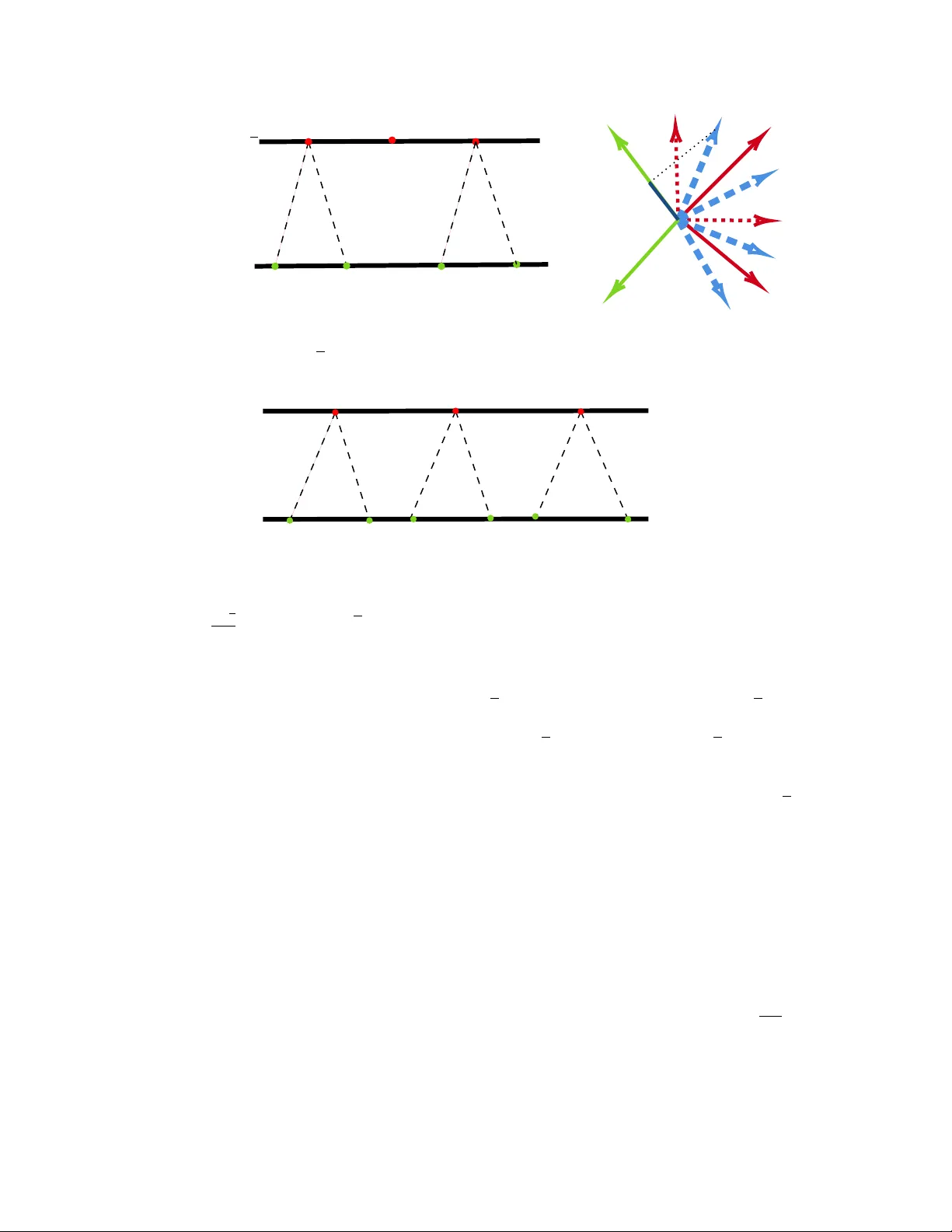
Stabilit y of a Kortew eg–de V ries equation close to critical lengths Jingrui Niu ∗ Shengquan Xiang † Abstract In this pap er, we inv estigate the quantitativ e exp onential stabilit y of the Kortew eg–de V ries equa- tion on a finite interv al with its length close to the critical set. Sharp deca y estimates are obtained via a constructiv e PDE control framework. W e first in tro duce a nov el transition–stabilization approach, com bining the Leb eau–Robbiano strategy with the momen t metho d, to establish constructive null con trollability for the KdV equation. This approach is then coupled with precise sp ectral analysis and inv ariant manifold theory to c haracterize the asymptotic b ehavior of the deca y rate as the length of the interv al approaches the set of critical lengths. Building on our classification of the critical lengths, we show that the KdV equation exhibits distinct asymptotic b ehaviors in neighborho o ds of differen t types of critical lengths. Keyw ords. K dV, observ ability , exp onen tial stabilit y , sp ectral theory , transition-stabilization MSC (2020). 35Q53, 93C20,93D23 Con ten ts 1 In tro duction 3 1.1 Review of the literature . . . . . . . . . . . . . . . . . . . . . . . . . . . . . . . . . . . . . 4 1.2 Motiv ations . . . . . . . . . . . . . . . . . . . . . . . . . . . . . . . . . . . . . . . . . . . . 5 1.3 Statemen t of the results . . . . . . . . . . . . . . . . . . . . . . . . . . . . . . . . . . . . . 6 1.4 Organization of the pap er . . . . . . . . . . . . . . . . . . . . . . . . . . . . . . . . . . . . 11 2 Strategy of the pro of 12 2.1 Outlines . . . . . . . . . . . . . . . . . . . . . . . . . . . . . . . . . . . . . . . . . . . . . . 12 2.2 Stage 1: establish the transition-stabilization metho d . . . . . . . . . . . . . . . . . . . . . 12 2.3 Stage 2: sharp stability analysis . . . . . . . . . . . . . . . . . . . . . . . . . . . . . . . . . 15 2.4 Stage 3: in v ariant manifolds for nonlinear KdV . . . . . . . . . . . . . . . . . . . . . . . . 18 3 Preliminary 19 4 Sp ectral analysis of the stationary op erator 22 4.1 Eigen v alues and eigenfunctions for B . . . . . . . . . . . . . . . . . . . . . . . . . . . . . . 22 4.2 Eigen v alues and eigenfunctions for A . . . . . . . . . . . . . . . . . . . . . . . . . . . . . . 36 ∗ Institute for Adv anced Study in Mathematics, Harbin Institute of T echnology , 150001, Harbin, China., jin- grui.niu@hit.edu.cn † Sc ho ol of Mathematical Sciences, Peking Univ ersity , 100871, Beijing, China., shengquan.xiang@math.pku.edu.cn 1 5 P art I: A transition-stabilization metho d 38 5.1 The intermediate system I: construction . . . . . . . . . . . . . . . . . . . . . . . . . . . . 38 5.2 The intermediate system II: a priori estimates . . . . . . . . . . . . . . . . . . . . . . . . . 40 5.3 Iteration scheme . . . . . . . . . . . . . . . . . . . . . . . . . . . . . . . . . . . . . . . . . 48 5.4 Quan titative observ abilit y and exp onen tial stabilit y . . . . . . . . . . . . . . . . . . . . . . 53 6 Classification of critical lengths, in v ariant manifolds 55 6.1 Classification of critical lengths and unreachable pairs . . . . . . . . . . . . . . . . . . . . 55 6.2 Classifiaction of elliptic eigenmo des . . . . . . . . . . . . . . . . . . . . . . . . . . . . . . . 56 7 P art I I: Sharp stability analysis 60 7.1 T ransition pro jections and state space decomposition . . . . . . . . . . . . . . . . . . . . . 61 7.2 Around Type I unreachable pair ( k, l ) . . . . . . . . . . . . . . . . . . . . . . . . . . . . . 62 7.3 Around Type II unreac hable pair ( k , l ) . . . . . . . . . . . . . . . . . . . . . . . . . . . . . 76 7.4 Around Type II I unreac hable pair ( k , l ) . . . . . . . . . . . . . . . . . . . . . . . . . . . . 83 7.5 Sk etch pro of of Theorem 1.4: general case . . . . . . . . . . . . . . . . . . . . . . . . . . . 89 8 Nonlinear case 90 8.1 Existence and smo othness of the inv arian t manifold . . . . . . . . . . . . . . . . . . . . . . 90 8.2 Dynamic on the inv ariant manifold: pro of of Theorem 1.6 . . . . . . . . . . . . . . . . . . 93 A Sp ectral analysis of B and A 94 A.1 Asymptotic analysis on the operator B . . . . . . . . . . . . . . . . . . . . . . . . . . . . . 94 A.2 Mo dulated functions . . . . . . . . . . . . . . . . . . . . . . . . . . . . . . . . . . . . . . . 95 A.3 Basic prop ertis of the operator A . . . . . . . . . . . . . . . . . . . . . . . . . . . . . . . . 97 A.4 Computation details . . . . . . . . . . . . . . . . . . . . . . . . . . . . . . . . . . . . . . . 99 B Bi-orthogonal family 112 B.1 Preparations . . . . . . . . . . . . . . . . . . . . . . . . . . . . . . . . . . . . . . . . . . . 112 B.2 Construction of bi-orthogonal family . . . . . . . . . . . . . . . . . . . . . . . . . . . . . . 113 B.3 Comp ensate bi-orthogonal family for 2 π . . . . . . . . . . . . . . . . . . . . . . . . . . . . 114 B.4 Comp ensate bi-orthogonal family for 2 √ 7 π . . . . . . . . . . . . . . . . . . . . . . . . . . 116 C Pro of for duality argumen ts 117 D P art I: A transition-stabilization metho d 120 D.1 Proof of Corollary 5.14 . . . . . . . . . . . . . . . . . . . . . . . . . . . . . . . . . . . . . 120 D.2 Choice of Q . . . . . . . . . . . . . . . . . . . . . . . . . . . . . . . . . . . . . . . . . . . . 122 2 1 In tro duction Let L > 0, we are interested in the exp onential stabilit y of the following KdV system equipp ed with Diric hlet boundary conditions and the Neumann boundary condition on the righ t: ∂ t y + ∂ 3 x y + ∂ x y + y ∂ x y = 0 in (0 , T ) × (0 , L ) , y ( t, 0) = y ( t, L ) = 0 in (0 , T ) , ∂ x y ( t, L ) = 0 in (0 , T ) , y (0 , x ) = y 0 ( x ) in (0 , L ) . (1.1) Giv en T > 0, we are also concerned with the null controllabilit y of the related KdV system equipp ed with Dirichlet b oundary conditions and using the Neumann b oundary control on the right: ∂ t y + ∂ 3 x y + ∂ x y + y ∂ x y = 0 in (0 , T ) × (0 , L ) , y ( t, 0) = y ( t, L ) = 0 in (0 , T ) , ∂ x y ( t, L ) = u ( t ) in (0 , T ) , y (0 , x ) = y 0 ( x ) in (0 , L ) , (1.2) Here y denotes the state, y 0 is the initial datum and u denotes the con trol function. The primary ob jectiv e of this pap er is tw ofold. Firstly , w e prop ose a control theory-based method to deriv e sharp decay rates for the stability of (nonlinear) KdV equations. Stabilit y of linearized KdV ( 1.6 ) Stabilit y of KdV ( 1.1 ) Observ abilit y C ( T , L ) Prop ogation of com- pactness Quan titative con- trol constrcution Con trollability of linearized KdV ( 1.8 ) Con trollability of KdV ( 1.2 ) HUM Figure 1: Relations among differen t notations In the literature, it is classical to use observ abilit y to prov e exp onential stability , follo wed b y a c omp actness-uniqueness metho d in pro ving the observ abilit y (denoted by green arro ws in the graph ab o ve). Due to the contradiction argumen ts, it is difficult to track the quantitativ e properties for both stabilit y and observ abilit y . In this pap er, we use the Hilb ert uniqueness metho d , which is a classic tool in con trol theory , to transform observ ability in to a con trollability problem. Then, in combination with v arious con trol ideas and several analysis tec hniques, we establish observ ability through a quantitativ e con trol construction (in red in the graph abov e). In general, w e could exp ect this idea, using observ abilit y as a bridge and bringing control-theory ingredien ts, to apply to other PDE mo dels. Moreo ver, our stabilit y result also provides a precise new characterization of the exp onential deca y rates of the system. As L approaches the critical set (see the definition in ( 1.3 ) below), the deca y rates remain uniform in a finite-codimensional in v arian t manifold. 3 Secondly , w e introduce a no vel constructiv e approac h to tac kling con trol problems, providing a quan ti- tativ e description of an imp ortan t but previously unknown constan t C ( T , L ). This constant w as initially defined in the observ abilit y inequalit y for linear KdV equations: Z L 0 | y (0 , x ) | 2 dx ≤ C ( T , L ) Z T 0 | ∂ x y ( t, 0) | 2 dt. Belo w w e briefly review the literature and some related problems in Section 1.1 and Section 1.2 . W e pro vide an ov erview of our main results in Section 1.3 , follo wed b y some comments. W e finish this in tro duction part with an outline for this article at the end. 1.1 Review of the literature The KdV equation w as initially introduced b y Boussinesq [ Bou77 ] and Kortew eg and de V ries [ KdV95 ] as a model for the propagation of surface w ater w a ves along a c hannel. This equation is no w commonly used to model the unidirectional propagation of small amplitude long wa v es in nonlinear disp ersive systems. This equation also serves as a v aluable nonlinear appro ximation model that balances w eak nonlinearit y and w eak disp ersiv e effects. The KdV equation has been extensively studied from v arious mathematical p ersp ectiv es in the existing literature, including the well-posedness, the existence and stabilit y of solitary w av es, the in tegrabilit y , the long-time b ehavior, etc., see e.g. [ Whi74 , Kat83 , Bou93 , CKS + 03 , KPV96 , MV03 , LP15 , KV19 ]. If w e further fo cus on the stability prop erties of the KdV system ( 1.1 ), there are also many related results. At first, by exp onen tial stability , we refer to small data stability results, since there exists a non-trivial stationary state (see for example [ DN14 ]). Recall the so-called “critical lengths set” for the KdV system ( 1.2 ) introduced b y Rosier [ Ros97 ] N := { 2 π r k 2 + k l + l 2 3 : k , l ∈ N ∗ } . (1.3) Defining the energy of this system b y E ( t ) := R L 0 | y ( t, x ) | 2 dx , w e notice that for f = u ≡ 0, E ( t ) dissipates due to the absorption on the boundary E (0) − E ( T ) = 2 R T 0 | y x ( t, 0) | 2 dt . Th us, the system is exp onen tially stable if and only if the following observ abilit y inequalit y holds E (0) = Z L 0 | y (0 , x ) | 2 dx ≤ C ( T , L ) Z T 0 | y x ( t, 0) | 2 dt. (1.4) When L / ∈ N , Rosier prov ed ( 1.4 ), leading to the lo cal exp onen tial stabilit y (see also [ PMVZ02 , KX21 ]), E ( t ) ≤ C e − C t E (0) , for t ∈ (0 , + ∞ ) . (1.5) The pro ofs are based on compactness arguments, and no quantitativ e information is provided. When L ∈ N , Rosier show ed that the linearized system ∂ t y + ∂ 3 x y + ∂ x y = 0 in (0 , T ) × (0 , L ) , y ( t, 0) = y ( t, L ) = ∂ x y ( t, L ) = 0 in (0 , T ) , y (0 , x ) = y 0 ( x ) in (0 , L ) . (1.6) admits a family of non-trivial solutions of the form e i λt G λ ( x ), where G λ (W e call it a “ T yp e I eigenfucn- tion ” and see Section 4.1.1 for more details) is the solution to ( G ′′′ λ + G ′ λ + i λ G λ = 0 , G λ (0) = G λ ( L ) = G ′ λ (0) = G ′ λ ( L ) = 0 . (1.7) 4 F or critical lengths, the nonlinear term plays an imp ortant role in the lo cal asymptotic stability of 0. In [ CCS15 ], based on the cen ter manifold metho d, Chu, Coron, and Shang first considered the sp ecial case, where L = 2 k π , and later considered some cases with dim M = 2 [ TCSC18 ]. Later Nguyen considered more general cases in [ Ngu21 ] using the p ow er series expansion metho d. The con trollabilit y of the KdV system ( 1.2 ) has been extensiv ely studied in the last decades, see e.g. the surv eys [ RZ09 , Cer14 ] and the references therein. Here we only concen trate on the righ t Neumann con trol as presented in ( 1.2 ). Rosier first sho w ed that the linearized system around 0 in L 2 (0 , L ) ∂ t y + ∂ 3 x y + ∂ x y = 0 in (0 , T ) × (0 , L ) , y ( t, 0) = y ( t, L ) = 0 in (0 , T ) , ∂ x y ( t, L ) = u ( t ) in (0 , T ) , y (0 , x ) = y 0 ( x ) in (0 , L ) , (1.8) is controllable if and only if L / ∈ N , from whic h he deduced that ( 1.2 ) is lo cally con trollable if L / ∈ N . In the same pap er, for L 0 ∈ N , he also sho wed decomposition of L 2 (0 , L 0 ) = H ( L 0 ) ⊕ M ( L 0 ), where M ( L 0 ) denotes the unreac hable subspace for the linearized system of ( 1.8 ) and H is the reac hable subspace. M ( L 0 ) = Span { Re G λ , Im G λ : G λ defined in ( 1.7 ) ab ov e } , and dim M ( L 0 ) = N 0 , (1.9) where N 0 is the num b er of differen t pairs of p ositive integers ( k j , l j ) satisfying L = 2 π q k 2 j + k j l j + l 2 j 3 . W e shall discuss about this crucial dimension N 0 in Section 6.2 . T o deal with the con trol problem for L ∈ N , Coron and Cr´ ep eau in tro duced the p ow er series expansion metho d in [ CC04 ] and pro ved that the system ( 1.2 ) is lo cally con trollable if N 0 = 1. Later on the con trollability and stabilization of the KdV equation on critical lengths has b een extensiv ely inv estigated, see [ Cer07 , CC09 , CRX17 , CKN24 , NX25 , Ngu25 ] and the references therein. 1.2 Motiv ations In this paper, w e aim to study the following questions. 1.2.1 The constructive con trol approach Note that in [ Ros97 ] Rosier used the compactness-uniqueness metho d to establish the observ abilit y ( 1.4 ) and the con trollabilit y of ( 1.8 ). This method is not sufficien t to pro vide enough information except for the existence. The v alue of the observ abilit y constan t has play ed a role in quantifying v arious estimates, including control costs and the rate of exp onential decay etc. Problem 1.1. Conc erning the Neumann b oundary c ontr ol pr oblem of KdV e quations as pr esente d in ( 1.8 ) , c an we find a c onstructive appr o ach for nul l c ontr ol lability, thus quantitatively char acterize the observability c onstant C ( T , L ) ? 1.2.2 The fast control cost Giv en L > 0. F or every T 0 > 0, the KdV system ( 1.8 ) is null controllable at time T 0 with some control cost C ( T , L ). As T → 0 + , whic h corresp onds to a fast con trol process, we exp ect the con trol cost C ( T , L ) to blow up. Understanding the asymptotic b ehavior of fast controls is of great interest in itself, but it ma y also b e applied to studying the uniform controllabilit y in the zero-disp ersion limit, e.g. see [ GG08 ]. This leads us to the following question: 5 Problem 1.2. Given L / ∈ N , when T → 0 + , how do es C ( T , L ) b ehave (blow up)? 1.2.3 The limiting stability problem F or b oth control and stability problems, w e hav e observ ed different b ehaviors dep ending on whether L ∈ N or L / ∈ N . Additionally , at a critical length L ∈ N , the space L 2 (0 , L ) decomp oses in to H ⊕ M . In the subspace H , the linearized KdV equations exhibit b oth null con trollability and exp onential stability . Con versely , in the subspace M , neither n ull con trollability nor exp onential stability is achiev ed due to the existence of Type I eigenfunctions of the form ( 1.7 ). F ollowing Problem 1.1 , it w ould b e in teresting to know Problem 1.3. Given T > 0 and L 0 ∈ N , c an we describ e the asymptotic b ehavior of C ( T , L ) as L tends to L 0 ? Can we define a de c omp osition H ( L ) ⊕ M ( L ) such that differ ent de c ay r ates ar e observe d in H ( L ) and M ( L ) ? F urthermor e, how do es this b ehavior extend to the nonline ar c ase? 1.3 Statemen t of the results 1.3.1 Stability results Firstly , our main results concern the sharp exp onen tial stabilit y of the KdV equations ( 1.6 ). Theorem 1.4. L et L 0 ∈ N b e a fixe d critic al length. L et I = [ L 0 − δ, L 0 + δ ] with δ = π 2 3 L 2 0 . F or every L ∈ I \ { L 0 } , the state sp ac e L 2 (0 , L ) c an b e de c omp ose d as H A ( L ) ⊕ M A ( L ) (se e Se ction 7.1 for detaile d definitions). Mor e over, ther e ar e effe ctive c omputable c onstants C 0 ( L 0 ) , K 0 ( L 0 ) , m 0 ( L 0 ) , M 0 ( L 0 ) , C u ( L 0 ) , and R 0 ( L 0 ) indep endent of L in I , such that 1. for ∀ y 0 ∈ H A ( L ) , ( 1.6 ) is exp onential ly stable and the solution y satisfies the fol lowing de c ay estimates E ( y ( t )) ≤ e − C 0 t E ( y 0 ) , ∀ t ∈ (0 , + ∞ ) , ∥ y 0 ∥ 2 L 2 (0 ,L ) ≤ K 0 e K 0 √ t Z t 0 | ∂ x y ( s, 0) | 2 ds, ∀ t ∈ (0 , + ∞ ) . 2. for ∀ y 0 ∈ M A ( L ) , ( 1.6 ) is exp onential ly stable and the solution y satisfies E ( y ( t )) ≤ e − m 0 | L − L 0 | 2 t E ( y 0 ) , ∀ t ∈ (0 , + ∞ ) , ∥ y 0 ∥ 2 L 2 (0 ,L ) ≤ K 0 t | L − L 0 | 2 Z t 0 | ∂ x y ( s, 0) | 2 ds, ∀ t ∈ (0 , + ∞ ) . On the other hand ther e exists y 0 ∈ M A ( L ) such that the the solution satisfies E ( y ( t )) ≥ e − M 0 | L − L 0 | 2 t E ( y 0 ) , ∀ t ∈ (0 , + ∞ ) . 3. for ∀ y 0 ∈ L 2 (0 , L ) , ( 1.6 ) is exp onential ly stable and the solution y satisfies E ( y ( t )) ≤ C u e − R 0 | L − L 0 | 2 t E ( y 0 ) , ∀ t ∈ (0 , + ∞ ) . Remark 1.5. Note that in The or em 1.4 , the c onstant C ( T , L ) blows up at a r ate of 1 | L − L 0 | 2 , which is sharp. Mor e over, the de c omp osition is sharp in the sense that the blow-up o c curs only along the dir e ctions in M A ( L ) , while observability holds uniformly in H A ( L ) . 6 Our stabilit y analysis is based on the decomposition L 2 (0 , L ) = M A ( L ) ⊕ H A ( L ) related to the op erator A defined b y A φ := − φ ′′′ − φ ′ with the domain D ( A ) := { φ ∈ H 3 (0 , L ) : φ (0) = φ ( L ) = φ ′ ( L ) = 0 } . This pro vides an answer to the linear part of Problem 1.3 . W e shall further show in Section 6 that M A ( L ) ∼ M ( L 0 ) + O ( | L − L 0 | ), where M ( L 0 ) is the unreachable subspace defined in ( 1.9 ). This result aligns well with the in tuition, i.e., C ( T , L ) blows up in M A ( L ) when L approac hes the critical length L 0 , whic h means we will finally lose control in the limit space M ( L 0 ). W e introduce a constructive approac h to obtain the quan titative estimates. The op erator A is dif- ficult to co op erate with the moment metho ds, since A is neither self-adjoint nor skew-adjoin t and its eigenfunctions do not form a Riesz basis. T o deal with this difficulty , we b enefit from another related op erator B defined by B φ := − φ ′′′ − φ ′ with the domain D ( B ) := { φ ∈ H 3 (0 , L ) : φ (0) = φ ( L ) = 0 , φ ′ (0) = φ ′ ( L ) } . B is skew-adjoin t with eigenmo des (i λ j , E j ) j ∈ Z \{ 0 } satisfying B E j = i λ j E j (See more details in Section 4.1.3 ). W e aim to hav e a go o d tr ansition from A to B and vice versa. W e achiev e this b y finding a prop er subspace H B ( L ) such that L 2 (0 , L ) = M B ( L ) ⊕ H B ( L ) and finding transitions b etw een H A ( L ) and H B ( L ). W e also exp ect M B ( L ) ∼ M ( L 0 ) + O ( | L − L 0 | ) 1 . In terestingly , it turns out that the characterization of the subspace M B ( L ) dep ends largely on the classification of critical lengths. W e need more detailed sp ectral analysis of the asymptotic b ehaviors of the eigen v alues and eigenfunctions of B (we refer to Section 4.1.3 ), see Section 6 . T o provide a brief in tuition, we sho w some links betw een this c haracterization and the classification of critical lengths using the following typical examples. • Let L 0 = 2 π . Then, the only possible pair is k = l = 1. Moreov er, M ( L 0 ) = Span { 1 − cos x } , M A ( L ) = Span { 1 − cos x + O ( L − 2 π ) } . Note that 1 − cos x is an eigenfunction of A at L 0 = 2 π with the eigenv alue 0, and (1 − cos x ) ′ (0) = 0. When L is close to L 0 , the related eigenfunctions of A and B can b e regarded as a p erturbation. F or B , there are t wo eigen v alues i λ ± 1 = O ( | L − 2 π | ) close to 0 and the asso ciated eigenfunctions are giv en b y E ± 1 = 1 √ 6 π (1 − cos x ± √ 3i sin x ) + O ( | L − 2 π | ) (see Fig. 2 ). In particular, one shall notice that E ′ 1 ( L ) = E ′ 1 (0) = 0 and this holds uniformly as L → 2 π . One can not directly define M B ( L ) as Span E +1 or Span E − 1 , due to the boundary deriv atives. Indeed, Re E +1 ∼ 1 − cos x + O ( L − 2 π ), while Im E 1 ∼ sin x + O ( L − 2 π ). F or the sin x function, B (sin x ) = 0 at L = 2 π , with sin ′ x | x =0 = sin ′ x | x =2 π = 1 . W e call this eigenfunction of T yp e 2, and w e study more general cases in Section 4.1.1 . In this case, to get rid of the T ype 2 eigenmo des of B , w e define M B ( L ) ∼ Span { Re E +1 } = M ( L 0 ) + O ( | L − 2 π | ) . Note that, ho wev er, the T yp e 2 eigenfunctions are useful in defining the transition maps. W e lea ve this part for more explanation in Remark 2.2 . 1 This notation is not mathematically precise, and we use it to simply provide an intuition that the tw o subspaces are clso e to each other. 7 0 λ − 1 λ +1 L L 0 = 2 π i sin x 1 − cos x E 1 ( x ) E − 1 ( x ) Figure 2: 2 π case: asymptotic behaviors of eigen v alues and eigenfunctions λ − c λ c 0 λ − 1 λ +1 L L 0 = 2 π q 7 3 i Im G c E 1 E − 1 Re G c G c G − c Figure 3: 2 π p 7 / 3 case: asymptotic b ehaviors of eigenv alues and eigenfunctions • No w w e turn to a differen t case L 0 = 2 π q 7 3 with k = 2 , l = 1. W e hav e dim M ( L 0 ) = 2 and M ( L 0 ) = Span { Re G c , Im G c , where A ( G c ) = i 20 21 √ 21 G c } , M A ( L ) ∼ M ( L 0 ) + O ( | L − 2 π r 7 3 | ) . Note that G ′ c (0) = 0. In this case, things are more direct. There are tw o eigenv alues i λ ± 1 of B such that i λ ± 1 = ± i 20 21 √ 21 + O (( L − 2 π q 7 3 ) 2 ) and their associated eigenfunctions E ± 1 ∼ G ± c + O ( | L − 2 π q 7 3 | ). Hence, here we define M B ( L ) = Span { Re E 1 , Im E 1 , where B ( E 1 ) = i λ 1 E 1 } ∼ M ( L 0 ) + O ( | L − 2 π r 7 3 | ) . In this case, there is no T yp e 2 eigenmo de for B at L = 2 π q 7 3 , see Section 4.1.3 . • The next example concerns the case L 0 = 2 π √ 7 with k = 4 , l = 1. W e also ha ve dim M ( L 0 ) = 2 and M ( L 0 ) = Span { Re G c , Im G c , where A ( G c ) = i 6 √ 7 49 G c } , M A ( L ) ∼ M ( L 0 ) + O ( | L − 2 π r 7 3 | ) . Note that G ′ c (0) = 0. Ev en though this case lo oks quite similar to the second one, there are some distinct phenomena. W e ha v e four eigenv alues i λ ± 2 , i λ ± 1 of B such that i λ 1 = i 6 √ 7 49 + O ( | L − 2 π √ 7 | ), 8 λ − c λ c 0 λ − 1 λ − 2 λ +2 λ +1 L L 0 = 2 π √ 7 i Im G c E 1 E − 1 Re G c G c G − c E − 2 E 2 ˜ G c ˜ G − c Figure 4: 2 π √ 7 case: asymptotic b ehaviors of eigenv alues and eigenfunctions λ − c λ c 0 λ − 3 λ − 2 λ − 1 λ +1 λ +2 λ +3 L L 0 = 14 π Figure 5: 14 π case: asymptotic behaviors of eigen v alues i λ 2 = i 6 √ 7 49 + O ( | L − 2 π √ 7 | ), and λ − 1 = − λ 1 , λ − 2 = − λ 2 . Let { E j } j = ± 1 , ± 2 b e the associated eigenfunctions ( B ( E j ) = i λ E j ). T o give a rough idea, w e present Figure 4 in analog of previous t wo cases. Here w e hav e G c = a 1 E 1 + b 1 E 2 + O ( | L − 2 π √ 7 | ) , e G c = a 2 E 1 + b 2 E 2 + O ( | L − 2 π √ 7 | ) , where e G c is a Type 2 eigenfunction of B at L = 2 π √ 7 with e G ′ c (0) = e G ′ c (2 π √ 7) = 0. Therefore, like 2 π case, M B ( L ) = Span { Re( a 1 E 1 + b 1 E 2 ) , Im( a 1 E 1 + b 1 E 2 ) } ∼ M ( L 0 ) + O ( | L − 2 π √ 7 | ) . W e notice that for dim M ( L 0 ) = 2, we also hav e there tw o distinguished situations lik e k = 2 , l = 1 and k = 4 , l = 1. • A t last, w e quic kly mention an example of L 0 = 14 π with k = 11 , l = 2, or k = l = 7. Here dim M ( L 0 ) = 3. One can see this as a com bination of the first and third examples. F or simplicity , w e do not men tion many details here and refer to Section 4.1.3 . Our next main result concerns the stabilit y result for the nonlinear KdV system ( 1.1 ). Theorem 1.6. L et L 0 ∈ N b e a fixe d critic al length. L et I = [ L 0 − δ, L 0 + δ ] with δ = π 2 3 L 2 0 . Ther e exist sever al p ositive c onstants ϵ 0 , m 0 , M 0 , and C 0 such that for every L ∈ I \ { L 0 } , ther e ar e two c onne cte d C 1 manifolds M , H ⊂ L 2 (0 , L ) satisfy the fol lowing. H and M ar e two invariant manifolds under the nonline ar KdV flow, with M of finite dimension and H of finite c o dimension. L et y b e any solution to ( 1.1 ) with ∥ y 0 ∥ L 2 (0 ,L ) < ϵ 0 . Then we have 9 1. T 0 H = H A ( L ) , T 0 M = M A ( L ) . (R e c al l that H A ( L ) and M A ( L ) ar e define d in The or em 1.4 ); 2. F or any y 0 ∈ H , E ( y ( t )) ≤ e − C 0 t E ( y 0 ) , ∀ t ∈ (0 , + ∞ ) ; 3. F or any y 0 ∈ M , E ( y ( t )) ≤ e − m 0 ( L − L 0 ) 2 t E ( y 0 ) , ∀ t ∈ (0 , + ∞ ) . Theorem 1.4 is related to Problem 1.3 . As reviewed in Section 1.1 , previous stability results focused on establishing the existence of exp onential deca y but lack ed information on quantifying the deca y rates. This result pro vides a quan titative characterization of the exponential decay rates. F urthermore, we analyze the limiting problem when L approac hes the critical set N . Through a state space decomp osition L 2 (0 , L ) = H A ( L ) ⊕ M A ( L ), we give a detailed description of the decay rates. Remark 1.7. We identify the uniform dir e ctions, namely, H A ( L ) , in which the de c ay r ates r emain uniform with r esp e ct to L thr oughout the limiting pr o c ess. Conversely, in M A ( L ) , we observe a c ompletely differ ent b ehavior, with the de c ay r ates vanishing as dist( L, N ) 2 when L gets close to N . Informally , this provides a persp ective on understanding the differen t behaviors of asymptotic stabilit y for L / ∈ N and L ∈ N . F or the nonlinear v ersion, Theorem 1.6 demonstrates the existence of tw o inv ariant manifolds, H and M . As imp ortant to ols in nonlinear systems, there is a substantial b o dy of literature on cen ter and in v arian t manifolds in v arious settings. W e refer [ MR09 , Car81 , NS11 ] to the abstract theory in Banach spaces and also some other imp ortant mo dels [ KS06 , KNS14 ]. F or our nonlinear KdV system ( 1.1 ), leveraging the cen ter manifold results from [ VMW04 ], w e pro v e the existence and smoothness of an inv ariant manifold for ( 1.1 ) with L near the critical set N . Conse- quen tly , w e obtain Theorem 1.6 for the original system ( 1.1 ). Remark 1.8. As we know, for L ∈ N , we c an only exp e ct p olynomial de c ay for the asymptotic stability of nonline ar KdV e quations (se e, for example, [ CCS15 ]). However, as we pr esente d in The or em 1.6 , we observe exp onential stability for L / ∈ N with a quantitative estimate of the de c ay r ates. Thr ough the differ ent char acteristics of these two invariant manifolds, we se e that in M , the de c ay r ates b e c ome pr o gr essively smal ler, ultimately losing the exp onential de c ay pr op erty at the critic al length. This pr ovides us with a p ersp e ctive for understanding the tr ansition fr om exp onential de c ay to p olynomial de c ay. In the pro of of Theorem 1.4 , we introduce a constructive approach, tr ansition-stabilization metho d (see details in Section 5 and Section 7 ). This approac h allows us to explicitly construct the n ull-control function u for the linearized con trol problem ( 1.8 ) and obtain quantitativ e estimates simultaneously . T o apply this method, w e need to explore the information on the spectrum of the stationary op erator. 1.3.2 Control results By applying this constructive approach, w e summarize the follo wing result Theorem 1.9. Given L / ∈ N , ther e exists a c onstant K , indep endent of the c ontr ol time T > 0 , such that ∀ y 0 ∈ L 2 (0 , L ) , we ar e able to c onstruct explicitly a function u ( t ) ∈ L 2 (0 , T ) such that the solution y to the system ( 1.8 ) satisfies y ( T , · ) = 0 , and ∥ u ∥ L ∞ (0 ,T ) ≤ K e K √ T ∥ y 0 ∥ L 2 (0 ,L ) , ∀ T > 0 . (1.10) 10 Theorem 1.9 pro vides an answer to Problem 1.1 . This result is a concise summary , with detailed information on the concrete construction of the con trol u a v ailable in Prop osition 5.15 . According to the result giv en in [ GG08 , Prop osition 3.1], one should expect that for KdV equations, the cost of fast con trols is b ounded b y C e C √ T due to the w eigh ts used in the Carleman estimates. In [ Lis14 ], Lissy pro ved the optimalit y of the pow er of T in C e C √ T . Ho w ever, in [ GG08 , Lis14 ], they did not deal with the right Neumann b oundary control as in ( 1.8 ). Note that, v ery recently and indep endently , Nguy en also studied the fast con trol problem for this mo del and obtained the same result [ Ngu26b ]. His pro of is based on a nov el semigroup approac h for unbounded op erators that he recently dev elop ed in [ Ngu26c , Ngu26a ], and it also exploits the idea of transitioning betw een tw o op erators. 1.4 Organization of the pap er Notations F or the sake of clarity and ease of reference, here w e introduce some basic notations used throughout the pap er (see T able 1 ). Our aim is to provide a coherent framew ork that supp orts the elucidation of the solutions, prop erties, and implications of the KdV equations. W e also wan t to introduce the follo wing P arameters and v ariables Solutions and sp ecial functions Constan ts. T > 0: fixed time; y , z , w : solutions to KdV sys- tems C, K , r : constants L : a non-critical length u, v : con trol functions C = C ( L ): sp ecify the signif- ican t dep endence on parame- ters L 0 : a critical length { ϕ j } , { ϑ j } : the bi-ortho gonal family (see Section 5.1.1 for details) N 0 : dimension of the unreac h- able subspace ( t, x ): the time v ariable and the spatial v ariable h : the mo dulate d functions (defined in Section 3 ) N E ( L ): dimension of the el- liptic subspace (see Definition 4.6 ). T able 1: Basic notations stationary KdV op erators. W e inv estigate KdV operators with differen t b oundary conditions, A , B . 1. W e define B via B φ := − φ ′′′ − φ ′ , with the domain D ( B ) := { φ ∈ H 3 (0 , L ) : φ (0) = φ ( L ) = 0 , φ ′ (0) = φ ′ ( L ) } . (1.11) Under this definition, we know that B is skew-adjoin t, with its sp ectrum { i λ j } j ∈ Z ⊂ i R and asso ciated eigenfunctions denoted by E j (i.e., B E j = i λ j E j , where E j (0) = E j ( L ) = 0 , E ′ j (0) = E ′ j ( L )). 2. W e define A via A φ := − φ ′′′ − φ ′ , with the domain D ( A ) := { φ ∈ H 3 (0 , L ) : φ (0) = φ ( L ) = φ ′ ( L ) = 0 } . (1.12) 11 Under this definition, we know that A is neither self-adjoin t nor skew-adjoin t. W e denote its eigenmo des b y ( ζ , F ζ ) ∈ C × L 2 ((0 , L ); C ), where A F ζ = ζ F ζ , with F ζ (0) = F ζ ( L ) = F ′ ζ ( L ) = 0. 3. In particular, by [ Ros97 ], w e kno w the existence of critical lengths L 0 ∈ N . A t the critical length L 0 = 2 π q k 2 + kl + l 2 3 , we are interested in a finite n umber of sp ecial eigenmo des of A that satisfy the follo wing (see [ Ros97 ]): A G = i λ c G , with λ c = (2 k + l )( k − l )(2 l + k ) 3 √ 3( k 2 + kl + l 2 5) 3 2 , G (0) = G ( L ) = G ′ ( L ) = 0 . Indeed, we p oint out that here one also has G ′ (0) = 0. 2 Strategy of the pro of 2.1 Outlines Our pro of can b e divided into three stages. 1. Stage 1: establish the tr ansition-stabilization metho d . In this stage, we introduce our transition-stabilization approac h. In application, we prov e a w eak form of Theorem 1.4 and The- orem 1.9 . The main difficult y here is the “bad” sp ectral b ehaviors of the stationary op erator A , th us the classic momen t metho d fails. W e divide the interv al (0 , T ) in to ∪ ∞ n =1 ( T n − 1 , T n ), and then construct an iterative sc heme where, in eac h ( T n − 1 , T n ), design a control function u n to ac hieve a quantitativ e estimate of the energy deca y ∥ y ( T n ) ∥ L 2 (0 ,L ) ≤ C n ∥ y ( T n − 1 ) ∥ L 2 (0 ,L ) , with lim t → T ∥ y ( t ) ∥ L 2 (0 ,L ) = 0 . 2. Stage 2: sharp stability analysis. In this stage, w e mainly p erform a quantitativ e and sharp analysis of the exp onen tial stability of the linear KdV system ( 1.6 ) and refine the transition- stabilization metho d to prov e Theorem 1.4 . The k ey result in Theorem 1.4 is the uniform decay rate in H A ( L ). Thanks to the HUM in a pro jectiv e space, it suffices to pro ve a null con trollability result in H A ( L ). T o refine our transition- stabilization metho d, the main difficult y here is to c haracterize a related subspace H B ( L ). It is reduced to characterize a finite-dimensional “quasi-inv ariant” subspace M B ( L ), which satisfies L 2 (0 , L ) = M B ( L ) ⊕ H B ( L ). W e additionally in tro duce t wo transition maps. 3. Stage 3: in v arian t manifolds for nonlinear KdV. Based on the results in Theorem 1.4 concerning the linearized KdV equation, we adapt the in v arian t manifold argumen ts for nonlinear KdV to obtain Theorem 1.6 . 2.2 Stage 1: establish the transition-stabilization metho d The central part of our pro of is constructing a null con trol for ( 1.8 ). Concerning this null con trol problem, there are many classical and t ypical attempts suc h as the momen t metho d [ TW09 , LRZ10 ], Carleman estimates, and harmonic analysis to ols [ NWX25 ], etc. F or example, 12 the momen t metho d is based on the orthonormal basis and go o d sp ectral analysis. Ho wev er, the eigenfunctions of the stationary op erator A , as w ell as generalized eigenfunctions, do not form a basis, since the operator is neither self-adjoint nor sk ew-adjoin t. In fact, they are not ev en complete in L 2 (0 , L ) (see [ Xia19 , App endix]). This fact b ecomes an obstacle to constructing a null con trol for ( 1.8 ). Therefore, we first “regularize” A to a sk ew-adjoint op erator B . This simple observ ation is the key of the analysis. Introduce the auxiliary system asso ciated with the stationary operator B ∂ t z + ∂ 3 x z + ∂ x z = 0 , z ( t, 0) = z ( t, L ) = 0 , ∂ x z ( t, L ) − ∂ x z ( t, 0) = v ( t ) , z | t =0 = z 0 . (2.1) Thanks to the go o d sp ectral properties of B and the moment metho d, we can construct the control function v explicitly steering any initial state z 0 to 0. W e exp ect that if y 0 = z 0 , taking u ( t ) = ∂ x z ( t, 0) + v ( t ) could help us drive y 0 to 0. But this simple direct approach is not enough z 0 = y 0 ∈ L 2 (0 , L ) ⇒ ∂ x z ( t, L ) = ∂ x z ( t, 0) + v ( t ) ∈ L 2 (0 , T ) . Only the transition from A to B do es not directly solv e the problem. Then we are inspired by the strategy of iterativ ely decreasing the energy , as discussed in works like Leb eau-Robbiano strategy [ LR95 ], and the finite time stabilization [ CN17 , CX21 , Xia18 , Xia24 ], Quan titative enhanced energy dissipation fast iteration − − − − − − − − → Null con trollability . This b ecomes the tr ansition-stabilization metho d , whic h incorp orates v arious techniques such as smo othing effects, the momen t metho d, and high-frequency energy dissipation. Sp ecifically , when fo cusing on the constructive approac h in (0 , T 0 ), this tr ansition-stabilization metho d is compose d b y four steps. The pac k age during the time in terv al (0 , T 0 ) works as follo ws: y 0 y ( T 0 2 ) ∈ D ( A 2 ) z 0 ∈ D ( B 2 ) c 1 h µ + c 2 h 2 µ 0 O ( ∥ y 0 ∥ L 2 e − µ T 0 2 ) y ( T 0 ) Smo othing effects Step 1 Step 2 Step 2 Constructiv e n ull-control Step 3 F ree flow Step 3 Step 1: Regularization. Based on a priori estimates of the intermediate system ( 2.1 ) (details in Section 5.2 ), we obtain z 0 ∈ L 2 (0 , L ) ⇒ ∂ x z ( t, 0) + v ( t ) ∈ H − 2 (0 , T ) . 13 Notice that impro ving the regularit y of z 0 can ensure ∂ x z ( t, 0) + v ( t ) ∈ L 2 . More precisely , z 0 ∈ D ( B 2 ) ⊂ H 6 (0 , L ) ⇒ ∂ x z ( t, 0) + v ( t ) ∈ L 2 (0 , T ) . Mean while, recall the smo othing effects of free KdV flo w w.r.t. A (see Prop osition 3.1 ). This motiv ates us to split [0 , T 0 ] = [0 , T 0 2 ] ∪ [ T 0 2 , T 0 ]. In [0 , T 0 2 ], using free KdV flow and due to the smo othing effects, w e obtain y ( T 0 2 ) ∈ D ( A 2 ) satisfying ∥ y ( T 0 2 ) ∥ H 6 (0 ,L ) ≤ C T 3 0 ∥ y 0 ∥ L 2 ; Step 2: T ransition. After Step 1, w e observe that y ( T 0 2 ) ∈ D ( A 2 ) ⊂ H 6 (0 , L ) is almost a well- prepared initial state for ( 2.1 ) except that the b oundary conditions do not matc h. Hence, we need to transition from D ( A 2 ) to D ( B 2 ), with a fo cus on reconciling the differing b oundary conditions b et ween A and B . Employ the follo wing decomp osition: y ( T 0 2 ) = z 0 + c 1 h µ + c 2 h 2 µ , where z 0 ∈ D ( B 2 ) and h µ and h 2 µ are t w o mo dulated functions defined in ( 3.12 ). h µ and h 2 µ are designed to compensate for the boundary difference. Then consider ∂ t z + ∂ 3 x z + ∂ x z = 0 z ( t, 0) = z ( t, L ) = 0 ∂ x z ( t, L ) − ∂ x z ( t, 0) = v ( t ) z t = T 0 2 = z 0 ∂ t z µ + ∂ 3 x z µ + ∂ x z µ = 0 z µ ( t, 0) = z µ ( t, L ) = 0 ∂ x z µ ( t, L ) = c 1 e − µ ( t − T 0 2 ) h ′ µ ( L ) z µ t = T 0 2 = c 1 h µ ∂ t z 2 µ + ∂ 3 x z 2 µ + ∂ x z 2 µ = 0 z 2 µ ( t, 0) = z 2 µ ( t, L ) = 0 ∂ x z 2 µ ( t, L ) = c 2 e − 2 µ ( t − T 0 2 ) h ′ 2 µ ( L ) z 2 µ t = T 0 2 = c 2 h 2 µ and let y = z + z µ + z 2 µ . W e easily v erify that y is a solution to ( 1.8 ) in [ T 0 2 , T 0 ] with u ( t ) = ∂ x z ( t, L ) + c 1 e − µ ( t − T 0 2 ) h ′ µ ( L ) + c 2 e − 2 µ ( t − T 0 2 ) h ′ 2 µ ( L ) . (2.2) Step 3: Dissipation. F or the mo dulated compensate terms, the free solutions z µ = c 1 e − µ ( t − T 0 2 ) h µ and z 2 µ = c 2 e − 2 µ ( t − T 0 2 ) h 2 µ ha ve fast deca y . Therefore, we only need to focus on the construction of v and z . F or ( 2.1 ), we use the moment metho d to construct v explicitly steering z 0 to 0 with quan titative energy estimates 2 . Then we use u ( t ) in ( 2.2 ) as a control such that the solution y to ( 1.8 ) satisfies that y | t =0 = y 0 and y | t = T 0 = y ( T 0 ) = c 1 e − µ T 0 2 h µ + c 2 e − µT 0 h 2 µ with ∥ y ( T 0 ) ∥ L 2 (0 ,L ) ≤ C e − µ T 0 2 T 3 0 ∥ y 0 ∥ L 2 , ∥ u ∥ L 2 (0 ,T 0 ) ≤ C | L − L 0 | e C √ T µ 5 2 + e − µ 1 3 2 L T 3 0 ∥ y 0 ∥ L 2 (0 ,L ) . 2 Using the moment metho d to construct a null control is a standard pro cess, as outlined in [ BL10 , App endix]. Ho wev er, deriving quantitativ e estimates is a more delicate issue. F or further details, we refer to Section 5 . 14 Step 4: Iteration. Rep eat the preceding three steps in each in terv al [ T n − 1 , T n ]. After a go o d c hoice of the parameters µ n and T n , we conclude that ∥ y ( T ) ∥ L 2 = lim n →∞ ∥ y ( T n ) ∥ L 2 = 0. Remark 2.1. We emphasize the fol lowing two p oints. (a) This tr ansition-stabilization scheme is sp e cific al ly designe d to addr ess the nul l c ontr ol pr oblem b oth quantitatively and c onstructively. With the help of quantitative estimates, we c an tr ack the asymptotic b ehavior as T → 0 + and ther eby pr ove The or em 1.9 . (b) Conversely, tr acking the asymptotic b ehavior as L → N pr esents a mor e c omplex chal lenge. A we ak version of The or em 1.4 c an b e pr oven dir e ctly using the tr ansition-stabilization metho d. However, pr oving the sharp version of the the or em r e quir es a mor e delic ate analysis on the eigenmo des of B (se e Se ction 7). 2.3 Stage 2: sharp stabilit y analysis In this stage, w e prov e Theorem 1.4 . More precisely , we characterize tw o subspaces M A ( L ) and H A ( L ) such that L 2 (0 , L ) = M A ( L ) ⊕ H A ( L ). In H A ( L ), w e pro v e exponential stability with a uniform deca y rate for L near L 0 , while in M A ( L ), exp onen tial stabilit y holds with a decay rate ∼ | L − L 0 | 2 . W e aim to prov e the sharp quan titative exp onen tial stability for ( 1.6 ) by establishing the corre- sp onding observ abilit y . Since M A ( L ) is finite-dimensional, w e perform a direct approac h to prov e observ ability in M A ( L ). Hence, w e concentrate on the uniform observ ability in H A ( L ). Thanks to the duality argumen t (see Section 3 ), establishing observ abilit y is reduced to a n ull controllabilit y problem for ( 1.8 ) in H A ( L ). Naturally , we exp ect to apply our transition-stabilization method to solv e this n ull con trol problem. Recall that in the transition-stabilization pack age, ∀ y 0 ∈ L 2 (0 , L ) , we construct a transition from D ( A 2 ) to D ( B 2 ) . In analog, w e expect to find a prop er subspace H B ( L ) as w ell as a transition for y 0 ∈ H A ( L ): D ( A 2 ) ∩ H A ( L ) − → D ( B 2 ) ∩ H B ( L ) . It is natural to consider L 2 (0 , L ) = M B ( L ) ⊕ H B ( L ). A t L 0 ∈ N , it is w ell-known that M ( L 0 ) is the unreac hable space for ( 1.8 ). As L → L 0 , we exp ect the finite-dimensional subspaces M A ( L ) and M B ( L ) as perturbations of M ( L 0 ). How ev er, w e will face three main questions: • ho w to characterize the subspace M B ( L )? • ho w to define the transition on D ( A 2 ) ∩ H A ( L )? • ho w to construct the n ull-control in the subspace H A ( L )? A key asp ect of deriving uniform quantitativ e estimates lies in characterizing the quasi-inv ariant subspace M B ( L ). F or A , due to its spectral prop erties, M A ( L ) is spanned b y eigenfunctions of A and can b e approximated b y M ( L 0 ) + O ( | L − L 0 | ). How ev er, the situation for B is considerably more complex, as it turns out to dep end on the nov el classification of the critical lengths set N 15 [ NX25 ]. F or a detailed classification of the eigenmo des of B and the precise definition of quasi- invariant subsp ac e M B ( L ), we refer to Section 6.1 and Section 6.2.2 . The second question is relatively straigh tforward. Similar to the approach discussed in Section 2.2 , w e exp ect the transition can b e achiev ed through a com bination of modulated functions, h µ . W e in tro duce T c , defined in Section 7.1 , as follo ws. F or ∀ y 0 ∈ H A ( L ) ∩ D ( A 2 ), we construct z 0 b y z 0 = y 0 − N 0 +2 X j =1 c j h µ j ∈ H B ( L ) ∩ D ( B 2 ) , (2.3) whic h achiev es the transition b etw een y 0 ∈ H A → z 0 ∈ H B . It remains to determine the exact mo dulated functions and to c haracterize the co efficien ts. Ho wev er, even with a well-prepared quasi-inv ariant subspace M B ( L ) and a transition map from H A ( L ) to H B ( L ), these elements are not sufficient to construct a n ull con trol in H A ( L ). It is still necessary to in tro duce another tr ansition map : T ϱ . Indeed, utilizing the same transition-stabilization pac k age in [0 , T 0 ], after a transition T c , w e con- struct a con trol such that the final state of z is 0. Therefore, using u ( t ) = ∂ x z ( t, L )+“mo dulated part”, we obtain y 0 ∈ H A ( L ) u ( t ) − − → y ( T 0 ) = N 0 +2 X j =1 c j e − µ j T 0 2 h µ j / ∈ H A ( L ) . This disrupts the interaction scheme. As a consequence, we need to in tro duce an additional transition map T ϱ to adjust our metho d. Specifically , this transition map T ϱ generates a w ell- c hosen final target z T 0 = P m ϱ m E m , where { E m } are N 0 w ell-prepared directions in H B ( L ) (as detailed in Section 7.1 ), suc h that z T 0 + N 0 +2 X j =1 c j e − µ j T 0 h µ j ∈ H A ( L ) , with c j b eing the exactly same as ( 2.3 ). This transition is sp ecifically designed to bring the final state y ( T 0 ) back into the same space as the initial state, H A ( L ), through the adjustment of z T 0 . Consequen tly , in this revised transition-stabilization metho d, we concen trate on the following six steps: Step 0: Characterization of M B ( L ) . At the b eginning, we shall construct our quasi-inv ariant subspaces M B ( L ) and H B ( L ). Step 1: Regularization. Same as before, in [0 , T 0 2 ], due to the smoothing effects, for y 0 ∈ H A ( L ), w e obtain y ( T 0 2 ) ∈ H A ( L ) ∩ D ( A 2 ). Step 2: T ransition map-1. After Step 1, using the first transition pro jection, w e obtain z 0 = y ( T 0 2 ) − N 0 +2 X j =1 c j h µ j ∈ H B ( L ) ∩ D ( B 2 ) , 16 Refined transition -stabilization metho d T ransition Map-2 I ter ation scheme T ransition Map-1 Figure 6: Refined transition-stabilization method and we also pro v e the co efficients { c j } 1 ≤ j ≤ N 0 +2 are uniformly bounded. As b efore, w e consider y = z + N 0 +2 X j =1 z µ j , u ( t ) = ∂ x z ( t, L ) + N 0 +2 X j =1 c j e − µ j ( t − T 0 2 ) h ′ µ j ( L ); Step 3: Stabilization. F or the mo dulated terms, w e use the free solutions c j e − µ j ( t − T 0 2 ) h µ j for 1 ≤ j ≤ N 0 + 2. Therefore, at t = T 0 , ∥ N 0 +2 X j =1 c j e − µ j ( t − T 0 2 ) h µ j ∥ L 2 ∼ O ( e − min µ j T 0 2 ) ∥ y 0 ∥ L 2 . Hence, it suffices to focus on the construction of z and v . Step 4: T ransition map-2. After that, using the second transition pro jection, we obtain a w ell-prepared final state z T 0 = P m ϱ m E m for ( 2.1 ) suc h that z T 0 + N 0 +2 X j =1 c j e − µ j T 0 h µ j ∈ H A ( L ) , with estimates ϱ m = O ( e − C T 0 ) . where c j are the same as ( 2.3 ). Using a revised moment metho d, we construct v explicitly steering z 0 to z T 0 . Com bining Step 3 and Step 4, in [0 , T 0 ], w e use u ( t ) = ∂ x z ( t, L ) + P N 0 +2 j =1 c j e − µ j ( t − T 0 2 ) h ′ µ j ( L ) as a con trol function such that the solution y = z + P N 0 +2 j =1 z µ j satisfies that y | t =0 = y 0 ∈ H A ( L ) with y | t = T 0 = z T 0 + N 0 +2 X j =1 c j e − µ j T 0 h µ j ∈ H A ( L ) , ∥ y | t = T 0 ∥ L 2 (0 ,L ) ≤ C e − µ 0 T 0 2 T 3 0 ∥ y 0 ∥ L 2 , ∥ u ∥ L 2 (0 ,T 0 ) ≤ e C √ T µ 4 0 + e − µ 1 3 0 4 L T 3 0 ∥ y 0 ∥ L 2 (0 ,L ) ; with a constan t µ 0 > 0. 17 Remark 2.2. Note that we ar e always able to cho ose go o d p ar ameters { ϱ m } such that z T 0 is a r e al-value d function. L ater in Se ction 6 and Se ction 7 , we shal l se e that the dir e ctions E m ar e just the r e al p arts and imaginary p arts of a sp e cial line ar c ombination of eigenfunctions of B . Mor e pr e cisely, • If N 0 = 1 , this me ans that we ar e in a c ase N 1 (Se e Definition 6.2 ). Then, z T 0 ∼ 2i sin k x , we r efer to Subse ction 7.2 for mor e details. Her e z T 0 is appr oximate d by the T yp e 2 eigenfunctions of B (Se e Se ction 4.1.1 ). • If N 0 ≥ 3 o dd, then we ar e in N 3 , ap art fr om the dir e ction sin k x , we r efer to Subse ction 7.3 for c onstruction of other dir e ctions and Subse ction 6.2 . Her e, r oughly sp e aking, E m is appr oximate d by the r e al p arts and imaginary p arts of T yp e 2 eigenfunctions of B . We take an example of L 0 = 14 π with N 0 = 3 . Ther e ar e thr e e T yp e 2 eigenfunctions e G ± 1 , and sin 7 x , which c an b e appr oximate d by e G 1 = a 2 E 2 + b 2 E 3 + O ( | L − 14 π | ) , 2i sin 7 x = E − 1 − E 1 + O ( | L − 14 π | ) . Then, in this situation, we have { E 1 , E 2 , E 3 } = { Re( a 2 E 2 + b 2 E 3 ) , Im( a 2 E 2 + b 2 E 3 ) , E − 1 − E 1 } . • If N 0 is even, we have two differ ent c ases: N 2 (se e mor e details in Subse ction 7.4 ) and N 3 (se e mor e details in Subse ction 7.3 ). F or N 2 c ase, E m is appr oximate d by eigenfunctions in the hyp erb olic r e gime (se e Pr op osition 4.2 and Subse ction 6.2 ); while N 2 c ase, E m is appr oximate d by T yp e 2 eigenfunctions of B . We only take L 0 = 2 π √ 7 as an example. Ther e ar e two T yp e 2 eigenfunctions e G ± 1 , which c an b e appr oximate d by e G 1 = a 2 E 1 + b 2 E 2 + O ( | L − 14 π | ) . Then, in this situation, we have { E 1 , E 2 } = { Re( a 2 E 1 + b 2 E 2 ) , Im( a 2 E 1 + b 2 E 2 ) } . Step 5: Iteration. Rep eat the preceding three steps in eac h in terv al [ T n − 1 , T n ], and we obtain the final target by ∥ y ( T ) ∥ L 2 = lim n →∞ ∥ y ( T n ) ∥ L 2 = 0. 2.4 Stage 3: in v ariant manifolds for nonlinear KdV In this stage, we prov e Theorem 1.6 . Our pro of builds up on the framework established by Chu, Coron, and Shang [ CCS15 ], but adapts their approac h for L near L 0 ∈ N but L ∈ N . The pro of pro ceeds in t wo main steps: (a) Construction of Invariant Manifolds: Inspired b y [ CCS15 ], after a smooth truncation to en- sure the nonlinear perturbation is globally Lipsc hitz near the origin, w e decompose L 2 (0 , L ) = H ⊕ M , where H ( or M ) is infinite-dimensional (or finite-dimensional) stable subspace. Then, w e define a stable manifold H (tangen t to H ) and a finite-dimensional inv arian t manifold M (tangen t to M ). F or initial data on H , the dynamic is gov erned by the strongly dissipativ e linear semigroup, yielding a fast, uniform exponential deca y bounded b y e − C 0 t . (b) Simplifie d Dynamics on M : Unlike the critical case ( L = L 0 ) studied in [ CCS15 ], our case retains a weak linear exp onential dissipation prop ortional to ( L − L 0 ) 2 . Com bined with 18 the asymptotic b eha viors O ( | L − L 0 | 2 ) of the eigenfunctions, this simplification allo ws us to directly close the energy estimate using a differential inequalit y of the form d dt E ≲ − ( L − L 0 ) 2 E + O ( | L − L 0 | 3 ) , rigorously establishing the e − m 0 ( L − L 0 ) 2 t exp onen tial deca y in M . 3 Preliminary In this section, we review some basic properties of the KdV system. There is a large literature on this classic topic. Here we mainly refer to [ Cor07 , Cha09 , KX21 , Ros97 ]. Smo othing effects In this part, we would like to in tro duce the smo othing effects related to the op erator A (Recall its definition in ( 1.12 )). W e denote b y S ( t ) the corresp onding semi-group of A . No w w e focus on the smo othing effects of the linear KdV flo w generated by S ( t ). In Rosier’s pap er [ Ros97 , Proposition 3.2], he observ ed the following Kato t ype regularizing effects of the solution: ∥ y ∥ L 2 ((0 ,T ); H 1 (0 ,L )) ≲ ∥ y 0 ∥ L 2 (0 ,L ) . In fact, w e are able to dev elop sev eral properties concerning the smo othing effects of S ( t ). Due to some compatibilit y issues, we need to define the follo wing adapted Sob olev spaces (one can also see [ KX21 ]) H 0 (0) (0 , L ) := L 2 (0 , L ) , H 1 (0) (0 , L ) := { φ ∈ H 1 (0 , L ) : φ (0) = φ ( L ) = 0 } ; H i (0) (0 , L ) := { φ ∈ H i (0 , L ) : φ (0) = φ ( L ) = φ ′ ( L ) = 0 } , for i = 2 , 3; H 4 (0) (0 , L ) := { φ ∈ H 4 (0 , L ) ∩ H 3 (0) (0 , L ) : ( A φ )(0) = ( A φ )( L ) = 0 } ; H j (0) (0 , L ) := { φ ∈ H j (0 , L ) ∩ H 3 (0) (0 , L ) : ( A φ )(0) = ( A φ )( L ) = ( A φ ) ′ ( L ) = 0 } , for j = 5 , 6 . with the same Sob olev norm: ∥ φ ∥ 2 H k (0 ,L ) := R L 0 | φ ( k ) ( x ) | 2 + | φ ( x ) | 2 dx . Prop osition 3.1. [ KX21 , L emma 2.2] F or k ∈ { 0 , 1 , 2 , 3 , 4 , 5 , 6 } , if y 0 ∈ H k (0) (0 , L ) , then the flow S ( t ) y 0 stays in C ([0 , T ]; H k (0) (0 , L )) ∩ L 2 ((0 , T ); H k +1 (0) (0 , L )) . Mor e over, ther e exist c onstants C k 0 ( L ) and ˜ C k ( L ) indep endent of the choic e of the initial data y 0 ∈ H k (0) (0 , L ) and T ∈ (0 , L ] such that ∥ S ( t ) y 0 ∥ C ([0 ,T ]; H k (0) (0 ,L )) + ∥ S ( t ) y 0 ∥ L 2 ([0 ,T ]; H k +1 (0) (0 ,L )) ≤ C k 0 ∥ y 0 ∥ H k (0) (0 ,L ) , ∥ S ( t ) y 0 ∥ H k (0) (0 ,L )) ≤ ˜ C k ( L ) t k 2 ∥ y 0 ∥ L 2 (0 ,L ) , ∀ t ∈ (0 , T ] , T ∈ (0 , L ] . Dualit y Argument: Hilb ert Uniqueness Metho d In this section, w e recall the Hilb ert Uniqueness Metho d (HUM), introduced b y J.-L. Lions [ Lio88b , Lio88a ]. This metho d presents the duality b etw een the con trollability and the observ abilit y; see also [ DR77 ]. W e also in troduce the equiv alence b et ween exp onential stability and observ ability for KdV equations. Thus, in order to give a quan titativ e exponential stabilit y , w e need a quan titative observ ability inequalit y . T o establish a quan titativ e observ ability inequalit y , thanks to the duality ar guments or HUM, it suffices to prov e a quan titative con trollability result. 19 In tro duce the following notations and definitions. Fix the L 2 ((0 , L ) × (0 , T ); C ), L 2 ((0 , L ); C ) and L 2 ((0 , T ); C ) with the duality relation respectively ⟨⟨ u, v ⟩⟩ (0 ,L ) × (0 ,T ) := Z T 0 Z L 0 u ( t, x ) v ( T − t, L − x ) dxdt, ∀ u, v ∈ L 2 ((0 , L ) × (0 , T ); C ) ⟨⟨ u, v ⟩⟩ (0 ,L ) := Z L 0 u ( x ) v ( L − x ) dx, ∀ u, v ∈ L 2 (0 , L ; C ) , ⟨⟨ u, v ⟩⟩ (0 ,T ) := Z T 0 u ( t ) v ( T − t ) dt, ∀ u, v ∈ L 2 (0 , T ; C ) . (3.1) Remark 3.2. In gener al, this duality r elation is differ ent fr om the usual L 2 − inner pr o duct. W e consider a controlled KdV system in (0 , L ) with a Neumann con trol acting on the righ t endpoint ( 1.8 ). Define the energy function as E ( y ( t )) := R L 0 | y ( t, x ) | 2 dx . The follo wing KdV system is called the adjoin t system of ( 1.8 ) under the dualit y relation ( 3.1 ): ∂ t w + ∂ 3 x w + ∂ x w = 0 in (0 , T ) × (0 , L ) , w ( t, 0) = w ( t, L ) = ∂ x w ( t, L ) = 0 in (0 , T ) , w (0 , x ) = w 0 ( x ) in (0 , L ) . (3.2) Using the definition of the op erator A , we can denote the ab ov e system b y ( ∂ t w − A w = 0 in (0 , T ) × (0 , L ) , w (0 , x ) = w 0 ( x ) in (0 , L ) . (3.3) T o deriv e exponential stabilit y , w e introduce the following dualit y argumen t. Definition 3.3 (Symmetric finite co-dimensional pro jector) . L et φ 1 , · · · , φ n ∈ L 2 (0 , L ; C ) b e eigenfunc- tions of the op er ator A . L et H b e a subsp ac e define d by H := { u ∈ L 2 (0 , L ; C ) : ⟨⟨ u, φ j ⟩⟩ (0 ,L ) = ⟨⟨ u, φ j ⟩⟩ (0 ,L ) = 0 , j = 1 , 2 , · · · , n } (3.4) Then L 2 (0 , L ; C ) = H ⊕ Span C { φ 1 , · · · , φ n , φ 1 , · · · , φ n } , with a c anonic al pr oje ctor Π H : L 2 (0 , L ; C ) → H , u 7→ ˜ u = Π H ( u ) . (3.5) Based on the definition of the pro jector Π H , we hav e the follo wing generalized n ull con trollabilit y . Definition 3.4 (Pro jectiv e n ull con trollability) . L et H and Π H b e the same as in Definition 3.3 . We say the system ( 1.8 ) is quantitatively nul l c ontr ol lable if and only if ther e exists a c ontr ol function f ∈ L 2 (0 , T ) such that for ∀ y 0 ∈ L 2 (0 , L ) , the solution y to the system ( 1.8 ) satisfies that Π H y ( T ) = 0 , wher e ∥ u ∥ L 2 (0 ,T ) ≤ C ∥ y 0 ∥ L 2 (0 ,L ) , (3.6) with a c onstant C . In analogy with the quan titativ e pro jectiv e null controllabilit y defined in Definition 3.4 , w e hav e the follo wing definition for Quan titativ e Pro jective Observ abilit y . 20 Definition 3.5 (Pro jectiv e observ abilit y) . L et H and Π H b e the same as in Definition 3.3 . We say the system ( 3.2 ) is quantitatively observable if and only if for ∀ w 0 ∈ H , the solution w to the system ( 3.2 ) satisfies the quantitative observability ∥ S ( T ) w 0 ∥ 2 L 2 (0 ,L ) ≤ C 2 Z T 0 | ∂ x w ( t, 0) | 2 dt, (3.7) with a c onstant C . Her e S ( t ) is the semi-gr oup gener ate d by the op er ator A . Last but not least, w e define the exp onential stability for the system ( 3.2 ). Definition 3.6 (Pro jectiv e exp onential stabilit y) . We say the system ( 3.2 ) is exp onential ly stable if and only if ther e exist two effe ctively c omputable c onstants C 1 and C 2 such that for ∀ w 0 ∈ H the solution w to the system ( 3.2 ) satisfies that E ( w ( t )) ≤ C 1 e − C 2 t E ( w 0 ) ∀ t ∈ (0 , + ∞ ) . (3.8) W e are now in a p osition to sho w the relations among these definitions. All the pro ofs can b e found in App endix C . 1. Stabilit y&Observ ability . In this part, w e giv e a detailed description of the relations b etw een exp onen tial stability and observ abilit y . In the following prop osition, w e prov e that there exists T 0 > 0 suc h that for T > T 0 , exp onential stability implies observ ability . Prop osition 3.7. Assume that the system ( 3.2 ) is exp onential ly stable. L et w 0 ∈ H and w b e a solution to the system ( 3.2 ) . Then, ther e exists a c onstant C such that the system ( 3.2 ) is quantitatively observable with ∥ S ( T ) w 0 ∥ 2 L 2 (0 ,L ) ≤ C 2 Z T 0 | ∂ x w ( t, 0) | 2 dt, wher e S ( t ) is the semi-gr oup gener ate d by the op er ator A . On the other hand, in this article, w e use the observ ability to prov e the exp onen tial stabilit y . Prop osition 3.8. Assume that the system ( 3.2 ) is quantitatively observable. L et w 0 ∈ H and w b e a solution to the system ( 3.2 ) . Then, ther e exists a c onstant C such that the system ( 3.2 ) is exp onential ly stable. 2. Hilb ert Uniqueness Metho d: Observ ability&Con trollabilit y . In this part, w e pro ve that the quantitativ e con trollability of the system ( 1.8 ) is equiv alen t to the quantitativ e observ ability of the system ( 3.2 ) with the same effectiv ely computable constan t C . W e in tro duce the follo wing lemma to sho w that n ull con trollability is equiv alen t to tra jectory controllabilit y . Lemma 3.9. L et H and Π H b e the same as in Definition 3.3 . The system ( 1.8 ) is nul l c ontr ol lable in the sense of Definition 3.4 with a c ontr ol function f and ∥ f ∥ L 2 (0 ,T ) ≤ C ∥ y 0 ∥ L 2 (0 ,L ) if and only if ther e exists a c ontr ol function ˆ f ∈ L 2 (0 , T ) such that for ∀ y 0 ∈ L 2 (0 , L ) , the solution ˆ y to the system ∂ t ˆ y + ∂ 3 x ˆ y + ∂ x ˆ y = 0 in (0 , T ) × (0 , L ) , ˆ y ( t, 0) = ˆ y ( t, L ) = 0 in (0 , T ) , ∂ x ˆ y ( t, L ) = ˆ f ( t ) in (0 , T ) , ˆ y (0 , x ) = 0 in (0 , L ) . (3.9) 21 satisfies that Π H ˆ y ( T ) = Π H S ( T ) y 0 , wher e S ( t ) is the c orr esp onding semi-gr oup gener ate d by A . In addition, with a same c onstant C , ˆ f satisfies ∥ ˆ f ∥ L 2 (0 ,T ) ≤ C ∥ y 0 ∥ L 2 (0 ,L ) . Prop osition 3.10. L et H and Π H b e the same as in Definition 3.3 . The fol lowing statements ar e e quivalent (a) the system ( 1.8 ) is nul l c ontr ol lable in the sense of Definition 3.4 with a c ontr ol function f and ∥ f ∥ L 2 (0 ,T ) ≤ C ∥ y 0 ∥ L 2 (0 ,L ) (3.10) (b) for the same c onstant C , we have ∥ S ( T ) w 0 ∥ L 2 (0 ,L ) ≤ C ∥ ∂ x w ( t, 0) ∥ L 2 (0 ,T ) , ∀ w 0 ∈ H , (3.11) wher e w is a solution to the system ( 3.2 ) . Mo dulated functions In this section, w e fix a parameter µ > 0. W e aim to giv e a detailed description of the solutions to the follo wing system h ′′′ + h ′ = µh ( x ) , h (0) = h ( L ) = 0 , h ′ ( L ) − h ′ (0) = 1 . (3.12) Lemma 3.11. F or e ach µ > 0 , ther e exists a unique solution to the system ( 3.12 ) . W e put the pro of into the App endix A.2 . Now we analyze the asymptotic b eha vior of the solution h µ as µ → + ∞ . F or the details of pro of, w e refer to the Appendix A.2 . Prop osition 3.12. F or µ > 0 , the solution h µ to the system ( 3.12 ) satisfies the fol lowing pr op erties: 1. ∥ h µ ∥ L ∞ (0 ,L ) ∼ 1 µ 1 3 , as µ → + ∞ . 2. ∥ h ′ µ ∥ L ∞ (0 ,L ) ≲ 1 , and ∥ h ′ µ ∥ L 2 (0 ,L ) ∼ µ − 1 6 as µ → + ∞ . 3. lim ω → + ∞ h ′ µ (0) = 1 , lim ω → + ∞ h ′ µ ( L ) = 0 . 4 Sp ectral analysis of the stationary op erator In this section, w e shall provide detailed spectral information of the stationary operators B (defined b y ( 1.11 )) and A (defined b y ( 1.12 )). T o enhance readability , it is important to note that only the asymptotic expansion for eigenv alues and eigenfunctions, along with their estimates, will be used in pro ving the main results. If preferred, this section can b e treated as a black b ox up to these statemen ts. All the tec hnical details in this section can be found in Appendix A . 4.1 Eigen v alues and eigenfunctions for B W e start by analyzing the eigenv alues and eigenfunctions of the op erator B . W e shall first inv estigate the sp ectral information at a fixed length L , where b oth L / ∈ N and L ∈ N are inv olv ed. Then we analyze the limiting pro cess as L tends to N . 22 4.1.1 Eigenmo des at a critical length Before we state our result on the asymptotic b ehaviors near the critical length, it is natural to pro vide a brief description of the eigenmodes at the critical length. By [ Ros97 ], w e are in terested in the eigenmodes that could generate the unreac hable subspace M ( L 0 ). Prop osition 4.1. F or a fixe d critic al length L 0 ∈ N , ther e exists a finite numb er of p airs { k m , l m } ⊂ N ∗ × N ∗ , with k m ≥ l m such that L 0 = 2 π q k 2 m + k m l m + l 2 m 3 . Mor e over, { i λ c,m , G m } satisfies the eigenvalue pr oblem ( G ′′′ + G ′ + i λ c G = 0 , in (0 , L 0 ) , G (0) = G ( L 0 ) = G ′ (0) − G ′ ( L 0 ) = 0 . (4.1) with explicit formulas: λ c,m := λ c,m ( k m , l m ) = (2 k m + l m )( k m − l m )(2 l m + k m ) 3 √ 3( k 2 m + k m l m + l 2 m ) 3 2 (4.2) G m ( x ) := π s 2 3 L 3 0 ( − l m e i x √ 3(2 k m + l m ) 3 √ k 2 m + k m l m + l 2 m − k m e − i x √ 3( k m +2 l m ) 3 √ k 2 m + k m l m + l 2 m + ( k m + l m ) e i x √ 3( − k m + l m ) 3 √ k 2 m + k m l m + l 2 m ) . (4.3) Mor e over, if k m − l m ≡ 0 mo d 3 , we observe another typ e of eigenfunctions: ˜ G m ( x ) := 1 √ 2 L 0 e i x √ 3(2 k m + l m ) 3 √ k 2 m + k m l m + l 2 m − e − i x √ 3( k m +2 l m ) 3 √ k 2 m + k m l m + l 2 m ! . (4.4) A dditional ly, G m and ˜ G m ar e line arly indep endent, while ˜ G ′ m (0) = ˜ G ′ m ( L 0 ) = i √ 2 π ( k m + l m ) L 3 / 2 0 = 0 . W e call these G m the T yp e 1 eigenfunctions. As is men tioned in [ Ros97 , Remark 3.6], for L 0 ∈ N , the eigenfunction G m can generate a unreachable state for ( 1.8 ). That is the reason that we call this t yp e of eigenfunctions unreachable directions. W e denote b y N 0 the num b er of Type 1 eigenfunctions, whic h is also the dimension of the unreachable subspace. W e emphasize that for k m − l m ≡ 0 mo d 3, G m is the only solution to ( 4.1 ). When k m − l m ≡ 0 mo d 3, w e call the eigenfunctions ˜ G m the T yp e 2 eigenfunctions . Moreov er, if we find a Type 2 eigenfunction e G m , then simple observ ation implies that any linear combination of e G m and G m is also of Type 2, where G m is defined b y ( 4.3 ). Therefore, if the Type 2 eigenfunctions exist, w e can alwa ys find a normalized T yp e 2 eigenfunction that is orthogonal to G m . Example. Let us take k = l = 1 as an example. In such case, L 0 = 2 π ∈ N . G ( x ) = 2(1 − cos x ) represen ts the Type 1 eigenfunction, while ˜ G ( x ) = 2i sin x represents the T yp e 2 eigenfunction. 4.1.2 Eigenmo des for B a fixed non-critical length L It is w ell-kno wn that B is a sk ew-adjoin t op erator with compact resolven t (see [ CL14 ]). F urthermore, if L / ∈ N , all the eigen v alues { i λ j } j ∈ Z are simple and { λ j } j ∈ Z could be organized in the wa y · · · < λ − 2 < λ − 1 < 0 < λ 1 < λ 2 < · · · . Let us denote the normalized eigenfunction corresp onding to the eigen v alue i λ j b y E j with ∥ E j ∥ L 2 (0 ,L ) = 1. Then { E j } j ∈ Z \{ 0 } forms an orthonormal basis of L 2 (0 , L ). In particular, w e p oint out that E j (0) = E j ( L ) = 0 and E ′ j (0) = E ′ j ( L ) = 0 for L / ∈ N . In the following prop osition, w e w ould lik e to analyze the asymptotic behaviors of the eigen v alues and eigenfunctions as | j | tends to infinit y for a fixed non-critical length. 23 Prop osition 4.2. L et { (i λ j , E j ) } j ∈ Z \{ 0 } b e the eigenmo des of the op er ator B : ( E ′′′ + E ′ + i λ E = 0 , E (0) = E ( L ) = E ′ (0) − E ′ ( L ) = 0 . Then they satisfy λ j = ( 2 j π L ) 3 + 40 π 2 3 j 2 + O ( j ) as j → + ∞ , λ j = ( 2 j π L ) 3 + 8 π 2 3 j 2 + O ( j ) as j → −∞ , ∥ E ′ j ∥ L ∞ (0 ,L ) = O ( | j | ) . T o solve the eigenv alue problem for B , w e consider the characteristic equation (i ξ ) 3 + i ξ + i λ = 0. In tro ducing a parameter τ ∈ R , let λ = 2 τ (4 τ 2 − 1). Therefore, the three ro ots read as ξ 1 = − τ + i √ 3 τ 2 − 1 , ξ 2 = − τ − i √ 3 τ 2 − 1 , ξ 3 = 2 τ . W e distinguish t wo differen t regimes: • Elliptic regime : 3 τ 2 − 1 < 0. • Hyp erb olic regime : 3 τ 2 − 1 > 0. In the pro of, we find finite (2 N L ) elliptic eigenv alues and infinite hyperb olic eigenv alues. W e shall see more different features for eigenv alues and eigenfunctions in these tw o regimes later. Pr o of of Pr op osition 4.2 . After the computation of eigen v alues of B , we con tinue to explore the localiza- tion of these eigen v alues and the general form of the asso ciated eigenfunctions. W e are no w in a p osition to complete the pro of of Prop osition 4.2 . W e distinguish three differen t cases. 1. Case 1: El liptic R e gime i.e. 3 τ 2 − 1 < 0. In this case, we obtain the eigenfunctions in the following form: E ( x ) = r 1 e − i( τ + √ 1 − 3 τ 2 ) x + r 2 e i( √ 1 − 3 τ 2 − τ ) x + r 3 e 2i τ x . (4.5) In addition, w e are able to compute the deriv ative of E in the follo wing form: E ′ ( x ) = − i r 1 ( τ + p 1 − 3 τ 2 ) e − i( τ + √ 1 − 3 τ 2 ) x + i r 2 ( p 1 − 3 τ 2 − τ ) e i( √ 1 − 3 τ 2 − τ ) x + 2i τ r 3 e 2i τ x . (4.6) Com bining with the b oundary conditions, the co efficien ts r 1 , r 2 , and r 3 satisfy the follo wing equa- tions: r 2 = r 1 e 2i τ L − e − i( τ + √ 1 − 3 τ 2 ) L e i( √ 1 − 3 τ 2 − τ ) L − e 2i τ L , r 3 = − r 1 1 + e 2i τ L − e − i( τ + √ 1 − 3 τ 2 ) L e i( √ 1 − 3 τ 2 − τ ) L − e 2i τ L ! . Simplifying the abov e equations, w e kno w that τ must satisfy the follo wing equation: 2 p 1 − 3 τ 2 cos (2 τ L ) − ( p 1 − 3 τ 2 +3 τ ) cos (( p 1 − 3 τ 2 − τ ) L )+(3 τ − p 1 − 3 τ 2 ) cos (( p 1 − 3 τ 2 + τ ) L ) = 0 . (4.7) 24 The num b er of parameters τ satisfying the equation ( 4.7 ) is finite and dep ends on L . A simple observ ation shows that if τ satisfies ( 4.7 ), then − τ also do es. And w e also notice that there exist t wo trivial solutions τ = ± √ 3 6 , such that for any L > 0, 2 p 1 − 3 τ 2 cos (2 τ L ) − ( p 1 − 3 τ 2 + 3 τ ) cos (( p 1 − 3 τ 2 − τ ) L ) + (3 τ − p 1 − 3 τ 2 ) cos (( p 1 − 3 τ 2 + τ ) L ) | τ = √ 3 6 = √ 3 cos ( √ 3 3 L ) − ( √ 3 2 + √ 3 2 ) cos ( √ 3 2 − √ 3 6 ) L + 0 · cos ( √ 3 2 + √ 3 6 ) L ≡ 0 . 2 p 1 − 3 τ 2 cos (2 τ L ) − ( p 1 − 3 τ 2 + 3 τ ) cos (( p 1 − 3 τ 2 − τ ) L ) + (3 τ − p 1 − 3 τ 2 ) cos (( p 1 − 3 τ 2 + τ ) L ) | τ = − √ 3 6 = √ 3 cos ( √ 3 3 L ) − 0 · cos ( √ 3 2 + √ 3 6 ) L − ( √ 3 2 + √ 3 2 ) · cos ( √ 3 2 − √ 3 6 ) L ≡ 0 . No w we plug τ = √ 3 6 in to the equations to verify the boundary condition. After simplifying the equations, we obtain r 1 + r 2 + r 3 = 0 , r 1 e − i 2 √ 3 3 L + r 2 e i √ 3 3 L + r 3 e i √ 3 3 L = 0 , − i 2 √ 3 3 r 1 + i √ 3 3 r 2 + i √ 3 3 r 3 = − i 2 √ 3 3 r 1 e − i 2 √ 3 3 L + i √ 3 3 r 2 e i √ 3 3 L + i √ 3 3 r 3 e i √ 3 3 L . This implies that r 1 = 0 and r 2 + r 3 = 0. Hence, in this case, E ( x ) ≡ 0, whic h implies that the candidate function fails to be an eigenfunction. Thus, w e exclude these t w o trivial solutions for τ . Therefore, we deduce that in this case, we find 2 N L eigen v alues (see more details in Lemma 4.3 b elo w) { λ − N L , · · · , λ − 1 , λ 1 , · · · , λ N L } . Based on the equation abov e, w e obtain the form of E j ( x ), | j | ≤ N L , E j ( x ) = α j 2i e i τ j (2 L − x ) sin ( x q 1 − 3 τ 2 j ) + e − i τ j ( L + x ) sin ( q 1 − 3 τ 2 j ( L − x )) − e i τ j (2 x − L ) sin ( L q 1 − 3 τ 2 j ) e i( q 1 − 3 τ 2 j − τ j ) L − e 2i τ j L , where α j ( L ) is a normalized constan t suc h that ∥ E j ∥ L 2 (0 ,L ) = 1. 2. Case 2: 3 τ 2 − 1 = 0. In this case, w e ha ve ξ 1 = − √ 3 3 , ξ 2 = − √ 3 3 , ξ 3 = 2 √ 3 3 , or ξ 1 = √ 3 3 , ξ 2 = √ 3 3 , ξ 3 = − 2 √ 3 3 . W e obtain the eigenfunctions in the form (the other case is similar) E ( x ) = r 1 e − i √ 3 3 x + r 2 e − i √ 3 3 x + r 3 e i 2 √ 3 3 x . T o v erify the b oundary condition, w e kno w that E (0) = r 1 + r 2 + r 3 = 0 , E ( L ) = r 1 e − i √ 3 3 L + r 2 e − i √ 3 3 L + r 3 e i 2 √ 3 3 L = 0 , E ′ (0) = − i √ 3 3 r 1 − i √ 3 3 r 2 + 2 √ 3 3 r 3 = − i √ 3 3 r 1 e − i √ 3 3 L − i √ 3 3 r 2 e − i √ 3 3 L + 2 √ 3 3 r 3 e i 2 √ 3 3 L = E ′ ( L ) The first tw o equations imply that r 3 = 0 and r 1 + r 2 = 0. Hence, in this case, E ′ (0) = E ′ ( L ) = 0, whic h implies that the candidate function cannot satisfy the b oundary conditions. As a consequence, the candidate function fails to b e an eigenfunction. 3. Case 3: Hyp erb olic R e gime i.e. 3 τ 2 − 1 > 0 . This case is quite similar to the first case, for the details, one can chec k in the App endix. This case can also b e found in [ CC09 , CL14 ]. In the remaining case 3 τ 2 − 1 > 0, w e obtain the eigenfunction E in the following form: E ( x ) = e − i τ x h r 1 cosh ( p 3 τ 2 − 1 x ) + r 2 sinh ( p 3 τ 2 − 1 x ) i + r 3 e 2i τ x . (4.8) 25 In addition, w e are able to compute the deriv ative of E in the follo wing form: E ′ ( x ) = − i τ e − i τ x h r 1 cosh ( p 3 τ 2 − 1 x ) + r 2 sinh ( p 3 τ 2 − 1 x ) i + 2i τ r 3 e 2i τ x + e − i τ x h ( p 3 τ 2 − 1 r 1 sinh ( p 3 τ 2 − 1 x ) + p 3 τ 2 − 1 r 2 cosh ( p 3 τ 2 − 1 x ) i . (4.9) Com bining with the boundary conditions, the coefficients r 1 , r 2 , and r 3 satisfy the follo wing equations: E (0) = r 1 + r 3 = 0 , E ( L ) = e − i τ L h r 1 cosh ( √ 3 τ 2 − 1 L ) + r 2 sinh ( √ 3 τ 2 − 1 L ) i + r 3 e 2i τ L = 0 , E ′ (0) = − i τ r 1 + 2i τ r 3 + √ 3 τ 2 − 1 r 2 = − i τ e − i τ L h r 1 cosh ( √ 3 τ 2 − 1 L ) + r 2 sinh ( √ 3 τ 2 − 1 L ) i + 2i τ r 3 e 2i τ L + e − i τ L h √ 3 τ 2 − 1 r 1 sinh ( √ 3 τ 2 − 1 L ) + √ 3 τ 2 − 1 r 2 cosh ( √ 3 τ 2 − 1 L ) i = E ′ ( L ) . F rom the first t w o equations, we obtain r 2 = r 1 e 2i τ L − e − i τ L cosh √ 3 τ 2 − 1) L sinh √ 3 τ 2 − 1) L , r 3 = − r 1 . Simplifying the abov e equations, w e kno w that τ must satisfy the follo wing equation: p 3 τ 2 − 1 cos (2 τ L ) − 3 τ sin ( τ L ) sinh ( p 3 τ 2 − 1 L ) − p 3 τ 2 − 1 cos ( τ L ) cosh ( p 3 τ 2 − 1 L ) = 0 . (4.10) As | τ | → ∞ , we know that sinh ( p 3 τ 2 − 1 L ) ∼ cosh ( p 3 τ 2 − 1 L ) ∼ 1 2 e √ 3 τ 2 − 1 L ∼ 1 2 e | τ | L . This implies that e √ 3 τ 2 − 1 L = cos 2 τ L 2 cos( τ L − π 3 ) + O (1) , as τ → + ∞ , e √ 3 τ 2 − 1 L = cos 2 τ L 2 cos( τ L + π 3 ) + O (1) , as τ → −∞ . Hence, for | j | large enough, there exists a unique solution τ N L + j (resp ectiv ely τ − N L − j ) in eac h interv al [ j π L , ( j +1) π L ) (resp ectively [ − ( j +1) π L , − j π L )) τ N L + j = j π L + 5 π 6 + O ( 1 j ) as j → + ∞ , τ − N L − j = − j π L + π 6 + O ( 1 j ) as j → + ∞ . As a consequence, the eigen v alue has the follo wing asymptotic expansion: λ N L + j = ( 2 j π L ) 3 + 40 π 2 3 j 2 + O ( j ) as j → + ∞ , λ − N L − j = − ( 2 j π L ) 3 + 8 π 2 3 j 2 + O ( j ) as j → + ∞ . 26 and the associated eigenfunction E N L + j ( x ) = α j ( L ) e − i τ N L + j x cosh ( q 3 τ 2 N L + j − 1 x ) + e 3i τ N L + j L − cosh ( q 3 τ 2 N L + j − 1 L ) sinh ( q 3 τ 2 N L + j − 1 L ) sinh ( q 3 τ 2 N L + j − 1 x ) − α j e 2i τ N L + j x , where α j ( L ) is a normalized constan t suc h that ∥ E N L + j ∥ L 2 = 1. In fact, Z L 0 | E N L + j ( x ) − α j e − i τ N L + j x 2 e 3i τ N L + j L + e q 3 τ 2 N L + j − 1( L − x ) 2 sinh ( q 3 τ 2 N L + j − 1 L ) − e 2i τ N L + j x | 2 dx 1 2 = O ( | α j | e − q 3 τ 2 N L + j − 1 L ) whic h implies that α j → 1 √ L . Moreov er, the deriv ative of E N L + j is in the following form | E ′ N L + j ( x ) | ≲ | τ N L + j || α j | | cosh ( q 3 τ 2 N L + j − 1 x ) + e 3i τ N L + j L − cosh ( q 3 τ 2 N L + j − 1 L ) sinh ( q 3 τ 2 N L + j − 1 L ) sinh ( q 3 τ 2 N L + j − 1 x ) | + | sinh ( q 3 τ 2 N L + j − 1 x ) + e 3i τ N L + j L − cosh ( q 3 τ 2 N L + j − 1 L ) sinh ( q 3 τ 2 N L + j − 1 L ) cosh ( q 3 τ 2 N L + j − 1 x ) | + 1 ≲ | τ N L + j || α j | | sinh ( q 3 τ 2 N L + j − 1( L − x )) + e 3i τ N L + j L sinh ( q 3 τ 2 N L + j − 1 x ) sinh ( q 3 τ 2 N L + j − 1 L ) | + | e 3i τ N L + j L cosh ( q 3 τ 2 N L + j − 1 x ) − cosh ( q 3 τ 2 N L + j − 1( L − x )) sinh ( q 3 τ 2 N L + j − 1 L ) | + 1 ≲ | τ N L + j || α j | e − q 3 τ 2 N L + j − 1 x + e q 3 τ 2 N L + j − 1( x − L ) + 1 . Since x ∈ (0 , L ), we obtain ∥ E ′ N L + j ∥ L ∞ (0 ,L ) ≲ | τ N L + j | ≲ | j | . In particular, at x = L , w e obtain that E ′ N L + j ( L ) = − 3i τ N L + j α j e 2i τ N L + j L + α j ( q 3 τ 2 N L + j − 1) e − i τ N L + j L h sinh ( q 3 τ 2 N L + j − 1 L ) + e 3i τ N L + j L − cosh ( q 3 τ 2 N L + j − 1 L ) sinh ( q 3 τ 2 N L + j − 1 L ) cosh ( q 3 τ 2 N L + j − 1 L ) = α j ( − 3i τ N L + j + q 3 τ 2 N L + j − 1 L ) e 2i τ N L + j L + α j O ( e − q 3 τ 2 N L + j − 1 L ) ∼ | j | . Lemma 4.3. L et L 0 ∈ N b e a fixe d critic al length. Supp ose that 0 < δ < L 0 2 is sufficiently smal l. L et I = [ L 0 − δ, L 0 + δ ] b e a smal l c omp act interval such that I ∩ N = { L 0 } . F or any L ∈ I \ { L 0 } , in the el liptic r e gime, ther e ar e 2 N L eigenfunctions (we r efer to Pr op osition 4.2 ). The numb er of eigenfunctions in the el liptic r e gime and N L ar e b oth invariant for L ∈ I . 27 Pr o of. Let us denote the stationary KdV op erator B in (0 , L ) by B ( L ). Under the condition of I , for ∀ L ∈ I , B ( L ) = B ( L 0 ) + ( L − L 0 ) R ( L ), with R ( L ) = L 2 0 + L 0 L + L 2 L 3 0 B ( L 0 ) − L ( L + L 0 ) L 3 0 ∂ x and | L − L 0 | ≤ δ . F or ∀ L ∈ I , by Definition 4.6 , L 2 (0 , L ) = U E ( L ) ⊕ U H ( L ) and U E ( L ) is finite-dimensional. F ollo wing [ Kat66 , Chapter 4 § 3.4, Theorem 3.16 and Chapter 4 § 3.5], we know that N E ( L ) := dim ( U E ( L )) is in v arian t for L ∈ I . Since U E ( L ) is spanned by eigenfunctions in the elliptic regime of B ( L ), the num b er of eigenfunctions in the elliptic regime of B ( L ), i.e. 2 N L , is in v arian t for L ∈ I . Remark 4.4. As we pr esente d in Se ction 4.1.1 , N 0 , the dimension of the unr e achable subsp ac e, is r elate d to the numb er of eigenfunctions of T yp e 1 in the el liptic r e gime. We shal l se e the explicit r elation b etwe en N E ( L ) and N 0 in Pr op osition 6.5 . Remark 4.5. L emma 4.3 pr ovides invariant quantities of the limiting pr o c ess as L gets close to the critic al set N . However, fol lowing this appr o ach, it is har d to obtain a quantitative explicit description of the eigenvalues and eigenfunctions. Ther efor e, we adopt a differ ent metho d to derive quantitative estimates and asymptotic b ehaviors of the eigenmo des. Definition 4.6. We define two index sets Λ E := { j ∈ Z : i λ j is in the el liptic r e gime } Λ H := { j ∈ Z : i λ j is in the hyp erb olic r e gime } . F urthermor e, we define the el liptic subsp ac e and the hyp erb olic subsp ac e by U E ( L ) := S pan { E j : j ∈ Λ E } , U H ( L ) := S pan { E j : j ∈ Λ H } . In p articular, we know that N E ( L ) := dim ( U E ( L )) = 2 N L < ∞ . Remark 4.7. R e c al l the unr e achable eigenvalues i λ c,m in ( 4.2 ) and we notic e that i λ c,m is in the el liptic r e gime. This motivates us to investigate the r elation b etwe en “the el liptic subsp ac e” and “the unr e achable sp ac e”. Mor e details ar e pr esente d in Se ction 6.2 . 4.1.3 Asymptotic b ehaviors for B as L approaches N In this section, we would lik e to analyze the quan titative asymptotic behaviors of eigenmo des: { (i λ j , E j )( L ) } j ∈ Z \{ 0 } as L tends to L 0 . There are man y results in this section, which can be sorted as follo ws: 1. F or the h yp erb olic regime, asymptotic b eha viors of eigen v alues are describ ed in Prop osition 4.8 , while the uniform estimates of eigenfunctions are presented in Prop osition 4.11 and Prop osition 4.12 ; 2. F or the elliptic regime, the asymptotic expansion of eigenv alues is presen ted in Prop osition 4.13 , while the singularit y of eigenfunctions is describ ed in Prop osition 4.15 . Before we state our asymptotic propositions, w e introduce the following assumption : (C) L et L 0 = 2 π q k 2 + kl + l 2 3 b e a fixe d critic al length. Supp ose that 0 < δ < L 0 2 is sufficiently smal l. L et I = [ L 0 − δ, L 0 + δ ] b e a smal l c omp act interval such that I ∩ N = { L 0 } . 28 • Hyp erbolic regime. T o analyze the asymptotic b ehaviors as L approac hes the critical length L 0 , w e begin with the follo wing prop osition, which describ es the eigen v alue asymptotic b ehaviors in the h yp erb olic regime as | j | → + ∞ . Prop osition 4.8 (Hyp erb olic eigen v alue lo calization) . L et I satisfy the c ondition (C) . Then for every L ∈ I , the se quenc e { λ j ( L ) } j ∈ Z \{ 0 } uniformly satisfies λ j = ( 2 j π L ) 3 + O ( j 2 ) as j → + ∞ , λ j = ( 2 j π L ) 3 + O ( j 2 ) as j → −∞ . Pr o of of Pr op osition 4.8 . The uniform asymptotic behavior of the eigenv alues is quite similar to that in Prop osition 4.2 . W e kno w that ( τ , L ) satisfies the equation, p 3 τ 2 − 1 cos (2 τ L ) − 3 τ sin ( τ L ) sinh ( p 3 τ 2 − 1 L ) − p 3 τ 2 − 1 cos ( τ L ) cosh ( p 3 τ 2 − 1 L ) = 0 . As | τ | → ∞ , we know that 1 4 e √ 3 τ 2 − 1 L ≤ sinh ( p 3 τ 2 − 1 L ) ≤ 1 2 e √ 3 τ 2 − 1 L , 1 4 e √ 3 τ 2 − 1 L ≤ cosh ( p 3 τ 2 − 1 L ) ≤ 1 2 e √ 3 τ 2 − 1 L Therefore, we obtain, uniformly in L , e √ 3 τ 2 − 1 L = cos 2 τ L 2 cos( τ L − π 3 ) + O (1) , as τ → + ∞ , e √ 3 τ 2 − 1 L = cos 2 τ L 2 cos( τ L + π 3 ) + O (1) , as | τ | → + ∞ . Hence, for | j | large enough, the eigenv alue has the follo wing asymptotic expansion uniformly in L : λ j = ( 2 j π L ) 3 + O ( j 2 ) as j → + ∞ , λ j = ( 2 j π L ) 3 + O ( j 2 ) as j → −∞ . The following lemma giv es a description on the eigenv alue b ounds. Lemma 4.9. L et I satisfy the c ondition (C) . F or any inte ger J > 0 ther e exists an effe ctively c onstant K such that for any L ∈ I , any | j | ≤ J , the eigenvalues λ j of B satisfies | λ j | ≤ K . In p articular, for any L ∈ I \{ L 0 } , any k ∈ N ∗ , we know that | λ − N L − k | = | λ N L + k | ≥ 2 √ 3 9 . Pr o of. F or our punctured interv al I \ { L 0 } , we hav e the decomposition I \ { L 0 } = I 1 J ∪ I 2 J , with I 1 J = { L ∈ I \ { L 0 } such that N L < J } I 2 J = { L ∈ I \ { L 0 } such that N L ≥ J } . Therefore, I = I 1 J ∪ I 2 J ∪ { L 0 } . 1. First, for the critical length L 0 ∈ I , by the proof of Lemma 4.14 in App endix A.4.1 , w e kno w that | λ c ( k j , l j ) | < 2 √ 3 9 . 2. F or an y L ∈ I 2 J , | j | ≤ J ≤ N L , we deduce that 3 τ 2 j < 1. Hence, we kno w that | λ j | < 2 √ 3 9 . 3. F or an y L ∈ I 1 J , w e know that | λ j | < 2 √ 3 9 holds for | j | ≤ N L . F or N L < | j | ≤ J , we are in the h yp erb olic regime, i.e., 3 τ 2 j > 1. Due to λ j = 2 τ j (4 τ 2 j − 1), we hav e | λ j | = 2 | τ j | ( τ 2 j + 3 τ 2 j − 1) > 2 | τ j | 3 > 2( √ 3 3 ) 3 = 2 √ 3 9 . Ho wev er, by the pro of of Prop osition 4.2 , there are finite τ N L + k (resp ectiv ely τ − N L − k ), 1 ≤ k ≤ J − N L , such that τ N L + k ∈ [ kπ L , ( k +1) π L ) (resp ectively τ − N L − k ∈ [ − ( k +1) π L , − kπ L )). Hence, | λ N L + k | = | 2 τ N L + k (4 τ 2 N L + k − 1) | ≤ | 8( ( k + 1) π L ) 3 | ≤ 8 J 3 π 3 ( L 0 − δ ) 3 . 29 In summary , let us define a constant K = K ( I , J ) = 8 J 3 π 3 ( L 0 − δ ) 3 + 2 √ 3 9 . Then, for any L ∈ I , any | j | ≤ J , the eigenv alues λ j of B satisfies | λ j | ≤ K := 8 J 3 π 3 ( L 0 − δ ) 3 + 2 √ 3 9 . Remark 4.10. Combining with L emma 4.9 , one c an use the eigenvalue b ound 2 √ 3 9 or e quivalently the index N L to divide the sp e ctrum of B into el liptic/hyp erb olic r e gimes. We c an use either of them for c onvenienc e. Figure 7: Spectral Division of B Prop osition 4.11 (High-frequency b ehaviors of hyperb olic eigenfunctions: uniform estimates) . L et I satisfy the c ondition (C) . Ther e exists an inte ger J and a c onstant γ such that for any L ∈ I , any eigenfunction E j with | j | > J of the op er ator B satisfies that | E ′ j (0) | = | E ′ j ( L ) | ≥ γ | j | . (4.11) Pr o of of Pr op osition 4.11 . Let J > 2 N 0 + J 0 ( L 0 ) with some J 0 ≥ L 0 π − 1. W e kno w that for | j | > J , | λ j | > 2 √ 3 9 F urthermore, w e kno w that E ′ N L + j ( L ) = − 3i τ N L + j α j e 2i τ N L + j L + α j ( q 3 τ 2 N L + j − 1) e − i τ N L + j L h sinh ( q 3 τ 2 N L + j − 1 L ) + e 3i τ N L + j L − cosh ( q 3 τ 2 N L + j − 1 L ) sinh ( q 3 τ 2 N L + j − 1 L ) cosh ( q 3 τ 2 N L + j − 1 L ) = − 3i τ N L + j α j e 2i τ N L + j L + α j ( q 3 τ 2 N L + j − 1) e − i τ N L + j L e 3i τ N L + j L cosh ( q 3 τ 2 N L + j − 1 L ) − 1 sinh ( q 3 τ 2 N L + j − 1 L ) . 30 Hence, we obtain the estimates | e 2i τ N L + j L E ′ N L + j ( L ) | = − 3i τ N L + j α j + α j q 3 τ 2 N L + j − 1 cosh ( q 3 τ 2 N L + j − 1 L ) − e − 3i τ N L + j L sinh ( q 3 τ 2 N L + j − 1 L ) ≥ α j q 3 τ 2 N L + j − 1 cosh ( q 3 τ 2 N L + j − 1 L ) − cos 3 τ N L + j L sinh ( q 3 τ 2 N L + j − 1 L ) Since N L + j ≥ J > 2 N 0 + J 0 ( L 0 ), w e deduce that j > J 0 ( L 0 ). This implies that τ N L + j ≥ ( J 0 +1) π L > 2 3 > √ 3 3 . Therefore, for any j > J 0 ( L 0 ), τ N L + j > 2 3 > √ 3 3 , and there exists a constant γ such that α j cosh ( q 3 τ 2 N L + j − 1 L ) − cos 3 τ N L + j L sinh ( q 3 τ 2 N L + j − 1 L ) > ϵ ∗ . Let γ = ϵ ∗ √ 3 π 3 L 0 . Since q 3 τ 2 N L + j − 1 | j | ≥ q 3( j π L ) 2 − 1 | j | ≥ q 3( j π L ) 2 − 9 4 ( j π L ) 2 | j | ≥ √ 3 π 3 L 0 , we conclude that | E ′ j (0) | = | E ′ j ( L ) | ≥ γ | j | . Prop osition 4.12 (Lo w-frequency b ehaviors of hyperb olic eigenfunctions: uniform estimates) . L et I satisfy the c ondition (C) . L et K > 2 √ 3 9 . Ther e exists γ = γ ( K ) > 0 such that for any L ∈ I and for any eigenfunction E j asso ciate d to λ j satisfying | λ j | ≤ K and j / ∈ Λ E , we obtain | E ′ j (0) | = | E ′ j ( L ) | ≥ γ . Sketch of the pr o of of Pr op osition 4.12 . Here we only state the sketc h of the pro of and more technical details can be found in App endix A.4.4 . Indeed, this proof is inspired b y the pro of of [ KX21 , Prop osition 1.2]. W e argue b y con tradiction. Supp ose that there exists j 0 / ∈ Λ E and | λ j 0 | < K suc h that | E ′ j 0 (0) | = | E ′ j 0 ( L ) | ≤ γ . F or simplicit y , we denote b y Λ = λ j 0 in this proof. W e first extend the function E j 0 trivially past the endp oints of the in terv al [0 , L ], w e obtain a function f ( x ) = E j 0 ( x ), for x ∈ [0 , L ], and f ( x ) = 0, for x / ∈ [0 , L ]. Then, the extended function f , via F ourier transform, further satisfies the equation: ˆ f ( ξ ) · ((i ξ ) 3 + i ξ + iΛ) = 2 α − 2 β e − i ξ L + i θ ξ (1 − e − i ξ L ) , (4.12) where α = E ′′ j 0 (0) , β = E ′′ j 0 ( L ) , θ = E ′ j 0 (0) = E ′ j 0 ( L ). In addition, we know that | θ | ≤ γ . By P ala y-Wiener theorem, it is easy to see that ˆ f is a holomorphic function when w e extend ξ to complex v alues, as f is compactly supp orted in R . Therefore, a wa y from the zeros of the p olynomial (i ξ ) 3 + i ξ + iΛ, we ha ve the follo wing expression ˆ f ( ξ ) = i 2 α − 2 β e − i ξ L + i θ ξ (1 − e − i ξ L ) ξ 3 − ξ − Λ . (4.13) Let γ ∗ = R 5 2 (1+18 e 12 L 0 R ) 1 2 . Th us, pro vided that γ < (2 π − 1) R 3 2 √ 3(3+2 e 12 RL 0 ) , w e can deduce that | α | + | β | > γ ∗ similarly as in [ KX21 ] (See more details in Appendix A.4.4 ). Then, let ε ∗ = ε ∗ ( K ) = 1 2 e − 2 L 0 q 3 4 (1+3 / 2 K ) 2 3 − 1 . Similarly as in [ KX21 ] (See more details in App endix A.4.4 ), we can verify that ε ∗ | β | ≤ | α | ≤ ε − 1 ∗ | β | 31 and min {| α | , | β |} ≥ ε ∗ ε ∗ +1 γ ∗ . Thanks to this fact, all the ro ots of 2 α − 2 β e − i Lξ are of the form: µ 0 + 2 π n L , with | Re µ 0 | ≤ π L , Im µ 0 ≤ 1 L ln 1 ε ∗ . Using Cauch y’s argument principle, pro vided that γ satisfies 48(1 + ε ∗ ) γ 96 Re 2 RL 0 (1+ e 2 RL 0 ) rε 2 ∗ γ ∗ L 0 + 1+ e 2 RL 0 +2 RL 0 e 2 RL 0 ε ∗ γ ∗ L 0 < 1, all zeros of the numerator 2 α − 2 β e − i ξ L + i θ ξ (1 − e − i ξ L ) in D R are of the form µ 0 + 2 kπ L + O ( r ) , k ∈ Z , where | µ 0 | ≤ 2 π L and r ≤ min { π L , R } . Because all zeros of the denominator should also b e the zeros of the numerator, assuming that ξ 3 0 − ξ 0 = Λ, we kno w that the roots of the denominator are of the form ξ 1 = ξ 0 , ξ 2 = ξ 0 + 2 k π L + 2 O ( r ) , ξ 3 = ξ 0 + 2( k + l ) π L + 2 O ( r ) , where k , l are positive in tegers. Since ξ 1 + ξ 2 + ξ 3 = 0, we obtain 3 ξ 0 + (2 k + l ) 2 π L + 4 O ( r ) = 0. Therefore, w e know that | ξ 0 + (2 k + l ) 2 π 3 L | ≤ 4 3 r . Since j / ∈ Λ E , we know that min k,l | ξ 0 + (2 k + l ) 2 π 3 L | > 0. In particular, if w e require that 4 3 r < min k,l | ξ 0 + (2 k + l ) 2 π 3 L | . Then, w e obtain a contradiction, whic h implies that there exists a constan t γ = γ ( K ) > 0 such that for any eigenfunction E j asso ciated to λ j satisfying | λ j | ≤ K and j / ∈ Λ E , we obtain | E ′ j (0) | = | E ′ j ( L ) | ≥ γ . • Elliptic regime. In the following prop osition, we study the eigenv alue asymptotic b eha viors in the elliptic regime. Prop osition 4.13 (Eigenv alue asymptotic b ehaviors: elliptic regime) . L et I satisfy the c ondition (C) . Then for every L ∈ I , and j ∈ Λ E ( L ) , ther e exists a critic al eigenvalue i λ c ( L 0 , j ) such that λ j ( L ) has the fol lowing asymptotic exp ansion λ j = λ c ( L 0 , j ) + O ( | L − L 0 | ) . Pr o of. Before w e present our pro of, we note that a more precise corresp ondence of the index is stated in Prop osition 6.5 . In this pro of, we omit some calculation details and put them into the App endix A.4.2 . F or | j | ≤ N L , w e recall the equation ( 4.7 ). 2 q 1 − 3 τ 2 j cos (2 τ j L ) − ( q 1 − 3 τ 2 j +3 τ j ) cos (( q 1 − 3 τ 2 j − τ j ) L )+(3 τ j − q 1 − 3 τ 2 j ) cos (( q 1 − 3 τ 2 j + τ j ) L ) = 0 . W e define a function F b y F ( t, L ) = 2 p 1 − 3 t 2 cos (2 tL ) − ( p 1 − 3 t 2 +3 t ) cos (( p 1 − 3 t 2 − t ) L )+(3 t − p 1 − 3 t 2 ) cos (( p 1 − 3 t 2 + t ) L ) . (4.14) F or the critical length L 0 = 2 π q k 2 + kl + l 2 3 with k ≥ l , there are three different roots for 2 τ c (4 τ 2 c − 1) = λ c ( k , l ). W e denote by τ c, 1 = π L 0 2 k + l 3 , τ c, 2 = τ c, 1 − k π L 0 , τ c, 3 = τ c, 2 − lπ L 0 (4.15) Here w e take π L 0 2 k + l 3 for example. Other cases can b e treated similarly . In particular, we observ e that F ( π L 0 2 k + l 3 , L 0 ) = 0. Then we lo ok at the first deriv ative of F at the point ( π L 0 2 k + l 3 , L 0 ) (for general explicit formulas of ∂ t F and ∂ L F , one can refer to the Appendix A.4.2 ). There are different cases. 1. Case 1: ∃ m ∈ N suc h that k − l = 3 m . In this case, w e know that ∇ F ( π L 0 2 k + l 3 , L 0 ) = 0. F or general explicit formulas, one can refer to App endix A.4.2 . Thus, we obtain the Hessian ∇ 2 F at the p oint ( π L 0 2 k + l 3 , L 0 ) as follo ws ∇ 2 F ( π L 0 2 k + l 3 , L 0 ) = 24 π ( k 2 + kl ) L 0 l 8 π 2 ( k − l )( k +2 l )(2 k + l ) 3 lL 0 8 π 2 ( k − l )( k +2 l )(2 k + l ) 3 lL 0 − 8 π 3 kl ( k + l ) L 3 0 ! . 32 No w w e know that the determinant of ∇ 2 F ( π L 0 2 k + l 3 , L 0 ) is det ∇ 2 F ( π L 0 2 k + l 3 , L 0 ) = − 128 π 4 ( − 2 k 2 − 2 k l + l 2 )( k 2 + 4 k l + l 2 )( − k 2 + 2 k l + 2 l 2 ) 9 l 2 L 2 0 . Since k = 3 m + l with m ∈ Z and m ≥ 0, it is easy to chec k that k 2 + 4 k l + l 2 > 0 and ( − 2 k 2 − 2 k l + l 2 ) < 0. In addition, − k 2 + 2 k l + 2 l 2 = 3( l 2 − 3 m 2 ). Since there is no solution ( m, l ) ∈ N ∗ × N ∗ suc h that l 2 − 3 m 2 = 0, w e deduce that the Hessain ∇ 2 F is non-degenerate at the p oint ( π L 0 2 k + l 3 , L 0 ). In summary , at the point ( π L 0 2 k + l 3 , L 0 ), we hav e that F ( π L 0 2 k + l 3 , L 0 ) = ∂ t F ( π L 0 2 k + l 3 , L 0 ) = ∂ L F ( π L 0 2 k + l 3 , L 0 ) = 0 , while the Hessian ∇ 2 F ( π L 0 2 k + l 3 , L 0 ) is non-degenerate. By Morse Lemma, w e kno w that there exists a neighborho o d U of ( π L 0 2 k + l 3 , L 0 ) and a change of co ordinates κ : B r ((0 , 0)) → U defined in a neighborho o d of (0 , 0), with κ (0 , 0) = ( π L 0 2 k + l 3 , L 0 ) , ∇ κ = I d, such that F ( t, L ) = 1 2 ⟨ κ − 1 ( t, L ) , ∇ 2 F ( π L 0 2 k + l 3 , L 0 ) κ − 1 ( t, L ) ⟩ holds in U. After simple computation, we hav e the follo wing expansion : τ j ( L ) − π L 0 2 k + l 3 + ( k − l )( k + 2 l )(2 k + l ) 12 π k ( k + l )( k 2 + k l + l 2 ) ( L − L 0 ) = √ k 2 + k l + l 2 6 π k ( k + l ) | L − L 0 | + O (( L − L 0 ) 2 ) , whic h implies that τ ± j ( L ) = π L 0 2 k + l 3 − ( k − l )( k +2 l )(2 k + l ) 12 π k ( k + l )( k 2 + kl + l 2 ) ( L − L 0 ) ± √ k 2 + kl + l 2 6 π k ( k + l ) | L − L 0 | + O (( L − L 0 ) 2 ). Hence, using λ j ( L ) = 2 τ j (4 τ 2 j − 1), τ + j and τ − j generate t wo eigenv alues i λ ± j of B that approach the same critical eigenv alues i λ c ( k , l ). More precisely , w e ha ve the following asymptotic expansion: λ ± j ( L ) = λ c ( k , l ) − ( k − l )( k + 2 l )(2 k + l ) 2 π ( k 2 + k l + l 2 ) 2 ( L − L 0 ) ± | L − L 0 | π √ k 2 + k l + l 2 + O (( L − L 0 ) 2 ) . (4.16) F rom the preceding form ula one observ es that the first order do es not v anish, thanks to the following Lemma 4.14. ( k − l )( k + 2 l )(2 k + l ) = 2( k 2 + k l + l 2 ) 3 2 . One can find its proof in App endix A.4.1 . 2. Case 2: ∃ m ∈ N such that k − l = 3 m + 1, ( ∂ t F )( π L 0 2 k + l 3 , L 0 ) = 4 √ 3 k π = 0. In this case, we also observe that ∂ L F ( π L 0 2 k + l 3 , L 0 ) = 0. Moreo ver, ∂ 2 L F ( π L 0 2 k + l 3 , L 0 ) = 4 l (2 k + l ) 2 π 3 9 L 3 0 = 0 (see details in the App endix A.4.2 ). By implicit function theorem, w e kno w that there exists a neighborho o d of L = L 0 suc h that τ j = τ j ( L ) and F ( τ j ( L ) , L ) = 0 holds near L = L 0 . After simple computation, w e ha v e the following expansion : τ j ( L ) = π L 0 2 k + l 3 − l (2 k + l ) 2 π 216 k 2 L 3 0 ( L − L 0 ) 2 + O (( L − L 0 ) 3 ) . (4.17) Hence, λ j ( L ) = λ c ( L 0 ) − l ( k + l )(2 k + l ) 2 27 kL 5 0 ( L − L 0 ) 2 + O (( L − L 0 ) 3 ). 33 3. Case 3: ∃ m ∈ N suc h that k − l = 3 m − 1. This case is the same to the second case. W e do not rep eat the pro cedure. The asymptotic b ehaviors for the elliptic eigenfunctions are very differen t from the h yp erb olic ones. They could v anish on the boundary . More precisely , w e ha v e the follo wing proposition. Prop osition 4.15 (Low-frequency b ehaviors: v anishing limits) . L et I satisfy the c ondition (C) . L et j ∈ Λ E . Ther e ar e two c ases: 1. If k ≡ l mo d 3 , E j ( x ) = G j ( x ) + O ( | L − L 0 | ) and | E ′ j (0) | = | E ′ j ( L ) | = O ( L − L 0 ) . 2. If k ≡ l mo d 3 , E ± j ( x ) = √ 3 L 0 G j ( x ) − (2 π ( k − l ) ± √ 3 L 0 ) e G j ( x ) √ 6 L 2 0 ± 2 √ 3 π L 0 ( k − l ) + O ( | L − L 0 | ) . Her e E ± j denotes the asso ciate d eigenfunctions for i λ ± j (define d in ( 4.16 ) ) and G j , e G j ar e in the form of ( 4.3 ) and ( 4.4 ) . Mor e over, ( E ± j ) ′ (0) = ( E ± j ) ′ ( L ) = ϵ ( L 0 ) + O ( L − L 0 ) . Pr o of of Pr op osition 4.15 . As we presen ted in the pro of of Prop osition 4.13 , there are t wo differen t cases for the eigen v alues of the op erator B . 1. Case 1: k ≡ l mod 3. The eigen v alues { λ j ( L ) } j ∈ Λ E near L = L 0 satisfy that τ j ( L ) = π L 0 2 k + l 3 − l (2 k + l ) 2 π 216 k 2 L 3 0 ( L − L 0 ) 2 + O (( L − L 0 ) 3 ) . Recall the expression of E j ( x ) and E ′ j ( L ), we obtain E j ( x ) = α j 2i e i τ j (2 L − x ) sin ( x q 1 − 3 τ 2 j ) + e − i τ j ( L + x ) sin ( q 1 − 3 τ 2 j ( L − x )) − e i τ j (2 x − L ) sin ( L q 1 − 3 τ 2 j ) e i( q 1 − 3 τ 2 j − τ j ) L − e 2i τ j L , E ′ j ( L ) = α j 2i − e − 2i Lτ j q 1 − 3 τ 2 j + e i Lτ j q 1 − 3 τ 2 j cos L q 1 − 3 τ 2 j − 3i e i Lτ j τ j sin L q 1 − 3 τ 2 j − e 2i Lτ j + e i L ( − τ j + q 1 − 3 τ 2 j ) . By inserting τ j ( L ) = π L 0 2 k + l 3 − l (2 k + l ) 2 π 216 k 2 L 3 0 ( L − L 0 ) 2 + O (( L − L 0 ) 3 ) in to the first equation, and after a painstaking computation, we arriv e at a new formulation whic h can b e revealed as follo ws, for t wo normalized eigenfunctions E j and G j : E j ( x ) = G j ( x ) + i( L − L 0 ) g j ( x ) + O (( L − L 0 ) 2 ) , (4.18) where g j is a uniformly b ounded function. Then, w e use the expression of E ′ j ( L ), and let τ j ( L ) = π L 0 2 k + l 3 + c j ( k , l )( L − L 0 ) 2 + O (( L − L 0 ) 3 ). After a painful but similar computation, we obtain an asymptotic formula for E ′ j ( L ) as follo ws: E ′ j ( L ) = − α j e − 2 3 i( k − l ) π 2 k l 2 ( k + l ) π 4 + 3i c j ( k , l ) L 5 0 k l π 2 L 2 0 ( L − L 0 ) + O (( L − L 0 ) 2 ) , whic h implies that | E ′ j ( L ) | ∼ | L − L 0 | . 34 2. Case 2: k ≡ l mo d 3. W e write k = l + 3 m with m ∈ N . The eigenv alues { λ j ( L ) } j ∈ Λ E near L = L 0 satisfy that τ ± j ( L ) = π L 0 2 k + l 3 − ( k − l )( k + 2 l )(2 k + l ) 12 π k ( k + l )( k 2 + k l + l 2 ) ( L − L 0 ) ± √ k 2 + k l + l 2 6 π k ( k + l ) | L − L 0 | + O (( L − L 0 ) 2 ) . By inserting τ − j ( L ) = π L 0 2 k + l 3 − ( k − l )( k +2 l )(2 k + l ) 12 π k ( k + l )( k 2 + kl + l 2 ) ( L − L 0 ) − √ k 2 + kl + l 2 6 π k ( k + l ) | L − L 0 | + O (( L − L 0 ) 2 ) into the expression of E j ( x ), without loss of generalit y , we consider L > L 0 , and after a painstaking computation, we arrive at a new formulation which can b e rev ealed as follows: E ± j ( x ) = √ 3 L 0 q 6 L 2 0 ± 2 √ 3 π L 0 ( k − l ) G j ( x ) − 2 π ( k − l ) ± √ 3 L 0 q 6 L 2 0 ± 2 √ 3 π L 0 ( k − l ) e G j ( x ) + ˜ g j ( x )( L − L 0 ) + O (( L − L 0 ) 2 ) , where ˜ g j is a uniformly b ounded function. Then, w e use the expression of E j ( x ) = α j ˜ f j ( x ) + α j ˜ g j ( x )( L − L 0 ) + O (( L − L 0 ) 2 ) to deriv e E ′ j ( L ) as follo ws: E ′ j ( L ) = − i √ 2 π ( k + l ) L 3 2 0 2 π ( k − l ) ± √ 3 L 0 q 6 L 2 0 ± 2 √ 3 π L 0 ( k − l ) + O ( L − L 0 ) . Remark 4.16. As we mentione d in Pr op osition 4.1 , e G j = 1 √ 2 L 0 e i x √ 3(2 k j + l j ) 3 √ k 2 j + k j l j + l 2 j − e − i x √ 3( k j +2 l j ) 3 √ k 2 j + k j l j + l 2 j is just a typic al example of T yp e 2 eigenfunctions. In fact, any line ar c ombination of e G j and G j c an b e a T yp e 2 eigenfunction. We notic e that Z L 0 0 G j ( x ) e G j ( x )d x = π ( k j − l j ) √ 3 L 0 , which is nonzer o when k j = l j . F or later applic ation, by a standar d Gr am–Schmidt pr o c ess, we obtain a normalize d T yp e 2 eigenfunction that is ortho gonal to G j define d by e G j := − k j − l j √ 3( k j + l j ) G j + L 0 π ( k j + l j ) e G j (4.19) Using G j and G j , we have asymptotic exp ansions for E ± j as fol lows: E + j E − j ! = C + 1 C + 2 C − 1 C − 2 ! G j G j ! + O ( | L − L 0 | ) , wher e we define the c o efficients via C ± 1 := − − 2 π 2 ( k 2 j + 4 k j l j + l 2 j ) ± √ 3 π L 0 ( k j − l j ) √ 3 L 0 q 6 L 2 0 ± 2 √ 3 π L 0 ( k j − l j ) , C ± 2 := − π ( k j + l j )(2 π ( k j − l j ) ± √ 3 L 0 ) L 0 q 6 L 2 0 ± 2 √ 3 π L 0 ( k j − l j ) Inter estingly, if we define an angle θ j = θ ( k j , l j ) ∈ ( π 3 , π 2 ) by cos θ = π ( k j − l j ) √ 3 L 0 , which c an b e understo o d as the angle b etwe en G j and e G j . Then, we have E + j E − j ! = − cos 3 θ j 2 − sin 3 θ j 2 sin 3 θ j 2 − cos 3 θ j 2 ! G j G j ! + O ( | L − L 0 | ) , 35 which implies that our p erturb e d eigenfunctions E ± j ar e the r otation of a T yp e 1 eigenfunction G j and its ortho gonal T yp e 2 eigenfunction e G j and the r otation angle is determine d by G j the choic e of typic al T yp e 2 eigenfunction e G j . We put the c omputation details in App endix A.4.5 . 4.2 Eigen v alues and eigenfunctions for A In this section, we aim to provide some basic sp ectral information for the operator A . After describing the sp ectrum of A for L / ∈ N (Sec. 4.2.1 ), w e present an asymptotic analysis for eigen v alues and eigenfunctions of A as L → N in Sec. 4.2.2 . 4.2.1 Eigenmo des of A at a non-critical length W e consider the eigen v alue problem: ( F ′′′ ( x ) + F ′ ( x ) + ζ F ( x ) = 0 , x ∈ (0 , L ) , F (0) = F ( L ) = F ′ ( L ) = 0 . (4.20) A t first glance at the eigenv alue problem, w e notice that the eigenv alues of the op erator A are symmet- rically distributed about the real axis and located on the left side of the imaginary axis. Lemma 4.17. L et F b e a normalize d eigenfunction of A asso ciate d with an eigenvalue ζ . Then, the fol lowing pr op erties hold 1. Re ζ ≤ 0 . In p articular, if L / ∈ N , Re ζ < 0 . 2. If L / ∈ N , ther e is a unique eigenfunction asso ciate d with e ach eigenvalue. 3. If L / ∈ N and Im λ = 0 , then ther e ar e infinitely many eigenvalues. W e omit its proof and one can find proof details in Appendix A.3 . 4.2.2 Asymptotic b ehaviors for A as L → N In Section 4.1.3 , we presen t a detailed asymptotic analysis of the eigen v alues of the op erator B near the critical lengths. Ho wev er, one cannot exp ect a similarly detailed analysis for the op erator A . T o the b est of our kno wledge, the lo calization of the eigen v alues for the op erator A remains unclear. W e only ha ve some partial information for the spectrum of A . In this part, we concentrate on the analysis of the eigen v alues and eigenfunctions asso ciated with the op erator A in the interv al (0 , L ), with L very close to the critical length L 0 ∈ N . More precisely , w e are in terested in the eigenmo des ( ζ , F ζ ) ∈ C × L 2 (0 , L ), whic h are solutions to the eigen v alue problem ( 4.20 ) for L near L 0 , with ( ζ , F ζ ) is a p erturbation of the eigenmo des (i λ c , G c ) (defined in defined in ( 4.2 ) and ( 4.1 )). Prop osition 4.18. L et I satisfy the c ondition (C) . Then for every L ∈ I , the eigenmo des ( ζ j , F ζ j ) have the fol lowing asymptotic exp ansion: ζ j = i λ c,j ( L 0 ) + O (( L − L 0 ) 2 ) , | F ′ ζ j (0) | = O ( | L − L 0 | ) . 36 Pr o of of Pr op osition 4.18 . W e shall use the same tric k as b efore. Let i ζ = 2 τ (4 τ 2 − 1). Then the three ro ots of (i ξ ) 3 + i ξ + ζ = 0, read as ξ 1 = τ + √ 1 − 3 τ 2 , ξ 2 = τ − √ 1 − 3 τ 2 , ξ 3 = − 2 τ . Th us, F ( x ) = r 1 e i( τ + √ 1 − 3 τ 2 ) x + r 2 e i( τ − √ 1 − 3 τ 2 ) x + r 3 e − 2i τ x . Using b oundary conditions, we obtain a equation for ( τ , L ) ∈ C × I as follo ws: − p 1 − 3 τ 2 cos 3 Lτ + p 1 − 3 τ 2 cos L p 1 − 3 τ 2 − i p 1 − 3 τ 2 sin 3 Lτ + 3i τ sin L p 1 − 3 τ 2 = 0 . After simplification, the eigenfunctions are in the form F ( x ) = r 1 2i e − 2i τ x sin L √ 1 − 3 τ 2 − e i τ x sin √ 1 − 3 τ 2 ( L − x ) − e − 3i Lτ +i τ x sin √ 1 − 3 τ 2 x − e − 3i Lτ + e − i L √ 1 − 3 τ 2 (4.21) Let τ = t r + i t i . Define the following t wo functions G r ( t r , t i , L ) = Re − p 1 − 3 τ 2 cos 3 Lτ + p 1 − 3 τ 2 cos L p 1 − 3 τ 2 − i p 1 − 3 τ 2 sin 3 Lτ + 3i τ sin L p 1 − 3 τ 2 , G i ( t r , t i , L ) = Im − p 1 − 3 τ 2 cos 3 Lτ + p 1 − 3 τ 2 cos L p 1 − 3 τ 2 − i p 1 − 3 τ 2 sin 3 Lτ + 3i τ sin L p 1 − 3 τ 2 . Then, we define the function G : R 2 × I → R 2 b y G ( t r , t i , L ) := G r ( t r , t i , L ) G i ( t r , t i , L ) ! . F or the Jacobian matrix of G with respect to ( τ r , τ i ) at the p oint ( π L 0 2 k + l 3 , 0 , L 0 ), J G,τ ( π L 0 2 k + l 3 , 0 , L 0 ) = ∂ G r ∂ t r ∂ G r ∂ t i ∂ G i ∂ t r ∂ G i ∂ t i ! | t r = π L 0 2 k + l 3 ,t i =0 ,L = L 0 = 0 − 4 π k 2 + kl + l 2 l 4 π k 2 + kl + l 2 l 0 ! . This implies that J G,τ ( π L 0 2 k + l 3 , 0 , L 0 ) is inv ertible. Thus, we deduce that there exists a neighborho o d ( L 0 − δ, L 0 + δ ), with δ > 0 sufficiently small, suc h that there exists a unique contin uously differentiable map ( t r ( · ) , t i ( · )) : ( L 0 − δ, L 0 + δ ) → R 2 suc h that ( t r ( L 0 ) , t i ( L 0 )) = ( π L 0 2 k + l 3 , 0) and G ( t r ( L ) , t i ( L ) , L ) = 0 for all L ∈ ( L 0 − δ, L 0 + δ ). In addition, since ∂ G r ∂ L ( π L 0 2 k + l 3 , 0 , L 0 ) = ∂ G i ∂ L ( π L 0 2 k + l 3 , 0 , L 0 ) = 0, the first deriv atives for t r and t i v anish at the point L = L 0 . Thus, t r and t i ha ve the follo wing expansions t r ( L ) = π L 0 2 k + l 3 + O (( L − L 0 ) 3 ) , t i ( L ) = ( − 1) l +1 π 2 k l 2 ( k + l ) 2( k 2 + k l + l 2 ) ( L − L 0 ) 2 + O (( L − L 0 ) 3 ) . As a consequence, we deduce that ζ = − i (2 k + l )( k − l )(2 l + k ) 3 √ 3( k 2 + k l + l 2 ) 3 2 + ( − 1) l +1 9 √ 3 k 2 l 2 ( k + l ) 2 8 π ( k 2 + k l + l 2 ) 7 2 ( L − L 0 ) 2 + O (( L − L 0 ) 3 ) . (4.22) W e plug τ = π L 0 2 k + l 3 + ( − 1) l +1 π 2 kl 2 ( k + l ) 2( k 2 + kl + l 2 ) ( L − L 0 ) 2 + O (( L − L 0 ) 3 ) in the formula ( 4.21 ), then we deriv e the following expansion for the eigenfunction F ζ ( x ) = r 1 G c ( x ) + r 1 ˜ f ( x )( L − L 0 ) + O (( L − L 0 ) 2 ) , (4.23) where G c ( x ) = 1 k e − i(2 k + l ) x √ 3 √ k 2 + kl + l 2 l − ( k + l ) e i √ 3 kx √ k 2 + kl + l 2 + k e i √ 3( k + l ) x √ k 2 + kl + l 2 ! is the eigenfunction associated with λ c = − i (2 k + l )( k − l )(2 l + k ) 3 √ 3( k 2 + kl + l 2 ) 3 2 at the critical length L 0 . 3 Moreo ver, | F ′ ζ (0) | ∼ | 3 l ( k + l )( k 2 + k l + l 2 − 6i( − 1) l k ( k + l )) 2( k 2 + k l + l 2 ) 2 r 1 ( L − L 0 ) | ∼ | L − L 0 | . F or the computation details, we put them in to the App endix A.4.7 . 3 w e hav e an explicit formula for ˜ f see in App endix A.4.7 37 5 P art I: A transition-stabilization metho d In this section, w e provide a detailed description of our metho d: tr ansition-stabilization metho d . In application, we prov e Theorem 1.9 and a weak v ersion of Theorem 1.4 . 5.1 The intermediate system I: construction In this sequel, w e aim to construct the control function v ∈ C 1 (0 , T ) explicitly for the follo wing in terme- diate system ∂ t z + ∂ 3 x z + ∂ x z = 0 in (0 , T ) × (0 , L ) , z ( t, 0) = z ( t, L ) = 0 in (0 , T ) , ∂ x z ( t, L ) − ∂ x z ( t, 0) = v ( t ) in (0 , T ) , z (0 , x ) = z 0 ( x ) in (0 , L ) , (5.1) with the constraints v (0) = v ( T ) = 0. A useful and t ypical technique to transform an inhomogeneous b oundary problem in to a homogenous one is to define a new function ˜ z ( t, x ) = z ( t, x ) − v ( t ) h ( x ), where h solves the equation h ′′′ + h ′ = 0 , in (0 , L ) , h (0) = h ( L ) = 0 , h ′ ( L ) − h ′ (0) = 1 . (5.2) In addition, w e kno w that h solves the equation ( 5.2 ). W e are able to obtain the exact expression of h . Lemma 5.1. F or L / ∈ N , ther e exists a unique solution to the e quation ( 5.2 ) . Mor e over, the unique solution is h ( x ) = − e i L +1 2i( e i L − 1) + e i x 2i( e i L − 1) + e i( L − x ) 2i( e i L − 1) . Mor e over, h ∈ C ∞ (0 , L ) . h (2 m ) ( L ) = h (2 m ) (0) = 0 , and h (2 m +1) ( L ) − h (2 m +1) (0) = ( − 1) m , ∀ m ∈ N . The pro of is straightforw ard and w e put it in the App endix A.2 . As a consequence, we kno w that ˜ z satisfies the follo wing con trol system: ∂ t ˜ z + ∂ 3 x ˜ z + ∂ x ˜ z = − v ′ ⊗ h in (0 , ∞ ) × (0 , L ) , ˜ z ( t, 0) = ˜ z ( t, L ) = 0 in (0 , ∞ ) , ∂ x ˜ z ( t, L ) − ∂ x ˜ z ( t, 0) = 0 in (0 , ∞ ) , ˜ z (0 , x ) = z 0 ( x ) in (0 , L ) , (5.3) According to Duhamel’s formula, we write the solution ˜ z in the form: ˜ z ( t, x ) = e t B z 0 ( x ) − Z t 0 e ( t − s ) B v ′ ( s ) h ( x ) ds. (5.4) Since { E j } j ∈ Z \{ 0 } forms an orthonormal basis of L 2 (0 , L ), w e write the initial data z 0 ( x ) = P j ∈ Z \{ 0 } z 0 j E j ( x ) and h ( x ) = P j ∈ Z \{ 0 } h j E j ( x ). Using these expansions, w e obtain e t B z 0 = X j ∈ Z \{ 0 } z 0 j e i λ j t E j ( x ) , Z t 0 e ( t − s ) B v ′ ( s ) h ( x ) ds = X j ∈ Z \{ 0 } Z t 0 e i( t − s ) λ j v ′ ( s ) h j E j ( x ) ds. F or the latter term, we in tegrate b y parts, and thanks to v (0) = 0, w e obtain Z t 0 e i( t − s ) λ j v ′ ( s ) h j E j ( x ) ds = h j v ( t ) E j ( x ) − i h j λ j Z t 0 e i( t − s ) λ j v ( s ) E j ( x ) ds. 38 Then the solution ( 5.4 ) is in the follo wing form: ˜ z ( t, x ) = X j ∈ Z \{ 0 } z 0 j e i λ j t − h j v ( t ) − i h j λ j Z t 0 e i( t − s ) λ j v ( s ) ds E j ( x ) . (5.5) No w we apply the moment metho d. A t t = T , n ull controllabilit y implies that ˜ z ( T , x ) = 0. By v ( T ) = 0, w e simplify the condition in to z 0 j − i h j λ j Z T 0 e − i sλ j v ( s ) ds = 0 . (5.6) Using this family of conditions, w e are able to construct the con trol function v based on the bi-orthogonal family . 5.1.1 Bi-orthogonal family In this sequel, we construct a family of functions that is bi-orthogonal to { e − i sλ j } j ∈ Z \{ 0 } . This type of construction has b een developed in several different settings, for example, Sc hr¨ odinger equations and heat equations in [ TT07 ], KdV equations and fractional Sc hr¨ odinger equations in [ Lis14 ]. Prop osition 5.2. Ther e exists a family of functions { ϕ j } j ∈ Z \{ 0 } such that 1. supp ( ϕ j ) ⊂ [ − T 2 , T 2 ] , ∀ j ∈ Z \{ 0 } ; 2. R T 2 − T 2 ϕ j ( s ) e − i λ k s ds = δ j k , ∀ j , k ∈ Z \{ 0 } ; 3. F or N ∈ N , ther e exists a c onstant K = K ( N ) such that ∥ ϕ ( m ) j ∥ L ∞ ( R ) ≤ C e K √ T | λ j | m , ∀ j ∈ Z \{ 0 } , ∀ m ∈ { 0 , 1 , · · · , N } . Her e the c onstant C app e aring in the ine quality might dep end on N but not on T and j . Corollary 5.3. L et I satisfy the c ondition (C) . Then for every L ∈ I \ { L 0 } , 1. if k ≡ l mo d 3 , al l estimates in L emma 5.2 ar e uniform in L . 2. if k ≡ l mo d 3 , for j / ∈ Λ E , the estimates ar e uniform in L . Mor e over, ∥ ϕ ( m ) σ ± ( q ) ∥ L ∞ ( R ) ≤ C | λ σ + ( q ) − λ σ − ( q ) | e K √ T | λ j | m , | q | ≤ N 0 . (5.7) Remark 5.4. Our c onstruction c an b e se en as an extension of the classic one, with a p articular fo cus on tr acking the L − dep endenc e. Pr op osition 5.2 pr ovides the existenc e and estimates for the bi-ortho gonal family. If pr eferr e d, this p art c an b e skipp e d temp or arily. The r e aders c an c ome b ack and r eview its pr o of later when they enc ounter pr o ofs that r ely on the r esults derive d her ein. The notations σ ± ( q ) for q ∈ Λ E wil l b e sp e cifie d in Pr op osition 6.5 and App endix A.4.3 . In fact, as one notic e d in Pr op osition 4.13 , for k ≡ l mo d 3 , every el liptic eigenvalue i λ c ( k , l ) at the critic al length wil l split to two eigenvalues i λ ± at non-critic al lengths. This σ ± is just a r elab eling of the indic es. 39 5.1.2 F ormal construction of the control function: momen t metho d No w w e could construct our con trol thanks to the family { ϕ j } j ∈ Z \{ 0 } . Let v ( t ) = X k ∈ Z \{ 0 } z 0 k i h k λ k e i T 2 λ k ϕ k ( t − T 2 ) . (5.8) By Prop osition 5.2 , it is easy to verify that ( 5.6 ) holds for this v . As a consequence, w e are also able to construct the solution ˜ z formally thanks to the family { ϕ j } j ∈ Z \{ 0 } . W e plug ( 5.8 ) into ( 5.5 ) and due to ( 5.6 ), ˜ z ( t, x ) is simplified into ˜ z ( t, x ) = X j ∈ Z \{ 0 } − h j v ( t ) + X k ∈ Z \{ 0 } e i T 2 λ k h j λ j z 0 k h k λ k Z T t e i( t − s ) λ j ϕ k ( s − T 2 ) ds E j ( x ) . In addition, b y z ( t, x ) = ˜ z ( t, x ) + v ( t ) h ( x ) and h ( x ) = P j ∈ Z \{ 0 } h j E j ( x ), w e obtain the formal solution z ( t, x ) to the KdV system ( 5.1 ). z ( t, x ) = X j,k ∈ Z \{ 0 } e i T 2 λ k h j λ j z 0 k h k λ k Z T t e i( t − s ) λ j ϕ k ( t − T 2 ) ds E j ( x ) (5.9) Moreo ver, it is easy to v erify that ∂ x z ( t, L ) has the following expansion ∂ x z ( t, L ) = X j,k ∈ Z \{ 0 } e i T 2 λ k e i tλ j h j λ j z 0 k h k λ k Z T t e − i sλ j ϕ k ( s − T 2 ) ds E ′ j ( L ) . (5.10) T o deriv e uniform estimates in L later, w e define v b ( t ) = X k / ∈ Λ E z 0 k i h k λ k e i T 2 λ k ϕ k ( t − T 2 ) , v s ( t ) = X k ∈ Λ E z 0 k i h k λ k e i T 2 λ k ϕ k ( t − T 2 ) , (5.11) z b ( t, x ) = X j ∈ Z \{ 0 } ,k / ∈ Λ E e i T 2 λ k h j λ j z 0 k h k λ k Z T t e i( t − s ) λ j ϕ k ( t − T 2 ) ds E j ( x ) , (5.12) z s ( t, x ) = X j ∈ Z \{ 0 } ,k ∈ Λ E e i T 2 λ k h j λ j z 0 k h k λ k Z T t e i( t − s ) λ j ϕ k ( t − T 2 ) ds E j ( x ) . (5.13) 5.2 The intermediate system I I: a priori estimates In this section, w e aim to giv e an appropriate b ound of the L 2 − norm of ∂ x z ( t, L ). Before introducing the main estimate, we first estimate the size of h j as | j | tends to ∞ . Lemma 5.5. h j = − E ′ j ( L ) i λ j . Mor e over, | h j | ∼ | j | − 2 , as | j | → + ∞ . Pr o of. In fact, h j = R L 0 h ( x ) E j ( x ) dx . Since E j ( x ) is the eigenfunction of the op erator B corresp onding to the eigenv alue i λ j , w e kno w that i λ j E j = B E j = − E ′′′ j − E ′ j . Hence, b y in tegrating b y parts, we obtain h j = Z L 0 h ( x ) E j ( x ) dx = 1 i λ j Z L 0 h ( x ) ( E ′′′ j ( x ) + E ′ j ( x )) dx = − h ′ ( L ) E ′ j ( L ) − h ′ (0) E ′ j (0) i λ j . 40 Other b oundary terms v anish b ecause h (0) = h ( L ) = E j (0) = E j ( L ) = 0. Since h ′ ( L ) − h ′ (0) = 1 and E j ( L ) = E j (0), we kno w h ′ ( L ) E ′ j ( L ) − h ′ (0) E ′ j (0) = E ′ j ( L ). Therefore, w e obtain h j = − E ′ j ( L ) i λ j . By Prop osition 4.2 , w e kno w that | E ′ j ( L ) | ∼ | j | and | λ j | ∼ | j | 3 . Therefore, | h j | = | E ′ j ( L ) | | λ j | ∼ | j | − 2 . In addition, w e kno w that h solv es the equation ( 5.2 ). W e are able to obtain the exact expression of h (See Lemma 5.1 ). Lemma 5.6. Supp ose that z 0 ∈ D ( B 2 ) . Then the c ontr ol function v define d in ( 5.8 ) satisfies v (0) = v ( T ) = 0 and v ∈ C 2 (0 , T ) . Mor e over, we have the fol lowing estimates ∥ v ( m ) ∥ L ∞ (0 ,T ) ≲ e K √ T ∥ z 0 ∥ H 3 m (0 ,L ) , m = 0 , 1 , 2 . (5.14) Pr o of. By our assumption z 0 ∈ H 6 (0 , L ) and z 0 ( x ) = P j ∈ Z \{ 0 } z 0 j E j ( x ), it is easy to verify that X j ∈ Z \{ 0 } | λ j | 2 m | z 0 j | 2 ≲ ∥ z 0 ∥ 2 H 3 m (0 ,L ) . By the definition ( 5.8 ), v ( t ) = P k ∈ Z \{ 0 } z 0 k i h k λ k e i T 2 λ k ϕ k ( t − T 2 ). Therefore, w e know that ∥ v ∥ L ∞ (0 ,T ) ≤ X j ∈ Z \{ 0 } z 0 j h j λ j ∥ ϕ j ( · − T 2 ) ∥ L ∞ (0 ,T ) . Applying Lemma 5.5 , w e obtain | h j λ j | = | E ′ j ( L ) | ∼ | j | . By Proposition 5.2 , ∥ ϕ j ∥ L ∞ ( − T 2 , T 2 ) ≲ e K √ T . Com bining these tw o estimates, w e are able to sho w that ∥ v ∥ L ∞ (0 ,T ) ≲ X j ∈ Z \{ 0 } | z 0 j | | j | e K √ T ≲ e K √ T X j ∈ Z \{ 0 } | z 0 j | 2 1 2 . In conclusion, w e obtain ∥ v ∥ L ∞ (0 ,T ) ≲ e K √ T ∥ z 0 ∥ L 2 (0 ,L ) , where the implicit constan t is indep enden t of T . Moreo ver, for m = 1 , 2 and for the m − th deriv ative of v , we ha ve the following similar estimate: ∥ v ( m ) ∥ L ∞ (0 ,T ) ≤ X j ∈ Z \{ 0 } z 0 j h j λ j ∥ ϕ ( m ) j ( · − T 2 ) ∥ L ∞ (0 ,T ) ≲ e K √ T ∥ z 0 ∥ H 3 m (0 ,L ) . Here all implicit constants are indep enden t of T . By Proposition 5.2 , ϕ j ∈ C 2 (0 , T ). Hence, we deduce that v ∈ C 2 (0 , T ). Thanks to the compact supp ort of ϕ j , we know that v (0) = v ( T ) = 0. Corollary 5.7. L et I satisfy the c ondition (C) . Then for every L ∈ I \ { L 0 } , uniformly in L , ∥ v ( m ) b ∥ L ∞ (0 ,T ) ≲ e K √ T ∥ z 0 ∥ H 3 m (0 ,L ) , m = 0 , 1 , 2 , (5.15) ∥ v ( m ) s ∥ L ∞ (0 ,T ) ≲ e K √ T | L − L 0 | ∥ z 0 ∥ H 3 m (0 ,L ) , m = 0 , 1 , 2 . (5.16) 41 Pr o of. W e first lo ok at the uniform estimates for v b . The pro of of these tw o estimates is similar to what w e did in the pro of of Lemma 5.6 . W e directly use that ∥ v b ∥ L ∞ (0 ,T ) ≤ X j / ∈M E z 0 j h j λ j ∥ ϕ j ( · − T 2 ) ∥ L ∞ (0 ,T ) . Applying Lemma 5.5 , we obtain | h j λ j | = | E ′ j ( L ) | . By Prop osition 4.11 , we kno w that for | j | > J = max N L + J 0 ( L 0 ), | E ′ j (0) | = | E ′ j ( L ) | ≥ γ | j | . By Prop osition 4.12 , since j / ∈ Λ E , w e obtain that | h j λ j | = | E ′ j ( L ) | > γ . Hence, ∥ v b ∥ L ∞ (0 ,T ) ≤ X | j |≤ J,j / ∈ Λ E z 0 j γ ∥ ϕ j ( · − T 2 ) ∥ L ∞ (0 ,T ) + X | j |≥ J z 0 j γ | j | ∥ ϕ j ( · − T 2 ) ∥ L ∞ (0 ,T ) . Using Corollary 5.3 , we know that for j / ∈ Λ E , uniformly in L , ∥ ϕ ( m ) j ∥ L ∞ ( R ) ≤ C e K √ T | λ j | m . Therefore, w e obtain uniform estimates for v b as follows ∥ v b ∥ L ∞ (0 ,T ) ≲ e K √ T ∥ z 0 ∥ L 2 (0 ,L ) . The same arguments hold for uniform estimates of m − order deriv atives. W e shall not rep eat it. F or the estimates of v s , we hav e tw o situations as usual. 1. If k ≡ l mo d 3, b y Prop osition 4.15 , we know that | E ′ j ( L ) | = O ( L − L 0 ) for j ∈ Λ E . Th us, for j ∈ Λ E , applying Lemma 5.5 , we obtain | h j λ j | = | E ′ j ( L ) | = O ( L − L 0 ). In this situation, b y Corollary 5.3 , ∥ ϕ ( m ) j ∥ L ∞ ( R ) ≤ C e K √ T | λ j | m holds uniformly in L . Th us, we obtain ∥ v s ∥ L ∞ (0 ,T ) ≤ X j ∈ Λ E z 0 j | L − L 0 | ∥ ϕ j ( · − T 2 ) ∥ L ∞ (0 ,T ) ≲ e K √ T | L − L 0 | ∥ z 0 ∥ L 2 (0 ,L ) . 2. If k ≡ l mo d 3, in this situation, by Corollary 5.3 , w e kno w that for j ∈ Λ E , ∥ ϕ ( m ) σ ± ( q ) ∥ L ∞ ( R ) ≤ C | λ σ + ( q ) − λ σ − ( q ) | e K √ T | λ j | m , | q | ≤ N 0 . Using Proposition 6.5 , we know that | λ σ + ( q ) − λ σ − ( q ) | = O ( L − L 0 ). By Prop osition 4.15 , w e kno w that | E ′ j ( L ) | > γ > 0 for j ∈ Λ E . Therefore, w e conclude that ∥ v s ∥ L ∞ (0 ,T ) ≤ X j ∈ Λ E z 0 j γ ∥ ϕ j ( · − T 2 ) ∥ L ∞ (0 ,T ) ≲ e K √ T | L − L 0 | ∥ z 0 ∥ L 2 (0 ,L ) . The same argumen ts hold for uniform estimates of m − order deriv ativ es. No w w e turn to the estimates of the solution z . Lemma 5.8. Supp ose that z 0 ∈ D ( B 2 ) . Ther e exists a unique solution ˜ z ∈ C ([0 , T ]; L 2 (0 , L )) to the e quation ( 5.3 ) . Mor e over, ˜ z ha s the fol lowing exp ansion: ˜ z ( t, x ) = X j ∈ Z \{ 0 } − h j v ( t ) + X k ∈ Z \{ 0 } e i T 2 λ k h j λ j z 0 k h k λ k Z T t e i( t − s ) λ j ϕ k ( s − T 2 ) ds E j ( x ) . (5.17) 42 In addition, ∂ x ˜ z ( t, L ) ∈ L 2 (0 , T ) and for fixe d L / ∈ N ∥ ∂ x ˜ z ( · , L ) ∥ L 2 (0 ,T ) ≲ e 2 K √ T ∥ z 0 ∥ H 6 . (5.18) Pr o of. By the assumption z 0 ∈ D ( B 2 ) and Lemma 5.6 , we know that v ∈ C 2 (0 , T ). Com bining with Lemma 5.1 , w e deduce that v ′ ⊗ h ∈ L 1 ((0 , T ); L 2 (0 , L )). Thus, there exists a unique solution ˜ z ∈ C ([0 , T ]; L 2 (0 , L )) to the equation ( 5.3 ). Therefore, we obtain the expansion in the basis { E j } j ∈ Z \{ 0 } of L 2 (0 , L ): ˜ z ( t, x ) = X j ∈ Z \{ 0 } − h j v ( t ) + X k ∈ Z \{ 0 } e i T 2 λ k h j λ j z 0 k h k λ k Z T t e i( t − s ) λ j ϕ k ( s − T 2 ) ds E j ( x ) . In tegrating b y parts, we also obtain ˜ z ( t, x ) = P j,k ∈ Z \{ 0 } e i T 2 λ k h j z 0 k i h k λ k R T t e i( t − s ) λ j ϕ ′ k ( s − T 2 ) ds E j ( x ). There- fore, taking deriv ative and in tegrating by parts, w e obtain ∂ x ˜ z ( t, x ) = X j,k ∈ Z \{ 0 } e i T 2 λ k − h j z 0 k h k λ k λ j ϕ ′ k ( t − T 2 ) − h j z 0 k h k λ k λ j Z T t e i( t − s ) λ j ϕ ′′ k ( s − T 2 ) ds E ′ j ( x ) . W e write ∂ x ˜ z ( t, x ) = I 1 + I 2 , with I 1 = − X j,k ∈ Z \{ 0 } e i T 2 λ k h j z 0 k h k λ k λ j ϕ ′ k ( t − T 2 ) E ′ j ( x ) , I 2 = − X j,k ∈ Z \{ 0 } e i T 2 λ k h j z 0 k h k λ k λ j Z T t e i( t − s ) λ j ϕ ′′ k ( s − T 2 ) ds E ′ j ( x ) . W e estimate them respectively . F or I 1 , | I 1 | ≤ X j,k ∈ Z \{ 0 } e i T 2 λ k h j z 0 k h k λ k λ j ϕ ′ k ( t − T 2 ) | E ′ j ( x ) | ≲ X j,k ∈ Z \{ 0 } | j | − 2 | z 0 k | | k || j | 3 | ϕ ′ k ( t − T 2 ) || E ′ j ( x ) | . By Prop osition 4.2 and Proposition 5.2 , we know that | E ′ j ( x ) | ≲ | j | and | ϕ ′ k ( t − T 2 ) | ≲ e K √ T | λ k | . Hence, | I 1 | ≲ e K √ T X j,k ∈ Z \{ 0 } | λ k || z 0 k | | j | 4 · 1 | k | ≲ e K √ T X k ∈ Z \{ 0 } | λ k | 2 | z 0 k | 2 1 2 ≲ e K √ T ∥ z 0 ∥ H 3 (0 ,L ) (5.19) F or I 2 , we hav e | I 2 | ≲ X j,k ∈ Z \{ 0 } e i T 2 λ k h j z 0 k h k λ k λ j Z T t e i( t − s ) λ j ϕ ′′ k ( s − T 2 ) ds | E ′ j ( x ) | ≲ X j,k ∈ Z \{ 0 } | j | − 2 | z 0 k | | k || j | 3 Z T t | ϕ ′′ k ( s − T 2 ) | ds | E ′ j ( x ) | ≲ X j,k ∈ Z \{ 0 } | z 0 k | | k || j | 5 Z T t | ϕ ′′ k ( s − T 2 ) | ds | E ′ j ( x ) | . 43 Again applying Prop osition 4.2 and Prop osition 5.2 , here w e use that | ϕ ′′ k ( t − T 2 ) | ≲ e K √ T | λ k | 2 . Therefore, w e deduce that | I 2 | ≲ T e K √ T X j,k ∈ Z \{ 0 } | λ k | 2 | z 0 k | | j | 4 · 1 | k | ≲ T e K √ T X k ∈ Z \{ 0 } | λ k | 4 | z 0 k | 2 1 2 ≲ T e K √ T ∥ z 0 ∥ H 6 (0 ,L ) . (5.20) Com bining the tw o estimates ( 5.19 ) and ( 5.20 ) ab ov e, we kno w that ∥ ∂ x ˜ z ∥ L ∞ ((0 ,T ) × (0 ,L )) ≲ e 2 K √ T ∥ z 0 ∥ H 6 (0 ,L ) . In particular, w e ha v e ∥ ∂ x ˜ z ( · , L ) ∥ L ∞ (0 ,T ) ≲ e 2 K √ T ∥ z 0 ∥ H 6 (0 ,L ) . By our construction, z ( t, x ) = ˜ z ( t, x ) + v ( t ) h ( x ). Then we hav e the follo wing lemma. Lemma 5.9. Supp ose that z 0 ∈ D ( B 2 ) . Ther e exists a unique solution z ∈ C ([0 , T ]; L 2 (0 , L )) to the e quation ( 5.1 ) . Mor e over, z has the fol lowing exp ansion: z ( t, x ) = X j ∈ Z \{ 0 } X k ∈ Z \{ 0 } e i T 2 λ k h j λ j z 0 k h k λ k Z T t e i( t − s ) λ j ϕ k ( s − T 2 ) ds E j ( x ) . (5.21) In addition, ∂ x z ( t, L ) ∈ L 2 (0 , T ) and for fixe d L / ∈ N ∥ ∂ x z ( · , L ) ∥ L 2 (0 ,T ) ≲ e 2 K √ T ∥ z 0 ∥ H 6 . (5.22) Pr o of. The pro of is just a com bination of the estimates for v and the estimates for ˜ z . By Lemma 5.1 , Lemma 5.6 , and Lemma 5.8 , it is easy to deduce that z ∈ C ([0 , T ]; L 2 (0 , L )). The expansion ( 5.21 ) is a direct result thanks to the expansion ( 5.17 ) of ˜ z and z ( t, x ) = ˜ z ( t, x ) + v ( t ) h ( x ). The estimate ( 5.22 ) follo ws the estimate ( 5.18 ). Corollary 5.10. L et I satisfy the c ondition (C) . Then for every L ∈ I \ { L 0 } , uniformly in L , ∥ ∂ x z b ( · , L ) ∥ L ∞ (0 ,T ) ≲ e 2 K √ T ∥ z 0 ∥ H 6 , (5.23) ∥ ∂ x z s ( · , L ) ∥ L ∞ (0 ,T ) ≲ e K √ T | L − L 0 | ∥ z 0 ∥ H 6 (0 ,L ) . (5.24) Pr o of. As w e defined in ( 5.12 ), w e kno w that ∂ x z b ( t, L ) = X j ∈ Z \{ 0 } ,k / ∈ Λ E e i T 2 λ k h j λ j z 0 k h k λ k Z T t e i( t − s ) λ j ϕ k ( t − T 2 ) ds E ′ j ( L ) . (5.25) If k = l , there exists a constant ϵ 0 suc h that | λ j | > ϵ 0 , for any j ∈ Z \ { 0 } . After in tegrating by parts, w e write ∂ x z b ( t, L ) = ˜ I 1 + ˜ I 2 , with ˜ I 1 = − X j ∈ Z \{ 0 } ,k / ∈ Λ E e i T 2 λ k h j z 0 k h k λ k λ j ϕ ′ k ( t − T 2 ) E ′ j ( L ) , ˜ I 2 = − X j ∈ Z \{ 0 } ,k / ∈ Λ E e i T 2 λ k h j z 0 k h k λ k λ j Z T t e i( t − s ) λ j ϕ ′′ k ( s − T 2 ) ds E ′ j ( L ) . 44 F or the term ˜ I 1 , we know that | ˜ I 1 | ≤ X j ∈ Z \{ 0 } ,k / ∈M E | h j z 0 k h k λ k λ j |∥ ϕ ′ k ( · − T 2 ) ∥ L ∞ ( R ) | E ′ j ( L ) | ≤ X j ∈ Z \{ 0 } ,k / ∈M E | z 0 k | | E ′ k ( L ) || λ j | 2 ∥ ϕ ′ k ( · − T 2 ) ∥ L ∞ ( R ) | E ′ j ( L ) | 2 . Since k / ∈ Λ E , using Corollary 5.3 , we know that for j / ∈ Λ E , uniformly in L , ∥ ϕ ( m ) k ∥ L ∞ ( R ) ≤ C e K √ T | λ k | m . Moreo ver, b y Prop osition 4.11 , w e know that for | k | > J = max N L + J 0 ( L 0 ), | E ′ k (0) | = | E ′ k ( L ) | ≥ γ | k | . By Prop osition 4.12 , since k / ∈ Λ E , we obtain that | E ′ k ( L ) | > γ . Hence, | ˜ I 1 | ≲ e K √ T X j ∈ Z \{ 0 } ,k / ∈ Λ E | λ k z 0 k | | γ || λ j | 2 | E ′ j ( L ) | 2 + X j ∈ Z \{ 0 } ,k >J | λ k z 0 k | γ | k || λ j | 2 | E ′ j ( L ) | 2 ≲ e K √ T ∥ z 0 ∥ H 3 (0 ,L ) X j ∈ Z \{ 0 } 1 γ | λ j | 2 | E ′ j ( L ) | 2 . By Prop osition 4.8 , we kno w that λ j = ( 2 j π L ) 3 + O ( j 2 ) uniformly in L and | E ′ j ( L ) | ≲ | j | . Th us, w e obtain uniform estimates for | ˜ I 1 | ≲ e K √ T ∥ z 0 ∥ H 3 (0 ,L ) . F or the term ˜ I 2 , the procedure is similar and we obtain | ˜ I 2 | ≲ e K √ T X j ∈ Z \{ 0 } ,k / ∈ Λ E | λ k | 2 | z 0 k | | γ || λ j | 2 | E ′ j ( L ) | 2 + X j ∈ Z \{ 0 } ,k >J | λ k | 2 | z 0 k | γ | k || λ j | 2 | E ′ j ( L ) | 2 . Using again Prop osition 4.11 , Prop osition 4.12 and Prop osition 4.8 , we obtain ˜ I 2 ≲ e K √ T ∥ z 0 ∥ H 6 (0 ,L ) . If k = l , let j 0 denote the index of the eigenv alue that satisfies λ j 0 = O ( L − L 0 ). Thus, λ − j 0 = O ( L − L 0 ). In the expression ( 5.25 ) of ∂ x z b ( t, L ), w e look at the term | X k / ∈ Λ E e i T 2 λ k h j 0 λ j 0 z 0 k h k λ k Z T t e i( t − s ) λ j 0 ϕ k ( t − T 2 ) ds E ′ j 0 ( L ) | ≤ T X k / ∈ Λ E | h j 0 λ j 0 || z 0 k | | h k λ k | ∥ ϕ k ( · − T 2 ) ∥ L ∞ ( R ) | E ′ j 0 ( L ) | . Since k / ∈ Λ E , using Corollary 5.3 , we know that for k / ∈ Λ E , uniformly in L , ∥ ϕ ( m ) k ∥ L ∞ ( R ) ≤ C e K √ T | λ k | m . Moreo ver, b y Proposition 4.11 and Proposition 4.12 , we know | X k / ∈ Λ E e i T 2 λ k h j 0 λ j 0 z 0 k h k λ k Z T t e i( t − s ) λ j 0 ϕ k ( t − T 2 ) ds E ′ j 0 ( L ) | ≲ T e K √ T X k / ∈ Λ E | z 0 k | | γ | | E ′ j 0 ( L ) | 2 + X k>J | z 0 k | | γ k | | E ′ j 0 ( L ) | 2 ≲ e K √ T ∥ z 0 ∥ L 2 (0 ,L ) . 45 W e could deal with all other terms using integration b y parts to derive uniform estimates. Consequen tly , w e conclude that ∥ ∂ x z b ( · , L ) ∥ L ∞ (0 ,T ) ≲ e 2 K √ T ∥ z 0 ∥ H 6 Next we lo ok at ∂ x z s ( t, L ), ∂ x z s ( t, L ) = X j ∈ Z \{ 0 } ,k ∈ Λ E e i T 2 λ k h j λ j z 0 k h k λ k Z T t e i( t − s ) λ j ϕ k ( t − T 2 ) ds E ′ j ( L ) . After integrating by parts, we write ∂ x z s ( t, L ) = ˜ J 1 + ˜ J 2 , with ˜ J 1 = − X j ∈ Z \{ 0 } ,k ∈ Λ E e i T 2 λ k h j z 0 k h k λ k λ j ϕ ′ k ( t − T 2 ) E ′ j ( L ) , ˜ J 2 = − X j ∈ Z \{ 0 } ,k ∈ Λ E e i T 2 λ k h j z 0 k h k λ k λ j Z T t e i( t − s ) λ j ϕ ′′ k ( s − T 2 ) ds E ′ j ( L ) . W e pro ve the estimates in tw o situations. 1. If k ≡ l mo d 3, b y Prop osition 4.15 , we know that | E ′ k ( L ) | = O ( L − L 0 ) for k ∈ Λ E . Thus, for k ∈ Λ E , w e obtain | h k λ k | = | E ′ k ( L ) | = O ( L − L 0 ). In this situation, by Corollary 5.3 , ∥ ϕ ( m ) k ∥ L ∞ ( R ) ≤ C e K √ T | λ k | m holds uniformly in L . Th us, | ˜ J 1 | ≲ e K √ T | L − L 0 | ∥ z 0 ∥ H 3 (0 ,L ) , | ˜ J 2 | ≲ e K √ T | L − L 0 | ∥ z 0 ∥ H 6 (0 ,L ) . 2. If k ≡ l mo d 3 and k = l , in this situation, b y Corollary 5.3 , we know that for j ∈ Λ E , ∥ ϕ ( m ) σ ± ( q ) ∥ L ∞ ( R ) ≤ C | λ σ + ( q ) − λ σ − ( q ) | e K √ T | λ j | m , | q | ≤ N 0 . Using Proposition 6.5 , we know that | λ σ + ( q ) − λ σ − ( q ) | = O ( L − L 0 ). By Prop osition 4.15 , w e kno w that | E ′ j ( L ) | > γ > 0 for j ∈ Λ E . Therefore, | ˜ J 1 | ≲ e K √ T X j ∈ Z \{ 0 } ,k ∈ Λ E | λ k z 0 k | γ | L − L 0 || λ j | 2 | E ′ j ( L ) | 2 ≲ e K √ T | L − L 0 | ∥ z 0 ∥ H 3 (0 ,L ) . Similarly , w e also ha ve | ˜ J 2 | ≲ e K √ T | L − L 0 | ∥ z 0 ∥ H 6 (0 ,L ) . 3. If k = l , w e only need to analyze the term P k ∈ Λ E e i T 2 λ k h j 0 λ j 0 z 0 k h k λ k R T t e i( t − s ) λ j 0 ϕ k ( s − T 2 ) ds E ′ j 0 ( L ). It is easy to v erify that | X k ∈ Λ E e i T 2 λ k h j 0 λ j 0 z 0 k h k λ k Z T t e i( t − s ) λ j 0 ϕ k ( s − T 2 ) ds E ′ j 0 ( L ) | ≤ T X k ∈M E | z 0 k | | E ′ k ( L ) | ∥ ϕ k ( · − T 2 ) ds ∥ L ∞ ( R ) | E ′ j 0 ( L ) | 2 ≲ T e K √ T X k ∈ Λ E | z 0 k | γ | L − L 0 | | E ′ j 0 ( L ) | 2 ≲ e K √ T | L − L 0 | ∥ z 0 ∥ L 2 (0 ,L ) . 46 As a consequence, we conclude that ∥ ∂ x z s ( · , L ) ∥ L ∞ (0 ,T ) ≲ e K √ T | L − L 0 | ∥ z 0 ∥ H 6 (0 ,L ) . Armed with all the estimates in this section, w e could pro v e the following lemma. Lemma 5.11. L et T > 0 .L et I satisfy the c ondition (C) and z 0 ∈ D ( B 2 ) . Ther e exists a unique solution z ∈ C ([0 , T ]; L 2 (0 , L )) to the e quation ( 5.1 ) such that z ( T , x ) ≡ 0 . Then for every L ∈ I \ { L 0 } , ther e ar e two c onstants K 1 and K 2 , indep endent of L , such that ∂ x z ( · , L ) ∈ L 2 (0 , T ) and ∥ ∂ x z ( · , L ) ∥ L ∞ (0 ,T ) ≤ K 1 | L − L 0 | e 2 K √ T ∥ z 0 ∥ H 6 (0 ,L ) . (5.26) and for any t ∈ (0 , T ] , we have the fol lowing estimate ∥ z ( t, · ) ∥ L 2 (0 ,L ) ≤ K 2 | L − L 0 | e 2 K √ T ∥ z 0 ∥ H 3 (0 ,L ) (5.27) Pr o of. Recall that z ( t, x ) = v ( t ) h ( x ) + P j,k ∈ Z \{ 0 } e i T 2 λ k h j z 0 k i h k λ k R T t e i( t − s ) λ j ϕ ′ k ( s − T 2 ) ds E j ( x ). Hence, for an y t ∈ (0 , T ), ∥ z ( t, · ) ∥ L 2 (0 ,L ) ≤ | v ( t ) |∥ h ∥ L 2 (0 ,L ) + X j,k ∈ Z \{ 0 } | e i T 2 λ k h j z 0 k i h k λ k Z T t e i( t − s ) λ j ϕ ′ k ( s − T 2 ) ds | ≤ ∥ v ∥ L ∞ (0 ,T ) ∥ h ∥ L 2 (0 ,L ) + T X j,k ∈ Z \{ 0 } | h j || z 0 k | | E ′ k ( L ) | ∥ ϕ ′ k ∥ L ∞ ( R ) . W e write that I 1 + I 2 = P j,k ∈ Z \{ 0 } | h j || z 0 k | | E ′ k ( L ) | ∥ ϕ ′ k ∥ L ∞ ( R ) , with I 1 = X j ∈ Z \{ 0 } X k / ∈ Λ E | h j || z 0 k | | E ′ k ( L ) | ∥ ϕ ′ k ∥ L ∞ ( R ) , I 2 = X j ∈ Z \{ 0 } X k ∈ Λ E | h j || z 0 k | | E ′ k ( L ) | ∥ ϕ ′ k ∥ L ∞ ( R ) . By Prop osition 4.11 and Proposition 4.12 , we know I 1 ≲ e K √ T X j ∈ Z \{ 0 } ,k / ∈ Λ E | h j || z 0 k | γ | λ k | + X j ∈ Z \{ 0 } ,k >J | E ′ j ( L ) || z 0 k | γ | k | | λ k | ≲ e K √ T ∥ z 0 ∥ H 3 (0 ,L ) X j | E ′ j ( L ) | | λ j | . I 2 ≲ e K √ T | L − L 0 | ∥ z 0 ∥ H 3 (0 ,L ) X j | E ′ j ( L ) | | λ j | If L 0 = 2 lπ , then P j | E ′ j ( L ) | | λ j | < ∞ is uniformly b ounded. Thus, w e obtain ∥ z ( t, · ) ∥ L 2 (0 ,L ) ≤ K 2 | L − L 0 | e 2 K √ T ∥ z 0 ∥ H 3 (0 ,L ) . If L 0 = 2 l π , let j 0 denote the index of the eigen v alue that satisfies λ j 0 = O ( L − L 0 ). Th us, λ − j 0 = O ( L − L 0 ). W e only need to analyze the term X k ∈ Z \{ 0 } e i T 2 λ k h j 0 z 0 k i h k λ k Z T t e i( t − s ) λ j 0 ϕ ′ k ( s − T 2 ) ds E j 0 ( x ) . 47 In tegrating b y parts, X k ∈ Z \{ 0 } e i T 2 λ k h j 0 z 0 k i h k λ k Z T t e i( t − s ) λ j 0 ϕ ′ k ( s − T 2 ) ds E j 0 ( x ) = X k ∈ Z \{ 0 } e i T 2 λ k λ j 0 h j 0 z 0 k h k λ k Z T t e i( t − s ) λ j 0 ϕ k ( s − T 2 ) ds E j 0 ( x ) − X k ∈ Z \{ 0 } e i T 2 λ k λ j 0 h j 0 z 0 k h k λ k ϕ k ( t − T 2 ) E j 0 ( x ) F or the term P k ∈ Z \{ 0 } e i T 2 λ k λ j 0 h j 0 z 0 k h k λ k ϕ k ( t − T 2 ) E j 0 ( x ), we p erform similar estimates, ∥ X k ∈ Z \{ 0 } e i T 2 λ k λ j 0 h j 0 z 0 k h k λ k ϕ k ( t − T 2 ) E j 0 ( · ) ∥ L 2 (0 ,L ) ≤ X k ∈ Z \{ 0 } | | E ′ j 0 ( L ) || z 0 k | | E ′ k ( L ) | ∥ ϕ k ( · ) ∥ L ∞ ( R ) ≲ K 2 | L − L 0 | e 2 K √ T ∥ z 0 ∥ H 3 (0 ,L ) . Moreo ver, for the term P k ∈ Z \{ 0 } e i T 2 λ k λ j 0 h j 0 z 0 k h k λ k R T t e i( t − s ) λ j 0 ϕ k ( s − T 2 ) ds E j 0 ( x ), we obtain ∥ X k ∈ Z \{ 0 } e i T 2 λ k λ j 0 h j 0 z 0 k h k λ k Z T t e i( t − s ) λ j 0 ϕ k ( s − T 2 ) ds E j 0 ( · ) ∥ L 2 (0 ,L ) ≤ T X k ∈ Z \{ 0 } | E ′ j 0 ( L ) || z 0 k | | E ′ k ( L ) | ∥ ϕ k ( · − T 2 ) ∥ L ∞ ( R ) ≲ K 2 | L − L 0 | e 2 K √ T ∥ z 0 ∥ H 3 (0 ,L ) . In summary , ∥ ∂ x z ( · , L ) ∥ L ∞ (0 ,T ) ≤ K 1 | L − L 0 | e 2 K √ T ∥ z 0 ∥ H 6 (0 ,L ) , and ∥ z ( t, · ) ∥ L 2 (0 ,L ) ≤ K 2 | L − L 0 | e 2 K √ T ∥ z 0 ∥ H 3 (0 ,L ) . Corollary 5.12. Under the same assumptions in L emma 5.11 , we obtain fol lowing estimates for z b and z s at t ∈ (0 , T ] , ∥ z b ( t, · ) ∥ L 2 (0 ,L ) ≤ K 2 e 2 K √ T ∥ z 0 ∥ H 3 (0 ,L ) , ∥ z s ( t, · ) ∥ L 2 (0 ,L ) ≤ K 2 | L − L 0 | e 2 K √ T ∥ z 0 ∥ H 3 (0 ,L ) . 5.3 Iteration scheme In this section, w e perform an infinite-iteration sc heme based on quan titativ e rapid stabilization to obtain a fast cost estimate. See also [ Xia24 ] for the heat equations, [ Xia23 ] for Navier-Stok es equations, and [ CX25 ] for the heat flo w. Prop osition 5.13. L et T > 0 , and two p ositive p ar ameters µ 2 > µ 1 > 1 . L et I satisfy the c ondition (C) . F or every L ∈ I \ { L 0 } , and every y 0 ∈ L 2 (0 , L ) , ther e exists a function u ∈ L 2 (0 , T ) satisfying u = u 1 + u 2 + u 3 in (0 , T ) , and u 1 ( t ) = u 2 ( t ) = u 3 ( t ) = 0 , ∀ t ∈ (0 , T / 2) and ∥ u 1 ∥ L ∞ (0 ,T ) ≤ 1 | L − L 0 | e 2 √ 2 K √ T T 3 µ 7 2 2 µ 2 − µ 1 ∥ y 0 ∥ L 2 (0 ,L ) ∥ u j ∥ L ∞ (0 ,T ) ≤ C e − µ 1 3 1 2 L 1 T 3 µ 2 ( µ 2 − µ 1 ) ∥ y 0 ∥ L 2 (0 ,L ) , j = 2 , 3 , 48 such that the unique solution y of ( 1.8 ) satisfies y ( t ) = ( S ( t ) y 0 , t ∈ (0 , T / 2) , y 1 ( t ) + y 2 ( t ) + y 3 ( t ) , t ∈ ( T / 2 , T ) , wher e y j ( t ) solves the e quation ( 5.31 ) . F urthermor e, ∥ y 1 ( t, · ) ∥ L 2 (0 ,L ) ≤ C | L − L 0 | e 2 √ 2 K √ T T 3 C µ 7 2 2 ( µ 2 − µ 1 ) ∥ y 0 ∥ L 2 (0 ,L ) ; ∥ y j ( t, · ) ∥ L 2 (0 ,L ) ≤ C e − µ 1 ( t − T 2 ) T 3 µ 2 + 1 µ 1 2 1 | µ 1 − µ 2 | ∥ y 0 ∥ L 2 (0 ,L ) , j = 2 , 3 . A l l c onstants app e aring in this pr op osition ar e indep endent of L . Pr o of. F or simplicity , set P = ∂ 3 x + ∂ x . P is a differential op erator. W e first split our time interv al [0 , T ] in to tw o parts [0 , T 2 ] and [ T 2 , T ]. In the first part, we only use the free KdV flow ( 1.6 ). By smo othing effects, we know that y ( T 2 , · ) ∈ D ( A 2 ) ⊂ H 6 (0 , L ) and hav e the follo wing estimate ∥ y ( T 2 , · ) ∥ H 6 (0 ,L ) + | ∂ x y ( T 2 , 0) | + | ∂ x P y ( T 2 , 0) | ≤ C 1 T 3 ∥ y 0 ∥ L 2 (0 ,L ) . (5.28) Then w e consider the second time interv al [ T 2 , T ]. W e notice that our initial datum y ( T 2 , · ) ∈ H 6 (0 , L ). As w e ha ve presented in the previous section (see Section 3 ), giv en tw o positive parameters µ 1 and µ 2 , w e can construct tw o mo dulated functions h µ 1 and h µ 2 . F or j = 1 , 2, h µ j solv es the following system resp ectiv ely: h ′′′ + h ′ = µ j h, in (0 , L ) h (0) = h ( L ) = 0 , h ′ ( L ) − h ′ (0) = 1 . And we ha ve the estimates for h µ j , ∥ h µ j ∥ L 2 (0 ,L ) ≤ C h j | µ j | − 1 2 and ∥ h µ j ∥ H 6 (0 ,L ) ≤ C h j | µ j | 5 2 . Using the functions h µ 1 and h µ 2 , we could write y ( T 2 , x ) in to three parts b y y ( T 2 , x ) = z 0 T 2 ( x ) + F 1 ( µ 1 , µ 2 ) h µ 1 ( x ) + F 2 ( µ 1 , µ 2 ) h µ 2 ( x ) , where F 1 ( µ 1 , µ 2 ) = µ 2 µ 1 − µ 2 ∂ x y ( T 2 , 0) + 1 µ 2 − µ 1 ( ∂ x P y )( T 2 , 0) , F 2 ( µ 1 , µ 2 ) = µ 1 µ 2 − µ 1 ∂ x y ( T 2 , 0) + 1 µ 1 − µ 2 ( ∂ x P y )( T 2 , 0) . By ( 5.28 ), the follo wing estimates hold for F 1 and F 2 | F 1 ( µ 1 , µ 2 ) | ≤ C 1 µ 2 + 1 | µ 1 − µ 2 | T 3 ∥ y 0 ∥ L 2 (0 ,L ) , | F 2 ( µ 1 , µ 2 ) | ≤ C 1 µ 1 + 1 | µ 1 − µ 2 | T 3 ∥ y 0 ∥ L 2 (0 ,L ) . (5.29) By the definitions of F 1 and F 2 , we can v erify that z 0 T 2 ∈ D ( B 2 ) ⊂ H 6 (0 , L ). Indeed, ∂ x z 0 T 2 ( L ) − ∂ x z 0 T 2 (0) = ∂ x y ( T 2 , L ) − ∂ x y ( T 2 , 0) + F 1 ( µ 1 , µ 2 ) h ′ µ 1 (0) + F 2 ( µ 1 , µ 2 ) h ′ µ 2 (0) − F 1 ( µ 1 , µ 2 ) h ′ µ 1 ( L ) − F 2 ( µ 1 , µ 2 ) h ′ µ 2 ( L ) = − ∂ x y ( T 2 , 0) + ∂ x y ( T 2 , 0) = 0 . 49 Similarly , we also hav e ∂ x P z 0 T 2 ( L ) − ∂ x P z 0 T 2 (0) = 0. Using Lemma 5.11 , w e are able to construct a con tinuous function v such that z is a solution to ( 5.1 ) in ( T 2 , T ) × (0 , L ) with the initial condition z ( T 2 , x ) = z 0 T 2 ( x ) and z ( T , x ) ≡ 0. F urthermore, we hav e ∥ ∂ x z ( · , L ) ∥ L ∞ ( T 2 ,T ) ≤ K 3 | L − L 0 | e 2 √ 2 K √ T ∥ z 0 T 2 ∥ H 6 , ∥ z ( t, · ) ∥ L 2 ( T 2 ,T ) ≤ K 2 | L − L 0 | e 2 √ 2 K √ T ∥ z 0 T 2 ∥ H 6 . Using the estimates ( 5.28 ) and ( 5.29 ), ∥ z 0 T 2 ∥ H 6 ≤ ∥ y ( T 2 , · ) ∥ H 6 (0 ,L ) + | F 1 ( µ 1 , µ 2 ) |∥ h µ 1 ∥ H 6 (0 ,L ) + | F 2 ( µ 1 , µ 2 ) |∥ h µ 2 ∥ H 6 (0 ,L ) ≤ C 1 T 3 1 + µ 2 + 1 | µ 1 − µ 2 | C h 2 µ 5 2 1 + µ 1 + 1 | µ 1 − µ 2 | C h 2 µ 5 2 2 ∥ y 0 ∥ L 2 (0 ,L ) ≤ C 1 | µ 1 − µ 2 | + C h 2 µ 1 µ 5 2 2 + C h 2 µ 5 2 2 + C h 2 µ 2 µ 5 2 1 + C h 2 µ 5 2 1 | µ 1 − µ 2 | T 3 ∥ y 0 ∥ L 2 (0 ,L ) . Therefore, we obtain ∥ ∂ x z ( · , L ) ∥ L ∞ ( T 2 ,T ) ≤ K 3 | L − L 0 | e 2 √ 2 K √ T C 1 | µ 1 − µ 2 | + C h 2 µ 1 µ 5 2 2 + C h 2 µ 5 2 2 + C h 2 µ 2 µ 5 2 1 + C h 2 µ 5 2 1 | µ 1 − µ 2 | T 3 ∥ y 0 ∥ L 2 (0 ,L ) , ∥ z ( t, · ) ∥ L 2 (0 ,L ) ≤ K 2 | L − L 0 | e 2 √ 2 K √ T C 1 | µ 1 − µ 2 | + C h 2 µ 1 µ 5 2 2 + C h 2 µ 5 2 2 + C h 2 µ 2 µ 5 2 1 + C h 2 µ 5 2 1 | µ 1 − µ 2 | T 3 ∥ y 0 ∥ L 2 (0 ,L ) . F or the other part, for j = 1 , 2, we define a function z µ j ( t, x ) b y z µ j ( t, x ) = e − µ j ( t − T 2 ) F j ( µ 1 , µ 2 ) h µ j ( x ). Then z µ j satisfies the equation with initial conditions z µ j ( T 2 , x ) = F j ( µ 1 , µ 2 ) h µ j ( x ) ∂ t z µ j + ∂ 3 x z µ j + ∂ x z µ j = − µ j z µ j + µ j z µ j = 0 in ( T 2 , T ) × (0 , L ) , z µ j ( t, 0) = z µ j ( t, L ) = 0 in ( T 2 , T ) , ∂ x z µ j ( t, L ) = e − µ j ( t − T 2 ) F j ( µ 1 , µ 2 ) h ′ µ j ( L ) in ( T 2 , T ) , Then it is easy to see ∥ z µ j ( t, · ) ∥ L 2 (0 ,L ) ≤ C 1 C h 1 e − µ j ( t − T 2 ) µ 3 − j +1 µ 1 2 j | µ 1 − µ 2 | T 3 ∥ y 0 ∥ L 2 (0 ,L ) . And the control cost ∥ ∂ x z µ j ( · , L ) ∥ L ∞ ( T 2 ,T ) ≤ C 2 e − µ 1 3 j 2 L µ 3 − j +1 | µ 1 − µ 2 | T 3 ∥ y 0 ∥ L 2 (0 ,L ) . W e set u 1 ( t ) = ( 0 t ∈ [0 , T 2 ) , ∂ x z ( t, L ) t ∈ [ T 2 , T ] , u j +1 ( t ) = ( 0 t ∈ [0 , T 2 ) , ∂ x z µ j ( t, L ) t ∈ [ T 2 , T ] , j = 1 , 2 . (5.30) W e consider the solution y j to ∂ t y j + ∂ 3 x y j + ∂ x y j = 0 in ( T 2 , T ) × (0 , L ) , y j ( t, 0) = y j ( t, L ) = 0 in ( T 2 , T ) , ∂ x y j ( t, L ) = u j ( t ) in ( T 2 , T ) , y j ( T 2 , x ) = y 0 j ( x ) in (0 , L ) , (5.31) 50 where y 0 1 ( x ) = z 0 T 2 ( x ), y 0 2 ( x ) = F 1 ( µ 1 , µ 2 ) h µ 1 ( x ), and y 0 3 ( x ) = F 2 ( µ 1 , µ 2 ) h µ 2 ( x ). W e hav e the following prop erties: 1. y ( T 2 , x ) = y 0 1 ( x ) + y 0 2 ( x ) + y 0 3 ( x ); 2. By the uniqueness, we kno w that y 1 ( t, x ) = z ( t, x ), y 2 ( t, x ) = z µ 1 ( t, x ), and y 3 ( t, x ) = z µ 2 ( t, x ) in ( T 2 , T ) × (0 , L ). No w let us consider the solutions in the time interv al [0 , T ]. Define Y ( t, x ) = ( y ( t, x ) t ∈ [0 , T 2 ] × (0 , L ) , y 1 ( t, x ) + y 2 ( t, x ) + y 3 ( t, x ) t ∈ [ T 2 , T ] × (0 , L ) . Then Y solves the equation ( 1.8 ) with u ( t ) = u 1 ( t ) + u 2 ( t ) + u 3 ( t ). Indeed, Y ∈ C ([0 , T ] , L 2 (0 , L )) and in particular, Y is con tinuous at the time t = T 2 . F or t ∈ [0 , T 2 ], by energy estimates, ∥ Y ( t, · ) ∥ L 2 (0 ,L ) = ∥ y ( t, · ) ∥ L 2 (0 ,L ) ≤ ∥ y 0 ∥ L 2 (0 ,L ) . F or t ∈ [ T 2 , T ], w e collect the estimates ab o ve, ∥ y 1 ( t, · ) ∥ L 2 (0 ,L ) ≤ K 2 | L − L 0 | e 2 √ 2 K √ T C 1 | µ 1 − µ 2 | + C h 2 µ 1 µ 5 2 2 + C h 2 µ 5 2 2 + C h 2 µ 2 µ 5 2 1 + C h 2 µ 5 2 1 | µ 1 − µ 2 | T 3 ∥ y 0 ∥ L 2 (0 ,L ) (5.32) ∥ y 2 ( t, · ) ∥ L 2 (0 ,L ) ≤ C 1 C h 1 e − µ 1 ( t − T 2 ) ( µ 2 + 1) µ 1 2 1 | µ 1 − µ 2 | T 3 ∥ y 0 ∥ L 2 (0 ,L ) , ∥ y 3 ( t, · ) ∥ L 2 (0 ,L ) ≤ C 1 C h 1 e − µ 2 ( t − T 2 ) ( µ 1 + 1) µ 1 2 2 | µ 1 − µ 2 | T 3 ∥ y 0 ∥ L 2 (0 ,L ) . As for the control cost ∥ u 1 ∥ L ∞ (0 ,T ) ≤ K 3 | L − L 0 | e 2 √ 2 K √ T C 1 | µ 1 − µ 2 | + C h 2 µ 1 µ 5 2 2 + C h 2 µ 5 2 2 + C h 2 µ 2 µ 5 2 1 + C h 2 µ 5 2 1 | µ 1 − µ 2 | T 3 ∥ y 0 ∥ L 2 (0 ,L ) , (5.33) ∥ u 2 ∥ L ∞ (0 ,T ) ≤ C 2 e − µ 1 3 1 2 L µ 2 + 1 | µ 1 − µ 2 | T 3 ∥ y 0 ∥ L 2 (0 ,L ) , ∥ u 3 ∥ L ∞ (0 ,T ) ≤ C 2 e − µ 1 3 2 2 L µ 1 + 1 | µ 1 − µ 2 | T 3 ∥ y 0 ∥ L 2 (0 ,L ) . (5.34) Thanks to the condition µ 2 > µ 1 > 0, w e deriv e the desired estimates outlined in the prop osition. Corollary 5.14. Under the assumptions of Pr op osition 5.13 . If we cho ose µ 2 = 2 µ 1 and µ 1 > 1 , we ar e able to simplify the estimates ab ove. Ther e exists a c onstant C such that the solution to ( 1.8 ) satisfies ∥ y ( t, · ) ∥ L 2 (0 ,L ) ≤ C | L − L 0 | e 2 √ 2 K √ T µ 5 2 1 + e − µ 1 ( t − T 2 ) T 3 ∥ y 0 ∥ L 2 (0 ,L ) , t ∈ ( T 2 , T ) ∥ u ∥ L ∞ (0 ,T ) ≤ C | L − L 0 | e 2 √ 2 K √ T µ 5 2 1 + e − µ 1 3 1 2 L T 3 ∥ y 0 ∥ L 2 (0 ,L ) . (5.35) Pr o of. W e plug µ 2 = 2 µ 1 in to the estimates ( 5.32 ), ( 5.33 ), then | µ 1 − µ 2 | = µ 1 and w e can find a constan t C = C ( L 0 , C 1 , C 2 , C h 2 , µ 1 ) suc h that estimates ( 5.35 ) hold. As for the explicit computation, one can refer to App endix D.1 . 51 Based on the previous estimates, we could construct the following iteration sc hemes. Prop osition 5.15 (Iteration schemes) . L et T > 0 . L et I satisfy the c ondition (C) . F or every L ∈ I \ { L 0 } , ther e exists a c onstant ϵ = ϵ ( T , L ) ∼ 1 √ T ln | L − L 0 | > 0 such that for ∀ y 0 ∈ L 2 (0 , L ) , ther e exists a function u ( t ) ∈ L 2 (0 , T ) such that the solution y to the system ( 1.8 ) satisfies lim t → T − ∥ y ( t, · ) ∥ L 2 (0 ,L ) = 0 , and ther e exists a c onstant K such that ∥ u ∥ L ∞ (0 ,T ) ≤ K | L − L 0 | 1+ ϵ ∥ y 0 ∥ L 2 (0 ,L ) . (5.36) In p articular, ϵ ( T , L ) tends to 0 as L appr o aches L 0 . Pr o of. F or every L ∈ I \ { L 0 } , without loss of generality , we set T ∈ (0 , 1). W e define the constant ϵ by ϵ ( T , L ) = K √ T ln | L − L 0 | , with K to b e sp ecified later. Supp ose that T = 2 − n 0 . Let T n = 2 − n 0 (1 − 2 − n ) and I n = [ T n − 1 , T n ), n ∈ N . Let us also take a constant Q > 0 that is indep endent of T and L . And Q will b e fixed later on. No w our concerned time interv al [0 , T ) has a partition [0 , T ) = S ∞ n =1 I n . W e fix our c hoice of µ 1 ,n = Q 2 3 2 ( n 0 + n ) , n = 1 , 2 , ... and µ 2 ,n = 2 µ 1 ,n . On eac h time interv al I n , w e construct the con trol function w n ( t ) ∈ L 2 ( I n ) the unique solution y n of the Cauch y problem with the initial condition y n ( T n − 1 , x ) = y n − 1 ( x ), ∂ t y n + ∂ 3 x y n + ∂ x y n = 0 in I n × (0 , L ) , y n ( t, 0) = y n ( t, L ) = 0 in I n , ∂ x y n ( t, L ) = u n ( t ) in I n , satisfies ∥ y ( t, · ) ∥ L 2 (0 ,L ) ≤ ∥ y n − 1 ∥ L ( 0 ,L ) , t ∈ ( T n − 1 , T n − 1 + T n 2 ] , ∥ y n ( t, · ) ∥ L 2 (0 ,L ) ≤ C | L − L 0 | e 2 √ 2 K √ T n − T n − 1 µ 5 2 1 ,n + e − µ 1 ,n ( t − T n − 1 + T n 2 ) ( T n − 1 − T n ) 3 ∥ y n − 1 ∥ L 2 (0 ,L ) , t ∈ ( T n − 1 + T n 2 , T n ) ∥ u n ∥ L ∞ ( I n ) ≤ C | L − L 0 | e 2 √ 2 K √ T n − T n − 1 µ 5 2 1 ,n + e − µ 1 3 1 ,n 2 L ( T n − T n − 1 ) 3 ∥ y n − 1 ∥ L 2 (0 ,L ) . This construction implies that the solution y to the equation ( 1.8 ) is defined b y y ( t, x ) | I n = y n ( t, x ). In the meanwhile, the con trol function u ( t ) | I n = u n ( t ). Consider the estimate at t = T n , we obtain ∥ y n ∥ L 2 (0 ,L ) = ∥ y n ( T n , · ) ∥ L 2 (0 ,L ) ≤ C | L − L 0 | e − ( T n − T n − 1 ) µ 1 ,n 2 ( T n − T n − 1 ) 3 ∥ y n − 1 ∥ L 2 (0 ,L ) . Using that T n − T n − 1 = 2 − n , we simplify the estimates abov e ∥ y ( t, · ) ∥ L 2 (0 ,L ) ≤ ∥ y n − 1 ∥ L ( 0 ,L ) , t ∈ ( T n − 1 , T n − 1 + T n 2 ] , (5.37) ∥ y n ( t, · ) ∥ L 2 (0 ,L ) ≤ C | L − L 0 | e 2 √ 2 K 2 n 0 + n 2 Q 5 2 2 15 4 ( n 0 + n ) + 1 2 3( n 0 + n ) ∥ y n − 1 ∥ L 2 (0 ,L ) , t ∈ ( T n − 1 + T n 2 , T n ) (5.38) ∥ u n ∥ L ∞ ( I n ) ≤ C | L − L 0 | e 2 √ 2 K 2 n 0 + n 2 Q 5 2 2 15 4 ( n 0 + n ) + e − Q 1 3 2 n 0 + n 2 2 L ! 2 3( n 0 + n ) ∥ y n − 1 ∥ L 2 (0 ,L ) , (5.39) ∥ y n ∥ L 2 (0 ,L ) ≤ C | L − L 0 | e − Q 2 n 0 + n 2 − 1 2 3( n 0 + n ) ∥ y n − 1 ∥ L 2 (0 ,L ) . (5.40) 52 Using the inequalit y ( 5.40 ), by induction, w e obtain ∥ y n ∥ L 2 (0 ,L ) ≤ C n | L − L 0 | n e − Q 2 P n − 1 j =0 2 n 0 + n − j 2 2 3 P n − 1 j =0 ( n 0 + n − j ) ∥ y 0 ∥ L 2 (0 ,L ) , whic h implies that ∥ y n ∥ L 2 (0 ,L ) ≤ C n | L − L 0 | n e − Q 2 n 0 2 (2 n 2 − 1) 2 − √ 2 2 3 n 0 n + 3 n (1+ n ) 2 ∥ y 0 ∥ L 2 (0 ,L ) , (5.41) With the help of the go o d c hoice of Q (see Appendix D.2 ), we simplify the estimates for n > 1, ∥ y n ( t, · ) ∥ L 2 (0 ,L ) ≤ e − Q 2 n 0 2 (2 n − 1 2 − 1) 2(2 − √ 2) ∥ y 0 ∥ L 2 (0 ,L ) , t ∈ ( T n − 1 , T n − 1 + T n 2 ] , (5.42) ∥ y n ( t, · ) ∥ L 2 (0 ,L ) ≤ ( Q 5 2 + 1) e − Q 2 n 0 2 (2 n − 1 2 − 1) 2(2 − √ 2) ∥ y 0 ∥ L 2 (0 ,L ) , t ∈ ( T n − 1 + T n 2 , T n ) (5.43) ∥ u n ∥ L ∞ ( I n ) ≤ 2 e − Q 2 n 0 2 (2 n − 1 2 − 1) 2(2 − √ 2) ∥ y 0 ∥ L 2 (0 ,L ) . (5.44) Therefore, w e kno w that for an y L ∈ I \ { L 0 } , lim t → T − ∥ y ( t, · ) ∥ L 2 (0 ,L ) = 0. Moreo ver, for n = 1, we hav e the following estimates ∥ y 1 ( t, · ) ∥ L 2 (0 ,L ) ≤ ∥ y 0 ∥ L 2 (0 ,L ) , t ∈ (0 , 1 2 n 0 +2 ] , ∥ y 1 ( t, · ) ∥ L 2 (0 ,L ) ≤ C | L − L 0 | e 2 √ 2 K 2 n 0 2 Q 5 2 2 15 4 ( n 0 ) + 1 2 3( n 0 +1) ∥ y 0 ∥ L 2 (0 ,L ) , t ∈ ( 1 2 n 0 +2 , 1 2 n 0 +1 ) ∥ ∂ x y 1 ( · , L ) ∥ L ∞ ( I 1 ) ≤ C | L − L 0 | e 2 √ 2 K 2 n 0 2 Q 5 2 2 15 4 ( n 0 ) + e − Q 1 3 2 n 0 2 2 L ! 2 3( n 0 +1) ∥ y 0 ∥ L 2 (0 ,L ) . Since T = 2 − n 0 , there exists a constan t K such that ∥ ∂ x y 1 ( · , L ) ∥ L ∞ ( I 1 ) ≤ K | L − L 0 | e K √ T ∥ y 0 ∥ L 2 (0 ,L ) Com bing with the inequalit y ( 5.44 ), we kno w that ∥ u ∥ L ∞ (0 ,T ) ≤ K | L − L 0 | e K √ T ∥ y 0 ∥ L 2 (0 ,L ) ≤ K | L − L 0 | 1+ ϵ ∥ y 0 ∥ L 2 (0 ,L ) . 5.4 Quan titativ e observ ability and exp onential stability In this section, we first pro v e Theorem 1.9 . Pr o of of The or em 1.9 . Applying Proposition 5.15 , for ∀ y 0 ∈ L 2 (0 , L ), there exists a con trol function u ∈ L 2 (0 , T ) suc h that the solution y to the equation ( 1.8 ) ac hieve n ull con trollabilit y and ∥ u ∥ L ∞ (0 ,T ) ≤ K e K √ T | L − L 0 | ∥ y 0 ∥ L 2 (0 ,L ) . Giv en L / ∈ N , let d := dist( L, N ) > 0. Therefore, defining K := max { K d , K } , ∥ u ∥ L ∞ (0 ,T ) ≤ K e K √ T ∥ y 0 ∥ L 2 (0 ,L ) . 53 Besides Theorem 1.9 , we are also able to pro ve a weak version of Theorem 1.4 as follo ws. Theorem 5.16. L et T > 0 . L et I satisfy the c ondition (C) . F or every L ∈ I \ { L 0 } , ther e exist two effe ctively c omputable c onstants ϵ = ϵ ( T , L ) = K √ T ln | L − L 0 | and C = C ( T , L ) = T K | L − L 0 | 1+ ϵ such that for ∀ y 0 ∈ L 2 (0 , L ) , the fol lowing quantitative observability ine quality ∥ y 0 ∥ 2 L 2 (0 ,L ) ≤ C ( T , L ) 2 Z T 0 | ∂ x y ( t, 0) | 2 dt (5.45) holds for any solution y to the KdV system ( 1.6 ) . In addition, for T > 0 , ther e exists R e = R e ( L ) = ln (1 + 2 | L − L 0 | 2+2 ϵ K 2 ) such that for ∀ y 0 ∈ L 2 (0 , L ) , the KdV system ( 1.6 ) E ( y ( t )) ≤ e − tR e ( L ) E ( y 0 ) , ∀ t ∈ (0 , ∞ ) . Pr o of. By the Hilb ert Uniqueness Metho d, it suffices to analyze the solution ˜ y to the controlled KdV system ( 1.8 ) with initial data ˜ y 0 ( x ) and control u ( t ). The quantitativ e observ abilit y ( 5.45 ) is equiv alen t to the follo wing estimate ∥ u ∥ L 2 (0 ,T ) ≤ C ( T , L ) ∥ ˜ y 0 ∥ L 2 (0 ,L ) . (5.46) Using Prop osition 5.15 and the estimate ( 5.36 ), we obtain that ∥ u ∥ L 2 (0 ,T ) ≤ T ∥ u ∥ L ∞ (0 ,T ) ≤ T K | L − L 0 | 1+ ϵ ∥ ˜ y 0 ∥ L 2 (0 ,L ) , whic h ensures the quan titative observ abilit y ( 5.45 ). F ollowing the standard approac h, the exp onential stabilit y is a direct consequence of the observ abilit y ( 5.45 ). Without loss of generality , w e set T = 1. Using the fact that d dt E ( y ( t )) = − 2 | ∂ x y ( t, 0) | 2 , w e obtain E ( y (1)) − E ( y 0 ) = − 2 R 1 0 | ∂ x y ( t, 0) | 2 dt . By the observ abilit y ( 5.45 ), we know that E ( y 0 ) − E ( y (1)) ≥ 2 K 2 | L − L 0 | 2+2 ϵ ∥ S (1) y 0 ∥ 2 L 2 (0 ,L ) = 2 | L − L 0 | 2+2 ϵ K 2 E ( y (1)) , whic h implies that E ( y (1)) ≤ e − ln (1+ 2 | L − L 0 | 2+2 ϵ K 2 ) E ( y 0 ). Then for any t ∈ (0 , + ∞ ), we deduce that E ( y ( t )) ≤ e − t ln (1+ 2 | L − L 0 | 2+2 ϵ K 2 ) E ( y 0 ) := e − tR e ( L ) E ( y 0 ) . In particular, R e ( L ) ∼ | L − L 0 | 2+2 ϵ . Remark 5.17. A t this p oint, we have establishe d an exp onential stability r esult of the KdV system ( 3.2 ) with the exp onential de c ay r ate R e ( L ) ∼ | L − L 0 | 2+2 ϵ . Her e we notic e that ther e is a loss of or der ϵ . However, we know that lim L → L 0 ϵ ( L ) = 0 . This motivates us to do a mor e c ar eful analysis of the exp onential stability to obtain a sharp exp onential de c ay r at e R e ( L ) ∼ | L − L 0 | 2 . F urthermor e, we c an obtain a de c omp osition of L 2 (0 , L ) = H A ( L ) ⊕ M A ( L ) such that on H we obtain exp onential stability with a uniform de c ay r ate, while on M A ( L ) we obtain exp onential stability with a de c ay r ate ∼ | L − L 0 | 2 . 54 6 Classification of critical lengths, inv ariant manifolds F rom the definition of the critical length, L 0 = 2 π q k 2 + kl + l 2 3 if L 0 ∈ N . W e introduce the following classification index I C ( L 0 ) := 3( L 0 2 π ) 2 ∈ N ∗ , ∀ L 0 ∈ N , (6.1) This motiv ates us to consider the following simple Diophan tine Equation a 2 + ab + b 2 = n, (6.2) or equiv alen tly k 2 + k l + l 2 = I C ( L 0 ) . (6.3) The solutions of the preceding algebraic equations lead to description of N 0 , i.e., the dimension of the unreac hable subspace. Dep ending on the solutions w e can classify differen t critical lengths, and distinguish the solutions ( k , l ) for each given length. The details are presen ted in Section 6.1 . As we noticed in Section 4 , k − l ≡ 0 mo d 3 is a crucial condition to distinguish differen t asymptotic b eha viors of eigenv alues and eigenfunctions. F or L / ∈ N close to L 0 ∈ N , we conduct a comparative analysis of the asymptotic properties in Section 6.2 related to differen t classes of L 0 . 6.1 Classification of critical lengths and unreac hable pairs F or each L 0 ∈ N , Equation ( 6.3 ) may admit more than one solution, w e ha ve the following natural classification for those solutions ( k, l ) (W e also refer to [ NX25 ] for more details). Definition 6.1. L et L 0 ∈ N . We define the fol lowing sets for the unr e achable p airs ( k , l ) : S 1 ( L 0 ) := { ( k , l ) solution of ( 6.3 ) : k = l } , S 2 ( L 0 ) := { ( k , l ) solution of ( 6.3 ) : k ≡ l mo d 3 , k = l } S 3 ( L 0 ) := { ( k , l ) solution of ( 6.3 ) : k ≡ l mo d 3 } . One easily observ e that S 3 ( L 0 ) ∩ S 1 ( L 0 ) = S 3 ( L 0 ) ∩ S 2 ( L 0 ) = ∅ . Later, we call S 1 ( L 0 ) ( S 2 ( L 0 ) , S 3 ( L 0 )) the T yp e I (Type I I, T yp e I I I) unreachable pairs, resp ectively . Let L 0 ∈ N . As we presented in Section 4.1.1 , for a pair ( k , l ), we obtain tw o eigen v alues ± i λ c = ± i (2 k + l )( k − l )(2 l + k ) 3 √ 3( k 2 + kl + l 2 ) 3 2 . Their associated eigenfunctions satisfy ( G ′′′ + G ′ + i λ c G = 0 , in (0 , L 0 ) , G (0) = G ( L 0 ) = G ′ (0) − G ′ ( L 0 ) = 0 . As noticed in Prop osition 4.1 , when ( k , l ) ∈ S 1 ∪ S 2 , we observ e tw o t yp es of eigenfunctions G c and ˜ G c (see their explicit formulas in ( 4.3 ) and ( 4.4 )). W e distinguish differen t t yp es of ( k, l ) by their differen t b eha viors concerning eigenmo des as follows. As noticed in [ NX25 ], based on the features of the in teger pairs ( k , l ) solving ( 6.3 ), we classify the critical lengths under three cases: 55 S 1 S 2 S 3 0 is eigen v alue YES NO NO Eigenfunctions Tw o eigenfucn tions Tw o eigenfucn tions A unique eigenfucn tion for B w.r.t i λ c G c and ˜ G c G c and ˜ G c G c T able 2: Eigenmo des for differen t t yp es of ( k , l ) Definition 6.2. We have the fol lowing typ es of critic al lengths, N 1 := { L 0 ∈ N : ther e exists only one p air ( k , l ) solving ( 6.3 ) , which b elongs to S 1 ( L 0 ) } , N 2 := { L 0 ∈ N : al l solutions ( k , l ) of ( 6.3 ) b elong to S 3 ( L 0 ) } N 3 := { L 0 ∈ N : ther e exists p air ( k , l ) solving ( 6.3 ) , which b elongs to S 2 ( L 0 ) } . Clearly , these sets are disjoint and N = N 1 ∪ N 2 ∪ N 3 . (6.4) Remark 6.3. We notic e that for L 0 ∈ N • L 0 ∈ N 1 , then I C ( L 0 ) ≡ 0 mo d 3 , and N 1 = 2 π N ∗ . • L 0 ∈ N 2 , then I C ( L 0 ) ≡ 0 mo d 3 . • L 0 ∈ N 3 , then I C ( L 0 ) ≡ 0 mo d 3 . However, N 3 may c ontain lengths L 0 with q I C ( L 0 ) 3 ∈ N ∗ . Example. F or eac h case ab ov e, we could c ho ose a model to catch a glimpse of its features. W e c ho ose L 0 = 2 π as a mo del for N 1 , L 0 = 2 π q 7 3 for N 2 , and L 0 = 2 π √ 7 for N 3 . Then w e hav e the follo wing prop osition to describ e the c haracteristics of dimensions of unreachable subspaces, which can be found in [ NX25 , Prop osition 2.9] and we omit its pro of here. Prop osition 6.4. F or any d ∈ N ∗ , ther e ar e infinitely many L 0 ∈ N such that the dimension of the unr e achable subsp ac e at L 0 is exactly d . Based on this classification, in [ NX25 ], w e also obtained a negativ e result on the small-time local con trollability of a KdV system for critical lengths in N 3 . 6.2 Classifiaction of elliptic eigenmo des In the preceding section, w e distinguish three differen t t yp es of critical lengths. This distinction allo ws us to classify the asymptotic b eha viors of elliptic eigenmo des as L → L 0 ∈ N . Indeed, w e shall c haracterize the relation b et ween the unreachable space M ( L 0 ) and the elliptic subspace U E ( L ) (see also Remark 4.7 ). W e p oint out that in general, these tw o spaces are of different dimensions (see Prop osition 6.5 ) and contain different directions (see t wo examples in Section 6.2.2 ). T o pro vide a b etter appro ximation of M ( L 0 ), we in tro duce a w ell-prepared subspace M B ( L ), which is the quasi-invariant subsp ac e for B (defined explicitly in ( 6.6 )). Ho wev er, w e ha ve already noticed different asymptotic b ehaviors of elliptic eigenmo des corresp onding to differen t types of ( k , l ) in Prop osition 4.13 , 4.15 , and 4.18 . Therefore, it is more conv enien t for us to classify elliptic eigenmodes using different types of ( k , l ) as a criterion. 56 Figure 8: Relations among spaces 6.2.1 Dimension of the elliptic subspace Firstly , we c haracterize the elliptic index set Λ E , which directly describ es the dimension of the elliptic subspace. Prop osition 6.5. L et I satisfy the c ondition (C) and N 0 b e the dimension of the unr e achable subsp ac e. Then, the el liptic index set Λ E = Λ E ( L 0 ) ⊂ [ − N 0 , N 0 ] ∩ Z (define d in Definition 4.6 ) such that 1. If L 0 ∈ N 1 , then Λ E = {− N 0 , · · · , − 1 , 1 , · · · , N 0 } with N L = N 0 . Mor e over, for e ach crit- ic al eigenvalue i λ c,m , 1 ≤ | m | ≤ N 0 − 1 2 , ther e ar e two p erturb e d el liptic eigenvalues i λ 2 m and i λ 2 m +1 such that lim L → L 0 λ 2 m ( L ) = lim L → L 0 λ 2 m +1 ( L ) = λ c,m . A dditional ly, for eigenvalue 0 , lim L → L 0 λ − 1 ( L ) = lim L → L 0 λ 1 ( L ) = 0 . λ c, − 1 λ c, +1 0 λ − 3 λ − 2 λ − 1 λ +1 λ +2 λ +3 L L 0 ∈ N 1 Figure 9: Index relation for L → L 0 ∈ N 1 2. If L 0 ∈ N 3 , then Λ E = {− N 0 , · · · , − 1 , 1 , · · · , N 0 } with N L = N 0 . Mor e over, for e ach critic al eigenvalue i λ c,m , 1 ≤ | m | ≤ N 0 2 , ther e ar e two p erturb e d el liptic eigenvalues i λ 2 m − 1 and i λ 2 m such that lim L → L 0 λ 2 m − 1 ( L ) = lim L → L 0 λ 2 m ( L ) = λ c,m . 3. If L 0 ∈ N 2 , then Λ E = {− N 0 2 , · · · , − 1 , 1 . · · · , N 0 2 } with N L = N 0 2 . Mor e over, for e ach critic al eigenvalue i λ c,m , 1 ≤ | m | ≤ N 0 − 1 2 , ther e is a unique p erturb e d el liptic eigenvalue i λ m such that lim L → L 0 λ m ( L ) = λ c,m , for 1 ≤ | j | ≤ N 0 2 . Here we omit its pro of and one can find it in the App endix A.4.3 . Moreov er, for the definitions of σ ± ( j ) app earing in Corollary 5.3 , w e also refer to the proof in the App endix A.4.3 . 57 λ c, − 1 λ c, +1 0 λ − 1 λ − 2 λ +2 λ +1 L L 0 ∈ N 3 Figure 10: Index relation for L → L 0 ∈ N 3 λ c, − 1 λ c, +1 0 λ − 1 λ − 2 λ +2 λ +1 L L 0 ∈ N 2 λ c, − 2 λ c, +2 Figure 11: Index relation for L → L 0 ∈ N 2 When L approac hes L 0 ∈ N , for different stationary KdV op erators A and B , we observe differen t b eha viors. F or A , recall the eigenmodes ( ζ , F ζ ) satisfying ( F ′′′ ζ ( x ) + F ′ ζ ( x ) + ζ F ζ ( x ) = 0 , x ∈ (0 , L ) , F ζ (0) = F ζ ( L ) = F ′ ζ ( L ) = 0 . Due to Proposition 4.18 , the asymptotic b ehavior for ( ζ , F ζ ) is consisten t across all t ypes of ( k , l ), • F or an y ( k, l ) solving ( 6.3 ), thanks to Prop osition 4.18 , ζ = i (2 k + l )( k − l )(2 l + k ) 3 √ 3( k 2 + k l + l 2 ) 3 2 + O (( L − L 0 ) 2 ) . F urthermore, for b oundary deriv atives, w e also hav e | F ′ ζ (0) | = O ( | L − L 0 | ). Whereas for B , the situation b ecomes more complex. Recall the elliptic eigenmode (i λ j , E j ) j ∈ Λ E for B ( E ′′′ j + E ′ j + i λ j E j = 0 , E j (0) = E j ( L ) = E ′ j (0) − E ′ j ( L ) = 0 . Let ( k m , l m ) solv e ( 6.3 ) and λ c,m = (2 k m + l m )( k m − l m )(2 l m + k m ) 3 √ 3( k 2 m + k m l m + l 2 m ) 3 2 . G c,m and ˜ G c,m are defined in ( 4.3 ) and ( 4.4 ). Due to Proposition 6.5 , we characterize elliptic eigenmo des based on differen t t yp es of ( k m , l m ). 1. If ( k m , l m ) ∈ S 3 , λ m = λ c,m + O (( L − L 0 ) 2 ) and for b oundary deriv ativ es, | E ′ m ( L ) | = | E ′ m (0) | = O ( | L − L 0 | ). 2. If ( k m , l m ) ∈ S 2 , λ 2 m − 1 = λ c,m + O ( | L − L 0 | ) and λ 2 m = λ c,m + O ( | L − L 0 | ). F urthermore, for b oundary deriv atives, | E ′ 2 m − 1 ( L ) | = O (1) and | E ′ 2 m ( L ) | = O (1). 58 S 1 S 2 S 3 Eigen v alues O ( | L − L 0 | ) O ( | L − L 0 | ) O (( L − L 0 ) 2 ) Boundary deriv ativ es | E ′ ( L ) | = O (1) | E ′ ( L ) | = O (1) | E ′ ( L ) | = O ( | L − L 0 | ) T able 3: Different asymptotic b ehaviors for eigenmodes of B A S 1 S 2 S 3 Eigen v alues O (( L − L 0 ) 2 ) O (( L − L 0 ) 2 ) O (( L − L 0 ) 2 ) Boundary deriv ativ e | F ′ ζ (0) | = O ( | L − L 0 | ) | F ′ ζ (0) | = O ( | L − L 0 | ) | F ′ ζ (0) | = O ( | L − L 0 | ) T able 4: Consistent asymptotic b ehaviors for eigenmodes of A 3. If ( k m , l m ) ∈ S 1 , in particular, w e obtain tw o eigenv alues close to 0, i.e., i λ ± 1 = ± | L − L 0 | π √ 3 k m . F urther- more, for boundary deriv atives, we also hav e | E ′ 1 ( L ) | = O (1) and | E ′ − 1 ( L ) | = O (1). In summary , w e obtain the follo wing t w o tables to show the asymptotic b ehaviors of eigenv alues and eigenfunctions of B and A near critical lengths. 6.2.2 Perturbation of the unreac hable space No w w e turn to comparing the eigenv ectors in the elliptic subspace and the unreachable subspace. Dep ending on different types of ( k m , l m ) at the critical length, we hav e differen t eigenfunction approxi- mations due to Prop osition 4.15 . W e give the follo wing tw o examples: Example ( L 0 = 2 π q 7 3 ) . W e b egin with a simple case. F or L 0 = 2 π q 7 3 , it is in N 2 and only one pair solv e ( 6.3 ), i.e. k = 2 , l = 1. A t 2 π q 7 3 , we hav e tw o unreachable eigenmo des (i λ c, 1 , G 1 ) = (i 20 21 √ 21 , e 5i x √ 21 − 3 e − i x √ 21 + 2 e − 4i x √ 21 ) (i λ c, − 1 , G − 1 ) = ( − i 20 21 √ 21 , e − 5i x √ 21 − 3 e i x √ 21 + 2 e 4i x √ 21 ) F or L near 2 π q 7 3 , there are tw o p erturb ed elliptic eigenmo des: (i λ 1 , E 1 ) and (i λ − 1 , E − 1 ) satisfying λ 1 = λ c, 1 + O ( | L − 2 π r 7 3 | 2 ) , λ − 1 = − λ c, − 1 + O ( | L − 2 π r 7 3 | 2 ) , E 1 ( x ) = α 1 2 G 1 + O ( | L − 2 π r 7 3 | ) , E − 1 ( x ) = α 1 2 G − 1 + O ( | L − 2 π r 7 3 | ) . In this case, the unreac hable space is M ( L 0 ) = Span { Re G 1 , Im G 1 } , and the elliptic subspace for L near 2 π q 7 3 is U E ( L ) = Span { Re E 1 , Im E 1 } ≈ M ( L 0 ) + O ( | L − 2 π q 7 3 | ). Example ( L 0 = 2 π ) . W e observe a different situation. F or L 0 = 2 π , it is in N 1 and the unique unreac hable eigenmo de is (0 , 1 − cos x √ 3 π ). Ho wev er, there are tw o p erturb ed elliptic eigenmo des: (i λ 1 , E 1 ) and (i λ − 1 , E − 1 ) satisfying λ 1 = 1 √ 3 π | L − 2 π | + O ( | L − 2 π | 2 ) , λ − 1 = − 1 √ 3 π | L − 2 π | + O ( | L − 2 π | 2 ) , E 1 ( x ) = √ 3(1 − cos x ) − 3i sin x 3 √ 2 π + O ( | L − 2 π | ) , E − 1 ( x ) = √ 3(1 − cos x ) + 3i sin x 3 √ 2 π + O ( | L − 2 π | ) . 59 In this case, the eigenfunctions E ± 1 in volv e not only the T yp e 1 eigenfunction 1 − cos x but also the Type 2 eigenfunction i sin x (see Section 4.1.1 ). F or L near 2 π , w e ha ve U E ( L ) = Span { E 1 , E − 1 } = Span { E 1 + E − 1 , E 1 − E − 1 } ≈ Span { 1 − cos x, i sin x } + O ( | L − 2 π | ) . On the other hand, the unreac hable space M ( L 0 ) = Span { 1 − cos x } . Thus, in this simple case, U E ( L ) con tains t wice as man y directions as M ( L 0 ), which implies that U E ( L ) is not a p erturbation of M ( L 0 ). In order to get a p erturb ed subspace of M ( L 0 ), w e need to delete the irrelev an t directions in U E ( L ). In this case, we can easily observe that E 1 + E − 1 = 2 √ 3(1 − cos x ) 3 √ 2 π + O ( | L − 2 π | ) and E 1 − E − 1 = 2i sin x √ 2 π + O ( | L − 2 π | ). Th us, we drop the direction E 1 − E − 1 and consider a subspace generated b y E 1 + E − 1 , i.e., Span { E 1 + E − 1 } ≈ M ( L 0 ) + O ( | L − 2 π | ). Through these t wo examples, we summarize 1. F or L 0 ∈ N 2 , the elliptic subspace U E ( L ) can be seen as a p erturbation of M ( L 0 ); 2. F or L 0 ∈ N 1 ∪ N 3 , due to the inv olv emen t of Type 2 eigenfunctions, w e need to define the quasi- in v arian t subspace M B ( L ) (see b elo w) to denote the p erturbation of M ( L 0 ). As w e all kno w, the unreachable subspace is generated only b y T yp e 1 eigenfunctions { G m } m ∈ Λ E . There- fore, for eac h pair ( k m , l m ) ∈ S 1 ∪ S 2 , we define the atom subspace as follows: V k m ,l m := Span { E 1 + E − 1 } , ( k m , l m ) ∈ S 1 , Span { a + m E 2 m − 1 + b + m E 2 m , a + m E − 2 m +1 + b + m E − 2 m } , ( k m , l m ) ∈ S 2 , Span { E m , E − m } , ( k m , l m ) ∈ S 3 . (6.5) Here the coefficients a + m , b + m are well-c hosen suc h that a + m E 2 m − 1 + b + m E 2 m ∼ G m and a + m E − 2 m +1 + b + m E − 2 m ∼ G − m . W e p oint out that for each ( k m , l m ), the atom space V k m ,l m is not an eigenspace. Moreov er, for ( k m , l m ) ∈ S 1 ∪ S 2 , V k m ,l m is not ev en an in v arian t subspace for B . Near different critical lengths, we define the quasi-in v arian t subspaces for the ope rator B M B ( L ) := ⊕ m ∈ Λ E ( L 0 ) V k m ,l m , for L near L 0 . (6.6) In general, M B ( L ) is not an in v arian t subspace for B , but as L → L 0 , its limit is the unreac hable subspace, which is in v ariant for B . That is a reason we call it quasi-invariant . In addition, similarly , w e can also define the quasi-inv arian t subspaces for the op erator A M A ( L ) := ⊕ m ∈ Λ E ( L 0 ) Span { F ζ m : ζ m = i λ c,m ( k m , l m ) + O (( L − L 0 ) 2 ) } . (6.7) W e shall see that these quasi-in v arian t subspaces pla y an important role when we deriv e the sharp decay rates in the next section. 7 P art I I: Sharp stability analysis In this section, we refine our transition-stabilization metho d to prov e Theorem 1.4 . A t first, we presen t our revised transition-stabilization pack age in [0 , T 0 ] as follo ws: 60 y 0 ∈ H A ( L ) y ( T 0 2 ) ∈ D ( A 2 ) z 0 ∈ H B ( L ) ∩ D ( B 2 ) P N 0 +2 j =1 c j h µ j z T 0 ∈ H B ( L ) P N 0 +2 j =1 c j e − µ j T 0 2 h µ j y ( T 0 ) ∈ H A ( L ) Smo othing effects T c T c Constructiv e exact -con trol F ree flo w T ϱ T ϱ Details are pro vided in Section 2.3 . W e begin b y in tro ducing the definitions of our transition maps in Section 7.1 . F ollowing this, we presen t three mo del cases to illustrate our refined transition-stabilization metho d. 1. In section 7.2 , we sp ecifically fo cus on the case inv olving a T yp e I unreachable pair 4 . Cho osing 2 π as a model, the typical feature of this case is the presence of 0 as an eigenv alue at the critical length, which makes this case unique in t wo distinct asp ects. As discussed in Section 6.2 , there are tw o p erturbed eigen v alues i λ ± 1 , close to 0. T ec hnically , during in tegration by parts, w e may encoun ter the factor 1 i λ ± 1 , which div erges to ∞ . This indicates that we must exercise extra caution in the pro of compared to other cases. F urthermore, the p erturb ed elliptic eigenfunctions, E ± 1 exhibit additional symmetry not presen t in other cases, whic h mak es the construction of the bi-orthogonal family distinct from other situations. 2. In section 7.3 , w e focus on the model case 2 π √ 7 inv olving a T yp e II unreac hable pair. Here, the dimension of the elliptic subspace U E ( L ) is t wice that of the unreac hable space M ( L 0 ). This distinction suggests a differen t method for constructing the bi-orthogonal family compared to the approac h used in Section 5 . 3. In section 7.4 , a model case 2 π q 7 3 is considered. In this case, the quasi-in v arian t subspace M B ( L ) coincides with U E ( L ). W e employ the same bi-orthogonal family as in Section 5 with a particular fo cus on its dep endence on L . 7.1 T ransition pro jections and state space decomp osition As we presen ted in Section 3 , w e hav e a decomposition for L 2 (0 , L ) depending on a pro jection operator Π, as defined in ( 3.3 ). W e use the definition of quasi-inv ariant subspaces M B ( L ) in ( 6.6 ) and M A ( L ) in ( 6.7 ). W e ha v e the following t wo decomp ositions for L 2 (0 , L ). L 2 (0 , L ) = M A ( L ) ⊕ H A ( L ) and L 2 (0 , L ) = M B ( L ) ⊕ H B ( L ) , (7.1) defined for A and B resp ectiv ely . Roughly sp eaking, w e shall pro ve the exp onen tial stabilit y for ( 1.6 ) in subspace H A ( L ) with a uniform decay rate indep enden t of L , while in M A ( L ), with a sharp decay 4 This is defined in Definition 6.1 . 61 rate ∼ | L − L 0 | 2 . By applying our transition-stabilization method, we need to establish a link b et w een the original KdV system and the intermediate system using the mo dulated functions h µ . Therefore, w e in tro duce the follo wing t w o transition pro jections T c and T ϱ , which specify the relation b etw een D ( A 2 ) ∩ H A ( L ) and D ( B 2 ) ∩ H B ( L ). Prop osition 7.1. L et { h µ j } 1 ≤ j ≤ N 0 +2 b e mo dulate d functions define d in Se ction 3 . The tr ansition pr o- je ctor T c is define d by T c : D ( A 2 ) ∩ H A ( L ) → C N 0 +2 , z 7→ ( c j ) 1 ≤ j ≤ N 0 +2 , such that z − P j c j h µ j ∈ D ( B 2 ) ∩ H B ( L ) . Mor e over, the c o efficients ( c j ) 1 ≤ j ≤ N 0 +2 ar e uniformly b ounde d w.r.t L . Before the in tro duction of the second transition map, we recall the quasi-inv ariant subspace M B ( L ) (see ( 6.5 ) and ( 6.6 )). F or different situations, w e choose different well-prepared directions in H B ( L ). More precisely , for L 0 ∈ N and L near L 0 , 1. If L 0 ∈ N 2 , N 0 is ev en and we c ho ose N 0 eigenfunctions of B , i.e. { E m } 1 ≤| m |≤ N 0 2 = { E j , E − j } 1 ≤ j ≤ N 0 2 . 2. If L 0 ∈ N 3 and N 0 is ev en, then w e set { E m } 1 ≤| m |≤ N 0 2 = { a − n E 2 n − 1 + b − n E 2 n , − a − n E 1 − 2 n − b − n E − 2 n } 1 ≤ n ≤ N 0 2 . 3. If L 0 ∈ N 3 and N 0 is o dd, then we set E 0 = E 1 − E − 1 and { E m } 1 ≤| m |≤ N 0 − 1 2 = { a − n E 2 n + b − n E 2 n +1 , − a − n E − 2 n − b − n E − 2 n − 1 } 1 ≤ n ≤ N 0 − 1 2 . 4. If L 0 ∈ N 3 , N 0 = 1, and E 0 = E 1 − E − 1 . Here the co efficien ts a − n , b − n are well-c hosen suc h that a − n E 2 n − 1 + b − n E 2 n ∼ f G n , etc. Prop osition 7.2. L et { E m } | m |≤ N 0 2 ⊂ H B ( L ) b e line arly indep endent in H B ( L ) (se e L emma 7.10 , 7.23 and 7.32 for explicit c onstructions of E j in differ ent situations). L et { h µ j } 1 ≤ j ≤ N 0 +2 b e the mo dulate d functions define d in Pr op osition 7.1 . The tr ansition pr oje ctor T ϱ is define d by T ϱ : D ( B 2 ) ∩ H B ( L ) → C N 0 , z = X | j |≤ N 0 2 ϱ j E j 7→ ( ϱ j ) | j |≤ N 0 2 , such that such that z + P j c j e − µ j T h µ j ∈ D ( A 2 ) ∩ H A ( L ) . Mor e over, the c o efficients ( ϱ j ) | j |≤ N 0 2 ar e uniformly b ounde d w.r.t L . 7.2 Around Type I unreac hable pair ( k , l ) In this section, we presen t the features near N 1 critical lengths through an example mo dal case L 0 = 2 π . The main result in this part is the follo wing: Theorem 7.3. L et T > 0 and I = [2 π − 1 , 2 π + 1] . F or every L ∈ I \ { 2 π } , and ∀ y 0 ∈ H A ( L ) , ther e exists a c onstant C = C ( T ) = ˜ K e K √ T , which is indep endent of L , such that the fol lowing quantitative observability ine quality ∥ S ( T ) y 0 ∥ 2 L 2 (0 ,L ) ≤ C 2 Z T 0 | ∂ x y ( t, 0) | 2 dt (7.2) holds for any solution y to ( 1.6 ) . 62 7.2.1 Quasi-inv ariant subspaces and transition maps W e begin b y recalling some basic prop erties. Prop osition 7.4. F or L 0 = 2 π , ther e is a unique eigenmo de ( λ c , G c ) = (0 , 1 − cos x √ 3 π ) such that G ′′′ c ( x ) + G ′ c ( x ) = 0 with G c (0) = G c (2 π ) = G ′ c (0) = G ′ c (2 π ) = 0 . F or L 0 = 2 π , the Condition (C) b ecomes Assumption 7.5. Supp ose that 0 < δ < π is sufficiently smal l. L et I = [2 π − δ, 2 π + δ ] b e a smal l c omp act interval such that I ∩ N = { 2 π } . Lemma 7.6. Supp ose that Assumption 7.5 holds. Supp ose that ζ 0 ∈ R is the first eigenvalue close to 0 , then ζ 0 and its asso ciate d r e al eigenfunction F ζ 0 satisfy that ζ 0 ∼ ( L − 2 π ) 2 , | F ′ ζ 0 (0) | ∼ | L − 2 π | . Pr o of. W e can just apply Prop osition 4.18 to this particular case L 0 = 2 π . Ho wev er, there is a slight difference. Here w e can obtain the p erturb ed eigen v alue ζ 0 ∈ R instead of roughly sa ying that ζ 0 ∈ C . Let us denote this real eigenv alue ζ 0 and the asso ciated eigenfunction F ζ 0 . By Prop osition 6.5 , w e kno w that λ 1 and λ − 1 are tw o p erturb ed elliptic eigen v alues of B in the interv al (0 , L ) with L ∈ [2 π − δ, 2 π + δ ] \ { 2 π } . Moreo ver, we kno w that λ 1 = 1 √ 3 π | L − 2 π | + O ( | L − 2 π | 2 ) , λ − 1 = − 1 √ 3 π | L − 2 π | + O ( | L − 2 π | 2 ) . W e define E 1 and E − 1 b y E 1 = E 1 + E − 1 = 2Re E 1 , E − 1 = E 1 − E − 1 = 2iIm E 1 . (7.3) Prop osition 7.7. Supp ose that Assumption 7.5 holds. Then, the fol lowing statements hold: 1. E 1 ( x ) and E − 1 ( x ) have the fol lowing asymptotic exp ansions ne ar 2 π E 1 ( x ) = r 2 3 π (1 − cos x ) + O ( | L − 2 π | ) , E − 1 ( x ) = − i r 2 π sin x + O ( | L − 2 π | ) . 2. E ′ 1 ( L ) = ϵ 0 ( L − 2 π ) + O (( L − 2 π ) 2 ) and E ′ − 1 ( L ) = − i q 2 π + O ( | L − 2 π | ) , wher e ϵ 0 = 3i √ 2 − (8+13i) √ 6 − (12 − 128i) √ 2 π +64 √ 6 π 2 192 π 5 / 2 = 0 . Pr o of. Here w e simply apply Prop osition 4.15 in our particular case L 0 = 2 π . Using the notations defined in Section 7.1 , w e ha ve M B = S pan { E 1 } , M A = S pan { F ζ 0 } , M ( L 0 ) = S pan { 1 − cos x } . F or s ≥ 0, w e define the following Hilb ert subspaces H s A := { u ∈ D ( A s ) : ⟨⟨ u, F ζ 0 ⟩⟩ (0 ,L ) = 0 } , H s B := { u ∈ D ( B s ) : ⟨ u, E 1 ⟩ L 2 (0 ,L ) = 0 } . (7.4) Comp ensate bi-orthogonal family W e p erform a similar procedure as we pro v e Theorem 5.16 . First, w e recall the bi-orthogonal family to e − i tλ j defined in Proposition 5.2 . Then, recalling Prop osition 6.5 , for the mo dal case L 0 = 2 π , there exist tw o eigenv alues λ ± 1 suc h that lim L → 2 π λ 1 = lim L → 2 π λ − 1 = 0 and λ − 1 = − λ 1 . 63 Lemma 7.8. Ther e exists a family of functions { ϑ j } j ∈ Z \{± 1 } such that 1. F or j = 0 , ± 1 , ϑ j = ϕ j , wher e ϕ j is define d in Pr op osition 5.2 . 2. supp ( ϑ j ) ⊂ [ − T 2 , T 2 ] , ∀ j ∈ Z \{± 1 } . 3. R T 2 − T 2 ϑ j ( s ) e − i λ k s ds = δ j k , ∀ j ∈ Z \{ 0 , ± 1 } and ∀ k ∈ Z \{ 0 } . Mor e over, Z T 2 − T 2 ϑ 0 ( s ) e − i λ k s ds = 0 , ∀ k = 0 , ± 1 , Z T 2 − T 2 ϑ 0 ( s ) e − i sλ 1 ds = Z T 2 − T 2 ϑ 0 ( s ) e − i sλ − 1 ds = 1 . (7.5) 4. F or N ∈ N , ther e exists a c onstant K = K ( N ) such that ∥ ϕ ( m ) j ∥ L ∞ ( R ) ≤ C e K √ T | λ j | m , ∀ j ∈ Z \{± 1 } , ∀ m ∈ { 0 , 1 , · · · , N } . Her e the c onstant C app e aring in the ine quality might dep end on N but not on T , L and j . Pr o of. W e put the pro of in App endix B.3 . T ransition maps near Type I critical lengths As we already know, if y is a solution to ( 1.6 ), using the smo othing effects, for y 0 ∈ H A , we obtain that y ( T 2 ) ∈ H 2 A . Then we ha ve the follo wing lemma to comp ensate for the b oundary condition of the KdV operator. Lemma 7.9. L et µ 1 , µ 2 , and µ 3 b e thr e e distinct r e al p ositive c onstants, for any r e al function z ∈ H 2 A ⊂ H A , ther e exist r e al c onstants c 1 , c 2 and c 3 such that z − c 1 h µ 1 − c 2 h µ 2 − c 3 h µ 3 ∈ H 2 B . Her e h µ j (1 ≤ j ≤ 3) ar e mo dulate d functions. Pr o of. F or any µ 1 , µ 2 , and µ 3 , we are able to construct the real mo dulated functions h µ 1 , h µ 2 , and h µ 3 . Let f := z − c 1 h µ 1 − c 2 h µ 2 − c 3 h µ 3 . Then it is easy to chec k that f (0) = f ( L ) = 0. F or the b oundary deriv ative, we ask that c 1 + c 2 + c 3 = − ∂ x z (0) and c 1 µ 1 + c 2 µ 2 + c 3 µ 3 = − ∂ x ( P z )(0). Next, for the pro jection on the direction E 1 , w e ha ve ⟨ z − c 1 h µ 1 − c 2 h µ 2 − c 3 h µ 3 , E 1 ⟩ L 2 (0 ,L ) = 0, whic h is equiv alent to c 1 ⟨ h µ 1 , E 1 ⟩ L 2 (0 ,L ) + c 2 ⟨ h µ 2 , E 1 ⟩ L 2 (0 ,L ) + c 3 ⟨ h µ 3 , E 1 ⟩ L 2 (0 ,L ) = ⟨ z , E 1 ⟩ L 2 (0 ,L ) F or the term ⟨ h µ j , E 1 ⟩ L 2 (0 ,L ) , we obtain ⟨ h µ j , E ± 1 ⟩ L 2 (0 ,L ) = Z L 0 h µ j ( x ) E ± 1 ( x ) dx = Z L 0 h µ j ( x ) E ± 1 ( x ) dx = − E ′ ± 1 ( L ) i λ ± 1 − µ j i λ ± 1 Z L 0 h µ j ( x ) E ± 1 ( x ) dx. Th us, w e obtain ⟨ h µ j , E 1 ⟩ L 2 (0 ,L ) = E ′ 1 ( L ) µ j +i λ 1 , ⟨ h µ j , E − 1 ⟩ L 2 (0 ,L ) = E ′ − 1 ( L ) µ j +i λ − 1 , which implies that ⟨ h µ j , E 1 ⟩ L 2 (0 ,L ) = E ′ 1 ( L ) µ j + i λ 1 + E ′ − 1 ( L ) µ j + i λ − 1 = µ j E ′ 1 ( L ) − i λ 1 E ′ − 1 ( L ) µ 2 j + λ 2 1 , ⟨ h µ j , E − 1 ⟩ L 2 (0 ,L ) = µ j E ′ − 1 ( L ) − i λ 1 E ′ 1 ( L ) µ 2 j + λ 2 1 . Recalling the definitions in Remark 7.3 , E 1 = E 1 + E − 1 = 2Re E 1 is a real function. How ev er, E − 1 = E 1 − E − 1 = 2iIm E 1 is a purely imaginary function. Th us, the co efficient ⟨ h µ j , E 1 ⟩ L 2 (0 ,L ) = µ j E ′ 1 ( L ) − i λ 1 E ′ − 1 ( L ) µ 2 j + λ 2 1 = µ j E ′ 1 ( L ) + i λ 1 E ′ − 1 ( L ) µ 2 j + λ 2 1 ∈ R . 64 Since z is also a real function, we obtain ⟨ z , E 1 ⟩ L 2 (0 ,L ) ∈ R . Let M ( c 1 , c 2 , c 3 ) = 1 1 1 µ 1 µ 2 µ 3 µ 1 E ′ 1 ( L ) − i λ 1 E ′ − 1 ( L ) µ 2 1 + λ 2 1 µ 2 E ′ 1 ( L ) − i λ 1 E ′ − 1 ( L ) µ 2 2 + λ 2 1 µ 3 E ′ 1 ( L ) − i λ 1 E ′ − 1 ( L ) µ 2 3 + λ 2 1 . Therefore, we obtain a linear system for the co efficien ts ( c 1 , c 2 , c 3 ), we obtain 1 1 1 µ 1 µ 2 µ 3 µ 1 E ′ 1 ( L ) − i λ 1 E ′ − 1 ( L ) µ 2 1 + λ 2 1 µ 2 E ′ 1 ( L ) − i λ 1 E ′ − 1 ( L ) µ 2 2 + λ 2 1 µ 3 E ′ 1 ( L ) − i λ 1 E ′ − 1 ( L ) µ 2 3 + λ 2 1 c 1 c 2 c 3 = − ∂ x z (0) − ∂ x ( P z )(0) −⟨ z , E 1 ⟩ L 2 (0 ,L ) . It is easy to compute that det M − 1 = ( λ 2 1 + µ 2 1 )( λ 2 1 + µ 2 2 )( λ 2 1 + µ 2 3 ) ( µ 1 − µ 2 )( µ 1 − µ 3 )( µ 2 − µ 3 ) i E ′ − 1 ( L ) λ 1 ( λ 2 1 − µ 2 µ 3 − µ 1 ( µ 2 + µ 3 )) + E ′ 1 ( L )( − µ 1 µ 2 µ 3 + λ 2 1 ( µ 1 + µ 2 + µ 3 )) . Cho osing three distinct p ositiv e real num b ers ( µ 1 , µ 2 , µ 3 ), the real matrix M is in vertible and we find the real coe fficien ts ( c 1 , c 2 , c 3 ) that compensate the b oundary conditions. Lemma 7.10. F or any initial stat e z 0 ∈ H 2 B and any final state z T ∈ H 2 B (as define d in ( 7.4 ) ), ther e exists a function v ∈ C 1 (0 , T ) such that the solution z to the c ontr ol le d KdV system ( 5.1 ) with L ∈ [2 π − δ, 2 π + δ ] , satisfies that z ( T ) = z T ∈ H 2 B . In p articular, we c an cho ose that z ( T , x ) = ϱ ( T ) E − 1 ( x ) . F urthermor e, ϱ such that z ( T ) + c 1 h µ 1 e − µ 1 T 2 + c 2 h µ 2 e − µ 2 T 2 + c 3 h µ 3 e − µ 3 T 2 ∈ H A . Pr o of. Without loss of generality , w e can require that z 0 − := ⟨ z 0 , E − 1 ⟩ L 2 (0 ,L ) ∈ i R and z T − := ⟨ z T , E − 1 ⟩ L 2 (0 ,L ) ∈ i R . In fact, if w e obtain the exact con trollability for z 0 − ∈ i R , it is standard to obtain the exact controlla- bilit y in the general case b y considering the real part and imaginary part of z 0 . Hence, in the follo wing pro of, we only consider the case that z 0 − := ⟨ z 0 , E − 1 ⟩ L 2 (0 ,L ) ∈ i R and z T − := ⟨ z T , E − 1 ⟩ L 2 (0 ,L ) ∈ i R . Sup- p ose that c 1 , c 2 and c 3 are fixed. As w e presented in Section 5.1 , w e aim to construct the con trol function v ∈ C 1 (0 , T ) for the KdV system ( 5.1 ) with the constraints v (0) = v ( T ) = 0. Thanks to the family { ϑ j } j ∈ Z \{± 1 } , we construct v as follows v ( t ) = X k = ± 1 v k ϑ k ( t − T 2 ) . (7.6) Here h k remains the same as in Section 5.1 and z 0 ( x ) = z 0 − E − 1 ( x ) + X k ∈ Z \{ 0 , ± 1 } z 0 k E k ( x ) , z ( T , x ) = z T − E − 1 ( x ) + X k ∈ Z \{ 0 , ± 1 } z T k E k ( x ) . Then the solution z to the system ( 7.43 ) has the follo wing expansion z ( t, x ) = e i λ 1 t z 0 − E 1 ( x ) − e i λ − 1 t z 0 − E − 1 ( x ) + X k ∈ Z \{ 0 , ± 1 } z 0 k e i λ k t E k ( x ) − X k =0 X j = ± 1 i λ k h k Z t 0 e i( t − s ) λ k v j ϑ j ( s − T 2 ) ds E k ( x ) . (7.7) 65 In particular, at t = T , z ( T , x ) = e i λ 1 T z 0 − E 1 ( x ) − e i λ − 1 T z 0 − E − 1 ( x ) + X k ∈ Z \{ 0 , ± 1 } z 0 k e i λ k T E k ( x ) − X k =0 X j = ± 1 i λ k h k Z T 0 e i( T − s ) λ k v j ϑ j ( s − T 2 ) ds E k ( x ) = z T − E − 1 ( x ) + X k ∈ Z \{ 0 , ± 1 } z T k E k ( x ) . Using the property 3 in Lemma 7.8 , as a consequence, we obtain the following equations e i λ 1 T z 0 − − i λ 1 h 1 e i T λ 1 2 v 0 = z T − , − e i λ − 1 T z 0 − − i λ − 1 h − 1 e i T λ − 1 2 v 0 = − z T − , z 0 k e i λ k T − i λ k h k e i λ k T 2 v k = z T k , k = 0 , ± 1 . F or the last equation, w e obtain v k = z 0 k e i λ k T 2 − z T k e − i λ k T 2 i λ k h k , k = 0 , ± 1. By Lemma 5.5 , w e know that − i λ 1 h 1 = E ′ 1 ( L ) and − i λ − 1 h − 1 = E ′ − 1 ( L ). Hence, the first t w o equations are equiv alen t to e i λ 1 T z 0 − + E ′ 1 ( L ) e i T λ 1 2 v 0 = z T − , − e i λ − 1 T z 0 − + E ′ − 1 ( L ) e i T λ − 1 2 v 0 = − z T − . Using the fact that λ 1 = − λ − 1 and E 1 = E − 1 , we obtain the following equations e i λ 1 T z 0 − + E ′ 1 ( L ) e i T λ 1 2 v 0 = z T − , − e − i λ 1 T z 0 − + E ′ 1 ( L ) e − i T λ 1 2 v 0 = − z T − . Due to the conditions that z 0 − ∈ i R and z T − ∈ i R , w e deduce that v 0 = z T − e − i λ 1 T 2 − z 0 − e i λ 1 T 2 E ′ 1 ( L ) = z 0 − e i λ 1 T 2 − z T − e − i λ 1 T 2 i λ 1 h 1 ∈ R , In particular, we can choose that z ( T , x ) = ϱE − 1 ( x ) ∈ H 2 . Indeed, z T − = ϱ ∈ i R and z T j = 0 for j = 0 , ± 1. T o ac hiev e this final target, we construct a special con trol function v as follo ws: v ( t ) := z 0 − e i λ 1 T 2 − ϱ ( T ) e − i λ 1 T 2 i λ 1 h 1 ϑ 0 ( t − T 2 ) + X k =0 , ± 1 z 0 k e i λ k T 2 i λ k h k ϑ k ( t − T 2 ) (7.8) F or this sp ecific final target z ( T ) = ϱE − 1 , w e aim to prov e that z ( T ) + c 1 h µ 1 e − µ 1 T / 2 + c 2 h µ 2 e − µ 2 T / 2 + c 3 h µ 3 e − µ 3 T / 2 ∈ H A , which is equiv alent to ⟨⟨ z ( T ) + c 1 h µ 1 e − µ 1 T / 2 + c 2 h µ 2 e − µ 2 T / 2 + c 3 h µ 3 e − µ 3 T / 2 , F ζ 0 ⟩⟩ (0 ,L ) = 0 . (7.9) By integration by parts, we obtain that Z L 0 h µ j ( x ) F ζ 0 ( L − x ) dx = F ′ ζ 0 (0) h ′ µ j ( L ) ζ 0 + µ j , Z L 0 E ± 1 ( x ) F ζ 0 ( L − x ) dx = F ′ ζ 0 (0) E ′ ± 1 ( L ) ζ 0 + i λ ± 1 . Therefore, we know that ϱ ( T ) = − ζ 2 0 + λ 2 1 ζ 0 F ′ ζ 0 (0) E ′ − 1 ( L ) − i λ 1 F ′ ζ 0 (0) E ′ 1 ( L ) 3 X j =1 c j e − µ j T / 2 F ′ ζ 0 (0) h ′ µ j ( L ) ζ 0 + µ j . (7.10) 66 As we observed in Remark 7.3 , E ′ − 1 ( L ) ∈ i R and E ′ 1 ( L ) ∈ R . By Lemma 7.9 , the term c 1 e − µ 1 T / 2 F ′ ζ 0 (0) h ′ µ 1 ( L ) ζ 0 + µ 1 + c 2 e − µ 2 T / 2 F ′ ζ 0 (0) h ′ µ 2 ( L ) ζ 0 + µ 2 + c 3 e − µ 3 T / 2 F ′ ζ 0 (0) h ′ µ 3 ( L ) ζ 0 + µ 3 ∈ R , whic h implies that ϱ ∈ i R . Remark 7.11. Her e we notic e that ϱ ∈ i R . This yields that the final tar get z T is always a r e al- value d function. This is a p articular c ase for R emark 2.2 in L 0 = 2 π . In the curr ent setup, we have E − 1 = 2iIm E 1 ∼ 2i sin x . Lemma 7.12. L et T ∈ (0 , 2) , and thr e e distinct p ositive p ar ameters b e µ 1 , µ 2 and µ 3 with µ j > | ζ 0 | + 1 , j = 1 , 2 , 3 . We fix thr e e r e al c onstants c 1 , c 2 , and c 3 . Supp ose that Assumption 7.5 holds. F or every L ∈ I \ { 2 π } , ϱ ( T ) , as we define d in L emma 7.10 is uniformly b ounde d by a effe ctively c omputable c onstant C ϱ = C ϱ ( µ 1 , µ 2 , µ 3 , c 1 , c 2 , c 3 ) , i.e. | ϱ | ≤ C ϱ . Pr o of. As w e defined in ( 7.10 ) in Lemma 7.10 , ϱ ( T ) = − ζ 2 0 + λ 2 1 ζ 0 F ′ ζ 0 (0) E ′ − 1 ( L ) − i λ 1 F ′ ζ 0 (0) E ′ 1 ( L ) 3 X j =1 c j e − µ j T / 2 F ′ ζ 0 (0) h ′ µ j ( L ) ζ 0 + µ j F or ζ 2 0 + λ 2 1 ζ 0 F ′ ζ 0 (0) E ′ − 1 ( L ) − i λ 1 F ′ ζ 0 (0) E ′ 1 ( L ) , due to the estimates in Proposition 4.13 and Lemma 7.6 , | ζ 0 | ∼ | L − 2 π | 2 , | λ 1 | ∼ | L − 2 π | , | F ′ ζ 0 (0) | ∼ | L − 2 π | . Applying Prop osition 4.15 , combining with ( 7.3 ) and Prop osition 7.7 , we derive that | ζ 0 E ′ − 1 ( L ) − i λ 1 E ′ 1 ( L ) | = − 1 3 π ( L − 2 π ) 2 + O (( L − 2 π ) 3 ) − i r 2 π + O ( | L − 2 π | ) ! − i 1 √ 3 π | L − 2 π | + O ( | L − 2 π | 2 ) ϵ 0 ( L − 2 π ) + O (( L − 2 π ) 2 ) = i 1 √ 3 π ( 2 3 − ϵ 0 )( L − 2 π ) 2 + O ( | L − 2 π | 3 ) = 1 √ 3 π | 2 3 − ϵ 0 | ( L − 2 π ) 2 + O ( | L − 2 π | 3 ) . Note that | 2 3 − ϵ 0 | > 0. Therefore, | ζ 0 F ′ ζ 0 (0) E ′ − 1 ( L ) − i λ 1 F ′ ζ 0 (0) E ′ 1 ( L ) | ∼ | F ′ ζ 0 (0) || L − 2 π | 2 , whic h deduces that | ζ 0 F ′ ζ 0 (0) E ′ − 1 ( L ) − i λ 1 F ′ ζ 0 (0) E ′ 1 ( L ) | ∼ | F ′ ζ 0 (0) || L − 2 π | 2 . Th us, ζ 2 0 + λ 2 1 ζ 0 F ′ ζ 0 (0) E ′ − 1 ( L ) − i λ 1 F ′ ζ 0 (0) E ′ 1 ( L ) ≲ 1 | F ′ ζ 0 (0) | . F or c j e − µ j T / 2 F ′ ζ 0 (0) h ′ µ j ( L ) ζ 0 + µ j , j = 1 , 2 , 3, we kno w that | c j e − µ j T / 2 F ′ ζ 0 (0) h ′ µ j ( L ) ζ 0 + µ j | ≤ | c j || F ′ ζ 0 (0) h ′ µ j ( L ) | . Using Prop osition 3.12 , w e know that | h ′ µ j ( L ) | ≲ 1. Therefore, we obtain that ϱ is uniformly b ounded b y C ϱ = C 0 ( | c 1 | + | c 2 | + | c 3 | ), where C 0 > 1 is a constan t whic h is indep endent of L and T , i.e. | ϱ | ≤ C ϱ := C 0 ( | c 1 | + | c 2 | + | c 3 | ). 67 7.2.2 Revised transition-stabilization metho d A priori estimates for the in termediate system Lemma 7.13. L et v ∈ C 1 (0 , T ) b e the c ontr ol function that we c onstruct in the formula ( 7.8 ) in L emma 7.10 . We have the fol lowing estimate for v ∥ v ∥ L ∞ (0 ,T ) + ∥ v ′ ∥ L ∞ (0 ,T ) ≤ C e K √ T ∥ z 0 ∥ H 3 (0 ,L ) . (7.11) Pr o of. W e only pro ve the estimate for ∥ v ∥ L ∞ (0 ,T ) . The estimate for the deriv ativ e follows similarly . ∥ v ∥ L ∞ (0 ,T ) = z 0 − e i λ 1 T 2 − ϱ ( T ) e − i λ 1 T 2 i λ 1 h 1 ϑ 0 ( t − T 2 ) + X k =0 , ± 1 z 0 k e i λ k T 2 i λ k h k ϑ k ( t − T 2 ) ≤ z 0 − e i λ 1 T 2 − ϱ ( T ) e − i λ 1 T 2 i λ 1 h 1 ϑ 0 ( t − T 2 ) + X k =0 , ± 1 | z 0 k | | λ k h k | ∥ ϑ k ∥ L ∞ ( R ) ≤ | z 0 − | + | ϱ ( T ) | | λ 1 h 1 | ∥ ϑ 0 ∥ L ∞ ( R ) + X k =0 , ± 1 | z 0 k | | λ k h k | ∥ ϑ k ∥ L ∞ ( R ) ≤ | z 0 − | + | ϱ ( T ) | | λ 1 h 1 | ∥ ϑ 0 ∥ L ∞ ( R ) + X k =0 , ± 1 , | k |≤ J | z 0 k | | E ′ k ( L ) | ∥ ϑ k ∥ L ∞ ( R ) + X | k | >J | z 0 k | | E ′ k ( L ) | ∥ ϑ k ∥ L ∞ ( R ) By Lemma 7.8 , we know that for k = ± 1, ∥ ϑ k ∥ L ∞ ( R ) ≤ C e K √ T . Thanks to Prop osition 4.12 , we know that | E ′ j ( L ) | > γ for j = 0 , ± 1 and | j | ≤ J . Applying Prop osition 4.15 , w e know that | E ′ 1 ( L ) | > γ . F or high-frequencies, by Prop osition 4.11 , | E ′ j ( L ) | > γ | j | . Com bining all these estimates, we conclude that ∥ v ∥ L ∞ (0 ,T ) ≤ C e K √ T ∥ z 0 ∥ H 3 (0 ,L ) Based on the lemma abov e, w e hav e the follo wing estimates on the b oundary deriv ativ e. Lemma 7.14. Supp ose that Assumption 7.5 holds. Supp ose that z 0 ∈ H 2 B and ⟨ z 0 , E − 1 ⟩ ∈ i R . Ther e exists a unique solution z ∈ C ([0 , T ]; L 2 (0 , L )) to the e quation ( 5.1 ) such that z ( T , x ) = ϱE − 1 ( x ) and ϱ ∈ i R . Then for every L ∈ I \ { L 0 } , ther e ar e two c onstants K 1 and K 2 , indep endent of L , such that ∂ x z ( · , L ) ∈ L 2 (0 , T ) and ∥ ∂ x z ( · , L ) ∥ L ∞ (0 ,T ) ≤ K 1 e 2 K √ T ∥ z 0 ∥ H 6 (0 ,L ) . (7.12) and for any t ∈ (0 , T ] , we have the fol lowing estimate ∥ z ( t, · ) ∥ L 2 (0 ,L ) ≤ K 2 e 2 K √ T ∥ z 0 ∥ H 3 (0 ,L ) (7.13) Pr o of. Recalling that the expansion for the solution z in ( 7.7 ) and using the prop erty 3 in Lemma 7.8 , 68 w e kno w that z ( t, x ) = e i λ 1 t z 0 − − X k =0 , ± 1 z 0 k λ 1 h 1 e i λ k T 2 λ k h k Z t 0 e i( t − s ) λ 1 ϑ k ( s − T 2 ) ds E 1 ( x ) − e i λ − 1 t z 0 − + X k =0 , ± 1 z 0 k λ − 1 h − 1 e i λ k T 2 λ k h k Z t 0 e i( t − s ) λ − 1 ϑ k ( s − T 2 ) ds E − 1 ( x ) + X j =0 , ± 1 X k =0 , ± 1 z 0 k λ j h j e i λ k T 2 λ k h k Z T t e i( t − s ) λ j ϑ k ( s − T 2 ) ds E j ( x ) − X j =0 λ j h j ( z 0 − e i λ 1 T 2 − ϱ ( T ) e − i λ 1 T 2 ) λ 1 h 1 Z t 0 e i( t − s ) λ j ϑ 0 ( s − T 2 ) ds E j ( x ) . (7.14) Th us, w e write ∂ x z ( t, L ) = I 1 + I 2 + I 3 + I 4 , with I 1 = e i λ 1 t z 0 − − X k =0 , ± 1 z 0 k λ 1 h 1 e i λ k T 2 λ k h k Z t 0 e i( t − s ) λ 1 ϑ k ( s − T 2 ) ds E ′ 1 ( L ) I 2 = − e i λ − 1 t z 0 − − X k =0 , ± 1 z 0 k λ − 1 h − 1 e i λ k T 2 λ k h k Z t 0 e i( t − s ) λ − 1 ϑ k ( s − T 2 ) ds E ′ − 1 ( L ) I 3 = X j =0 , ± 1 X k =0 , ± 1 z 0 k λ j h j e i λ k T 2 λ k h k Z T t e i( t − s ) λ j ϑ k ( s − T 2 ) ds E ′ j ( L ) I 4 = − X j =0 λ j h j ( z 0 − e i λ 1 T 2 − ϱ ( T ) e − i λ 1 T 2 ) λ 1 h 1 Z t 0 e i( t − s ) λ j ϑ 0 ( s − T 2 ) ds E ′ j ( L ) Then, we estimate term by term. F or I 1 , | I 1 | ≤ | z 0 − | + X k =0 , ± 1 T | z 0 k || λ 1 h 1 | | λ k h k | ∥ ϑ k ∥ L ∞ ( R ) | E ′ 1 ( L ) | ≤ | z 0 − | + X k =0 , ± 1 , | k |≤ J T | z 0 k || E ′ 1 ( L ) | 2 | E ′ k ( L ) | ∥ ϑ k ∥ L ∞ ( R ) + X | k | >J T | z 0 k || E ′ 1 ( L ) | 2 | E ′ k ( L ) | ∥ ϑ k ∥ L ∞ ( R ) . F or high-frequencies, by Prop osition 4.11 , w e kno w that | E ′ k ( L ) | > γ | k | for | k | > J . F or low-frequencies, b y Prop osition 4.12 , we kno w that | E ′ k ( L ) | > γ , for | k | ≤ J and k = 0 , ± 1. Thanks to Prop osition 7.8 , w e kno w that ∥ ϑ k ∥ L ∞ ( R ) ≤ C e K √ T , k = 0 , ± 1. Combining all these estimates, we obtain | I 1 | ≤ C e K √ T | z 0 − | + X k =0 , ± 1 , | k |≤ J | z 0 k | γ | E ′ 1 ( L ) | 2 + X | k | >J | z 0 k | γ | k | | E ′ 1 ( L ) | 2 ≤ C e K √ T ∥ z 0 ∥ L 2 (0 ,L ) . The same procedure holds for I 2 . Thus, | I 2 | ≤ C e K √ T ∥ z 0 ∥ L 2 (0 ,L ) . F or I 3 , in tegrating by parts twice, w e 69 write I 3 = I 1 3 + I 2 3 + I 3 3 with I 1 3 = − X j,k ∈ Z \{ 0 , ± 1 } e i T 2 λ k h j z 0 k h k λ k λ j ϑ ′ k ( t − T 2 ) E ′ j ( L ) , I 2 3 = − X j,k ∈ Z \{ 0 , ± 1 } e i T 2 λ k h j z 0 k h k λ k λ j Z T t e i( t − s ) λ j ϑ ′′ k ( s − T 2 ) ds E ′ j ( L ) , I 3 3 = X j,k ∈ Z \{ 0 , ± 1 } e i T 2 λ k h j z 0 k i h k λ k ϑ k ( t − T 2 ) E ′ j ( L ) . As usual, w e compute one by one. W e b egin with the term I 3 3 , it is easy to see that | I 3 3 | ≤ ∥ v ∥ L ∞ ( R ) | h ′ ( L ) | + | z 0 − | + | ϱ ( T ) | | λ 1 h 1 | ∥ ϑ 0 ∥ L ∞ ( R ) . By Lemma 7.13 and Lemma 7.8 , we know that | I 3 3 | ≤ C e K √ T ∥ z 0 ∥ L 2 (0 ,L ) . F or the term I 1 3 , we split the sum in to high-frequency and low-frequency parts | I 1 3 | ≤ X j,k ∈ Z \{ 0 , ± 1 } , | k |≤ J | h j || z 0 k | | h k λ k || λ j | ∥ ϑ ′ k ∥ L ( ∞ )( R ) | E ′ j ( L ) | + X j,k ∈ Z \{ 0 , ± 1 } , | k | >J | h j || z 0 k | | h k λ k || λ j | ∥ ϑ ′ k ∥ L ( ∞ )( R ) | E ′ j ( L ) | . As what w e present in the pro of of estimating I 1 , we use once again Prop osition 4.11 , Proposition 4.12 , and Prop osition 7.8 to deriv e the follo wing estimates. | I 1 3 | ≤ C e K √ T X j,k ∈ Z \{ 0 , ± 1 } , | k |≤ J | E ′ j ( L ) | 2 | λ k || z 0 k | γ | λ j | 2 + X j,k ∈ Z \{ 0 , ± 1 } , | k | >J | E ′ j ( L ) | 2 | λ k || z 0 k | γ | k || λ j | 2 ≤ C e K √ T X j,k ∈ Z \{ 0 , ± 1 } , | j |≤ J , | k |≤ J | E ′ j ( L ) | 2 | λ k || z 0 k | γ | λ j | 2 + X j,k ∈ Z \{ 0 , ± 1 } , | j | >J , | k |≤ J | E ′ j ( L ) | 2 | λ k || z 0 k | γ | λ j | 2 + X j,k ∈ Z \{ 0 , ± 1 } , | j |≤ J , | k | >J | E ′ j ( L ) | 2 | λ k || z 0 k | γ | k || λ j | 2 + X j,k ∈ Z \{ 0 , ± 1 } , | j | >J , | k | >J | E ′ j ( L ) | 2 | λ k || z 0 k | γ | k || λ j | 2 . Using Prop osition 4.8 and Proposition 4.11 , we kno w that | E ′ j ( L ) | 2 | λ j | 2 ∼ 1 | j | 4 for | j | > J . W e take the term P j,k ∈ Z \{ 0 , ± 1 } , | j | >J , | k | >J | E ′ j ( L ) | 2 | λ k || z 0 k | γ | k || λ j | 2 for example. Other terms can b e treated similarly . X j,k ∈ Z \{ 0 , ± 1 } , | j | >J , | k | >J | E ′ j ( L ) | 2 | λ k || z 0 k | γ | k || λ j | 2 = X | j | >J | E ′ j ( L ) | 2 | λ j | 2 X | k | >J | λ k || z 0 k | γ | k | ≤ ∥ z 0 ∥ H 3 (0 ,L ) X | j | >J | E ′ j ( L ) | 2 | λ j | 2 X | k | >J 1 γ 2 | k | 2 1 2 ≤ C ∥ z 0 ∥ H 3 (0 ,L ) . Then the sums are b ounded by | I 1 3 | ≤ C e K √ T ∥ z 0 ∥ H 3 (0 ,L ) . The term I 2 3 follo ws the same pro cedure and we could find | I 2 3 | ≤ C e K √ T ∥ z 0 ∥ H 6 (0 ,L ) . Therefore, w e obtain the estimate for ∥ ∂ x z ( · , L ) ∥ L ∞ (0 ,T ) as follows, ∥ ∂ x z ( · , L ) ∥ L ∞ (0 ,T ) ≤ K 1 e 2 K √ T ∥ z 0 ∥ H 6 (0 ,L ) . Same pro cedure could give the estimate for ∥ z ( t, · ) ∥ L 2 (0 ,L ) ≤ K 2 e 2 K √ T ∥ z 0 ∥ H 3 (0 ,L ) . 70 Iteration Sc hemes with uniform constants Prop osition 7.15. L et T ∈ (0 , 2) , and thr e e distinct p ositive p ar ameters µ 1 = µ , µ 2 = 2 µ and µ 3 = 3 µ with µ > 0 . Supp ose that Assumption 7.5 holds. F or every L ∈ I \ { 2 π } , and every r e al initial state y 0 ∈ H A , ther e exists a function u ∈ L 2 (0 , T ) satisfying u = u 1 + u 2 + u 3 + u 4 in (0 , T ) with u 1 ( t ) = u 2 ( t ) = u 3 ( t ) = u 4 ( t ) = 0 , ∀ t ∈ (0 , T / 2) , and ∥ u 1 ∥ L ∞ (0 ,T ) ≤ K e 2 √ 2 K √ T µ 4 T 3 ∥ y 0 ∥ L 2 (0 ,L ) , ∥ u j +1 ∥ L ∞ (0 ,T ) ≤ K e − µ 1 3 4 L T 3 ∥ y 0 ∥ L 2 (0 ,L ) , j = 1 , 2 , 3 , such that the unique solution y ( t ) = ( S ( t ) y 0 , t ∈ (0 , T / 2) , y 1 ( t ) + y 2 ( t ) + y 3 ( t ) + y 4 ( t ) , t ∈ ( T / 2 , T ) , to ( 1.8 ) , wher e y j ( t ) solves the e quation ( 7.21 ) , satisfies ∥ y 1 ( t, · ) ∥ L 2 (0 ,L ) ≤ K e 2 √ 2 K √ T µ 4 T 3 ∥ y 0 ∥ L 2 (0 ,L ) , y 1 ( T , x ) = ϱE − 1 ( x ) , wher e | ϱ | ≤ K e − T 4 µ T 3 ∥ y 0 ∥ L 2 (0 ,L ) , ∥ y j +1 ( t, · ) ∥ L 2 (0 ,L ) ≤ K µ 1 2 e − µ j ( t − T 2 ) T 3 ∥ y 0 ∥ L 2 (0 ,L ) , j = 1 , 2 , 3 , ∀ t ∈ ( T / 2 , T ) . A l l c onstants app e aring in this pr op osition ar e indep endent of L and T . Pr o of. W e first split our time in terv al [0 , T ] in to t wo parts [0 , T 2 ] and [ T 2 , T ]. In the first part, w e only use the free KdV flow y ( t ) = S ( t ) y 0 . By smo othing effects, w e kno w that y ( T 2 , · ) ∈ H 2 A ⊂ H 6 (0 , L ) is a real function and we hav e the follo wing estimate ∥ y ( T 2 , · ) ∥ H 6 (0 ,L ) + | ∂ x y ( T 2 , 0) | + | ∂ x P y ( T 2 , 0) | ≤ C 1 T 3 ∥ y 0 ∥ L 2 (0 ,L ) . (7.15) Then w e consider the second time interv al [ T 2 , T ]. W e notice that our initial datum y ( T 2 , · ) ∈ H 2 A . Thanks to Lemma 7.9 , w e are able to define z 0 T 2 ( x ) = y ( T 2 , x ) − c 1 h µ 1 ( x ) − c 2 h µ 2 ( x ) − c 3 h µ 3 ( x ) ∈ H 2 B , where c 1 , c 2 , and c 3 solv e the equations M c 1 c 2 c 3 := 1 1 1 µ 2 µ 3 µ µE ′ 1 ( L ) − i λ 1 E ′ − 1 ( L ) µ 2 + λ 2 1 2 µE ′ 1 ( L ) − i λ 1 E ′ − 1 ( L ) 4 µ 2 + λ 2 1 3 µE ′ 1 ( L ) − i λ 1 E ′ − 1 ( L ) 9 µ 2 + λ 2 1 c 1 c 2 c 3 = − ∂ x y ( T 2 , 0) − ∂ x ( P y )( T 2 , 0) −⟨ y ( T 2 , · ) , E 1 ⟩ L 2 (0 ,L ) Without loss of generality , as usual, we treat the case ⟨ z 0 T 2 , E − 1 ⟩ L 2 (0 ,L ) ∈ i R . W e write the solutions as c 1 = F 1 − ∂ x y ( T 2 , 0)(30i E ′ 1 ( L ) µ 3 − E ′ − 1 ( L ) λ 1 ( λ 2 1 + 19 µ 2 )) − i ∂ x ( P y )( T 2 , 0)( E ′ 1 ( L )( λ 2 1 − 6 µ 2 ) − 5i E ′ − 1 ( L ) λ 1 µ ) + i ⟨ y ( T 2 , · ) , E 1 ⟩ L 2 (0 ,L ) ( λ 2 1 + 4 µ 2 )( λ 2 1 + 9 µ 2 ) , c 2 = F 2 − ∂ x y ( T 2 , 0)(12i E ′ 1 ( L ) µ 3 − E ′ − 1 ( L ) λ 1 ( λ 2 1 + 13 µ 2 )) + ∂ x ( P y )( T 2 , 0)( − i E ′ 1 ( L )( λ 2 1 − 3 µ 2 ) − 4 E ′ − 1 ( L ) λ 1 µ ) i ⟨ y ( T 2 , · ) , E 1 ⟩ L 2 (0 ,L ) ( λ 2 1 + µ 2 )( λ 2 1 + 9 µ 2 ) , c 3 = F 3 ∂ x y ( T 2 , 0)(6i E ′ 1 ( L ) µ 3 − E ′ − 1 ( L ) λ 1 ( λ 2 1 + 7 µ 2 )) + i ∂ x ( P y )( T 2 , 0)( E ′ 1 ( L )( λ 2 1 − 2 µ 2 ) − 3i E ′ − 1 ( L ) λ 1 µ ) − i ⟨ y ( T 2 , · ) , E 1 ⟩ L 2 (0 ,L ) ( λ 2 1 + µ 2 )( λ 2 1 + 4 µ 2 ) . 71 where F 1 = λ 2 1 + µ 2 2 µ 2 (i E ′ 1 ( L )(6 λ 2 1 µ − 6 µ 3 ) − E ′ − 1 ( L ) λ 1 ( λ 2 1 − 11 µ 2 )) , F 2 = λ 2 1 +4 µ 2 µ 2 ( − i E ′ 1 ( L )(6 λ 2 1 µ − 6 µ 3 ) − E ′ − 1 ( L ) λ 1 ( − λ 2 1 +11 µ 2 )) , and F 3 = ( λ 2 1 +9 µ 2 ) 2 µ 2 ( − i E ′ 1 ( L )(6 λ 2 1 µ − 6 µ 3 ) − E ′ − 1 ( L ) λ 1 ( − λ 2 1 +11 µ 2 )) . Due to the estimates in Prop osition 4.13 and Proposition 4.15 , we know that | E ′ 1 ( L ) | ∼ | L − 2 π | , | λ 1 | ∼ | L − 2 π | . Thus, | F j | ∼ 1 µ 3 | L − 2 π | , j = 1 , 2 , 3 . (7.16) Moreo ver, w e can verify the follo wing estimates | − ∂ x y ( T 2 , 0)(30i E ′ 1 ( L ) µ 3 − E ′ − 1 ( L ) λ 1 ( λ 2 1 + 19 µ 2 )) | ≲ | L − 2 π | µ 3 | ∂ x y ( T 2 , 0) | , | ∂ x ( P y )( T 2 , 0)( E ′ 1 ( L )( λ 2 1 − 6 µ 2 ) − 5i E ′ − 1 ( L ) λ 1 µ ) | ≲ | L − 2 π | µ 2 | ∂ x ( P y )( T 2 , 0) | . W e need to b e careful with the term ⟨ y ( T 2 , · ) , E 1 ⟩ L 2 (0 ,L ) . Since E ± 1 are eigenfunctions of B in (0 , L ), w e kno w that B ( E ± 1 ) = i λ ± 1 E ± 1 . Let f ± 1 ( x ) = E ± 1 ( L − x ) for x ∈ (0 , L ). It is easy to see that B ( f ± 1 ) = − i λ ± 1 f ± 1 . Then f − 1 is the eigenfunction of B asso ciated with i λ 1 . Since every eigen v alue of B is simple, we know that f − 1 ( x ) = E − 1 ( L − x ) ∈ Span E 1 . Considering that Im f ′ − 1 (0) = − Im E ′ − 1 ( L ) = − Im E ′ − 1 (0) = Im E ′ 1 (0) = 0. W e know that f − 1 ( x ) = E − 1 ( L − x ) = E 1 ( x ). Similarly , E 1 ( L − x ) = E − 1 ( x ). This implies that E 1 ( L − x ) = E ( x ). Due to Lemma 7.6 , F ζ 0 ( L − x ) = − 2 r 1 (1 − cos ( L − x )) + O (( L − 2 π )). Com bining with Prop osition 7.7 , we deduce that E 1 ( x ) = e r 1 F ζ 0 ( L − x ) + O (( L − 2 π )) . Then, we lo ok at the term ⟨ y ( T 2 , · ) , E 1 ⟩ L 2 (0 ,L ) . |⟨ y ( T 2 , · ) , E 1 ⟩ L 2 (0 ,L ) | ≤ e r 1 | Z L 0 y ( T 2 , x ) F ζ 0 ( L − x ) dx | + ∥ y ( T 2 , · ) ∥ L 1 (0 ,L ) O ( | L − 2 π | ) ≤ e r 1 |⟨⟨ y ( T 2 , · ) , F ζ 0 ⟩⟩ (0 ,L ) | + ∥ y ( T 2 , · ) ∥ L 1 (0 ,L ) O ( | L − 2 π | ) . Since y ( T 2 , · ) ∈ H 2 0 , ⟨⟨ y ( T 2 , · ) , F ζ 0 ⟩⟩ (0 ,L ) = 0 b y the definition of the space H 2 A in ( 7.4 ). Due to H¨ older inequalit y , w e know that ∥ y ( T 2 , · ) ∥ L 1 (0 ,L ) ≤ L ∥ y ( T 2 , · ) ∥ L ∞ (0 ,L ) ≤ 3 π ∥ y ( T 2 , · ) ∥ L ∞ (0 ,L ) . Hence, |⟨ y ( T 2 , · ) , E 1 ⟩ L 2 (0 ,L ) ( λ 2 1 + 4 µ 2 )( λ 2 1 + 9 µ 2 ) | ≲ | L − 2 π | µ 4 ∥ y ( T 2 , · ) ∥ L ∞ (0 ,L ) . Using the estimate ( 7.15 ), there exists a constant ˜ C 1 , which is independent of T and L such that | c 1 | ≤ | F 1 || L − 2 π | µ 4 ˜ C 1 T 3 ∥ y 0 ∥ L 2 (0 ,L ) . Therefore, com bining with the estimates of F 1 in ( 7.16 ), we deduce that | c 1 | ≤ ˜ C 1 µ T 3 ∥ y 0 ∥ L 2 (0 ,L ) . W e p erform same estimates for c 2 and c 3 with constan ts ˜ C 2 and ˜ C 3 . Let ˜ C := ˜ C 1 + ˜ C 2 + ˜ C 3 + 1. W e obtain | c j | ≤ ˜ C µ T 3 ∥ y 0 ∥ L 2 (0 ,L ) , j = 1 , 2 , 3 (7.17) 72 By the definition of ϱ in ( 7.10 ), w e kno w that ϱ ∈ i R and | ϱ | ≤ C 3 e − T 4 µ T 3 ∥ y 0 ∥ L 2 (0 ,L ) . This implies that z ( T , x ) = ϱE − 1 ( z ) is a real function. Using Lemma 7.14 , w e are able to construct a con tinuous function v such that ∂ t z + ∂ 3 x z + ∂ x z = 0 in ( T 2 , T ) × (0 , L ) , z ( t, 0) = z ( t, L ) = 0 in ( T 2 , T ) , ∂ x z ( t, L ) − ∂ x z ( t, 0) = v ( t ) in ( T 2 , T ) , z ( T 2 , x ) = z 0 T 2 ( x ) in (0 , L ) , (7.18) suc h that z ( T , x ) = ϱE − 1 ( x ) and ∥ ∂ x z ( · , L ) ∥ L ∞ ( T 2 ,T ) ≤ K 3 e 2 √ 2 K √ T ∥ z 0 T 2 ∥ H 6 , ∥ z ( t, · ) ∥ L 2 ( T 2 ,T ) ≤ K 2 e 2 √ 2 K √ T ∥ z 0 T 2 ∥ H 3 ≤ K 2 e 2 √ 2 K √ T ∥ z 0 T 2 ∥ H 6 . By Prop osition 3.12 , there exists a constan t C h suc h that ∥ h µ j ∥ L 2 (0 ,L ) ≤ C h | µ j | − 1 2 , ∥ h µ j ∥ H 6 (0 ,L ) ≤ C h | µ j | 5 2 , j = 1 , 2 , 3 . Using the estimates ( 7.15 ) and ( 7.17 ), ∥ z 0 T 2 ∥ H 6 ≤ C 1 T 3 ∥ y 0 ∥ L 2 (0 ,L ) + 3 ˜ C µ T 3 C h µ 5 2 ∥ y 0 ∥ L 2 (0 ,L ) ≤ C 1 + 3 ˜ C C h µ 4 T 3 ∥ y 0 ∥ L 2 (0 ,L ) . Therefore, we obtain ∥ ∂ x z ( · , L ) ∥ L ∞ ( T 2 ,T ) ≤ K 3 e 2 √ 2 K √ T C 1 + 3 ˜ C C h µ 4 T 3 ∥ y 0 ∥ L 2 (0 ,L ) , ∥ z ( t, · ) ∥ L 2 (0 ,L ) ≤ K 2 e 2 √ 2 K √ T C 1 + 3 ˜ C C h µ 4 T 3 ∥ y 0 ∥ L 2 (0 ,L ) . F or the other part, for j = 1 , 2 , 3, w e define a function z µ j ( t, x ) b y z µ j ( t, x ) = e − µ j ( t − T 2 ) c j h µ j ( x ) . Then z µ j satisfies the equation ∂ t z µ j + ∂ 3 x z µ j + ∂ x z µ j = − µ j z µ j + µ j z µ j = 0 in ( T 2 , T ) × (0 , L ) , z µ j ( t, 0) = z µ j ( t, L ) = 0 in ( T 2 , T ) , ∂ x z µ j ( t, L ) = e − µ j ( t − T 2 ) c j h ′ µ j ( L ) in ( T 2 , T ) , z µ j ( T 2 , x ) = c j h µ j ( x ) in (0 , L ) , (7.19) Then it is easy to see ∥ z µ j ( t, · ) ∥ L 2 (0 ,L ) ≤ ∥ e − µ j ( t − T 2 ) c j h µ j ( · ) ∥ L 2 (0 ,L ) ≤ C h e − µ j ( t − T 2 ) ˜ C µ 1 2 T 3 ∥ y 0 ∥ L 2 (0 ,L ) . Using the estimate ( A.7 ), the control cost ∥ ∂ x z µ j ( · , L ) ∥ L ∞ ( T 2 ,T ) ≤ ˜ C µ T 3 ∥ y 0 ∥ L 2 (0 ,L ) | h ′ µ j ( L ) | ≤ C 4 e − µ 1 3 4 L T 3 ∥ y 0 ∥ L 2 (0 ,L ) . 73 W e set w 1 ( t ) = ( 0 t ∈ [0 , T 2 ) , ∂ x z ( t, L ) t ∈ [ T 2 , T ] , w j +1 ( t ) = ( 0 t ∈ [0 , T 2 ) , ∂ x z µ j ( t, L ) t ∈ [ T 2 , T ] , j = 1 , 2 , 3 . (7.20) W e consider the solution y j to ∂ t y j + ∂ 3 x y j + ∂ x y j = 0 in ( T 2 , T ) × (0 , L ) , y j ( t, 0) = y j ( t, L ) = 0 in ( T 2 , T ) , ∂ x y j ( t, L ) = w j ( t ) in ( T 2 , T ) , y j ( T 2 , x ) = y 0 j ( x ) in (0 , L ) , (7.21) where y 0 1 ( x ) = z 0 T 2 ( x ), y 0 j +1 ( x ) = c j h µ j ( x ), j = 1 , 2 , 3. W e ha v e the following prop erties: 1. y ( T 2 , x ) = y 0 1 ( x ) + y 0 2 ( x ) + y 0 3 ( x ) + y 0 4 ( x ); 2. By the uniqueness, w e know that y 1 ( t, x ) = z ( t, x ), y j +1 ( t, x ) = z µ j ( t, x ), j = 1 , 2 , 3, in ( T 2 , T ) × (0 , L ). No w let us consider the solutions in the time interv al [0 , T ]. Define Y ( t, x ) = ( y ( t, x ) ( t, x ) ∈ [0 , T 2 ] × (0 , L ) , y 1 ( t, x ) + y 2 ( t, x ) + y 3 ( t, x ) + y 4 ( t, x ) ( t, x ) ∈ [ T 2 , T ] × (0 , L ) . (7.22) Then Y solves the equation ( 1.8 ) where u ( t ) = u 1 ( t ) + u 2 ( t ) + u 3 ( t ) + u 4 ( t ). Indeed, Y ∈ C ([0 , T ] , L 2 (0 , L )) and in particular, Y is contin uous at the time t = T 2 . F or t ∈ [0 , T 2 ], b y energy estimates, ∥ Y ( t, · ) ∥ L 2 (0 ,L ) ≤ ∥ y 0 ∥ L 2 (0 ,L ) . W e define a new constan t K , indep endent of L , K := ( K 2 + K 3 )( C 1 + 6 ˜ C C h ) + 2 ˜ C C h + 2 C 4 + 2 C 3 + 1 . Since | λ 1 | = c 0 | L − 2 π | + O (( L − 2 π ) 2 ), choosing δ sufficien tly small and µ > max { 2 c 0 π , 1 } , for t ∈ [ T 2 , T ], w e collect the estimates ab ov e, ∥ y 1 ( t, · ) ∥ L 2 (0 ,L ) ≤ K 2 e 2 √ 2 K √ T C 1 + 3 ˜ C C h µ 4 T 3 ∥ y 0 ∥ L 2 (0 ,L ) ≤ K e 2 √ 2 K √ T µ 4 T 3 ∥ y 0 ∥ L 2 (0 ,L ) , (7.23) ∥ y j +1 ( t, · ) ∥ L 2 (0 ,L ) ≤ C h e − µ j ( t − T 2 ) ˜ C µ 1 2 T 3 ∥ y 0 ∥ L 2 (0 ,L ) ≤ K µ 1 2 e − µ j ( t − T 2 ) T 3 ∥ y 0 ∥ L 2 (0 ,L ) , j = 1 , 2 , 3 . (7.24) As for the control cost ∥ w 1 ∥ L ∞ (0 ,T ) ≤ K 3 e 2 √ 2 K √ T C 1 + 3 ˜ C C h µ 4 T 3 ∥ y 0 ∥ L 2 (0 ,L ) ≤ K e 2 √ 2 K √ T µ 4 T 3 ∥ y 0 ∥ L 2 (0 ,L ) , (7.25) ∥ w j +1 ∥ L ∞ (0 ,T ) ≤ C 4 e − µ 1 3 4 L T 3 ∥ y 0 ∥ L 2 (0 ,L ) ≤ K e − µ 1 3 4 L T 3 ∥ y 0 ∥ L 2 (0 ,L ) , j = 1 , 2 , 3 . (7.26) Prop osition 7.16 (Iteration sc hemes) . L et T > 0 . Supp ose that Assumption 7.5 holds. F or every L ∈ I \ { 2 π } , and ∀ y 0 ∈ H A . Ther e exists a function u ( t ) ∈ L 2 (0 , T ) such that the solution y to the system ( 1.8 ) satisfies lim t → T − ∥ y ( t, · ) ∥ L 2 (0 ,L ) = 0 and ther e exists a c onstant K such that ∥ u ∥ L ∞ (0 ,T ) ≤ ˜ K e K √ T ∥ y 0 ∥ L 2 (0 ,L ) . (7.27) 74 Pr o of. F or every L ∈ I \ { 2 π } , without loss of generality , we set T ∈ (0 , 1). Suppose that T = 2 − n 0 . Let T n = 2 − n 0 (1 − 2 − n ) and I n = [ T n − 1 , T n ), n ∈ N . Let us also take a constan t Q > 0 that is indep endent of T and L . And Q will b e fixed later on. Now our concerned time interv al [0 , T ) has a partition as S ∞ n =1 I n . W e fix our c hoice of µ 1 ,n = Q 2 3 2 ( n 0 + n ) , n = 1 , 2 , ... and µ 2 ,n = 2 µ 1 ,n and µ 3 ,n = 3 µ 1 ,n . On each time interv al I n , we construct the con trol function u n ( t ) ∈ L 2 ( I n ) the unique solution y n of the Cauch y problem ∂ t y n + ∂ 3 x y n + ∂ x y n = 0 in I n × (0 , L ) , y n ( t, 0) = y n ( t, L ) = 0 in I n , ∂ x y n ( t, L ) = u n ( t ) in I n , y n ( T n − 1 , x ) = y n − 1 ( x ) in (0 , L ) , (7.28) satisfies ∥ y ( t, · ) ∥ L 2 (0 ,L ) ≤ ∥ y n − 1 ∥ L ( 0 ,L ) , t ∈ ( T n − 1 , T n − 1 + T n 2 ] , ∥ y n ( t, · ) ∥ L 2 (0 ,L ) ≤ K e 2 √ 2 K 2 n 0 + n 2 Q 4 2 6( n 0 + n ) + Q 1 2 2 3 4 ( n 0 + n ) 2 3( n 0 + n ) ∥ y n − 1 ∥ L 2 (0 ,L ) , t ∈ ( T n − 1 + T n 2 , T n ) ∥ u n ∥ L ∞ ( I n ) ≤ K e 2 √ 2 K 2 n 0 + n 2 Q 4 2 6( n 0 + n ) + e − Q 1 3 2 n 0 + n 2 4 L ! 2 3( n 0 + n ) ∥ y n − 1 ∥ L 2 (0 ,L ) , ∥ y n ∥ L 2 (0 ,L ) ≤ 2 K e − Q 2 n 0 + n 2 − 2 2 3( n 0 + n ) ∥ y n − 1 ∥ L 2 (0 ,L ) With the help of the go o d c hoice of Q , we simplify the estimates for n > 1, ∥ y n ( t, · ) ∥ L 2 (0 ,L ) ≤ e − Q 2 n 0 2 (2 n − 1 2 − 1) 4(2 − √ 2) ∥ y 0 ∥ L 2 (0 ,L ) , t ∈ ( T n − 1 , T n − 1 + T n 2 ] , (7.29) ∥ y n ( t, · ) ∥ L 2 (0 ,L ) ≤ ( Q 4 + Q 1 2 ) e − Q 2 n 0 2 (2 n − 1 2 − 1) 4(2 − √ 2) ∥ y 0 ∥ L 2 (0 ,L ) , t ∈ ( T n − 1 + T n 2 , T n ) (7.30) ∥ u n ∥ L ∞ ( I n ) ≤ 2 e − Q 2 n 0 2 (2 n − 1 2 − 1) 4(2 − √ 2) ∥ y 0 ∥ L 2 (0 ,L ) . (7.31) Therefore, w e kno w that for an y L ∈ I \ { L 0 } , lim t → T − ∥ y ( t, · ) ∥ L 2 (0 ,L ) = 0. Moreov er, combining with the estimates for n = 1, there exists a constan t ˜ K suc h that ∥ ∂ x y 1 ( · , L ) ∥ L ∞ ( I 1 ) ≤ ˜ K e K √ T ∥ y 0 ∥ L 2 (0 ,L ) , and ∥ u ∥ L ∞ (0 ,T ) ≤ ˜ K e K √ T ∥ y 0 ∥ L 2 (0 ,L ) . 7.2.3 Pro of of main results In this section, we present our pro of of Theorem 1.4 in the mo del case L 0 = 2 π . Pr o of of The or em 7.3 . In the follo wing, we fo cus on the situation L ∈ [2 π − δ, 2 π + δ ] with s ome explicit and sufficiently s mall δ . Indeed, for L ∈ [2 π − 1 , 2 π + 1] \ (2 π − δ, 2 π + δ ), we get a uniform exponential deca y rate thanks to Theorem 5.16 . Using once again the HUM on H A , it suffices to analyze the con trolled KdV system ∂ t ˜ y + ∂ 3 x ˜ y + ∂ x ˜ y = 0 in (0 , T ) × (0 , L ) , ˜ y ( t, 0) = ˜ y ( t, L ) = 0 in (0 , T ) , ∂ x ˜ y ( t, L ) = u ( t ) in (0 , T ) , ˜ y (0 , x ) = ˜ y 0 ( x ) in (0 , L ) . (7.32) 75 The quan titative observ abilit y ( 7.2 ) is equiv alen t to the following estimate ∥ u ∥ L 2 (0 ,T ) ≤ C ∥ ˜ y 0 ∥ L 2 (0 ,L ) . Using Prop osition 7.16 and the estimate ( 7.27 ), we obtain ∥ u ∥ L 2 (0 ,T ) ≤ T ∥ u ∥ L ∞ (0 ,T ) ≤ ˜ K e K √ T ∥ ˜ y 0 ∥ L 2 (0 ,L ) . T o complete the full picture of the stability result, w e contin ue to analyze the b eha viors of the solution in the subspace C F ζ 0 . As w e defined in Lemma 7.6 , we kno w that ζ 0 = − 1 3 π ( L − 2 π ) 2 + O ( | L − 2 π | 3 ) , | F ′ ζ 0 (0) | = 3 r 1 | L − 2 π | + O ( | L − 2 π | 2 ) , where r 1 is a normalized constan t such that ∥ F ζ 0 ∥ L 2 (0 ,L ) = 1, and we know that | r 1 | is uniformly bounded as we presented in Prop os ition 4.8 . Prop osition 7.17. L et T > 0 . L et I = [2 π − 1 , 2 π + 1] . F or every L ∈ I \ { 2 π } , and y 0 = F ζ 0 , ther e exists a c onstant C = C ( T , L ) such that the fol lowing quantitative observability ine quality ∥ S ( T ) F ζ 0 ∥ 2 L 2 (0 ,L ) ≤ C 2 Z T 0 | ∂ x y ( t, 0) | 2 dt (7.33) holds for any solution y to ( 1.6 ) with initial datum y 0 = F ζ 0 . Pr o of. W e presen t a direct pro of of this prop osition. Since F ζ 0 is the eigenfunction asso ciated with the eigen v alue ζ 0 . W e know that the solution y to the KdV system is in the form y ( t, x ) = e ζ 0 t F ζ 0 ( x ). Hence, | ∂ x y ( t, 0) | = e ζ 0 t | F ′ ζ 0 (0) | and Z T 0 | ∂ x y ( t, 0) | 2 dt = | F ′ ζ 0 (0) | 2 Z T 0 e 2 ζ 0 t dt = − | F ′ ζ 0 (0) | 2 2 ζ 0 (1 − e 2 ζ 0 T ) = 18 r 1 T ( L − 2 π ) 2 + O ( | L − 2 π | 3 ) . There exists a constant C 2 ≳ e 2 ζ 0 T T ( L − 2 π ) 2 suc h that the observ ability ( 7.33 ) holds. 7.3 Around Type I I unreachable pair ( k , l ) 7.3.1 Quasi-inv ariant subspaces and transition pro jectors In this section, w e aim to prov e a similar result as w e presented in Section 7.2 . W e assume that L 0 = 2 π √ 7 in this sequel. Prop osition 7.18. F or L 0 = 2 π √ 7 , ther e two eigenvalues λ c, ± 1 = ± 6 √ 7 49 with the asso ciate d eigenfunc- tions G c, 1 ( x ) = 1 √ 84 π √ 7 − e i x 3 √ 7 7 − 4 e − i x 2 √ 7 7 + 5 e − i x √ 7 7 and G c, − 1 = G c, 1 such that G ′′′ c, ± 1 ( x ) + G ′ c, ± 1 ( x ) ± i 6 √ 7 49 G c, ± 1 = 0 , x ∈ (0 , 2 π √ 7) , G c, ± 1 (0) = G c, ± 1 (2 π √ 7) = 0 , G ′ c, ± 1 (0) = G ′ c, ± 1 (2 π √ 7) = 0 . This is just a particular case of the system ( 4.1 ) at L 0 = 2 π √ 7. Moreo v er, in this case, we find T ype 2 eigenfunctions e G c, ± 1 defined by e G c, 1 ( x ) := 1 p 28 √ 7 π 3 e i x 3 √ 7 7 − 2 e − i x 2 √ 7 7 − e − i x √ 7 7 . W e notice that ⟨ e G c, 1 , G c, 1 ⟩ = 0 and e G ′ c, 1 (0) = e G ′ c, 1 (2 π √ 7) = i √ √ 7 π = 0. 76 Lemma 7.19. Supp ose that 0 < δ < π √ 7 is sufficiently smal l. L et I = [2 π √ 7 − δ , 2 π √ 7 + δ ] b e a smal l c omp act interval such that I ∩ N = { 2 π √ 7 } . Then ther e ar e two eigenvalues ζ ± and their asso ciate d r e al eigenfunctions F ζ ± satisfying that | ζ ± − i λ c, ± 1 | ∼ ( L − 2 π √ 7) 2 , | F ′ ζ ± (0) | ∼ | L − 2 π √ 7 | . As presen ted before, this is a particular case L 0 = 2 π √ 7 of Prop osition 4.18 . By Proposition 6.5 , w e kno w that for each λ c, ± , there are t wo eigenv alues of B in (0 , L ) approaching the same limit. W e use the follo wing notations: λ 1 := λ c, 1 − 9 49 π ( L − 2 π √ 7) − √ 21 21 π | L − 2 π √ 7 | + O (( L − 2 π √ 7) 2 ); λ 2 := λ c, 1 − 9 49 π ( L − 2 π √ 7) + √ 21 21 π | L − 2 π √ 7 | + O (( L − 2 π √ 7) 2 ); λ − 1 := λ c, − 1 + 9 49 π ( L − 2 π √ 7) + √ 21 21 π | L − 2 π √ 7 | + O (( L − 2 π √ 7) 2 ) , λ − 2 := λ c, − 1 + 9 49 π ( L − 2 π √ 7) − √ 21 21 π | L − 2 π √ 7 | + O (( L − 2 π √ 7) 2 ) . In particular, w e denote the corresponding eigenfunctions b y E j , j = ± 1 , ± 2. Corollary 7.20. Supp ose that 0 < δ < π √ 7 is sufficiently smal l. L et I = [2 π √ 7 − δ, 2 π √ 7 + δ ] b e a smal l c omp act interval such that I ∩ N = { 2 π √ 7 } . L et E 1 , + = √ 98+18 √ 21 14 E 1 + √ 98 − 18 √ 21 14 E 2 and E 1 , − = √ 98 − 18 √ 21 14 E 1 − √ 98+18 √ 21 14 E 2 . Then, the fol lowing statements hold: 1. E 1 and E 2 have the asymptotic exp ansions ne ar 2 π √ 7 : E 1 = p 98 + 18 √ 21 14 G c, 1 + p 98 − 18 √ 21 14 e G c, 1 + O ( | L − 2 π √ 7 | ) , E 2 = p 98 − 18 √ 21 14 G c, 1 − p 98 + 18 √ 21 14 e G c, 1 + O ( | L − 2 π √ 7 | ) . 2. E 1 , + and E 1 , − ( x ) have the fol lowing asymptotic exp ansions ne ar 2 π √ 7 E 1 , + ( x ) = G c, 1 + O ( L − 2 π √ 7) , E 1 , − ( x ) = ˜ G c, 1 + O ( L − 2 π √ 7) . 3. ( E 1 , + ) ′ ( L ) = O ( | L − 2 π √ 7 | ) and ( E 1 , − ) ′ ( L ) = i √ π √ 7 + O ( L − 2 π √ 7) . Pr o of. Here w e simply apply Prop osition 4.15 in our particular case L 0 = 2 π √ 7. W e p oin t out that ⟨ E 1 , + , E 1 , − ⟩ L 2 (0 ,L ) = 0. Similar results hold for E − 1 , + and E − 1 , − . Here we omit the details and only tak e E 1 , + and E 1 , − as an example. F or s ≥ 0, w e define the follo wing Hilb ert subspaces H s A := { u ∈ D ( A s ) : ⟨⟨ u, F ζ + ⟩⟩ (0 ,L ) = ⟨⟨ u, F ζ − ⟩⟩ (0 ,L ) = 0 } , H s B := { u ∈ D ( B s ) : ⟨ u, E ± 1 , + ⟩ L 2 (0 ,L ) = 0 } . (7.34) Comp ensate bi-orthogonal family W e p erform a similar procedure as we pro v e Theorem 5.16 . First, w e recall the bi-orthogonal family to e − i tλ j defined in Prop osition 5.2 . Then, recalling Proposition 6.5 , for the mo dal case L 0 = 2 π √ 7, there exist t wo eigen v alues λ ± 1 suc h that lim L → 2 π √ 7 λ 1 = lim L → 2 π √ 7 λ 2 = λ c, 1 and lim L → 2 π √ 7 λ − 1 = lim L → 2 π √ 7 λ − 2 = λ c, − 1 . 77 Lemma 7.21. L et J = {±} ∪ ( Z \ { 0 , ± 1 , ± 2 } ) b e a c ountable index set. Ther e exists a family of functions { ϑ j } j ∈J such that 1. F or j = 0 , ± 1 , ± 2 , ϑ j = ϕ j , wher e ϕ j is define d in Pr op osition 5.2 . 2. supp ( ϑ j ) ⊂ [ − T 2 , T 2 ] , ∀ j ∈ Z \{± 1 , ± 2 } . 3. R T 2 − T 2 ϑ j ( s ) e − i λ k s ds = δ j k , ∀ j ∈ Z \{ 0 , ± 1 , ± 2 } and ∀ k ∈ Z \{ 0 } . Mor e over, Z T 2 − T 2 ϑ ± ( s ) e − i λ k s ds = 0 , ∀ k = 0 , ± 1 , ± 2 Z T 2 − T 2 ϑ + ( s ) e − i sλ 1 ds = 1 , Z T 2 − T 2 ϑ + ( s ) e − i sλ 2 ds = Y k =1 , 2 λ k − λ 2 λ k − λ 1 Z T 2 − T 2 ϑ − ( s ) e − i sλ − 1 ds = 1 , Z T 2 − T 2 ϑ − ( s ) e − i sλ − 2 ds = Y k =1 , 2 λ k − λ 2 λ k − λ 1 . 4. F or N ∈ N , ther e exists a c onstant K = K ( N ) such that ∥ ϕ ( m ) j ∥ L ∞ ( R ) ≤ C e K √ T | λ j | m , ∀ j ∈ Z \{± 1 } , ∀ m ∈ { 0 , 1 , · · · , N } . Her e the c onstant C app e aring in the ine quality might dep end on N but not on T , L and j . Pr o of. W e put the pro of in App endix B.4 . In this section, we alwa ys denote a ( L ) := Q k =1 , 2 λ k − λ 2 λ k − λ 1 . Then, w e consider the KdV system ∂ t y + ∂ 3 x y + ∂ x y = 0 in (0 , T / 2) × (0 , L ) , y ( t, 0) = y ( t, L ) = ∂ x y ( t, L ) = 0 in (0 , T / 2) , y (0 , x ) = y 0 ( x ) in (0 , L ) . (7.35) Using the smo othing effects, for y 0 ∈ H 0 0 , we obtain that y ( T 2 ) ∈ H 2 A . Then w e hav e the following lemma to comp ensate for the b oundary condition of the KdV operator. Lemma 7.22. L et µ 1 , µ 2 , µ 3 , and µ 4 b e four distinct r e al p ositive c onstants, for any function z ∈ H 2 A ⊂ H A , ther e exist c onstants c 1 , c 2 , c 3 , and c 4 such that z − c 1 h µ 1 − c 2 h µ 2 − c 3 h µ 3 − c 4 h µ 4 ∈ H 2 . (7.36) Her e h µ j (1 ≤ j ≤ 4) ar e mo dulate d functions define d in Se ction 3 . Pr o of. F or an y µ 1 , µ 2 , µ 3 , and µ 4 , we are able to construct the real functions h µ 1 , h µ 2 , h µ 3 , and h µ 4 as h ′′′ µ j + h ′ µ j = µ j h µ j ( x ) , h µ j (0) = h µ j ( L ) = 0 , h ′ µ j ( L ) − h ′ µ j (0) = 1 , (7.37) 78 Let f := z − c 1 h µ 1 − c 2 h µ 2 − c 3 h µ 3 − c 4 h µ 4 . Then it is easy to c heck that f (0) = f ( L ) = 0. F or the b oundary deriv ative, w e ask that c 1 + c 2 + c 3 + c 4 = − ∂ x z (0) , c 1 µ 1 + c 2 µ 2 + c 3 µ 3 + c 4 µ 4 = − ∂ x ( P z )(0) Next, for the pro jection on the direction E g + , we hav e ⟨ z − c 1 h µ 1 − c 2 h µ 2 − c 3 h µ 3 − c 4 h µ 4 , E 1 , + ⟩ L 2 (0 ,L ) = 0 , (7.38) whic h is equiv alen t to c 1 ⟨ h µ 1 , E 1 , + ⟩ L 2 (0 ,L ) + c 2 ⟨ h µ 2 , E 1 , + ⟩ L 2 (0 ,L ) + c 3 ⟨ h µ 3 , E 1 , + ⟩ L 2 (0 ,L ) + c 4 ⟨ h µ 4 , E 1 , + ⟩ L 2 (0 ,L ) = ⟨ z , E 1 , + ⟩ L 2 (0 ,L ) (7.39) F or the term ⟨ h µ j , E 1 ⟩ L 2 (0 ,L ) , we obtain ⟨ h µ j , E 1 ⟩ L 2 (0 ,L ) = E ′ 1 ( L ) µ j +i λ 1 . W e deduce that ⟨ h µ j , E 1 , + ⟩ L 2 (0 ,L ) = p 98 + 18 √ 21 14 E ′ 1 ( L ) µ j + i λ 1 + p 98 − 18 √ 21 14 E ′ 2 ( L ) µ j + i λ 2 , (7.40) ⟨ h µ j , E − 1 , + ⟩ L 2 (0 ,L ) = p 98 + 18 √ 21 14 E ′ − 1 ( L ) µ j + i λ − 1 + p 98 − 18 √ 21 14 E ′ − 2 ( L ) µ j + i λ − 2 . (7.41) Therefore, we obtain a linear system of the co efficien ts c 1 + c 2 + c 3 + c 4 = − ∂ x z (0) c 1 µ 1 + c 2 µ 2 + c 3 µ 3 + c 4 µ 4 = − ∂ x ( P z )(0) , P 4 j =1 c j √ 98+18 √ 21 14 E ′ 1 ( L ) µ j +i λ 1 + √ 98 − 18 √ 21 14 E ′ 2 ( L ) µ j +i λ 2 = −⟨ z , E 1 , + ⟩ L 2 (0 ,L ) , P 4 j =1 c j √ 98+18 √ 21 14 E ′ − 1 ( L ) µ j +i λ − 1 + √ 98 − 18 √ 21 14 E ′ − 2 ( L ) µ j +i λ − 2 = −⟨ z , E − 1 , + ⟩ L 2 (0 ,L ) . (7.42) Cho osing the distinct positive real n um b ers ( µ 1 , µ 2 , µ 3 , µ 4 ), then we find the real co efficien ts ( c 1 , c 2 , c 3 , c 4 ) that comp ensate the b oundary conditions. Lemma 7.23. F or any initial stat e z 0 ∈ H 2 B and any final state z T ∈ H 2 B (as define d in ( 7.4 ) ), ther e exists a function v ∈ C 1 (0 , T ) such that the solution z to the c ontr ol le d KdV system ∂ t z + ∂ 3 x z + ∂ x z = 0 in (0 , T ) × (0 , L ) , z ( t, 0) = z ( t, L ) = 0 in (0 .T ) , ∂ x z ( t, L − ∂ x z ( t, 0)) = v ( t ) in (0 , T ) , z (0 , x ) = z 0 ∈ H 2 B in (0 , L ) , (7.43) satisfies that z ( T ) = z T ∈ H 2 . In p articular, we c an cho ose that z ( T , x ) = ϱ 1 ( T ) E 1 , − ( x )+ ϱ − 1 ( T ) E − 1 , − ( x ) . F urthermor e, ϱ ± 1 satisfies that ϱ 1 = ϱ − 1 and z ( T ) + 4 X j =1 c j h µ j e − µ j T 2 ∈ H A . 79 Pr o of. Supp ose that c 1 , c 2 , c 3 , and c 4 are fixed. As we presented in Section 5.1 , w e aim to construct the con trol function v ∈ C 1 (0 , T ) for ∂ t z + ∂ 3 x z + ∂ x z = 0 in (0 , T ) × (0 , L ) , z ( t, 0) = z ( t, L ) = 0 in (0 , T ) , ∂ x z ( t, L ) − ∂ x z ( t, 0) = v ( t ) in (0 , T ) , z (0 , x ) = z 0 ( x ) in (0 , L ) , with the constrain ts v (0) = v ( T ) = 0. Thanks to the family { ϑ j } j ∈J , we construct v as follows v ( t ) = v − ϑ − ( t − T 2 ) + v + ϑ + ( t − T 2 ) + X k = ± 1 , ± 2 v k ϑ k ( t − T 2 ) , v + = v − . (7.44) Here h k remains the same as in Section 5.1 and we fo cus on the real solutions ,i.e., z 0 1 , − = z 0 − 1 , − and z T 1 , − = z T − 1 , − and we hav e the expansions z 0 ( x ) = z 0 1 , − E 1 , − ( x ) + z 0 − 1 , − E − 1 , − ( x ) + X k ∈ Z \{ 0 , ± 1 , ± 2 } z 0 k E k ( x ) , z ( T , x ) = z T 1 , − E 1 , − ( x ) + z T − 1 , − E − 1 , − ( x ) + X k ∈ Z \{ 0 , ± 1 , ± 2 } z T k E k ( x ) . Then the solution z to the system ( 7.43 ) has the follo wing expansion z ( t, x ) = p 98 − 18 √ 21 14 e i λ 1 t z 0 1 , − E 1 ( x ) − p 98 + 18 √ 21 14 e i λ 2 t z 0 − 1 , − E 2 ( x ) + p 98 − 18 √ 21 14 e i λ − 1 t z 0 − 1 , − E − 1 ( x ) − p 98 + 18 √ 21 14 e i λ − 2 t z 0 − 1 , − E − 2 ( x ) + X k ∈ Z \{ 0 , ± 1 } z 0 k e i λ k t E k ( x ) − X k =0 X j = ± 1 i λ k h k Z t 0 e i( t − s ) λ k v j ϑ j ( s − T 2 ) ds E k ( x ) . In particular, at t = T , z ( T , x ) = p 98 − 18 √ 21 14 e i λ 1 T z 0 1 , − E 1 ( x ) − p 98 + 18 √ 21 14 e i λ 2 T z 0 − 1 , − E 2 ( x ) + p 98 − 18 √ 21 14 e i λ − 1 T z 0 − 1 , − E − 1 ( x ) − p 98 + 18 √ 21 14 e i λ − 2 T z 0 − 1 , − E − 2 ( x ) + X k ∈ Z \{ 0 , ± 1 , ± 2 } z 0 k e i λ k T E k ( x ) − X k =0 X j = ± 1 i λ k h k Z T 0 e i( T − s ) λ k v j ϑ j ( s − T 2 ) ds E k ( x ) . 80 As a consequence, we use the prop ert y 3 in Lemma 7.21 . Thus, p 98 − 18 √ 21 14 e i λ 1 T z 0 1 , − − i λ 1 h 1 e i T λ 1 2 v + = p 98 − 18 √ 21 14 z T 1 , − , − p 98 + 18 √ 21 14 e i λ 2 T z 0 1 , − − i λ 2 h 2 e i T λ 2 2 v + a ( L ) = − p 98 + 18 √ 21 14 z T 1 , − , p 98 − 18 √ 21 14 e i λ − 1 T z 0 − 1 , − − i λ − 1 h − 1 e i T λ − 1 2 v − = p 98 − 18 √ 21 14 z T − 1 , − , − p 98 + 18 √ 21 14 e i λ − 2 T z 0 − 1 , − − i λ − 2 h − 2 e i T λ − 2 2 v − a ( L ) = − p 98 + 18 √ 21 14 z T − 1 , − , z 0 k e i λ k T − i λ k h k e i λ k T 2 v k = z T k , k = 0 , ± 1 , ± 2 . W e notice that if we take the conjugate of the first equation, w e obtain the third one. A t the same time, if we tak e the conjugate of the second equation, we obtain the fourth one. This implies that there are t wo indep endent equations ab o ve and we can find Re( v + ) and Im( v + ) accordingly . Therefore ,we obtain v k = z 0 k e i λ k T 2 − z T k e − i λ k T 2 i λ k h k , k = 0 , ± 1 , ± 2 , v + = p 98 − 18 √ 21 14 z 0 1 , − e i λ 1 T 2 − z T 1 , − e − i λ 1 T 2 i λ 1 h 1 , v − = p 98 − 18 √ 21 14 z 0 − 1 , − e i λ − 1 T 2 − z T − 1 , − e − i λ − 1 T 2 i λ − 1 h − 1 In particular, w e can c ho ose that z ( T , x ) = ϱ 1 E 1 , − ( x ) + ϱ − 1 E − 1 , − ( x ) ∈ H 2 . Indeed, z T ± , − = ϱ ± 1 and z T j = 0 for j = 0 , ± 1 , ± 2. T o achiev e this final target, w e construct a special control function v as follo ws: v ( t ) := p 98 − 18 √ 21 14 ( z 0 1 , − e i λ 1 T 2 − ϱ 1 e − i λ 1 T 2 i λ 1 h 1 ϑ + ( t − T 2 ) + z 0 − 1 , − e i λ − 1 T 2 − ϱ − 1 e − i λ − 1 T 2 i λ − 1 h − 1 ϑ − ( t − T 2 )) + X k =0 , ± 1 z 0 k e i λ k T 2 i λ k h k ϑ k ( t − T 2 ) . F or this sp ecific final target z ( T ) = ϱ 1 E 1 , − + ϱ − 1 E − 1 , − , we aim to prov e that z ( T ) + P 4 j =1 c j h µ j e − µ j T / 2 ∈ H A , which is equiv alent to ⟨⟨ z ( T ) + 4 X j =1 c j h µ j e − µ j T / 2 , F ζ ± ⟩⟩ (0 ,L ) = 0 . (7.45) By integration by parts, we obtain that Z L 0 h µ j ( x ) F ζ ± ( L − x ) dx = F ′ ζ ± (0) h ′ µ j ( L ) ζ ± + µ j , Z L 0 E ± 1 ( x ) F ζ ± ( L − x ) dx = F ′ ζ ± (0) E ′ ± 1 ( L ) ζ ± + i λ ± 1 , Z L 0 E ± 2 ( x ) F ζ ± ( L − x ) dx = F ′ ζ ± (0) E ′ ± 2 ( L ) ζ ± + i λ ± 2 . 81 Therefore, we know that ϱ 1 ( T ) and ϱ − 1 ( T ) satisfy the following linear equations M ϱ 1 ϱ − 1 ! = − P 4 j =1 c j e − 1 2 µ j T h ′ µ j ( L ) µ j + ζ + P 4 j =1 c j e − 1 2 µ j T h ′ µ j ( L ) µ j + ζ + , where we define M as √ 98 − 18 √ 21 14 E ′ 1 ( L ) i λ 1 + ζ + − √ 98+18 √ 21 14 E ′ 2 ( L ) i λ 2 + ζ + √ 98 − 18 √ 21 14 E ′ 1 ( L ) − i λ 1 + ζ + − √ 98+18 √ 21 14 E ′ 2 ( L ) − i λ 2 + ζ + √ 98 − 18 √ 21 14 E ′ 1 ( L ) i λ 1 + ζ + − √ 98+18 √ 21 14 E ′ 2 ( L ) i λ 2 + ζ + √ 98 − 18 √ 21 14 E ′ 1 ( L ) − i λ 1 + ζ + − √ 98+18 √ 21 14 E ′ 2 ( L ) − i λ 2 + ζ + So it is easy to chec k that ϱ 1 = ϱ − 1 . Remark 7.24. Her e ϱ 1 and ϱ − 1 ar e chosen such that z T is r e al-value d, which is a p articular c ase for R emark 2.2 in L 0 = 2 π √ 7 . Her e the dir e ctions E 1 ∼ Re f G 1 and E − 1 ∼ 2iIm f G 1 . 7.3.2 Revised transition-stabilization metho d Iteration sc hemes Prop osition 7.25. L et T ∈ (0 , 2) , and four distinct p ositive p ar ameters µ j = µ , j = 1 , 2 , 3 , 4 with µ > 0 . Supp ose that 0 < δ < π is sufficiently smal l. L et I = [2 π √ 7 − δ , 2 π √ 7 + δ ] b e a smal l c omp act interval such that I ∩ N = { 2 π √ 7 } . F or every L ∈ I \ { 2 π √ 7 } , and every r e al initial state y 0 ∈ H A , ther e exists a function w ∈ L 2 (0 , T ) satisfying • w = w 1 + w 2 + w 3 + w 4 + w 5 in (0 , T ) ; • w 1 ( t ) = w 2 ( t ) = w 3 ( t ) = w 4 ( t ) = w 5 ( t ) = 0 , ∀ t ∈ (0 , T / 2) ; • ∥ w 1 ∥ L ∞ (0 ,T ) ≤ K e 2 √ 2 K √ T µ N T 3 ∥ y 0 ∥ L 2 (0 ,L ) ; • ∥ w j +1 ∥ L ∞ (0 ,T ) ≤ K e − µ 1 3 4 L T 3 ∥ y 0 ∥ L 2 (0 ,L ) , j = 1 , 2 , 3 . such that the unique solution y of the Cauchy pr oblem ∂ t y + ∂ 3 x y + ∂ x y = 0 in (0 , T ) × (0 , L ) , y ( t, 0) = y ( t, L ) = 0 in (0 , T ) , ∂ x y ( t, L ) = w ( t ) in (0 , T ) , y (0 , x ) = y 0 ( x ) in (0 , L ) , (7.46) satisfies • y = S ( t ) y 0 , ∀ t ∈ (0 , T / 2) . In this p erio d we have ∥ y ( t, · ) ∥ L 2 (0 ,L ) ≤ ∥ y 0 ∥ L 2 (0 ,L ) , ∀ t ∈ (0 , T / 2) ; • y = y 1 + y 2 + y 3 + y 4 + y 5 in ( T / 2 , T ) ; • ∥ y 1 ( t, · ) ∥ L 2 (0 ,L ) ≤ K e 2 √ 2 K √ T µ N T 3 ∥ y 0 ∥ L 2 (0 ,L ) ; • y 1 ( T , x ) = ϱ 1 E 1 , − ( x ) + ϱ − 1 E − 1 , − ( x ) , wher e | ϱ ± 1 | uniformly b ounde d; 82 • ∥ y j +1 ( t, · ) ∥ L 2 (0 ,L ) ≤ K µ 1 2 e − µ j ( t − T 2 ) T 3 ∥ y 0 ∥ L 2 (0 ,L ) , j = 1 , 2 , 3 , 4 , ∀ t ∈ ( T / 2 , T ) . A l l c onstants app e aring in this pr op osition ar e indep endent of L and T . Prop osition 7.26 (Iteration schemes) . L et T > 0 . Supp ose that 0 < δ < π is sufficiently smal l. L et I = [2 π √ 7 − δ, 2 π √ 7+ δ ] b e a smal l c omp act interval such that I ∩ N = { 2 π √ 7 } . F or every L ∈ I \{ 2 π √ 7 } , and ∀ y 0 ∈ H A . Ther e exists a function u ( t ) ∈ L 2 (0 , T ) such that the solution y to the system ∂ t y + ∂ 3 x y + ∂ x y = 0 in (0 , T ) × (0 , L ) , y ( t, 0) = y ( t, L ) = 0 in (0 , T ) , ∂ x y ( t, L ) = u ( t ) in (0 , T ) , y (0 , x ) = y 0 ( x ) in (0 , L ) , (7.47) satisfies lim t → T − ∥ y ( t, · ) ∥ L 2 (0 ,L ) = 0 . (7.48) and ther e exists a c onstant K such that ∥ u ∥ L ∞ (0 ,T ) ≤ ˜ K e K √ T ∥ y 0 ∥ L 2 (0 ,L ) . (7.49) 7.4 Around Type I II unreac hable pair ( k , l ) 7.4.1 Quasi-inv ariant subspaces and transition pro jectors In this section, we lo ok at a different case for L 0 = 2 π q 7 3 . Prop osition 7.27. F or L 0 = 2 π q 7 3 , ther e ar e two eigenvalues λ c, 1 = i 20 21 √ 21 and λ c, − 1 = − i 20 21 √ 21 . We denote the asso ciate d eigenfunctions by G c, ± 1 . Pr o of. W e only consider the eigenfunction G c, 1 asso ciated with the eigenv alue λ c, 1 = i 20 21 √ 21 . The other case with λ c, − 1 = − i 20 21 √ 21 can b e dealt with in the same wa y . W e start with G ′′′ c, + ( x ) + G ′ c, + ( x ) + i 20 21 √ 21 G c, + ( x ) = 0 , x ∈ (0 , 2 π q 7 3 ) , G c, + (0) = G c, + (2 π q 7 3 ) = 0 , G ′ c, + (2 π q 7 3 ) = 0 . It is easy to find that the solution is in the form: G c, + ( x ) = r 1 e − 4i x √ 21 + r 2 e − i x √ 21 + r 3 e 5i x √ 21 . Using the boundary conditions, ( r 1 + r 2 + r 3 = 0 , − 4i √ 21 r 1 e − 8 π i 3 − i x √ 21 r 2 e − 2 π i 3 + 5i x √ 21 r 3 e 10 π i 3 = 0 . Hence, w e kno w that G c, +1 ( x ) = q 3 28 π √ 21 2 e − 4i x √ 21 − 3 e − i x √ 21 + e 5i x √ 21 is normalized eigenfunction. This giv es us the unique solution associated with the eigenv alue λ c, 1 . 83 Lemma 7.28. Supp ose that 0 < δ < π is sufficiently smal l. L et I = [2 π q 7 3 − δ, 2 π q 7 3 + δ ] b e a smal l c omp act interval such that I ∩ N = { 2 π q 7 3 } . Supp ose that ζ ± ∈ C ar e the two eigenvalues close to λ c, ± 1 , then ζ ± and its asso ciate d eigenfunction E ζ ± satisfy that ζ ± = i λ c, ± 1 + O ( | L − 2 π | 2 ) , | F ′ ζ ± (0) | ∼ | L − 2 π | . Pr o of. This lemma is just a particular case of our general result Prop osition 4.18 . The pro of remains the same. W e just p oin t out that, in this particular case, w e ha ve the follo wing asymptotic expansion for ζ − and E ζ − for instance: ζ + = i 20 21 √ 21 − 81 √ 21 4802 π ( L − 2 π r 7 3 ) 2 + O (( L − 2 π r 7 3 ) 3 ) , (7.50) F ζ + ( x ) = G c, 1 ( x ) + O ( | L − 2 π r 7 3 | ) , (7.51) Moreo ver, | E ′ ζ − (0) | ∼ | L − 2 π r 7 3 | . (7.52) Similar results hold for ζ + and E ζ + . By Prop osition 6.5 , there exist t wo eigenv alues λ ± 1 of B in the interv al (0 , L ) with L ∈ [2 π q 7 3 − δ, 2 π q 7 3 + δ ] \ { 2 π q 7 3 } , as defined in Lemma 7.28 . Moreo v er, w e know that λ 1 = λ c, 1 − 9 392 √ 7 π ( L − 2 π r 7 3 ) 2 + O (( L − 2 π ) 3 ) , λ − 1 = λ c, − 1 + 9 392 √ 7 π ( L − 2 π r 7 3 ) 2 + O (( L − 2 π ) 3 ) . Corollary 7.29. Supp ose that 0 < δ < π is sufficiently smal l. L et I = [2 π q 7 3 − δ , 2 π q 7 3 + δ ] b e a smal l c omp act interval such that I ∩ N = { 2 π q 7 3 } . Then, the fol lowing statements hold: 1. E ± 1 ( x ) have the fol lowing asymptotic exp ansions ne ar 2 π q 7 3 : E 1 ( x ) = G c, 1 + O ( | L − 2 π r 7 3 | ) , E − 1 ( x ) = G c, − 1 + O ( | L − 2 π r 7 3 | ) . 2. E ′ ± 1 ( L ) = q 3 7 π √ 21 9 14 + ± 25 576 π i ( L − 2 π q 7 3 ) + O (( L − 2 π q 7 3 ) 2 ) . Pr o of. Here w e simply apply Prop osition 4.15 in our particular case L 0 = 2 π q 7 3 . F or s ≥ 0, w e define the following Hilb ert subspaces H s A := { u ∈ D ( A s ) : ⟨⟨ u, F ζ + ⟩⟩ (0 ,L ) = ⟨⟨ u, F ζ − ⟩⟩ (0 ,L ) = 0 } , H s B := { u ∈ D ( B s ) : ⟨ u, E 1 ⟩ L 2 (0 ,L ) = ⟨ u, E − 1 ⟩ L 2 (0 ,L ) = 0 } . (7.53) W e aim to pro v e the uniform quan titativ e observ ability 84 Theorem 7.30. Supp ose that 0 < δ < π is sufficiently smal l. L et I = [2 π q 7 3 − δ, 2 π q 7 3 + δ ] b e a smal l c omp act interval such that I ∩ N = { 2 π q 7 3 } . F or every L ∈ I \ { 2 π q 7 3 } , and ∀ y 0 ∈ H A , ther e exists a c onstant C such that the fol lowing quantitative observability ine quality ∥ S ( T ) y 0 ∥ 2 L 2 (0 ,L ) ≤ C 2 Z T 0 | ∂ x y ( t, 0) | 2 dt (7.54) holds for any solution y to the KdV system ∂ t y + ∂ 3 x y + ∂ x y = 0 in (0 , T ) × (0 , L ) , y ( t, 0) = y ( t, L ) = 0 in (0 , T ) , ∂ x y ( t, L ) = 0 in (0 , T ) , y (0 , x ) = y 0 ( x ) in (0 , L ) . (7.55) Her e S ( t ) is the semi-gr oup gener ate d by A , and we p oint out that C is indep endent of L . As we already p erformed in the case L 0 = 2 π , we first recall the bi-orthogonal family to e − i tλ j defined in Prop osition 5.2 . In the current case L 0 = 2 π q 7 3 , by Remark B.2 , w e know that { λ j ( L ) } j ∈ Z ,j =0 is a uniform regular 3 − sequence. Then w e are able to utilize the bi-orthogonal family defined in Prop osition 5.2 to construct our control function v . T o apply the same metho d, we need the follo wing lemma to comp ensate for b oundary conditions betw een differen t KdV operators. Lemma 7.31. L et µ j , j = 1 , 2 , 3 , 4 b e four distinct r e al p ositive c onstants, for any function z ∈ H 2 A ⊂ H A , ther e exist c onstants c 1 , c 2 , c 3 and c 4 such that z − c 1 h µ 1 − c 2 h µ 2 − c 3 h µ 3 − c 4 h µ 4 ∈ H 2 B . (7.56) Her e h µ j (1 ≤ j ≤ 4) ar e tr ansition functions define d in Subse ction 3 . Pr o of. F or an y µ 1 , µ 2 , µ 3 and µ 4 , w e are able to construct the transition functions h µ 1 , h µ 2 , h µ 3 , and h µ 4 as h ′′′ µ j + h ′ µ j = µ j h µ j ( x ) , h µ j (0) = h µ j ( L ) = 0 , h ′ µ j ( L ) − h ′ µ j (0) = 1 , (7.57) Let f := z − c 1 h µ 1 − c 2 h µ 2 − c 3 h µ 3 − c 4 h µ 4 . Then it is easy to c heck that f (0) = f ( L ) = 0. F or the b oundary deriv ative, w e ask that c 1 + c 2 + c 3 + c 4 = − ∂ x z (0) , c 1 µ 1 + c 2 µ 2 + c 3 µ 3 + c 4 µ 4 = − ∂ x ( P z )(0) Next, for the pro jection on the direction E 1 and E − 1 , we hav e ⟨ z − c 1 h µ 1 − c 2 h µ 2 − c 3 h µ 3 , E 1 ⟩ L 2 (0 ,L ) = 0 , ⟨ z − c 1 h µ 1 − c 2 h µ 2 − c 3 h µ 3 , E − 1 ⟩ L 2 (0 ,L ) = 0 . whic h is equiv alen t to 4 X j =1 c j ⟨ h µ j , E 1 ⟩ L 2 (0 ,L ) = ⟨ z , E 1 ⟩ L 2 (0 ,L ) , 4 X j =1 c j ⟨ h µ j , E − 1 ⟩ L 2 (0 ,L ) = ⟨ z , E − 1 ⟩ L 2 (0 ,L ) . 85 Th us, w e obtain ⟨ h µ j , E 1 ⟩ L 2 (0 ,L ) = E ′ 1 ( L ) µ j + i λ 1 , ⟨ h µ j , E − 1 ⟩ L 2 (0 ,L ) = E ′ − 1 ( L ) µ j + i λ − 1 . Therefore, we obtain a linear system of the real co efficients c 1 + c 2 + c 3 + c 4 = − ∂ x z (0) , c 1 µ 1 + c 2 µ 2 + c 3 µ 3 + c 4 µ 4 = − ∂ x ( P z )(0) , P 4 j =1 c j E ′ 1 ( L ) µ j +i λ 1 = ⟨ z , E 1 ⟩ L 2 (0 ,L ) , P 4 j =1 c j E ′ − 1 ( L ) µ j +i λ − 1 = ⟨ z , E − 1 ⟩ L 2 (0 ,L ) . (7.58) Let M ( c 1 , c 2 , c 3 , c 4 ) = 1 1 1 1 µ 1 µ 2 µ 3 µ 4 E ′ 1 ( L ) µ 1 +i λ 1 E ′ 1 ( L ) µ 2 +i λ 1 E ′ 1 ( L ) µ 3 +i λ 1 E ′ 1 ( L ) µ 4 +i λ 1 E ′ − 1 ( L ) µ 1 +i λ − 1 E ′ − 1 ( L ) µ 2 +i λ − 1 E ′ − 1 ( L ) µ 3 +i λ − 1 E ′ − 1 ( L ) µ 4 +i λ − 1 . (7.59) Rewriting the system ab ov e into the matrix form, for the co efficien ts ( c 1 , c 2 , c 3 ), we obtain M c 1 c 2 c 3 c 4 = − ∂ x z (0) − ∂ x ( P z )(0) −⟨ z , E j 0 ⟩ L 2 (0 ,L ) −⟨ z , E − j 0 ⟩ L 2 (0 ,L ) . (7.60) Using the fact that λ 1 = − λ − 1 , it is easy to compute that | det M − 1 | = Q 4 j =1 ( λ 2 1 + µ 2 j ) 2 | E ′ 1 ( L ) | 2 λ 1 Q 1 ≤ m 1 and s ∈ N ∗ . F urthermor e, ϱ such that z ( T ) + c 1 h µ 1 e − µ 1 T 2 + c 2 h µ 2 e − µ 2 T 2 + c 3 h µ 3 e − µ 3 T 2 + c 4 h µ 4 e − µ 4 T 2 ∈ K 0 . Pr o of. Supp ose that c 1 , c 2 , c 3 and c 4 are fixed. As w e presen ted in Section 5.1 , w e aim to construct the con trol function v ∈ C 1 (0 , T ) for ∂ t z + ∂ 3 x z + ∂ x z = 0 in (0 , T ) × (0 , L ) , z ( t, 0) = z ( t, L ) = 0 in (0 , T ) , ∂ x z ( t, L ) − ∂ x z ( t, 0) = v ( t ) in (0 , T ) , z (0 , x ) = z 0 ( x ) in (0 , L ) , 86 with the constrain ts v (0) = v ( T ) = 0. Thanks to the family { ϕ j } j ∈ Z \{ 0 , ± 1 } , we construct v as follows v ( t ) = X k =0 , ± 1 v k ϕ k ( t − T 2 ) . (7.62) Here h k remains the same as in Section 5.1 and z 0 ( x ) = X k ∈ Z \{ 0 , ± 1 } z 0 k E k ( x ) , z ( T , x ) = X k ∈ Z \{ 0 , ± 1 } z T k E k ( x ) . Then the solution z to the system ( 7.61 ) has the follo wing expansion z ( t, x ) = X k ∈ Z \{ 0 , ± 1 } z 0 k e i λ k t E k ( x ) − X k =0 X j = ± 1 i λ k h k Z t 0 e i( t − s ) λ k v j ϕ j ( s − T 2 ) ds E k ( x ) . In particular, at t = T , z ( T , x ) = X k ∈ Z \{ 0 , ± 1 } z 0 k e i λ k T E k ( x ) − X k =0 X j = ± 1 i λ k h k Z T 0 e i( T − s ) λ k v j ϕ j ( s − T 2 ) ds E k ( x ) = X k ∈ Z \{ 0 , ± 1 } z T k E k ( x ) . As a consequence, we obtain the follo wing equations − X j = ± 1 i λ 1 h 1 Z T 0 e i λ 1 ( T − s ) v j ϕ j ( s − T 2 ) ds = 0 , − X j = ± 1 i λ − 1 h − 1 Z T 0 e i λ − 1 ( T − s ) v j ϕ j ( s − T 2 ) ds = 0 , z 0 k e i λ k T − X j = ± 1 i λ k h k Z T 0 e i( T − s ) λ k v j ϕ j ( s − T 2 ) ds = z T k , k = 0 , ± 1 . The first t w o equations are direct consequences of the fact that { ϕ j } j =0 , ± 1 is a bi-orthogonal family to e − i tλ ± 1 . F urthermore, for the last equation, we obtain v k = z 0 k e i λ k T 2 − z T k e − i λ k T 2 i λ k h k , k = 0 , ± 1 . In particular, w e can choose that z ( T , x ) = ϱ + E s ( x ) + ϱ − E − s ( x ) ∈ H 2 B . T o ac hieve this final target, w e construct a spec ial control function v as follows: v ( t ) := z 0 s e i λ s T 2 − ϱ + ( T ) e − i λ s T 2 i λ s h s ϕ s ( t − T 2 )+ z 0 − s e i λ − s T 2 − ϱ − ( T ) e − i λ − s T 2 i λ − s h − s ϕ − s ( t − T 2 )+ X | k | =0 , 1 ,s z 0 k e i λ k T 2 i λ k h k ϕ k ( t − T 2 ) F or this sp ecific final target z ( T ) = ϱ + E s + ϱ − E − s , we aim to pro ve that z ( T ) + c 1 h µ 1 e − µ 1 T / 2 + c 2 h µ 2 e − µ 2 T / 2 + c 3 h µ 3 e − µ 3 T / 2 + c 4 h µ 4 e − µ 4 T / 2 ∈ H A , which is equiv alent to ⟨⟨ z ( T ) + c 1 h µ 1 e − µ 1 T / 2 + c 2 h µ 2 e − µ 2 T / 2 + c 3 h µ 3 e − µ 3 T / 2 + c 4 h µ 4 e − µ 4 T / 2 , F ζ + ⟩⟩ (0 ,L ) = 0 , ⟨⟨ z ( T ) + c 1 h µ 1 e − µ 1 T / 2 + c 2 h µ 2 e − µ 2 T / 2 + c 3 h µ 3 e − µ 3 T / 2 + c 4 h µ 4 e − µ 4 T / 2 , F ζ − ⟩⟩ (0 ,L ) = 0 . 87 By integration by parts, we obtain that Z L 0 h µ j ( x ) F ζ ± ( L − x ) dx = F ′ ζ ± (0) h ′ µ j ( L ) ζ ± + µ j , j = 1 , 2 , 3 , 4 , Z L 0 E ± s ( x ) F ζ ± ( L − x ) dx = F ′ ζ ± (0) E ′ ± s ( L ) ζ ± + i λ ± s . Therefore, we know that ϱ + ( T ) = − ( ζ 2 + + λ 2 s )( ζ 2 − + λ 2 s ) 2i λ s E ′ s ( L ) 4 X j =1 c j e − µ j T 2 ( µ j + i λ s ) h ′ µ j ( L ) ( ζ + − i λ s )( ζ + + µ j )( ζ − + µ j )( ζ − − i λ s ) , ϱ − ( T ) = ( ζ 2 + + λ 2 s )( ζ 2 − + λ 2 s ) 2i λ s E ′ − s ( L ) 4 X j =1 c j e − µ j T 2 ( µ j − i λ s ) h ′ µ j ( L ) ( ζ + + i λ s )( ζ + + µ j )( ζ − + µ j )( ζ − + i λ s ) . Remark 7.33. Her e ϱ ± ar e chosen such that z T is r e al-value d. Her e we c onsider a p articular situation wher e L 0 = 2 π q 7 3 and the dir e ctions E 1 = Re E 1 and E − 1 = 2iIm E 1 . 7.4.2 Revised transition-stabilization metho d A priori estimates for the in termediate system Lemma 7.34. L et T ∈ (0 , 2) , and four distinct p ositive p ar ameters b e µ j , with µ j > | ζ + | + | ζ − | + 1 , j = 1 , 2 , 3 , 4 . We fix four c onstants c j , j = 1 , 2 , 3 , 4 . Supp ose that 0 < δ < π is sufficiently smal l. L et I = [2 π q 7 3 − δ, 2 π q 7 3 + δ ] b e a smal l c omp act interval such that I ∩ N = { 2 π q 7 3 } . F or every L ∈ I \ { 2 π q 7 3 } , ϱ ± ( T ) , as we define d in L emma 7.32 is uniformly b ounde d by a effe ctively c omputable c onstant C ϱ = C ϱ ( µ 1 , µ 2 , µ 3 , c 1 , c 2 , c 3 ) , i.e. | ϱ ± | ≤ C ϱ Iteration Sc hemes with uniform constants Prop osition 7.35. L et T ∈ (0 , 2) , and four distinct p ositive p ar ameters µ j = j µ , j = 1 , 2 , 3 , 4 with µ > 0 . Supp ose that 0 < δ < π is sufficiently smal l. L et I = [2 π q 7 3 − δ, 2 π q 7 3 + δ ] b e a smal l c omp act interval such that I ∩ N = { 2 π q 7 3 } . F or every L ∈ I \ { 2 π q 7 3 } , and every r e al initial state y 0 ∈ H A , ther e exists a function w ∈ L 2 (0 , T ) satisfying • w = w 1 + w 2 + w 3 + w 4 + w 5 in (0 , T ) ; • w 1 ( t ) = w 2 ( t ) = w 3 ( t ) = w 4 ( t ) = w 5 ( t ) = 0 , ∀ t ∈ (0 , T / 2) ; • ∥ w 1 ∥ L ∞ (0 ,T ) ≤ K e 2 √ 2 K √ T µ N T 3 ∥ y 0 ∥ L 2 (0 ,L ) ; • ∥ w j +1 ∥ L ∞ (0 ,T ) ≤ K e − µ 1 3 4 L T 3 ∥ y 0 ∥ L 2 (0 ,L ) , j = 1 , 2 , 3 . 88 such that the unique solution y of the Cauchy pr oblem ∂ t y + ∂ 3 x y + ∂ x y = 0 in (0 , T ) × (0 , L ) , y ( t, 0) = y ( t, L ) = 0 in (0 , T ) , ∂ x y ( t, L ) = w ( t ) in (0 , T ) , y (0 , x ) = y 0 ( x ) in (0 , L ) , (7.63) satisfies • y = S ( t ) y 0 , ∀ t ∈ (0 , T / 2) . In this p erio d we have ∥ y ( t, · ) ∥ L 2 (0 ,L ) ≤ ∥ y 0 ∥ L 2 (0 ,L ) , ∀ t ∈ (0 , T / 2) ; • y = y 1 + y 2 + y 3 + y 4 + y 5 in ( T / 2 , T ) ; • ∥ y 1 ( t, · ) ∥ L 2 (0 ,L ) ≤ K e 2 √ 2 K √ T µ N T 3 ∥ y 0 ∥ L 2 (0 ,L ) ; • y 1 ( T , x ) = ϱ + E s ( s ) + ϱ − E − s ( x ) , wher e ϱ + = ϱ − ; • ∥ y j +1 ( t, · ) ∥ L 2 (0 ,L ) ≤ K µ 1 2 e − µ j ( t − T 2 ) T 3 ∥ y 0 ∥ L 2 (0 ,L ) , j = 1 , 2 , 3 , 4 , ∀ t ∈ ( T / 2 , T ) . A l l c onstants app e aring in this pr op osition ar e indep endent of L and T . Prop osition 7.36 (Iteration schemes) . L et T > 0 . Supp ose that 0 < δ < π is sufficiently smal l. L et I = [2 π q 7 3 − δ, 2 π q 7 3 + δ ] b e a smal l c omp act interval such that I ∩ N = { 2 π q 7 3 } . F or every L ∈ I \ { 2 π q 7 3 } , and ∀ y 0 ∈ H A . Ther e exists a function u ( t ) ∈ L 2 (0 , T ) such that the solution y to the system ∂ t y + ∂ 3 x y + ∂ x y = 0 in (0 , T ) × (0 , L ) , y ( t, 0) = y ( t, L ) = 0 in (0 , T ) , ∂ x y ( t, L ) = u ( t ) in (0 , T ) , y (0 , x ) = y 0 ( x ) in (0 , L ) , (7.64) satisfies lim t → T − ∥ y ( t, · ) ∥ L 2 (0 ,L ) = 0 . (7.65) and ther e exists a c onstant K such that ∥ u ∥ L ∞ (0 ,T ) ≤ ˜ K e K √ T ∥ y 0 ∥ L 2 (0 ,L ) . (7.66) 7.5 Sk etc h pro of of Theorem 1.4 : general case Recall the classification in Section 6.1 . Our pro of of Theorem 1.4 is divided into the follo wing three distinguished cases. 1. Case: L 0 ∈ N 1 . In this situation, w e are exactly in the same case as Subsection 7.2 . There is a unique pair ( k , l ) satisfying that k = l . W e just repeat the procedure presented in Subsection 7.2 , and for the directions { E m } generating the second transition map, w e hav e E 0 ∼ 2i sin k x. 89 2. Case: L 0 ∈ N 3 . In this situation, we ha ve all pairs ( k , l ) satisfying that k ≡ l mo d 3 and w e may ha ve a sp ecial pair k = l . In Subsection 7.2 , w e present how we adjust the construction of the bi-orthogonal family for k = l . Moreov er, in Subsection 7.3 , we show how w e comp ensate for the unreachable pair of T yp e I I. Since we ha ve a finite n umber of pairs to deal with, w e can construct a suitable bi-orthogonal family { ϑ j } j ∈J with all the uniform estimates in Subsection 7.2 and Subsection 7.3 holding true. There are t w o possibilities: • If the dimension N 0 is odd, this means that w e include a special pair k = l in this case. F or the directions { E m } generating the second transition map, w e hav e E 0 ∼ 2i sin k x, as the 2 π case; E m ∼ 2Re e G m , E − m ∼ 2iIm e G m , similar to the 2 π √ 7 case. Then, z T = P | j |≤ N 0 − 1 2 ϱ m E m is real-v alued. Then we repeat the revised transition-stabilization metho d based on this w ell-prepared bi-orthogonal family { ϑ j } j ∈J and w e are able to conclude in this situation. • If N 0 is ev en, then in this case, we only ha ve T yp e I I unreachable pairs. Hence, we just rep eat the pro cedure in Subsection 7.3 . F or the directions { E m } generating the second transition map, we only ha v e E m ∼ 2Re e G m , E − m ∼ 2iIm e G m , similar to the 2 π √ 7 case. Then, z T = P 0 < | j |≤ N 0 2 ϱ m E m is real-v alued. 3. Case: L 0 ∈ N 2 . In this case, we only hav e T yp e I I I unreachable pairs. W e just rep eat the pro cedure in Subsection 7.4 . In this situation, we do not ha ve the T yp e 2 eigenfunctions. F or the directions { E m } generating the second transition map, they are just real parts and imaginary parts of hyperb olic eigenfunctions. E m ∼ 2Re E m , E − m ∼ 2iIm E m , similar to the 2 π r 7 3 case , | j | ≥ N 0 2 . Then, z T = P N 0 2 +1 ≤| j |≤ N 0 ϱ m E m is real-v alued. 8 Nonlinear case 8.1 Existence and smo othness of the inv ariant manifold This section is devoted to showing the existence and smo othness of the inv ariant manifold for the nonlinear KdV system ( 1.1 ) b y follo wing the ideas giv en in [ VMW04 , CCS15 ]. The first step is to sho w that the nonlinear p erturbation has a small global Lipschitz constan t. T o that end, we mo dify the nonlinear part of the original system ( 1.1 ) b y using some smo oth cut-off mapping, and consider the follo wing equation ∂ t y + ∂ 3 x y + ∂ x y + Φ ε ( ∥ y ∥ L 2 (0 ,L ) ) y ∂ x y = 0 , y ( t, 0) = y ( t, L ) = ∂ x y ( t, L ) = 0 , y (0 , x ) = y 0 ( x ) ∈ L 2 (0 , L ) . (8.1) 90 Here ε > 0 is small enough, and Φ ε : [0 , + ∞ ) → [0 , 1] is defined by Φ ε ( x ) = Φ x ε , ∀ x ∈ [0 , + ∞ ) , where Φ ∈ C ∞ ([0 , + ∞ ) ; [0 , 1]) satisfies Φ( x ) = 1 , when x ∈ [0 , 1 2 ] , 0 , when x ∈ [1 , + ∞ ) , and Φ ′ ≤ 0 . It can be readily chec k ed that Φ ε ( x ) = 1 , w hen x ∈ [0 , 1 2 ] , Φ ε ( x ) = 0 , w hen x ∈ [ ε, + ∞ ) . (8.2) Moreo ver, there exists some constant C > 0 suc h that 0 ≤ − Φ ′ ε ( x ) ≤ C ε , ∀ x ∈ [0 , + ∞ ) . (8.3) In ( 8.3 ) and in the following, C denotes v arious p ositiv e constan ts, which may v ary from line to line, but do not depend on ε ∈ (0 , 1] and y 0 ∈ L 2 (0 , L ) . F or the w ell-p osedness of ( 8.1 ), w e prov e the following prop osition on the global (in p ositive time) existence and uniqueness of the solution to system ( 8.1 ). Prop osition 8.1. F or every y 0 ∈ L 2 (0 , L ) , ther e exists a unique mild solution y ∈ C ([0 , + ∞ ); L 2 (0 , L )) ∩ L 2 loc [0 , + ∞ ); H 1 0 (0 , L ) of ( 8.1 ) . Mor e over, ther e exists C > 0 such that for every ε > 0 , for every y 0 ∈ L 2 (0 , L ) and for every T > 0 , the unique solution of ( 8.1 ) satisfies ∥ y ∥ 2 L 2 ( 0 ,T ; H 1 0 (0 ,L ) ) ≤ 8 T + 2 L 3 ∥ y 0 ∥ 2 L 2 (0 ,L ) + C T ∥ y 0 ∥ 4 L 2 (0 ,L ) . (8.4) 8.1.1 Prop erties of the semigroup generated by ( 8.1 ) Let S ( t ) : L 2 (0 , L ) → L 2 (0 , L ) b e the semigroup on L 2 (0 , L ) defined by S N ( t )( y 0 ) := y ( t, x ), where y ( t, x ) is the unique solution of ( 8.1 ) with respect to the initial v alue y 0 ∈ L 2 (0 , L ). Let T > 0. Then, for every t ∈ [0 , T ], S N ( t ) = S ( t ) + R ( t ), or equiv alen tly , y ( t, x ) = w ( t, x ) + α ( t, x ) where, as abov e, for ev ery y 0 ∈ L 2 (0 , L ), w ( t, · ) := S ( t ) y 0 is the unique solution of ( 1.6 ). and α ( t, · ) := R ( t ) y 0 is the unique solution of ∂ t α + ∂ 3 x α + ∂ x α + Φ ε ∥ w + α ∥ L 2 (0 ,L ) ( ∂ x w α + ∂ x αw + w∂ x w + α∂ x α ) = 0 , α ( t, 0) = α ( t, L ) = ∂ x α ( t, L ) = 0 , α (0 , x ) = 0 . Let M := ⊕ | j |≤ N 0 Span { F ζ j : ζ j = i λ c,j ( k , l ) + O (( L − L 0 ) 2 ) } where F ζ j is an eigenfunction of A corresp onding to the eigenv alue ζ j . Then we can do the follo wing decomp osition of L 2 (0 , L ) := H ⊕ M , where H := { f ∈ D ( A ) : ⟨⟨ f , F ζ j ⟩⟩ 0 ,L = 0 } . Let P M and P H b e the canonical pro jections on M and H , resp ectiv ely , with P H + P M = Id. It is clear that S ( t ) leav es M and H inv ariant and S ( t ) comm utes with P H and P M . Denote b y S M ( t ) : M → M and S H ( t ) : H → H the restriction of S ( t ) on M and H resp ectiv ely . Then, b y Theorem 1.4 , there exists C 0 > 0 suc h that ∥ S H ( t ) ∥ ≤ e − C 0 t , ∀ t ≥ 0 . 91 8.1.2 Global Lipsc hitzianity of the map R ( t ) : L 2 (0 , L ) → L 2 (0 , L ) The aim of this part is to prov e and estimate the global Lipschitzianit y of the map R ( t ) : L 2 (0 , L ) → L 2 (0 , L ). T o that end, we consider ∂ t α + ∂ 3 x α + ∂ x α + Φ ε ∥ w + α ∥ L 2 (0 ,L ) ( ∂ x w α + ∂ x αw + w∂ x w + α∂ x α ) = 0 , α ( t, 0) = α ( t, L ) = ∂ x α ( t, L ) = 0 , α (0 , x ) = 0 . and ∂ t ˜ α + ∂ 3 x ˜ α + ∂ x ˜ α + Φ ε ∥ ˜ w + ˜ α ∥ L 2 (0 ,L ) ( ∂ x ˜ w ˜ α + ∂ x ˜ α ˜ w + ˜ w∂ x ˜ w + ˜ α∂ x ˜ α ) = 0 , ˜ α ( t, 0) = ˜ α ( t, L ) = ∂ x ˜ α ( t, L ) = 0 , ˜ α (0 , x ) = 0 . where w is the solution of ∂ t w + ∂ 3 x w + ∂ x w = 0 , w ( t, 0) = w ( t, L ) = ∂ x w ( t, L ) = 0 , w (0 , x ) = 0 . and ˜ w is the solution of ∂ t ˜ w + ∂ 3 x ˜ w + ∂ x ˜ w = 0 , ˜ w ( t, 0) = ˜ w ( t, L ) = ∂ x ˜ w ( t, L ) = 0 , ˜ w (0 , x ) = 0 . Set ∆ := α − ˜ α, y := α + w , ˜ y := ˜ w + ˜ α, Φ 1 := Φ ε ∥ y ∥ L 2 (0 ,L ) , Φ 2 := Φ ε ∥ ˜ y ∥ L 2 (0 ,L ) . Then we obtain ∂ t ∆ + ∂ 3 x ∆ + ∂ x ∆ = − Φ 1 y ∂ x y + Φ 2 ˜ y ∂ x ˜ y = Φ 1 [ − ( α + w ) ∂ x ∆ − ( ∂ x ˜ α + ∂ x w ) ∆ − ˜ α∂ x ( w − ˜ w ) − ∂ x ˜ α ( w − ˜ w ) − w ∂ x w + ˜ w∂ x ˜ w ] − (Φ 1 − Φ 2 ) ( ˜ α∂ x ˜ w + ˜ w ∂ x ˜ α + ˜ w ∂ x ˜ w + ˜ α∂ x ˜ α ) , ∆ ( t, 0) = ∆ ( t, L ) = ∂ x ∆ ( t, L ) = 0 , ∆ (0 , x ) = 0 . (8.5) Moreo ver, b y the definition of Φ 1 , Φ 2 and ( 8.2 ), w e get Φ 1 = Φ 2 = 0 , ∀ ∥ y ∥ L 2 (0 ,L ) ≥ ε, ∀ ∥ ˜ y ∥ L 2 (0 ,L ) ≥ ε. (8.6) No w we are in a position to prov e the following proposition on the global Lipsc hitzianit y of the map R ( t ). With our notation, w e ha v e R ( t ) y 0 − R ( t ) ˜ y 0 = α ( t, · ) − ˜ α ( t, · ) = ∆. Prop osition 8.2. L et T > 0 . Ther e exists ε 0 ∈ (0 , 1] and ˜ C : (0 , ε 0 ] → (0 , + ∞ ) such that ∥ ∆ ∥ L 2 (0 ,L ) ≤ ˜ C ( ε ) ∥ y 0 − ˜ y 0 ∥ L 2 (0 ,L ) , ∀ ˜ y 0 , y 0 ∈ L 2 (0 , L ) , ∀ t ∈ [0 , T ] , ∀ ε ∈ (0 , ε 0 ] , (8.7) ˜ C ( ε ) → 0 as ε → 0 + . (8.8) 92 8.1.3 Smo othness of the semigroup Lemma 8.3. L et ε > 0 and T > 0 b e given. Then the nonline ar map S N ( t ) define d by the unique solution of ( 8.1 ) is of class C 3 fr om L 2 (0 , L ) to C [0 , T ] ; L 2 (0 , L ) . Mor e over, its derivative S (1) N at y 0 ∈ L 2 (0 , L ) is given by S (1) N ( y 0 )( h ) := D (1) ( y )( h ) , ∀ h ∈ L 2 (0 , L ) , (8.9) wher e D (1) ( y )( h ) is define d by the fol lowing system ( 8.10 ) with y = S N ( y 0 ) . ∂ t ∆ + ∂ 3 x ∆ + ∂ x ∆ + Φ ′ ε ( ∥ y ∥ L 2 (0 ,L ) ) R L 0 y ∆ dx ∥ y ∥ L 2 (0 ,L ) y ∂ x y + Φ ε ( ∥ y ∥ L 2 (0 ,L ) )( y ∂ x ∆ + ∆ ∂ x y ) = 0 , ∆( t, 0) = ∆( t, L ) = ∂ x ∆( t, L ) = 0 , ∆(0 , x ) = h ( x ) , (8.10) Pr o of. W e refer to [ Zha95 ] and [ BSZ03 , Theorem 5.4] for a detailed argumen t in related circumstances. 8.1.4 Inv ariant manifolds Com bining [ VMW04 , Remark 2.3], and Prop osition 8.2 , w e are in a position to apply [ VMW04 , Theorem 2.19] and [ VMW04 , Theorem 2.28]. This gives, if ε > 0 is small enough whic h will b e alwa ys assumed from now on, the existence of an in v arian t manifold for ( 8.1 ) whic h is of class C 3 . More precisely , there exists a map g : M → M ⊥ of class C 3 satisfying g (0) = 0 and g ′ (0) = 0, such that, if G := { x 1 + g ( x 1 ) : x 1 ∈ M } , then, for every y 0 ∈ G and for ev ery t ∈ [0 , + ∞ ), S ( t ) y 0 ∈ G . Moreov er, Theorem 1.6 holds, if (and only if ), S ( t ) y 0 → 0 as t → + ∞ , ∀ y 0 ∈ G suc h that ∥ y 0 ∥ L 2 (0 ,L ) is small enough. (8.11) (F or this last statemen t, see (2.42) in [ VMW04 ].) W e prov e ( 8.11 ) in the next section. 8.2 Dynamic on the in v ariant manifold: pro of of Theorem 1.6 In this section, we prov e ( 8.11 ), whic h concludes the pro of of Theorem 1.6 . Pr o of of The or em 1.6 . Let y 0 ∈ M . Let, for t ∈ [0 , + ∞ ), y ( t )( x ) := y ( t, x ) := ( S ( t ) y 0 )( x ). W e write y ( t, x ) = X j p j ( t ) F ζ j ( x ) + y ⋆ ( t, x ), (8.12) where y ⋆ ( t, x ) ∈ M ⊥ . Let P ( t ) = p 1 ( t ) . . . p N 0 ( t ) , F ( x ) = F ζ 1 ( x ) . . . F ζ N 0 ( x ) and the Gramian matrix with resp ect to the duality ⟨⟨· , ·⟩⟩ L 2 (0 ,L ) b e D ( L ) := ⟨⟨ F ζ j , F ζ k ⟩⟩ L 2 (0 ,L ) j k . Th us, the co efficients P ( t ) is 93 defined b y the matrix equation D ( L ) P ( t ) = ⟨⟨ y , F ζ 1 ⟩⟩ L 2 (0 ,L ) . . . ⟨⟨ y , F ζ N 0 ⟩⟩ L 2 (0 ,L ) . W e notice that D ( L ) = Id + O ( | L − L 0 | ). Therefore, w e obtain p j ( t ) = ⟨⟨ y , F ζ j ⟩⟩ L 2 (0 ,L ) (1 + O ( | L − L 0 | )). dp j ( t ) dt = Z L 0 ∂ t y ( t, x ) F ζ j ( L − x ) dx = Z L 0 − ∂ 3 x y ( t, x ) − ∂ x y ( t, x ) − y ( t, x ) ∂ x y ( t, x ) F ζ j ( L − x )( x ) dx + O ( | L − L 0 | ) = − Z L 0 y ( t, x )( ∂ 3 x + ∂ x ) F ζ j ( L − x )( x ) dx − Z L 0 y ∂ x y F ζ j ( L − x )( x ) dx + O ( | L − L 0 | ) = − ζ j p j ( t ) − 1 2 Z L 0 y 2 ∂ x F ζ j ( L − x ) dx + O ( | L − L 0 | 2 ) = − ζ j p j ( t ) + O ( | L − L 0 | 2 ) . (8.13) This concludes the pro of of ( 8.11 ) and the proof of Theorem 1.6 . A Sp ectral analysis of B and A In this section, we demonstrate the results in Section 4 . A.1 Asymptotic analysis on the op erator B Pr o of of Pr op osition 4.1 . Let G satisfy the equation G ′′′ + G ′ + i λ c G = 0 , in (0 , L 0 ) , G (0) = G ( L 0 ) = 0 , G ′ (0) = G ′ ( L 0 ) , (A.1) with λ c = (2 k + l )( k − l )(2 l + k ) 3 √ 3( k 2 + kl + l 2 ) 3 2 and L 0 = 2 π q k 2 + kl + l 2 3 . Then the general form of eigenfunctions is as follo ws G ( x ) := e i x √ 3(2 k + l ) 3 √ k 2 + kl + l 2 + C 1 e − i x √ 3( k +2 l ) 3 √ k 2 + kl + l 2 + C 2 e i x √ 3( − k + l ) √ k 2 + kl + l 2 . Using the boundary conditions, we obtain 1 + C 1 + C 2 = 0 , − i(( − 2+ C 1 + C 2 ) k ++( − 1+2 C 1 − C 2 ) l ) √ 3 √ k 2 + kl + l 2 = i e − i 2 3 ( k +2 l ) π (( − 2+ C 1 + C 2 ) k ++( − 1+2 C 1 − C 2 ) l ) √ 3 √ k 2 + kl + l 2 . There are t wo situations, 1. If e − i 2 3 ( k +2 l ) π = 1 ⇔ ( k − l ) ≡ 0 mo d 3, we kno w that C 1 = l k and C 2 = − l + k k . In this case, we ha ve G ( x ) = e i x √ 3(2 k + l ) 3 √ k 2 + kl + l 2 + l k e − i x √ 3( k +2 l ) 3 √ k 2 + kl + l 2 − l + k k e i x √ 3( − k + l ) √ k 2 + kl + l 2 , with G ′ (0) = G ′ ( L 0 ) = 0. 94 2. If e − i 2 3 ( k +2 l ) π = 1 ⇔ ( k − l ) ≡ 0 mo d 3, w e know C 2 = − (1 + C 1 ) and the second equation is trivial. In fact, we obtain tw o linearly indep endent solutions G as b efore and ˜ G in the follo wing form ˜ G ( x ) = e i x √ 3(2 k + l ) 3 √ k 2 + kl + l 2 − e − i x √ 3( k +2 l ) 3 √ k 2 + kl + l 2 , with ˜ G ′ (0) = ˜ G ′ ( L 0 ) = i √ 3( k + l ) √ k 2 + kl + l 2 = 0. Remark A.1. One c an e asily de duc e fr om ( 4.7 ) and ( 4.10 ) that τ − j = − τ j and λ − j = − λ j , ∀ j ∈ Z \{ 0 } . A.2 Modulated functions Pr o of of L emma 3.11 . F or the algebraic equation ξ 3 + ξ − µ = 0, w e kno w that there exists a real ro ot denoted b y ω , with ω > 0, whic h indicates that µ = ω 3 + ω . Moreov er, we obtain the three ro ots for ξ 3 + ξ + µ = 0, whic h are giv en b y ξ 1 = ω , ξ 2 = − ω 2 + √ 4 + 3 ω 2 2 i , and ξ 3 = − ω 2 − √ 4 + 3 ω 2 2 i . (A.2) W e construct the solution to ( 3.12 ) in the follo wing form: h µ ( x ) = C 1 e ω x + C 2 e − ω 2 x cos √ 4 + 3 ω 2 2 x + C 3 e − ω 2 x sin √ 4 + 3 ω 2 2 x. (A.3) In addition, w e obtain the first deriv ative of h ω , h ′ µ ( x ) = C 1 ω e ω x + − C 2 ω + C 3 √ 4 + 3 ω 2 2 e − ω 2 x cos √ 4 + 3 ω 2 2 x − C 2 √ 4 + 3 ω 2 + C 3 ω 2 e − ω 2 x sin √ 4 + 3 ω 2 2 x. F or the b oundary condition, we plug ( A.3 ) into the system ( 3.12 ) and obtain C 1 + C 2 = 0 , C 1 e ωL + C 2 e − ω 2 L cos √ 4 + 3 ω 2 2 L + C 3 e − ω 2 L sin √ 4 + 3 ω 2 2 L = 0 , C 1 ω e ωL + − C 2 ω + C 3 √ 4 + 3 ω 2 2 e − ω 2 L cos √ 4 + 3 ω 2 2 L − C 2 √ 4 + 3 ω 2 + C 3 ω 2 e − ω 2 L sin √ 4 + 3 ω 2 2 L − C 1 ω − − C 2 ω + C 3 √ 4 + 3 ω 2 2 = 1 . (A.4) Therefore, we solve the linear equations for ( C 1 , C 2 , C 3 ) and obtain the solution h µ to the equation ( 3.12 ), i.e. h µ ( x ) = e ω 2 (2 x − L ) sin √ 4+3 ω 2 2 L − e − ω 2 ( L + x ) sin √ 4+3 ω 2 2 ( L − x ) − e ω 2 (2 L − x ) sin √ 4+3 ω 2 2 x √ 4 + 3 ω 2 cosh ω L + 3 ω sinh ω 2 L sin √ 4+3 ω 2 2 L − √ 4 + 3 ω 2 cosh ω 2 L cos √ 4+3 ω 2 2 L (A.5) Pr o of of Pr op osition 3.12 . First, w e concen trate on the ∥ h ω ∥ L ∞ (0 ,L ) . As ω → + ∞ , for the denominator terms, cosh ω L ∼ e ω L , sinh ω 2 L ∼ cosh ω 2 L ∼ e ω 2 L . 95 And for the numerator terms, since x ∈ (0 , L ), we know that − ( L + x ) < − L < 0, which implies that | e − ω 2 ( x + L ) sin √ 4+3 ω 2 2 ( L − x ) | ≤ e − ω 2 L . Moreov er, e ω 2 (2 x − L ) < e ω 2 (2 L − x ) , ∀ x ∈ (0 , L ). Therefore, we deduce that as ω → + ∞ , | h µ ( x ) | ∼ e ω 2 (2 L − x ) ω e ω L ∼ e − ω 2 x ω ∼ 1 ω , ∀ x ∈ (0 , L ) . Hence, we obtain ∥ h µ ∥ L ∞ (0 ,L ) ∼ 1 ω as ω → + ∞ . F or the L 2 − norm, ∥ h µ ∥ 2 L 2 (0 ,L ) = Z L 0 | h µ ( x ) | 2 dx ∼ Z L 0 e − ω x ω 2 dx ∼ 1 ω 3 (1 − e − ω L ) ∼ 1 ω 3 . Hence, we know that as ω → + ∞ , ∥ h µ ∥ L 2 (0 ,L ) ∼ ω − 3 2 ∼ µ − 1 2 . Now we lo ok at the first deriv ative of h µ . By simple computation, we know its expression is as follo ws: h ′ µ ( x ) = ω e ω 2 (2 x − L ) sin √ 4+3 ω 2 2 L + ω 2 e − ω 2 ( L + x ) sin √ 4+3 ω 2 2 ( L − x ) + √ 4+3 ω 2 2 e − ω 2 ( L + x ) cos √ 4+3 ω 2 2 ( L − x ) √ 4 + 3 ω 2 cosh ω L + 3 ω sinh ω 2 L sin √ 4+3 ω 2 2 L − √ 4 + 3 ω 2 cosh ω 2 L cos √ 4+3 ω 2 2 L + ω 2 e ω 2 (2 L − x ) sin √ 4+3 ω 2 2 x − √ 4+3 ω 2 2 e ω 2 (2 L − x ) cos √ 4+3 ω 2 2 x √ 4 + 3 ω 2 cosh ω L + 3 ω sinh ω 2 L sin √ 4+3 ω 2 2 L − √ 4 + 3 ω 2 cosh ω 2 L cos √ 4+3 ω 2 2 L . As ω → + ∞ , | h ′ µ ( x ) | ∼ ω e ω 2 (2 x − L ) + ω e − ω 2 ( L + x ) + ω e ω 2 ( L + x ) + ω e ω 2 (2 L − x ) + ω e ω 2 (2 L − x ) ω e ω L ∼ ω e ω 2 (2 L − x ) ω e ω L ∼ e − ω 2 x . Th us, w e obtain ∥ h ′ µ ∥ L ∞ (0 ,L ) ∼ 1 as ω → + ∞ . And similarly , for L 2 − norm, as ω → + ∞ , ∥ h ′ µ ∥ 2 L 2 (0 ,L ) = Z L 0 | h ′ µ ( x ) | 2 dx ∼ Z L 0 e − ω x dx ∼ 1 ω (1 − e − ω L ) ∼ 1 ω . Consequen tly , w e obtain ∥ h ′ µ ∥ L 2 (0 ,L ) ∼ ω − 1 2 ∼ µ − 1 6 as ω → + ∞ . A t the endpoint x = 0 and x = L , h ′ µ (0) = 3 2 ω e − ω 2 L sin √ 4+3 ω 2 2 L + √ 4+3 ω 2 2 e − ω 2 L cos √ 4+3 ω 2 2 L − √ 4+3 ω 2 2 e ω L √ 4 + 3 ω 2 cosh ω L + 3 ω sinh ω 2 L sin √ 4+3 ω 2 2 L − √ 4 + 3 ω 2 cosh ω 2 L cos √ 4+3 ω 2 2 L ∼ 1 , as ω → + ∞ , (A.6) and h ′ µ ( L ) = 3 2 ω e ω 2 L sin √ 4+3 ω 2 2 L + √ 4+3 ω 2 2 e − ω L − √ 4+3 ω 2 2 e ω 2 L cos √ 4+3 ω 2 2 L √ 4 + 3 ω 2 cosh ω L + 3 ω sinh ω 2 L sin √ 4+3 ω 2 2 L − √ 4 + 3 ω 2 cosh ω 2 L cos √ 4+3 ω 2 2 L ∼ e − ω 2 L , as ω → + ∞ . (A.7) In addition, w e kno w that lim ω → + ∞ h ′ µ (0) = 1 , lim ω → + ∞ h ′ µ ( L ) = 0 . (A.8) Lemma A.2. F or L / ∈ N , ther e exists a unique solution to the e quation ( 5.2 ) . Mor e over, the unique solution is h ( x ) = − e i L + 1 2i( e i L − 1) + e i x 2i( e i L − 1) + e i( L − x ) 2i( e i L − 1) . (A.9) 96 Pr o of. The pro of is straightforw ard. It is easy to verify that h ( x ) = − e i L +1 2i( e i L − 1) + e i x 2i( e i L − 1) + e i( L − x ) 2i( e i L − 1) solv es the equation ( 5.2 ). Indeed, h ′′′ ( x ) = − e i x 2( e i L − 1) + e i( L − x ) 2( e i L − 1) , h ′ ( x ) = e i x 2( e i L − 1) − e i( L − x ) 2( e i L − 1) . Hence, h ′′′ + h ′ = 0. As for b oundary conditions, h (0) = − e i L + 1 2i( e i L − 1) + 1 2i( e i L − 1) + e i L 2i( e i L − 1) = 0 , h ( L ) = − e i L + 1 2i( e i L − 1) + e i L 2i( e i L − 1) + 1 2i( e i L − 1) = 0 , h ′ ( L ) = e i L 2( e i L − 1) − 1 2( e i L − 1) = 1 2 , h ′ (0) = 1 2( e i L − 1) − e i L 2( e i L − 1) = − 1 2 . Hence, h (0) = h ( L ) = 0, and h ′ ( L ) − h ′ (0) = 1. In particular, w e p oint out that h ( L − x ) = h ( x ), ∀ x ∈ [0 , L ]. F or the uniqueness, assume that h 1 and h 2 are both solutions to the equation ( 5.2 ), define ˜ h = h 1 − h 2 . Then ˜ h is the eigenfunction of the op erator A corresponding to the eigenv alue 0. W e know that 0 is not an eigenv alue of A , which implies that ˜ h ≡ 0. Therefore, w e obtain a unique solution to the equation ( 5.2 ), h ( x ) = − e i L + 1 2i( e i L − 1) + e i x 2i( e i L − 1) + e i( L − x ) 2i( e i L − 1) . Thanks to the expression of h , w e hav e the follo wing corollary . Corollary A.3. h ∈ C ∞ (0 , L ) . h (2 m ) ( L ) = h (2 m ) (0) = 0 , and h (2 m +1) ( L ) − h (2 m +1) (0) = ( − 1) m , ∀ m ∈ N . A.3 Basic prop ertis of the op erator A Pr o of of L emma 4.17 . F or the first statement, using simple in tegration b y parts, λ Z L 0 F ( x ) F ( x ) dx = Z L 0 A F ( x ) F ( x ) dx = − Z L 0 F ( x ) A F ( x ) dx − | F ′ (0) | 2 = − λ Z L 0 F ( x ) F ( x ) dx − | F ′ (0) | 2 , th us 2Re λ ∥ F ∥ 2 L 2 (0 ,L ) = ( λ + λ ) R L 0 F ( x ) F ( x ) dx = −| F ′ (0) | 2 . Therefore, using that F is normalized, w e kno w that Re λ = − 1 2 | F ′ (0) | 2 ≤ 0 . (A.10) If we further require that L / ∈ N , w e know that F ′ (0) = 0, th us Re λ < 0. This means that Re λ k = 0. The second statemen t follo ws by taking conjugation to the system ( 4.20 ). W e pro ve the third statement by 97 the argumen t of con tradiction. Supp ose that F 1 and F 2 are b oth eigenfunctions of the same eigenv alue λ . Then w e define a function u by u ( x ) = F 1 ( x ) − F ′ 1 (0) F ′ 2 (0) F 2 ( x ) , x ∈ [0 , L ] . Then u is also an eigenfunction associated with the eigen v alue λ with u (0) = u ( L ) = u ′ (0) = u ′ ( L ) = 0, whic h is a con tradiction to the fact that L / ∈ N . Thus, all eigenv alues are simple for L / ∈ N . Now w e turn to the last statemen t. W e know that λ ∈ R and λ < 0. Then, there is a unique τ ∈ R such that − λ = 2 τ (4 τ 2 + 1) and τ > 0. Therefore, the three ro ots of (i ξ ) 3 + i ξ + λ = 0 , read as ξ 1 = i τ + p 3 τ 2 + 1 , ξ 2 = i τ − p 3 τ 2 + 1 , ξ 3 = − 2i τ . Hence, we obtain the eigenfunctions in the following form: F ( x ) = r 1 e ( − τ +i √ 1+3 τ 2 ) x + r 2 e ( − τ − i √ 1+3 τ 2 ) x + r 3 e 2 τ x . (A.11) In addition, w e are able to compute the deriv ative of E in the follo wing form: F ′ ( x ) = r 1 ( − τ + i p 1 + 3 τ 2 ) e ( − τ +i √ 1+3 τ 2 ) x − r 2 ( τ + i p 1 + 3 τ 2 ) e ( − τ − i √ 1+3 τ 2 ) x + 2 τ r 3 e 2 τ x . (A.12) Com bining with the boundary conditions, the coefficients r 1 , r 2 , and r 3 satisfy the follo wing equations: F (0) = r 1 + r 2 + r 3 = 0 , F ( L ) = r 1 e ( − τ +i √ 1+3 τ 2 ) L + r 2 e ( − τ − i √ 1+3 τ 2 ) L + r 3 e 2 τ L = 0 , F ′ ( L ) = r 1 ( − τ + i √ 1 + 3 τ 2 ) e ( − τ +i √ 1+3 τ 2 ) L − r 2 ( τ + i √ 1 + 3 τ 2 ) e ( − τ − i √ 1+3 τ 2 ) L + 2 τ r 3 e 2 τ L = 0 . F rom the first and second equations, w e obtain that r 2 = − r 1 e ( − τ +i √ 1+3 τ 2 ) L − e 2 τ L e − ( τ +i √ 1+3 τ 2 ) L − e 2 τ L , r 3 = − r 1 e − ( τ +i √ 1+3 τ 2 ) L − e ( − τ +i √ 1+3 τ 2 ) L e − ( τ +i √ 1+3 τ 2 ) L − e 2 τ L . Th us, after simplifying the third e quation, we obtain − e − 3 Lτ p 1 + 3 τ 2 + p 1 + 3 τ 2 cos L p 1 + 3 τ 2 − 3 t sin L p 1 + 3 τ 2 = 0 . (A.13) It is equiv alent to cos ( L p 1 + 3 τ 2 + θ ( τ )) = e − 3 Lτ √ 1 + 3 τ 2 √ 1 + 12 τ 2 ∈ (0 , 1) , where tan θ ( τ ) = 3 τ √ 1+3 τ 2 > 0. There exists a unique solution such that in each in terv al L √ 1 + 3 τ 2 + θ ( τ ) ∈ ( − π 2 + 2 k π , π 2 + 2 k π ). While 0 < L < L √ 1 + 3 τ 2 + θ ( τ ), th us, w e know that k ≥ 0. 98 A.4 Computation details A.4.1 Pro of of Lemma 4.14 Pr o of of L emma 4.14 . Let us define a function g ( t ) = 2 t (4 t 2 − 1). It is easy to c heck that the following prop erties hold for g . • | g ( t ) | < 2 √ 3 9 is equiv alen t to | t | < √ 3 3 , i.e. 3 t 2 < 1. • F or an y s 0 ∈ ( − 2 √ 3 9 , 2 √ 3 9 ), g ( t ) = s 0 has three differen t roots. W e first claim that λ c ( k j , l j ) < 2 √ 3 9 . In fact, this is deduced b y (2 k + l )( k − l )(2 l + k ) 3 √ 3( k 2 + k l + l 2 ) 3 2 < 2 √ 3 9 , k ≥ l . Let x = l k ∈ (0 , 1]. It suffices to pro v e that (2 + x ) 2 (1 − x ) 2 (2 x + 1) 2 < 4(1 + x + x 2 ) 3 , x ∈ (0 , 1] . (A.14) Indeed, 4(1 + x + x 2 ) 3 − (2 + x ) 2 (1 − x ) 2 (2 x + 1) 2 = 27 x 2 + 54 x 3 + 27 x 4 > 0 for x ∈ (0 , 1]. No w since | λ c ( k j , l j ) | < 2 √ 3 9 , we know that g ( τ c ) = λ c ( k j , l j ) has three different ro ots and 3 | τ c | 2 < 1. A.4.2 Remainders of the pro of of Prop osition 4.13 F ollowing the analysis of the high frequencies, we contin ue to study the asymptotic b eha viors at low frequencies. The most technical part of the pro of of Prop osition 4.13 is to verify the condition of the implicit function theorem, whic h in v olves a detailed and sophisticated computation of man y deriv ativ es of the function F ( t, L ) defined in ( 4.14 ). He re we complete the details of the pro of of Prop osition 4.13 . R emainders of the pr o of of Pr op osition 4.13 . Let recall the definition of F ( t, L ), F ( t, L ) = 2 p 1 − 3 t 2 cos (2 tL ) − ( p 1 − 3 t 2 +3 t ) cos (( p 1 − 3 t 2 − t ) L )+(3 t − p 1 − 3 t 2 ) cos (( p 1 − 3 t 2 + t ) L ) . Then the first deriv ativ es are the follo wing: ∂ t F ( t, L ) = − 6 t √ 1 − 3 t 2 cos 2 tL − 4 L p 1 − 3 t 2 sin 2 tL − 3 √ 1 − 3 t 2 − 3 t √ 1 − 3 t 2 cos ( p 1 − 3 t 2 − t ) L − L ( √ 1 − 3 t 2 + 3 t ) 2 √ 1 − 3 t 2 sin (( p 1 − 3 t 2 − t ) L ) + 3 √ 1 − 3 t 2 + 3 t √ 1 − 3 t 2 cos (( p 1 − 3 t 2 + t ) L ) + L ( √ 1 − 3 t 2 − 3 t ) 2 √ 1 − 3 t 2 sin (( p 1 − 3 t 2 + t ) L ) , ∂ L F ( t, L ) = − 4 t p 1 − 3 t 2 sin 2 Lt + (1 − 6 t 2 + 2 t p 1 − 3 t 2 ) sin (( − t + p 1 − 3 t 2 ) L ) − (6 t 2 − 1 + 2 t p 1 − 3 t 2 ) sin (( t + p 1 − 3 t 2 ) L ) . 99 Then we plug ( t, L ) = ( π L 0 2 k + l 3 , L 0 ) in the expressions abov e and obtain ( ∂ t F )( π L 0 2 k + l 3 , L 0 ) = − 4 k + 2 l l cos 2 π (2 k + l ) 3 − 4 lπ sin 2 π (2 k + l ) 3 − 2( l − k ) l cos 2 π ( l − k ) 3 − 4 π ( k + l ) 2 l sin 2 π ( l − k ) 3 + 2 k + 4 l l cos 2 π ( k + 2 l ) 3 + 4 π k 2 l sin 2 π ( k + 2 l ) 3 , ∂ L F ( π L 0 2 k + l 3 , L 0 ) = − 4 π L 0 2 k + l 3 lπ L 0 sin 2 π (2 k + l ) 3 + ( − 3( π L 0 2 k + l 3 ) 2 + ( lπ L 0 ) 2 + 2 π L 0 2 k + l 3 lπ L 0 ) sin 2 π ( l − k ) 3 − (3( π L 0 2 k + l 3 ) 2 − ( lπ L 0 ) 2 + 2 π L 0 2 k + l 3 lπ L 0 ) sin 2 π ( k + 2 l ) 3 = − π 2 L 2 0 4 l (2 k + l ) 3 sin 2 π (2 k + l ) 3 − π 2 L 2 0 (2 k + l ) 2 − 3 l 2 − 2 l (2 k + l ) 3 sin 2 π ( l − k ) 3 − π 2 L 2 0 (2 k + l ) 2 − 3 l 2 + 2 l (2 k + l ) 3 sin 2 π ( k + 2 l ) 3 = − 4 π 2 3 L 2 0 l (2 k + l ) sin 2 π (2 k + l ) 3 + ( k 2 − l 2 ) sin 2 π ( l − k ) 3 + k ( k + 2 l ) sin 2 π ( k + 2 l ) 3 . F or the second deriv atives, w e obtain ∂ 2 L F ( t, L ) = − 8 t 2 p 1 − 3 t 2 cos 2 Lt + ( − t + p 1 − 3 t 2 ) 2 (3 t + p 1 − 3 t 2 ) cos (( − t + p 1 − 3 t 2 ) L ) − ( t + p 1 − 3 t 2 ) 2 (3 t − p 1 − 3 t 2 ) cos (( t + p 1 − 3 t 2 ) L ) , ∂ tL F ( t, L ) = − 8 tL p 1 − 3 t 2 cos 2 Lt + ( 12 t 2 √ 1 − 3 t 2 − 4 p 1 − 3 t 2 ) sin 2 Lt − L ( √ 1 − 3 t 2 − t )(3 t + √ 1 − 3 t 2 ) 2 √ 1 − 3 t 2 cos (( p 1 − 3 t 2 − t ) L ) − 2( − 1 + 6 t 2 + 6 t √ 1 − 3 t 2 ) √ 1 − 3 t 2 sin (( p 1 − 3 t 2 − t ) L ) + L ( √ 1 − 3 t 2 + t )(3 t − √ 1 − 3 t 2 ) 2 √ 1 − 3 t 2 cos (( p 1 − 3 t 2 + t ) L ) − 2(1 − 6 t 2 + 6 t √ 1 − 3 t 2 ) √ 1 − 3 t 2 sin (( p 1 − 3 t 2 + t ) L ) . 1. In the case k ≡ l mo d 3, w e kno w that F ( π L 0 2 k + l 3 , L 0 ) = ∂ t F ( π L 0 2 k + l 3 , L 0 ) = ∂ L F ( π L 0 2 k + l 3 , L 0 ) = 0. Indeed, ( ∂ t F )( π L 0 2 k + l 3 , L 0 ) = − 4 k + 2 l l − 2( l − k ) l + 2 k + 4 l l = 0 . ∂ L F ( π L 0 2 k + l 3 , L 0 ) = − 4 π 2 3 L 2 0 l (2 k + l ) sin 2 π (2 k + l ) 3 + ( k 2 − l 2 ) sin 2 π ( l − k ) 3 + k ( k + 2 l ) sin 2 π ( k + 2 l ) 3 = 0 . 100 Th us, w e lo ok at the second deriv ativ es ∂ 2 L F ( π L 0 2 k + l 3 , L 0 ) = − 8( (2 k + l ) π 3 L 0 ) 2 lπ L 0 cos 2 (2 k + l ) π 3 +( − (2 k + l ) π 3 L 0 + lπ L 0 ) 2 ( (2 k + l ) π L 0 + lπ L 0 ) cos ( − (2 k + l ) π 3 + lπ ) − ( (2 k + l ) π 3 L 0 + lπ L 0 ) 2 ( (2 k + l ) π L 0 − lπ L 0 ) cos ( (2 k + l ) π 3 + lπ ) = − 8 l (2 k + l ) 2 π 3 9 L 3 0 cos (4 k + 2 l ) π 3 + 8( l − k ) 2 ( k + l ) π 3 9 L 3 0 cos ( 2( l − k ) π 3 ) − 8 k ( k + 2 l ) 2 π 3 9 L 3 0 ) cos ( 2( k + 2 l ) π 3 ) = 8 π 3 L 3 0 ( − l (2 k + l ) 2 + ( k − l ) 2 ( k + l ) − k ( k + 2 l ) 2 ) = − 8 π 3 k l ( k + l ) L 3 0 , ∂ tL F ( π L 0 2 k + l 3 , L 0 ) = − 8 (2 k + l ) π 3 lπ L 0 cos 2 (2 k + l ) π 3 + ( 12( π L 0 2 k + l 3 ) 2 lπ L 0 − 4 lπ L 0 ) sin 2 (2 k + l ) π 3 − ( lπ − (2 k + l ) π 3 )( (2 k + l ) π L 0 + lπ L 0 ) 2 lπ L 0 cos ( l π − (2 k + l ) π 3 ) − 2( − 1 + 6( π L 0 2 k + l 3 ) 2 + 6 π L 0 2 k + l 3 lπ L 0 ) lπ L 0 sin ( l π − (2 k + l ) π 3 ) + ( lπ + (2 k + l ) π 3 )( (2 k + l ) π L 0 − lπ L 0 ) 2 lπ L 0 cos ( l π + (2 k + l ) π 3 ) − 2(1 − 6( π L 0 2 k + l 3 ) 2 + 6 π L 0 2 k + l 3 lπ L 0 ) lπ L 0 sin (( l π + (2 k + l ) π 3 )) = − 8 l (2 k + l ) π 2 3 L 0 cos (4 k + 2 l ) π 3 + 4 lπ L 0 ( (2 k + l ) 2 3 l 2 − 1) sin (4 k + 2 l ) π 3 − 8 π 2 ( l − k )( k + l ) 2 3 lL 0 cos 2( l − k ) π 3 + 8 π 2 k 2 ( k + 2 l ) 3 lL 0 cos (2 k + 4 l ) π 3 − 2 2 π (2 k + l ) 2 + 6 l (2 k + l ) π − 4 π ( k 2 + k l + l 2 ) 3 lL 0 sin 2( l − k ) π 3 − 2 − 2 π (2 k + l ) 2 + 6 l (2 k + l ) π + 4 π ( k 2 + k l + l 2 ) 3 lL 0 sin (2 k + 4 l ) π 3 = − 8 π 2 3 lL 0 l 2 (2 k + l ) + ( l − k )( k + l ) 2 − k 2 ( k + 2 l ) = 8 π 2 ( k − l )( k + 2 l )(2 k + l ) 3 lL 0 . Th us, w e know that the Hessian ∇ 2 F at the point ( π L 0 2 k + l 3 , L 0 ) is ∇ 2 F ( π L 0 2 k + l 3 , L 0 ) = 24 π ( k 2 + kl ) L 0 l 8 π 2 ( k − l )( k +2 l )(2 k + l ) 3 lL 0 8 π 2 ( k − l )( k +2 l )(2 k + l ) 3 lL 0 − 8 π 3 kl ( k + l ) L 3 0 ! . 101 2. In the case k ≡ l mo d 3, we need to c heck that ∂ 2 L F is not v anishing at the p oint ( π L 0 2 k + l 3 , L 0 ). W e take k = 3 m + 1 + l for example, where m ∈ Z with m ≥ 0. By the computation ab ov e, w e kno w that in this situation, ∂ 2 L F ( π L 0 2 k + l 3 , L 0 ) = − 8 l (2 k + l ) 2 π 3 9 L 3 0 cos (4 k + 2 l ) π 3 + 8( l − k ) 2 ( k + l ) π 3 9 L 3 0 cos ( 2( l − k ) π 3 ) − 8 k ( k + 2 l ) 2 π 3 9 L 3 0 ) cos ( 2( k + 2 l ) π 3 ) = − 8 l (2 k + l ) 2 π 3 9 L 3 0 cos (6 l + 12 m + 4) π 3 + 8( l − k ) 2 ( k + l ) π 3 9 L 3 0 cos ( − 2(3 m + 1) π 3 ) − 8 k ( k + 2 l ) 2 π 3 9 L 3 0 ) cos ( 2(3 m + 3 l + 1) π 3 ) = 8 l (2 k + l ) 2 π 3 9 L 3 0 cos π 3 − 8( l − k ) 2 ( k + l ) π 3 9 L 3 0 cos π 3 + 8 k ( k + 2 l ) 2 π 3 9 L 3 0 ) cos π 3 = 8 l (2 k + l ) 2 π 3 9 L 3 0 cos π 3 = 0 . A.4.3 Pro of of Prop osition 6.5 Pr o of of Pr op osition 6.5 . W e consider case by case. Indeed, for the detailed classification information, w e refer to Section 6.1 . 1. Case 1: k = l . In this case, the eigen v alues at the critical length L 0 include 0 as an eigenv alue. Moreo ver, N 0 is odd and all eigen v alues { i λ c,j } are labeled with j ∈ { 1 − N 0 2 , · · · , − 1 , 0 , 1 , · · · , N 0 − 1 2 } . By Prop osition 4.8 , we kno w that for ev ery λ c,j , there exist t wo different λ σ + ( j ) and λ σ − ( j ) suc h that λ σ ± ( j ) ( L ) = λ c,j − ( k j − l j )( k j + 2 l j )(2 k j + l j ) 2 π ( k 2 j + k j l j + l 2 j ) 2 ( L − L 0 ) ± | L − L 0 | π q k 2 j + k j l j + l 2 j + O (( L − L 0 ) 2 ) . Hence, lim L → L 0 λ σ + ( j ) ( L ) = lim L → L 0 λ σ − ( j ) ( L ) = λ c,j . In particular, when j = 0, λ σ ± (0) ( L ) = ± 2 | L − L 0 | 3 L 0 + O (( L − L 0 ) 2 ). W e define σ + b y σ + ( j ) = 2 j + 1, for 0 ≤ j ≤ N 0 − 1 2 and σ + ( j ) = 2 j , 1 − N 0 2 ≤ j ≤ − 1. W e define σ − b y σ − ( j ) = − σ + ( − j ). Then, M E = {− N 0 , · · · , − 1 , 1 , · · · , N 0 } and # M E = 2 N 0 < ∞ . 2. Case 2: k ≡ l mo d 3 but k = l . In this case, 0 is NOT an eigenv alue at the critical length L 0 . Th us, N 0 is even and all eigen v alues { i λ c,j } are listed with 0 < | j | ≤ N 0 2 . By Prop osition 4.8 , w e kno w that for every λ c,j , there exist t w o differen t λ σ + ( j ) and λ σ − ( j ) suc h that λ σ ± ( j ) ( L ) = λ c,j − ( k j − l j )( k j +2 l j )(2 k j + l j ) 2 π ( k 2 j + k j l j + l 2 j ) 2 ( L − L 0 ) ± | L − L 0 | π q k 2 j + k j l j + l 2 j + O (( L − L 0 ) 2 ). Hence, lim L → L 0 λ σ + ( j ) ( L ) = lim L → L 0 λ σ − ( j ) ( L ) = λ c,j . W e define σ + b y σ + ( j ) = 2 j , for 1 ≤ j ≤ N 0 2 and σ + ( j ) = 2 j + 1, − N 0 2 ≤ j ≤ − 1. W e define σ − b y σ − ( j ) = − σ + ( − j ). Then, M E = {− N 0 , · · · , − 1 , 1 . · · · , N 0 } and # M E = 2 N 0 < ∞ . 102 3. Case 3: k 1 ≡ l 1 mo d 3 . In this case, 0 is NOT an eigen v alue at the critical length L 0 . Th us, N 0 is ev en and all eigenv alues { i λ c,j } are listed with 0 < | j | ≤ N 0 2 . By Prop osition 4.8 , we know that for ev ery λ c,j , there exists a unique λ j suc h that λ j ( L ) = λ c,j − l ( k + l )(2 k + l ) 2 27 kL 5 0 ( L − L 0 ) 2 + O (( L − L 0 ) 3 ). Hence, lim L → L 0 λ j ( L ) = λ c,j . Thus, M E = {− N 0 2 , · · · , − 1 , 1 . · · · , N 0 2 } and # M E = N 0 < ∞ . A.4.4 Remainders of the pro of of Prop osition 4.12 Pr o of of Pr op osition 4.12 . Before we begin our pro of, we first notice that for an y L ∈ I \ { L 0 } , L 0 2 < L < 2 L 0 since that 0 < δ < L 0 2 . W e argue b y con tradiction. Supp ose that there exists j 0 / ∈ M E and | λ j 0 | < K suc h that | E ′ j 0 (0) | = | E ′ j 0 ( L ) | ≤ γ . F or simplicity , we denote by Λ = λ j 0 in this pro of. W e first extend the function E j 0 trivially past the endp oints of the interv al [0 , L ], w e obtain a function f ( x ) = E j 0 ( x ), for x ∈ [0 , L ], and f ( x ) = 0, for x / ∈ [0 , L ]. W e know that f ∈ H 3 2 − ( R ) and satisfies the equation for all x ∈ R f ′′′ + f ′ + iΛ f = 2 E ′′ j 0 (0) δ 0 − 2 E ′′ j 0 ( L ) δ L + E ′ j 0 (0) δ ′ 0 − E ′ j 0 ( L ) δ ′ L . (A.15) Then, the extended function f , via F ourier transform, further satisfies the equation: ˆ f ( ξ ) · ((i ξ ) 3 + i ξ + iΛ) = 2 α − 2 β e − i ξ L + i θ ξ (1 − e − i ξ L ) , (A.16) where α = E ′′ j 0 (0) , β = E ′′ j 0 ( L ) , θ = E ′ j 0 (0) = E ′ j 0 ( L ). In addition, we know that | θ | ≤ γ . By P ala y-Wiener theorem, it is easy to see that ˆ f is a holomorphic function when w e extend ξ to complex v alues, as f is compactly supp orted in R . Therefore, a wa y from the zeros of the p olynomial (i ξ ) 3 + i ξ + iΛ, we ha ve the follo wing expression ˆ f ( ξ ) = i 2 α − 2 β e − i ξ L + i θ ξ (1 − e − i ξ L ) ξ 3 − ξ − Λ . (A.17) W e claim that ( α, β ) = (0 , 0). In fact, supp ose that α = β = 0, then i i θξ (1 − e − i ξL ) ξ 3 − ξ − Λ ∈ L 2 ( R ). This implies that the quotient is an entire function. How ever, we know that | Λ | < K , all the ro ots of this p olynomial ξ 3 − ξ − Λ lie in a disc of radius R = R ( K ) := (1 + 3 2 K ) 1 3 > 1 in the complex plane centered at the origin: | ξ | 3 = | ξ + Λ | < K + | ξ | < K + 1 3 | ξ | 3 + 2 3 . Let η ∈ D 2 R and Γ 3 R = ∂ D 3 R , by Cauch y’s integral formula, w e obtain | ˆ f ( η ) | = | i i θ η (1 − e − i η L ) η 3 − η − Λ | = | 1 2 π i Z Γ 3 R i i θ ζ (1 − e − i ζ L ) ( ζ 3 − ζ − Λ)( ζ − η ) dζ | . On the one hand, for b oth the numerator and the denominator, we ha ve the follo wing estimates: | θ ζ (1 − e − i ζ L ) | ≤ (1 + e 3 RL ) | ζ | γ ≤ 3 R (1 + e 3 RL ) γ , ∀ ζ ∈ ∂ D 3 R | ( ζ 3 − ζ − Λ)( ζ − η ) | ≥ R (26 K + 52 3 ) = 52 3 R 4 > 17 R 4 , ∀ ζ ∈ ∂ D 3 R , η ∈ D 2 R . Hence, we know that | ˆ f ( η ) | ≤ | 3 R (1+ e 3 RL ) γ 17 R 4 | · 3 R ≤ 9(1+ e 3 RL ) γ 17 R 2 . On the other hand, for ξ ∈ ( D 2 R ) c , we ha ve the follo wing estimates | ξ 3 − ξ − Λ | ≥ 2 3 | ξ | 3 − 1 3 | ξ | ≥ 16 3 R 3 − 2 3 R > 4 R 3 , | ξ | | ξ 3 − ξ − Λ | ≤ | ξ | 2 3 | ξ | 3 − 1 3 | ξ | < 2 | ξ | 2 103 th us | ˆ f ( ξ ) | ≤ | i i θξ (1 − e − i ξL ) ξ 3 − ξ − Λ | < 2 γ (1+ e 3 RL ) | ξ | 2 . As a consequence, Z R | ˆ f ( ξ ) | 2 dξ = Z | ξ | > 2 R | ˆ f ( ξ ) | 2 dξ + Z | ξ |≤ 2 R | ˆ f ( ξ ) | 2 dξ ≤ Z | ξ | > 2 R ( 2 γ (1 + e 3 RL ) | ξ | 2 ) 2 dξ + Z | ξ |≤ 2 R 81(1 + e 3 RL ) 2 γ 2 17 2 R 4 dξ ≤ (1 + e 3 RL ) 2 3 R 3 + 4 R · 81(1 + e 3 RL ) 2 17 2 R 4 γ 2 ≤ 2(1 + e 3 RL ) 2 γ 2 3 R 3 . Hence, provided γ < √ 3 R 3 2 √ 2(1+ e 6 RL 0 ) small enough, w e know that R R | ˆ f ( ξ ) | 2 dξ < 1, which con tradicts to our assumption that ∥ f ∥ L 2 = 1. Moreov er, by a simple v ariation of the proceeding argumen t, there exists a constan t γ ∗ = γ ∗ ( K ) such that | α | + | β | ≥ γ ∗ , which is forced b y the normalized condition of f . Indeed, ∀ η ∈ D 2 R , we obtain the following estimate | ˆ f ( η ) | = | 1 2 π Z Γ 3 R 2 α − 2 β e − i ζ L + i θ ζ (1 − e − i ζ L ) ( ζ 3 − ζ − Λ)( ζ − η ) dζ | ≤ ( 9 17 R 2 + 9 Re 3 RL 17 R 3 ) γ + 3 2 R 3 ( | α | + e 3 LR | β | ) . And for ξ ∈ ( D 2 R ) c ∩ R , we hav e | ˆ f ( ξ ) | = | 2 α − 2 β e − i ξL +i θξ (1 − e − i ξL ) | | ξ 3 − ξ − Λ | < 4 γ | ξ | 2 + 6( | α | + | β | ) 2 | ξ | 3 −| ξ | < 4 γ | ξ | 2 + 6( | α | + | β | ) | ξ | 3 . Therefore, Z R | ˆ f ( ξ ) | 2 dξ = Z | ξ | > 2 R | ˆ f ( ξ ) | 2 dξ + Z | ξ |≤ 2 R | ˆ f ( ξ ) | 2 dξ ≤ Z | ξ | > 2 R 32 γ 2 | ξ | 4 + 72( | α | + | β | ) 2 | ξ | 6 dξ + Z | ξ |≤ 2 R 162(1 + e 3 RL ) 2 γ 2 289 R 4 + 9 2 R 6 ( | α | + e 3 LR | β | ) 2 dξ ≤ 3(3 + 2 e 6 RL ) γ 2 R 3 + 1 + 18 e 6 LR R 5 ( | α | + | β | ) 2 . Let γ ∗ = R 5 2 (1+18 e 12 L 0 R ) 1 2 . Thus, pro vided that γ < (2 π − 1) R 3 2 √ 3(3+2 e 12 RL 0 ) , 1 + 18 e 12 L 0 R R 5 ( | α | + | β | ) 2 ≥ 1 + 18 e 6 LR R 5 ( | α | + | β | ) 2 ≥ Z R | ˆ f ( ξ ) | 2 dξ − 3(3 + 2 e 6 RL ) γ 2 R 3 > 2 π − (2 π − 1) = 1 . This implies that | α | + | β | > γ ∗ . W e define another constant ε ∗ = ε ∗ ( K ) = 1 2 e − 2 L 0 q 3 4 (1+3 / 2 K ) 2 3 − 1 . In addition, we assume that ε ∗ | β | ≤ | α | ≤ ε − 1 ∗ | β | and min {| α | , | β |} ≥ ε ∗ ε ∗ +1 γ ∗ . Otherwise, either | α | < ε ∗ | β | , with | β | ≥ 1 1 + ε ∗ γ ∗ , or | α | > ε − 1 ∗ | β | , with | α | ≥ 1 1 + ε ∗ γ ∗ . If we are in the first case, the zeros of the n umerator that lie in D R satisfy that 2 α − 2 β e − i ξ L + i θ ξ (1 − e − i ξ L ) = 0. This implies that 2 | β | e L Im ξ ≤ 2 | α | + γ R (1 + e Im ξ L ). Thus, w e obtain e L Im ξ ≤ 2 | α | + γ R 2 | β | − γ R ≤ 2 ε ∗ | β | + γ R 2 | β | − γ R ≤ 2 ε ∗ γ ∗ + (1 + ε ∗ ) γ R 2 γ ∗ − (1 + ε ∗ ) γ R . While for the latter case, we kno w that 2 | α | ≤ 2 | β | e L Im ξ + γ R (1 + e Im ξ L ). This implies that e L Im ξ ≥ 2 | α | − γ R 2 | β | + γ R ≥ 2 | α | − γ R 2 ε ∗ | α | + γ R ≥ 2 γ ∗ − (1 + ε ∗ ) γ R 2 ε ∗ γ ∗ + (1 + ε ∗ ) γ R . 104 Pro vided that γ satisfies that (1 + ε ∗ ) γ R < γ ∗ 1+ ε ∗ , we get the estimates | Im ξ | ≥ 2 L 0 ln 2 γ ∗ − (1 + ε ∗ ) γ R 2 ε ∗ γ ∗ + (1 + ε ∗ ) γ R ≥ 2 L 0 ln 1 + 2 ε ∗ 1 + 2 ε ∗ + 2 ε 2 ∗ . (A.18) On the other hand, w e turn to the zeros of the denominator, whic h all lie in D R , ξ 3 − ξ − Λ = 0. Supp ose that ξ 0 is a real ro ot of ξ 3 − ξ − Λ = 0, and | Λ | > 2 √ 3 9 , we know that all three ro ots are as follo ws ξ 1 = ξ 0 , ξ 2 = − 1 2 ξ 0 + i r 3 4 ξ 2 0 − 1 , ξ 3 = − 1 2 ξ 0 − i r 3 4 ξ 2 0 − 1 . Th us, | Im ξ | = q 3 4 ξ 2 0 − 1 ≤ q 3 4 (1 + 3 2 K ) 2 3 − 1 = 2 L 0 ln 1 2 ε ∗ . This is a contradiction to the estimates ( A.18 ). Thanks to the fact that ε ∗ | β | ≤ | α | ≤ ε − 1 ∗ | β | , all the ro ots of 2 α − 2 β e − i Lξ are of the form: µ 0 + 2 π n L , with | Re µ 0 | ≤ π L , Im µ 0 ≤ 1 L ln 1 ε ∗ . F urthermore, if µ is such a zero of 2 α − 2 β e − i Lξ that is in D R , we pic k a circle Γ r ( µ ) in the complex plane centered at µ with radius r ≤ min { π L , R } . W e claim that under certain c onditions, which will b e c hosen later, there is only one solution of 2 α − 2 β e − i ξ L + i θ ξ (1 − e − i ξ L ) that lies in the domain [ − π 8 L + Re µ, π L + Re µ ) × R , in particular this ro ot lies inside Γ r ( µ ). F or an y ξ ∈ Γ r ( µ ), we hav e | 2 α − 2 β e − i Lξ | 2 = | (2 α − 2 β e − i Lξ ) − (2 α − 2 β e − i Lµ ) | 2 = | 2 β e − i Lµ ( e − i Lξ r − 1) | 2 = 4 | α | 2 ( e Lrb cos r aL − 1) 2 + ( e Lrb sin r aL ) 2 , where ξ r = ξ − µ = r ( a + i b ) with a 2 + b 2 = 1. 1. If | a | ≥ 1 8 , we kno w that Lr 8 ≤ | aLr | ≤ π 8 . Th us, we obtain ( e Lrb sin r aL ) 2 ≥ ( e − Lr | raL | 2 ) 2 ≥ ( 1 3 · Lr 16 ) 2 ≥ ( Lr 48 ) 2 . 2. If | a | < 1 8 , it is easy to see that | b | ≥ 7 8 . If b ≤ − 7 8 , then ( e Lrb cos r aL − 1) 2 ≥ (1 − e − 7 Lr 8 ) 2 ≥ ( Lr 48 ) 2 . Else b ≥ 7 8 , ( e Lrb cos r aL − 1) 2 ≥ ( Lr 2 ) 2 Therefore, we know that | 2 α − 2 β e − i Lξ | ≥ 2 | α | Lr 48 ≥ ε ∗ γ ∗ Lr 24(1+ ε ∗ ) , ∀ ξ ∈ Γ r ( µ ). Pro vided that γ R (1 + e 2 L 0 R ) < ε ∗ γ ∗ L 0 r 96(1+ ε ∗ ) , which implies that γ R (1 + e LR ) ≤ ε ∗ γ ∗ Lr 48(1+ ε ∗ ) , ∀ L ∈ ( L 0 − δ, L 0 + δ ), w e obtain | 2 α − 2 β e − i ξ L + i θ ξ (1 − e − i ξ L ) | ≥ ε ∗ γ ∗ Lr 48(1 + ε ∗ ) , ∀ ξ ∈ Γ r ( µ ) . (A.19) Moreo ver, under the condition ab o ve, w e claim that there is no ro ot in [ − π 8 L + Re µ, π L + Re µ ) × R \ D r ( µ ). In fact, for any ξ ∈ D R ∩ [ − π 8 L + Re µ, π L + Re µ ), we hav e the follo wing t w o cases. 1. If | Im( ξ − µ ) | ≥ r 2 , then | 2 α − 2 β e − i Lξ | = 2 | α || e − i L ( ξ − µ ) − 1 | ≥ ε ∗ γ ∗ Lr 24(1+ ε ∗ ) . 2. If | Re( ξ − µ ) | ≥ r 2 and | Im( ξ − µ ) | < r 2 , then w e kno w that | 2 α − 2 β e − i Lξ | = 2 | α || e L Im( ξ − µ ) sin (Re( ξ − µ ) L ) | ≥ ε ∗ γ ∗ Lr 24(1 + ε ∗ ) . 105 Next, we aim to show that, shrinking the upp er b ound of γ if necessary , there is exactly one ro ot inside Γ r ( µ ). As sho wn in ( A.19 ), there is no solution on Γ r ( µ ). Therefore, the n um b er of solutions (coun ting m ultiplicity) inside Γ r ( µ ) is giv en b y 1 2 π i Z Γ r ( µ ) 2 α − 2 β e − i ξ L + i θ ξ (1 − e − i ξ L ) ′ 2 α − 2 β e − i ξ L + i θ ξ (1 − e − i ξ L ) dξ = 1 2 π i Z Γ r ( µ ) 2i Lβ e − i ξ L + i θ (1 − e − i ξ L ) − θ ξ Le − i ξ L 2 α − 2 β e − i ξ L + i θ ξ (1 − e − i ξ L ) dξ . Since µ is the only solution for 2 α − 2 β e − i Lξ = 0, we know that 1 = 1 2 π i Z Γ r ( µ ) 2 α − 2 β e − i ξ L ′ 2 α − 2 β e − i ξ L dξ = 1 2 π i Z Γ r ( µ ) 2i Lβ e − i ξ L 2 α − 2 β e − i ξ L dξ . Define an in teger N r b y N r := 1 2 π i Z Γ r ( µ ) 2i Lβ e − i ξ L + i θ (1 − e − i ξ L ) − θ ξ Le − i ξ L 2 α − 2 β e − i ξ L + i θ ξ (1 − e − i ξ L ) dξ − 1 2 π i Z Γ r ( µ ) 2i Lβ e − i ξ L 2 α − 2 β e − i ξ L dξ . It suffices to find a sufficient condition such that N r < 1. N r = 1 2 π i Z Γ r ( µ ) 2 Lβ θξ e − i ξ L (1 − e − i ξ L ) (2 α − 2 β e − i ξ L + i θ ξ (1 − e − i ξ L )) (2 α − 2 β e − i ξ L ) dξ + 1 2 π i Z Γ r ( µ ) i θ (1 − e − i ξ L ) − θ ξ Le − i ξ L 2 α − 2 β e − i ξ L dξ ≤ 1 2 π Z Γ r ( µ ) 2 Lβ θξ e − i ξ L (1 − e − i ξ L ) (2 α − 2 β e − i ξ L + i θ ξ (1 − e − i ξ L )) (2 α − 2 β e − i ξ L ) dξ + 1 2 π Z Γ r ( µ ) i θ (1 − e − i ξ L ) − θ ξ Le − i ξ L 2 α − 2 β e − i ξ L dξ ≤ r 2 L | β | γ Re RL (1 + e RL ) ε ∗ γ ∗ Lr 48(1+ ε ∗ ) · | α | Lr 24 + γ (1 + e RL ) + γ RLe RL ε ∗ γ ∗ L 24(1+ ε ∗ ) ≤ 48(1 + ε ∗ ) γ 96 Re 2 RL 0 (1 + e 2 RL 0 ) r ε 2 ∗ γ ∗ L 0 + 1 + e 2 RL 0 + 2 RL 0 e 2 RL 0 ε ∗ γ ∗ L 0 . Th us, it suffices to require that γ satisfies 48(1 + ε ∗ ) γ 96 Re 2 RL 0 (1+ e 2 RL 0 ) rε 2 ∗ γ ∗ L 0 + 1+ e 2 RL 0 +2 RL 0 e 2 RL 0 ε ∗ γ ∗ L 0 < 1. Hence, we conclude that all zeros of the n umerator 2 α − 2 β e − i ξ L + i θξ (1 − e − i ξ L ) in D R are of the form µ 0 + 2 kπ L + O ( r ) , k ∈ Z , where | µ 0 | ≤ 2 π L . Because all zeros of the denominator should also be the zeros of the n umerator, assuming that ξ 3 0 − ξ 0 = Λ, we know that the ro ots of the denominator are of the form ξ 1 = ξ 0 , ξ 2 = ξ 0 + 2 k π L + 2 O ( r ) , ξ 3 = ξ 0 + 2( k + l ) π L + 2 O ( r ) , where k , l are p ositiv e in tegers. Since ξ 1 + ξ 2 + ξ 3 = 0 , ξ 1 ξ 2 + ξ 2 ξ 3 + ξ 3 ξ 1 = − 1 , ξ 1 ξ 2 ξ 3 = − Λ, therefore, w e obtain 3 ξ 0 + (2 k + l ) 2 π L + 4 O ( r ) = 0. Therefore, we know that | ξ 0 + (2 k + l ) 2 π 3 L | ≤ 4 3 r . Since j / ∈ M E , w e kno w that min k,l | ξ 0 + (2 k + l ) 2 π 3 L | > 0. In particular, if w e require that 4 3 r < min k,l | ξ 0 + (2 k + l ) 2 π 3 L | . Then, w e obtain a contradiction, whic h implies that there exists a constan t γ = γ ( K ) > 0 suc h that for an y eigenfunction E j asso ciated to λ j satisfying | λ j | ≤ K and j / ∈ M E , we obtain | E ′ j (0) | = | E ′ j ( L ) | ≥ γ . A.4.5 Rotation structure of Type 1 and Type 2 eigenfunctions In this part, we include some computation details in Remark 4.16 . Recall that E + j E − j ! = C + 1 C + 2 C − 1 C − 2 ! G j G j ! + O ( | L − L 0 | ) , 106 C ± 1 := − − 2 π 2 ( k 2 + 4 k l + l 2 ) ± √ 3 π L 0 ( k − l ) √ 3 L 0 q 6 L 2 0 ± 2 √ 3 π L 0 ( k − l ) , C ± 2 := − π ( k + l )(2 π ( k − l ) ± √ 3 L 0 ) L 0 q 6 L 2 0 ± 2 √ 3 π L 0 ( k − l ) . First, we show that the co efficien t matrix C Rot := C + 1 C + 2 C − 1 C − 2 ! ∈ O (2). Lemma A.4. C Rot is an ortho gonal matrix. Pr o of. At first glance, we could expand L 0 = 2 π q k 2 + kl + l 2 3 , then c hec k that ( C + 1 ) 2 + ( C + 2 ) 2 = ( C − 1 ) 2 + ( C − 2 ) 2 = 1 and C + 1 C − 1 + C − 2 C − 2 = 0. Let us first c hec k the orthogonality . C + 1 C − 1 = − 2 π 2 ( k 2 + 4 k l + l 2 ) + √ 3 π L 0 ( k − l ) √ 3 L 0 q 6 L 2 0 + 2 √ 3 π L 0 ( k − l ) − 2 π 2 ( k 2 + 4 k l + l 2 ) − √ 3 π L 0 ( k − l ) √ 3 L 0 q 6 L 2 0 − 2 √ 3 π L 0 ( k − l ) = 4 π 4 ( k 2 + 4 k l + l 2 ) 2 − 3 π 2 L 2 0 ( k − l ) 2 3 L 2 0 p 36 L 4 0 − 12 π 2 L 2 0 ( k − l ) 2 , C + 2 C − 2 = π ( k + l )(2 π ( k − l ) + √ 3 L 0 ) L 0 q 6 L 2 0 + 2 √ 3 π L 0 ( k − l ) π ( k + l )(2 π ( k − l ) − √ 3 L 0 ) L 0 q 6 L 2 0 − 2 √ 3 π L 0 ( k − l ) = π 2 ( k + l ) 2 (4 π 2 ( k − l ) 2 − 3 L 2 0 ) L 2 0 p 36 L 4 0 − 12 π 2 L 2 0 ( k − l ) 2 . It suffices to prov e that 4 π 4 ( k 2 + 4 k l + l 2 ) 2 − 3 π 2 L 2 0 ( k − l ) 2 + 3 π 2 ( k + l ) 2 (4 π 2 ( k − l ) 2 − 3 L 2 0 ) = 0. W e directly compute this term, using that 3 L 2 0 = 4 π 2 ( k 2 + k l + l 2 ): 4 π 4 ( k 2 + 4 k l + l 2 ) 2 − 3 π 2 L 2 0 ( k − l ) 2 + 3 π 2 ( k + l ) 2 (4 π 2 ( k − l ) 2 − 3 L 2 0 ) = 4 π 4 ( k 2 + 4 k l + l 2 ) 2 + 3( k 2 − l 2 ) 2 − 3 π 2 L 2 0 (( k − l ) 2 + 3( k + l ) 2 ) = 16 π 4 ( k 2 + l 2 + k l ) 2 − 12 π 2 L 2 0 ( k 2 + l 2 + k l ) = 9 L 4 0 − 3 L 2 0 × 3 L 2 0 = 0 . Then, we chec k the norm of the first ro w. Let D = √ 3 L 0 q 6 L 2 0 + 2 √ 3 π L 0 ( k − l ) , N 1 = − 2 π 2 ( k 2 + 4 k l + l 2 ) + √ 3 π L 0 ( k − l ) , N 2 = √ 3 π ( k + l )(2 π ( k − l ) + √ 3 L 0 ) . It suffices to chec k that N 2 1 + N 2 2 = D 2 . F or the term inv olving π 4 , we hav e 4 π 4 ( k 2 + 4 k l + l 2 ) 2 + 3( k 2 − l 2 ) 2 = 9 L 4 0 . F or π 2 term: 3 π 2 L 2 0 ( k − l ) 2 + 3( k + l ) 2 = 12 π 2 L 2 0 ( k 2 + k l + l 2 ) = 9 L 4 0 . F or the mixing term inv olving π 3 , we hav e − 4 √ 3 π 3 L 0 ( k − l )( k 2 + 4 k l + l 2 ) + 12 √ 3 π 3 L 0 ( k − l )( k + l ) 2 = − 4 √ 3 π 3 L 0 ( k − l ) k 2 + 4 k l + l 2 − 3( k + l ) 2 = 8 √ 3 π 3 L 0 ( k − l )( k 2 + k l + l 2 ) = 6 √ 3 π L 3 0 ( k − l ) . Therefore, we obtain N 2 1 + N 2 2 = 18 L 4 0 + 6 √ 3 π L 3 0 ( k − l ) = D 2 . Similarly , ( C − 1 ) 2 + ( C − 2 ) 2 = 1. 107 Then, we hav e the follo wing result. Prop osition A.5. C Rot = − cos 3 θ 2 − sin 3 θ 2 sin 3 θ 2 − cos 3 θ 2 ! is a r otation matrix wher e cos θ = π ( k − l ) √ 3 L 0 = ⟨ G j , e G j ⟩ L 2 (0 ,L 0 ) . Pr o of. Using this θ , w e simplify the notation of C + 1 . By 3 L 2 0 = 4 π 2 ( k 2 + k l + l 2 ), we know that 2 π 2 ( k 2 + 4 k l + l 2 ) = 4 π 2 3 L 2 0 4 π 2 − 2 π 2 3 L 2 0 π 2 cos 2 θ = 3 L 2 0 (1 − 2 cos 2 θ ) = − 3 L 2 0 cos 2 θ F or the denominator, w e hav e q 6 L 2 0 + 2 √ 3 π L 0 ( k − l ) = q 6 L 2 0 (1 + cos θ ) = √ 12 L 0 cos θ 2 . So we deduce that C + 1 = − 3 L 2 0 cos(2 θ ) + 3 L 2 0 cos θ √ 3 L 0 × √ 12 L 0 × cos( θ 2 ) = − cos(2 θ ) + cos θ 2 cos( θ 2 ) = − 2 cos( 3 θ 2 ) cos( θ 2 ) 2 cos( θ 2 ) = − cos 3 θ 2 All three other terms can b e treated similarly . Then we conclude C Rot = − cos 3 θ 2 − sin 3 θ 2 sin 3 θ 2 − cos 3 θ 2 ! is a rotation matrix where cos θ = π ( k − l ) √ 3 L 0 = ⟨ G j , e G j ⟩ L 2 (0 ,L 0 ) . A.4.6 Growth b ounds for C 0 − semigroup In order to consider the sp ectral localization properties of the operator A , w e giv e the definition of gro wth bound and essen tial gro wth b ound of the infinitesimal generator of a linear C 0 − semigroup. W e refer to [ W eb85 , Definition 4.15] or [ CCS15 , Definition 2.1] for this definition. Definition A.6. L et K : D ( K ) ⊂ X → X b e the infinitesimal gener ator of a line ar C 0 − semigr oup { S K ( t ) } t ≥ 0 on a Banach sp ac e X . We define ω 0 ( K ) ∈ [ −∞ , + ∞ ) the gr owth b ound of K by ω 0 ( K ) := lim t → + ∞ ln ∥ S K ( t ) ∥ L ( X ) t . The essential gr owth b ound of ω ess ( K ) ∈ [ −∞ , + ∞ ) of K is define d by ω ess ( K ) := lim t → + ∞ ln ∥ S K ( t ) ∥ ess t , wher e ∥ S K ( t ) ∥ ess is the essential norm of S K ( t ) define d by ∥ S K ( t ) ∥ ess := κ ( S K ( t ) B X (0 , 1)) , wher e B X (0 , 1) is the unit b al l in X and, for e ach b ounde d set B , κ ( B ) := inf { ε > 0 : B c an b e c over e d by a finite numb er of b al ls of r adius ≤ ε } is the Kur atovsky me asur e of non-c omp actness. The following result is prov ed by W ebb [ W eb85 , Prop osition 4.11] and by Engel and Nagel [ EN00 , Corollary 2.11]. Theorem A.7. L et K : D ( K ) ⊂ X → X b e the infinitesimal gener ator of a line ar C 0 − semigr oup { S K ( t ) } t ≥ 0 on a Banach sp ac e X . Then ω 0 ( K ) = max( ω ess ( K ) , max λ ∈ σ ( K ) \ σ ess ( K ) Re λ ) . F urthermor e, if ω ess ( K ) < ω 0 ( K ) , then for e ach γ ∈ ( ω ess ( K ) , ω 0 ( K )] , { λ ∈ σ ( K ) : Re λ ≥ γ } ⊂ σ p ( K ) is non-empty, finite, and c ontains only p oles of the r esolvent of K . 108 A.4.7 Remainders of the pro of of Prop osition 4.18 No w w e are in a p osition to prov e the asymptotic b ehaviors for eigenmo des of A near the eigenmo des (i λ c ( L 0 ) , E c ) with L close to L 0 . As we presented in Prop osition 4.18 , the crucial part is to v erify the conditions of the implicit function theorem. Here w e complete the details of the pro of. R emainders of the pr o of of Pr op osition 4.18 . W e need to c hec k the in vertibilit y of the Jacobian matrix J G,τ . First, It is easy to notice that at the p oint ( t r , t i , L ) = ( π L 0 2 k + l 3 , 0 , L 0 ), p 1 − 3( t r + i t i ) 2 | t r = π L 0 2 k + l 3 ,t i =0 = π l L 0 , ( t r + i t i ) L | t r = π L 0 2 k + l 3 ,t i =0 ,L = L 0 = π (2 k + l ) 3 , p 1 − 3( t r + i t i ) 2 L | t r = 5 2 √ 21 ,t i =0 ,L = L 0 = π l . Therefore, we deduce that G r ( π L 0 2 k + l 3 , 0 , L 0 ) = Re − π l L 0 cos 3 · π (2 k + l ) 3 + π l L 0 cos π l − i π l L 0 sin 3 · π (2 k + l ) 3 + 3i π L 0 2 k + l 3 sin π l = − π l L 0 ( − 1) 2 k + l + π l L 0 ( − 1) l = 0 . G i ( π L 0 2 k + l 3 , 0 , L 0 ) = Im − π l L 0 cos 3 · π (2 k + l ) 3 + π l L 0 cos π l − i π l L 0 sin 3 · π (2 k + l ) 3 + 3i π L 0 2 k + l 3 sin π l = 0 . By the definition, we know that ∂ G r ∂ L = Re 3 τ p 1 − 3 τ 2 sin 3 Lτ − (1 − 3 τ 2 ) sin L p 1 − 3 τ 2 − 3i τ p 1 − 3 τ 2 cos 3 Lτ + 3i τ p 1 − 3 τ 2 cos L p 1 − 3 τ 2 , ∂ G i ∂ L = Im 3 τ p 1 − 3 τ 2 sin 3 Lτ − (1 − 3 τ 2 ) sin L p 1 − 3 τ 2 − 3i τ p 1 − 3 τ 2 cos 3 Lτ + 3i τ p 1 − 3 τ 2 cos L p 1 − 3 τ 2 . Then, we hav e ∂ G r ∂ L ( π L 0 2 k + l 3 , 0 , L 0 ) = Re π 2 (2 k + l ) l L 2 0 sin (2 k + l ) π − ( π l L 0 ) 2 sin lπ − i π 2 (2 k + l ) l L 2 0 cos (2 k + l ) π +i π 2 (2 k + l ) l L 2 0 cos lπ = 0 . ∂ G i ∂ L ( π L 0 2 k + l 3 , 0 , L 0 ) = Im π 2 (2 k + l ) l L 2 0 sin (2 k + l ) π − ( π l L 0 ) 2 sin lπ − i π 2 (2 k + l ) l L 2 0 cos (2 k + l ) π +i π 2 (2 k + l ) l L 2 0 cos lπ = − π 2 (2 k + l ) l L 2 0 ( − 1) 2 k + l + π 2 (2 k + l ) l L 2 0 ( − 1) l = 0 . 109 In addition, w e compute the second deriv ative of G with respect to L , ∂ 2 G r ∂ L 2 = Re 9 τ 2 p 1 − 3 τ 2 cos 3 Lτ − (1 − 3 τ 2 ) 3 2 cos L p 1 − 3 τ 2 + 3i τ (3 τ p 1 − 3 τ 2 sin(3 Lτ ) +( − 1 + 3 τ 2 ) sin L p 1 − 3 τ 2 ) , ∂ 2 G i ∂ L 2 = Im 9 τ 2 p 1 − 3 τ 2 cos 3 Lτ − (1 − 3 τ 2 ) 3 2 cos L p 1 − 3 τ 2 + 3i τ (3 τ p 1 − 3 τ 2 sin(3 Lτ ) +( − 1 + 3 τ 2 ) sin L p 1 − 3 τ 2 ) . Th us, ∂ 2 G r ∂ L 2 ( π L 0 2 k + l 3 , 0 , L 0 ) = Re π 3 (2 k + l ) 2 l L 3 0 cos (2 k + l ) π − π 3 l 3 L 3 0 cos lπ + i π 3 (2 k + l ) 2 l 3 L 3 0 sin((2 k + l ) π ) +i π 3 (2 k + l ) l 3 L 3 0 sin lπ = π 3 (2 k + l ) 2 l L 3 0 ( − 1) 2 k + l − π 3 l 3 L 3 0 ( − 1) l = 4 π 3 k l ( k + l ) L 3 0 ( − 1) l , ∂ 2 G i ∂ L 2 (( π L 0 2 k + l 3 , 0 , L 0 ) = Im π 3 (2 k + l ) 2 l L 3 0 cos (2 k + l ) π − π 3 l 3 L 3 0 cos lπ + i π 3 (2 k + l ) 2 l 3 L 3 0 sin((2 k + l ) π ) +i π 3 (2 k + l ) l 3 L 3 0 sin lπ = 0 . T o apply the implicit function theorem, we also need to calculate the Jacobian matrix of G with resp ect to t r and t i . Then, we need to compute ∂ G r ∂ t r , ∂ G r ∂ t i , ∂ G i ∂ t r , and ∂ G i ∂ t i . F or the real part, w e hav e the follo wing expressions: ∂ G r ∂ t r = Re 3 τ cos 3 Lτ − ( τ + 3i Lτ 2 ) cos L √ 1 − 3 τ 2 + i τ sin 3 Lτ √ 1 − 3 τ 2 − 3i L p 1 − 3 τ 2 cos 3 Lτ + 3 L p 1 − 3 τ 2 sin 3 Lτ + 3(i + Lτ ) sin L p 1 − 3 τ 2 , ∂ G r ∂ t i = Re 3i τ cos 3 Lτ − ( τ + 3i Lτ 2 ) cos L √ 1 − 3 τ 2 + i τ sin 3 Lτ √ 1 − 3 τ 2 +3 L p 1 − 3 τ 2 cos 3 Lτ + 3i L p 1 − 3 τ 2 sin 3 Lτ + 3i(i + Lτ ) sin L p 1 − 3 τ 2 . Similarly , for the imaginary part, the deriv ativ es are as follows: ∂ G i ∂ t r = Im 3 τ cos 3 Lτ − ( τ + 3i Lτ 2 ) cos L √ 1 − 3 τ 2 + i τ sin 3 Lτ √ 1 − 3 τ 2 − 3i L p 1 − 3 τ 2 cos 3 Lτ + 3 L p 1 − 3 τ 2 sin 3 Lτ + 3(i + Lτ ) sin L p 1 − 3 τ 2 ∂ G i ∂ t i = Im 3i τ cos 3 Lτ − ( τ + 3i Lτ 2 ) cos L √ 1 − 3 τ 2 + i τ sin 3 Lτ √ 1 − 3 τ 2 +3 L p 1 − 3 τ 2 cos 3 Lτ + 3i L p 1 − 3 τ 2 sin 3 Lτ + 3i(i + Lτ ) sin L p 1 − 3 τ 2 . 110 Then, we plug t r = π L 0 2 k + l 3 , t i = 0 , L = L 0 in the form ulas abov e and w e obtain ∂ G r ∂ t r ( π L 0 2 k + l 3 , 0 , L 0 ) = Re 3 π L 0 2 k + l 3 cos (2 k + l ) π − ( π L 0 2 k + l 3 + 3i π (2 k + l ) 3 π L 0 2 k + l 3 ) cos lπ + i π L 0 2 k + l 3 sin (2 k + l ) π πl L 0 − 3i π l cos (2 k + l ) π + 3 πl sin (2 k + l ) π + 3(i + π (2 k + l ) 3 ) sin lπ = Re i π 2 (2 k + l ) 2 L 0 ( − 1) l +1 lπ L 0 + 3i lπ ( − 1) l +1 = 0 , ∂ G i ∂ t r ( π L 0 2 k + l 3 , 0 , L 0 ) = Im 3 π L 0 2 k + l 3 cos (2 k + l ) π − ( π L 0 2 k + l 3 + 3i π (2 k + l ) 3 π L 0 2 k + l 3 ) cos lπ + i π L 0 2 k + l 3 sin (2 k + l ) π πl L 0 − 3i π l cos (2 k + l ) π + 3 πl sin (2 k + l ) π + 3(i + π (2 k + l ) 3 ) sin lπ = Im i π 2 (2 k + l ) 2 L 0 ( − 1) l +1 lπ L 0 + 3i lπ ( − 1) l +1 = 4 π k 2 + k l + l 2 l , ∂ G r ∂ t i ( π L 0 2 k + l 3 , 0 , L 0 ) = Re i 3 π L 0 2 k + l 3 cos (2 k + l ) π − ( π L 0 2 k + l 3 + 3i π (2 k + l ) 3 π L 0 2 k + l 3 ) cos lπ + i π L 0 2 k + l 3 sin (2 k + l ) π πl L 0 +3 π l cos (2 k + l ) π + 3i πl sin (2 k + l ) π + 3i(i + π (2 k + l ) 3 ) sin lπ = − 4 π k 2 + k l + l 2 l , ∂ G i ∂ t i ( π L 0 2 k + l 3 , 0 , L 0 ) = Im i 3 π L 0 2 k + l 3 cos (2 k + l ) π − ( π L 0 2 k + l 3 + 3i π (2 k + l ) 3 π L 0 2 k + l 3 ) cos lπ + i π L 0 2 k + l 3 sin (2 k + l ) π πl L 0 +3 π l cos (2 k + l ) π + 3i πl sin (2 k + l ) π + 3i(i + π (2 k + l ) 3 ) sin lπ = 0 . In summary , the Jacobian matrix of G with resp ect to ( τ r , τ i ) at the p oint ( π L 0 2 k + l 3 , 0 , L 0 ) is J G,τ ( π L 0 2 k + l 3 , 0 , L 0 ) = ∂ G r ∂ t r ∂ G r ∂ t i ∂ G i ∂ t r ∂ G i ∂ t i ! | t r = π L 0 2 k + l 3 ,t i =0 ,L = L 0 = 0 − 4 π k 2 + kl + l 2 l 4 π k 2 + kl + l 2 l 0 ! . The deriv ativ es with resp ect to L are ∂ G r ∂ L ∂ G i ∂ L ! | t r = π L 0 2 k + l 3 ,t i =0 ,L = L 0 = 0 0 ! , ∂ 2 G r ∂ L 2 ∂ 2 G i ∂ L 2 ! | t r = π L 0 2 k + l 3 ,t i =0 ,L = L 0 = 4 π 3 kl ( k + l ) L 3 0 ( − 1) l 0 ! . Then we obtain the following expansions : t r ( L ) = π L 0 2 k + l 3 + O (( L − L 0 ) 3 ) , t i ( L ) = ( − 1) l +1 π 2 k l 2 ( k + l ) 2( k 2 + k l + l 2 ) ( L − L 0 ) 2 + O (( L − L 0 ) 3 ) . 111 W e plug τ = π L 0 2 k + l 3 + ( − 1) l +1 π 2 kl 2 ( k + l ) 2( k 2 + kl + l 2 ) ( L − L 0 ) 2 + O (( L − L 0 ) 3 ) in the formula ( 4.21 ), then we deriv e the following expansion for the eigenfunction F ζ ( x ) = r 1 G c ( x ) + r 1 ˜ f ( x )( L − L 0 ) + O (( L − L 0 ) 2 ) , (A.20) where G c ( x ) = 1 k e − i(2 k + l ) x √ 3 √ k 2 + kl + l 2 l − ( k + l ) e i √ 3 kx √ k 2 + kl + l 2 + k e i √ 3( k + l ) x √ k 2 + kl + l 2 ! is the eigenfunction associated with λ c = − i (2 k + l )( k − l )(2 l + k ) 3 √ 3( k 2 + kl + l 2 ) 3 2 at the critical length L 0 and ˜ f ( x ) = − √ 3 e − i(2 k + l ) x √ 3 √ k 2 + kl + l 2 ( k + l ) 2( k 2 + k l + l 2 ) 5 2 − 3( − 1) l k l ( k + l )(2 k + l ) + e i √ 3 kx √ k 2 + kl + l 2 (3( − 1) l k ( k − l ) l ( k + l ) − i( k 2 + k l + l 2 ) 2 ) + e i √ 3( k + l ) x √ k 2 + kl + l 2 (3( − 1) l k l ( k + l )( k + 2 l ) + i( k 2 + k l + l 2 ) 2 ) ! . No w w e complete the pro of of Prop osition 4.18 . B Bi-orthogonal family B.1 Preparations Before we present our concrete construction, we introduce some notations and definitions. Definition B.1. L et J b e a c ountable index set. We say that a se quenc e of r e al numb ers { µ j ( L ) } j ∈J , which dep ends on a p ar ameter L , is uniformly r e gular if the fol lowing gap c ondition holds uniformly in L , i.e. g ( { µ j ( L ) } j ∈J ) := inf L inf m = n | µ m ( L ) − µ n ( L ) | > 0 . (B.1) We c an also define uniform r e gular 3 − se quenc es if we r e quir e that the fol lowing asymptotic b ehaviors of µ j ar e uniformly in L : the se quenc e { µ j } j ∈ Z \{ 0 } is a r e gular incr e asing se quenc e: · · · < µ − 2 < µ − 1 < 0 < µ 1 < µ 2 < · · · . Mor e over, ther e exists C > 0 such that µ ± j = ± C | j | 3 + O j →∞ ( | j | α − 1 ) , for j ∈ N ∗ . Remark B.2. By Pr op osition 4.8 and Pr op osition 4.13 , we know that ther e ar e two differ ent c ases for the lo c alization of the eigenvalues of the op er ator B . 1. If k ≡ l mo d 3 , the se quenc e { λ j ( L ) } j ∈ Z \{ 0 } is a uniform r e gular 3 − se quenc e. 2. If k ≡ l mo d 3 , for j ∈ Λ E , ther e ar e 2 N 0 p airs of eigenvalues ( λ σ + ( j ) , λ σ − ( j ) ) , j ∈ {− N 0 , · · · , − 1 , 1 , · · · , N 0 } such that lim L → L 0 | λ σ + ( j ) − λ σ − ( j ) | = 0 . Henc e, Ther efor e, the se quenc e { λ j ( L ) } j / ∈ Λ E is a uniform r e gular 3 − se quenc e. Based on the definition ab o ve, w e introduce the following tw o sp ecial functions (see more details in [ Lis14 , TW09 ]). Lemma B.3. [ Lis14 , L emma 2.4] F or e ach L / ∈ N , let Ψ j b e define d as fol lows: Ψ j ( z ) := Y k = j 1 − z λ k − λ j . (B.2) L et I satisfy the c ondition (C) . Then for every L ∈ I \ { L 0 } , 112 1. if k ≡ l mo d 3 , the se quenc e { λ j ( L ) } j ∈ Z \{ 0 } is a uniform r e gular 3 − se quenc e. Mor e over, | Ψ j ( z ) | ≤ K 1 e K 2 | z | 1 3 P ( | z | ) , (B.3) wher e K 1 is indep endent of z , l , and L , K 2 = 2 5 2 L 3 2 0 √ 6 π , and P is a p olynomial in | z | . 2. if k ≡ l mo d 3 , for j ∈ Λ E , ther e ar e 2 N 0 p airs of eigenvalues ( λ σ + ( j ) , λ σ − ( j ) ) , j ∈ {− N 0 , · · · , N 0 } such that lim L → L 0 | λ σ + ( j ) − λ σ − ( j ) | = 0 . Ther efor e, the se quenc e { λ j ( L ) } j / ∈ ˜ Λ E is a uniform r e gular 3 − se quenc e with the fol lowing uniform estimates | Ψ j ( z ) | ≤ K 1 e K 2 | z | 1 3 P ( | z | ) , j / ∈ Λ E , | Ψ σ ± ( j ) ( z ) | ≤ 1 | λ σ + ( j ) − λ σ − ( j ) | K 1 e K 2 | z | 1 3 P ( | z | ) . (B.4) wher e K 1 is indep endent of z , l , and L , K 2 = 2 5 2 L 3 2 0 √ 6 π , and P is a p olynomial in | z | . Lemma B.4. [ Lis14 , L emma 2.3] We define a function σ β ( x ) = e − β 1 − x 2 for | x | < 1 and σ β ( x ) = 0 for | x | ≥ 1 . L et Σ β ( z ) := 1 ∥ σ β ∥ L 1 ( − 1 , 1) R 1 − 1 σ β ( x ) e − i ν δ ( β ) xz dx , with a smal l p ar ameter δ > 0 and ν δ ( β ) = 64 K 3 2 (1+ δ ) 3 81 β 2 . Then | Σ β ( z ) | ≤ e ν δ ( β ) | Im z | . (B.5) In addition, for x ∈ R , ther e exists a c onstant K 3 , indep endent of β , such that | Σ β ( x ) | ≤ K 3 p β + 1 e 3 β 4 − K 2 (1+ δ 2 ) | x | 1 3 . (B.6) W e omit the pro of of these tw o lemmas, one can see [ Lis14 ] for more details. As a consequence of these tw o Lemmas, w e are able to construct the bi-orthogonal family to e − i λ j s . B.2 Construction of bi-orthogonal family Pr o of of Pr op osition 5.2 . Let ψ j ( z ) := Ψ j ( z − λ j )Σ β ( − z + λ j ). Clearly , since Σ β (0) = 1 ∥ σ β ∥ L 1 ( − 1 , 1) Z 1 − 1 σ β ( x ) dx = 1 , and Ψ j (0) = 1 , w e ha v e ψ ( λ j ) = 1. F or k = j , Ψ j ( λ k − λ j ) = 0 by the definition ( B.2 ). W e conclude that ψ j ( λ k ) = δ j k . Set ν δ ( β ) = T (1 − δ ) 2 , which implies that β = 8 √ 2 K 3 2 2 (1+ δ ) 3 2 9 T 1 2 (1 − δ ) 1 2 and ν δ → T 2 as δ → 0. By the esti- mates ( B.3 ) and ( B.6 ), w e obtain | ψ j ( x ) | ≤ C ( N ) K 1 K 3 √ β +1 e 3 β 4 1+ | x − λ j | 2 N . Now we fix N > 2 and set K > max { C ( N ) K 1 K 3 , 16 √ 2 K 3 2 2 9 } , and δ as close to 0 as needed. Then we obtain | ψ j ( x ) | ≤ K e K √ T 1 + | x − λ j | 2 N . (B.7) This implies that ψ j ∈ L 2 ( R ). By the estimates ( B.3 ) and ( B.5 ), we also obtain | ψ j ( z ) | ≲ e T | z | 2 . Hence, using the Paley-Wiener Theorem, ψ j is the F ourier transform of a function ϕ j ∈ L 2 ( R ) with compact supp ort in [ − T 2 , T 2 ], which prov es the first statement. The second statement comes from δ j k = ψ j ( λ k ) = 113 R T 2 − T 2 e − i sλ k ϕ j ( s ) ds . F or the last statement, for 0 ≤ m ≤ N , since ψ j is the F ourier transform of ϕ j , we kno w that ∥ ϕ ( m ) j ∥ L ∞ ( R ) ≤ ∥ x m ψ j ( x ) ∥ L 1 ( R ) ≤ ∥ K e K √ T x m 1+ | x − λ j | 2 N ∥ L 1 ( R ) . By c hanging of v ariable, w e obtain ∥ ϕ ( m ) j ∥ L ∞ ( R ) ≤ C e K √ T | λ j | m , (B.8) where C is a universal constan t independent of T and j . B.3 Compensate bi-orthogonal family for 2 π Pr o of of L emma 7.8 . First, as w e presen ted in Remark B.2 , w e notice that inf L inf j = k ,k = ± 1 | λ j ( L ) − λ k ( L ) | > 0 , (B.9) inf L inf j = ± 1 | λ j ( L ) − λ 1 ( L ) | > 0 , (B.10) inf L inf j = ± 1 | λ j ( L ) − λ − 1 ( L ) | > 0 , . (B.11) Recalling the definitions of ψ j in Prop osition 5.2 , for j = 0 , ± 1, ψ j ( z ) := Ψ j ( z − λ j )Σ β ( − z + λ j ) = Y k = j 1 − z − λ j λ k − λ j Σ β ( − z + λ j ) The uniform condition ( B.9 ) ensures that ψ j ∈ L 2 ( R ) and | ψ j ( z ) | ≲ e T | z | 2 , same as we presen ted in the pro of of Proposition 5.2 based on the estimates ( B.3 ) and ( B.5 ). Th us, b y Paley-Wiener’s Theorem, we obtain the same function ϕ j , whose F ourier transform is ψ j , for j = 0 , ± 1. Let ϑ j = ϕ j , for j = 0 , ± 1. Then, supp( ϑ j ) ⊂ [ − T 2 , T 2 ] , ∥ ϑ ( m ) j ∥ L ∞ ( R ) ≤ C e K √ T | λ j | m , ∀ j = 0 , ± 1 , Z T 2 − T 2 ϑ j ( s ) e − i λ k s ds = δ j k , ∀ j , k ∈ Z \{ 0 , ± 1 } , holds in the same w a y as ϕ j in Prop osition 5.2 . Then, we focus on defining the function ϑ 0 . W e b egin b y defining the function ψ 0 ( z ) := C 1 Y k = ± 1 1 − z − λ 1 λ k − λ 1 Σ β ( − z + λ 1 ) + C 2 Y k = ± 1 1 − z − λ − 1 λ k − λ − 1 Σ β ( − z + λ − 1 ) , (B.12) where C 1 and C 2 are tw o co efficien ts to b e chosen later. Using the uniform gap conditions ( B.10 ) and ( B.11 ), by Lemma B.3 , we kno w that z ∈ C , (similarly for λ − 1 ) | Y k = ± 1 1 − z − λ 1 λ k − λ 1 | ≤ K 1 e K 2 | z − λ 1 | 1 3 P ( | z − λ 1 | ) , (B.13) where K 1 and K 2 are the same as in Lemma B.3 and P is a p olynomial. Thus, in particular, for x ∈ R , | ψ 0 ( x ) | ≤ | C 1 | K 1 e K 2 | x − λ 1 | 1 3 P ( | x − λ 1 | ) | Σ β ( − z + λ 1 ) | + | C 2 | K 1 e K 2 | x − λ − 1 | 1 3 P ( | x − λ − 1 | ) | Σ β ( − z + λ − 1 ) | . 114 Using the estimates ( B.6 ), set ν δ ( β ) = T (1 − δ ) 2 and w e obtain, with the same K and N as in the estimate ( B.7 ), | ψ 0 ( x ) | ≤ K | C 1 | e K √ T 1 + | x − λ 1 | 2 N + K | C 2 | e K √ T 1 + | x − λ − 1 | 2 N . (B.14) Moreo ver, by the estimates ( B.13 ) and ( B.5 ), we deduce that | ψ 0 ( z ) | ≲ ( | C 1 | + | C 2 | ) e T | z | 2 . Assume that | C 1 | and | C 2 | are uniformly b ounded with resp ect to L . Then, applying Paley-Wiener’s Theorem, w e obtain a function ϑ 0 ∈ L 2 ( R ), whose F ourier transform is ψ 0 and supp( ϑ 0 ) ⊂ [ − T 2 , T 2 ]. W e shall verify the uniform b ound assumption at the end of the pro of for w ell-c hosen co efficients C 1 and C 2 . As a consequence of our c hoice of ϑ 0 , we know that R T 2 − T 2 e − i sλ k ϑ 0 ( s ) ds = ψ 0 ( λ k ). F or k = ± 1, it is easy to v erify that ψ 0 ( λ k ) = 0. F or k = ± 1, using the fact that λ 1 = − λ − 1 , ψ 0 ( λ 1 ) = C 1 Y l = ± 1 1 − λ 1 − λ 1 λ l − λ 1 Σ β (0) + C 2 Y l = ± 1 1 − λ 1 − λ − 1 λ l + λ 1 Σ β ( − λ 1 + λ − 1 ) = C 1 + C 2 Y l = ± 1 1 − 2 λ 1 λ l + λ 1 Σ β ( − 2 λ 1 ) , ψ 0 ( λ − 1 ) = C 1 Y l = ± 1 1 + 2 λ 1 λ l − λ 1 Σ β (2 λ 1 ) + C 2 . F or the infinite product, w e use the fact that λ − l = − λ l as we observed in Prop osition ?? , Y l = ± 1 1 − 2 λ 1 λ l + λ 1 = Y l =1 ,l> 0 1 − 2 λ 1 λ l + λ 1 Y l = − 1 ,l< 0 1 − 2 λ 1 λ l + λ 1 = Y l =1 ,l> 0 λ l − λ 1 λ l + λ 1 λ l + λ 1 λ l − λ 1 = 1 . Similarly , Q l = ± 1 1 + 2 λ 1 λ l − λ 1 = 1. After simplifying the equation, the co efficien ts C 1 and C 2 satisfy that ψ 0 ( λ 1 ) = C 1 + C 2 Σ β ( − 2 λ 1 ) , ψ 0 ( λ − 1 ) = C 1 Σ β (2 λ 1 ) + C 2 . Since Σ β (2 λ 1 ) = 1 ∥ σ β ∥ L 1 ( − 1 , 1) R 1 − 1 σ β ( x ) e − 2i ν δ ( β ) xλ 1 dx , changing the v ariable y = − x , w e obtain that 1 ∥ σ β ∥ L 1 ( − 1 , 1) Z 1 − 1 σ β ( x ) e − 2i ν δ ( β ) xλ 1 dx = 1 ∥ σ β ∥ L 1 ( − 1 , 1) Z 1 − 1 σ β ( − y ) e 2i ν δ ( β ) y λ 1 dy . Using the fact that σ β ( − y ) = e − β 1 − y 2 = σ β ( y ), we kno w that Σ β (2 λ 1 ) = Σ β ( − 2 λ 1 ). Therefore, w e choose that C 1 = C 2 = 1 1+Σ β (2 λ 1 ) . Then, w e conclude that ψ 0 ( λ 1 ) = ψ 0 ( λ − 1 ) = 1. This implies that Z T 2 − T 2 ϑ 0 ( s ) e − i λ k s ds = 0 , ∀ k = 0 , ± 1 , Z T 2 − T 2 ϑ 0 ( s ) e − i sλ 1 ds = Z T 2 − T 2 ϑ 0 ( s ) e − i sλ − 1 ds = 1 . No w we c heck the uniform b ound of | C 1 | and | C 2 | . As w e set b efore, ν δ ( β ) = T (1 − δ ) 2 . Since lim L → 2 π λ 1 = 0, for 0 < δ < 1 2 sufficien tly small, and L ∈ [2 π − δ , 2 π + δ ] \ { 2 π } , w e obtain 0 < | λ 1 ( L ) | ≤ T − 1 . Hence, let s 0 = s 0 ( ν, λ 1 ) = 2 ν δ ( β ) λ 1 , thus | s 0 | < 2 T − 1 T 2 = 1. By definition of Σ β (2 λ 1 ), Σ β (2 λ 1 ) = R 1 − 1 σ β ( x ) e − 2i ν δ ( β ) xλ 1 dx ∥ σ β ∥ L 1 ( − 1 , 1) = R 1 − 1 σ β ( x ) e − i xs 0 dx ∥ σ β ∥ L 1 ( − 1 , 1) = R 1 − 1 σ β ( x ) cos s 0 xdx − i R 1 − 1 σ β ( x ) sin s 0 xdx ∥ σ β ∥ L 1 ( − 1 , 1) . 115 Since σ β ( x ) is ev en and sin s 0 x is o dd, we know that R 1 − 1 σ β ( x ) sin s 0 xdx = 0. Therefore, Σ β (2 λ 1 ) = R 1 − 1 σ β ( x ) cos s 0 xdx ∥ σ β ∥ L 1 ( − 1 , 1) ≥ R 1 − 1 σ β ( x )(1 − s 2 0 x 2 2 ) dx ∥ σ β ∥ L 1 ( − 1 , 1) ≥ 1 − 1 2 R 1 − 1 x 2 σ β ( x ) dx ∥ σ β ∥ L 1 ( − 1 , 1) . It is easy to see that R 1 − 1 x 2 σ β ( x ) dx ≤ R 1 − 1 σ β ( x ) dx = ∥ σ β ∥ L 1 ( − 1 , 1) . Thus, w e kno w that 1 2 ≤ Σ β (2 λ 1 ) ≤ 1. W e conclude that 1 2 ≤ | C 1 | = | C 2 | ≤ 2 3 . At the end, b y the estimate ( B.14 ), w e obtain for m ∈ { 0 , · · · , N } ∥ ϑ ( m ) 0 ∥ L ∞ ( R ) ≤ ∥ x m ψ 0 ( x ) ∥ L 1 ( R ) ≤ ∥ K C 1 e K √ T x m 1 + | x − λ 1 | 2 N ∥ L 1 ( R ) + ∥ K C 2 e K √ T x m 1 + | x − λ − 1 | 2 N ∥ L 1 ( R ) ≤ C e K √ T | λ 1 | m . B.4 Compensate bi-orthogonal family for 2 √ 7 π Pr o of of L emma 7.21 . W e only concentrate on the construction of ϑ ± . Other statemen ts are similar to Section B.3 . W e begin b y defining the function ψ + ( z ) := C 1 Y k =1 , 2 1 − z − λ 1 λ k − λ 1 Σ β ( − z + λ 1 ) + C 2 Y k =1 , 2 1 − z − λ 2 λ k − λ 2 Σ β ( − z + λ 2 ) , ψ − ( z ) := C − 1 Y k = − 1 , − 2 1 − z − λ − 1 λ k − λ − 1 Σ β ( − z + λ − 1 ) + C − 2 Y k = − 1 , − 2 1 − z − λ − 2 λ k − λ − 2 Σ β ( − z + λ − 2 ) (B.15) where { C m } m = ± 1 , ± 2 are co efficients to b e chosen later. Then, applying P aley-Wiener’s Theorem, we obtain a function ϑ + ∈ L 2 ( R ), whose F ourier transform is ψ ± and supp( ϑ ± ) ⊂ [ − T 2 , T 2 ]. W e shall verify the uniform b ound assumption at the end of the pro of for well-c hosen co efficien ts C m . As a consequence of our c hoice of ϑ ± , we know that R T 2 − T 2 e − i sλ k ϑ ± ( s ) ds = ψ ± ( λ k ). Now w e focus on the prop erties for ϑ + and ψ + . ϑ − and ψ − can b e treated similarly . F or k = 1 , 2, it is easy to v erify that ψ + ( λ k ) = 0. After simplifying the equation, the coefficients C 1 and C 2 satisfy that ψ + ( λ 1 ) = C 1 + C 2 Σ β ( − λ 1 + λ 2 ) Y k =1 , 2 λ k − λ 1 λ k − λ 2 , ψ + ( λ 2 ) = C 1 Σ β ( − λ 2 + λ 1 ) Y k =1 , 2 λ k − λ 2 λ k − λ 1 + C 2 . Therefore, we choose that C 1 = 1 1 + Σ β ( − λ 2 + λ 1 ) , C 2 = Q k =1 , 2 λ k − λ 2 λ k − λ 1 1 + Σ β ( − λ 2 + λ 1 ) . (B.16) Then, we conclude that ψ + ( λ 1 ) = 1, and ψ + ( λ 2 ) = Q k =1 , 2 λ k − λ 2 λ k − λ 1 . This implies that Z T 2 − T 2 ϑ + ( s ) e − i λ k s ds = 0 , ∀ k = 0 , 1 , 2 Z T 2 − T 2 ϑ + ( s ) e − i sλ 1 ds = Z T 2 − T 2 ϑ + ( s ) e − i sλ 2 ds = Y k =1 , 2 λ k − λ 2 λ k − λ 1 . 116 No w we chec k the uniform bound of | C 1 | and | C 2 | . As w e presen ted b efore, since lim L → 2 π √ 7 λ 1 = lim L → 2 π √ 7 λ 2 = λ c, 1 , Σ β ( − λ 2 + λ 1 ) satisfies 1 2 ≤ Σ β ( − λ 2 + λ 1 ) ≤ 1. F or Q k =1 , 2 λ k − λ 2 λ k − λ 1 , since lim L → 2 π √ 7 λ 1 = lim L → 2 π √ 7 λ 2 , we know that lim L → 2 π √ 7 Q k =1 , 2 λ k − λ 2 λ k − λ 1 = 1. Th us, for δ sufficiently small, L ∈ [2 π √ 7 − δ, 2 π √ 7 + δ ], 1 4 ≤ Q k =1 , 2 λ k − λ 2 λ k − λ 1 ≤ 1. W e conclude that 1 2 ≤ | C 1 | ≤ 2 3 and 1 4 ≤ | C 1 | ≤ 2 3 . C Pro of for dualit y arguments Pr o of of Pr op osition 3.7 . This is a direct consequence of the energy estimates. Using the equation ( 3.2 ) and in tegrating by parts, we obtain d dt E ( w ( t )) = − 2 | ∂ x w ( t, 0) | 2 . This implies that E ( w 0 ) − E ( w ( t )) = 2 R t 0 | ∂ x w ( s, 0) | 2 ds . Since the system ( 3.2 ) is exponentially stable, we know that 2 Z t 0 | ∂ x w ( s, 0) | 2 ds = E ( w 0 ) − E ( w ( t )) ≥ ( C − 1 1 e C 2 t − 1) E ( w ( t )) W e c ho ose T 0 suc h that e C 2 T 0 − C 1 > 0. F or T > T 0 , set C 2 = 2 C 1 e C 2 T − C 1 . W e obtain the quan titative observ ability inequality ∥ S ( T ) w 0 ∥ 2 L 2 (0 ,L ) ≤ C 2 R T 0 | ∂ x w ( t, 0) | 2 dt . Pr o of of Pr op osition 3.8 . Without loss of generality , w e set T = 1. Thus, thanks to the quantitativ e observ ability , there exists an effectiv ely computable constan t C suc h that the solution w to the system ( 3.2 ) satisfies ∥ S (1) w 0 ∥ 2 L 2 (0 ,L ) ≤ C 2 R 1 0 | ∂ x w ( t, 0) | 2 dt . Using again d dt E ( w ( t )) = − 2 | ∂ x w ( t, 0) | 2 , w e kno w that E ( w (1)) ≤ C 2 ( E ( w 0 ) − E ( w (1))). This is equiv alen t to E ( w (1)) ≤ C 2 C 2 +1 E ( w 0 ). Com bining with E ( w ( s )) ≤ E ( w ( t )), ∀ s ≤ t , w e obtain E ( w ( t )) ≤ e − t ln C 2 +1 C 2 E ( w 0 ). Here w e c ho ose C 1 = 1 and C 2 = ln C 2 +1 C 2 . First, w e introduce the following inclusion lemma. F or this lemma and its pro of, one can refer to [ DR77 , Pages 194-195]. Lemma C.1. L et H 1 , H 2 , and H 3 b e thr e e Hilb ert sp ac es. L et C 2 b e a c ontinuous line ar map fr om H 2 to H 1 . L et C 3 b e a densely define d close d line ar op er ator fr om D ( C 3 ) ⊂ H 3 to H 1 . Then the fol lowing two statements ar e e quivalent 1. C 2 ( H 2 ) ⊂ C 3 ( D ( C 3 )) . 2. Ther e exists a c onstant M such that ∥ C ∗ 2 h 1 ∥ H 2 ≤ M ∥ C ∗ 3 h 1 ∥ H 3 , ∀ h 1 ∈ H 1 . (C.1) Mor e over, if the inclusion ine quality holds, ther e exists a c ontinuous line ar map C 1 fr om H 2 to H 3 such that C 1 ( H 2 ) ⊂ D ( C 3 ) , C 2 = C 3 C 1 , ∥ C 1 ∥ L ( H 2 ,H 3 ) ≤ M . (C.2) Pr o of of L emma 3.9 . Assume that the system ( 1.8 ) is n ull con trollable. Th us, there exists a con trol function f ∈ L 2 (0 , T ) suc h that for ∀ y 0 ∈ L 2 (0 , L ), the solution y to the system ( 1.8 ) satisfies that 117 Π H y ( T , x ) = 0. Let ˆ y ( t, x ) = S ( t ) y 0 ( x ) − y ( t, x ). Then, ˆ y (0 , x ) = y 0 ( x ) − y 0 ( x ) = 0. And ˆ y is a solution to ∂ t ˆ y + ∂ 3 x ˆ y + ∂ x ˆ y = 0 in (0 , T ) × (0 , L ) , ˆ y ( t, 0) = ˆ y ( t, L ) = 0 in (0 , T ) , ∂ x ˆ y ( t, L ) = − f ( t ) in (0 , T ) , ˆ y (0 , x ) = 0 in (0 , L ) . Here ˆ f ( t ) = − f ( t ) with ∥ ˆ f ∥ L 2 (0 ,T ) ≤ C ∥ y 0 ∥ L 2 (0 ,L ) . Moreov er, Π H ˆ y ( T , x ) = Π H S ( T ) y 0 ( x ). On the other hand, the proof of the con verse statemen t can b e treated similarly using ˆ y ( t, x ) = S ( t ) y 0 ( x ) − y ( t, x ). F or T > 0, let us define a linear op erator F T b y F T : L 2 (0 , T ) → H , f ( t ) 7→ Π H ˆ y ( T , · ) , (C.3) where ˆ y is a solution to the system ( 3.9 ). By energy estimates, it is easy to v erify that ∥ F T ( f ) ∥ 2 L 2 (0 ,L ) = ∥ Π H ˆ y ( T , · ) ∥ 2 L 2 (0 ,L ) ≤ 2 ∥ f ∥ 2 L 2 (0 ,T ) . This implies that F T is a bounded operator from L 2 (0 , T ) to H . Th us, the system ( ?? ) is n ull controllable if and only if Π H S ( T )( L 2 (0 , L )) ⊂ F T ( L 2 (0 , T )). Then the follo wing theorem is a direct conclusion of Lemma C.1 . Pr o of of Pr op osition 3.10 . Let H 1 = H , H 2 = L 2 (0 , L ), and H 3 = L 2 (0 , T ). F urthermore, set C 2 = Π H S ( T ) : H 2 → H 1 and C 3 = F T : H 3 → H 1 . Th us, C 2 ∈ L ( H 2 , H 1 ) and C 3 ∈ L ( H 3 , H 1 ). By Lemma C.1 and Lemma 3.9 , w e obtain ∥ (Π H S ( T )) ∗ w 0 ∥ L 2 (0 ,L ) ≤ C ∥ F ∗ T w 0 ∥ L 2 (0 ,T ) , ∀ w 0 ∈ H W e need to specify the term F ∗ T w 0 and (Π H S ( T )) ∗ w 0 . W e consider the system ∂ t ˆ y + ∂ 3 x ˆ y + ∂ x ˆ y = 0 in (0 , T ) × (0 , L ) , ˆ y ( t, 0) = ˆ y ( t, L ) = 0 in (0 , T ) , ∂ x ˆ y ( t, L ) = ˆ f ( t ) in (0 , T ) , ˆ y (0 , x ) = 0 in (0 , L ) . (C.4) Using the solution w as a test function and multiplying on both sides of the equation ab ov e, we apply the duality relation defined in ( 3.1 ) and integrate by parts, 0 = ⟨⟨ ∂ t ˆ y + ∂ 3 x ˆ y + ∂ x ˆ y , w ⟩⟩ (0 ,T ) × (0 ,L ) = ⟨⟨ ˆ y ( T . · ) , w 0 ⟩⟩ (0 ,L ) − ⟨⟨ ˆ y (0 . · ) , w ( T , · ) ⟩⟩ (0 ,L ) + ⟨⟨ ∂ x ˆ y ( · , L ) , ∂ x w ( · , 0) ⟩⟩ (0 ,T ) − ⟨⟨ ∂ x ˆ y ( · , L ) , ∂ x w ( · , L ) ⟩⟩ (0 ,T ) . Using that ˆ y (0 . · ) = 0, ∂ x ˆ y ( · , L ) = ˆ f ( t ) and ∂ x w ( · , L ) = 0, we obtain ⟨⟨ ˆ y ( T . · ) , w 0 ⟩⟩ (0 ,L ) = −⟨⟨ ˆ f , ∂ x w ( · , 0) ⟩⟩ (0 ,T ) . By the decompos ition ˆ y ( T . · ) = Π H ˆ y ( T . · ) + ( I d − H ) ˆ y ( T . · ) and w 0 ∈ H , we know that ⟨⟨ F T ˆ f , w 0 ⟩⟩ (0 ,L ) = ⟨⟨ Π H ˆ y ( T . · ) , w 0 ⟩⟩ (0 ,L ) = −⟨⟨ ˆ f , ∂ x w ( · , 0) ⟩⟩ (0 ,T ) . 118 This implies that F ∗ T w 0 = − ∂ x w ( · , 0). F or the term (Π H S ( T )) ∗ w 0 , we consider the system ( ∂ t y − A y = 0 in (0 , T ) × (0 , L ) , y (0 , x ) = y 0 ( x ) in (0 , L ) , (C.5) tested by the solution w . Similarly , in tegrating by parts, w e obtain 0 = ⟨⟨ ∂ t y − A y , w ⟩⟩ (0 ,T ) × (0 ,L ) = ⟨⟨ y ( T , · ) , w 0 ⟩⟩ (0 ,L ) − ⟨⟨ y 0 , w ( T , · ) ⟩⟩ (0 ,L ) + ⟨⟨ ∂ x y ( · , L ) , ∂ x w ( · , 0) ⟩⟩ (0 ,T ) − ⟨⟨ ∂ x y ( · , 0) , ∂ x w ( · , L ) ⟩⟩ (0 ,T ) . Using that ∂ x w ( · , L ) = ∂ x y ( · , L ) = 0, we obtain ⟨⟨ y ( T , · ) , w 0 ⟩⟩ (0 ,L ) = ⟨⟨ y 0 , w ( T , · ) ⟩⟩ (0 ,L ) . Using again the decomp osition y ( T , · ) = Π H S ( T ) y 0 + ( I d − Π H ) S ( T ) y 0 , we know that ⟨⟨ Π H S ( T ) y 0 , w 0 ⟩⟩ (0 ,L ) = ⟨⟨ y 0 , S ( T ) w 0 ⟩⟩ (0 ,L ) . This implies that (Π H S ( T )) ∗ w 0 = S ( T ) w 0 t. In summary , w e know that the null con trollability is equiv alent to ∥ S ( T ) w 0 ∥ L 2 (0 ,L ) ≤ C ∥ ∂ x w ( t, 0) ∥ L 2 (0 ,T ) , ∀ w 0 ∈ H , where w is a solution to the system ( 3.2 ). Next, w e prov e the inequality ( 3.10 ) and the inequalit y ( 3.11 ) share the same constan t C . Assume that the observ ability ( 3.11 ) holds. Applying Lemma C.1 , there exists a linear con tinuous map G ∈ L ( L 2 (0 , L ); L 2 (0 , T )) suc h that Π H S ( T ) = F T ◦ G , i.e. the control function f = G y 0 . Thanks to the estimate ( C.2 ), w e know that ∥ f ∥ L 2 (0 ,T ) = ∥ G y 0 ∥ L 2 (0 ,T ) ≤ C ∥ y 0 ∥ L 2 (0 ,L ) . (C.6) F or the conv erse, assume that the quan titativ e con trol estimate ( 3.10 ) holds. W e consider the system ∂ t y + ∂ 3 x y + ∂ x y = 0 in (0 , T ) × (0 , L ) , y ( t, 0) = y ( t, L ) = 0 in (0 , T ) , ∂ x y ( t, L ) = f ( t ) in (0 , T ) , y (0 , x ) = y 0 ( x ) in (0 , L ) , Π H y ( T , · ) = 0 , tested with the solution w . Using the dualit y relations and integrating b y parts, we obtain 0 = ⟨⟨ ∂ t y + ∂ 3 x y + ∂ x y , w ⟩⟩ (0 ,T ) × (0 ,L ) = ⟨⟨ y ( T , · ) , w 0 ⟩⟩ (0 ,L ) − ⟨⟨ y 0 , w ( T , · ) ⟩⟩ (0 ,L ) + ⟨⟨ ∂ x y ( · , L ) , ∂ x w ( · , 0) ⟩⟩ (0 ,T ) − ⟨⟨ ∂ x y ( · , 0) , ∂ x w ( · , L ) ⟩⟩ (0 ,T ) . Using that ∂ x w ( · , L ) = 0 and ∂ x y ( · , L ) = f , w e know that 0 = ⟨⟨ y ( T , · ) , w 0 ⟩⟩ (0 ,L ) − ⟨⟨ y 0 , S ( T ) w 0 ⟩⟩ (0 ,L ) + ⟨⟨ f , ∂ x w ( · , 0) ⟩⟩ (0 ,T ) . By the decomp osition y ( T , · ) = Π H y ( T , · ) + ( I d − Π H ) y ( T , · ) = ( I d − Π H ) y ( T , · ), we deduce that ⟨⟨ y ( T , · ) , w 0 ⟩⟩ (0 ,L ) = 0. Thus, ⟨⟨ S ( T ) w 0 , y 0 ⟩⟩ (0 ,L ) = ⟨⟨ ∂ x w ( · , 0) , f ⟩⟩ (0 ,T ) . 119 Since for ev ery y 0 ∈ L 2 (0 , L ), ⟨⟨ S ( T ) w 0 , y 0 ⟩⟩ (0 ,L ) defines a linear functional on L 2 (0 , L ), w e can choose a sp ecific ˜ y 0 suc h that ∥ ˜ y 0 ∥ L 2 (0 ,L ) = 1 and ⟨⟨ S ( T ) w 0 , ˜ y 0 ⟩⟩ (0 ,L ) = ∥ S ( T ) w 0 ∥ L 2 (0 ,L ) . Therefore, ∥ S ( T ) w 0 ∥ L 2 (0 ,L ) = |⟨⟨ ∂ x w ( · , 0) , f ⟩⟩ (0 ,T ) | ≤ ∥ f ∥ L 2 (0 ,T ) ∥ ∂ x w ( · , 0) ∥ L 2 (0 ,T ) ≤ C ∥ ˜ y 0 ∥ L 2 (0 ,L ) ∥ ∂ x w ( · , 0) ∥ L 2 (0 ,T ) ≤ C ∥ ∂ x w ( · , 0) ∥ L 2 (0 ,T ) . D P art I: A transition-stabilization metho d D.1 Proof of Corollary 5.14 Pr o of. W e plug µ 2 = 2 µ 1 in to the estimate ( 5.32 ), then | µ 1 − µ 2 | = µ 1 and ∥ y 1 ( t, · ) ∥ L 2 (0 ,L ) ≤ K 2 | L − L 0 | e 2 √ 2 K √ T C 1 µ 1 + 2 5 2 C 2 C h 2 µ 7 2 1 + 2 5 2 C 3 C h 2 µ 5 2 1 + 2 C 2 C h 2 µ 7 2 1 + C 3 C h 2 µ 5 2 1 µ 1 T 3 ∥ y 0 ∥ L 2 (0 ,L ) . Thanks to µ 1 > 1, w e kno w that C 1 µ 1 + 2 5 2 C 2 C h 2 µ 7 2 1 + 2 5 2 C 3 C h 2 µ 5 2 1 + 2 C 2 C h 2 µ 7 2 1 + C 3 C h 2 µ 5 2 1 ≤ C 1 + 2 5 2 C 2 C h 2 + 2 5 2 C 3 C h 2 + 2 C 2 C h 2 + C 3 C h 2 µ 7 2 1 Define a new constant C 1 := K 2 C 1 + 2 5 2 C 2 C h 2 + 2 5 2 C 3 C h 2 + 2 C 2 C h 2 + C 3 C h 2 . Then, we simplify the estimate ( 5.32 ) ∥ y 1 ( t, · ) ∥ L 2 (0 ,L ) ≤ K 2 | L − L 0 | e 2 √ 2 K √ T C 1 µ 1 + 2 5 2 C 2 C h 2 µ 7 2 1 + 2 5 2 C 3 C h 2 µ 5 2 1 + 2 C 2 C h 2 µ 7 2 1 + C 3 C h 2 µ 5 2 1 µ 1 T 3 ∥ y 0 ∥ L 2 (0 ,L ) ≤ K 2 | L − L 0 | e 2 √ 2 K √ T C 1 µ 7 2 1 K 2 µ 1 T 3 ∥ y 0 ∥ L 2 (0 ,L ) ≤ C 1 | L − L 0 | e 2 √ 2 K √ T µ 5 2 1 T 3 ∥ y 0 ∥ L 2 (0 ,L ) . Similarly , w e define the following constants: C 2 = C h 1 (2 C 2 + C 3 ) , C 3 = C h 1 C 2 + C 3 √ 2 . Using these constan ts abov e, we obtain ∥ y 2 ( t, · ) ∥ L 2 (0 ,L ) ≤ C h 1 e − µ 1 ( t − T 2 ) 2 C 2 µ 1 + C 3 µ 3 2 1 T 3 ∥ y 0 ∥ L 2 (0 ,L ) , ≤ e − µ 1 ( t − T 2 ) C 2 µ 1 µ 3 2 1 T 3 ∥ y 0 ∥ L 2 (0 ,L ) ≤ C 2 e − µ 1 ( t − T 2 ) 1 µ 1 2 1 T 3 ∥ y 0 ∥ L 2 (0 ,L ) . 120 ∥ y 3 ( t, · ) ∥ L 2 (0 ,L ) ≤ C h 1 e − 2 µ 1 ( t − T 2 ) C 2 µ 1 + C 3 √ 2 µ 3 2 1 T 3 ∥ y 0 ∥ L 2 (0 ,L ) ≤ e − 2 µ 1 ( t − T 2 ) C 3 µ 1 µ 3 2 1 T 3 ∥ y 0 ∥ L 2 (0 ,L ) ≤ C 3 e − 2 µ 1 ( t − T 2 ) 1 µ 1 2 1 T 3 ∥ y 0 ∥ L 2 (0 ,L ) . By µ 1 ( t − T 2 ) ≥ 0 for t ∈ ( T 2 , T ), hence, ∥ y 3 ( t, · ) ∥ L 2 (0 ,L ) ≤ C 3 e − µ 1 ( t − T 2 ) 1 µ 1 2 1 T 3 ∥ y 0 ∥ L 2 (0 ,L ) . Then we lo ok at the con trol cost for w j ( t ), t ∈ [0 , T ] , j = 1 , 2 , 3. F or instance, we estimate w 1 . W e plug µ 2 = 2 µ 1 in to the estimate ( 5.33 ), ∥ w 1 ∥ L ∞ (0 ,T ) ≤ K 3 | L − L 0 | e 2 √ 2 K √ T C 1 µ 1 + 2 5 2 C 2 C h 2 µ 7 2 1 + 2 5 2 C 3 C h 2 µ 5 2 1 + 2 C 2 C h 2 µ 7 2 1 + C 3 C h 2 µ 5 2 1 µ 1 T 3 ∥ y 0 ∥ L 2 (0 ,L ) . Define a constan t C 4 := K 3 K 2 C 1 . Therefore, thanks to µ 1 > 1, w e obtain ∥ w 1 ∥ L ∞ (0 ,T ) ≤ K 3 | L − L 0 | e 2 √ 2 K √ T C 1 µ 1 + 2 5 2 C 2 C h 2 µ 7 2 1 + 2 5 2 C 3 C h 2 µ 5 2 1 + 2 C 2 C h 2 µ 7 2 1 + C 3 C h 2 µ 5 2 1 µ 1 T 3 ∥ y 0 ∥ L 2 (0 ,L ) ≤ K 3 | L − L 0 | e 2 √ 2 K √ T C 1 + 2 5 2 C 2 C h 2 + 2 5 2 C 3 C h 2 + 2 C 2 C h 2 + C 3 C h 2 µ 7 2 1 µ 1 T 3 ∥ y 0 ∥ L 2 (0 ,L ) ≤ K 3 | L − L 0 | e 2 √ 2 K √ T C 1 µ 5 2 1 K 2 T 3 ∥ y 0 ∥ L 2 (0 ,L ) ≤ C 4 | L − L 0 | e 2 √ 2 K √ T µ 5 2 1 T 3 ∥ y 0 ∥ L 2 (0 ,L ) . Similarly , define C 5 = C 4 (2 C 2 + C 3 ) , C 6 = C 4 ( C 2 + C 3 ) . Using the t wo constan ts abov e, we know that ∥ w 2 ∥ L ∞ (0 ,T ) ≤ C 5 e − µ 1 3 1 2 L 1 T 3 ∥ y 0 ∥ L 2 (0 ,L ) , ∥ w 3 ∥ L ∞ (0 ,T ) ≤ C 6 e − µ 1 3 2 2 L 1 T 3 ∥ y 0 ∥ L 2 (0 ,L ) ≤ C 6 e − µ 1 3 1 2 L 1 T 3 ∥ y 0 ∥ L 2 (0 ,L ) . 121 In summary , define C := C 1 + ( L 0 2 + 1) C 2 + ( L 0 2 + 1) C 3 + C 4 + ( L 0 2 + 1) C 5 + ( L 0 2 + 1) C 6 + 1. W e obtain the estimates for the solution ∥ y ( t, · ) ∥ L 2 (0 ,L ) ≤ ∥ y 0 ∥ L ( 0 ,L ) , t ∈ (0 , T 2 ] , ∥ y ( t, · ) ∥ L 2 (0 ,L ) ≤ ∥ y 1 ( t, · ) ∥ L 2 (0 ,L ) + ∥ y 2 ( t, · ) ∥ L 2 (0 ,L ) + ∥ y 3 ( t, · ) ∥ L 2 (0 ,L ) ≤ C 1 | L − L 0 | e 2 √ 2 K √ T µ 5 2 1 T 3 + C 2 e − µ 1 ( t − T 2 ) 1 µ 1 2 1 T 3 + C 3 e − µ 1 ( t − T 2 ) 1 µ 1 2 1 T 3 ∥ y 0 ∥ L 2 (0 ,L ) ≤ C | L − L 0 | e 2 √ 2 K √ T µ 5 2 1 + e − µ 1 ( t − T 2 ) T 3 ∥ y 0 ∥ L 2 (0 ,L ) , t ∈ ( T 2 , T ) . (D.1) In particular, y 1 ( T , · ) = 0. Therefore, ∥ y ( T , · ) ∥ L 2 (0 ,L ) ≤ ∥ y 2 ( T , · ) ∥ L 2 (0 ,L ) + ∥ y 3 ( T , · ) ∥ L 2 (0 ,L ) ≤ C 2 e − µ 1 ( t − T 2 ) 1 µ 1 2 1 T 3 + C 3 e − µ 1 ( t − T 2 ) 1 µ 1 2 1 T 3 ∥ y 0 ∥ L 2 (0 ,L ) ≤ C e − µ 1 ( t − T 2 ) T 3 ∥ y 0 ∥ L 2 (0 ,L ) (D.2) In addition, for the cost of the con trol function w , w e obtain ∥ w ∥ L ∞ (0 ,T ) ≤ ∥ w 1 ∥ L ∞ (0 ,T ) + ∥ w 2 ∥ L ∞ (0 ,T ) + ∥ w 3 ∥ L ∞ (0 ,T ) ≤ C 4 | L − L 0 | e 2 √ 2 K √ T µ 5 2 1 T 3 + C 5 e − µ 1 3 1 2 L 1 T 3 + C 6 e − µ 1 3 1 2 L 1 T 3 ∥ y 0 ∥ L 2 (0 ,L ) ≤ C | L − L 0 | e 2 √ 2 K √ T µ 5 2 1 + e − µ 1 3 1 2 L T 3 ∥ y 0 ∥ L 2 (0 ,L ) . (D.3) D.2 Choice of Q No w w e choose a go o d constan t Q such that for n > 1 C n − 1 | L − L 0 | n − 1 e − Q 2 n 0 2 (2 n − 1 2 − 1) 2(2 − √ 2) 2 3 n 0 ( n − 1)+ 3 n ( n − 1) 2 ≤ 1 , C n | L − L 0 | n e 2 √ 2 K 2 n 0 + n 2 − Q 2 n 0 2 (2 n − 1 2 − 1) 2(2 − √ 2) 2 15 4 ( n 0 + n )+3 n ( n 0 +1)+ 3 n ( n − 1) 2 ≤ 1 , C n | L − L 0 | n e − Q 2 n 0 2 (2 n − 1 2 − 1) 2(2 − √ 2) 2 3 n ( n 0 +1)+ 3 n ( n − 1) 2 ≤ 1 , C n | L − L 0 | n e − Q 1 3 2 n 0 + n 2 2 L e − Q 2 n 0 2 (2 n − 1 2 − 1) 2(2 − √ 2) 2 3 n ( n 0 +1)+ 3 n ( n − 1) 2 ≤ 1 . (D.4) 122 Since 2 − n 0 = T = K 2 ϵ 2 (ln | L − L 0 | ) 2 , it suffices to c ho ose Q that satisfies the following conditions, C n − 1 e 2 n 0 ( n − 1) 2 K ϵ e − Q 2 n 0 2 (2 n − 1 2 − 1) 2(2 − √ 2) 2 3 n 0 ( n − 1)+ 3 n ( n − 1) 2 ≤ 1 , e 2 n 0 n 2 K ϵ C n e 2 √ 2 K 2 n 0 + n 2 − Q 2 n 0 2 (2 n − 1 2 − 1) 2(2 − √ 2) 2 15 4 ( n 0 + n )+3 n ( n 0 +1)+ 3 n ( n − 1) 2 ≤ 1 , e 2 n 0 n 2 K ϵ C n e − Q 2 n 0 2 (2 n − 1 2 − 1) 2(2 − √ 2) 2 3 n ( n 0 +1)+ 3 n ( n − 1) 2 ≤ 1 , e 2 n 0 n 2 K ϵ C n e − Q 1 3 2 n 0 + n 2 2 L e − Q 2 n 0 2 (2 n − 1 2 − 1) 2(2 − √ 2) 2 3 n ( n 0 +1)+ 3 n ( n − 1) 2 ≤ 1 . Ac kno wledgements The authors would like to thank Ludovic k Gagnon for v aluable discussions during the preparation of this man uscript. Shengquan Xiang is partially supp orted b y NSFC under gran t 12571474. P art of this w ork w as carried out while Jingrui Niu was visiting Peking Universit y in August 2023 and July–August 2024. He would like to thank Peking Universit y for its hospitality and financial supp ort. Conflict of interest The authors ha v e no competing interests to declare that are relev an t to the con tent of this article. Data a v ailabilit y Data sharing not applicable to this article as no datasets w ere generated or analyzed during the curren t study . References [BL10] Karine Beauchard and Camille Laurent. Lo cal con trollabilit y of 1D linear and nonlinear Sc hr¨ odinger equations with bilinear con trol. J. Math. Pur es Appl. (9) , 94(5):520–554, 2010. [Bou77] Joseph Boussinesq. Essai sur la th ´ eorie des eaux courantes. M´ emoir es pr ´ esent´ es p ar divers savants ` a l’A c ad. des Sci. Inst. Nat. F r anc e, XXIII, pp. 1–680 , pages 1–680, 1877. [Bou93] J. Bourgain. F ourier transform restriction phenomena for certain lattice subsets and ap- plications to nonlinear evolution e quations. I. Schr¨ odinger equations. Ge om. F unct. A nal. , 3(2):107–156, 1993. [BSZ03] Jerry L. Bona, Shu Ming Sun, and Bing-Y u Zhang. A nonhomogeneous boundary-v alue prob- lem for the Kortew eg-de Vries equation posed on a finite domain. Comm. Partial Differ ential Equations , 28(7-8):1391–1436, 2003. [Car81] Jac k Carr. Applic ations of c entr e manifold the ory , volume 35 of Applie d Mathematic al Sci- enc es . Springer-V erlag, New Y ork-Berlin, 1981. [CC04] Jean-Mic hel Coron and Emmanuelle Cr´ ep eau. Exact b oundary controllabilit y of a nonlinear KdV equation with critical lengths. J. Eur. Math. So c. (JEMS) , 6(3):367–398, 2004. [CC09] Eduardo Cerpa and Emman uelle Cr ´ epeau. Rapid exp onen tial stabilization for a linear Kortew eg-de Vries equation. Discr ete Contin. Dyn. Syst. Ser. B , 11(3):655–668, 2009. 123 [CCS15] Jixun Chu, Jean-Mic hel Coron, and P eip ei Shang. Asymptotic stabilit y of a nonlinear Kortew eg–de Vries equation with critical lengths. J. Differ ential Equations , 259(8):4045– 4085, 2015. [Cer07] Eduardo Cerpa. Exact con trollability of a nonlinear Korteweg-de Vries equation on a critical spatial domain. SIAM J. Contr ol Optim. , 46(3):877–899, 2007. [Cer14] Eduardo Cerpa. Control of a Kortew eg-de Vries equation: a tutorial. Math. Contr ol R elat. Fields , 4(1):45–99, 2014. [Cha09] Marianne Chap ouly . Global controllabilit y of a nonlinear Kortew eg-de Vries equation. Com- mun. Contemp. Math. , 11(3):495–521, 2009. [CKN24] Jean-Michel Coron, Armand Koenig, and Hoai-Minh Nguyen. On the small-time lo cal con- trollabilit y of a KdV system for critical lengths. J. Eur. Math. So c. (JEMS) , 26(4):1193–1253, 2024. [CKS + 03] J. Colliander, M. Keel, G. Staffilani, H. T ak aok a, and T. T ao. Sharp global w ell-p osedness for KdV and mo dified KdV on R and T . J. Amer. Math. So c. , 16(3):705–749, 2003. [CL14] Jean-Mic hel Coron and Qi L¨ u. Lo cal rapid stabilization for a kortew eg–de vries equation with a neumann b oundary con trol on the right. Journal de Math´ ematiques Pur es et Appliqu´ ees , 102(6):1080–1120, 2014. [CN17] J.-M. Coron and H.-M. Nguy en. Null controllabilit y and finite time stabilization for the heat equations with v ariable co efficients in space in one dimension via bac kstepping approac h. A r ch. R ation. Me ch. Anal. , 225(3):993–1023, 2017. [Cor07] Jean-Mic hel Coron. Contr ol and nonline arity , volume 136 of Mathematic al Surveys and Mono gr aphs . American Mathematical So c iet y , Pro vidence, RI, 2007. [CRX17] Jean-Mic hel Coron, Iv onne Riv as, and Shengquan Xiang. Lo cal exp onen tial stabilization for a class of Korteweg–de Vries equations b y means of time-v arying feedbac k la ws. Anal. PDE , 10(5):1089–1122, 2017. [CX21] J.-M. Coron and S. Xiang. Small-time global stabilization of the viscous Burgers equation with three scalar controls. J. Math. Pur es Appl. (9) , 151:212–256, 2021. [CX25] Jean-Mic hel Coron and Shengquan Xiang. Global controllabilit y to harmonic maps of the heat flow from a circle to a sphere. J. Math. Pur es Appl. (9) , 204:Paper No. 103761, 47, 2025. [DN14] Gleb Germanovitc h Doronin and F´ abio M. Natali. An example of non-decreasing solution for the KdV equation p osed on a b ounded in terv al. C. R. Math. A c ad. Sci. Paris , 352(5):421–424, 2014. [DR77] Szymon Dolec ki and David L Russell. A general theory of observ ation and control. SIAM Journal on Contr ol and Optimization , 15(2):185–220, 1977. 124 [EN00] Klaus-Jo chen Engel and Rainer Nagel. One-p ar ameter semigr oups for line ar evolution e qua- tions , volume 194 of Gr aduate T exts in Mathematics . Springer-V erlag, New Y ork, 2000. With con tributions by S. Brendle, M. Campiti, T. Hahn, G. Metafune, G. Nic kel, D. Pallara, C. P erazzoli, A. Rhandi, S. Romanelli and R. Schnaubelt. [GG08] O. Glass and S. Guerrero. Some exact controllabilit y results for the linear KdV equation and uniform controllabilit y in the zero-disp ersion limit. Asymptot. Anal. , 60(1-2):61–100, 2008. [Kat66] T osio Kato. Perturb ation the ory for line ar op er ators , volume Band 132 of Die Grund lehr en der mathematischen Wissenschaften . Springer-V erlag New Y ork, Inc., New Y ork, 1966. [Kat83] T osio Kato. On the Cauch y problem for the (generalized) Korteweg-de Vries equation. In Studies in applie d mathematics , v olume 8 of A dv. Math. Suppl. Stud. , pages 93–128. Academic Press, New Y ork, 1983. [KdV95] Diederik J. Korteweg and Gustav e de V ries. On the c hange of form of long w av es adv ancing in a rectangular canal, and on a new t yp e of long stationary wa v es. Philos. Mag. (5) , 39(240):422–443, 1895. [KNS14] Joac him Krieger, Kenji Nak anishi, and Wilhelm Sc hlag. Threshold phenomenon for the quin tic w a ve equation in three dimensions. Comm. Math. Phys. , 327(1):309–332, 2014. [KPV96] C. E. Kenig, G. P once, and L. V ega. A bilinear estimate with applications to the KdV equation. J. Amer. Math. So c. , 9(2):573–603, 1996. [KS06] J. Krieger and W. Sc hlag. Stable manifolds for all monic sup ercritical fo cusing nonlinear Sc hr¨ odinger equations in one dimension. J. Amer. Math. So c. , 19(4):815–920, 2006. [KV19] R. Killip and M. Visan. KdV is well-posed in H − 1 . Ann. of Math. (2) , 190(1):249–305, 2019. [KX21] Joac him Krieger and Shengquan Xiang. Cost for a con trolled linear KdV equation. ESAIM Contr ol Optim. Calc. V ar. , 27:P ap er No. S21, 41, 2021. [Lio88a] J. L. Lions. Exact controllabilit y , stabilization and p erturbations for distributed systems. SIAM R eview , 30(1):1–68, 1988. [Lio88b] Jacques-Louis Lions. Contrˆ olabilit ´ e exacte, p erturb a tions et stabilisation de syst` emes dis- tribu ´ es. Tome 1 , volume 8 of R e cher ches en Math ´ ematiques Appliqu´ ees [R ese ar ch in Applie d Mathematics] . Masson, P aris, 1988. Con trˆ olabilit ´ e exacte. [Exact con trollability], With ap- p endices by E. Zuazua, C. Bardos, G. Leb eau and J. Rauc h. [Lis14] Pierre Lissy . On the cost of fast con trols for some families of dispersive or parabolic equations in one space dimension. SIAM J. Contr ol Optim. , 52(4):2651–2676, 2014. [LP15] F elip e Linares and Gustav o Ponce. Intr o duction to nonline ar disp ersive e quations . Universi- text. Springer, New Y ork, second edition, 2015. [LR95] G. Leb eau and L. Robbiano. Con trˆ ole exact de l’´ equation de la chaleur. Comm. Partial Differ ential Equations , 20(1-2):335–356, 1995. 125 [LRZ10] Camille Laurent, Lionel Rosier, and Bing-Y u Zhang. Control and stabilization of the Kortew eg-de Vries equation on a p eriodic domain. Comm. Partial Differ ential Equations , 35(4):707–744, 2010. [MR09] Pierre Magal and Shigui Ruan. Center manifolds for semilinear equations with non-dense domain and applications to Hopf bifurcation in age structured mo dels. Mem. Amer. Math. So c. , 202(951):vi+71, 2009. [MV03] F. Merle and L. V ega. L 2 stabilit y of soliton s for KdV equation. Int. Math. R es. Not. , (13):735–753, 2003. [Ngu21] Hoai-Minh Nguy en. Deca y for the nonlinear KdV equations at critical lengths. J. Differ ential Equations , 295:249–291, 2021. [Ngu25] Hoai-Minh Nguyen. Lo cal controllabilit y in finite time and the controllable time of the k orteweg-de vries equation using the right neumann controls. arXiv pr eprint arXiv 2512.13066 , 2025. [Ngu26a] H.-M. Nguyen. Rapid and Finite-Time Boundary Stabilization of a KdV System. SIAM J. Contr ol Optim. , 64(1):76–101, 2026. [Ngu26b] Hoai-Minh Nguyen. Optimal b ounds for the cost of fast controls of a kdv system. arXiv pr eprint arXiv 2602.12698 , 2026. [Ngu26c] Hoai-Minh Nguyen. Stabilization of control systems asso ciated with a strongly contin uous group. ESAIM Contr ol Optim. Calc. V ar. , 32:Paper No. 1, 32, 2026. [NS11] Kenji Nak anishi and Wilhelm Sc hlag. Invariant manifolds and disp ersive Hamiltonian evolu- tion e quations . Zuric h Lectures in Adv anced Mathematics. European Mathematical Society (EMS), Z ¨ uric h, 2011. [NWX25] Jingrui Niu, Ming W ang, and Shengquan Xiang. The perio dic kdv with con trol on space-time measurable sets. arXiv pr eprint arXiv 2507.13740 , 2025. [NX25] J. Niu and S. Xiang. Small-time lo cal con trollability of a KdV system for all critical lengths. arXiv preprint arXiv:2501.13640, 2025. [PMVZ02] G. Perla Menzala, C. F. V asconcellos, and E. Zuazua. Stabilization of the Korteweg-de Vries equation with localized damping. Quart. Appl. Math. , 60(1):111–129, 2002. [Ros97] Lionel Rosier. Exact b oundary con trollability for the Kortew eg-de Vries equation on a b ounded domain. ESAIM Contr ol Optim. Calc. V ar. , 2:33–55, 1997. [RZ09] Lionel Rosier and Bing-Y u Zhang. Control and stabilization of the Kortew eg-de Vries equa- tion: recent progresses. J. Syst. Sci. Complex. , 22(4):647–682, 2009. [TCSC18] Shuxia T ang, Jixun Ch u, Peipei Shang, and Jean-Michel Coron. Asymptotic stability of a Kortew eg–de Vries equation with a t wo-dimensional cen ter manifold. A dv. Nonline ar A nal. , 7(4):497–515, 2018. 126 [TT07] G. T enenbaum and M. T ucsnak. New blow-up rates for fast controls of Schr¨ odinger and heat equations. J. Differ ential Equations , 243(1):70–100, 2007. [TW09] Marius T ucsnak and George W eiss. Observation and c ontr ol for op er ator semigr oups . Birkh¨ auser Adv anced T exts: Basler Lehrb ¨ ucher. [Birkh¨ auser Adv anced T exts: Basel T ext- b o oks]. Birkh¨ auser V erlag, Basel, 2009. [VMW04] Nguy en V an Minh and Jianhong W u. Inv ariant manifolds of partial functional differential equations. J. Differ ential Equations , 198(2):381–421, 2004. [W eb85] G. F. W ebb. The ory of nonline ar age-dep endent p opulation dynamics , v olume 89 of Mono- gr aphs and T extb o oks in Pur e and Applie d Mathematics . Marcel Dekker, Inc., New Y ork, 1985. [Whi74] Gerald Beresford Whitham. Line ar and nonline ar waves . Wiley-Interscience [John Wiley & Sons], New Y ork-London-Sydney , 1974. Pure and Applied Mathematics. [Xia18] Shengquan Xiang. Small-time local stabilization for a Korteweg–de Vries equation. Systems Contr ol L ett. , 111:64–69, 2018. [Xia19] S. Xiang. Null controllabilit y of a linearized Korteweg–de Vries equation b y backstepping approac h. SIAM J. Contr ol Optim. , 57(2):1493–1515, 2019. [Xia23] Shengquan Xiang. Small-time lo cal stabilization of the tw o-dimensional incompressible Na vier-Stokes equations. Ann. Inst. H. Poinc ar´ e C A nal. Non Lin´ eair e , 40(6):1487–1511, 2023. [Xia24] Shengquan Xiang. Quantitativ e rapid and finite time stabilization of the heat equation. ESAIM Contr ol Optim. Calc. V ar. , 30:P ap er No. 40, 25, 2024. [Zha95] Bing Y u Zhang. Analyticity of solutions of the generalized Kortw eg-de Vries equation with resp ect to their initial v alues. SIAM J. Math. A nal. , 26(6):1488–1513, 1995. 127
Original Paper
Loading high-quality paper...
Comments & Academic Discussion
Loading comments...
Leave a Comment