Lifting and Folding: A Framework for Unstable Graphs and TF-Cousins
A graph $G$ is \emph{unstable} if its canonical double cover CDC$(G)$ has more automorphisms than Aut$(G)\times \mathbb{Z}_2$. A related problem asks when two non-isomorphic graphs share the same CDC. We unify both via \emph{lifting} and \emph{guided…
Authors: Russell Mizzi
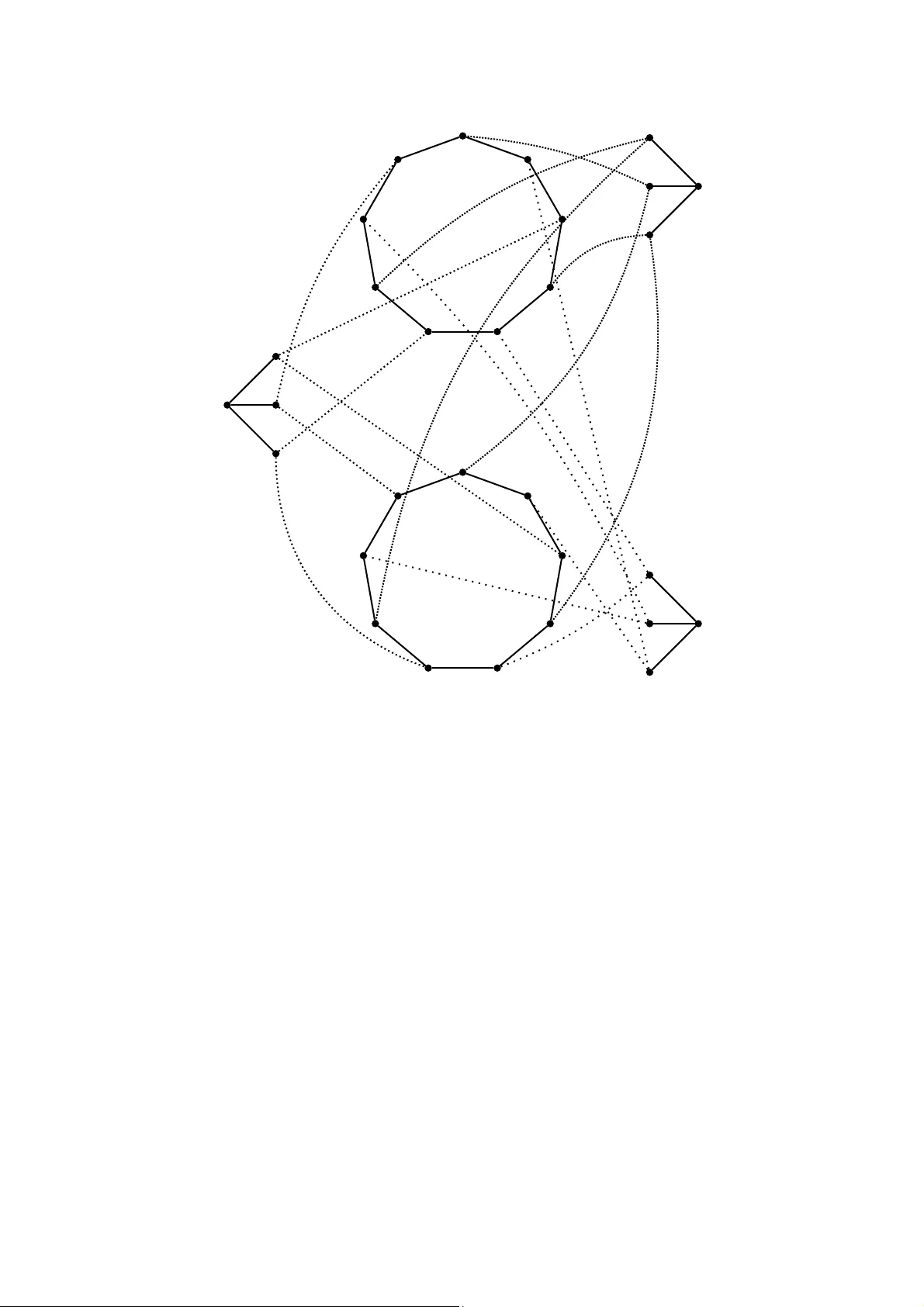
LIFTING AND F OLDING: A FRAMEW ORK F OR UNST ABLE GRAPHS AND TF-COUSI NS RUSSELL MIZZI Abstract. A graph G is unstable if its canonical double co v er CDC ( G ) has stri ctly more automorphisms than Aut ( G ) × Z 2 . A related but distinct question i s whether tw o non-isomorphic graphs can share the same CDC. W e place b oth problems within a unified framewo rk of li fting and guide d folding , revealing that b oth are gov erned by the same algebraic datum: th e conjugacy classes of strongly switc hing inv olutions in Aut ( CDC ( G )) . Our approac h is based on two-fold isomorphisms (TF -isomorphisms), a generalisation of graph isomorphism, and on lifting and guided folding adapted from voltag e-graph theory . Lifting a TF-isomorphism ( α, β ) : G → H pro duces a digraph isomorphic to the alternating d ouble co ver of G . F olding t his digraph back alw a ys y ields a graph TF-isomorphic to G : if the result is non-isomorphic to G , the tw o form a TF-cousin pair; if it coincides with G , then ( α, β ) is a non-trivial TF-automorphism and G is un stable. The tw o problems are thus tw o asp ects of t h e same construction, addressed simultaneously . Each guide corresponds to a switching invol ution of Aut ( CDC ( G )) , and distinct conjugacy classes of such invol utions pro duce d istinct non- isomorphic base graphs sharing the same CDC, recov ering a theorem of Pa cco and Scap ellato. The framework generates TF-cousin pairs and unstable graphs of an y order f rom a simple seed pair ( C k ∪ C k , C 2 k ) . W e introduce th e claw gr aph family CG ( n ) as a concrete infinite family of examples and pro ve that CG ( n ) and its companion CG ′ ( n ) are TF-cousins if and only if n is o dd. F or n = 1 t he pair ( CG (1) , CG ′ (1)) consists of the Petersen graph and a companion cubic graph on 10 vertices, wi th the Desargues graph as their common CDC. F or eac h odd n ≥ 3 th e construction yields a n ew pair of non-isomorphic cubic graphs sharing the same CDC that do es not app ear to b e isomorphic to any previously named graph family . W e conjecture t h at every TF-cousin pair and every unstable graph contains circuits C k and C 2 k as substructures for some o dd k ; this has been verified computationally for all connected graphs on at most 9 vertices. 1. Preliminaries W e consider simple mixe d gr aphs , that is, graphs whic h may con tain b oth undirected edges and directed arcs. An undirected edge { u, v } in a mixed graph is treated as the union of tw o directed arcs, ( u, v ) and ( v , u ) . A mixed graph consisting solely of undirected edges is referred to as a gr aph . Throughout th is pap er w e consider only co nnected graphs unless explici tly stated otherwise. Let G and H b e tw o graphs, and let α , β b e bijections from V ( G ) to V ( H ) . The pair ( α, β ) is a tw o-fold isomorphism (or TF-isomorphism ) from G to H if ( u, v ) is an arc of G if and only if ( α ( u ) , β ( v )) is an arc of H . T his notion w as in troduced b y Zelink a [20 ] under the name isotopy of digr aphs and later formalised as TF-isomorphi sm by Lau ri et al. [10]. W e sa y that G and H are T F-isomorphic and write G ∼ = TF H . When α = β , this re duces to an ordinary is omorphism. When α 6 = β , the pair ( α, β ) is a non-trivial TF-isomorphism: α and β need not individually b e isomorphisms from G to H , as illustrated in Figure 1. T wo non-isomorphic graphs that are TF-isomorphic are called TF-c ousins . When G = H , the pair ( α, β ) is a TF-automorphism , whic h is non -trivial when α 6 = β . The col- lection of all TF-automorphisms of G , with m ultiplication ( α, β )( γ , δ ) = ( αγ , β δ ) , is a subgroup of S V ( G ) × S V ( G ) called the two-fold automorphism gr ou p of G , denoted Aut TF ( G ) . Iden tifying eac h α ∈ Aut ( G ) with the TF-automorphism ( α, α ) giv es the inclusion Aut ( G ) ⊆ Aut TF ( G ) ; 2020 Mathematics Subje ct C l assific ation. Primary 05C25; Secondary 05C60, 20B25. Key wor ds and phr ases. canonical doub le cov er, TF-isomorphism, unstable graph, lifting, folding, vo ltage graph, cla w graph, Petersen graph. 1 2 R. MIZZI 2 3 4 5 6 1 7 G 2 3 1 7 4 6 5 H Figure 1 . A non-trivial TF-isomorphism from G to H , with α = (2 5) and β = (1 4)(3 6) . equalit y holds when G has no non-trivial TF-automorphisms. How ever , an asym metric graph G (one with | Aut ( G ) | = 1 ) ma y still admit non-trivial TF- automorphisms [11]. The c an on ic al double c ove r of G , denoted CD C ( G ) , has v ertex set V ( G ) × Z 2 ; the pairs (( u, 0) , ( v , 1)) and (( u, 1) , ( v , 0)) are arcs of CD C ( G ) whenev er ( u, v ) is an arc of G . The CDC coincides with the direct pro duct G × K 2 [6, 8] and is alw a ys bipartite with colour classes V 0 = V ( G ) × { 0 } and V 1 = V ( G ) × { 1 } . It is observed in [8 ] that Aut ( CDC ( G )) equals A ut ( G ) × Z 2 in some cases and properly con tain s it in others. A graph is said to b e unstable if Aut ( G ) × Z 2 is a prop er subgroup of Aut ( CDC ( G )) ; the elemen ts of Aut ( CDC ( G )) \ ( Aut ( G ) × Z 2 ) are called unexp e cte d automor- phisms of CDC ( G ) [12]. The index of instability of G is | Aut ( G × K 2 ) | 2 | Aut ( G ) | . This equals 1 when G is s table, and is a p ositive in teger greater than 1 wh en G is unstable. The follo wing t w o cases are regard ed as trivial ly unstable : (a) If G is bipartite, then G × K 2 consists of t w o copies of G , so G is unstable unless Aut ( G ) is trivial. (b) If t w o vertic es u , v of G share the same neigh b ourhoo d (that is, G is not vert ex- determining) , then ( α, id ) with α = ( u v ) is a non-trivial TF-au tomorphism. W e assume through out that no graph und er considera tion is trivially unstable. Standard graph-theoretic terminolog y follo ws [2, 3]; information on automorphism groups of graphs can b e found in [14]. In a cycle C 2 m , t w o v ertices at distance m are called an t i p o dal . 2. Ba ck grou nd: Inst ability and T F-A utomo rphisms The follo wing result from [12] is fundamen tal to both problems studied in this paper. Theorem 2.1 ([12]) . L et G b e a gr aph. Then Au t ( CDC ( G )) = Aut TF ( G ) ⋊ Z 2 . In p articular, G is unstable if and only if it has a non-trivial TF-automorphism. Figure 2 sho ws the smallest kno wn unstable asymmetric graph, con structed in [13] by finding a permut ation γ of its vertex set suc h that ( γ , γ − 1 ) is a non-trivial TF-automor phism; it is the first member of an infinite family of such graphs. LIFTING AND FOLDING 3 1 2 3 4 5 6 7 8 9 10 11 12 Figure 2. The smallest kno wn unstable asymmetric graph [13]. With γ = (1 2 3)(4 5 6)(7 8 9)(10 11 12) , the pair ( γ , γ − 1 ) is a non-trivial TF-automorphi sm. 3. A -Trails and Al terna ting Double C o vers The standard notion of a path carries an impl icit direction ev en for undirected graphs: under an ordinary isomorphism α , the arcs ( u, v ) and ( v , w ) map to ( α ( u ) , α ( v )) and ( α ( v ) , α ( w )) , sharing the common v ertex α ( v ) . Under a TF-isomorphism ( α, β ) , how ever, ( u, v ) maps to ( α ( u ) , β ( v )) and ( v, w ) maps to ( α ( w ) , β ( v )) : the shared v ertex is β ( v ) . Maintai ning a common v ertex b etw een the images of successive arcs therefore requires alternating directions in the original path, motiv ating the notion of an A -trail [17]. A sequence P = ( a 1 , a 2 , . . . , a k ) of arcs in a mixed graph G is an alternating tr ail ( A - tr ai l ) if eac h consecutiv e pair a i , a i +1 shares exactly one v ertex, and whenev er a i = ( x, y ) either a i +1 = ( x, z ) or a i +1 = ( z , y ) for some vertex z . The first and last vertices of P are the vertices of a 1 and a k , re sp ectiv ely , that are not shared with their neigh b our in the s equence. A mixed graph G is A - c onne cte d if every pair of ve rtices is joined by an A -trail. E v ery connected graph is A -co nnected; mixed grap hs nee d not b e. The alternating double c over ADC ( G ) of a mixed graph G is the direct pro duct of G with the digraph ~ D having V ( ~ D ) = { 0 , 1 } and unique arc (0 , 1) . Th us V ( ADC ( G )) = V ( G ) × { 0 , 1 } , with (( u, 0) , ( v , 1)) ∈ A ( ADC ( G )) if and only if ( u, v ) ∈ A ( G ) ; all vertic es ( u, 0) are sources and all ( u, 1) are sinks. Theorem 3.1 ([10]) . Gr aphs G and H ar e TF-isomorphic if and only i f CDC ( G ) ∼ = CDC ( H ) . Theorem 3.2 ([17]) . Mixe d gr aphs G and H ar e TF-is om orphic if and only if ADC ( G ) ∼ = ADC ( H ) . Theorem 3.2 extends Theorem 3.1 to mixed graphs. In the setting of undirected graphs, whic h we adopt for the remainder of the pap er, TF-isomorphic graphs G and H s atisfying CDC ( G ) ∼ = CDC ( H ) will b e called b ase gr aphs with resp ect to their common CDC. 4. Lifting and Guided F olding Lifting. W e introduce a construction analogous to the p ermutation voltage gr aph of Gross and T uck er [5], but with the p ermu tations restricted to those arising from TF-isomorphisms of the base graph. W e retain the established voltag e-graph terminology and refer to the construction as a lifting . Giv en a non-trivial TF-isomorphism ( α, β ) from a graph G to a gr aph H , the pair ( α, β ) lifts G to a digrap h ~ G α,β with v ertex set V ( ~ G α,β ) = α ( V ( G )) ∪ β ( V ( G )) and arc set determ ined by 4 R. MIZZI ( α ( u ) , β ( v )) ∈ A ( ~ G α,β ) if and on ly if ( u, v ) ∈ A ( G ) . The digraph ~ G α,β has the s ame underlying structure as ADC ( G ) , with v ertex lab els enco ded b y α and β . Where ADC ( G ) con tains arcs (( u, 0) , ( v , 1)) and (( v , 0) , ( u, 1)) , the lift con tains ( α ( u ) , β ( v )) and ( α ( v ) , β ( u )) . Figure 3 s hows the lifting of G ∼ = C 3 . 1 2 3 α (1) β (2) α (3) β (1) α (2) β (3) Figure 3. The grap h G ∼ = C 3 (left) and its lift ~ G α,β ∼ = ADC ( G ) (rig h t). If ( α, β ) is a TF-isomo rphism from H to K , the n ( α − 1 , β − 1 ) is a TF-isomorphism from K to H and ~ K α,β ∼ = ~ H α − 1 ,β − 1 ; in particular, the lifts of TF-isomorphic base graphs are i somorphic, and replacing the arcs of an y lift with undir ected edges recov ers the common CD C. The follo wing t w o observ ation s will be used in the constructions of Section 5. Prop osition 4.1. L et G b e c onne cte d and let ( α, β ) b e a TF-isomorphism fr om G to some gr aph H . Then the lift ~ G α,β is disc onne cte d i f and only if G is bip artite. Pr o of. I f G is bipartite with colour classes A and B , ev ery arc of ~ G α,β runs from α ( A ) to β ( B ) or f rom α ( B ) to β ( A ) , so the lift splits in to t w o comp onen ts, eac h a rev ersal of the other. Con v ersely , if ~ G α,β is disconnected, there exists u ∈ V ( G ) for whic h no A -trail joins α ( u ) to β ( u ) , implying that G has no o dd closed trail through u . Since every connected non-bipartite graph adm its an o dd closed trail through each of its v ertice s [2], G m ust be bipartite. Prop osition 4.2. I f G is disc onne cte d, then so is ~ G α,β . Pr o of. Each arc of ~ G α,β connects α ( u ) to β ( v ) for an arc ( u, v ) of G . If u and v lie in differen t comp onents of G , no A -trail can join α ( u ) to β ( u ) , so the lift inhe rits the disconnection. F olding. Recov ering a graph from a lift is called folding or pr oje ction [5]. The idea is to asso ciate eac h v ertex α ( u ) in one colour class of ~ G α,β uniquely with a v ertex in the other class β V ( G ) , then collapse eac h ass o ciated pair to a single vertex, so that arcs and their rev erses collapse to the s ame undirected edge. The canonical iden tificatio n α ( u ) ↔ β ( u ) reco ver s G ; more generally , an y γ ∈ Aut ( G ) yields the ident ification αγ ( u ) ↔ β γ ( u ) and produces a graph is omorphic to G . A folding is calle d trivial if its output is isomorphic to G . F ormally , a guide is a bijection φ : αV ( G ) ∪ β V ( G ) → β V ( G ) ∪ αV ( G ) b etw een the t w o colour classes satisf y ing φ ( α ( u )) = β ( v ) ⇐ ⇒ φ ( β ( v )) = α ( u ) , and the asso ciated s ti tcher ˆ φ is the surjection s ending b oth α ( u ) and φ ( α ( u )) to a common v ertex ˆ u for every u ∈ V ( G ) . Ev ery guid e is induced b y a colour-class-switc hing p ermutation of V ( CDC ( G )) . The follo wing example illustrates the t w o distinct outcomes. Example 4.1 . Let G ∼ = C 6 with V ( G ) = { 1 , 2 , 3 , 4 , 5 , 6 } and edges { i, i + 1 mo d 6 } . Set α = (2 5) and β = (3 6)(4 1) . Eac h edge { u, v } of G con trib utes arcs α ( u ) → β ( v ) and α ( v ) → β ( u ) to the lift, and the t w elv e arcs decomp ose into tw o A -connected circuits: Circuit 1 has α -class LIFTING AND FOLDING 5 { α (1) , α (3) , α (5) } and β -class { β (2) , β (4) , β (6) } ; Circuit 2 has the complemen tary classes. W e apply tw o guides, using the stitc her ˆ φ of the definition ab ov e. T rivial f olding. Set φ 1 ( α ( u )) = β ( u ) for eac h u ∈ V ( G ) . The stitche r ˆ φ 1 collapses { α ( u ) , β ( u ) } to ˆ u , and arc α ( u ) → β ( v ) b ecomes edge { ˆ u, ˆ v } . Circuit 1 yields ˆ 1 – ˆ 2 , ˆ 3 – ˆ 2 , ˆ 3 – ˆ 4 , ˆ 5 – ˆ 4 , ˆ 5 – ˆ 6 , ˆ 1 – ˆ 6 , the six edges of C 6 ; Ci rcuit 2 pro duces the same six edge s. Hence H ∼ = G : a trivial folding. Non-trivial folding. W rite ¯ u for the an tip o dal of u in C 6 (so ¯ 1 = 4 , ¯ 2 = 5 , ¯ 3 = 6 , and vice v ersa), and set φ 2 ( α ( u )) = β ( ¯ u ) for eac h u . The s titc her ˆ φ 2 collapses { α ( u ) , β ( ¯ u ) } to ˆ u . Since β ( v ) b elongs to the pair { α ( ¯ v ) , β ( v ) } , it is sent to ˆ ¯ v , so arc α ( u ) → β ( v ) b ecomes edge { ˆ u, ˆ ¯ v } . The three distinct arcs of Circuit 1 give, for instance, α (1) → β (2) ⇒ ˆ 1 – ˆ ¯ 2 = ˆ 5 ; the full set yields the triangle ˆ 1 – ˆ 3 – ˆ 5 . Circuit 2 similarly yields the triangle ˆ 2 – ˆ 4 – ˆ 6 . Hence H ∼ = C 3 ∪ C 3 6 ∼ = G : a non-trivial f olding, and G and H are TF-cousins. The followin g three lemmas formalise the s tructural constrain ts on non-trivial foldings; they build to w ard Theorem 4.6 , th e algebrai c core of the framew ork. Lemma 4. 3 . L et G b e a b ase gr aph, ( α, β ) a TF-isom orphis m fr om G to a mixe d gr aph H , φ a guide for ~ G α,β , and H ′ the gr aph obtaine d by applying the sti tcher ˆ φ . Then H ′ ∼ = TF G ∼ = TF H if and only if φ is an isomorphism fr om ~ G α,β to its c onverse ~ G opp α,β . Pr o of. A n arc ( u ′ , v ′ ) ∈ A ( H ′ ) if and only if ( α ( u ) , β ( v )) ∈ A ( ~ G α,β ) , whic h holds if and only if ( φ ( α ( u )) , φ ( β ( v ))) ∈ A ( ~ G opp α,β ) . The claim f ollows from the c hain of equiv alences ( φ ( α ( u )) , φ ( β ( v ))) ∈ A ( ~ G α,β ) ⇐ ⇒ ( u, v ) ∈ A ( G ) ⇐ ⇒ ( α ( u ) , β ( v )) ∈ A ( H ) . Lemma 4.4 ([17, 10]) . If H ′ is obtaine d b y a non-trivial folding of the li ft of a b ase gr aph G via ( α, β ) , then ( α, β ) is a TF-isomorphis m fr om G to H ′ . Lemma 4.5. L et G b e a b ase gr aph and φ a gu ide for ~ G α,β . Then φ is a s witching in volution of Au t ( CDC ( G )) . Pr o of. F or an y α ( u ) ∈ αV ( G ) there is β ( v ) ∈ β V ( G ) with φ 2 ( α ( u )) = φ ( β ( v )) = α ( u ) , and similarly φ 2 ( β ( v )) = β ( v ) . Hence φ is an inv olution sw apping the tw o colour classes. Since φ maps arcs of ~ G α,β to arcs of ~ G opp α,β and A ( ~ G opp α,β ) ∪ A ( ~ G α,β ) = A ( CDC ( G )) , φ is a s witc hing in v olution of CDC ( G ) . Theorem 4.6. L et G and H ′ b e TF-isomorphic gr aphs and ( α, β ) a TF-isomorphism fr om G to H ′ . The guides that fold ADC ( G ) into G and ADC ( H ′ ) into H ′ ar e switching i n volutions of Au t ( CDC ( G )) b elonging to the same c onj ugacy class. Pr o of. Since ( α, β ) is a TF-isomorphism from G to H ′ , the pair ( α − 1 , β − 1 ) is a TF-isomorphism from H ′ to G . Using H ′ as a base graph giv es ~ H ′ α − 1 ,β − 1 ∼ = ADC ( H ′ ) ∼ = ADC ( G ) ∼ = ~ G α,β , so there is an isomorphism ρ : ~ G α,β → ~ H ′ α − 1 ,β − 1 . Denoting the guide for G b y φ and the guide for H ′ b y φ ′ , w e hav e φ ′ ρ = ρφ b ecause both φ ′ ρ and ρφ map eac h arc of ~ G α,β to the corresp onding arc of ~ H ′ opp α − 1 ,β − 1 , giving φ = ρ − 1 φ ′ ρ . Since ρ preserves the colour classes of CDC ( G ) , the in v olutions φ and φ ′ are conjugat e. R emark 4.7 . Theorem 4.6 is consisten t with the framew ork of P acco and Scap ellato [18]. Because ev ery guide φ arises as an isomorphism b et w een ADCs, it is str ongly switc hing in Aut ( CDC ( G )) when the base graph is lo op-free. This recov ers Theorem 3.5 of [18]: the num b er of non- isomorphic lo opless graphs sharing a giv en CDC equals the n um ber of conjugacy classes of strongly s witchin g in v olutions in the au tomorphism group of that CDC. R emark 4.8 . The results of Imric h and Pisanski [7] and Aba y-Asmerom et al. [1] on Kronec ker co v ers of bipartite graphs also fall within the present framew ork. The k ey ob j ects in b oth pap ers are bip artit i on-r eversing involutions of G , that is, in volutions α ∈ A ut ( G ) that in terc hange 6 R. MIZZI the tw o colour classes; these are called p olarities in [7]. When G is bipartite, CD C ( G ) ∼ = G ∪ G , and a bip artition-rev ersing in v olution of G is preci sely a s trongly switc hing in vol ution of Aut ( CDC ( G )) . Theorem 4.6 then reco v ers the main result of [7] (Prop osition 3): the n um b er of non-isomorphic graphs H with G ∼ = H × K 2 equals the n um ber of conjuga cy classes of p olarities in A ut ( G ) , whic h is Theorem 1 of [1]. 5. Constr ucting TF-Isomorphic P airs an d Unst able Graph s In every kno wn example of an un stable asymmetric graph or a pair of non-isomorphic graphs with the same CDC, one can identify at least one pair of o dd circuits C k alongside a cir cuit C 2 k of t wice the leng th. W e hereafter tak e k to be an o dd in teger unless otherwise stated. This pattern suggests the follo wing strategy: b egin with the disconnected graph G 0 ∼ = C k ∪ C k paired with H 0 ∼ = C 2 k , and progressiv ely extend this se e d p air b y adding edges and verti ces in a con trolle d w a y . Since G 0 and H 0 share a CDC (they are TF-isomorphic), any extension that resp ects the underlying TF-isomorphism will pro duce connected TF-isomorphic pairs, yielding either TF-cousins or unstable graphs dep ending on whic h typ e of extension is applied. Note that the lift of the seed pa ir is disconn ected, as expected f rom Proposition 4.2, since G 0 ∼ = C k ∪ C k is itself discon nected. W e w ork throughout the ca se k = 3 for conc reteness. Figure 4 sho ws a TF-isomorphism f rom G 0 ∼ = C 3 ∪ C 3 to H 0 ∼ = C 6 , and Figure 5 sho ws the corresponding lift ~ G 0 α,β . The lift consists of tw o iden tical directed 6-circuits; any automorphism of one circuit that fixes arc orien tations giv es a v alid reasso ciation of the t w o componen ts, and every such reasso ciation corresp onds to a strongly switc hing inv olution of CDC ( G 0 ) in the same conjugacy class in Aut ( CDC ( G 0 )) . Hence all suc h c hoices are equiv alen t and w e ma y fix an y one. v 1 v 2 v 3 v 4 v 5 v 6 C 3 ∪ C 3 α ( v 1 ) = β ( v 4 ) β ( v 2 ) = α ( v 5 ) α ( v 3 ) = β ( v 6 ) β ( v 1 ) = α ( v 4 ) α ( v 2 ) = β ( v 5 ) β ( v 3 ) = α ( v 6 ) C 6 Figure 4. A TF-i somorphism from C 3 ∪ C 3 to C 6 . α ( v 1 ) β ( v 2 ) α ( v 3 ) β ( v 1 ) α ( v 2 ) β ( v 3 ) β ( v 4 ) α ( v 5 ) β ( v 6 ) α ( v 4 ) β ( v 5 ) α ( v 6 ) Figure 5. The lift ~ G 0 α,β corresp onding to Figure 4. LIFTING AND FOLDING 7 Extending a seed pair. The follo wing termino logy captures the t w o structural roles a v ertex can play relative to a TF-isomorphism. Definition 5.1. Let ( α, β ) b e a TF-isomorphism. A vertex x is a pi n if α ( x ) = β ( x ) . T w o distinct v ertices x , y form an entangle d p air if α ( x ) = β ( y ) and α ( y ) = β ( x ) . In the seed pair ab ov e, the v ertices v 1 , v 4 form an en tangled pair (as do v 2 , v 5 and v 3 , v 6 ), since α ( v i ) = β ( v i +3 ) and α ( v i +3 ) = β ( v i ) for i = 1 , 2 , 3 . The seed pair ma y b e extended in three wa ys, each pro ducing a different kind of output. The first t wo con structions add edges or vertices directl y to the pair; the third operates on an y existing TF-isomorphic pair and generates new ones b y a substitution mec han ism. Construction 5.1 (A dding entang led edges) . Si n c e G 0 is dis c onne cte d, at le ast one e dge must b e adde d to c onne ct it. Wheneve r an e dge { v i , v j } is adde d to G 0 , its image under ( α, β ) (namely the e dge { α ( v i ) , β ( v j ) } in H 0 ) must b e adde d sim ultane ously to pr ese rve TF-i s om orphism. T he structur e of the TF-isomorphism then determines two ty p es of e dges: • En tangled edges : e dges { v i , v j } for which v i , v j form an entangle d p air. Such an e dge maps to a self-p air e d ar c in the lif t, so its image is a single wel l-define d e dge. A dding such an e dge to G 0 , and its image to H 0 , always pr o duc es a p ai r of non-isomorphic TF-isomorphic gr aphs [12] . • Split-image edges : e dges whose image c onsists of two dir e cte d ar cs that ar e n ot self-p ai r e d. These m ust b e intr o duc e d in c omplementary p airs; doi n g so pr o duc es a p air of isomorphic gr aphs, e ach admitting a non-trivial T F-automorphism and henc e unstable [12] . A dding one, two, or thr e e entangle d e dges to the se e d p air (in n on-e quivalent ways) yields exactly the thr e e p airs of TF-c ou sins shown in Figur e 6. A dding c ompleme ntary p ai rs of split- image e dges in ste ad pr o duc es the unstable symmetric gr aphs in Figur e 7. (a) (b) (c) Figure 6 . The three non-equiv alen t pairs of TF-cousins on six vertices obtain- able from the seed pai r b y adding one, tw o, or three entang led edges. (a) (b) (c) Figure 7. P airs of isomorphic unstable s ymmetric graphs f rom the same seed pair, b y adding one, tw o, or three com plemen tary pairs of split-image edges. Construction 5.2 (Addi ng ver tices via pins) . The c ons t ruction extends natur al ly to lar ge r vertex sets. A dding an isolate d vertex x to G 0 and an isolate d vertex y to H 0 , and extending ( α, β ) by α ( x ) = β ( x ) = y , makes x a pin . Conne cting x to an entangle d p air v i , v j in G 0 by e dge s { v i , x } and { v j , x } , and adding the c orr esp onding i mages to H 0 , pr o duc es a T F-isomorphic p air of or der 7 . The ar gument extends to pins of arbitr ary de gr e e and to chain s of pins, giving TF- isomorphic p airs of any or der. 8 R. MIZZI The follo wing result pro duces new TF-isomorphic pairs from old ones b y a differen t mec hanism: replacing enta ngled v ertices b y o dd circuits. Prop osition 5.3. L et ( α, β ) b e a non-trivial T F-isomorphism fr om a gr aph G to a gr aph H , and let u , v b e an entangle d p air in G , e ach of o dd de gr e e k . L ab el the neighb ours of u as 1 , . . . , k and those of v as k + 1 , . . . , 2 k . F orm G ′ by r eplac ing u wi th an o dd cir cuit C k with vertic es u 1 , . . . , u k , attaching u i to neighb our i for e ach i , and similarly r eplac ing v wi th C ′ k with vertic es u k +1 , . . . , u 2 k , attaching u k + i to neighb our k + i . F orm H ′ fr om H by deleting α ( u ) and α ( v ) and intr o ducing the even cir cuit C 2 k whose vertic es alternate b etwe en α ( u i ) and β ( u i ) , extending α and β by α ( u i ) = β ( u i + k ) an d β ( u i ) = α ( u i + k ) for 1 ≤ i ≤ k . Then G ′ and H ′ ar e TF-isomorphic but non-isomorphic. Pr o of. That ( α, β ) extends to a TF-isomorphism from G ′ to H ′ follo ws by construction: the an tipo dal pairing α ( u i ) = β ( u i + k ) is precisely the TF-isomorphism from C k ∪ C k to C 2 k of Theorem 3.1, and the images of all edges inciden t to u 1 , . . . , u 2 k matc h those of H ′ b y the extended de finitions of α and β [17]. F or non-isomorphism, no te that the 2 k new circuit ve rtices in G ′ induce t w o comp onen ts ( C k and C ′ k ), while in H ′ they induce the connected circuit C 2 k . These vert ices are iden tifiable as those adjacent to the retained neigh b ours 1 , . . . , 2 k of u and v , so an y isomorphism G ′ → H ′ m ust carry the new circuit vertice s of G ′ to those of H ′ , mapping a disconnected induced subgra ph to a connected one, a con tradiction. An initial pair satisfying the hypotheses is readily av ailable: an y graph con taining t w o vertic es with an o dd n um b er k of common neighbours serves as a starting p oin t when tak en together with itself. Increasing k then pro duces an infinite family of non-isomorphic TF-isomorphic pairs. R emark 5.4 . The construction s ab o v e are based on the seed pair C k ∪ C k and C 2 k , whose CDC is a union of even cy cles. There exist TF-cousin pairs that do not fit this pattern and are not pro duced b y an y seed-pair construction. As a concrete example, take G = Q 5 , the 5 - dimensional hypercub e. The 5 -cube is bipartite with CD C ( Q 5 ) ∼ = Q 5 ∪ Q 5 . Among the six graphs H f or which Q 5 ∼ = H × K 2 (en ume rated in [1], Figure 6), exactly three are lo opless: those corresp onding to the conjugacy classes with parameters ( j, k ) = (3 , 0) , (3 , 1) , and (5 , 0) in the notation of [1]. Eac h is a 5 -regular graph on 16 vert ices, obtained b y add ing a p erfect matc hing to Q 4 [1]. A direct computat ion confirms that all three satisfy H × K 2 ∼ = Q 5 and ha ve pairw ise distinct adjacency sp ectra; by Theorem 3.1 they are therefore three m utu ally non-isomorphic TF-cousins. Their CDC is a h y p ercube, not a union of even cycles, so they lie outside the reac h of the construction ab ov e, but they are fully accoun ted for by the conjugacy-class criterion of Theorem 4.6. This illustrates that the lifting-and-folding framew ork is strictly more general than the seed-pair method. 6. Cla w Graphs The constructions of Section 5 establish that TF-cousin pairs and unstable graphs exis t at ev ery order, but the resulting graphs are not easy to describ e in closed form: they dep end on the partic ular c hoic es made at eac h step. This section presents an expli cit infinit e family wh ere the TF-cousin question reduce s to a single arit hmetic condition on the param eter n . The building blo c k is K 1 , 3 , the graph consisting of a centre ver tex joined to three leav es , commonly called a claw . The circuit C 6 n has 3 n an tipo dal pairs, whic h are group ed into n triples; w e attac h one cla w to eac h triple. Eac h leaf connects to exactly one an tip o dal pair and so acts as a pin in the sense of Definition 5.1. The result, denoted CG ( n ) , is a connected cubi c graph on 10 n vertices. Its companion CG ′ ( n ) is obtained b y replacing the single circuit C 6 n with tw o disjoin t copies of C 3 n , le a ving all cla w connection s unc hanged. W e sho w that CG ( n ) and CG ′ ( n ) are TF-cousins if an d only if n is o dd. F or n = 1 , CG (1) is the P etersen graph. Its companion CG ′ (1) is the graph identifi ed b y Krnc and Pisanski [9] as the unique non-isomorp hic Kronec k er cov er of the Desargues graph other than the P etersen graph; th eir comm on CDC is the Desargues graph GP(10 , 3) [7]. LIFTING AND FOLDING 9 α ( u 0 ) = β ( u 3 ) β ( u 1 ) = β ( u 4 ) α ( u 2 ) = β ( u 5 ) β ( u 0 ) = β ( u 3 ) α ( u 1 ) = β ( u 4 ) β ( u 2 ) = β ( u 5 ) α ( v 0 ) = β ( v 0 ) 0 3 6 Figure 8. The P etersen graph as a cla w graph ( k = 3 , n = 1 ). W e fix k = 3 throughout this section so that the resulting graphs are cubic: cla w cen tres and lea v es b oth ha v e degree 3 , matc hing the tw o circuit neigh bours of eac h circuit v ertex. The general case k ≥ 2 is addressed in Remark 6.2. Definition 6.1. F or a p ositive integer n , the claw g r aph CG ( n ) is constru cted as follo ws. T ak e a circuit C 6 n with vertices u 0 , . . . , u 6 n − 1 and attach n disjoint copies of K 1 , 3 , one for eac h residue 0 ≤ i < n . The i -th cop y has cen tre c i and lea v es ℓ i, 0 , ℓ i, 1 , ℓ i, 2 ; leaf ℓ i,j is joined to the pair { u i + j n , u i + j n +3 n } of an tip o dal circuit v ertices (indic es mo dulo 6 n ). The result is a cubic graph on 10 n ve rtices. Its c omp anion CG ′ ( n ) is obtained f rom CG ( n ) by replacing the single circuit C 6 n with t w o disjoin t copies of C 3 n , retaining the v ertices u 0 , . . . , u 6 n − 1 and making u 0 , . . . , u 3 n − 1 the first cop y and u 3 n , . . . , u 6 n − 1 the second. A ll cla w connections are unc hanged. Note that CG ( n ) and CG ′ ( n ) share the same v ertex set and the same cla w edges; they differ only in the circuit edges. F or n = 1 , CG (1) is the P etersen graph (Figure 8); for n = 3 , CG (3) and its companion CG ′ (3) are show n in Figures 9 and 10. Prop osition 6.1. CG ( n ) and CG ′ ( n ) ar e TF-c ousins if and only if n is o dd. Pr o of. W e pro ve the three parts in logical order: non-isomorphism first (a pure graph -theoretic argumen t independen t of TF-isomorphism theory), then the n -even obstruction using it, then the n -o dd construction. Step 1: Non-isomorphism for al l n ≥ 1 . Let S = V ( CG ( n )) \ { c 0 , . . . , c n − 1 } denote all non- cen tre v ertices. I n the subgraph G [ S ] induced b y S , ev ery circuit vert ex u m retains all three of its neigh b ours (t w o circuit, one leaf, all in S ) and has degree 3 , while ev ery leaf ℓ i,j loses its edge to c i and has degree 2 . Hence the circuit v ertices are precisely the degree- 3 vertices of G [ S ] . R emo ving the degree- 2 v ertices from G [ S ] reco v ers the subgraph induced by the 6 n circuit v ertices alone. I n CG ( n ) this is C 6 n , whic h is connected. In CG ′ ( n ) it is C 3 n ∪ C 3 n , whic h has t w o comp onen ts. A n y isomorphism f : CG ( n ) → CG ′ ( n ) w ould comm ute with this pro cedure and so carry the (connected) circuit subgraph of CG ( n ) to the (disconnecte d) circuit subgraph of CG ′ ( n ) , a con tradiction. Hence CG ( n ) 6 ∼ = CG ′ ( n ) . Step 2: n even implies the gr aphs ar e not TF-c ousins. When n is even, 3 n is even, so the an tipo dal pair { u m , u m +3 n } in C 6 n satisfies m ≡ m + 3 n (mo d 2) : b oth endp oin ts ha v e the same parit y . Ev ery leaf ℓ i,j is adjacen t to exactly such an an tipo dal pair, so assigning colour 0 to all ev en-indexed circuit v ertices and colour 1 to all o dd-indexed ones, then colour 1 to all lea v es and colour 0 to all cla w cen tres, gives a proper 2 -colouring of CG ( n ) . The same colouring w orks for 10 R. MIZZI α ( u 0 ) = β ( u 9 ) β ( u 1 ) = β ( u 10 ) α ( u 2 ) = β ( u 11 ) β ( u 3 ) = β ( u 12 ) α ( u 4 ) = β ( u 13 ) β ( u 5 ) = β ( u 14 ) α ( u 6 ) = β ( u 15 ) β ( u 7 ) = β ( u 16 ) α ( u 8 ) = β ( u 17 ) β ( u 0 ) = β ( u 9 ) α ( u 1 ) = β ( u 10 ) β ( u 2 ) = β ( u 11 ) α ( u 3 ) = β ( u 12 ) β ( u 4 ) = β ( u 13 ) α ( u 5 ) = β ( u 14 ) β ( u 6 ) = β ( u 15 ) α ( u 7 ) = β ( u 16 ) β ( u 8 ) = β ( u 17 ) α ( v 0 ) = β ( v 0 ) 0 3 6 α ( w 0 ) = β ( w 0 ) 1 4 7 α ( x 0 ) = β ( x 0 ) 2 5 8 Figure 9. The cla w graph CG (3) : the case k = 3 , n = 3 . CG ′ ( n ) (the tw o copies of C 3 n are ev en cycles, hence bipartit e, with the same par it y structure). Th us b oth graphs are bipartite. F or any bipartit e graph G , the CDC s atisfies CDC ( G ) ∼ = G ∪ G (the t wo sheets of the co v er are isomorphic copies of G ). H ence CDC ( CG ( n )) ∼ = CG ( n ) ∪ CG ( n ) and CDC ( CG ′ ( n )) ∼ = CG ′ ( n ) ∪ CG ′ ( n ) . These are isomor phic if and only if CG ( n ) ∼ = CG ′ ( n ) , which w e ha ve sho wn is false. By Theorem 3.1, CG ( n ) and CG ′ ( n ) ar e not TF-isomorphic. Step 3: n o dd implies the gr aphs ar e TF-c ousins. When n is o dd, 3 n is odd, s o m and m + 3 n ha v e opp osite parit y; the leaf ℓ i,j is then adjacen t to ve rtices of b oth colour classes, and the path u m − ℓ i,j − u m +3 n closes an o dd cycle. Hence CG ( n ) and CG ′ ( n ) are b oth non-bipart ite. Define ( α, β ) on V ( CG ′ ( n )) b y setting α ( u m ) = u m and β ( u m ) = u m +3 n mo d 6 n for 0 ≤ m < 6 n , and α ( v ) = β ( v ) = v f or ev ery cla w v ertex v (cen tre or leaf ). Then α is the identit y , and β acts as translation-b y- 3 n mo dulo 6 n on circuit vert ices and as the iden tity on cla w v ertices; b oth are bijections V ( CG ′ ( n )) → V ( CG ( n )) . W e v erify the TF-isomorphism condition { α ( u ) , β ( v ) } ∈ E ( CG ( n )) for eac h edge { u, v } ∈ E ( CG ′ ( n )) . • Cir cu it e dges. Eac h edge { u m , u m +1 } lies within one cop y of C 3 n ; it maps to the edge { u m , u m +1+3 n } of C 6 n . A s m ranges o v er b oth copies, all 6 n edges of C 6 n are co v ered exactly once. • L e af–cir cuit e dges. Leaf ℓ i,j is a pin: α ( ℓ i,j ) = β ( ℓ i,j ) = ℓ i,j . Its edges { ℓ i,j , u i + j n } and { ℓ i,j , u i + j n +3 n } map to { ℓ i,j , u i + j n } (via α ) and { ℓ i,j , u i + j n +3 n } (via β ), reco v erin g b oth leaf–circuit edges of CG ( n ) . • Claw e dges. Eac h edge { c i , ℓ i,j } is fixed b y b oth α and β . Hence ( α, β ) is a TF-isomorphism from CG ′ ( n ) to CG ( n ) . T ogeth er with the non-isomorphism pro v ed ab o v e, CG ( n ) and CG ′ ( n ) are TF-cousins. LIFTING AND FOLDING 11 u 0 u 1 u 2 u 3 u 4 u 5 u 6 u 7 u 8 u 9 u 10 u 11 u 12 u 13 u 14 u 15 u 16 u 17 v 0 0 3 6 w 0 1 4 7 x 0 2 5 8 Figure 1 0. The companion CG ′ (3) , whic h is TF-isomorphic but non-isomorphic to CG (3) . R emark 6.2 . The same construction and proof w ork f or any in teger k ≥ 2 , replacing 3 n by k n throughout. The seed pair C k n ∪ C k n and C 2 kn satisfies CDC ( C k n ∪ C k n ) ∼ = CDC ( C 2 kn ) if and only if k n is o dd, b y the same CDC component-c oun t argumen t used ab ov e. When k n is even , whic h is forced whenev er k or n is even, no TF-cousin pair arises; when k n is o dd, requiring b oth k and n to b e o dd, the an tip o dal TF-isomorph ism extends to the f ull cla w gr aph as b efore. F or k = 3 the graphs are cubic; f or k > 3 the cla w centre s ha v e degree k while all other ve rtices hav e degree 3 , so the graphs are no longer regular, but the non-isomorp hism argumen t via induced subgraph co nnectivit y is unc hanged. R emark 6.3 . The graphs CG (3) and CG ′ (3) s hare several parameter s: b oth are cubic, ha v e 30 v ertices and 45 edges, are triangle-free with girth 6, hav e diameter 5, are bridgeless, and con tain exactly 18 six-cycles. Each has t w o v ertex orbits under its automorph ism group: the three cla w-c en tre vertices v 0 , w 0 , x 0 form one orbit, and the remaining 27 v ertices form the other, so neither graph is v ertex-tra nsitiv e. The adjacency sp ectra of the tw o graphs differ, how ev er, confirming tha t they are non-isomo rphic despite sharing all the abov e inv arian ts. I n particular, the s p ectral radius of b oth is 3 (as exp ected for an y cubic graph), but the f ull sp ectra are distinct. As the theory requires, the canonical double co v ers of the t w o graphs are is omorphic; this w as v erified b y comparing their adjacency sp ectra directly . Neither graph is isomorphic to an y generalised P etersen graph GP(15 , j ) (all suc h graphs ha v e differen t girth or sp ectrum), and neither is a circulan t graph, since those are v ertex-tran sitiv e. T o the b est of our knowled ge, neither graph app ears in an y published census of named cubic graphs. 12 R. MIZZI 7. Concluding Remarks W e ha v e in troduced a unified framew ork of lifting and guided folding for t w o problems that ha v e typically been treated indep enden tly: constructing unstable graphs, and constructing TF- cousins. The cen tral observ ation, formalised in Theorem 2.1 and sharpened by Lemmas 4.3–4.5 and Theorem 4.6, is that b oth problems are gov erned by the s ame algebraic datum: the conjugacy classes of strongly switc hing in v olutions in the automorp hism group of the common CDC. The language of lifting and folding, adapted from v oltage graph theory [5], mak es this rela- tionship transparen t. Each guide φ determines a sp ecific fold, and distinct conjugacy classes of guides yield distinct TF-cousins sharing the same CDC (Prop ositions 4.5–4.6). The construc- tions of Section 5 sho w concretely that b oth problems ha v e solutions at ev ery order: the seed pair ( C k ∪ C k , C 2 k ) , together with the op erations of adding entangl ed edges and pins, yields TF- isomorphic pairs and unstable graphs of ev ery order. A further construction (Prop osition 5.3) pro duces new TF-isomorphic pairs b y replacing en tan gled vertices with o dd circuits, giving a s ec- ond infinite family of examples. The cla w-gr aph family of Sec tion 6 demonstrates that prominen t graphs, including the P etersen graph, arise naturally within this framew ork. W e note in passing that Collins and Sciriha [4] ask whether graphs with isomorphic CDCs necessarily s hare the same main eigen v alues, describing this as an open problem . The answ er is affirmativ e and is in fact a con sequence of the s tronger result, already established by Po rcu [19 ], that graphs with isomorp hic CDCs are cosp ectral. Sev eral questions remain op en. Ev ery know n example of either problem con tains a pair of circuits C k , C 2 k as a substructure; we conjecture that this is a necessary condition, and confirming or refuting it w ould clarify the structural role of C k ∪ C 2 k in b oth problems. I n particular, the conjecture is consistent with all TF-cousin pairs on at most 8 v ertices catalogued by Collins and Sciriha [4]: in every case the common CDC con tains C 2 k and eac h base graph cont ains C k for some o dd k . W e ha v e extended this verifica tion to all connected graphs on at most 9 vertices using McKa y’s complete enum eration [16, 15]: there are no TF-cousin pairs on 6 v ertices, 4 pairs on 7 vertices, 39 pairs on 8 verti ces, and 469 pairs on 9 vertices, and in every case b oth members of the pair con tain circuits C k and C 2 k as substruct ures of their commo n CDC for some odd k . W e note that our coun ts include all connected non-isomorphic TF-cousin pairs, without ex- cluding trivially unstable cases; the coun t of 32 in [4] restricts to pairs in whic h neither graph is trivially unstable, accoun ting for the difference. The n um ber of TF-cousins of a given graph is dete rmined in principle b y the conjugacy classes of strongly switc hing in v oluti ons in its CDC (Theorem 4.6), but an explicit count for the cla w graph family remains op en: Prop osition 6.1 establishes that CG ( n ) has at least one TF-cousin for each o dd n , but whether CG ′ ( n ) is the unique one is an open question that w ould be resolv ed b y a complete description of the strongly switc hing in v olutions of CD C ( CG ( n )) . Progress on any of these questions w ould deep en the connection b et w een the algebraic structure of Aut ( CDC ( G )) and the com bina torial prop erties of its base graphs. A ckno wledgements The author thanks Josef Lauri and Raffaele Scapellato for their encouragem en t and guidance during the early s tages of this w ork. The term TF -c ousin w as us ed informally in our earlier collaboration; it is adopted here in the hope that they find it a fitting name. Reference s [1] G. Abay-Asmerom, R . Hammack, C. E. Larson, and D. T. T a ylor. Direct pro duct factorization of bipartite graphs with bipartition-reversing inv olutions. SIAM Journal on Discr ete Mathematics , 23(4):2042–20 52, 2010. [2] A. Bondy and U.S.R. Murty . Gr aph The ory (Gr aduate T exts i n Mathematics) . Springer, 2008. [3] F. Buckley and F. Harary . Distanc e in gr aphs . The Adv anced Bo ok Program. Addison-W esley Pub. Co., 1990. [4] Luke Collins and Irene Sciriha. The w al ks and cdc of graphs with th e same main eigenspac e. Discussiones Mathematic ae Gr aph The ory , 2020. [5] Jonathan L. Gross and Thomas W. T uc ker. T op olo gic al Gr aph The ory . Wiley Series in Discrete Mathematics and Optimization. Wiley-Interscience, New Y ork, 1987. LIFTING AND FOLDING 13 [6] W. Imrich and S. Klavzar. Pr o duct Gr aphs: Structur e and R e c o gnition . W iley , 2000. [7] W. Imrich and T. Pisanski. Multiple Kronec ker cov ering graphs. Eur op e an Journal of Combinatorics , 29(5):111 6–112 2, 20 08. [8] M. H. Klin, J. Lauri, and M. Ziv-A v. Links b et w een tw o semisymmetric graphs on 112 verti ces via association sc hemes. J. Symb. Comput. , 47(10):1175–1 191, 2012. [9] M. Krn c and T. Pisanski. Generalized Petersen graphs and Kronecke r cov ers. Discr ete Mathematics and The or etic al C om puter Scienc e , 21(4), 2019. [10] J. Lauri, R . Mizzi, and R. Scap ellato. T wo -fold orbital digraphs and other constructions. International J. of Pur e and Applie d Math. , 1:63–93, 2004. [11] J. Lauri, R. Mizzi, and R. Scapellato. T w o-fo ld automorphisms of graphs. Aust r alasian J. Combinatorics. , 49:165 –176, 2011. [12] J. Lauri, R . Mizzi, and R. Scap ellato. Unstable graphs: A fresh outlook via TF-automorphisms. Ars Mathe- matic a Contemp or ane a , 8(1 ):115–1 31, 2015. [13] J. Lauri, R. Mizzi, and R. Scap ellato. The construction of a smallest u nstable asymmetric graph and a family of u n stable asymmetric graphs with an a rbitrarily h igh index of instabilit y . Discr ete Applie d Mathe- matics , 266:85–91 , 2019. Sp ecial issue: The Second Malta Conference in Graph Theory and Combinatorics (2MCGTC -2017). [14] J. Lauri and R. Scap ellato. T opics in Gr aph Aut omorphisms and R e c onstruction . Cambridge Universit y Press, 2003. [15] B. D. McKa y . C om binatorial data: Graphs, 2024. Graph data av ailable at https://users. cecs.anu. edu. au/~bdm/da ta/graphs. html . [16] B. D . McKa y and A. Piperno. Practical graph isomorphism, I I. Journal of Symb ol ic Computation , 60:94–112 , 2014. [17] R. Mizzi. Two-F old Aut omorphisms . PhD thesis, Universit y of Malta, Malta, 2015. [18] W. P acc o and R. Scap ellato. Digraphs ha ving the same canonical double co vering . Discr ete Math. , 173(1– 3):291– 296, 1997. [19] L. Po rcu. Sul raddoppio di un grafo. At t. Ist. L omb ar do (R end. Sci.) , A(110):453–480 , 1976. [20] B. Zelink a. Isotopy of digraphs. Cze choslova k Mathematic al Journal , 22(3):353– 360, 1972. Dep ar tment of Ma thema tic s, University of Mal t a, M al t a Email addr ess : russell. mizzi@um.e du.mt
Original Paper
Loading high-quality paper...
Comments & Academic Discussion
Loading comments...
Leave a Comment