Root lattices over totally real fields
A root lattice is a finite rank $\mathbb{Z}$-lattice generated by elements $x$ satisfying $x\cdot x=2$. It is well-known that the root lattices have an $ADE$ classification and they play a prominent role in the study of even unimodular lattices. The …
Authors: Ryotaro Sakamoto, Miyu Suzuki, Hiroyoshi Tamori
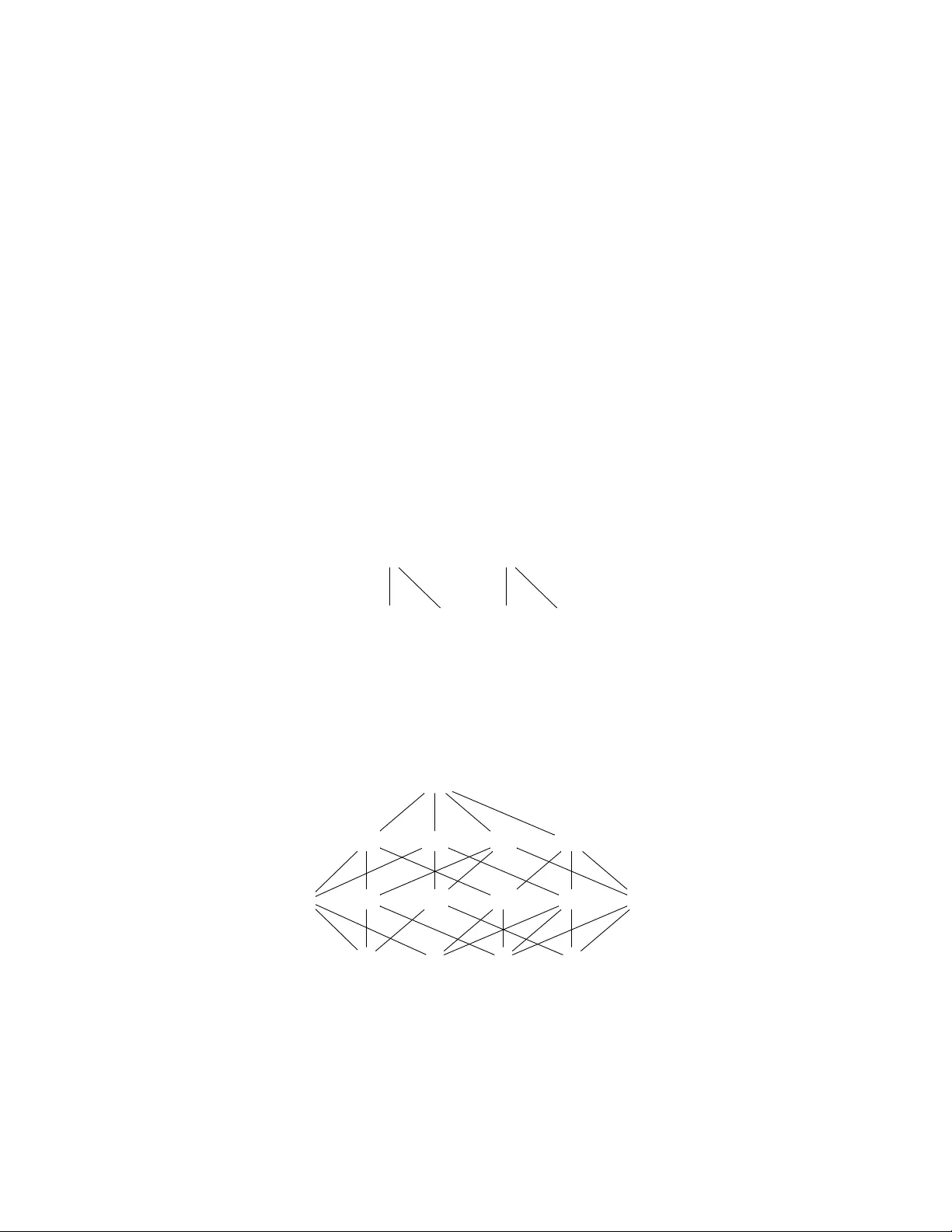
Ro ot lattices o v er totally real fields Ry otaro Sak amoto, Miyu Suzuki, and Hiroy oshi T amori Abstract. A ro ot lattice is a finite rank Z -lattice generated b y elemen ts x satisfying x · x = 2. It is well-kno wn that the root lattices hav e an ADE classification and they pla y a prominent role in the study of ev en unimodular lattices. The notion of ro ot lattices can be naturally generalized to lattices o ver the ring of integers O of a totally real field K . In the case where K is a real quadratic field, suc h lattices w ere classified b y Mim ura in 1979, and this classification has b een used b y several researc hers in the study of even unimodular O -lattices. In this pap er, we extend this classification to arbitrary totally real fields. The irreducible ro ot lattices of rank greater than 2 are indexed by finite Co xeter systems. All the rank 2 ro ot lattices are realized as orders in quadratic extensions of K and their classification requires some technique from algebraic n umber theory . Contents 1. In tro duction 1 2. Preliminaries 3 3. Structure of ro ot systems 7 4. The case of rank greater than 2 10 5. The case of rank 2 14 References 20 1. In tro duction A r o ot lattic e is a finitely generated free Z -mo dule L generated b y the set of ro ots Φ( L ) : = { x ∈ L | x · x = 2 } . Here, ( x, y ) 7→ x · y is a p ositiv e definite symmetric bilinear form on the real v ector space V : = L ⊗ Z R of p ositiv e dimension satisfying x · y ∈ Z for all x, y ∈ L . Ro ot lattices play a prominent role in the classification of 24-dimensional even unimodular lattices, namely Niemeier lattices. See [ 2 , Chapter 18] and [ 4 , Chapter 3]. It is known that every ro ot lattice admits a unique direct sum decomp osition in to irreducible ro ot lattices, whic h are classified by the AD E -t yp es. T o b e precise, if L is an irreducible ro ot lattice, then Φ( L ) is an irreducible simply-laced ro ot system and is classified using the Dynkin diagrams of t yp e A n ( n ≥ 1), D n ( n ≥ 4), and E n ( n = 6 , 7 , 8). F or the details, w e refer the readers to [ 4 , Chapter 1]. In the presen t pap er, we generalize this classification to the ro ot lattices o v er totally real fields. Let K b e a totally real num b er field, that is, K is an algebraic (p ossibly infinite) extension of Q and all embeddings K → C ha v e image in R . Let O : = O K denote the ring of integers of K , that is, the set of all elemen ts of K that are in tegral o ver Z . Supp ose that L is a 1 nonzero finitely generated free O -module with a non-degenerate symmetric bilinear form L × L → O ; ( x, y ) 7→ x · y . W e sa y that L is an O -lattic e if the bilinear form is totally p ositiv e definite, i.e. , for all real em b edding σ : K → R , we ha ve σ ( x · x ) > 0 , x ∈ L \ { 0 } . An O -lattice L is called a ro ot lattice if it is generated by Φ( L ) : = { x ∈ L | x · x = 2 } . In the case where K is a real quadratic field, ro ot lattices w ere classified by Mimura in [ 8 ] using an ad-ho c method. Based on that classification, even unimo dular lattices ov er real quadratic fields are studied by many researc hers, see for example [ 12 ], [ 3 ] [ 6 ], [ 5 ] and [ 10 ]. Ho wev er, to our knowledge, the authors could not find an y references on ro ot lattices o ver general totally real fields. Sc harlau [ 10 , § 2.6] men tioned that several finite Co xeter groups o ccur as W eyl groups of ro ot lattices ov er real quadratic fields, but did not consider general totally real fields, saying that ⟨ ⟨ Since so little is known in general, the restriction to quadratic fields seems to b e quite natural at presen t and is also adopted in our work. ⟩ ⟩ No w we state our main results. First, we fix an em b edding of K into R , and regard K as a subfield of R . F or simplicit y , we also assume that [ K : Q ] < ∞ . Let L b e a ro ot lattice ov er O . W e then observ e that Φ( L ) is a finite set and has a natural structure of a ro ot system. Then it admits a fundamental system of ro ots ∆ : = ∆( L ) ⊂ Φ( L ), which is • a basis of the K -v ector space L ⊗ O K and • each α ∈ Φ( L ) is written in the form α = P β ∈ ∆ c β β with c β ∈ O ≥ 1 ⊔ { 0 } for all β ∈ ∆ or − c β ∈ O ≥ 1 ⊔ { 0 } for all β ∈ ∆. Here O ≥ 1 : = O ∩ R ≥ 1 . W e prov e in Theorem Counter 3.2 that for each α, β ∈ ∆, there exists a unique positive integer m : = m ( α, β ) such that α · β = − 2 cos( π /m ) . Hence w e can asso ciate the Coxeter-Dynkin diagram to L , whose vertices are the ro ots in ∆ and the edges are lab eled by m ( α, β ). It turns out that this diagram is the one corresp onding to a finite Co xeter system (see Theorem Counter 3.10 ). The p ossible diagrams are recalled in Theorem Coun ter 2.11 . They are one of the following types: A n ( n ≥ 1), B n ( n ≥ 2), D n ( n ≥ 4), E n ( n = 6 , 7 , 8), F 4 , H n ( n = 3 , 4), and I 2 ( m ) ( m ≥ 5). The problem is the existence of an irreducible ro ot lattice ov er O of t yp e X n , where X n is one of the lab els listed abov e. W e note that the ro ot lattice of t yp e X n has O -rank n . F or each X n , w e set c ( X n ) = 1 if X n = A n ( n ≥ 1), D n ( n ≥ 4), or E n ( n = 6 , 7 , 8) , √ 2 if X n = B n ( n ≥ 2) or F 4 , (1 + √ 5) / 2 if X n = H n ( n = 3 , 4) , 2 cos( π /m ) if X n = I 2 ( m ) ( m ≥ 5). When the O -rank is greater than 2, we pro ve the next theorem. Theorem 1.1. L et K b e a total ly r e al numb er field and O = O K its ring of inte gers. Supp ose that n is an inte ger gr e ater than 2 . Then, ther e exists an irr e ducible r o ot lattic e over O of typ e X n if and only if c ( X n ) ∈ K . Note that Theorem Counter 1.1 holds for all totally real fields K , without assuming [ K : Q ] < ∞ . F or more details, see Section 4 . When the O -rank is 2, the situation is drastically differen t. F or any p ositiv e integer n , let ζ n ∈ ¯ K denote a primitiv e n -th ro ot of unity . W e define a directed graph with the set of vertices Q K = { n > 1 | ζ 2 n + ζ − 1 2 n ∈ K } 2 and the vertices x, y ∈ Q K are connected by an edge directed from x to y if x divides y and y /x is a prime n um b er. By an abuse of notation, we denote this graph by Q K . W e also define the partial order on Q K suc h that x ⪯ y if there is a path from x to y . Let π 0 ( Q K ) denote the set of connected comp onents of the graph Q K and define the subsets P K and R K of the p o w er set of Q K as follows: P K : = {{ q } | q ∈ Q K is a prime p o wer } , R K : = { C ∈ π 0 ( Q K ) | C con tains an integer that is not a prime p o wer } . Let µ ∞ ⊂ ¯ K × denote the group of all ro ots of unit y . F or each C ∈ P K ∪ R K , let µ ( C ) b e the subgroup of µ ∞ generated b y { ζ 2 n | n ∈ C } . The next theorem classifies all the rank 2 ro ot lattices. Theorem 1.2. F or any r o ot lattic e L over O of r ank 2 , let µ ( L ) denote the sub gr oup of µ ∞ gener ate d by { ζ ∈ µ ∞ | ζ + ζ − 1 = α · β for some α, β ∈ Φ( L ) } . Then we have µ ( L ) = µ ( C ) for some C ∈ P K ∪ R K and the map { r o ot lattic es over O of r ank 2 } / ≃ → { µ ( C ) | C ∈ P K ∪ R K } ; L 7→ µ ( L ) . is a bije ction. In p articular when [ K : Q ] < ∞ , ther e exists an irr e ducible r o ot lattic e over O of typ e I 2 ( m ) ( m ≥ 3 ) if and only if K satisfies the fol lowing c onditions (i) and (ii): (i) We have c ( I 2 ( m )) = 2 cos( π /m ) ∈ K i.e., m ∈ Q K . (ii) The inte ger m is a prime p ower or a maximal element of Q K . F or more precise statement, see Theorem Counter 4.6 , Theorem Counter 5.20 , and Theorem Coun ter 5.21 . The case of K = Q of our result recov ers the ADE classification of the ordinary ro ot lattices. When [ K : Q ] = 2, our classification concincides with the one obtained b y Mim ura in [ 8 ]. This article is organized as follo ws. In Section 2 , we introduce necessary notations for ro ot lattices and recall the classification of finite Co xeter systems. In Section 3 , we sho w that the set of ro ots Φ( L ) of a ro ot lattice L has a fundamen tal system of roots assuming | Φ( L ) | < ∞ . W e asso ciate Coxeter-Dynkin diagrams with irreducible root lattices and observ e that they corresp ond to finite Coxeter systems. Section 4 is dev oted to proving the following: for an irreducible root lattice of rank greater than 2, the set of roots do es not c hange under extension of scalars. In particular, we see that an irreducible ro ot lattice L with rank( L ) ≥ 3 satisfies | Φ( L ) | < ∞ , and we deduce Theorem Counter 1.1 from this. The rank 2 ro ot lattices are studied in Section 5 . First w e observ e a rank 2 ro ot lattice is isomorphic to an order O [ ζ ] in a quadratic extension K ( ζ ) of K . The group of ro ots of unity in O [ ζ ] is a complete inv arian t of its isomorphism class as a ro ot lattice. W e are thus reduced to studying p ossible orders of the form O [ ζ ], which can b e analyzed b y examining the ramification at eac h prime. Ac kno wledgment. The authors would like to thank T amotsu Ikeda and Hiroyuki Ochiai for v aluable commen ts and kindly answ ering questions. R.S. w as supp orted b y JSPS KAKENHI Gran t Num b er JP24K16886. M.S. w as supp orted b y JSPS KAKENHI Gran t Num b er JP22K13891. H.T. w as supp orted b y JSPS KAKENHI Gran t Num b er JP23K12947. 2. Preliminaries 2.1. Definitions of ro ot lattices. Let K b e a totally real n um b er field and O : = O K its ring of integers. W e fix an embedding K → R once for all and consider the total order on K induced from this em b edding. Supp ose that V is a K -vector space of dimension n ∈ Z > 0 with a symmetric bilinear form V × V → K ; ( x, y ) 7→ x · y . 3 Throughout this article, w e assume that this symmetric bilinear form is total ly p ositive definite , that is, for any real embedding σ : K → R and any non-zero vector x ∈ V , we ha ve σ ( x · x ) > 0. Definition 2.1. An O -lattic e in V is a finitely generated O -submo dule L ⊂ V with the prop erty that there exists a basis v 1 , v 2 , . . . , v n of V ov er K such that L = O v 1 + O v 2 + · · · + O v n . W e sa y that an O -lattice L in V is r e ducible if there exist an orthogonal decomp osition V = V 1 ⊕ V 2 with V 1 = 0 and V 2 = 0, and O -lattices L i in V i for i = 1 , 2 suc h that L = L 1 ⊕ L 2 . A lattice is called irr e ducible if it is not reducible. Definition 2.2. (1) An O -lattice L ⊂ V is called inte gr al if x · y ∈ O for all x, y ∈ L . (2) Set Φ( L ) : = { x ∈ L | x · x = 2 } . An element of Φ( L ) is called a r o ot of L . (3) An O -lattice L ⊂ V is called a r o ot lattic e ov er O if it is integral and generated by Φ( L ). F rom now until the end of this article, let L ⊂ V b e a ro ot lattice ov er O and set Φ : = Φ( L ). Let K ≥ 1 denote the elements of K not smaller than 1 with resp ect to the order induced from the fixed embedding K → R . W e set O ≥ 1 = K ≥ 1 ∩ O . Definition 2.3. A subset ∆ : = ∆( L ) of Φ is called a fundamental system of ro ots if it satisfies the follo wing conditions (i) and (ii): (i) The set ∆ is a basis of the v ector space V . (ii) Each ro ot α ∈ Φ can be written as α = P β ∈ ∆ c β β with c β ∈ O ≥ 1 ⊔ { 0 } for all β ∈ ∆ or − c β ∈ O ≥ 1 ⊔ { 0 } for all β ∈ ∆. A priori we do not kno w the existence of a fundamental system of ro ots. This is prov ed in Section 3 when [ K : Q ] < ∞ and in Section 4 when rank( L ) > 2 for general K . Note that a fundamen tal system of ro ots ma y not exist when rank( L ) = 2 and [ K : Q ] = ∞ . The following lemma is a w ell-known result due to Kroneck er. F or the reader’s con venience, we include a pro of. Lemma 2.4 (Kroneck er’s theorem) . L et α b e a non-zer o algebr aic inte ger. (1) If al l c onjugates of α over Q have absolute value at most 1 , then α is a r o ot of unity. (2) If al l c onjugates of α over Q ar e r e al numb ers with absolute values at most 2 , then α = 2 cos( rπ ) for some r ∈ Q . (3) If al l c onjugates of α over Q ar e r e al numb ers with absolute values at most √ 2 , then α ∈ { 0 , ± 1 , ± √ 2 } . Proof. Let ¯ Z denote the ring of all algebraic integers. Let { α 1 , α 2 , . . . , α r } b e the set of all conjugates of α ov er Q . (1) W e present a pro of for completeness, adapted from [ 1 , Theorem 1.5.9]. F or an y in teger k ∈ { 0 , 1 , . . . , r } , let s k ( t 1 , t 2 , . . . , t r ) : = X 1 ≤ i 1 0 . By the pigeonhole principle, there are integers m, n ∈ Z > 0 with m < n such that s k ( α m 1 , α m 2 , . . . , α m r ) = s k ( α n 1 , α n 2 , . . . , α n r ) = : s k 4 for all k = 0 , 1 , . . . , r . Then b oth { α m j } r j =1 and { α n j } r j =1 are the set of the ro ots of the p olynomial P r k =0 ( − 1) k s k t r − k , and hence there exists a p erm utation τ ∈ S r satisfying α m j = α n τ ( j ) for an y j = 1 , 2 , . . . , r . If d denotes the order of τ , then w e ha ve α m d j = ( α n τ ( j ) ) m d − 1 = ( α n 2 τ 2 ( j ) ) m d − 2 = · · · = α n d τ d ( j ) = α n d j , whic h implies α j is a ro ot of unity . (2) W e ma y assume that α = ± 2. Let ζ b e a ro ot of the p olynomial t 2 − αt + 1. Then ζ ∈ { ( α ± √ α 2 − 4) / 2 } . It follo ws from α 2 − 4 < 0 that | ζ | = 1, and the other ro ot of t 2 − αt + 1 is ζ − 1 . In particular α = ζ + ζ − 1 . Hence it suffices to show that ζ is a ro ot of unity . Note that ζ ∈ ¯ Z since is ¯ Z is integrally closed. F or eac h α j , set ζ j = ( α j + q α 2 j − 4) / 2. Then all conjugates of ζ ov er Q is ζ ± 1 , ζ ± 1 2 , . . . , ζ ± 1 r . Since all of them hav e absolute v alue 1, it follo ws from (1) that ζ is a ro ot of unity . (3) W e see from (2) that, by replacing α with − α if nec essary , there exist an embedding ι : Q ( α ) → R and a p ositiv e integer n such that ι ( α ) = 2 cos( π /n ). Since | ι ( α ) | ≤ √ 2 by as- sumption, we deduce that n ≤ 4. Consequently , α ∈ { 0 , ± 1 , ± √ 2 } . □ Corollary 2.5. F or al l α, β ∈ Φ( L ) , we have α · β = 2 cos( r π ) with some r ∈ Q . Proof. Set c = α · β ∈ O . Since ( α ± β ) · ( α ± β ) = 4 ± 2 c , for any embedding σ : K → R w e ha ve σ (4 ± 2 c ) ≥ 0, i.e. − 2 ≤ σ ( c ) ≤ 2. Hence the assertion follo ws from Theorem Counter 2.4 (2). □ W e recall another basic fact on cyclotomic units for later use. Lemma 2.6. L et m and k b e p ositive inte gers with m ≥ 2 . Set R : = Z [2 cos( π /m )] , c k : = sin( k π /m ) sin( π /m ) . Then c k ∈ R . Mor e over, if m and k ar e c oprime, then c k ∈ R × . Proof. Let U n ( t ) b e the Cheb yshev p olynomial of the second kind. It is a p olynomial with in teger co efficien ts of degree n , satisfying U n (cos θ ) = sin(( n + 1) θ ) sin θ . Set q n ( t ) : = U n ( t/ 2). F rom the recurrence relation q n +1 ( t ) = tq n ( t ) − q n − 1 ( t ), we see that q n ( t ) is a monic p olynomial in Z [ t ]. Hence c k = q k − 1 (2 cos( π /m )) is in R . Supp ose that m and k are relativ ely prime. W e then hav e c k = ζ k 2 m − ζ − k 2 m ζ 2 m − ζ − 1 2 m = ζ 1 − k 2 m 1 − ζ k m 1 − ζ m , whic h is a unit of Z [ ζ 2 m ] by [ 13 , Prop oisition 2.8, Lemma 8.1]. Hence it follows that c k is in R ∩ Z [ ζ 2 m ] × = R × . □ W e define the W eyl group as usual. F or a non-zero v ector α ∈ V \ { 0 } , let s α ∈ GL( V ) denote the reflection with resp ect to the hyperplane H α : = { v ∈ V ⊗ K R | α · v = 0 } . Precisely , we set s α ( v ) : = v − 2 α · v α · α α, v ∈ V . Definition 2.7. The Weyl gr oup W : = W ( L ) of L is the subgroup of GL( V ) generated b y the reflections { s α | α ∈ Φ( L ) } . Since reflections preserve the symmetric bilinear form on V , the W eyl group W is a subgroup of the orthogonal group O( V ). In particular Φ is stable under W . 5 2.2. Finite Co xeter systems. This subsection is devoted to recalling basic facts ab out finite Co xeter groups. Definition 2.8. A group W is called a Coxeter gr oup if it has a presentation W = ⟨ s 1 , s 2 , . . . , s n | ( s i s j ) m ij = 1 ⟩ , where m ij ∈ Z ⊔ {∞} with the prop ert y that m j j = 1 and m ij = m j i > 1 for i = j . Set S : = { s 1 , s 2 , . . . , s n } , then the pair ( W , S ) is called a Coxeter system . The Schl¨ afli matrix of ( W , S ) is the symmetric matrix A ( W , S ) : = ( a ij ) giv en b y a ij = − cos( π /m ij ). It is kno wn that the finite Co xeter groups are precisely the finite reflection groups. In this section, supp ose that ( W , S ) is a Co xeter system. Prop osition 2.9 ([ 7 ], Theorem 6.4) . The fol lowing ar e e quivalent. (i) | W | < ∞ . (ii) A ( W, S ) is p ositive-definite. (iii) W is a finite r efle ction gr oup. The finite Co xeter groups are classified by using the Coxeter-Dynkin diagrams. Definition 2.10. The Coxeter-Dynkin diagr am of ( W, S ) is a lab elled graph asso ciated to S = { s 1 , s 2 , . . . , s n } as follo ws. The vertex set is one-to-one correspondence with S . F or distinct s i , s j ∈ ∆, the v ertices corresp onding to s i and s j are connected by an edge if and only if m ij ≥ 3, equiv alently s i and s j do not comm ute. If m ij ≥ 4, this edge is lab elled with m ij . Note that t wo Coxeter systems are isomorphic if and only if they ha v e the same Co xeter-Dynkin diagram. A Coxeter group or a Co xeter system is said to b e irr e ducible if the corresponding Co xeter- Dynkin diagrams are connected. Each Co xeter group is uniquely written as a direct pro duct of irreducible Coxeter groups. The classification of irreducible finite Co xeter groups is as follows. Theorem 2.11 ([ 7 ], Theorem 2.7) . The Coxeter-Dynkin diagr ams of irr e ducible finite Coxeter systems ar e liste d b elow: A n • • · · · • • B n • • · · · • • 4 D n • • · · · • • • H 3 • • 5 • H 4 • • 5 • • I 2 ( m ) • • m ( m ≥ 5) E 6 • • • • • • E 7 • • • • • • • E 8 • • • • • • • • F 4 • • • 4 • Her e, A n ( n ≥ 1 ), B n ( n ≥ 2 ), and D n ( n ≥ 4 ) have n vertic es. Conversely, e ach diagr am has the asso ciate d finite Coxeter system. 6 3. Structure of ro ot systems Let K b e a totally real num b er field, O = O K its ring of integers, and L a ro ot lattice ov er O . Throughout this section, w e assume | Φ( L ) | < ∞ . Lemma 3.1. Supp ose that [ K : Q ] < ∞ . Then the ab ove c ondition is satisfie d, i.e., Φ( L ) is a finite set. Proof. It is well-kno wn that O is a Z -lattice in K ⊗ Q R ≃ R [ K : Q ] . Since L is an O -lattice in V , it follo ws that L is a discrete subset of V ⊗ Q R . Consider an R -bilinear form ⟨· , ·⟩ : ( V ⊗ Q R ) × ( V ⊗ Q R ) → R characterized b y ⟨ x, y ⟩ = trace K/ Q ( x · y ) for any x, y ∈ V . Note that if x · y ∈ Q , then ⟨ x, y ⟩ = [ K : Q ]( x · y ). Since the bilinear form ( x, y ) 7→ x · y on V is totally p ositive definite, ⟨· , ·⟩ is an inner pro duct on V ⊗ Q R . In particular, the set { x ∈ V ⊗ Q R | ⟨ x, x ⟩ = 2[ K : Q ] } is compact. Hence Φ( L ) ⊂ L ∩ { x ∈ V ⊗ Q R | ⟨ x, x ⟩ = 2[ K : Q ] } is finite since it is discrete and compact. □ 3.1. F undamen tal system of ro ots. W e prov e that L has a fundamantal system, following the lines of [ 4 , § 1.4]. By the assumption that | Φ( L ) | < ∞ , one can tak e a non-zero vector t ∈ V ⊗ K R = R n so that t · α = 0 for all α ∈ Φ( L ). Here, we extend the bilinear form on V to R n b y fixing a basis of V . Set Φ + t : = { α ∈ Φ | t · α > 0 } and Φ − t : = {− α | α ∈ Φ + t } so that we ha ve the partition Φ = Φ + t ⊔ Φ − t . F or an y α, β ∈ Φ + t w e write α ⪯ β if there are ro ots β 1 : = β , β 2 , . . . , β r ∈ Φ + t and scalars c 1 , c 2 , . . . , c r ∈ O ≥ 1 suc h that α = P r j =1 c j β j . This defines a partial order ⪯ on Φ + t . Let ∆ t b e the set of maximal elements with resp ect to the order ⪯ . Lemma 3.2. F or any distinct α , β ∈ ∆ t , we have α · β = − 2 cos( π /m ) with some inte ger m ≥ 2 . In p articular α · β ≤ 0 . Proof. Set Φ ′ : = Φ ∩ ( R α + R β ). W e prov e that Φ ′ consists of vertices of a regular (2 m )-gon for some m ≥ 2 in the Euclidean plane R α + R β = R 2 . Since | Φ ′ | < ∞ and α = ± β , w e may choose α 0 , α 1 ∈ Φ ′ suc h that the angle 0 < θ < π b et ween α 0 and α 1 is minimal among all angles formed b y distinct pairs of ro ots in Φ ′ . W e inductiv ely define α j +2 for j ≥ 0 by (3.1) α j +2 = − s α j +1 α j = − α j + ( α j +1 · α j ) α j +1 . Since Φ ′ is inv arian t under reflections with resp ect to its elements, w e hav e α j ∈ Φ ′ for all j ≥ 0. F rom the recurrence α j +2 · α j +1 = − α j · ( s α j +1 α j +1 ) = α j · α j +1 , it follows that α j +1 · α j = α 1 · α 0 = 2 cos θ for all j ≥ 0. In other words, the angle b et ween α j and α j +1 equals θ for all j ≥ 0. Also note that α j +2 · α j = ( α j +1 · α j ) 2 − α j · α j = 2(2 cos 2 θ − 1) = 2 cos 2 θ , whic h in particular implies that α j +2 is different from α j . Since | Φ ′ | < ∞ , there exists a p ositive in teger k suc h that α k = α 0 . Let N b e the smallest such p ositiv e in teger. F rom the ab o ve argument, it follows that ro ots α 0 , α 1 , . . . , α N − 1 are adjacent v ertices of a regular N -gon. Supp ose that γ ∈ Φ ′ is differen t from all of these v ertices. Then there is a unique index j 0 suc h that b oth the angle b et ween γ and α j 0 and the angle b et ween γ and α j 0 +1 are smaller than θ . This con tradicts the minimality of θ . Hence w e obtain Φ ′ = { α 0 , α 1 , . . . , α N − 1 } . 7 Since Φ ′ is closed under the multiplication b y ( − 1), it follo ws that N is ev en. Therefore, Φ ′ consists of vertices of a regular (2 m )-gon with m : = π /θ ≥ 2 and N = 2 m . F rom the definition of Φ + t , b y replacing the adjacent ro ots α 0 , α 1 if necessary , we may assume that Φ ′ ∩ Φ + t = { α 0 , . . . , α m − 1 } . In particular, α = α k for some 0 ≤ k < m . No w α k is written as α k = sin((1 + k ) π /m ) sin( π /m ) α 0 + sin( k π /m ) sin( π /m ) α m − 1 . Remark that the co efficien ts of α 0 , α m − 1 b elong to O by Theorem Coun ter 2.6 , and to R ≥ 1 if 0 < k < m − 1. Hence the maximality of α ∈ Φ + t implies k = 0 , m − 1, and α = α 0 , α m − 1 . Similarly , w e obtain β = α 0 , α m − 1 . F rom α = β , we see α · β = α 0 · α m − 1 = − 2 cos( π /m ). □ Lemma 3.3. The set ∆ t is line arly indep endent over K . Proof. Supp ose that P α ∈ ∆ t c α α = 0 for some c α ∈ K . Set S ± : = { α ∈ ∆ t | ± c α > 0 } to obtain P β ∈ S + c β β = P γ ∈ S − ( − c γ ) γ . W rite the left-hand side of this equality as λ . Then it follows from Theorem Coun ter 3.2 that λ · λ = X β ∈ S + X γ ∈ S − c β ( − c γ )( β · γ ) ≤ 0 . Hence we get λ = 0 and 0 = t · λ = X β ∈ S + c β ( t · β ) . Since c β > 0 and t · β > 0 for each β ∈ S + , we deduce that S + = ∅ . Similarly , S − = ∅ , which implies that c α = 0 for all α ∈ ∆ t . □ Corollary 3.4. (1) The set ∆ t is a fundamental system of r o ots for L . In p articular, L has a fundamental system of r o ots. (2) If ∆ is a fundamental system of r o ots for L , then ther e exists t ∈ R n such that ∆ = ∆ t . Proof. (1) F rom the definition of ∆ t , eac h ro ot in Φ + t is written in the form P α ∈ ∆ t c α α with c α ∈ O ≥ 1 . In particular, ∆ t spans V . Combined with Theorem Coun ter 3.3 , this sho ws that ∆ t is a fundamen tal system of ro ots. (2) Let Φ + b e the set of ro ots which are non-negativ e coefficient linear com bination of the ro ots in ∆. Set Φ − : = {− β | β ∈ Φ + } . This gives the partition Φ = Φ + ⊔ Φ − . T ake a non-zero v ector t ∈ R n so that t · α > 0 for all α ∈ ∆. It follows that Φ ± ⊂ Φ ± t , and hence Φ ± = Φ ± t . Since maximal elemen ts in Φ + t b elong to ∆, w e obtain ∆ t ⊂ ∆. Then the equalit y of cardinalities | ∆ | = n = | ∆ t | implies ∆ = ∆ t . □ 3.2. Irreducibilit y of ro ot lattices. W e say that Φ is r e ducible if there exists a disjoin t decomp osition Φ = Φ 1 ⊔ Φ 2 with Φ 1 = ∅ and Φ 2 = ∅ such that α 1 · α 2 = 0 for any α 1 ∈ Φ 1 and α 2 ∈ Φ 2 . Otherwise Φ is said to b e irr e ducible . Lemma 3.5. Supp ose that L is r e ducible as an O -lattic e, i.e., ther e exists an ortho gonal de c omp o- sition L = L 1 ⊕ L 2 . Set Φ i : = Φ ∩ L i for e ach i = 1 , 2 . (1) We have a disjoint de c omp osition Φ = Φ 1 ⊔ Φ 2 . (2) F or e ach i = 1 , 2 , we have Φ( L i ) = Φ i ; in p articular, L i is a r o ot lattic e over O . Conse quently, every r o ot lattic e over O admits a unique de c omp osition as an ortho gonal dir e ct sum of irr e ducible r o ot lattic es. Proof. 8 (1) Let α ∈ Φ, and write α = α 1 + α 2 with α 1 ∈ L 1 and α 2 ∈ L 2 . Assume that α 2 = 0. Let us sho w that α 1 = 0. F or an y embedding σ : K → R , we ha ve 2 = σ ( α · α ) = σ ( α 1 · α 1 ) + σ ( α 2 · α 2 ) , whic h implies that 0 ≤ σ ( α 1 · α 1 ) < 2 since α 2 = 0. It follo ws from Theorem Coun ter 2.4 (2) that w e can find relatively prime integers s and t > 1 with α 1 · α 1 = 2 cos( sπ /t ). If t and s are odd, then 2 t is coprime to s and t − 2. If t is o dd and s is even, then t is coprime to s/ 2 and ( t − 1) / 2. If t is even, then s is o dd and 2 t is coprime to s and t − 1. Hence, there is an embedding σ : K → R suc h that σ (cos( sπ /t )) = ( cos(( t − 2) π /t ) = − cos(2 π /t ) if t and s are o dd , cos(( t − 1) π /t ) = − cos( π /t ) otherwise . Therefore, the inequalit y 0 ≤ σ (cos( sπ /t )) < 1 implies that t = 2 or t = 3. If t = 3, w e ha ve α 1 · α 1 = 1. Since L is generated b y Φ, it follo ws that α 1 · α 1 ∈ 2 O , which is a con tradiction. Hence, w e m ust ha ve t = 2, and consequen tly α 1 = 0. (2) Obviously , Φ( L i ) ⊂ Φ ∩ L i = Φ i , and hence Φ i = Φ( L i ) by (1). As L is generated by Φ, eac h L i is generated b y Φ i , and in particular, L i is a ro ot lattice. □ Corollary 3.6. A r o ot lattic e L is irr e ducible if and only if Φ is irr e ducible. Proof. Supp ose that Φ is reducible, that is, there exists a disjoint decomp osition Φ = Φ 1 ⊔ Φ 2 with Φ 1 = ∅ and Φ 2 = ∅ such that α 1 · α 2 = 0 for any α 1 ∈ Φ 1 and α 2 ∈ Φ 2 . F or each i = 1 , 2, let L i denote the sublattice of L generated by Φ i . Since L is generated b y Φ, w e hav e the orthogonal decomp osition L = L 1 ⊕ L 2 . Hence L is reducible. This prov es the ‘only if ’ part. The other direction immediately follo ws from Theorem Coun ter 3.5 . □ Let e K b e a totally real field which is a finite extension of K . The ring of integers of e K is denoted by e O and set e L : = L ⊗ O e O . Prop osition 3.7. The r o ot lattic e e L over e O is irr e ducible if and only if L is irr e ducible. Proof. Since e O is a flat O -mo dule, when L is reducible, ˜ L is also reducible. Next, suppose that L is irreducible. T o show that e L is irreducible, assume that there exists a disjoint decomp osition e Φ = e Φ 1 ⊔ e Φ 2 suc h that α 1 · α 2 = 0 for any α 1 ∈ e Φ 1 and α 2 ∈ e Φ 2 . Since Φ is irreducible b y Theorem Coun ter 3.6 and Φ ⊂ e Φ, w e ha ve Φ ⊂ e Φ i for some i . As e L is generated by Φ (as an e O -module), it is generated b y e Φ i . Th us e Φ = e Φ i , and it follows from Theorem Coun ter 3.6 that e L is irreducible. □ 3.3. Comparison with Coxeter systems. No w w e fix a fundamen tal system of ro ots ∆. F or eac h α, β ∈ ∆, denote by m ( α, β ) the p ositiv e integer m satisfying α · β = − 2 cos( π /m ) (see Theorem Counter 3.2 ). Note that m ( α, β ) = 1 if and only if α = β . Definition 3.8. The Coxeter-Dynkin diagr am of L is a labelled graph asso ciated with ∆ as fol- lo ws. The vertex set is one-to-one corresp ondence with ∆. F or distinct α , β ∈ ∆, the vertices corresp onding to α and β are connected b y an edge if and only if m ( α, β ) ≥ 3, which is equiv alent to that α · β = 0. If m ( α, β ) ≥ 4, this edge is lab elled with m ( α, β ). Note that the Co xeter-Dynkin diagram is connected if and only if Φ is irreducible. F rom Theorem Coun ter 3.6 , w e see that L is irreducible if and only if the Co xeter-Dynkin diagram is connected. W rite ∆ = { α 1 , α 2 , . . . , α n } and set m ij : = m ( α i , α j ) for any in tegers i, j ∈ { 1 , 2 , . . . , n } . Definition 3.9. The Schl¨ afli matrix of L is a symmetric n × n matrix A ( L ) : = ( a ij ) given b y a ij : = − cos( π /m ij ) = 1 2 α i · α j . Note that 2 A ( L ) is the Gram matrix of ∆. In particular, A ( L ) is (totally) p ositiv e definite. 9 Prop osition 3.10. Supp ose that L is irr e ducible. The Coxeter-Dynkin diagr am of L is one of the gr aphs liste d in The or em Counter 2.11 . Proof. Since A ( L ) is p ositiv e definite, the Co xeter-Dynkin diagram of L is p ositive definite in the sense of [ 7 , § 2.3]. Such diagrams are classified by [ 7 , Theorem 2.7]. □ 3.3.1. W e summarize some immediate observ ations. • The ro ot system of a finite reflection group realized in the Euclidean space V ⊗ K R is a finite set of non-zero vectors Ψ ⊂ V ⊗ K R satisfying the following conditions ([ 7 , § 1.2]): (R1) Ψ ∩ R α = { α, − α } for all α ∈ Ψ; (R2) s α Ψ = Ψ for all α ∈ Ψ. Ob viously the set Φ( L ) satisfies these conditions. Note that the ro ot system of a finite reflection group is unique up to the scaling of each ro ot. • The W eyl group W ( L ) of the ro ot lattice L coincides with the finite Co xeter group corre- sp onding to the ro ot system Φ( L ), that is, the group generated b y reflections with resp ect to elemen ts in Φ( L ). • Given a non-zero v ector t ∈ V ⊗ K R so that t · α = 0 for all α ∈ Φ( L ), then there exists a unique simple system ∆ ′ t ⊂ Φ( L ) so that Φ + t is the p ositiv e system in the con text of finite reflection groups [ 7 , § 1.3]. Comparing the definition in [ 7 , § 1.3] with Theorem Counter 2.3 , it follo ws that ∆ t ⊂ ∆ ′ t . Ho wev er, since b oth ∆ ′ t and ∆ t are basis of V ⊗ K R , we obtain ∆ t = ∆ ′ t . This prov es that our notion of fundamental system of ro ots coincides with simple system of finite reflection groups. No w we can app eal to the known results on finite reflection groups to conclude the following prop ositions. Prop osition 3.11. The Weyl gr oup W ( L ) acts simply tr ansitively on the set of fundamental sys- tems of r o ots of L . In p articular, the Coxeter-Dynkin diagr am of L is indep endent of the choic e of a fundamental system of r o ots. Proof. See [ 7 , Theorems 1.4 and 1.8] for example. □ Theorem Coun ter 3.10 and Theorem Coun ter 3.11 sho w that there exists a natural injection from the set of isomorphism classes of irreducible ro ot lattices o ver O to the set of irreducible finite Co xeter systems. A root lattice is said to b e of typ e X n if the corresp onding Co xeter-Dynkin diagram is of type X n . 4. The case of rank greater than 2 Supp ose that e K /K is an extension of totally real fields. Remark that we do not assume [ e K : K ] < ∞ . The ring of integers of K and e K are denoted by O and e O , respectively . Let L b e an irreducible ro ot lattice ov er O and set e L : = L ⊗ O e O . Note that e L is an irreducible root lattice ov er e O due to Theorem Coun ter 3.7 . In this section, w e pro ve the next prop osition. Prop osition 4.1. Supp ose that rank( L ) ≥ 3 and | Φ( L ) | < ∞ . Then we have Φ( L ) = Φ( e L ) . In p articular, we have | Φ( e L ) | < ∞ and the typ e of e L is the same as that of L . Since Φ( L ) ⊂ Φ( e L ) is ob vious, w e pro ve the conv erse inclusion b y a case-by-case analysis. 4.1. The case of t yp e A n . Supp ose that L is of t yp e A n with n ≥ 3. Let ∆ : = ∆( L ) b e a fundamen tal system of ro ots and write ∆ = { α 1 , . . . , α n } so that we ha ve α i · α j = 2 if i = j , − 1 if | i − j | = 1 , 0 if | i − j | ≥ 2 . 10 T ake β ∈ Φ( e L ) and write β = r 1 α 1 + · · · + r n α n with r 1 , . . . , r n ∈ e O . The condition β · β = 2 is equiv alent to r 2 1 + ( r 1 − r 2 ) 2 + · · · + ( r n − 1 − r n ) 2 + r 2 n = 2 . (4.1) F or any em b edding ι : e K → R , we obtain ι ( r 1 ) 2 + ι ( r 1 − r 2 ) 2 + · · · + ι ( r n − 1 − r n ) 2 + ι ( r n ) 2 = 2 , whic h implies | ι ( r 1 ) | ≤ √ 2 , | ι ( r n ) | ≤ √ 2 , | ι ( r i − r i +1 ) | ≤ √ 2 , for i = 1 , 2 , . . . , n − 1. Hence it follo ws from Theorem Coun ter 2.4 (3) that r 1 , r 1 − r 2 , . . . , r n − 1 − r n , r n ∈ { 0 , ± 1 , ± √ 2 } . If one of r 1 , r 1 − r 2 , . . . , r n − 1 − r n , r n is equal to ± √ 2, then the equation ( 4.1 ) forces all the remaining ones to b e 0. How ev er, if all but one of them are 0, then the remaining one m ust also b e 0. This sho ws that none of them can b e equal to ± √ 2. Consequen tly , we ha ve r 1 , . . . , r n ∈ Z , and thus β ∈ Φ( L ). This completes the pro of of Theorem Coun ter 4.1 for the case of type A n , and we conclude that the set of ro ots coincides with the standard ro ot system of t yp e A n : Φ( L ) = {± ( α i + α i +1 + · · · + α j ) | 1 ≤ i ≤ j ≤ n } . (4.2) Corollary 4.2. F or any total ly r e al field K , ther e is an irr e ducible r o ot lattic e over O of typ e A n with n ≥ 3 . Proof. When K = Q , the ab o ve discussion implies that the set of roots Φ( L ) of the ro ot lattice L = P n i =1 Z α i equals ( 4.2 ). Therefore L is an irreducible root lattice ov er Z of t yp e A n . F or a general totally real field K , we then obtain a ro ot lattice of t yp e A n b y extending scalars from Z to O K , that is, L ⊗ Z O K . □ 4.2. The case of t yp e B n . Supp ose that √ 2 ∈ K and L is of type B n with n ≥ 3. Let ∆ : = ∆( L ) b e a fundamen tal system of ro ots and write ∆ = { α 1 , . . . , α n } so that we ha ve α i · α i = 2 , α i · α i +1 = − 1 for i = 1 , 2 , . . . , n − 2 , α n − 1 · α n = − √ 2 , α i · α j = 0 if | i − j | ≥ 2 . T ake β ∈ Φ( e L ) and write β = r 1 α 1 + · · · + r n α n with r 1 , . . . , r n ∈ e O . The condition β · β = 2 is equiv alent to r 2 1 + ( r 1 − r 2 ) 2 + · · · + ( r n − 2 − r n − 1 ) 2 + ( r n − 1 − √ 2 r n ) 2 = 2 . (4.3) Arguing as in the case of type A n , we obtain from Theorem Counter 2.4 (3) that r 1 , r 1 − r 2 , . . . , r n − 2 − r n − 1 , r n − 1 − √ 2 r n ∈ { 0 , ± 1 , ± √ 2 } . Hence w e hav e r 1 , . . . , r n ∈ Q [ √ 2] ∩ e O = Z [ √ 2] ⊂ O , which implies β ∈ Φ( L ). This completes the pro of of Theorem Counter 4.1 for the case of type B n . An easy calculation sho ws that the set of ro ots is as follo ws: Φ( L ) = ± ( α i + α i +1 + · · · + α j − 1 ) , ± ( √ 2 α k + √ 2 α k +1 + · · · + √ 2 α n − 1 + α n ) , ± ( α i + · · · + α j − 1 + 2 α j + · · · + 2 α n − 1 + √ 2 α n ) 1 ≤ i < j ≤ n, 1 ≤ k ≤ n . The next corollary follows from the same argument as Theorem Counter 4.2 . 11 Corollary 4.3. F or any total ly r e al field K c ontaining √ 2 , ther e exists an irr e ducible r o ot lattic e over O of typ e B n with n ≥ 3 . 4.3. The case of type D n . Supp ose that L is of t yp e D n with n ≥ 4. Note that the ro ot lattice of t yp e D 3 is isomorphic to that of type A 3 . Let ∆ = ∆( L ) b e a fundamen tal system of ro ots and write ∆ = { α 1 , . . . , α n } so that we ha ve for any 1 ≤ i ≤ j ≤ n , w e ha ve α i · α j = 2 if i = j, − 1 if j = i + 1 ≤ n − 1 , − 1 if i = n − 2 and j = n, 0 otherwise . T ake β ∈ Φ( e L ) and write β = r 1 α 1 + · · · + r n α n with r 1 , . . . , r n ∈ e O . The condition β · β = 2 is equiv alent to r 2 1 + ( r 1 − r 2 ) 2 + · · · + ( r n − 3 − r n − 2 ) 2 + 1 2 ( r n − 2 − 2 r n − 1 ) 2 + 1 2 ( r n − 2 − 2 r n ) 2 = 2 . (4.4) By the same argument as in the case of type A n , it follo ws from Theorem Coun ter 2.4 (3) that r 1 , r 1 − r 2 , . . . , r n − 3 − r n − 2 ∈ { 0 , ± 1 , ± √ 2 } . If one of r 1 , r 1 − r 2 , . . . , r n − 3 − r n − 2 is equal to ± √ 2, then the equation ( 4.4 ) forces all the remaining ones to b e 0. Such a situation occurs only when r n − 2 = ± √ 2. Moreo ver, since we must ha v e r n − 2 − 2 r n − 1 = 0, it follows that r n − 1 = ± √ 2 / 2. This con tradicts the assumption that r n − 1 is an algebraic integer. Hence, we conclude that r 1 , r 1 − r 2 , . . . , r n − 3 − r n − 2 ∈ { 0 , ± 1 } . Moreo ver, at most tw o of r 1 , r 1 − r 2 , . . . , r n − 3 − r n − 2 are nonzero. Case 1. If r 1 = r 1 − r 2 = · · · = r n − 3 − r n − 2 = 0, then w e ha ve r 1 = · · · = r n − 2 = 0, and the equation ( 4.4 ) reduces to r 2 n − 1 + r 2 n = 1 . F rom Theorem Counter 2.4 we see that r n − 1 , r n ∈ { 0 , ± 1 } . Hence r 1 , r 2 , . . . , r n ∈ Z and in particular β ∈ Φ( L ). Case 2. If exactly one of r 1 , r 1 − r 2 , . . . , r n − 3 − r n − 2 is nonzero, then w e ha ve r n − 2 = ± 1 in an y case. The equation ( 4.4 ) b ecomes ( r n − 2 − 2 r n − 1 ) 2 + ( r n − 2 − 2 r n ) 2 = 2 . By the same argument as in the case of type A n , from Theorem Counter 2.4 (3) we obtain r n − 2 − 2 r n − 1 , r n − 2 − 2 r n ∈ { 0 , ± 1 , ± √ 2 } . Since r n − 2 = ± 1 and r n − 1 , r n are algebraic integers, b oth r n − 2 − 2 r n − 1 and r n − 2 − 2 r n are ± 1. This pro ves that r 1 , r 2 , . . . , r n ∈ Z and in particular β ∈ Φ( L ). Case 3. If exactly tw o of r 1 , r 1 − r 2 , . . . , r n − 3 − r n − 2 is nonzero, then it follows from the equation ( 4.4 ) that ( r n − 2 − 2 r n − 1 ) 2 + ( r n − 2 − 2 r n ) 2 = 0 . Hence, r n − 2 − 2 r n − 1 = r n − 2 − 2 r n = 0. Again we obtain r 1 , r 2 , . . . , r n ∈ Z and in particular β ∈ Φ( L ). This completes the pro of of Theorem Counter 4.1 for the case of type D n . The set of ro ots coincides with the ordinary ro ot system of t yp e D n : Φ( L ) = ± ( α i + α i +1 + · · · + α j − 1 ) , ± ( α k + · · · + α l − 1 + 2 α l + · · · + 2 α n − 2 + α n − 1 + α n ) ± ( α m + · · · + α n − 2 + α n ) 1 ≤ i < j ≤ n + 1 , 1 ≤ k < l ≤ n − 2 , 1 ≤ m ≤ n − 2 . Similarly as Theorem Counter 4.2 we obtain the next corollary . 12 Corollary 4.4. F or any total ly r e al field K , ther e is an irr e ducible r o ot lattic e over O of typ e D n with n ≥ 4 . 4.4. The case of t yp e E n , F 4 and H n . Supp ose that L is of t yp e X n ∈ { E 6 , E 7 , E 8 , F 4 , H 3 , H 4 } and that √ 2 ∈ K when X n = F 4 and √ 5 ∈ K when X n = H n . As observ ed in Section 3.3.1 , Φ( L ) coincides with the ro ot system of the finite reflection group of type X n . In particular, we kno w its cardinalit y as given in the follo wing table: X n A n B n D n E 6 E 7 E 8 F 4 H 3 H 4 | Φ( L ) | n ( n + 1) 2 n 2 2 n ( n − 1) 72 126 240 48 30 120 Note that e L is a ro ot lattice ov er e K of rank n with Φ( L ) ⊂ Φ( e L ). T aking the cardinalit y of ro ot systems into consideration (see the table ab o ve), the p ossible types of e L are as follows: B 6 or E 6 if X n = E 6 , E 7 if X n = E 7 , E 8 if X n = E 8 , F 4 or H 4 if X n = F 4 , H 3 if X n = H 3 , H 4 if X n = H 4 . If L is of type E 6 , then we obtain from the ab o v e argument that | Φ( L ) | = 72 = | Φ( e L ) | . Since Φ( L ) ⊂ Φ( e L ), it follo ws that Φ( L ) = Φ( e L ). Hence e L is of type E 6 . Supp ose that L is of type F 4 . Then there exists a pair of ro ots α , β ∈ Φ( L ) ⊂ Φ( e L ) suc h that α · β = − √ 2. This is imp ossible if e L is of type H 4 . Hence e L is of type F 4 and Φ( L ) = Φ( e L ). Therefore, in each case we hav e Φ( L ) = Φ( e L ). This concludes the pro of of Theorem Coun ter 4.1 . As for the existence of ro ot lattice s of t yp e E n ( n = 6 , 7 , 8), F 4 , H n ( n = 3 , 4), we hav e the follo wing Corollary 4.5. L et the notation b e as ab ove. (1) F or any total ly r e al field K , ther e exists an irr e ducible r o ot lattic e over O of typ e E n with n = 6 , 7 , 8 . (2) If c ( F 4 ) = √ 2 ∈ K , ther e exists an irr e ducible r o ot lattic e over O of typ e F 4 . (3) If c ( H 3 ) = c ( H 4 ) = (1 + √ 5) / 2 ∈ K , ther e exists an irr e ducible r o ot lattic e over O of typ e H n with n = 3 , 4 . Proof. Let X n ∈ { E 6 , E 7 , E 8 , F 4 , H 3 , H 4 } . F rom the assumption c ( X n ) ∈ K , we can define a totally p ositiv e definite symmetric bilinear form on a free O -module L = L n i =1 O α i so that α i · α j = − 2 cos( π /m ( α i , α j )) (1 ≤ i, j ≤ n, m ( α i , α j ) ∈ Z > 0 ), m ( α i , α i ) = 1 (1 ≤ i ≤ n ) and the diagram obtained from { α i } n i =1 b y the metho d in Theorem Coun ter 3.8 is the Co xeter-Dynkin diagram of t yp e X n . Then L b ecomes an irreducible ro ot lattice ov er O with { α i } n i =1 ⊂ Φ( L ). No w the ab o ve discussion in this subsection implies { α i } n i =1 = Φ( L ). Therefore the ro ot lattice L is of t yp e X n . □ 4.5. Summary for the case of rank greater than 2 . Theorem 4.6. L et K b e a total ly r e al field. Then for any irr e ducible r o ot lattic e L over O with rank( L ) ≥ 3 , we have | Φ( L ) | < ∞ , and the isomorphism class of L is determine d by its typ e X n . 13 Mor e over, if n ≥ 3 , then for e ach typ e X n , ther e exists an irr e ducible r o ot lattic e over O of typ e X n if and only if c ( X n ) ∈ K , wher e c ( X n ) : = 2 if X n = A n ( n ≥ 3 ), D n ( n ≥ 4 ), or E n ( n = 6 , 7 , 8 ) , √ 2 if X n = B n ( n ≥ 3 ) or F 4 , (1 + √ 5) / 2 if X n = H n ( n = 3 , 4 ). Proof. If w e prov e | Φ( L ) | < ∞ , then the first assertion follo ws from Theorem Counter 4.1 and the discussion in Section 3.3 (remark that | Φ( L ) | < ∞ is assumed in Section 3 ), and the second assertion follows from Theorem Coun ter 4.2 , Theorem Coun ter 4.3 , Theorem Coun ter 4.4 , and Theorem Counter 4.5 . Let us prov e | Φ( L ) | < ∞ . Since L is finitely generated as an O -mo dule and is generated by Φ( L ), it is generated by finitely man y roots α 1 , . . . , α d ∈ Φ( L ). Define K 0 = Q ( α i · α j | 1 ≤ i, j ≤ d ). Then K 0 is a totally real num b er field satisfying [ K 0 : Q ] < ∞ . W rite O 0 for the ring of integers of K 0 . Then L 0 := P i =1 O 0 α i is a ro ot lattice o ver O 0 . Moreo v er, L 0 has finitely many ro ots b y Theorem Counter 3.1 and is irreducible by Theorem Counter 3.7 . Since Theorem Counter 4.1 implies Φ( L 0 ) = Φ( L ), we see that Φ( L ) is a finite set. □ 5. The case of rank 2 In this section, we study ro ot lattices of rank 2. Let L b e a (not necessarily irreducible) ro ot lattice ov er O of rank 2. As we see later, the situation is quite different from when it has a rank greater than 2. F or example, Φ( L ) is not necessary a finite set when [ K : Q ] = ∞ . Moreo v er, the existence of a ro ot lattice of type I 2 ( m ) for a giv en integer m hea vily dep ends on the base field K . F or any p ositiv e integer n , let ζ n denote a primitive n -th ro ot of unity . Note that ζ n ∈ K for n > 2 since K is totally real. Let µ ∞ ⊂ ¯ K × denote the group of all ro ots of unity in ¯ K . F or an y ζ ∈ µ ∞ , w e put ζ + : = ζ + ζ − 1 . Note that µ ∞ ≃ Q / Z and an y tw o isomorphic subgroups of µ ∞ are equal. F or an y p ositiv e integer n , set µ n : = { ζ ∈ µ ∞ | ζ n = 1 } ≃ Z /n Z . 5.1. Directed Graph Q K . Definition 5.1. W e define a directed graph Q K asso ciated with K as follows: • The set of vertices (also denoted b y Q K ) is giv en b y Q K : = { n > 1 | ζ + 2 n ∈ K } = { n > 1 | [ K ( ζ 2 n ) : K ] = 2 } . • F or any x, y ∈ Q K , there is a directed edge from x to y if x divides y and y /x is a prime n umber. If there is a path from x to y , then w e write x ⪯ y . W e write π 0 ( Q K ) for the set of maximal connected subgraphs (connected comp onen ts) of Q K . Lemma 5.2. (1) If [ K : Q ] < ∞ , then the gr aph Q K is finite. (2) If n ∈ Q K and 1 = m | n , then m ∈ Q K . (3) If m, n ∈ Q K and gcd( m, n ) > 1 , then lcm( m, n ) ∈ Q K . Proof. (1) F or any p ositiv e integer n ∈ Q K , we ha ve | ( Z / 2 n Z ) × | = [ Q ( ζ 2 n ) : Q ] ≤ [ K ( ζ 2 n ) : Q ] = 2[ K : Q ] . Since [ K : Q ] < ∞ by assumption, the set of p ositiv e integers n satisfying | ( Z / 2 n Z ) × | ≤ 2[ K : Q ] is finite. Hence the s et Q K is finite. (2) When m | n , w e ha ve K ( ζ 2 m ) ⊂ K ( ζ 2 n ). Hence, if n ∈ Q K , then K ( ζ 2 m ) = K or K ( ζ 2 n ), since [ K ( ζ 2 n ) : K ] = 2. As K is a totally real field and m > 1, w e hav e ζ 2 m ∈ K , whic h implies that [ K ( ζ 2 m ) : K ] = [ K ( ζ 2 n ) : K ] = 2, and therefore m ∈ Q K . 14 (3) F or notational simplicit y , set d : = gcd( m, n ), m ′ : = m/d , and n ′ : = n/d . Since m, n ∈ Q K , w e ha ve Q ( ζ + 2 m , ζ + 2 n ) ⊂ K . Thus, it suffices to show that Q ( ζ + 2 m , ζ + 2 n ) = Q ( ζ + 2 dm ′ n ′ ) . The inclusion Q ( ζ + 2 m , ζ + 2 n ) ⊂ Q ( ζ + 2 dm ′ n ′ ) is clear. Therefore, it is enough to v erify that [ Q ( ζ + 2 dm ′ n ′ ) : Q ( ζ + 2 d )] = [ Q ( ζ + 2 m , ζ + 2 n ) : Q ( ζ + 2 d )] . Since d = 1, w e ha ve [ Q ( ζ + 2 dm ′ n ′ ) : Q ( ζ + 2 d )] = [ Q ( ζ 2 dm ′ n ′ ) : Q ] / 2 [ Q ( ζ 2 d ) : Q ] / 2 = [ Q ( ζ 2 dm ′ n ′ ) : Q ( ζ 2 d )] . On the other hand the equality Q ( ζ + 2 m ) ∩ Q ( ζ + 2 n ) = Q ( ζ + 2 d ) implies [ Q ( ζ + 2 m , ζ + 2 n ) : Q ( ζ + 2 d )] = [ Q ( ζ + 2 m ) : Q ( ζ + 2 d )] · [ Q ( ζ + 2 n ) : Q ( ζ + 2 d )] = [ Q ( ζ 2 m ) : Q ( ζ 2 d )] · [ Q ( ζ 2 n ) : Q ( ζ 2 d )] = [ Q ( ζ 2 m , ζ 2 n ) : Q ( ζ 2 d )] = [ Q ( ζ 2 dm ′ n ′ ) : Q ( ζ 2 d )] . Hence we obtain the desired identit y . □ Definition 5.3. F or any subset S ⊂ Q K , w e write µ ( S ) for the subgroup of µ ∞ generated by the set { ζ 2 n | n ∈ S } . The next corollary immediately follo ws from Theorem Counter 5.2 . Corollary 5.4. (1) F or any distinct C 1 , C 2 ∈ π 0 ( Q K ) , we have µ ( C 1 ) ∩ µ ( C 2 ) = {± 1 } . (2) The gr aph Q K is r e c over e d fr om the set { µ ( C ) | C ∈ π 0 ( Q K ) } as fol lows: Q K = n > 1 ζ 2 n ∈ [ C ∈ π 0 ( Q K ) µ ( C ) . Remark 5.5. Supp ose that { H i } i ∈ I is a family of subgroups of µ ∞ indexed by a set I , satisfying H i ∩ H j = {± 1 } for an y distinct i, j ∈ I . W e asso ciate to it a totally real field K : = Q ( ζ + 2 n | ζ 2 n ∈ H i , i ∈ I ) . Then one can see that { H i } i ∈ I coincides with { µ ( C ) | C ∈ π 0 ( Q K ) } . This means that the prop erties (2) and (3) of Theorem Counter 5.2 characterize the family of directed graphs { Q K } K , where K runs ov er all totally real fields. Lemma 5.6. The map π 0 ( Q K ) → { cyclotomic quadr atic extensions of K } ; C 7→ K ( µ ( C )) , is a bije ction. Proof. This map is well-defined since K ( ζ 2 m ) = K ( ζ 2 n ) for an y m, n ∈ Q K with m ⪯ n . F or an y m, n ∈ Q K , if K ( ζ m ) = K ( ζ n ), then K ( ζ lcm( m,n ) ) = K ( ζ m ) = K ( ζ n ). Hence lcm( m, n ) ∈ Q K b y definition. This pro ves the injectivity . The surjectivit y is immediate from the definition of Q K . □ 15 5.2. Ro ot lattice of rank 2 . Let ζ ∈ µ ∞ b e a ro ot of unity satisfying [ K ( ζ ) : K ] = 2 and σ the non-trivial element of Gal( K ( ζ ) /K ). W e define the symmetric K -bilinear form ⟨· , ·⟩ : K ( ζ ) × K ( ζ ) → K b y ⟨ x, y ⟩ = xσ ( y ) + σ ( x ) y , x, y ∈ K ( ζ ) . In the next prop osition, we construct a ro ot lattice o ver O of rank 2 as an order in K ( ζ ). Prop osition 5.7. (1) The biline ar form ⟨· , ·⟩ is total ly p ositive definite. (2) The or der O [ ζ ] ⊂ K ( ζ ) is a r o ot lattic e over O of r ank 2 . (3) We have Φ( O [ ζ ]) = µ ∞ ∩ O [ ζ ] . Proof. (1) Let ι : K ( ζ ) → C b e an embedding. Since K ( ζ ) /K is a CM-extension, w e hav e ι ( σ ( x )) = ι ( x ) for any x ∈ K ( ζ ), where ¯ · denotes the complex conjugation. Hence ι ( ⟨ x, x ⟩ ) = 2 | ι ( x ) | 2 . This prov es that ⟨· , ·⟩ is totally p ositiv e definite. (2) Since [ K ( ζ ) : K ] = 2, the order O [ ζ ] is a free O -module of rank 2 with basis { 1 , ζ } . Since ⟨ 1 , 1 ⟩ = ⟨ ζ , ζ ⟩ = 2, the order O [ ζ ] is a ro ot lattice ov er O of rank 2. (3) F or any ro ot x ∈ Φ( O [ ζ ]) we ha ve xσ ( x ) = 1, in other words Φ( O [ ζ ]) ⊂ ( O [ ζ ] × ) σ = − 1 , where ( · ) σ = − 1 denotes the subset of x satisfying σ ( x ) = x − 1 . By Dirichlet’s unit theorem, w e hav e ( O × K ( ζ ) ⊗ Z Q ) σ = − 1 = ( O × ⊗ Z Q ) σ = − 1 = { 0 } . This implies that ( O [ ζ ] × ) σ = − 1 = ( O [ ζ ] × ) tors , where ( · ) tors denotes the torsion subgroup. Hence we obtain Φ( O [ ζ ]) ⊂ µ ∞ ∩ O [ ζ ]. The conv erse inclusion is immediate from the definition of ⟨· , ·⟩ . □ Recall that L is a (not necessarily irreducible) root lattice o ver O of rank 2. F rom Theorem Coun ter 2.5 , for an y α, β ∈ Φ( L ) there exists ζ ∈ µ ∞ satisfying α · β = ζ + . Lemma 5.8. The r o ot lattic e L is isomorphic to O [ ζ ] for some ζ ∈ µ ∞ . Proof. Since L is generated by Φ( L ), one can take an O -basis { α, β } ⊂ Φ( L ) of L . Supp ose that ζ ∈ µ ∞ satisfies α · β = ζ + . W e define the O -homomorphism ϕ : L → O [ ζ ] b y ϕ ( α ) = 1 and ϕ ( β ) = ζ . This is an isomorphism of ro ot lattices o ver O by definition. □ Definition 5.9. Let µ ( L ) denote the subgroup of µ ∞ generated by the set { ζ ∈ µ ∞ | ζ + = α · β , α, β ∈ Φ( L ) } . Note that for any ζ ∈ µ ∞ one has µ ( O [ ζ ]) = µ ∞ ∩ O [ ζ ] = Φ( O [ ζ ]) , where the latter equality is Theorem Counter 5.7 (3). The next lemma shows that the group µ ( L ) is a complete inv arian t of the isomorphism classes of ro ot lattices of rank 2. Lemma 5.10. L et L 1 and L 2 b e r o ot lattic es of r ank 2 over O . Then L 1 ≃ L 2 as r o ot lattic es if and only if µ ( L 1 ) ≃ µ ( L 2 ) as gr oups, or e quivalently µ ( L 1 ) = µ ( L 2 ) . Proof. The only if part is obvious. W e prov e the con verse direction. Supp ose that µ ( L 1 ) ≃ µ ( L 2 ). By Theorem Counter 5.8 , one ma y assume that L 1 = O [ ζ ] and L 2 = O [ ζ ′ ], with some ζ , ζ ′ ∈ µ ∞ . Then Theorem Coun ter 5.7 combined with µ ( L 1 ) = µ ( L 2 ) yields µ ∞ ∩ O [ ζ ] = µ ∞ ∩ O [ ζ ′ ]. This implies that ζ ′ ∈ O [ ζ ] and ζ ∈ O [ ζ ′ ], and hence O [ ζ ] = O [ ζ ′ ]. In particular w e obtain L 1 ≃ L 2 . □ Definition 5.11. Let H b e a subgroup of µ ∞ con taining − 1. W e sa y that L is of typ e H if µ ( L ) is isomorphic to H , or equiv alently µ ( L ) = H . 16 Remark 5.12. Suppose that | H | = 2 m < ∞ and L is of t yp e H . Note that H = µ 2 m ≃ Z / 2 m Z . It follo ws from Theorem Coun ter 5.7 (3) and Theorem Coun ter 5.8 that | Φ( L ) | = | H | < ∞ . In this case, L is of t yp e I 2 ( m ) when m > 2 and of type A 1 × A 1 when m = 2. In particular, a root lattice of type H is NOT irreducible if and only if | H | = 4. 5.3. Preliminaries on cyclotomic fields. F rom the results in the previous subsection, it suffices to study ro ots of unity in the order O [ ζ ] for ζ ∈ µ ∞ . Before that, we prepare some useful lemmas on cyclotomic fields. Lemma 5.13. L et n b e a p ositive inte ger. (1) Supp ose that n is not a prime p ower. Then Q ( ζ 2 n ) / Q ( ζ + 2 n ) is unr amifie d at al l finite plac es. (2) Supp ose that n = p k with a prime numb er p and a p ositive inte ger k . Then Q ( ζ 2 n ) / Q ( ζ + 2 n ) is r amifie d at al l plac es ab ove p and unr amifie d at other plac es. Proof. This is [ 13 , Prop osition 2.15]. Note that the statement therein requires a minor mo dification; it b ecomes v alid after replacing n with 2 n . □ Lemma 5.14. L et p and q b e prime numb ers, not ne c essarily distinct. L et e b e a p ositive inte ger. Then Q ( ζ + 2 p e q ) / Q ( ζ + 2 p e ) is r amifie d at al l plac es ab ove p . Proof. The case p = q is clear, since Q ( ζ + 2 p e q ) / Q is totally ramified at p in this case. W e assume that p = q . It follows from Theorem Coun ter 5.13 that Q ( ζ 2 p e q ) / Q ( ζ + 2 p e q ) is unramified at all finite places. F or any num b er field F , let e p ( F ) denote the ramification index of the extension F / Q at p . Since e p ( Q ( ζ 2 p e q )) = ( p − 1) p e − 1 , we obtain e p ( Q ( ζ + 2 p e q )) = ( p − 1) p e − 1 . On the other hand, we hav e e p ( Q ( ζ + 2 p e )) = [ Q ( ζ + 2 p e ) : Q ] = ( p − 1) p e − 1 / 2. Since e p ( Q ( ζ + 2 p e )) < e p ( Q ( ζ + 2 p e q )), we conclude that Q ( ζ + 2 p e q ) / Q ( ζ + 2 p e ) is ramified at all places ab o ve p . □ T ake m ∈ Q K . Note that K ∩ Q ( ζ 2 m ) = Q ( ζ + 2 m ). Lemma 5.15. The c anonic al homomorphism K ⊗ Q ( ζ + 2 m ) Q ( ζ 2 m ) ∼ → K ( ζ 2 m ) is an isomorphism. In other wor ds, K and Q ( ζ 2 m ) ar e line arly disjoint over Q ( ζ + 2 m ) . Proof. Since Q ( ζ 2 m ) / Q ( ζ + 2 m ) is a Galois extension and K ∩ Q ( ζ 2 m ) = Q ( ζ + 2 m ), the homomor- phism K ⊗ Q ( ζ + 2 m ) Q ( ζ 2 m ) − → K ( ζ 2 m ) is injectiv e. The surjectivity is clear from the definition of K ( ζ 2 m ). □ Lemma 5.16. L et M /L b e an extension of numb er fields with [ L : Q ] < ∞ . The inclusion O L → O M is faithful ly flat. Proof. T ake a tow er of subfields M 1 ⊂ M 2 ⊂ · · · ⊂ M satisfying M = ∞ [ i =1 M i and [ M i : Q ] < ∞ for all i so that we hav e O M = lim − → O M i . By [ 11 , T ag 090N ] we are reduced to sho w each O M i is faithfully flat ov er O L . Now w e may assume that [ M : Q ] < ∞ . Since O L is a Dedekind domain and O M is a torsion-free O L -mo dule, the O L -mo dule O M is flat. On the other hand the map Sp ec( O M ) → Sp ec( O L ) is surjective, and hence the inclusion O L → O M is faithfully flat. □ Corollary 5.17. The c anonic al homomorphism O ⊗ Z [ ζ + 2 m ] Z [ ζ 2 m ] → O K ( ζ 2 m ) is inje ctive. Proof. Since w e ha ve isomorphisms O ⊗ Z [ ζ + 2 m ] Z [ ζ 2 m ] ⊗ Z Q ∼ − → K ⊗ Q ( ζ + 2 m ) Q ( ζ 2 m ) ∼ − → K ( ζ 2 m ) b y Theorem Counter 5.15 , the k ernel of the homomorphism O ⊗ Z [ ζ + 2 m ] Z [ ζ 2 m ] → O K ( ζ 2 m ) is a torsion 17 Z -mo dule. How ev er, since O ⊗ Z [ ζ + 2 m ] Z [ ζ 2 m ] is torsion-free by Theorem Counter 5.16 , w e conclude that the k ernel of this homomorphism is trivial. □ 5.4. Main Result for Rank 2 Ro ot Lattices. W e define the subsets P K and R K of the p o w er set of Q K as follows: P K = {{ q } | q ∈ Q K is a prime p o wer } , R K = { C ∈ π 0 ( Q K ) | C con tains an integer that is not a prime p o wer } . Prop osition 5.18. L et C ∈ R K and supp ose that m, m ′ ∈ C ar e not prime p owers. Then we have O [ ζ 2 m ] = O [ ζ 2 m ′ ] . In p articular, µ ( O [ ζ 2 m ]) = µ ( C ) . Proof. W e ma y assume that m ⪯ m ′ b y Theorem Counter 5.2 (3). Since Z [ ζ + 2 m ′ ] ⊂ O b y the definition of Q K , it suffices to sho w Z [ ζ + 2 m ′ , ζ 2 m ] = Z [ ζ 2 m ′ ]. Since m is not a prime p o wer by assumption, Theorem Coun ter 5.13 sho ws that the extension Q ( ζ 2 m ) / Q ( ζ + 2 m ) is unramified at all finite places. Hence the disc riminan ts of the extensions Q ( ζ 2 m ) / Q ( ζ + 2 m ) and Q ( ζ + 2 m ′ ) / Q ( ζ + 2 m ) are coprime. This fact implies that Z [ ζ + 2 m ′ , ζ 2 m ] = Z [ ζ 2 m ′ ] (see, for example, [ 9 , Prop osition 2.11]). □ Prop osition 5.19. If { q } ∈ P K , then we have µ ( O [ ζ 2 q ]) = µ 2 q . Proof. Let b e a prime n umber. It suffices to show that O [ ζ 2 q ] = O [ ζ 2 ℓq ]. By Theorem Coun ter 5.17 , this is equiv alen t to saying that the natural ring homomorphism O ⊗ Z [ ζ + 2 q ] Z [ ζ 2 q ] → O ⊗ Z [ ζ + 2 ℓq ] Z [ ζ 2 ℓq ] is not an isomorphism. Since O is a faithfully flat Z [ ζ + 2 ℓq ]-algebra b y Theorem Coun ter 5.16 , this is equiv alent to that the ring homomorphism (5.1) Z [ ζ + 2 ℓq ] ⊗ Z [ ζ + 2 q ] Z [ ζ 2 q ] → Z [ ζ 2 ℓq ] is not an isomorphism. Let p be the prime n umber dividing q . Then the ring Z [ ζ 2 ℓq ] ⊗ Z Z p is isomorphic to a direct pro duct of the complete discrete v aluation ring Z p [ ζ 2 ℓq ]. In particular Z [ ζ 2 ℓq ] ⊗ Z Z p is regular. On the other hand, the ring Z [ ζ + 2 ℓq ] ⊗ Z [ ζ + 2 q ] Z [ ζ 2 q ] ⊗ Z Z p is isomorphic to a direct product of the semi-lo cal ring (5.2) Z p [ ζ + 2 ℓq ] ⊗ Z p [ ζ + 2 q ] Z p [ ζ 2 q ] . Since b oth extensions Q p ( ζ 2 q ) / Q p ( ζ + 2 q ) and Q p ( ζ + 2 ℓq ) / Q p ( ζ + 2 q ) are ramified by Theorem Coun ter 5.13 and Theorem Counter 5.14 , the semi-lo cal ring ( 5.2 ) is not regular. Therefore the homomorphism ( 5.1 ) is not an isomorphism. □ No w w e can prov e the follo wing classification theorems of rank 2 ro ot lattices. Theorem 5.20. Supp ose that L is a r o ot lattic e over O of r ank 2 . (1) We have µ ( L ) = µ ( C ) for some C ∈ P K ∪ R K . (2) F or e ach C ∈ P K ∪ R K , ther e exists a r o ot lattic e of r ank 2 over O of typ e µ ( C ) . In other wor ds, we have the fol lowing bije ction: { r o ot lattic es over O of r ank 2 } / ≃ ∼ → { µ ( C ) | C ∈ P K ∪ R K } ; L 7→ µ ( L ) . Note that sinc e P K ∪ R K ∼ → { µ ( C ) | C ∈ P K ∪ R K } ; C 7→ µ ( C ) is a bije ction, r o ot lattic es over O of r ank 2 c an b e classifie d by P K ∪ R K . 18 Proof. (1) By Theorem Counter 5.8 and Theorem Counter 5.10 , one may assume that L = O [ ζ 2 n ] with some ζ 2 n ∈ µ ∞ . If n is not a prime p o wer, let C ∈ π 0 ( Q K ) b e the connected comp o- nen t con taining n . Then C b elongs to R K and the equalit y µ ( L ) = µ ( C ) follows from Theorem Coun ter 5.18 . If n is a prime p o w er, then { n } ∈ P K and the equalities µ ( L ) = µ 2 n = µ ( { n } ) follo ws from Theorem Coun ter 5.19 . (2) This follo ws from Theorem Coun ter 5.18 and Theorem Counter 5.19 . The last statemen t follo ws from (1), (2), and Theorem Counter 5.10 . □ Theorem 5.21. L et e K b e an total ly r e al extension of K with ring of inte gers e O . Supp ose that L is a r o ot lattic e over O of r ank 2 . Set e L : = L ⊗ O e O , a r o ot lattic e over e O . (1) L et { q } ∈ P K and supp ose that L is of typ e µ 2 q . Then Φ( e L ) = Φ( L ) . In p articular e L is of typ e µ 2 q . (2) L et C ∈ R K and supp ose that L is of typ e µ ( C ) . L et C ′ denote the c onne cte d c omp onent of Q e K c ontaining C . Then e L is of typ e µ ( C ′ ) . Proof. Let n ∈ Q K . Then O [ ζ 2 n ] (resp. e O [ ζ 2 n ]) is a free O -mo dule (resp. e O -module) of rank 2 with a basis { 1 , ζ 2 n } . Hence, the canonical homomorphism O [ ζ 2 n ] ⊗ O e O ∼ − → e O [ ζ 2 n ] is an isomorphism. Th us the assertion follo ws from Theorem Counter 5.18 and Theorem Counter 5.19 . □ 5.5. Examples. 5.5.1. Let K : = Q ( ζ + 28 , ζ + 30 ). The directed graph Q K is as follo ws: 14 2 O O 7 _ _ 15 3 O O 5 _ _ Hence we ha ve P K = {{ 2 } , { 3 } , { 5 } , { 7 }} , R K = π 0 ( Q K ) = {{ 2 , 7 , 14 } , { 3 , 5 , 15 }} . Th us there are fiv e isomorphism classes of irreducible ro ot lattices of rank 2 o ver O , namely of type I 2 (3), I 2 (5), I 2 (7), I 2 (14), and I 2 (15). Let e K : = Q ( ζ + 420 ). The directed graph Q e K is as follo ws: 210 30 = = 42 O O 70 a a 105 h h 6 ? ? 6 6 10 O O 6 6 14 O O = = 15 h h = = 21 h h O O 35 h h a a 2 _ _ O O = = 3 h h = = 6 6 5 h h O O 6 6 = = 7 h h O O = = Th us there are four isomorphism classes of irreducible ro ot lattices of rank 2 ov er e O , namely of t yp e I 2 (3), I 2 (5), I 2 (7), and I 2 (210). Note that we ha ve e O [ ζ 28 ] ∼ = O [ ζ 420 ] ∼ = e O [ ζ 30 ] . In this w a y , in rank 2, root lattices of differen t types can sometimes b ecome isomorphic after scalar extension. 19 5.5.2. Let K : = Q ( ζ + n | n ∈ Z > 0 ) b e the maximal totally real subfield of the maximal ab elian extension Q ab of Q . Then we see that Q K = Z > 1 , which is connected and P K = {{ p n } | p : a prime num b er , n ∈ Z > 0 } , R K = π 0 ( Q K ) = { Q K } . Therefore for an y prime p o wer q , there is a ro ot lattice of rank 2 ov er O of type µ 2 q . Also there exists a ro ot lattice of t yp e µ ∞ . More concretely , it is given b y the ring of integers O Q ab of Q ab since O Q ab = O [ ζ 12 ] by Theorem Coun ter 5.18 . Since O ⊗ Z [ ζ + 12 ] Z [ ζ 12 ] = O Q ab , the ro ot lattice of t yp e µ ∞ giv en b y O Q ab can b e obtained as a scalar extension of the ro ot lattice Z [ ζ 12 ] of type µ 12 o ver Z [ ζ + 12 ]. 5.5.3. Supp ose that K : = S n> 0 Q ( ζ + p n ), where p is a prime n umber. Then we hav e Q K = { p n | n ∈ Z > 0 } and P K = {{ p n } | n ∈ Z > 0 } , R K = ∅ . F or any positive integer n , there exists a ro ot lattice of rank 2 ov er O of type µ 2 p n . On the other hand, a root lattice of t yp e µ 2 p ∞ : = S n> 0 µ 2 p n do es not exist. This is b ecause the ring of integers O K ( ζ p ) is not a ro ot lattice of t yp e µ 2 p ∞ , unlik e the situation in Section 5.5.2 , since it is not finitely generated ov er O . References [1] Enrico Bom bieri and W alter Gubler, Heights in Diophantine ge ometry , New Mathematical Monographs, v ol. 4, Cam bridge Universit y Press, Cam bridge, 2006. MR2216774 ↑ 4 [2] J. H. Conw ay and N. J. A. Sloane, Sphere packings, lattic es and gr oups , Third, Grundlehren der mathematischen Wissensc haften [F undamen tal Principles of Mathematical Sciences], v ol. 290, Springer-V erlag, New Y ork, 1999. With additional contributions by E. Bannai, R. E. Borcherds, J. Leech, S. P . Norton, A. M. Odlyzko, R. A. P arker, L. Queen and B. B. V enko v. MR1662447 ↑ 1 [3] Patric k J. Costello and John S. Hsia, Even unimo dular 12 -dimensional quadr atic forms over Q ( √ 5), Adv. in Math. 64 (1987), no. 3, 241–278. MR888629 ↑ 2 [4] W olfgang Eb eling, L attic es and c o des , Third, Adv anced Lectures in Mathematics, Springer Sp ektrum, Wiesbaden, 2013. A course partially based on lectures b y F riedrich Hirzebruch. MR2977354 ↑ 1 , 7 [5] J. S. Hsia, Even p ositive definite unimo dular quadr atic forms over r e al quadr atic fields , 1989, pp. 725–733. Qua- dratic forms and real algebraic geometry (Corv allis, OR, 1986). MR1043244 ↑ 2 [6] J. S. Hsia and D. C. Hung, Even unimo dular 8 -dimensional quadr atic forms over Q ( √ 2), Math. Ann. 283 (1989), no. 3, 367–374. MR985237 ↑ 2 [7] James E. Humphreys, R efle ction gr oups and Coxeter gr oups , Cambridge Studies in Adv anced Mathematics, v ol. 29, Cam bridge Universit y Press, Cambridge, 1990. MR1066460 ↑ 6 , 10 [8] Y oshio Mim ura, On 2 -lattic es over r e al quadratic inte gers , Math. Sem. Notes Kob e Univ. 7 (1979), no. 2, 327–342. MR557306 ↑ 2 , 3 [9] J ¨ urgen Neukirch, Algebr aic numb er the ory , Grundlehren der mathematischen Wissenschaften [F undamen tal Prin- ciples of Mathematical Sciences], v ol. 322, Springer-V erlag, Berlin, 1999. T ranslated from the 1992 German original and with a note b y Norb ert Sc happacher, With a foreword by G. Harder. MR1697859 ↑ 18 [10] Rudolf Scharlau, Unimo dular lattic es over r e al quadratic fields , Math. Z. 216 (1994), no. 3, 437–452. MR1283081 ↑ 2 [11] The Stac ks pro ject authors, The stacks pr oje ct , 2026. ↑ 17 [12] Ichiro T ak ada, On the classific ation of definite unimo dular lattic es over the ring of inte gers in Q ( √ 2), Math. Jap on. 30 (1985), no. 3, 423–433. MR803294 ↑ 2 [13] Lawrence C. W ashington, Intr o duction to cyclotomic fields , Second, Graduate T exts in Mathematics, vol. 83, Springer-V erlag, New Y ork, 1997. MR1421575 ↑ 5 , 17 20 Dep ar tment of Ma thema tics, University of Tsukuba, 1-1-1 Tennodai, Tsukuba, Ibaraki 305-8571, Jap an Email addr ess : rsakamoto@math.tsukuba.ac.jp Dep ar tment of Ma thema tics, Kyoto University, Kit ashiraka w a Oiw ake-cho, Sakyo-ku, Kyoto 606- 8502, Jap an Email addr ess : suzuki.miyu.4c@kyoto-u.ac.jp Dep ar tment of Ma thema tical Sciences, Shibaura Institute of Technology, 307 Fukasaku, Minuma- ku, Sait ama City, Sait ama, 337-8570, Jap an Email addr ess : tamori@shibaura-it.ac.jp 21
Original Paper
Loading high-quality paper...
Comments & Academic Discussion
Loading comments...
Leave a Comment