Hyperrigidity I: singly generated commutative $C^*$-algebras
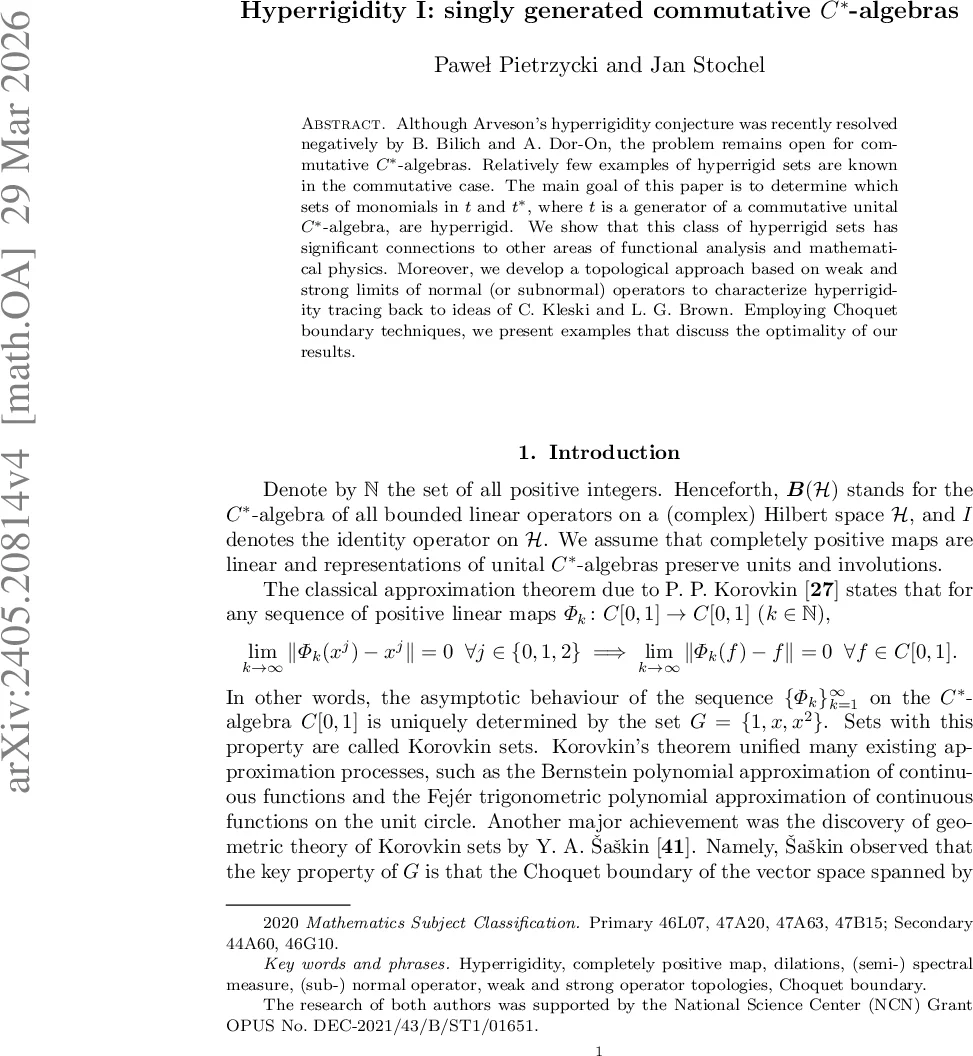
Although Arveson’s hyperrigidity conjecture was recently resolved negatively by B. Bilich and A. Dor-On, the problem remains open for commutative $C^$-algebras. Relatively few examples of hyperrigid sets are known in the commutative case. The main goal of this paper is to determine which sets of monomials in $t$ and $t^$, where $t$ is a generator of a commutative unital $C^*$-algebra, are hyperrigid. We show that this class of hyperrigid sets has significant connections to other areas of functional analysis and mathematical physics. Moreover, we develop a topological approach based on weak and strong limits of normal (or subnormal) operators to characterize hyperrigidity tracing back to ideas of C. Kleski and L. G. Brown. Employing Choquet boundary techniques, we present examples that discuss the optimality of our results.
💡 Research Summary
The paper investigates hyperrigidity—a strong non‑commutative approximation property introduced by Arveson—in the setting of commutative unital C*‑algebras that are singly generated. Let A be a commutative unital C*‑algebra generated by a single element t, and consider sets of monomials of the form
G = { t*^m t^n : (m,n) ∈ Ξ } ⊂ A,
where Ξ ⊂ ℤ_+^2. The authors’ main goal is to determine precisely when such a set G is hyperrigid relative to A.
Key Definitions and Background.
Hyperrigidity (Definition 1.1) requires that for any faithful representation π of A on a Hilbert space H and any sequence of unital completely positive (UCP) maps Φ_k on B(H), convergence of Φ_k(π(g)) to π(g) for all g in a subset G forces convergence for every a ∈ A. This is a non‑commutative strengthening of the classical Korovkin approximation property. The paper recalls Arveson’s conjecture linking hyperrigidity to the maximality of the non‑commutative Choquet boundary, notes its recent disproof in the general case (Bilich–Dor‑On), and emphasizes that the conjecture remains open for commutative algebras.
Main Results.
Theorem 2.1 (general sufficient condition). If Ξ contains a non‑diagonal pair (p,q) with p ≠ q and a diagonal pair (r,r) such that p+q < 2r, and if the monomials indexed by Ξ generate A, then G is hyperrigid in A. The inequality p+q < 2r guarantees that the diagonal monomial has strictly higher total degree than the sum of the non‑diagonal pair, a technical requirement that enables the passage from weak to strong convergence.
Theorem 2.2 (two concrete scenarios).
(i) If Ξ satisfies the same combinatorial condition as in Theorem 2.1 and the greatest common divisor of all differences m−n (for (m,n)∈Ξ) equals 1, then G is hyperrigid.
(ii) If Ξ consists exactly of two elements {(p,q),(r,r)} with p+q < 2r, and the spectrum σ(t) lies in a union of n = |p−q| disjoint angular sectors of the complex plane, each bounded away from the origin by a fixed ε>0, then G is hyperrigid. These cases illustrate how arithmetic properties of the exponent pairs and geometric placement of the spectrum jointly control hyperrigidity.
Theorem 3.1 (topological characterization). For a compact set X ⊂ ℂ and a generating set G ⊂ C(X), the following are equivalent:
(i) G is hyperrigid;
(ii) For any Hilbert space H, any sequence of subnormal operators {T_n} and any normal operator T with spectrum in X, weak convergence of f(T_n) to f(T) for all f∈G forces strong convergence for all f∈C(X);
(iii) The same implication holds when all operators involved are normal. This theorem connects hyperrigidity to the behavior of operator sequences under the weak and strong operator topologies, extending classical results of Kadison, Bishop, and Conwy‑Hadwin.
Applications to Spectral Measures.
The authors apply the above framework to semispectral (positive operator‑valued) measures. Theorem 4.1 shows that for a normal operator T and a compactly supported semispectral measure F, the equality of moments T*^m T^n = ∫ \bar z^m z^n F(dz) for all (m,n)∈Ξ (with Ξ as in Theorem 2.2(i)) is equivalent to F being the genuine spectral measure of T. This yields a multivariate analogue of the classical moment condition ∫ x dF = (∫ x² dF)^{1/2} ⇔ F spectral. Theorems 4.2 and 4.3 further demonstrate that weak convergence of a prescribed finite set of moments for a sequence of subnormal operators forces strong convergence of the entire functional calculus, provided the moment set satisfies the conditions of Theorem 2.2.
Choquet Boundary Perspective.
Section 10 uses Choquet boundary techniques to analyze the failure of hyperrigidity. When G is not hyperrigid, there exists a point in the Choquet boundary of the operator system generated by G that admits a non‑trivial representing measure, showing that the non‑commutative Choquet boundary is not maximal. This aligns with Arveson’s original conjecture in the commutative setting.
Methodology and Technical Tools.
The proofs blend several strands: (1) operator‑theoretic convergence arguments for normal and subnormal operators; (2) arithmetic conditions on exponent pairs to guarantee generation of the whole algebra; (3) spectral theory of normal operators and the functional calculus; (4) Choquet theory for operator systems; (5) dilation theory for UCP maps. The paper also includes an appendix clarifying the modified definition of hyperrigidity, summarizing relevant classical theorems, and providing background on operator systems and semispectral measures.
Conclusion.
The authors succeed in giving a complete description of hyperrigid monomial sets in singly generated commutative C*‑algebras. Their results show that, contrary to the negative answer in the non‑commutative case, the commutative setting admits a rich family of hyperrigid generating sets, tightly linked to arithmetic properties of exponent pairs, the geometry of the spectrum, and the maximality of the Choquet boundary. This advances the understanding of hyperrigidity, bridges it with classical approximation theory, and opens new avenues for studying non‑commutative approximation phenomena in commutative operator algebras.
Comments & Academic Discussion
Loading comments...
Leave a Comment