Personalization in Serious Games and Gamification for Healthcare: A Three-Tiered Review of Models, Methods and Opportunities
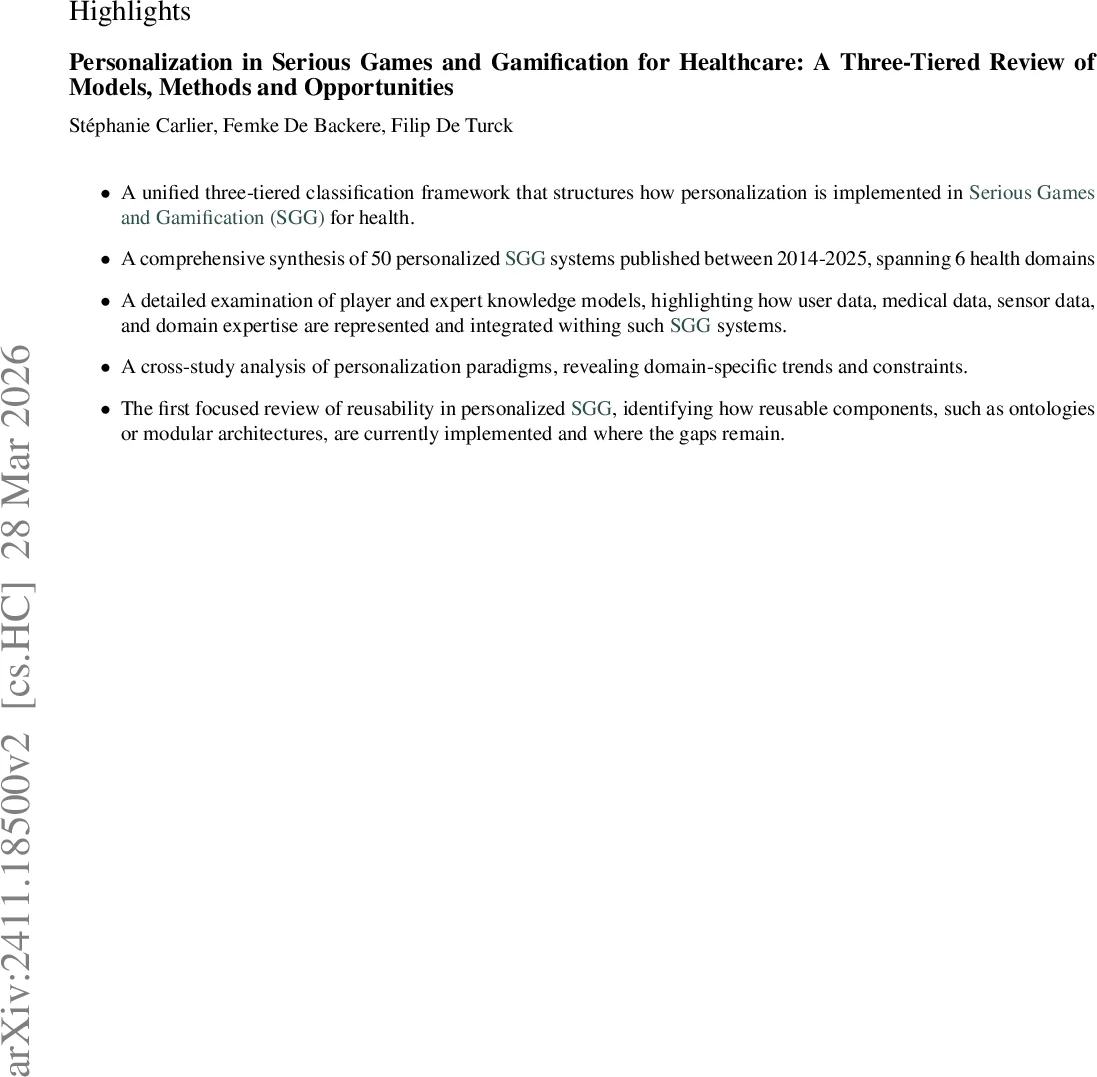
Serious games and gamification (SGG) have shown to have positive effects on health outcomes of eHealth applications. However, research has shown that a shift towards a personalized approach is needed, considering the diversity of users. This introduces new challenges to the domain of SGG as research is needed on how such personalization is achieved. A literature search was conducted to provide an overview of personalization strategies. In total, 50 articles were identified, 35 reported on a serious game and 15 focused on gamification. We introduce a three-tiered classification model, including a model level, a personalization paradigm level, and algorithmic framework level to synthesize how personalization is implemented. Data-driven approaches are most common overall (22/50), with knowledge-driven and hybrid methods more prevalent in rehabilitation, reflecting safety and explainability requirements. Popular modeling choices include Hexad-based player modeling and ontologies for expert knowledge integration. Despite encouraging results, reusability remains limited, impeding comparison and knowledge transfer. This review outlines opportunities for progress:shareable knowledge assets, swap-friendly personalization engines, and clinically bounded hybrid approaches, alongside cautious use of generative AI to accelerate design while maintaining safety and explainability. This classification framework and synthesis aims to guide more modular, comparable, and clinically aligned personalized SGG.
💡 Research Summary
**
This paper presents a comprehensive three‑tiered review of personalization strategies in serious games (SG) and gamification (Gf) for healthcare, covering 50 peer‑reviewed studies published between 2014 and 2025. The authors identify a clear need to move beyond one‑size‑fits‑all designs because static personalization fails to sustain long‑term engagement and treatment adherence. To systematically map how personalization is achieved, they propose a three‑level classification framework: (1) Model Level, which distinguishes between player models (capturing individual traits, preferences, in‑game performance, sensor data) and expert knowledge models (clinical guidelines, biomechanical standards, nutritional recommendations) often encoded as ontologies; (2) Paradigm Level, which identifies the source of adaptation logic as data‑driven, knowledge‑driven, or hybrid; and (3) Algorithmic Level, which details the concrete computational mechanisms such as Bayesian networks, Markov models, reinforcement learning (RL), rule‑based inference engines, and emerging generative AI techniques.
The literature search was conducted in October 2025 using Web of Science and PubMed, with a carefully crafted query that combined personalization‑related terms (e.g., “personal*”, “adapt*”, “ontology”) with health‑related domains and excluded non‑original works. After duplicate removal and multi‑stage screening, 50 articles remained: 35 focused on serious games and 15 on gamified interventions. The studies span six health domains—physical and cognitive rehabilitation, patient education, behavior change (e.g., smoking cessation, physical activity), mental health, chronic disease self‑management, and others.
Findings reveal that data‑driven approaches dominate overall (22/50), especially for dynamic difficulty adjustment and procedural content generation. However, in rehabilitation contexts, knowledge‑driven and hybrid methods are more prevalent (13/18), reflecting stringent safety and explainability requirements. The most frequently employed player modeling technique is the Hexad framework, used in 36 % of the studies, while ontologies serve as the primary vehicle for expert knowledge in 24 % of the papers. Hybrid solutions typically combine machine‑learning predictions with rule‑based constraints, thereby leveraging the predictive power of data while preserving clinical safety nets.
A critical insight concerns reusability: most systems are built as closed, monolithic solutions, limiting the transfer of models, ontologies, or personalization engines across projects. The authors argue for “shareable knowledge assets” and “swap‑friendly personalization engines” that can be exposed via standardized APIs and described with rich metadata. Such modularization would enable systematic benchmarking, accelerate development, and support regulatory compliance.
The paper also discusses emerging opportunities. Generative AI (e.g., large language models, diffusion models) can accelerate design by automatically producing storylines, graphics, or feedback messages, provided that a safety filter—anchored in clinical constraints—is applied to prevent harmful content. Moreover, a “clinically bounded hybrid” paradigm is advocated: data‑driven components operate within predefined safety thresholds derived from expert knowledge, ensuring that personalization never compromises patient safety.
In the discussion of future directions, the authors recommend: (i) standardizing ontologies and player models using interoperable formats such as OWL/RDF and aligning them with health‑IT standards (e.g., HL7 FHIR, IEEE 24765); (ii) encapsulating personalization logic as micro‑services that can be dynamically swapped into existing SG or Gf platforms; (iii) incorporating explainability modules that surface the rationale behind adaptations to clinicians and users; and (iv) engaging regulatory bodies early to define certification pathways for adaptive health games.
Overall, the review provides a valuable taxonomy, highlights current methodological trends, and outlines concrete steps toward more modular, reusable, and clinically safe personalized serious games and gamified health interventions. It serves as a roadmap for researchers, developers, and healthcare professionals aiming to design next‑generation digital therapeutics that adapt intelligently to individual users while meeting rigorous safety and efficacy standards.
Comments & Academic Discussion
Loading comments...
Leave a Comment