On almost everywhere convergence of planar Bochner-Riesz mean
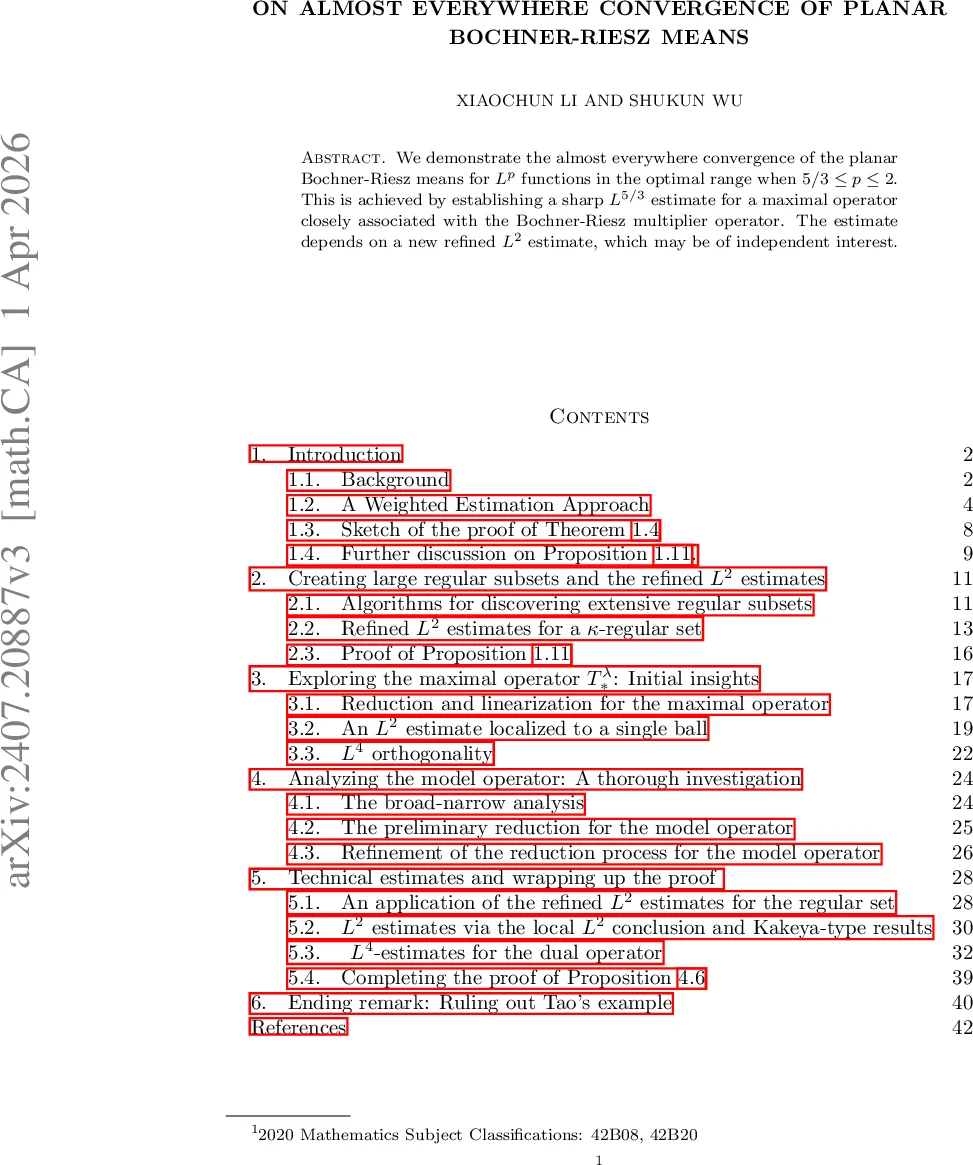
We demonstrate that the almost everywhere convergence of the planar Bochner-Riesz means for $L^p$ functions in the optimal range when $5/3\leq p\leq 2$. This is achieved by establishing a sharp $L^{5/3}$ estimate for a maximal operator closely associated with the Bochner-Riesz multiplier operator. The estimate depends on a novel refined $L^2$ estimate, which may be of independent interest.
💡 Research Summary
This paper makes a significant breakthrough in the long-standing problem of almost everywhere convergence for the planar Bochner-Riesz means. The main result, Theorem 1.3, confirms Tao’s Conjecture 1.2 for the maximal Bochner-Riesz operator T_λ* in two dimensions when the exponent p lies in the optimal range 5/3 ≤ p ≤ 2. This is the first non-trivial result for this conjecture when p < 2 and the index λ is near zero.
The proof strategy centers on establishing sharp L^p estimates for an auxiliary maximal operator S*_R closely related to the Bochner-Riesz multiplier (Theorem 1.4). The core of the argument involves a sophisticated “weighted estimation approach” applied to a model operator of the form ∑j S_j f 1{F_j}, where {F_j} are disjoint unions of unit balls within a larger R-ball.
A key innovation of the paper is the introduction and proof of a “refined L^2 estimate” (Proposition 1.11). The authors define the concept of a κ-regular set, which captures a quantified non-concentration property of a set F at various scales. For such a set F, which is a union of finitely overlapping K-balls, Proposition 1.11 provides a crucial inequality linking the broad norm ∥ S f ∥{L^2{br_M}(B)} summed over balls B in F to the global L^2 norm ∥ S f ∥_2, with a gain factor involving (|F|/R^2)^{1/2}. This refined estimate generalizes the bilinear weighted L^2 restriction estimate (1.12) by removing the requirement for a bilinear structure in one of the terms, as seen in its corollary (1.24). This generalization is essential for handling the model operator after duality arguments.
The technical journey to prove Theorem 1.4 is intricate. After reducing the problem to the model operator, the authors employ an iterative broad-narrow analysis (Lemma 4.3) to decompose the operator until it is α-broad. To handle the summation loss over these α-broad parts, they combine the refined L^2 estimates with a local L^2 estimate (Lemma 3.3) within αR-balls and a Kakeya-type inequality (Lemma 5.6) to control interactions between αR-balls and thin αR × R tubes. This intricate combination allows them to establish the critical L^{5/3} bound for the model operator, which, via interpolation with the known L^2 bound, yields Theorem 1.4 for the full range 5/3 ≤ p ≤ 2.
Finally, the paper briefly discusses (Section 6) how the presented method has the potential to rule out Tao’s well-known counterexample, hinting at the strength and generality of the new refined L^2 technique. Overall, this work provides a novel and powerful framework based on refined weighted L^2 estimates, solving a key case of a major conjecture in harmonic analysis and opening avenues for further progress in the field.
Comments & Academic Discussion
Loading comments...
Leave a Comment