Mixed-dispersion Schrödinger equations and Gagliardo-Nirenberg inequalities: equivalence between ground states and optimizers
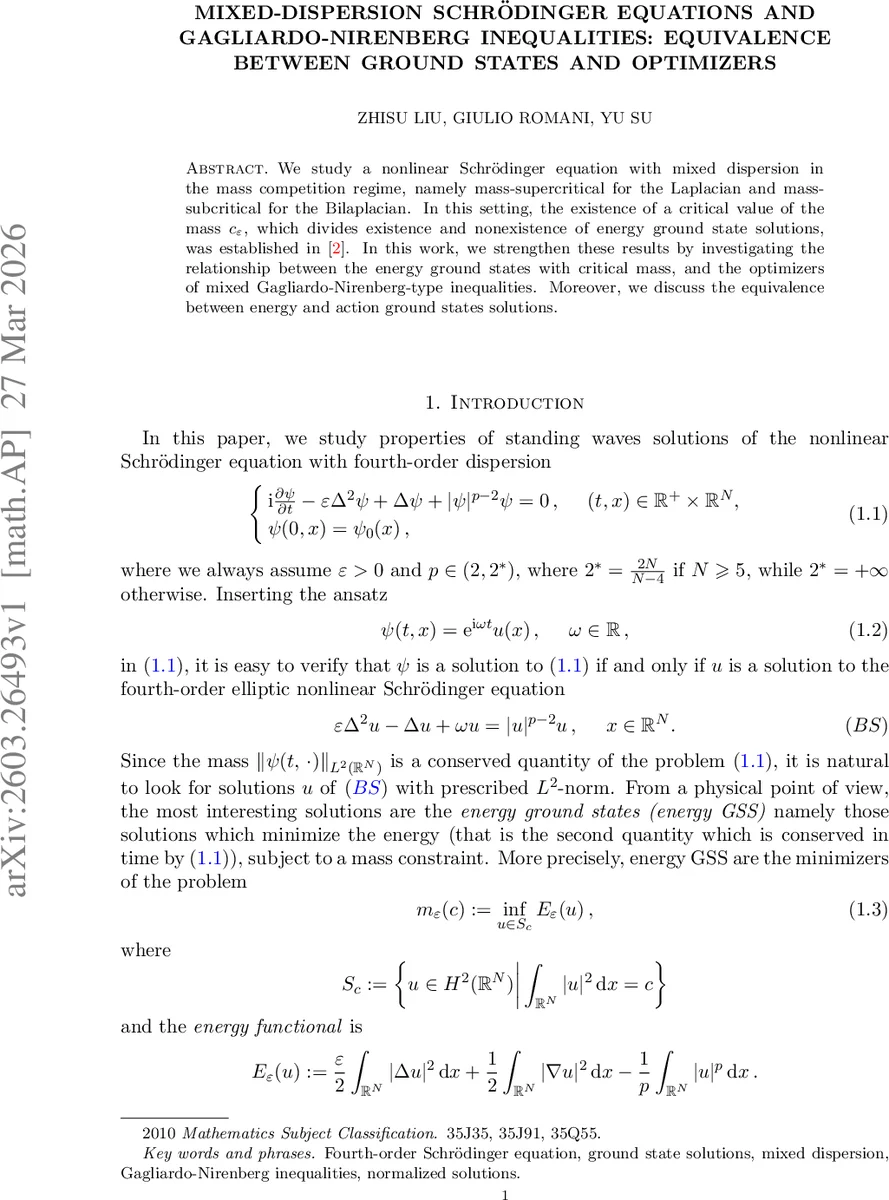
We study a nonlinear Schrödinger equation with mixed dispersion in the mass competition regime, namely mass-supercritical for the Laplacian and mass-subcritical for the Bilaplacian. In this setting, the existence of a critical value of the mass $c_\varepsilon$, which divides existence and nonexistence of energy ground state solutions, was established in [Bonheure, Castéras, dos Santos, Nascimento, SIAM J. Math. Anal. 50 (2018)]. In this work, we strengthen these results by investigating the relationship between the energy ground states with critical mass, and the optimizers of mixed Gagliardo-Nirenberg-type inequalities. Moreover, we discuss the equivalence between energy and action ground states solutions.
💡 Research Summary
This paper presents a rigorous mathematical analysis of the fourth-order nonlinear Schrödinger equation with mixed dispersion, often called the biharmonic NLS, in the so-called “mass competition regime.” The model equation is (i\partial_t \psi - \varepsilon \Delta^2 \psi + \Delta \psi + |\psi|^{p-2}\psi = 0), where (\varepsilon > 0) controls the strength of the fourth-order dispersion. The study focuses on the exponent range (p \in (2+4/N, 2+8/N)), where the second-order term ((-\Delta \psi)) is mass-supercritical and the fourth-order term ((\varepsilon \Delta^2 \psi)) is mass-subcritical, creating a competitive interplay.
Previous work by Bonheure et al. established the existence of a critical mass threshold (c_\varepsilon), which separates the existence and non-existence of energy ground state solutions (GSS) for the associated stationary equation (\varepsilon \Delta^2 u - \Delta u + \omega u = |u|^{p-2}u). Energy GSS are defined as minimizers of the energy functional (E_\varepsilon(u)) subject to a fixed (L^2)-norm constraint (|u|_2^2 = c).
The authors significantly strengthen these prior results through three main theorems, establishing deep connections between variational problems and functional inequalities.
First, Theorem 1.1 characterizes the energy GSS with the critical mass (c_\varepsilon) via a non-homogeneous Gagliardo-Nirenberg inequality (GN_K): (|u|p^p \le K{N,p,\varepsilon} |u|2^{p-2} (\varepsilon |\Delta u|2^2 + |\nabla u|2^2)). It proves that (u) is an energy GSS with mass (c\varepsilon) if and only if it is an optimizer of (GN_K) and (|u|2^2 = c\varepsilon). Furthermore, it derives the explicit relation (c\varepsilon = (2K{N,p,\varepsilon}/p)^{-\frac{2}{p-2}}), linking the critical mass directly to the best constant of the inequality.
Second, Theorem 1.2 provides an equivalent characterization using the homogeneous mixed Gagliardo-Nirenberg inequality (GN_C): (|u|p^p \le C{N,p} |\Delta u|_2^{\frac{N(p-2)-4}{2}} |\nabla u|2^{\frac{8-N(p-2)}{2}} |u|2^{p-2}). It shows that the energy GSS with critical mass (c\varepsilon) are precisely the optimizers of (GN_C) whose mass equals (c\varepsilon). This generalizes the classical result of Weinstein for the second-order NLS to the mixed dispersion case.
Third, Theorem 1.3 establishes the equivalence between energy GSS and action GSS in the mass competition regime. Action GSS are defined as minimizers of the action functional (I_\omega(u) = E_\varepsilon(u) + \frac{\omega}{2}|u|2^2) on the corresponding Nehari manifold, for a fixed frequency (\omega). The theorem proves that for a specific frequency (\omega(\varepsilon)) explicitly given in terms of an optimizer (v) of (GN_C), the set of energy GSS with critical mass (c\varepsilon) (and Lagrange multiplier (\omega(\varepsilon))) is identical to the set of action GSS with frequency (\omega(\varepsilon)). This unifies the two common approaches for finding solitary wave solutions.
The proofs rely on variational methods, scaling arguments, careful analysis of the energy functional, and properties of the Gagliardo-Nirenberg inequalities. The paper thus provides a complete and refined picture of ground state solutions for the mixed dispersion NLS in the critical mass scenario, connecting minimization problems, elliptic PDE solutions, and sharp functional inequalities.
Comments & Academic Discussion
Loading comments...
Leave a Comment