Capital-Allocation-Induced Risk Sharing
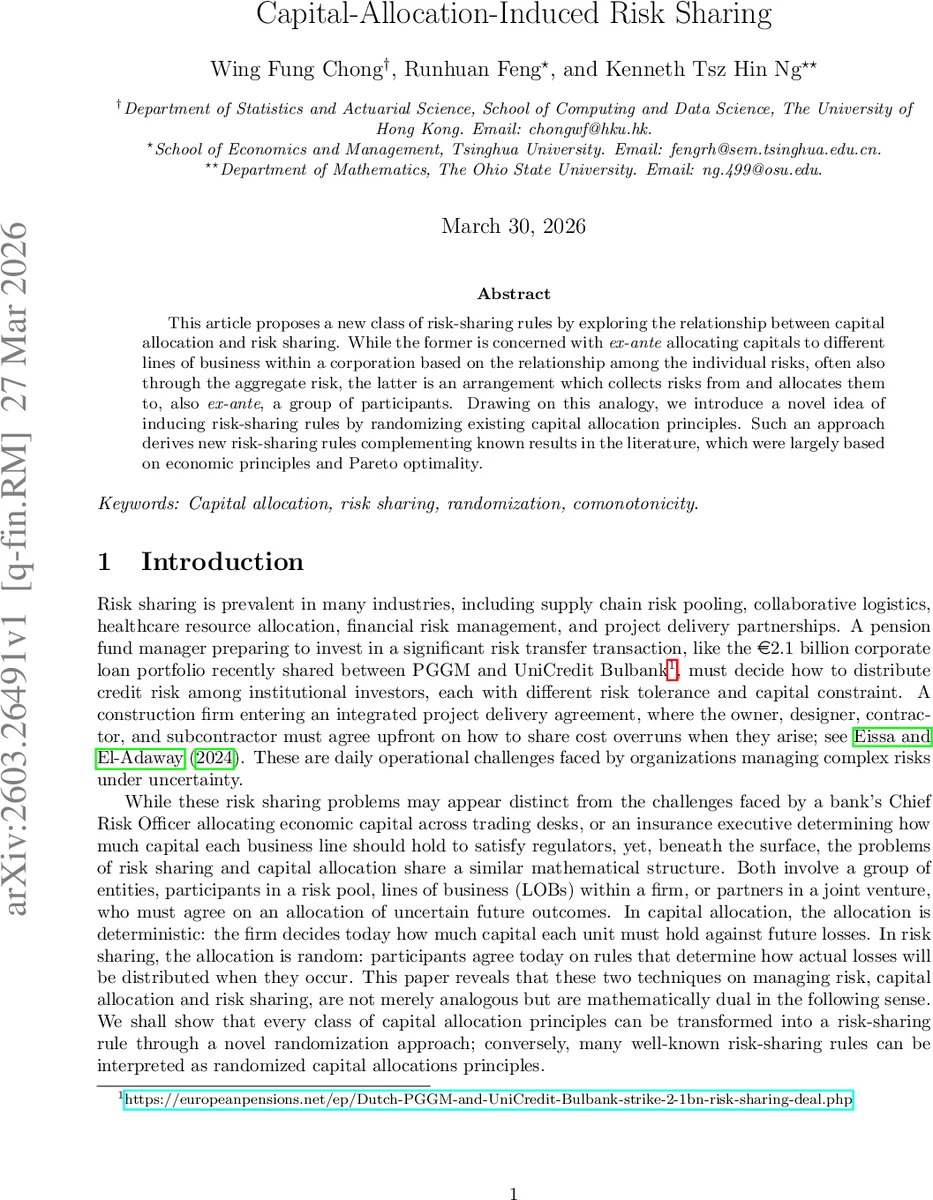
This article proposes a new class of risk-sharing rules by exploring the relationship between capital allocation and risk sharing. While the former is concerned with ex-ante allocating capitals to different lines of business within a corporation based on the relationship among the individual risks, often also through the aggregate risk, the latter is an arrangement which collects risks from and allocates them to, also ex-ante, a group of participants. Drawing on this analogy, we introduce a novel idea of inducing risk-sharing rules by randomizing existing capital allocation principles. Such an approach derives new risk-sharing rules complementing known results in the literature, which were largely based on economic principles and Pareto optimality.
💡 Research Summary
This paper proposes a novel and systematic methodology for generating risk-sharing rules by “randomizing” established capital allocation principles. It builds on the observed mathematical analogy between two core risk management practices: capital allocation within a firm (distributing deterministic capital to business units ex-ante) and risk sharing among participants (distributing random losses ex-post according to a pre-agreed rule).
The authors’ central innovation is the “randomization approach.” The method involves considering a rich family of capital allocation principles, indexed by a parameter. For each possible realization of the loss vector, a specific member from this family is selected such that its total allocated capital equals the realized aggregate loss for that scenario. Assembling these scenario-specific allocations yields a new risk-sharing rule. For this process to be mathematically valid, the aggregate capital function of the family must be “measurably right-invertible” over the support of the aggregate risk, meaning every possible total loss can be mapped back to a parameter value in a measurable way.
The paper thoroughly explores this framework. It first motivates the idea with illustrative examples and formalizes the general definition. A significant portion is dedicated to analyzing the right-invertibility condition, particularly for top-down allocation principles where the total capital is determined first.
The research then delves into applying the randomization to specific classes of principles. For top-down principles like the Euler and optimization principles, the authors show how the parameter sampling rule is dictated by the chosen method for calculating aggregate capital (e.g., the level of a distortion risk measure). They derive closed-form expressions for the induced sharing rules in certain cases, such as under elliptical distributions. Notably, they demonstrate that the quantile risk-sharing rule can be recovered by randomizing the optimization principle with an absolute deviation penalty.
The framework is also extended to bottom-up principles, such as the weighted risk allocation and holistic principles, where the total capital emerges endogenously. The authors prove the right-invertibility for these cases and derive corresponding sharing rules, contrasting them with results from top-down approaches.
A key insight is that the induced risk-sharing rule inherits the properties of its parent capital allocation principles in a “pointwise” or “scenario-wise” manner. For instance, if every principle in the family satisfies a form of Pareto optimality for a given capital level, then the resulting risk-sharing rule will satisfy a stronger, realization-by-realization form of optimality, differing from the traditional distributional notion of Pareto optimality in risk-sharing literature.
In conclusion, this work establishes a formal duality between capital allocation and risk sharing. It provides a unified and alternative framework for constructing risk-sharing rules, moving beyond conventional economic equilibrium approaches. By leveraging the extensive toolkit of capital allocation, it opens new pathways for designing practical risk-sharing mechanisms in areas like finance, insurance, and collaborative projects.
Comments & Academic Discussion
Loading comments...
Leave a Comment