Invertibility, Often
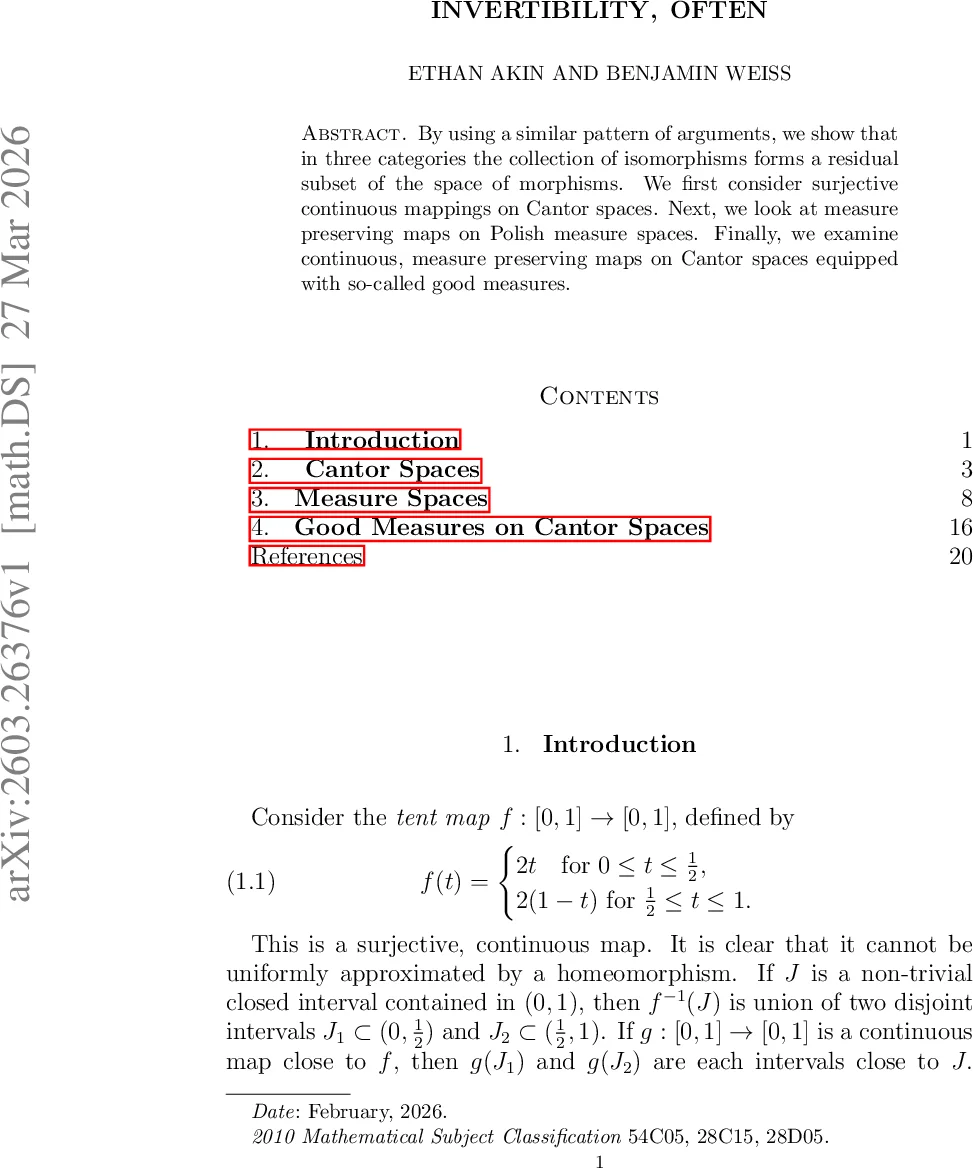
By using a similar pattern of arguments, we show that in three categories the collection of isomorphisms forms a residual subset of the space of morphisms. We first consider surjective continuous mappings on Cantor spaces. Next, we look at measure preserving maps on Polish measure spaces. Finally, we examine continuous, measure preserving maps on Cantor spaces equipped with so-called good measures.
💡 Research Summary
The paper “Invertibility, Often” presents a unified argument demonstrating that in three distinct mathematical categories, the collection of isomorphisms (i.e., structure-preserving bijections) forms a residual subset within the complete metric space of all morphisms. This means that invertible maps are not just possible but are “generic” and dense in these spaces, a potentially counterintuitive result.
The authors establish this using a consistent three-step pattern in each category: Uniqueness, Gδ, and Density.
1. Cantor Spaces (Continuous Maps): The objects are Cantor spaces (perfect, zero-dimensional, compact metrizable spaces). The morphisms are surjective continuous maps. The proof proceeds by showing: (Uniqueness) Any two Cantor spaces are homeomorphic (Brouwer’s theorem). (Gδ) Within the space of surjective continuous maps (with the uniform topology), the subset of homeomorphisms is a Gδ set. (Density) Any surjective continuous map can be uniformly approximated arbitrarily closely by a homeomorphism. The key technique involves refining clopen partitions of the range and constructing compatible homeomorphisms on the preimages.
2. Measure Spaces (Measurable Maps): The objects are non-atomic standard probability spaces (e.g., Polish spaces with a Borel probability measure). The morphisms are measure-preserving measurable maps. Here, the steps are: (Uniqueness) All such measure spaces are measure-theoretically isomorphic. (Gδ) Under a suitable topology of pointwise convergence on the measure algebras, the set of measure space isomorphisms is a Gδ set. (Density) Any measure-preserving map can be approximated by an isomorphism, using approximations by finite partitions of the measure algebras.
3. Cantor Spaces with Good Measures (Continuous Measure-Preserving Maps): This category combines the previous two. Objects are Cantor spaces equipped with a “good” probability measure (where the measure interacts nicely with the topology, e.g., giving positive measure to every non-empty open set). Morphisms are continuous, measure-preserving maps. The authors show that an analogous triad of results holds: a suitable uniqueness theorem for such spaces, the Gδ property for the isomorphisms (which are now homeomorphisms that also preserve measure), and a density theorem stating that any continuous measure-preserving map can be approximated by such a measure-theoretic homeomorphism.
Throughout, the Baire Category Theorem is the engine that turns the “Gδ” and “Density” properties into the powerful conclusion that isomorphisms are residual. The paper also thoughtfully discusses the conflict between topological genericity (residual sets) and measure-theoretic genericity (full measure sets), noting that they are distinct and often opposing notions. By successfully applying the same conceptual framework across different fields, the paper reveals a deep and surprising commonality: in many natural spaces of transformations, the perfectly symmetric, invertible ones are the rule rather than the exception.
Comments & Academic Discussion
Loading comments...
Leave a Comment