A proof of Fill's spectral gap conjecture
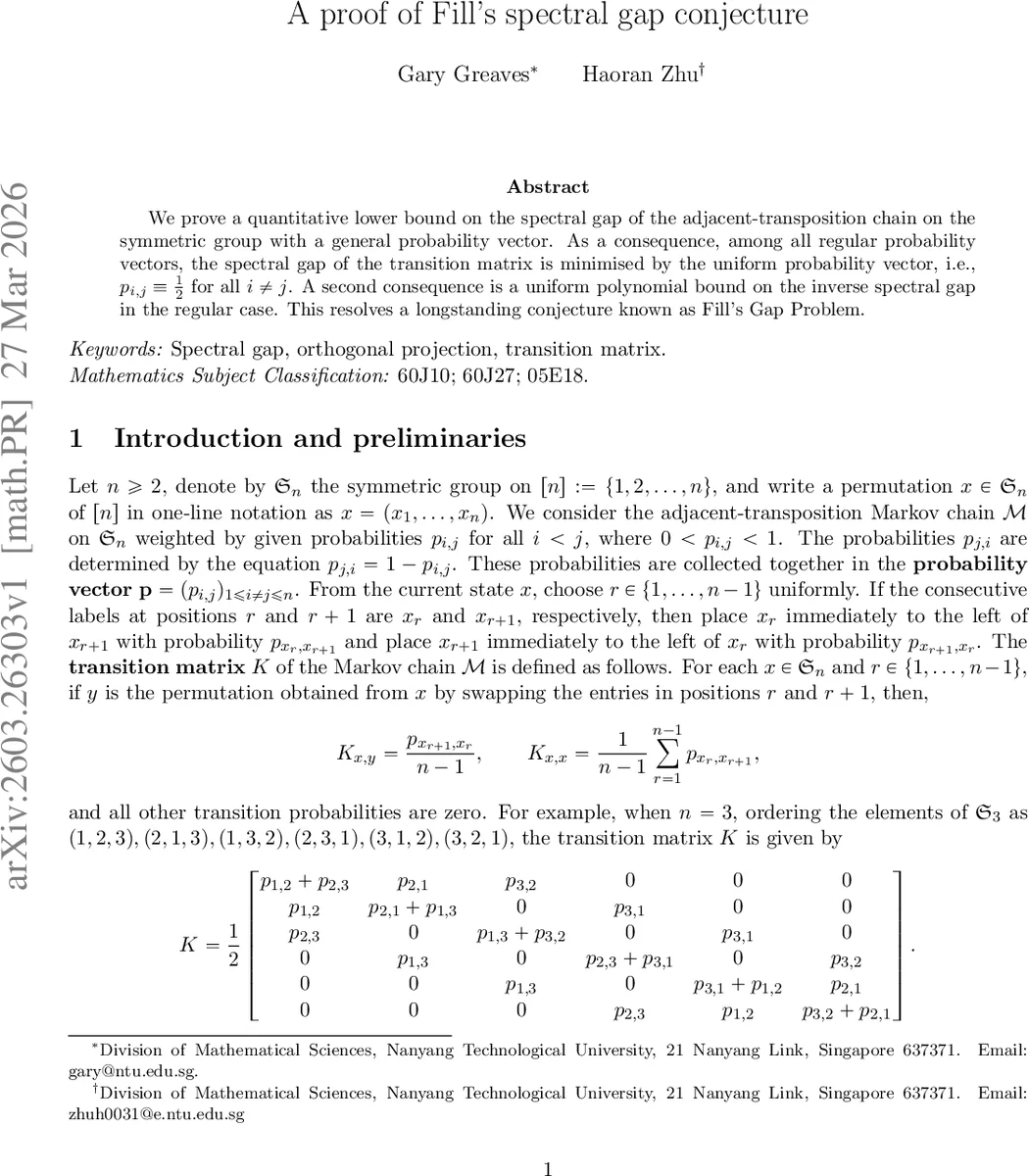
We prove a quantitative lower bound on the spectral gap of the adjacent-transposition chain on the symmetric group with a general probability vector. As a consequence, among all regular probability vectors, the spectral gap of the transition matrix is minimised by the uniform probability vector, i.e., $p_{i,j}\equiv {\frac 1 2}$ for all $i \ne j$. A second consequence is a uniform polynomial bound on the inverse spectral gap in the regular case. This resolves a longstanding conjecture known as Fill’s Gap Problem.
💡 Research Summary
The paper addresses a long‑standing open problem in the theory of Markov chains on permutations, known as Fill’s Gap Problem. The authors consider the adjacent‑transposition Markov chain M on the symmetric group Sₙ, where at each step a uniformly chosen adjacent pair (r, r+1) is swapped with probability p_{x_r,x_{r+1}} and left unchanged with the complementary probability. The transition matrix K of this chain depends on a probability vector p = (p_{i,j}){i≠j} with 0≤p{i,j}≤1 and p_{j,i}=1−p_{i,j}. The spectral gap λ_K is defined as 1 minus the second‑largest eigenvalue of K.
The main contribution is a quantitative lower bound on λ_K that holds for any probability vector p, and a sharp bound for the subclass of regular vectors (those satisfying (1.1)–(1.3) in the paper). The authors first rewrite K as the average of n−1 elementary transition matrices E₁,…,E_{n−1}, each acting only on a single adjacent pair. By introducing a weighted inner product ⟨·,·⟩_p (which makes the chain reversible with respect to the stationary distribution μ_p), they prove that each E_r is an orthogonal projection onto the subspace V_r of functions symmetric under the transposition τ_r that swaps positions r and r+1. Consequently, the E_r’s are self‑adjoint, idempotent, and commute whenever |r−s|>1.
The second technical step analyses the sum of two consecutive projections, E_r+E_{r+1}. The state space Sₙ is partitioned into orbits of the group generated by τ_r and τ_{r+1}, each orbit containing six permutations. On each orbit the restriction of M:=E_r+E_{r+1} becomes a 6×6 matrix M_t whose smallest positive eigenvalue can be computed explicitly. It equals 1 − p_{i,j}p_{j,k}p_{k,i} + p_{k,j}p_{j,i}p_{i,k}, where (i,j,k) are the three distinct labels occupying the three positions involved in the two adjacent swaps. Defining m(p) = max_{i<j<k} (p_{i,j}p_{j,k}p_{k,i} + p_{k,j}p_{j,i}p_{i,k}), the authors obtain that every block has smallest positive eigenvalue at least 1−m(p).
A purely linear‑algebraic lemma (Lemma 2.4) then relates the smallest non‑zero eigenvalue of the sum of two orthogonal projections to a lower bound on the inner product of the projected vectors. Applying this lemma with P=E_r and Q=E_{r+1} yields ⟨E_r f, E_{r+1} f⟩ ≥ −m(p)‖E_r f‖‖E_{r+1} f‖ for any vector f. Using the decomposition K = (1/(n−1))∑_{r}E_r and expanding ⟨f, K² f⟩, the authors separate terms with |r−s|>1 (which are non‑negative because the corresponding projections commute) and the adjacent terms (which are bounded by the inequality above). After a careful summation they obtain the quadratic form inequality ⟨f, K² f⟩ ≥ (1 − 2 m(p) cos(π/n)) ⟨f, K f⟩ for all f∈ℝ^{Sₙ}. This inequality implies that every positive eigenvalue λ of K satisfies λ ≥ 1 − 2 m(p) cos(π/n).
When p is regular (i.e., each p_{i,j}≥½ and the other regularity conditions (1.1)–(1.3) hold), Lemma 3.3 shows that m(p)≤½. Substituting this into the previous bound yields the clean estimate λ ≥ 1 − cos(π/n). Wilson’s earlier work had proved that in the uniform case (p_{i,j}=½ for all i≠j) the spectral gap is exactly 1−cos(π/n). Hence the lower bound is tight, and the uniform vector indeed minimizes the spectral gap among all regular probability vectors. This resolves Fill’s conjecture.
An immediate corollary is a uniform polynomial bound on the inverse spectral gap in the regular case: 1/λ = O(n³), which improves upon earlier results that were limited to special subclasses of biased adjacent‑transposition chains. The paper also discusses how the techniques extend to more general biased chains, references related work on mixing times, and situates the result within the broader literature on spectral analysis of Markov chains.
In summary, the authors combine a novel decomposition of the transition matrix into orthogonal projections, an explicit eigenvalue calculation on six‑element orbits, and a general projection‑angle lemma to derive a sharp, universal lower bound on the spectral gap. This not only settles Fill’s Gap Problem but also provides a powerful framework for analyzing other non‑reversible or biased permutation chains.
Comments & Academic Discussion
Loading comments...
Leave a Comment