Euler band topology and multiple hinge modes in three-dimensional insulators
In two-dimensional systems with space-time inversion symmetry, such as $C_{2z}T$, the reality condition on wave functions gives rise to real band topology characterized by the Euler class, a $\mathbb{Z}$-valued topological invariant for a pair of rea…
Authors: Yutaro Tanaka, Shingo Kobayashi
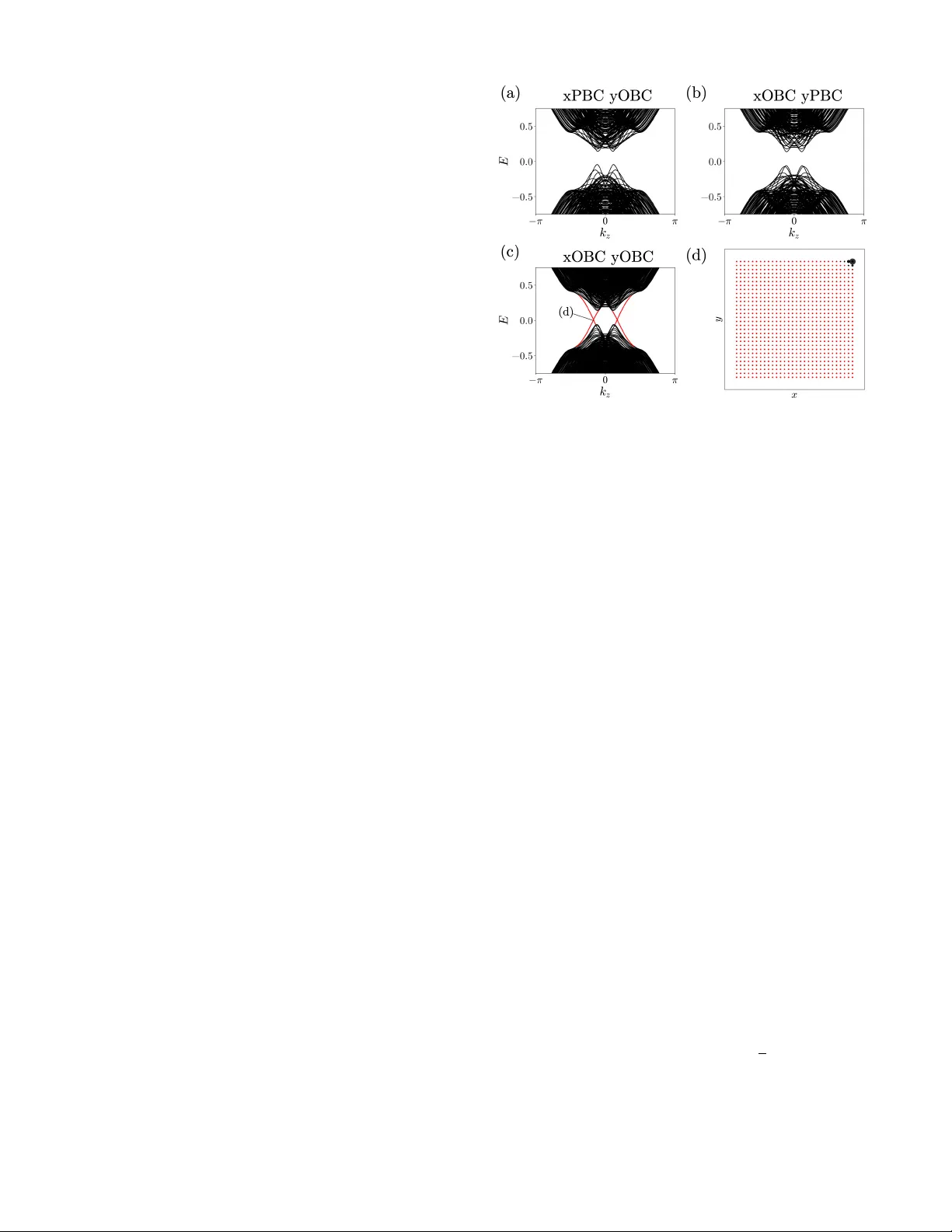
Euler band top ology and m ultiple hinge mo des in three-dimensional insulators Y utaro T anak a 1 and Shingo Koba yashi 1 1 RIKEN Center for Emer gent Matter Scienc e, Wako, Saitama, 351-0198, Jap an In tw o-dimensional systems with space-time inv ersion symmetry , such as C 2 z T , the reality condi- tion on w av e functions giv es rise to real band top ology c haracterized by the Euler class, a Z -v alued top ological inv arian t for a pair of real bands in the Brillouin zone. In this pap er, we study three- dimensional C 2 z T -symmetric insulators characterized by ¯ e 2 , defined as the difference in the Euler classes b et w een tw o C 2 z T -in v arian t planes in the three-dimensional Brillouin zone. By deriving effectiv e surface Hamiltonians from generic lo w-energy con tin uum Hamiltonians c haracterized b y the top ological inv ariant ¯ e 2 , we reveal that multiple gapless b oundary states exist at the domain w alls of the surface mass, whic h give rise to the multiple chiral hinge mo des. W e also show that three-dimensional insulators characterized by ¯ e 2 = N support N c hiral hinge mo des. Notably , due to the constraint of tw o o ccupied bands in our system, these phases are distinct from stack ed Chern insulators comp osed of N lay ers. F urthermore, we construct tight-binding models for ¯ e 2 = 2 and 3 and n umerically demonstrate the emergence of t w o and three c hiral hinge mo des, respectively . These results are consistent with those obtained from the surface theory . I. INTR ODUCTION The disco very of topological insulators established a new paradigm in condensed matter ph ysics [ 1 , 2 ]. A defining hallmark of top ological insulators is the bulk-b oundary corresp ondence, whic h stipulates that d - dimensional systems p ossess ( d − 1)-dimensional b ound- ary states characterized b y bulk top ological inv arian ts. This concept extends naturally to higher-order topolog- ical insulators, in whic h d -dimensional n th-order top o- logical phases supp ort ( d − n )-dimensional b oundary states [ 3 – 10 ]. Driv en by this generalized bulk-b oundary corresp ondence, higher-order top ological phases hav e at- tracted significan t researc h interest in recent years [ 11 – 40 ]. A systematic metho d for classifying these top ologi- cal phases is the K -theory approach [ 41 – 43 ], wherein the nontrivial topology is stable under the addition of top ologically trivial bands. How ev er, certain top ological phases fall outside this classification framew ork. In b oth spinless and spinful tw o-dimensional systems with C 2 z T symmetry , where C 2 z and T denote a t wo-fold rotation ab out the z -axis and the time-reversal op erator, resp ec- tiv ely , one can alwa ys c ho ose a real gauge in whic h b oth the Hamiltonian and the wa v e functions are real [ 44 – 46 ], giving rise to real band top ology [ 47 – 53 ]. In systems with real bands, a Z -v alued top ological inv ariant e 2 , known as Euler class [ 54 , 55 ], characterizes exotic top ological phe- nomena asso ciated with a pair of real bands isolated from the rest of the bands, suc h as the violation of the fermion doubling theorem and non-Ab elian braiding of band de- generacy p oints [ 54 , 56 , 57 ]. Since the Euler class is de- fined for a sp ecific num ber of bands isolated from oth- ers, the Euler band top ology falls outside the established classification theory of top ological phases that are stable under the addition of trivial bands. Despite extensiv e previous studies on the Euler band top ology [ 58 – 70 ], its role in three-dimensional (3D) insu- lators remains elusive. In this pap er, we fo cus on C 2 z T - symmetric 3D band insulators exhibiting a difference in the Euler class b etw een t wo C 2 z T -inv ariant planes in the 3D Brillouin zone, which we refer to as 3D Euler insulators. While previous works ha v e elucidated that suc h 3D Euler insulators supp ort c haracteristic surface states on the C 2 z T -inv ariant surface, namely , the (100) surface [ 71 , 72 ], it remains largely unclear whether these insulators exhibit b oundary states at locations other than the C 2 z T -inv ariant surface. In this pap er, based on generic low-energy contin uum theories and tigh t-binding mo dels, we sho w that 3D Euler insulators c haracterized b y the top ological in v ariant ¯ e 2 = e 2 (0) − e 2 ( π ), defined as the difference in the Euler class b et w een the k z = 0 and k z = π planes, supp ort m ultiple one-dimensional hinge mo des along the z direction. W e also elucidate that the n umber of hinge mo des corresp onds to the v alue of the top ological inv ariant ¯ e 2 [Fig. 1 (a-c)]. By deriving effectiv e surface Hamilto- nians from the generic contin uum Hamiltonians exhibit- ing a nonzero Euler class, w e reveal that m ultiple gapless solutions exist at the domain w alls of the surface mass, whic h bind one, t wo, and three chiral hinge mo des for ¯ e 2 = 1, 2, and 3, resp ectively . F urthermore, we general- ize our contin uum theory to arbitrary ¯ e 2 = N and show that 3D Euler insulators supp ort N chiral hinge modes for p ositive integer N . W e numerically demonstrate the emergence of these c hiral hinge mo des using tw o tight-binding mo dels corre- sp onding to the con tinuum Hamiltonians with the top o- logical in v arian ts ¯ e 2 = 2 and ¯ e 2 = 3, confirming agree- men t with the predictions of the con tinuous theory . This pap er is organized as follows. In Sec. I I , we review the reality condition on w a ve functions in the presence of C 2 z T symmetry and the Euler class, which characterizes the band topology asso ciated with a pair of real bands isolated from the rest of the bands. In Sec. I II , we review that 3D Euler insulators characterized by ¯ e 2 = 1 host a single chiral hinge mode. In Sec. IV , we sho w that 3D Eu- ler insulators characterized by ¯ e 2 = 2 host double chiral hinge mo des using b oth a generic low-energy contin uum theory and numerical calculations of the corresp onding 2 Surface states Hinge states Surface states Hinge states Surface states Hinge states x y z x y z x y z k x k y (a) e = 1 2 e = 0 2 k z k = 0 z k = π z k x k y (b) e = 2 2 e = 0 2 k z k = 0 z k = π z k x k y (c) e = N 2 e = 0 2 k z k = 0 z k = π z × N × N FIG. 1. Three-dimensional Euler insulators with multiple hinge mo des. The left panels show sc hematics of the Eu- ler class e 2 ( k z ) in the k z = 0 and k z = π planes within the Brillouin zone for (a) ¯ e 2 := e 2 (0) − e 2 ( π ) = 1, (b) ¯ e 2 = 2, and (c) ¯ e 2 = N . The righ t panels depict the real-space config- urations of the corresp onding Euler insulators with multiple hinge mo des. tigh t-binding mo del. In Sec. V , w e demonstrate that Euler insulators c haracterized by ¯ e 2 = 3 supp ort triple c hiral hinge mo des, emplo ying a similar approach based on a contin uum theory and tight-binding calculations. In Sec. VI , b y generalizing the lo w-energy con tin uum theory for ¯ e 2 = 1,2, and 3 in Secs. I I I , IV , and V , we show that a 3D Euler insulator c haracterized b y ¯ e 2 = N supp orts N hinge mo des, where N is a p ositive integer. Finally , conclusions and discussion are given in Sec. VI I . I I. EULER BAND TOPOLOGY IN 3D INSULA TORS In this section, we review the Euler band top ology in 3D insulators. In this w ork, w e focus on C 2 z T -symmetric systems satisfying C 2 z T H ( k ∥ , k ∗ z )( C 2 z T ) − 1 = H ( k ∥ , k ∗ z ) , (1) where C 2 z denotes tw o-fold rotation ab out the z axis, T denotes the time-rev ersal op erator, k ∥ := ( k x , k y ), and k ∗ z ∈ { 0 , π } . Throughout this w ork, w e consider systems p ossessing only C 2 z T and translational symme- tries. Since C 2 z T is an anti-unitary op erator satisfying ( C 2 z T ) 2 = 1 for b oth spinless ( T 2 = 1) and spinful ( T 2 = − 1) systems, a real gauge can b e imp osed on the wa ve function | u n ( k ∥ , k ∗ z ) ⟩ : C 2 z T | u n ( k ∥ , k ∗ z ) ⟩ = | u n ( k ∥ , k ∗ z ) ⟩ . (2) Here, we choose the symmetry represen tation C 2 z T = K without loss of generality , where K denotes complex conjugation. W e employ this real gauge throughout this w ork. F or a system with tw o o ccupied bands, w e can c har- acterize the band top ology in the C 2 z T -inv ariant plane (the k x - k y plane at k z = k ∗ z ) by the Euler class e 2 . The Euler class e 2 is given by the flux in tegral e 2 ( k ∗ z ) = 1 2 π Z 2D d S · ˜ F 12 ( k ∥ , k ∗ z ) , (3) where the integral is taken ov er the k z = k ∗ z plane in the 3D Brillouin zone, ˜ F mn := ∇ k × ˜ A mn ( k ) is the real Berry curv ature, and ˜ A mn ( k ) := ⟨ u m | ∇ k u n ⟩ ( m, n ∈ { 1 , 2 } ) is the real Berry connection defined b y the real o ccupied states | u n ⟩ . The Euler class is well defined only for orien table wa v e functions, and the systems considered b elo w satisfy this orientabilit y condition. Here, we introduce the difference in the Euler class e 2 b et w een the k z = 0 and k z planes, ¯ e 2 := e 2 (0) − e 2 ( π ) , (4) as a topological in v arian t c haracterizing a pair of isolated bands (or when the num b er of o ccupied bands is t wo) in 3D C 2 z T -symmetric insulators. This definition is moti- v ated b y v arious previous w orks [ 68 , 71 – 74 ], in which the real band top ology of C 2 T -symmetric s ystems is c har- acterized by the difference in 2D top ological inv ariants b et w een the k z = 0 and k z = π planes. In particular, when ¯ e 2 = 1, it has b een sho wn that the system supp orts a single chiral hinge mo de, since ¯ e 2 mo d 2 is equiv alent to the Chern-Simons inv ariant [ 74 ]. In addition, since the Chern-Simons in v arian t in 3D C 2 z T -symmetric insulators is a stable Z 2 top ological in- v arian t related to the second Stiefel-Whitney class and defined for an arbitrary num b er of o ccupied bands, the single chiral hinge mode remains stable upon adding triv- ial bands [ 74 ]. In what follows, we extend this relation to ¯ e 2 ≥ 2. F or this purpose, we assume (i) e 2 (0) = 0 and e 2 ( π ) = 0, and (ii) the num b er of o ccupied bands is fixed to t wo. In calculating ¯ e 2 , there are t wo subtleties. First, the sign of ¯ e 2 is not gauge inv ariant, since the signs of e 2 ( k ∗ z ) flip under an O (2) transformation with determinant − 1. Sec- ond, the ev aluation of ¯ e 2 requires fixing the relative sign b et w een e 2 (0) and e 2 ( π ) [ 72 ]. T o av oid these issues, w e assume that only e 2 (0) is nonzero and fo cus on its abso- lute v alue. F urthermore, since e 2 is a fragile top ological 3 in v arian t, the hinge states discussed b elow are v alid only for tw o o ccupied bands and b ecome unstable under the addition of bands, for example, by attaching 2D Chern insulators to the three-dimensional surface. I II. EULER CLASS ¯ e 2 = 1 In this section, w e revisit the chiral hinge mode app ear- ing in a 3D Euler insulator c haracterized b y ¯ e 2 = 1 based on a low-energy contin uum Hamiltonian. W e show that our approac h repro duces the results of previous studies and clarifies the physical origin of the c hiral hinge m ode. Let us consider a generic low-energy contin uum Hamil- tonian H = v x k x Γ 1 + v y k y Γ 2 + v z k z Γ 3 + λ Γ 4 , (5) where v x , v y , v z , and λ are p ositiv e real parameters, and Γ i ( i = 1 , · · · 4) are the 4 × 4 gamma matrices satisfying { Γ i , Γ j } = 2 δ ij . The symmetry representation is given b y C 2 z T = K , where K denotes complex conjugation. Since the Hamiltonian H resp ects C 2 z T symmetry [Eq. ( 1 )], the gamma matrices Γ i satisfy [ C 2 z T , Γ 1 ] = [ C 2 z T , Γ 2 ] = [ C 2 z T , Γ 4 ] = 0 , { C 2 z T , Γ 3 } = 0 . (6) The Euler class | ¯ e 2 | = 1 of this mo del can b e verified by ev aluating Eq. ( 3 ) using the o ccupied states in a real gauge. Here, how ev er, we present an alternativ e ex- planation. In ev aluating ¯ e 2 in the contin uum Hamilto- nian, we compactify momentum space by adding a p oin t at infinity , whic h yields S 3 , where k z = π corresp onds to k z = ∞ . Under this compactification, we obtain e 2 ( ∞ ) = 0. Hence, the top ology of the system is deter- mined by the Euler class defined on the S 2 in the k x - k y plane at k z = 0. On this plane, the third term v anishes. In addition, the fourth term pla ys the role of a mass term that induces band inv ersion. Therefore, the v alue of e 2 is determined from the first and second terms, whic h break b oth time-reversal and C 2 z symmetries, where T = K and C 2 z = 1. | e 2 (0) | is ev aluated b y the band inv er- sion and the topology of band touching p oin ts (i.e., nodal p oin ts) in the o ccupied bands as follows. In real tw o-band systems with a nontrivial Euler class, no dal p oints app ear in the tw o bands, and the Euler class is related to a one-dimensional winding n umber around the no dal p oin ts as [ 54 ] e 2 = − N t 2 , (7) where N t denotes the total winding num be rs on S 2 . In the present case, the first and second terms v anish at k x = k y = 0 and at infinity due to the compactifica- tion, resulting in tw o no dal p oints. Since the disp ersion around the no dal p oints is linear, eac h winding n umber is one. In the trivial phase, the tw o no dal p oin ts carry op- p osite signs of the winding num b er. Th us, e 2 = 0. On the other hand, when band inv ersion o ccurs at k x = k y = 0, the sign of the winding num ber around k x = k y = 0 flips through the braiding of band degeneracy p oints b et ween o ccupied and uno ccupied bands [ 54 , 72 ], whic h results in | e 2 | = 1. W e derive an effective Hamiltonian for the (100) sur- face from the bulk Hamiltonian given in Eq. ( 5 ). F ollow- ing the standard pro cedure [ 75 – 78 ] for deriving surface Hamiltonians, w e define x as the co ordinate normal to the surface and introduce an x -dep endence to the co effi- cien t λ of the mass term λ Γ 4 via the replacemen t λ → λ x . The system is mo deled such that the bulk crystal o ccu- pies the region x < 0, the v acuum occupies x > 0, and the surface is lo cated at x = 0. The spatial profile of λ x is defined to v anish at the surface ( λ x =0 = 0) and to v ary sharply to wards λ x = 1 inside the bulk for x < 0, and to wards λ x = − 1 outside the crystal x > 0 [Fig. 2 (a)]. Consequen tly , the bulk crystal is characterized b y λ x = 1, while the v acuum is represented by λ x = − 1. Replacing k x with − i ∂ x , the Hamiltonian in Eq. ( 5 ) b ecomes H = − i v x ∂ x Γ 1 + v y k y Γ 2 + v z k z Γ 3 + λ x Γ 4 . (8) The solutions ψ for this Hamiltonian H lo calized at x = 0 are given by ψ = exp 1 v x Z x 0 dx ′ λ x ′ P ψ k y ,k z , (9) where the pro jection op erator P is defined as P := 1 2 (1 − iΓ 1 Γ 4 ) . (10) Note that the pro jection op erators P satisfy P 2 = P , [ P , Γ 2 ] = [ P , Γ 3 ] = 0 . (11) By applying the Hamiltonian in Eq. ( 8 ) to the eigenstate ψ in Eq. ( 9 ), we obtain H ψ = exp 1 v x Z x 0 dx ′ λ x ′ H s ψ k y ,k z . (12) Here, H s is the effective surface Hamiltonian defined as H s := P ( v y k y Γ 2 + v z k z Γ 3 ) P , (13) whic h describ es the surface Dirac cone on the (100) sur- face. F urthermore, b y substituting ∂ x → − ∂ x in Eq. ( 8 ), we obtain the ( ¯ 100) surface Hamiltonian. F ollowing a pro- cedure similar to that used for the (100) surface, we find that this Hamiltonian is iden tical to Eq. ( 13 ), with the pro jection operator given by P = (1 + iΓ 1 Γ 4 ) / 2. Thus, b oth the (100) and ( ¯ 100) surface Hamiltonians demon- strate the emergence of gapless b oundary states on these surfaces. In addition, we also obtain the (010) and (0 ¯ 10) sur- face Hamiltonians in a manner analogous to the (100) and ( ¯ 100) surfaces by replacing k y as − i ∂ y for the (010) 4 x ( + ) λ x = 0 Bulk x x ( + ) λ x = 0 (a) (b) x y (010) surface (100) surface m s -m s (010) surface (100) surface m s , -m s , FIG. 2. (a) The spatial profile of λ x around x = 0 for the (100) surface. (b) The surface mass terms on the (100), ( ¯ 100), (010), and (0 ¯ 10) surfaces. surface and i ∂ y for the (0 ¯ 10) surface in the Hamiltonian presen ted in Eq. ( 5 ). Through similar pro cedures to the (100) and ( ¯ 100) surfaces, we obtain the surface Hamilto- nian H s := P ′ ( v x k x Γ 1 + v z k z Γ 3 ) P ′ , (14) where the pro jection op erator P ′ is giv en by P ′ := (1 − iΓ 2 Γ 4 ) / 2 for the (010) surface and b y P ′ := (1 + iΓ 2 Γ 4 ) / 2 for the (0 ¯ 10) surface. T o see a chiral hinge mo de, w e in tro duce a time- rev ersal-symmetry-breaking mass term that gaps out these gapless b oundary states. The only possible mass term capable of op ening a gap in these surface states is giv en by m n Γ 5 , where Γ 5 is the gamma matrix satisfying { Γ 5 , C 2 z T } = 0, and m n dep ends on the surface normal v ector n . T o preserv e the C 2 z T symmetry , the spatial profile of the mass term m ust satisfy m n = − m C 2 z n . Therefore, in a ro d geometry extending along the z direc- tion and bounded b y the (100), ( ¯ 100), (010), and (0 ¯ 10) surfaces, the (100) and ( ¯ 100) surfaces host mass terms with opp osite signs, namely , m s and − m s [Fig. 2 (b)]. Similarly , the (010) and (0 ¯ 10) surfaces host mass terms with opp osite signs, m ′ s and − m ′ s . When m s and m ′ s share the same sign, zero-mass lines emerge b et w een the (100) and (0 ¯ 10) surfaces, and b et w een the (010) and ( ¯ 100) surfaces. Con v ersely , when they hav e opp osite signs, zero-mass lines emerge b et ween the (100) and (010) sur- faces, and b etw een the ( ¯ 100) and (0 ¯ 10) surfaces. These zero-mass lines act as domain w alls that bind chiral hinge states [ 3 , 4 , 7 – 9 , 77 , 78 ]. IV. 3D EULER INSULA TORS WITH ¯ e 2 = 2 A. Con tinuum theory No w, we extend the ab ov e argument to a 3D Euler insulator characterized by ¯ e 2 = 2 and show that double c hiral hinge mo des app ear. W e start from a generic low- energy contin uum Hamiltonian H = v 1 ( k 2 x − k 2 y )Γ 1 + v 2 k x k y Γ 2 + v z k z Γ 3 + ( v xz k x + v y z k y ) k z Γ 4 + λ Γ 5 , (15) where v 1 , v 2 , v z , v xz , v y z , and λ are p ositive real v alues, and Γ i ( i = 1 , · · · 5) are the 4 × 4 gamma matrices sat- isfying { Γ i , Γ j } = 2 δ ij . The symmetry representation is giv en by C 2 z T = K , where K denotes complex conju- gation. Since the Hamiltonian H resp ects C 2 z T symme- try [Eq. ( 1 )], the gamma matrices Γ i satisfy [ C 2 z T , Γ 1 ] = [ C 2 z T , Γ 2 ] = [ C 2 z T , Γ 5 ] = 0 , { C 2 z T , Γ 3 } = { C 2 z T , Γ 4 } = 0 . (16) The Euler class | ¯ e 2 | = 2 can be understo od in a man- ner similar to the | ¯ e 2 | = 1 case. On the k z = 0 plane, the third and fourth terms v anish, and the fifth term serv es as a mass term resp onsible for a band inv ersion. Consequen tly , the first and second terms determine the v alue of e 2 . Since the co efficients of these terms exhibit quadratic disp ersion around k x = k y = 0, the corre- sp onding winding n um b er b ecomes tw o [ 71 ]. Thus, this Hamiltonian exhibits | ¯ e 2 | = 2 via the band in v ersion at k x = k y = 0. Here, we add the fourth term that breaks b oth time-rev ersal symmetry and C 2 z symmetry ( T = K and C 2 z = 1), which plays an imp ortant role as a surface mass term in the following argument. W e derive an effective Hamiltonian for the (100) sur- face from the bulk Hamiltonian in Eq. ( 15 ) in a man- ner analogous to that in Sec. I II , via the replacement λ → λ x . The spatial profile of λ x is defined such that it v anishes at the surface ( λ 0 = 0) and v aries sharply from λ x = 0 to λ x = 1 for x < 0, and to λ x = − 1 for x > 0. By replacing k x as − i ∂ x and setting v 2 k y = v xz k z or v 2 k y = − v xz k z , the Hamiltonian in Eq. ( 15 ) reduces to the following Hamiltonian H i ( i = 1 , 2): H i = − i √ 2 v xz k z ∂ x ˜ Γ i − v 1 ∂ 2 x Γ 1 + v z k z Γ 3 + λ x Γ 5 , (17) where H 1 and H 2 corresp ond to v 2 k y = v xz k z and v 2 k y = − v xz k z , resp ectively , and w e neglect terms quadratic in the wa v evector. Here, ˜ Γ i ( i = 1 , 2) are defined as ˜ Γ 1 = (Γ 2 + Γ 4 ) / √ 2 and ˜ Γ 2 = ( − Γ 2 + Γ 4 ) / √ 2. The solutions ψ 1 and ψ 2 for the Hamiltonians H 1 and H 2 , resp ectively , lo calized at x = 0 are given by ψ i = exp 1 √ 2 v xz k z Z x 0 dx ′ λ x ′ P i ψ k z ,i , (18) with i = 1 , 2, where the pro jection op erators P i are de- fined as P i := 1 2 1 − i ˜ Γ i Γ 5 ( i = 1 , 2) . (19) Note that the pro jection op erators P i ( i = 1 , 2) satisfy P 2 i = P i , [ P i , Γ 1 ] = [ P i , Γ 3 ] = 0 . (20) 5 Because [ P 1 , P 2 ] = 0, ψ 1 and ψ 2 represen t tw o distinct b oundary state solutions. Equation ( 18 ) div erges at k z = 0, which is an artifact of the simplified mo del. Applying the Hamiltonian H i ( i = 1 , 2) to the states ψ i , we obtain H i ψ i = exp 1 √ 2 v xz k z Z x 0 dx ′ λ x ′ H s,i ψ k z ,i . (21) Here, H s,i is the effective surface Hamiltonian corre- sp onding to the (100) surface defined as H s,i := P i ( v z k z Γ 3 + m s Γ 1 ) P i , (22) with m s := − v 1 ∂ x λ x / ( √ 2 v xz k z ), where we ha v e ne- glected terms of order O ( λ 2 x ) by assuming λ x ≪ 1 near the surface. The corresp onding energy eigenv alues of the surface Hamiltonian are given by E = ± p ( v z k z ) 2 + m 2 s . (23) Via the replacemen t ∂ x → − ∂ x in Eq. ( 17 ), w e can deriv e the effectiv e surface Hamiltonian corresponding to the ( ¯ 100) surface. Through a similar pro cedure to the (100) surface, we obtain the solutions ¯ ψ i = exp 1 √ 2 v xz k z Z x 0 dx ′ λ x ′ ¯ P i ¯ ψ k z ,i , (24) and the surface Hamiltonian for the ( ¯ 100) surface ¯ H s,i = ¯ P i ( v z k z Γ 3 − m s Γ 1 ) ¯ P i (25) with i = 1 , 2, where ¯ P i is defined as ¯ P i := 1 2 1 + i ˜ Γ i Γ 5 ( i = 1 , 2) . (26) Th us, we find that these t wo surfaces host mass terms with opp osite signs: ± m s Γ 1 in Eqs. ( 22 ) and ( 25 ). Similarly , w e can derive the (010) and (0 ¯ 10) surface Hamiltonians b y following a pro cedure similar to that used for the (100) and ( ¯ 100) surfaces, replacing k y with − i ∂ y in the Hamiltonian presen ted in Eq. ( 15 ). By the same reasoning applied to the (100) and ( ¯ 100) surface Hamiltonians, the (010) and (0 ¯ 10) surface Hamiltonians also host mass terms with opp osite signs. In a ro d geometry extending along the z direction and b ounded by the (100), ( ¯ 100), (010), and (0 ¯ 10) surfaces, the (100) and ( ¯ 100) surfaces host mass terms with opp o- site signs, as do the (010) and (0 ¯ 10) surfaces [Fig. 2 (b)]. As discussed in Sec. I II , with such surface mass terms, zero-mass lines emerge b et w een the surfaces and act as domain walls that bind chiral hinge states. F urthermore, since there are tw o b oundary state solutions, ψ 1 and ψ 2 (or ¯ ψ 1 and ¯ ψ 2 ), exactly tw o c hiral hinge states emerge at eac h hinge. While the tw o chiral hinge modes become gapless at k z = 0, the argument of the exp onen tial function in the solutions given in Eq. ( 18 ) div erges at this p oint. T o sta- bilize the c hiral hinge modes and av oid this div ergence, k y k z k x Γ V Z R X Y T U (a) (c) (d) (b) FIG. 3. (a) The Brillouin zone and the high-symmetry p oin ts of the mo del H ( ¯ e 2 =2) k [Eq. ( 29 )]. (b) The bulk band structure along the high-symmetry lines. (c,d) The sp ectra of the x - directed Wilson lo op matrix at (c) k z = 0 and (d) k z = π [ λ = 1, v 1 = 0 . 5, v 2 = 2, v z = 1, v xz = v yz = 0 . 5, B 1 = B 2 = 0 . 1, ∆ = 0 . 6]. w e can add a p erturbation ∆ D (∆ ∈ R ) to shift the gap- less p oints from k z = 0 to k z = ± ∆ /v z , where D is a matrix satisfying [Γ 3 , D ] = { Γ 1 , D } = [ C 2 z T , D ] = 0 . (27) In the presence of this p erturbation, the corresp onding energy eigenv alues are given by E = ± p ( v z k z ± ∆) 2 + m 2 s , (28) resulting in hinge mo des with gapless points located at k z = ± ∆ /v z . B. Tigh t-binding mo del T o n umerically verify our theory , w e construct a 3D tigh t-binding model on a simple cubic lattice corresp ond- ing to the contin uum Hamiltonian in Eq. ( 15 ). Setting the lattice constant to unity , the lattice sites are denoted b y vectors R = ( x, y , z ) with x, y , z ∈ Z . The lattice Hamiltonian is given by H ( ¯ e 2 =2) k = 2 v 1 (cos k x − cos k y ) σ x τ x + v 2 sin k x sin k y σ z τ x + ( v xz sin k x + v y z sin k y ) sin k z τ y − 3 − λ − X i = x,y ,z cos k i τ z + v z sin k z σ y τ x + B 1 σ x + B 2 σ z + ∆ τ x , (29) where σ i and τ i ( i = x, y , z ) are Pauli matrices. At each lattice site, there are four orbitals labeled as | σ z ⟩ ⊗ | τ z ⟩ with σ z , τ z = ± 1. This model resp ects C 2 z T symme- try [Eq. ( 1 )], where C 2 z T = K is the complex conju- gation op erator. Throughout this w ork, we calculate 6 the energy sp ectrum of the tigh t-binding mo dels using the PythTB pack age [ 79 ]. Figure 3 (a) shows the high- symmetry points in the Brillouin zone. Figure 3 (b) in- dicates the bulk band structures of H ( ¯ e 2 =2) k . Setting the F ermi energy to zero, the low er t wo of the four bands are o ccupied. T o ev aluate the Euler class e 2 in the k x - k y plane at k z = k ∗ z , we emplo y the Wilson lo op matrix [ 80 – 82 ], de- fined as W ( k y , k z ) := P exp i Z 2 π 0 dk x A x ( k ) , (30) where P denotes the path-ordering op erator, and A x ( k ) is the non-Abelian Berry connection matrix with elemen ts [ A x ( k )] nm := i ⟨ u n ( k ) | ∂ k x u m ( k ) ⟩ . Since W ( k y , k ∗ z ) is an SO(2) matrix in the C 2 z T -inv ariant plane, the tw o eigenv alues of W ( k y , k ∗ z ) are given as a complex conjugate pair e ± i θ ( k y ,k ∗ z ) , where the phase θ ( k y , k ∗ z ) corresp onds to the W annier center. The wind- ing num ber of the evolution of θ ( k y , k ∗ z ) as k y v aries from 0 to 2 π is equal to the Euler class e 2 [ 45 , 51 , 54 , 57 ]. Th us, w e ev aluate the Euler class of the mo del H ( ¯ e 2 =2) k b y tracing the ev olution of θ ( k y , k ∗ z ) at k z = 0 and k z = π [Figs. 3 (c) and 3 (d)]. The sp ectra of the Wilson lo op matrix yield | e 2 (0) | = 2 and e 2 ( π ) = 0, resulting in the top ological inv ariant | ¯ e 2 | = 2. W e numerically demonstrate that our mo del H ( ¯ e 2 =2) k supp orts double chiral hinge mo des. As shown in Fig. 4 (a) (Fig. 4 (b)), this mo del do es not host the gap- less b oundary states under the p erio dic b oundary condi- tions (PBCs) along b oth the x ( y ) and z directions and the op en b oundary condition (OBC) along the y ( x ) di- rection. Under the PBC along the z direction and the OBCs along the x and y directions, the mo del supp orts the double c hiral hinge mo des at different k z [Fig. 4 (c)], lo calized at the hinge [Fig. 4 (d)]. The emergence of these t wo hinge mo des is consisten t with our contin uum theory in Sec. IV A . F urthermore, as discussed in App endix A , w e deriv e an effective surface Hamiltonian from the tigh t- binding model in Eq. ( 29 ). F rom this analysis, we also confirm that our lattice model supports t w o hinge modes. V. 3D EULER INSULA TORS WITH ¯ e 2 = 3 A. Con tinuum theory In this section, we demonstrate that a 3D Euler in- sulator characterized by ¯ e 2 = 3 supp orts triple c hiral hinge mo des b y considering a generic low-energy contin- uum Hamiltonian H = v 1 ( k 3 x − 3 k x k 2 y )Γ 1 + v 2 (3 k 2 x k y − k 3 y )Γ 2 + v z k z Γ 3 + ( v xz k x + v y z k y ) k z Γ 4 + λ Γ 5 , (31) where Γ i are the 4 × 4 gamma matrices satisfying { Γ i , Γ j } = 2 δ ij , and v 1 , v 2 , v z , v xz , v y z , λ ∈ R . F urther- more, the Γ i matrices and the op erator C 2 z T satisfy FIG. 4. (a-c) Band structures of the mo del H ( ¯ e 2 =2) k [Eq. ( 29 )] along the k z direction under (a) the p eriodic b oundary con- ditions (PBCs) b oth in the x and z directions and the op en b oundary condition (OBC) in the y direction, (b) the PBCs b oth in the y and z directions and the OBC in the x direc- tion, and (c) the PBC in the z direction and the OBCs b oth in the x and y directions. (d) The real-space distributions of the boundary states colored in (c) at k z = − 0 . 168 π . The parameter v alues are the same as those in Fig. 3 . The system sizes in the x and y directions are L x = 30 and L y = 30, resp ectiv ely . the comm utation and anticomm utation relations given b y Eq. ( 16 ). The first and second terms give rise to the Euler class | e 2 (0) | = 3 through band inv ersion at k x = k y = 0, since the winding num ber around the no dal p oin t at k x = k y = 0 b ecomes three due to the cubic dis- p ersion. The fourth term breaks b oth time-reversal and C 2 z symmetries ( T = K and C 2 z = 1). The fifth term is the mass term resp onsible for inducing a band in version. W e deriv e an effective surface Hamiltonian from the bulk Hamiltonian in Eq. ( 31 ) in a manner analogous to that in Sec. IV A . W e introduce an x -dep endence to the co efficien t λ of the mass term λ Γ 5 via the replacemen t λ → λ x , where x is the distance from the surface. The spatial profile of λ x is defined suc h that it v anishes at the surface ( λ 0 = 0) and v aries sharply to λ x = 1 for x < 0, and to λ x = − 1 for x > 0. By replacing k x → − i ∂ x , we obtain H =i v 1 ( ∂ 3 x + 3 k 2 y ∂ x )Γ 1 + v 2 ( − 3 k y ∂ 2 x − k 3 y )Γ 2 + v z k z Γ 3 + ( − iv xz ∂ x + v y z k y ) k z Γ 4 + λ x Γ 5 . (32) By c hoosing the w av ev ector to satisfy 3 v 1 k 2 y = ± v xz k z , the Hamiltonian reduces to H i = − 3 v 2 k y ∂ 2 x Γ 2 + v z k z Γ 3 + i √ 2 v xz k z ∂ x ˜ Γ i + λ x Γ 5 ( i = 1 , 2) , (33) where H 1 and H 2 corresp ond to 3 v 1 k 2 y = v xz k z and 7 3 v 1 k 2 y = − v xz k z , resp ectiv ely . Here, we retain terms up to second order in k y and neglect the third-order deriv a- tiv e term as a p erturbation. W e will discuss the case in whic h the third-order deriv ative term is dominan t later in this section. The mo dified gamma matrices ˜ Γ i ( i = 1 , 2) are defined as ˜ Γ 1 := (Γ 1 − Γ 4 ) / √ 2 and ˜ Γ 2 = (Γ 1 +Γ 4 ) / √ 2. The solutions ψ 1 and ψ 2 for H 1 and H 2 , localized at x = 0, are given by ψ i = exp 1 √ 2 v xz k z Z x 0 dx ′ λ x ′ P i ψ k z ,i , (34) with i = 1 , 2, where the pro jection op erators P i are de- fined as P i := 1 2 1 + i ˜ Γ i Γ 5 ( i = 1 , 2) . (35) These pro jection op erators satisfy Eq. ( 20 ). By applying the Hamiltonians H i ( i = 1 , 2) to the eigenstates ψ i , we obtain H i ψ i = exp 1 √ 2 v xz k z Z x 0 dx ′ λ x ′ P i H s,i ψ k y ,i . (36) Here, the surface Hamiltonians H s,i ( i = 1 , 2) are given b y H s,i = P i ( m s Γ 2 + v z k z Γ 3 ) P i , (37) where m s := − v 2 ∂ x λ x / ( √ 2 v 1 k y ). Via the replacemen t ∂ x → − ∂ x in Eq. ( 32 ), w e can obtain the effective surface Hamiltonian corresp onding to the ( ¯ 100) surface. Through a similar pro cedure to the (100) surface, we obtain the solutions ¯ ψ i = exp 1 √ 2 v xz k z Z x 0 dx ′ λ x ′ ¯ P i ¯ ψ k z ,i , (38) and the surface Hamiltonian ¯ H s,i = ¯ P i ( − m s Γ 2 + v z k z Γ 3 ) ¯ P i , (39) where the pro jection op erator ¯ P i is giv en by ¯ P i = (1 + i ˜ Γ i Γ 5 ) / 2 ( i = 1 , 2). Thus, the (100) and ( ¯ 100) surfaces host mass terms with opp osite signs. Similarly , w e can derive the (010) and (0 ¯ 10) surface Hamiltonians by following a procedure identical to that used for the (100) and ( ¯ 100) surfaces, namely , by re- placing k y with − i ∂ y in the Hamiltonian presented in Eq. ( 31 ). By the same reasoning applied to the (100) and ( ¯ 100) cases, the (010) and (0 ¯ 10) surfaces also host mass terms with opp osite signs. In a ro d geometry extending along the z direction and b ounded by the (100), ( ¯ 100), (010), and (0 ¯ 10) surfaces, the (100) and ( ¯ 100) surfaces host mass terms with op- p osite signs, as do the (010) and (0 ¯ 10) surfaces. As discussed in Sec. I I I , zero-mass lines emerge b etw een the surfaces with suc h surface mass terms. Along these zero-mass lines, the energy eigen v alues v anish at k z = 0. While the argument of the exp onential function in Eq. ( 34 ) div erges at k z = 0, we can shift the gapless p oin ts b y adding a p erturbation term ∆ D in a manner analogous to Eq. ( 28 ). Th us, the t wo eigenstates ψ 1 and ψ 2 are gapless solutions for the surface Hamiltonian. Since the preceding discussion did not address the case where the third-order spatial deriv ativ e dominates the spatial profiles of the b oundary states, we now fo- cus on b oundary states gov erned by the third-order spa- tial deriv ativ e. By setting k y = 0, the Hamiltonian in Eq. ( 32 ) reduces to H = i v 1 ∂ 3 x Γ 1 + v z k z Γ 3 + λ x Γ 5 , (40) where we hav e neglected the term − i v xz k z ∂ x Γ 4 as a p er- turbation, since we fo cus on boundary states gov erned b y the third-order spatial deriv ativ e. The solutions ψ ( ± ) 3 for the Hamiltonian H in Eq.( 40 ) lo calized at x = 0 are giv en by ψ ( ± ) 3 = f ( ± ) ( x ) P ( ± ) 3 ψ ( ± ) k z ,N , (41) where the pro jection op erators P ( ± ) 3 are defined as P ( ± ) 3 := 1 2 (1 ± iΓ 1 Γ 5 ) . (42) Applying the Hamiltonian H in Eq.( 40 ) to the b oundary states ψ ( ± ) 3 yields H ψ ( ± ) 3 = f ( ± ) 3 ( x ) P ( ± ) 3 v z k z Γ 3 ψ ( ± ) k z , 3 ± iΓ 1 P ( ± ) 3 ( ± v 1 ∂ 3 x − λ x ) f ( ± ) 3 ( x ) ψ ( ± ) k z , 3 . (43) As discussed in App endix B , exactly one of the tw o b oundary states, either ψ (+) 3 or ψ ( − ) 3 , makes the sec- ond term on the right-hand side of this equation v anish. Th us, the num ber of the b oundary states gov erned b y the third-order spatial deriv ativ e is exactly one. In summary , considering b oth Hamiltonians giv en in Eqs. ( 33 ) and ( 40 ), we obtain a total of three gapless so- lutions in the ro d geometry . These three gapless modes emerge along the zero-mass line and manifest as three c hiral hinge mo des. Crucially , the first and second terms in Eq. ( 31 ) driv e the emergence of these hinge mo des. Since these same terms generate the Euler class | e 2 | = 3 in the k x - k y plane, this strongly suggests a direct corre- sp ondence b etw een the three chiral hinge mo des and the Euler class | ¯ e 2 | = 3. B. Tigh t-binding mo del T o numerically confirm our contin uum theory , we em- plo y a tight-binding mo del on a 3D stack ed triangular lat- tice, where the lattice vectors are given by a 1 = (1 , 0 , 0), a 2 = ( − 1 / 2 , √ 3 / 2 , 0), and a 3 = (0 , 0 , 1) [Fig. 5 (a)]. Each 8 a 1 a 2 a 3 x y z k k k x y z (a) (c) (d) (e) (b) FIG. 5. (a) A three-dimensional stack ed triangular lattice of the mo del H ( ¯ e 2 =3) k [Eq. ( 45 )]. (b) The Brillouin zone and the high-symmetry p oints for the mo del. (c) The bulk band structure of the mo del. (d,e) The sp ectra of the Wilson lo op op erator at (c) k z = 0 and (d) k z = π [ λ = 1, v 1 = 0 . 4, v 2 = 0 . 5, v z = 0 . 5, v xz = 4, v yz = 6, B 1 = 0 . 15, B 2 = 0 . 1, ∆ = 0 . 3]. site hosts four orbital degrees of freedom. The four-band Blo c h Hamiltonian of our mo del is given by H ( ¯ e 2 =3) k = − (4 − λ − f 0 ( k )) τ z + v 1 f 1 ( k ) σ x τ x + v 2 f 2 ( k ) σ z τ x + v z sin k z σ y τ x + v xz sin( k · a 1 ) sin k z τ y + v y z √ 3 [sin( k · a 2 ) + sin( k · ( a 1 + a 2 ))] sin k z τ y + B 1 σ x + B 2 σ z + ∆ σ x τ z , (44) with f 0 ( k ) = cos( k · a 1 ) + cos( k · a 2 ) + cos( k · ( a 1 + a 2 )) + cos( k · a 3 ) , f 1 ( k ) = − 8[sin( k · a 1 ) + sin( k · a 2 ) − sin( k · ( a 1 + a 2 ))] , f 2 ( k ) = 8 3 √ 3 [sin( k · ( a 1 + 2 a 2 )) + sin( k · ( − 2 a 1 − a 2 )) + sin( k · ( a 1 − a 2 ))] , (45) where λ, v 1 , v 2 , v xz , v y z , B 1 , B 2 , ∆ ∈ R . There exist four orbitals at eac h lattice site, whic h are labeled as | σ z ⟩⊗ | τ z ⟩ with σ z , τ z = ± 1. This mo del resp ects C 2 z T symmetry giv en b y Eq. ( 1 ), where C 2 z T is the complex conjuga- tion op erator. The high-symmetry points in the Brillouin zone for this model are shown in Fig. 5 (b). Figure 5 (c) sho ws the bulk band structures of this mo del. T o ev aluate the Euler class e 2 in the k x - k y plane at k z = k ∗ z , w e in tro duce the x -directed Wilson lo op matrix defined W ( k y , k ∗ z ) b y Eq. ( 30 ). As discussed in Sec. IV B , the tw o eigenv alues of W ( k y , k ∗ z ) are given as a complex conjugation pair e ± i θ ( k y ,k ∗ z ) . By tracing the evolution of the phase θ ( k y , k ∗ z ), w e obtain the Euler class e 2 since the winding n umber of θ ( k y , k ∗ z ) is equal to the Euler class e 2 . Figures 5 (d) and 5 (e) demonstrate that the Euler class takes the v alues | e 2 | = 3 at k z = 0 and | e 2 | = 0 at k z = π , showing the top ological inv ariant | ¯ e 2 | = 3. W e numerically v erify that our mo del H ( ¯ e 2 =3) k supp orts triple c hiral hinge mo des. Figures 6 (a) and 6 (b) sho w the band structures under the OBC in one direction, and the PBCs in the other tw o directions. In these geometries, the gapless b oundary states do not emerge. Figure 6 (c) sho ws the band structures under the OBCs in b oth the a 1 and a 2 directions and the PBC in the z direction. In this geometry , our mo del supports three b oundary states that are lo calized at the hinges [Figs. 6 (d) and 6 (e)], consisten t with our contin uum theory . VI. 3D EULER INSULA TORS WITH ¯ e 2 = N In this section, by generalizing the low-energy contin- uum theory for ¯ e 2 = 1,2, and 3 in Secs. I II , IV , and V , we sho w that a 3D Euler insulator characterized by ¯ e 2 = N supp orts N chiral hinge modes, where N is a p ositive in teger. W e start from a generic low-energy contin uum Hamiltonian H ( N ) = v 1 Re( k N + )Γ 1 + v 2 Im( k N + )Γ 2 + v z k z Γ 3 + f ( k x , k y ) k z Γ 4 + λ Γ 5 , (46) where k + := k x + i k y , and f ( k x , k y ) = 2 ⌊ N/ 2 ⌋− 1 X m ∈ odd v ( m ) xz k m x + v ( m ) y z k m y (47) with v 1 , v 2 , v z , v ( m ) xz , v ( m ) y z , λ ∈ R . The Γ i matrices satisfy the comm utation and anticomm utation relations giv en in Eq. ( 16 ). Here, m runs o v er p ositiv e o dd num b ers, and ⌊ x ⌋ denotes the floor function, whic h gives the greatest in teger less than or equal to x . The first and second terms in H ( N ) giv e rise to the Euler class e 2 = N in the k x - k y plane at k z = 0 [ 71 ]. These terms are generalizations of those app earing in Eqs. ( 5 ), ( 15 ), and ( 31 ). The fourth term in H ( N ) is finite for N ≥ 2 and breaks b oth time- rev ersal and C 2 z symmetries, where T = K and C 2 z = 1. Using the binomial theorem, the real and imaginary parts of k N + can b e expressed as Re( k N + ) = ⌊ N/ 2 ⌋ X j =0 N 2 j ( − 1) j k N − 2 j x k 2 j y , (48) Im( k N + ) = ⌊ ( N − 1) / 2 ⌋ X j =0 N 2 j + 1 ( − 1) j k N − 2 j − 1 x k 2 j +1 y . (49) 9 FIG. 6. (a-c) Band structures of the model H ( ¯ e 2 =3) k [Eq. ( 45 )] along the k z direction under (a) the p eriodic b oundary conditions (PBCs) b oth in the a 1 and z directions and the op en b oundary condition (OBC) in the a 2 direction, (b) the PBCs b oth in the a 2 and z directions and the OBC in the a 1 direction, (c) the OBCs b oth in the a 1 and a 2 directions and the PBC in the z direction. The system sizes along the a 1 and a 2 directions are L 1 = 30 and L 2 = 30, resp ectiv ely . (d) and (e) The real-space distributions of a b oundary state in (c) at (d) k z = 0 . 01 π and (e) k z = 0 . 083 π . The parameter v alues are the same as those in Fig. 5 . A. ev en N When N is ev en, in a manner analogous to Sec. IV A , w e show that the Hamiltonian giv en in Eq. ( 46 ) hosts N gapless b oundary states on the (100) surface by sub- stituting k x → − i ∂ x . W e fo cus on the case where the m -th order spatial deriv ativ e gives rise to gapless b ound- ary states, where m is an o dd num b er. The follo w- ing discussion applies to any o dd m , which tak es v alues m = 1 , 3 , . . . , N − 1. Whic h m -th order spatial deriv ativ e pla ys the dominant role in generating the gapless b ound- ary states dep ends on the v alues of k y and ∂ x ∼ 1 /ξ , where ξ is the p enetration length of the b oundary states. When the wa v evector is chosen to satisfy v 2 N N − m ( − 1) N − m − 1 2 k N − m y = ± v ( m ) xz k z , (50) the Hamiltonian [Eq. ( 46 )] reduces to H ( N ) i = v 1 N/ 2 X j =0 N 2 j ( − 1) j k 2 j y ( − i ∂ x ) N − 2 j Γ 1 + v 2 N − 1 X l ∈ o dd ,l = m N N − l ( − 1) N − l − 1 2 k N − l y ( − i ∂ x ) l Γ 2 + N − 1 X l ∈ o dd ,l = m v ( l ) xz k z ( − i ∂ x ) l Γ 4 + N − 1 X l ∈ o dd v ( l ) y z k l y k z Γ 4 + v z k z Γ 3 + √ 2 v ( m ) xz k z ( − i ∂ x ) m ˜ Γ i + λ Γ 5 , (51) for i = 1 , 2, where l runs ov er p ositiv e o dd num bers, and H ( N ) 1 and H ( N ) 2 corresp ond to the + and − signs in Eq. ( 50 ), resp ectiv ely . Here, ˜ Γ i ( i = 1 , 2) are defined as ˜ Γ 1 = (Γ 2 + Γ 4 ) / √ 2 and ˜ Γ 2 = ( − Γ 2 + Γ 4 ) / √ 2. T o capture the gapless b oundary mo des, w e fo cus on a regime characterized by the p enetration length ξ ∼ 1 / | ∂ x | of the boundary states, where the m -th or- der spatial deriv ativ e dominates their spatial profiles. Under this condition, spatial deriv ativ e terms of order l = m become parametrically small and can b e treated as p erturbations. F urthermore, since the momentum-only term P N − 1 l ∈ o dd v ( l ) y z k l y k z Γ 4 represen ts higher-order correc- tions in momentum relative to the leading-order linear term v z k z Γ 3 , we neglect it perturbatively . W e also ne- glect the first term in Eq. ( 51 ), since it consists of the ev en order spatial deriv ativ es that induce surface mass terms, as discussed in Sec. IV A [see Eq. ( 17 ) and Eq. ( 22 )]. Con- sequen tly , the Hamiltonians H ( N ) i,m ( i = 1 , 2) gov erned b y the m -th order spatial deriv ativ e are given by H ( N ) i,m = v z k z Γ 3 + √ 2 v ( m ) xz k z ( − i ∂ x ) m ˜ Γ i + λ Γ 5 . (52) The solutions ψ ( ± ) 1 ,m and ψ ( ± ) 2 ,m for the Hamiltonians H ( N ) 1 ,m and H ( N ) 2 ,m , resp ectively , lo calized at x = 0 are given by ψ ( ± ) i,m = f ( ± ) i,m ( x ) P ( ± ) i,m ψ ( ± ) k z ,i,m , (53) with i = 1 , 2, where the pro jection op erators P ( ± ) i,m are defined as P ( ± ) i,m := 1 2 1 ∓ i m ˜ Γ i Γ 5 ( i = 1 , 2) . (54) Applying the Hamiltonian H ( N ) i,m to the eigenstate ψ ( ± ) i,m yields H ( N ) i,m ψ ( ± ) i,m = f ( ± ) i,m ( x ) P ( ± ) i,m v z k z Γ 3 ψ ( ± ) k z ,i,m ∓ i m ˜ Γ i P ( ± ) i,m ± √ 2 v ( m ) xz k z ∂ m x − λ f ( ± ) i,m ( x ) ψ ( ± ) k z ,i,m . (55) As discussed in Appendix B , pro vided that the parameter λ is giv en by λ = − sgn( x ), exactly one of the tw o bound- ary states, either ψ (+) i,m or ψ ( − ) i,m , mak es the second term on the righ t-hand side of Eq. ( 55 ) v anish. This yields one b oundary state for each of the Hamiltonians H ( N ) 1 ,m and H ( N ) 2 ,m , resulting in a total of t wo boundary states for a giv en m . Since m tak es v alues m = 1 , 3 , . . . , N − 1, the total num ber of gapless b oundary states is N . These N b oundary states give rise to N c hiral hinge modes b ecause the mass term originating from the first term in Eq. ( 51 ) tak es opp osite signs on the (100) and ( ¯ 100) surfaces, as discussed in Sec. IV A . 10 B. o dd N When N is o dd, in a manner analogous to Sec. V A , w e sho w that the Hamiltonian given in Eq. ( 46 ) hosts N gap- less b oundary states on the (100) surface by substituting k x → − i ∂ x . Similar to the even- N case, we fo cus on the case where the m -th order spatial deriv ativ e gives rise to gapless b oundary states, where m is an o dd num b er. The follo wing discussion applies to any o dd m , whic h tak es v alues m = 1 , 3 , . . . , N − 2. When the wa v ev ector is chosen to satisfy v 1 N N − m ( − 1) N − m 2 k N − m y = ± v ( m ) xz k z , (56) the Hamiltonian [Eq. ( 46 )] reduces to H ( N ) i = v 1 N X l ∈ o dd ,l = m N N − l ( − 1) N − l 2 k N − l y ( − i ∂ x ) l Γ 1 + v 2 N X l ∈ o dd N l ( − 1) l − 1 2 k l y ( − i ∂ x ) N − l Γ 2 + N − 2 X l ∈ o dd ,l = m v ( l ) xz k z ( − i ∂ x ) l Γ 4 + N − 2 X l ∈ o dd v ( l ) y z k l y k z Γ 4 + v z k z Γ 3 + √ 2 v ( m ) xz k z ( − i ∂ x ) m ˜ Γ i + λ Γ 5 , (57) for i = 1 , 2, where l runs ov er p ositiv e o dd num bers, and H ( N ) 1 and H ( N ) 2 corresp ond to the + and − signs in Eq. ( 56 ), resp ectiv ely . Here, ˜ Γ i ( i = 1 , 2) are defined as ˜ Γ 1 = (Γ 1 + Γ 4 ) / √ 2 and ˜ Γ 2 = ( − Γ 1 + Γ 4 ) / √ 2. Similar to the even- N case, we focus on the case where the m -th order spatial deriv ativ e dominates the spatial profiles of the b oundary states, and w e drop the first four terms in Eq. ( 57 ). Consequen tly , the Hamiltonians H ( N ) i,m ( i = 1 , 2) go v erned by the m -th order spatial deriv ative are given by Eq. ( 52 ) in Sec. VI A . Applying the Hamil- tonian H ( N ) i,m to the eigenstates ψ ( ± ) i,m giv en by Eq. ( 53 ) yields Eq. ( 55 ). The num ber of b oundary states that mak e the second term on the right-hand side of Eq. ( 55 ) v anish is exactly one (see App endix B ) for each of the Hamiltonians H ( N ) 1 ,m and H ( N ) 2 ,m , resulting in a total of t wo b oundary states for a giv en m . Since m takes v alues m = 1 , 3 , . . . , N − 2, the total n umber of gapless b ound- ary states is N − 1. Since the preceding discussion did not include the case where the N -th order spatial deriv ativ e dominates the spatial profiles of the b oundary states, we no w examine the Hamiltonian H ( N ) N go verned by this N -th order spa- tial deriv ativ e. By setting k y = 0, the Hamiltonian in Eq. ( 57 ) reduces to H ( N ) N = v 1 ( − i ∂ x ) N Γ 1 + v z k z Γ 3 + λ Γ 5 , (58) where w e hav e neglected the term P N − 2 l ∈ o dd v ( l ) xz k z ( − i ∂ x ) l Γ 4 as a p erturbation. The solutions ψ ( ± ) N for the Hamilto- nian H ( N ) N lo calized at x = 0 are given by ψ ( ± ) N = f ( ± ) N ( x ) P ( ± ) N ψ ( ± ) k z ,N , (59) where the pro jection op erators P ( ± ) N are defined as P ( ± ) N := 1 2 1 ∓ i N Γ 1 Γ 5 . (60) Applying the Hamiltonian H ( N ) N to the b oundary states ψ ( ± ) N yields H ( N ) N ψ ( ± ) N = f ( ± ) N ( x ) P ( ± ) N v z k z Γ 3 ψ ( ± ) k z ,N ∓ i N Γ 1 P ( ± ) N ( ± v 1 ∂ N x − λ ) f ( ± ) N ( x ) ψ ( ± ) k z ,N . (61) As shown in Appendix B , one of the t wo boundary states, either ψ (+) N or ψ ( − ) N , mak es the second term on the right- hand side v anish. In summary , b y considering the Hamil- tonian H ( N ) N go verned by the N -th order spatial deriv a- tiv e in addition to the Hamiltonians H ( N ) m in Eq. ( 52 ) with m = 1 , 3 , . . . , N − 2, we obtain a total of N gapless b oundary states. VI I. CONCLUSIONS AND DISCUSSION In this work, w e hav e studied 3D Euler insulators c har- acterized by the top ological inv ariant ¯ e 2 = e 2 (0) − e 2 ( π ), defined as the difference in the Euler class e 2 b et w een the k z = 0 and k z = π planes, and demonstrated the emer- gence of multiple c hiral hinge mo des characterized by this in v arian t. F o cusing on systems with C 2 z T symmetry , we constructed generic low-energy contin uum Hamiltonians for ¯ e 2 = 1, 2, and 3 and derived the corresp onding sur- face Hamiltonians. W e show ed that sign changes in the surface mass lead to domain walls supp orting multiple c hiral hinge modes. W e numerically v erified these pre- dictions using 3D tight-binding models on simple cubic and stac k ed triangular lattices, confirming the presence of m ultiple hinge mo des consisten t with the con tin uum theory . Finally , we generalized the contin uum theory to arbitrary ¯ e 2 = N and demonstrated that a 3D Euler in- sulator c haracterized by ¯ e 2 = N supp orts N chiral hinge mo des. Giv en the exp erimental realizations of Euler band top ology in v arious artificial platforms, such as acous- tic metamaterials [ 83 – 86 ], photonic crystals [ 87 – 94 ], and transmission line netw orks [ 95 , 96 ], exploring the ex- p erimen tal realization of 3D Euler insulators supp ort- ing these multiple hinge mo des in these platforms is a promising direction. F urthermore, Euler band topology often also emerges in electronic systems, such as t wisted bila yer graphene [ 54 ], ZrT e [ 57 ], ZrT e 5 [ 67 ], RE 8 CoX 3 family (RE = rare earth elemen ts, X = Al, Ga, or In) [ 66 ], and superfluid 3 He-B [ 68 ]. Although isolating a pair of real bands from other bands in 3D insulators is gener- ally challenging, multiple hinge mo des are nevertheless 11 exp ected to emerge in realistic electronic systems. In particular, when the Euler class is o dd, at least one chi- ral hinge mo de remains robust regardless of the num ber of bands, due to its connection to the Chern-Simons in- v arian t. A CKNOWLEDGMENTS This w ork was supp orted by the Promotion of Science (JSPS) KAKENHI Grants No. JP24K22868, No. JP24K00557, and No. JP25K07161 and by JST CREST Grant No. JPMJCR19T2. App endix A: Deriv ation of the surface Hamiltonian from the lattice mo del In this app endix, we deriv e an effectiv e surface Hamil- tonian from the lattice model in Eq. ( 29 ). F ollo w- ing a pro cedure similar to the deriv ation of the sur- face Hamiltonian in Sec. IV A , we expand this Hamil- tonian around k = 0. Substituting k x → − i ∂ x and − (3 − λ − P i = x,y ,z cos k i ) → λ x , we obtain H ( ¯ e 2 =2) k = v 1 σ x τ x ∂ 2 x − i ( v 2 k y σ z τ x + v xz k z τ y σ x ) ∂ x + v z k z σ y τ x + λ x τ z , (A1) where we neglect terms quadratic in the wa vev ector as w ell as the p erturbation terms B 1 σ x , B 2 σ z , and ∆ τ x . Here, the spatial profile of λ x is defined such that it v anishes at the surface ( λ 0 = 0) and v aries sharply to λ x = 1 for x < 0, and to λ x = − 1 for x > 0. By setting v 2 k y = v xz k z or v 2 k y = − v xz k z , we obtain the Hamilto- nians H ( ¯ e 2 =2) k , 1 = v 1 σ x τ x ∂ 2 x − iv xz k z ( σ z τ x + τ y ) ∂ x + v z k z σ y τ x + λ x τ z , H ( ¯ e 2 =2) k , 2 = v 1 σ x τ x ∂ 2 x − iv xz k z ( − σ z τ x + τ y ) ∂ x + v z k z σ y τ x + λ x τ z , (A2) where H ( ¯ e 2 =2) k , 1 and H ( ¯ e 2 =2) k , 2 corresp ond to v 2 k y = v xz k z and v 2 k y = − v xz k z , resp ectively . W e obtain the solutions ψ ( ± ) 1 and ψ ( ± ) 2 , as defined by ψ ( ± ) i = exp ± 1 √ 2 v xz k z Z x 0 dx ′ λ x ′ P ( ± ) i ψ ( ± ) k z ,i ( i = 1 , 2) , (A3) for the Hamiltonians H ( ¯ e 2 =2) k , 1 and H ( ¯ e 2 =2) k , 2 , respectively . The pro jection op erators P ( ± ) i ( i = 1 , 2) are defined as P ( ± ) 1 := 1 2 1 ∓ 1 √ 2 ( σ z τ y − τ x ) , P ( ± ) 2 := 1 2 1 ∓ 1 √ 2 ( − σ z τ y − τ x ) . (A4) Applying the Hamiltonian H ( ¯ e 2 =2) i ( i = 1 , 2) to the states ψ ( ± ) i in a manner analogous to Eq. ( 21 ), we obtain the effective surface Hamiltonian H ( ± ) s,i = P ( ± ) i [ v z k z σ y τ x + m ( ± ) σ x τ x ] P ( ± ) i , (A5) with m ( ± ) := ± v 1 ∂ x λ x √ 2 v xz k z , (A6) where we hav e neglected terms of order O ( λ 2 x ), assuming λ x ≪ 1 near the surface. T o make the formulation more transparen t, it is conv enien t to express the pro jection op erators P ( ± ) i in the form (1 ± τ z ) / 2. Thus, we p erform the following unitary transformation: U 1 := 1 √ 2 1 + i √ 2 ( σ z τ x + τ y ) , (A7) U 2 := 1 √ 2 1 − i √ 2 ( σ z τ x − τ y ) , (A8) P ′ ( ± ) i = U † i P ( ± ) i U i = 1 2 (1 ∓ τ z ) , ( i = 1 , 2) . (A9) Under this unitary transformation, the surface Hamilto- nians H ( ± ) s,i in Eq. ( A5 ) b ecome H ′ ( ± ) s, 1 := P ′ ( ± ) 1 U † 1 H ( ± ) s, 1 U 1 P ′ ( ± ) 1 = v z k z − σ x ± σ y √ 2 + m ( ± ) ± σ x + σ y √ 2 , (A10) H ′ ( ± ) s, 2 := P ′ ( ± ) 2 U † 2 H ( ± ) s, 2 U 2 P ′ ( ± ) 2 = v z k z σ x ± σ y √ 2 + m ( ± ) ± σ x − σ y √ 2 . (A11) Here, the degrees of freedom τ z = ± 1 corresp ond to the top and b ottom surfaces, and therefore H ′ (+) s,i is the sur- face Hamiltonian for one surface, while H ′ ( − ) s,i corresp onds to the opp osite surface. The energy eigenv alues for b oth of these Hamiltonians are given by E = ± q ( v z k z ) 2 + ( m ( ± ) ) 2 , (A12) and the (100) and ( ¯ 100) surfaces host mass terms m (+) and m ( − ) with opp osite signs. As discussed in the main text, suc h mass terms with opp osite signs give rise to c hi- ral hinge modes. Consequently , tw o chiral hinge modes asso ciated with the H ′ (+) s, 1 and H ′ (+) s, 2 app ear at the line where the mass v anishes. App endix B: The num b er of gapless b oundary states go verned by m -th order spatial deriv ativ e In this app endix, w e show that the num b er of b ound- ary states lo calized around x = 0 with a spatial profile 12 f ( x ) is exactly one for only one of the tw o cases: A > 0 or A < 0. Here, f ( x ) is a function satisfying ( A∂ m x − λ ) f ( x ) = 0 , (B1) where A is a nonzero real parameter, m is a p ositiv e o dd in teger, and λ is given b y λ = − sgn( x ). W e assume a solution of the form f ( x ) = e rx for Eq. ( B1 ), where r is a complex n umber. In tro ducing a complex v ariable z satisfying z m = Ar m , the c haracteristic equation for Eq. ( B1 ) is written as z m = ( − 1 , ( x > 0) , 1 , ( x < 0) , (B2) F or z m = − 1, let p and q denote the num b er of solutions satisfying Re( z ) > 0 and Re( z ) < 0, resp ectively . F or z m = 1, it follows that the num ber of solutions satisfy- ing Re( z ) > 0 and Re( z ) < 0 are q and p , resp ectively , b ecause m is an o dd in teger. F urthermore, since p and q satisfy p + q = m and m is o dd, the pair of ( p, q ) is giv en b y ( p, q ) = m + 1 2 , m − 1 2 , (B3) or ( p, q ) = m − 1 2 , m + 1 2 . (B4) 1. A > 0 In this subsection, we discuss the case where A > 0. • F or x > 0 ( z m = − 1), w e consider solutions that satisfy the b oundary condition f ( x ) → 0 as x → ∞ . In this case, r m ust satisfy Re[ r ] < 0, which implies Re[ z ] < 0. The num ber of solutions satisfying b oth z m = − 1 and Re[ z ] < 0 is q . • Similarly , for x < 0 ( z m = 1), we require the solu- tions to satisfy f ( x ) → 0 as x → −∞ . In this case, r m ust satisfy Re[ r ] > 0, whic h implies Re[ z ] > 0. The num ber of solutions satisfying b oth z m = 1 and Re[ z ] > 0 is also q . Consequen tly , we construct the general solution f ( x ) by taking a linear combination of these 2 q solutions of the form e rx . Because of the discontin uity of λ = − sgn( x ) at x = 0, the function f ( x ) and its deriv atives up to the ( m − 1)-th order ( f , ∂ x f , ∂ 2 x f , . . . , ∂ m − 1 x f ) must b e contin uous at x = 0. Imp osing these m constrain t conditions, the n umber of independent solutions b ecomes 2 q − m. 2. A < 0 In this subsection, we discuss the case where A < 0. • F or x > 0 ( z m = − 1), w e consider solutions that satisfy the b oundary condition f ( x ) → 0 as x → ∞ . In this case, r m ust satisfy Re[ r ] < 0, which implies Re[ z ] > 0. The num ber of solutions satisfying b oth z m = − 1 and Re[ z ] > 0 is p . • Similarly , for x < 0 ( z m = 1), we require the solu- tions to satisfy f ( x ) → 0 as x → −∞ . In this case, r m ust satisfy Re[ r ] > 0, whic h implies Re[ z ] < 0. The num ber of solutions satisfying b oth z m = 1 and Re[ z ] < 0 is also p . Consequen tly , we construct the general solution f ( x ) by taking a linear combination of these 2 p solutions of the form e rx . The function f ( x ) and its deriv atives up to the ( m − 1)-th order must b e contin uous at x = 0. Imp osing these m constrain t conditions, the num ber of indep en- den t solutions b ecomes 2 p − m. 3. The num ber of solutions If p and q satisfy Eq. ( B3 ), exactly one solution exists for A < 0 since 2 p − m = 1, whereas no solution exists for A > 0 since 2 q − m = − 1 < 0. Conv ersely , if p and q satisfy Eq. ( B4 ), exactly one solution exists for A > 0 since 2 q − m = 1, whereas no solution exists for A < 0 since 2 p − m = − 1 < 0. Therefore, regardless of whether ( p, q ) satisfies Eq. ( B3 ) or Eq. ( B4 ), we obtain exactly one solution for only one of the tw o cases: A > 0 or A < 0. [1] M. Z. Hasan and C. L. Kane, Collo quium: T opological insulators, Rev. Mo d. Phys. 82 , 3045 (2010) . [2] X.-L. Qi and S.-C. Zhang, T opological insulators and su- p erconductors, Rev. Mo d. Phys. 83 , 1057 (2011) . [3] M. Sitte, A. Rosch, E. Altman, and L. F ritz, T opological Insulators in Magnetic Fields: Quantum Hall Effect and Edge Channels with a Nonquantized θ T erm, Phys. Rev. Lett. 108 , 126807 (2012) . [4] F. Zhang, C. L. Kane, and E. J. Mele, Surface State Mag- netization and Chiral Edge States on T op ological Insula- tors, Phys. Rev. Lett. 110 , 046404 (2013) . [5] W. A. Benalcazar, B. A. Bernevig, and T. L. Hughes, Quan tized electric multipole insulators, Science 357 , 61 (2017) . [6] W. A. Benalcazar, B. A. Bernevig, and T. L. Hughes, Electric m ultip ole moments, top ological m ultip ole mo- men t pumping, and chiral hinge states in crystalline in- 13 sulators, Phys. Rev. B 96 , 245115 (2017) . [7] J. Langb ehn, Y. P eng, L. T rifunovic, F. von Opp en, and P . W. Brouw er, Reflection-Symmetric Second-Order T op ological Insulators and Sup erconductors, Ph ys. Rev. Lett. 119 , 246401 (2017) . [8] Z. Song, Z. F ang, and C. F ang, ( d − 2)-Dimensional Edge States of Rotation Symmetry Protected T op olog- ical States, Phys. Rev. Lett. 119 , 246402 (2017) . [9] F. Schindler, A. M. Co ok, M. G. V ergniory , Z. W ang, S. S. P arkin, B. A. Bernevig, and T. Neup ert, Higher-order top ological insulators, Sci. Adv. 4 , eaat0346 (2018) . [10] C. F ang and L. F u, New classes of top ological crystalline insulators having surface rotation anomaly, Sci. Adv. 5 , eaat2374 (2019) . [11] M. Geier, L. T rifunovic, M. Hosk am, and P . W. Brouw er, Second-order top ological insulators and sup erconductors with an order-t wo crystalline symmetry, Phys. Rev. B 97 , 205135 (2018) . [12] F. K. Kunst, G. v an Miert, and E. J. Bergholtz, Lattice mo dels with exactly solv able topological hinge and corner states, Phys. Rev. B 97 , 241405(R) (2018) . [13] F. Sc hindler, Z. W ang, M. G. V ergniory , A. M. Co ok, A. Murani, S. Sengupta, A. Y. Kasumo v, R. Deblo ck, S. Jeon, I. Drozdov, H. Bouc hiat, S. Gu´ eron, A. Y azdani, B. A. Bernevig, and T. Neup ert, Higher-order top ology in bismuth, Nat. Phys. 14 , 918 (2018) . [14] B.-Y. Xie, H.-F. W ang, H.-X. W ang, X.-Y. Zh u, J.-H. Jiang, M.-H. Lu, and Y.-F. Chen, Second-order photonic top ological insulator with corner states, Phys. Rev. B 98 , 205147 (2018) . [15] M. Serra-Garcia, V. Peri, R. S ¨ usstrunk, O. R. Bilal, T. Larsen, L. G. Villan uev a, and S. D. Hub er, Obser- v ation of a phononic quadrup ole topological insulator, Nature 555 , 342 (2018) . [16] C. W. P eterson, W. A. Benalcazar, T. L. Hughes, and G. Bahl, A quantized micro w av e quadrup ole insulator with top ologically protected corner states, Nature 555 , 346 (2018) . [17] S. Imhof, C. Berger, F. Ba yer, J. Brehm, L. W. Molenk amp, T. Kiessling, F. Schindler, C. H. Lee, M. Greiter, T. Neup ert, and R. Thomale, T op olectrical- circuit realization of top ological corner mo des, Nat. Ph ys. 14 , 925 (2018) . [18] Y. Peng and G. Refael, Flo quet second-order top ological insulators from nonsymmorphic space-time symmetries, Ph ys. Rev. Lett. 123 , 016806 (2019) . [19] Z. W ang, B. J. Wieder, J. Li, B. Y an, and B. A. Bernevig, Higher-Order T op ology , Monop ole No dal Lines, and the Origin of Large F ermi Arcs in T ransition Metal Dichalco- genides X T e 2 ( X = Mo , W), Phys. Rev. Lett. 123 , 186401 (2019) . [20] X.-L. Sheng, C. Chen, H. Liu, Z. Chen, Z.-M. Y u, Y. X. Zhao, and S. A. Y ang, Two-dimensional second-order top ological insulator in graphdiyne, Ph ys. Rev. Lett. 123 , 256402 (2019) . [21] T. F ukui and Y. Hatsugai, Entanglemen t p olarization for the top ological quadrup ole phase, Phys. Rev. B 98 , 035147 (2018) . [22] R. Okuga w a, S. Ha yashi, and T. Nak anishi, Second-order top ological phases protected b y chiral symmetry, Phys. Rev. B 100 , 235302 (2019) . [23] A. K. Ghosh, G. C. Paul, and A. Saha, Higher order top ological insulator via p eriodic driving, Phys. Rev. B 101 , 235403 (2020) . [24] A. Agarwala, V. Juriˇ ci ´ c, and B. Roy , Higher-order top o- logical insulators in amorphous solids, Ph ys. Rev. Re- searc h 2 , 012067(R) (2020) . [25] R. Chen, C.-Z. Chen, J.-H. Gao, B. Zhou, and D.-H. Xu, Higher-order top ological insulators in quasicrystals, Ph ys. Rev. Lett. 124 , 036803 (2020) . [26] M. Hiray ama, R. T ak ahashi, S. Matsuishi, H. Hosono, and S. Murak ami, Higher-order top ological crystalline in- sulating phase and quan tized hinge charge in top ological electride apatite, Phys. Rev. Research 2 , 043131 (2020) . [27] C. Chen, Z. Song, J.-Z. Zhao, Z. Chen, Z.-M. Y u, X.-L. Sheng, and S. A. Y ang, Universal Approac h to Magnetic Second-Order T opological Insulator, Ph ys. Rev. Lett. 125 , 056402 (2020) . [28] Y. T anak a, R. T ak ahashi, and S. Murak ami, App earance of hinge states in second-order top ological insulators via the cutting pro cedure, Phys. Rev. B 101 , 115120 (2020) . [29] R. T ak ahashi, Y. T anak a, and S. Murak ami, Bulk-edge and bulk-hinge corresp ondence in in version-symmetric insulators, Phys. Rev. Research 2 , 013300 (2020) . [30] Y. T anak a, R. T ak ahashi, T. Zhang, and S. Murak ami, Theory of inv ersion- Z 4 protected top ological chiral hinge states and its applications to la y ered an tiferromagnets, Ph ys. Rev. Res. 2 , 043274 (2020) . [31] J. Ko ˇ sata and O. Zilb erb erg, Second-order top ological mo des in tw o-dimensional contin uous media, Ph ys. Rev. Res. 3 , L032029 (2021) . [32] B. F u, Z.-A. Hu, and S.-Q. Shen, Bulk-hinge corresp on- dence and three-dimensional quantum anomalous Hall effect in second-order top ological insulators, Phys. Rev. Researc h 3 , 033177 (2021) . [33] P .-L. Zhao, X.-B. Qiang, H.-Z. Lu, and X. C. Xie, Coulom b Instabilities of a Three-Dimensional Higher- Order T op ological Insulator, Phys. Rev. Lett. 127 , 176601 (2021) . [34] C. W ang and X. R. W ang, Robustness of helical hinge states of weak second-order top ological insulators, Phys. Rev. B 103 , 115118 (2021) . [35] S. Qian, C.-C. Liu, and Y. Y ao, Second-order top ologi- cal insulator state in hexagonal lattices and its abundant material candidates, Phys. Rev. B 104 , 245427 (2021) . [36] Y. T anak a, R. T ak ahashi, R. Okuga w a, and S. Murak ami, Rotoin version-symmetric bulk-hinge correspondence and its applications to higher-order W eyl semimetals, Ph ys. Rev. B 105 , 115119 (2022) . [37] Y. T anak a and S. Murak ami, Effects of first- and second- order topological phases on equilibrium crystal shapes, Ph ys. Rev. B 107 , 245148 (2023) . [38] Y. Y amazaki and S. Kobay ashi, Higher-order top olog- ical phases for time-reversal-symmetry breaking sup er- conductivit y in ute 2 , Phys. Rev. B 112 , 174507 (2025) . [39] Y. T anak a, D. Nak am ura, R. Okugaw a, and K. Ka w a- bata, Exceptional second-order top ological insulators, Ph ys. Rev. B 112 , 245302 (2025) . [40] Y. T anak a, S. Zhang, T. Zhang, and S. Murak ami, Hopp er Growth of Higher-Order T op ological Insulators, arXiv:2509.09875 (2025) . [41] A. P . Schn yder, S. Ryu, A. F urusaki, and A. W. W. Lud- wig, Classification of top ological insulators and sup er- conductors in three spatial dimensions, Phys. Rev. B 78 , 195125 (2008) . [42] A. Kitaev, P erio dic table for topological insulators and sup erconductors, AIP Conf. Pro c. 1134 , 22 (2009) . 14 [43] S. Ryu, A. P . Sc hn yder, A. F urusaki, and A. W. Lud- wig, T op ological insulators and sup erconductors: tenfold w ay and dimensional hierarch y , New J. Phys. 12 , 065010 (2010) . [44] C. F ang and L. F u, New classes of three-dimensional top ological crystalline insulators: Nonsymmorphic and magnetic, Phys. Rev. B 91 , 161105 (2015) . [45] J. Ahn, D. Kim, Y. Kim, and B.-J. Y ang, Band T opology and Linking Structure of Nodal Line Semimetals with Z 2 Monop ole Charges, Ph ys. Rev. Lett. 121 , 106403 (2018) . [46] J. Ahn, S. Park, D. Kim, Y. Kim, and B.-J. Y ang, Stiefel– Whitney classes and top ological phases in band theory, Chin. Phys. B 28 , 117101 (2019) . [47] T. Morimoto and A. F urusaki, W eyl and Dirac semimet- als with Z 2 top ological charge, Phys. Rev. B 89 , 235127 (2014) . [48] C. F ang, Y. Chen, H.-Y. Kee, and L. F u, T op ological no dal line semimetals with and without spin-orbital cou- pling, Phys. Rev. B 92 , 081201 (2015) . [49] Y. X. Zhao and Y. Lu, P T -Symmetric Real Dirac F ermions and Semimetals, Ph ys. Rev. Lett. 118 , 056401 (2017) . [50] T. c. v. Bzdu ˇ sek and M. Sigrist, Robust doubly charged no dal lines and no dal surfaces in cen trosymmetric sys- tems, Phys. Rev. B 96 , 155105 (2017) . [51] A. Bouhon, A. M. Blac k-Schaffer, and R.-J. Slager, Wil- son lo op approac h to fragile top ology of split elemen- tary band representations and top ological crystalline in- sulators with time-reversal symmetry , Phys. Rev. B 100 , 195135 (2019) . [52] A. Bouhon, T. c. v. Bzdu ˇ sek, and R.-J. Slager, Geomet- ric approach to fragile top ology b ey ond symmetry indi- cators, Phys. Rev. B 102 , 115135 (2020) . [53] P . W. Brouw er and V. Dwivedi, Homotopic classifica- tion of band structures: Stable, fragile, delicate, and sta- ble represen tation-protected topology , Phys. Rev. B 108 , 155137 (2023) . [54] J. Ahn, S. Park, and B.-J. Y ang, F ailure of nielsen-ninomiy a theorem and fragile top ology in tw o- dimensional systems with space-time inv ersion symme- try: Application to twi sted bilay er graphene at magic angle, Phys. Rev. X 9 , 021013 (2019) . [55] A. Hatcher, V ector bundles and K-Theory, http://pi. math.cornell.edu/ ~ hatcher/VBKT/VB.pdf . [56] Q. W u, A. A. Soluyano v, and T. Bzdu ˇ sek, Non-Ab elian band top ology in noninteracting metals, Science 365 , 1273 (2019) . [57] A. Bouhon, Q. W u, R.-J. Slager, H. W eng, O. V. Y azyev, and T. Bzduˇ sek, Non-Abelian reciprocal braiding of W eyl p oin ts and its manifestation in ZrT e, Nat. Ph ys. 16 , 1137 (2020) . [58] F. N. ¨ Unal, A. Bouhon, and R.-J. Slager, T op ological Eu- ler Class as a Dynamical Observ able in Optical Lattices, Ph ys. Rev. Lett. 125 , 053601 (2020) . [59] M. Eza wa, T opological Euler insulators and their electric circuit realization, Phys. Rev. B 103 , 205303 (2021) . [60] Y. Guan, A. Bouhon, and O. V. Y azyev, Landau levels of the Euler class topology, Phys. Rev. Res. 4 , 023188 (2022) . [61] S. Chen, A. Bouhon, R.-J. Slager, and B. Monser- rat, Non-Ab elian braiding of W eyl nodes via symmetry- constrained phase transitions, Ph ys. Rev. B 105 , L081117 (2022) . [62] R. Ghadimi, C. Mondal, S. Kim, and B.-J. Y ang, Quan- tum V alley Hall Effect without Berry Curv ature, Phys. Rev. Lett. 133 , 196603 (2024) . [63] Z. Dav oy an, W. J. Janko wski, A. Bouhon, and R.- J. Slager, Three-dimensional P T -symmetric topological phases with a P ontry agin index, Ph ys. Rev. B 109 , 165125 (2024) . [64] W. J. Janko wski, M. No ormandip our, A. Bouhon, and R.-J. Slager, Disorder-induced top ological quantum phase transitions in multigap Euler semimetals, Ph ys. Rev. B 110 , 064202 (2024) . [65] W. J. Janko wski, A. S. Morris, Z. Da vo y an, A. Bouhon, F. N. ¨ Unal, and R.-J. Slager, Non-Ab elian Hopf-Euler insulators, Phys. Rev. B 110 , 075135 (2024) . [66] M. Sato, J. Bouaziz, S. Sumita, S. Koba y ashi, I. T ateishi, S. Bl ¨ ugel, A. F urusaki, and M. Hiray ama, Ideal spin- orbit-free Dirac semimetal and div erse topological transi- tions in Y8CoIn3 family , Commun. Mater. 5 , 253 (2024) . [67] S. H. Lee, Y. Qian, and B.-J. Y ang, Euler band top ol- ogy in spin-orbit coupled magnetic systems, Phys. Rev. B 111 , 245127 (2025) . [68] S. Kobay ashi, M. Sato, and A. F urusaki, Euler band top ology in sup erfluids and sup erconductors, Phys. Rev. B 113 , L060501 (2026) . [69] C. Mondal, R. Ghadimi, and B.-J. Y ang, Non-Abelian c harge conv ersion in bilay er binary honeycom b lattice systems, Phys. Rev. B 113 , L081101 (2026) . [70] V. Karle, M. Lemeshko, A. Bouhon, R.-J. Slager, and F. N. ¨ Unal, Anomalous multigap topological phases in p eriodically driv en quantum rotors, Ph ys. Rev. A 113 , 012216 (2026) . [71] S. Koba y ashi and A. F urusaki, F ragile top ological insula- tors protected by rotation symmetry without spin-orbit coupling, Phys. Rev. B 104 , 195114 (2021) . [72] M. Sato, S. Kobay ashi, M. Hiray ama, and A. F urusaki, Three-dimensional spinless Euler insulators with rota- tional symmetry , Phys. Rev. B 112 , 195108 (2025) . [73] L. F u, T op ological Crystalline Insulators, Ph ys. Rev. Lett. 106 , 106802 (2011) . [74] J. Ahn and B.-J. Y ang, Symmetry representation ap- proac h to top ological in v arian ts in C 2 z T -symmetric sys- tems, Phys. Rev. B 99 , 235125 (2019) . [75] R. Jackiw and C. Rebbi, Solitons with fermion num b er ½ , Phys. Rev. D 13 , 3398 (1976) . [76] F. Zhang, C. L. Kane, and E. J. Mele, Surface states of top ological insulators, Phys. Rev. B 86 , 081303 (2012) . [77] E. Khalaf, Higher-order topological insulators and super- conductors protected by inv ersion symmetry , Phys. Rev. B 97 , 205136 (2018) . [78] E. Khalaf, H. C. P o, A. Vishw anath, and H. W atan- ab e, Symmetry Indicators and Anomalous Surface States of T op ological Crystalline Insulators, Phys. Rev. X 8 , 031070 (2018) . [79] S. Coh and D. V anderbilt, Python tigh t binding (p ythtb) (2022). [80] A. A. Soluy anov and D. V anderbilt, Computing top olog- ical inv ariants without in v ersion symmetry , Phys. Rev. B 83 , 235401 (2011) . [81] R. Y u, X. L. Qi, A. Bernevig, Z. F ang, and X. Dai, Equiv- alen t expression of Z 2 top ological inv ariant for band in- sulators using the non-Ab elian Berry connection, Ph ys. Rev. B 84 , 075119 (2011) . 15 [82] A. Alexandradinata, X. Dai, and B. A. Bernevig, Wilson- lo op characterization of inv ersion-symmetric top ological insulators, Phys. Rev. B 89 , 155114 (2014) . [83] V. Peri, Z.-D. Song, M. Serra-Garcia, P . Engeler, R. Queiroz, X. Huang, W. Deng, Z. Liu, B. A. Bernevig, and S. D. Huber, Experimental c haracterization of fragile top ology in an acoustic metamaterial, Science 367 , 797 (2020) . [84] B. Jiang, A. Bouhon, Z.-K. Lin, X. Zhou, B. Hou, F. Li, R.-J. Slager, and J.-H. Jiang, Exp erimen tal observ ation of non-Ab elian top ological acoustic semimetals and their phase transitions, Nat. Phys. 17 , 1239 (2021) . [85] H. Qiu, Q. Zhang, T. Liu, X. F an, F. Zhang, and C. Qiu, Minimal non-ab elian no dal braiding in ideal metamate- rials, Nat. Commun. 14 , 1261 (2023) . [86] B. Jiang, A. Bouhon, S.-Q. W u, Z.-L. Kong, Z.-K. Lin, R.-J. Slager, and J.-H. Jiang, Observ ation of an acoustic top ological Euler insulator with meronic w av es, Sci. Bull. 69 , 1653 (2024) . [87] A. Slobozhanyuk, S. H. Mousavi, X. Ni, D. Smirnov a, Y. S. Kivshar, and A. B. Khanik aev, Three-dimensional all-dielectric photonic top ological insulator, Nature Pho- tonics 11 , 130 (2017) . [88] H. Park, S. W ong, X. Zhang, and S. S. Oh, Non-Ab elian Charged Nodal Links in a Dielectric Photonic Crystal, A CS Photonics 8 , 2746 (2021) . [89] M. Kim, Z. W ang, Y. Y ang, H. T. T eo, J. Rho, and B. Zhang, Three-dimensional photonic topological insula- tor without spin–orbit coupling, Nature Comm unications 13 , 3499 (2022) . [90] M. W ang, S. Liu, Q. Ma, R.-Y. Zhang, D. W ang, Q. Guo, B. Y ang, M. Ke, Z. Liu, and C. T. Chan, Exp erimen- tal observ ation of non-abelian earring nodal links in phononic crystals, Phys. Rev. Lett. 128 , 246601 (2022) . [91] Y. Hu, M. T ong, T. Jiang, J.-H. Jiang, H. Chen, and Y. Y ang, Observ ation of tw o-dimensional time-rev ersal brok en non-Ab elian top ological states, Nat. Commun. 15 , 10036 (2024) . [92] Y. Y ang, B. Y ang, G. Ma, J. Li, S. Zhang, and C. T. Chan, Non-ab elian physics in ligh t and sound, Science 383 , eadf9621 (2024) . [93] W. Liu, H. W ang, B. Y ang, and S. Zhang, Corresp on- dence b et ween euler charges and no dal-line top ology in euler semimetals, Science Adv ances 11 , eads5081 (2025) . [94] Z. W ang, Y. Meng, B. Y an, D. Zhao, L. Y ang, J. Chen, M. Cheng, T. Xiao, P . P . Sh um, G.-G. Liu, Y. Y ang, H. Chen, X. Xi, Z.-X. Zh u, B. Xie, and Z. Gao, Re- alization of a three-dimensional photonic higher-order top ological insulator, Nature Communications 16 , 3122 (2025) . [95] Q. Guo, T. Jiang, R.-Y. Zhang, L. Zhang, Z.-Q. Zhang, B. Y ang, S. Zhang, and C. T. Chan, Exp erimental ob- serv ation of non-Ab elian topological charges and edge states, Nature 594 , 195 (2021) . [96] T. Jiang, Q. Guo, R.-Y. Zhang, Z.-Q. Zhang, B. Y ang, and C. T. Chan, F our-band non-Ab elian top ological in- sulator and its exp erimen tal realization, Nat. Commun. 12 , 6471 (2021) .
Original Paper
Loading high-quality paper...
Comments & Academic Discussion
Loading comments...
Leave a Comment