Spontaneous oscillations and geometric cutoff in confined bacterial swarms
Self-organized dynamic patterns in dense active matter are striking manifestations of non-equilibrium physics. A prominent example is the macroscopic elliptical motion observed in quasi-2D bacterial suspensions, which has lacked a physical explanation. Here, we examine a minimal linear response framework coupling bacterial swimming dynamics with fluid flow, treating long-range hydrodynamic interactions as a macroscopic communication channel. We demonstrate that microscopic swim motion, via Jeffery coupling, manifests as a ``phase-leading’’ response to local shear flows. System-wide sustained oscillations, on the other hand, require both a critical bacterial density and strict geometric confinement. By analytically predicting the onset cell density and maximum film thickness, our model achieves excellent quantitative agreement with experiments, establishing a unified physical framework for self-organized periodic motion of elongated body in active fluids.
💡 Research Summary
This paper presents a first-principles hydrodynamic theory to explain the emergence of spontaneous, macroscopic elliptical collective motion observed in quasi-two-dimensional, high-density bacterial suspensions confined within thin liquid films. The central puzzle addressed is how microscopic, non-equilibrium activity from individual run-and-tumble bacteria translates into a coherent, system-wide oscillatory flow.
The authors develop a minimal linear response framework that couples bacterial swimming dynamics to fluid flow. The bacterial population is described statistically by a Smoluchowski equation for the orientation-resolved distribution function. This equation incorporates self-propulsion, advection by the fluid, translational/rotational diffusion, and crucially, the Jeffery rotation torque that reorients elongated particles in shear flow. The fluid motion is governed by the Stokes equation, driven by an active stress tensor generated by the force dipoles of the swimming bacteria. To model the experimental setup, the flow is decomposed into in-plane, circularly polarized shear modes.
A key insight from a spherical harmonic expansion of the distribution function is that the active stress couples exclusively to a specific nematic order parameter mode (a_{2,±1}). This mode acts as an independent “communication channel” between the cells and the fluid: bacteria inject a signal into the fluid via active stress, and the resulting flow reorients the bacteria via the Jeffery torque, feeding the signal back. Sustained oscillations occur when the gain of this feedback loop becomes positive.
The analysis identifies a critical control parameter: the “active Péclet number” (Pe_s), which compares the bacterial tumbling time to the time needed to traverse the fluid film thickness (W). The system’s response to an oscillatory shear flow is characterized by a response function χ(ω). The model reveals that for Pe_s above a threshold value, the imaginary part of χ(ω) becomes negative at low frequencies, indicating a “phase-leading” response where bacterial reorientation anticipates the shear flow. This phase lead is the essential mechanism for converting microscopic energy injection into a macroscopic instability.
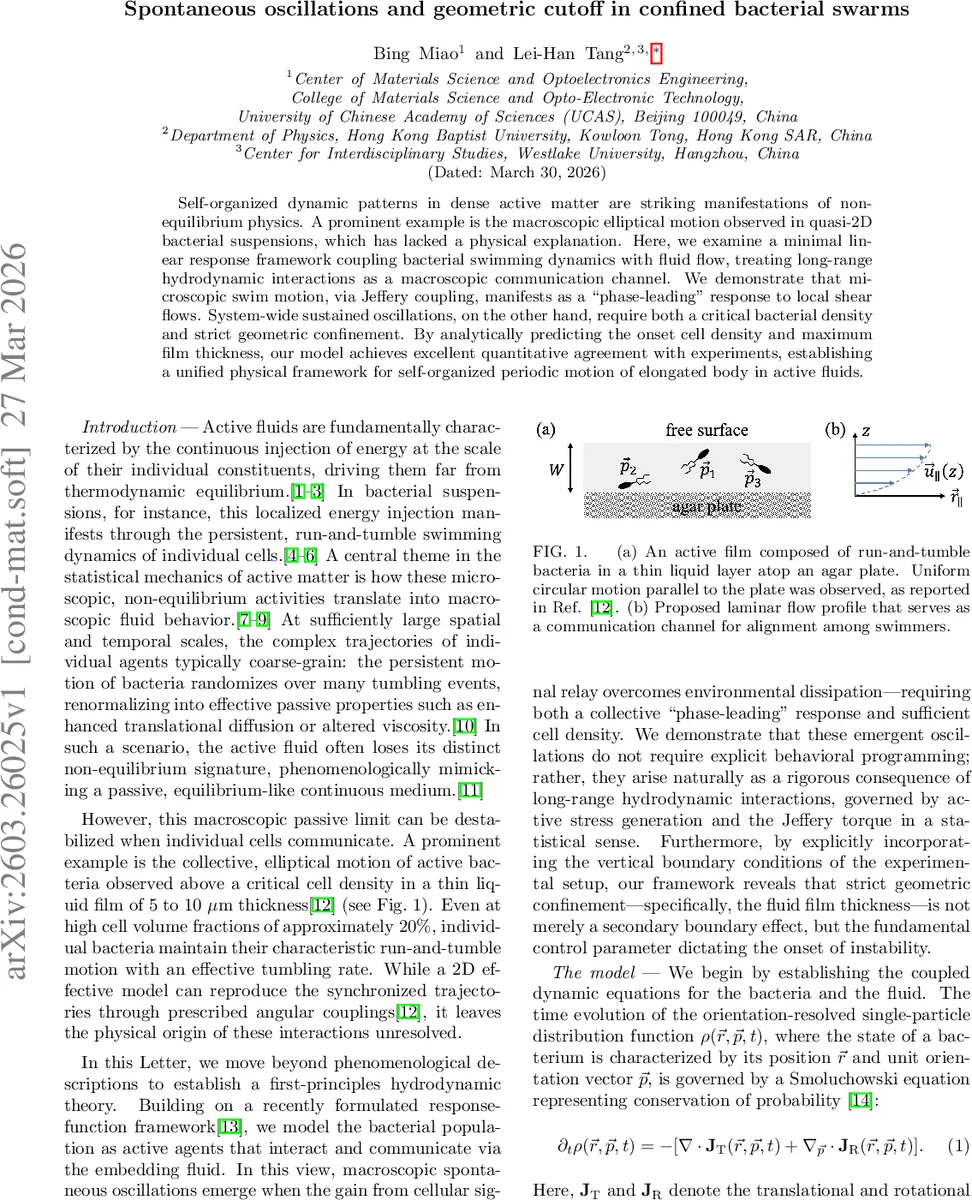
For this instability to manifest as spontaneous oscillations, two additional conditions must be met. First, the bacterial density (c) must exceed a critical value (c_0) to generate enough active stress to overcome viscous damping in the fluid. Second, the geometric confinement must be strict; the fluid film thickness W cannot exceed a maximum value (~10 µm in the experiment). If W is too large, Pe_s falls below the threshold, as bacteria lose orientational memory before crossing the film, weakening the coherent collective response.
Using experimentally measured parameters for swimming speed, rotational diffusion, and the ratio of viscosity to active stress, the model quantitatively predicts an onset cell density of c_0 ≈ 0.05 µm⁻³ and an oscillation period of about 4 seconds, in excellent agreement with experimental observations. The work elevates the fluid film thickness from a mere boundary condition to the primary control parameter for the transition to collective motion.
In conclusion, the study establishes a unified physical framework for self-organized periodic motion in confined active matter. It demonstrates that long-range hydrodynamic interactions, framed as a macroscopic communication channel, can naturally lead to synchronized oscillations through a phase-leading feedback mechanism, requiring a precise combination of microscopic bacterial properties, a critical population density, and strict geometric confinement.
Comments & Academic Discussion
Loading comments...
Leave a Comment