A Dipolar Chiral Spin Liquid on the Breathed Kagome Lattice
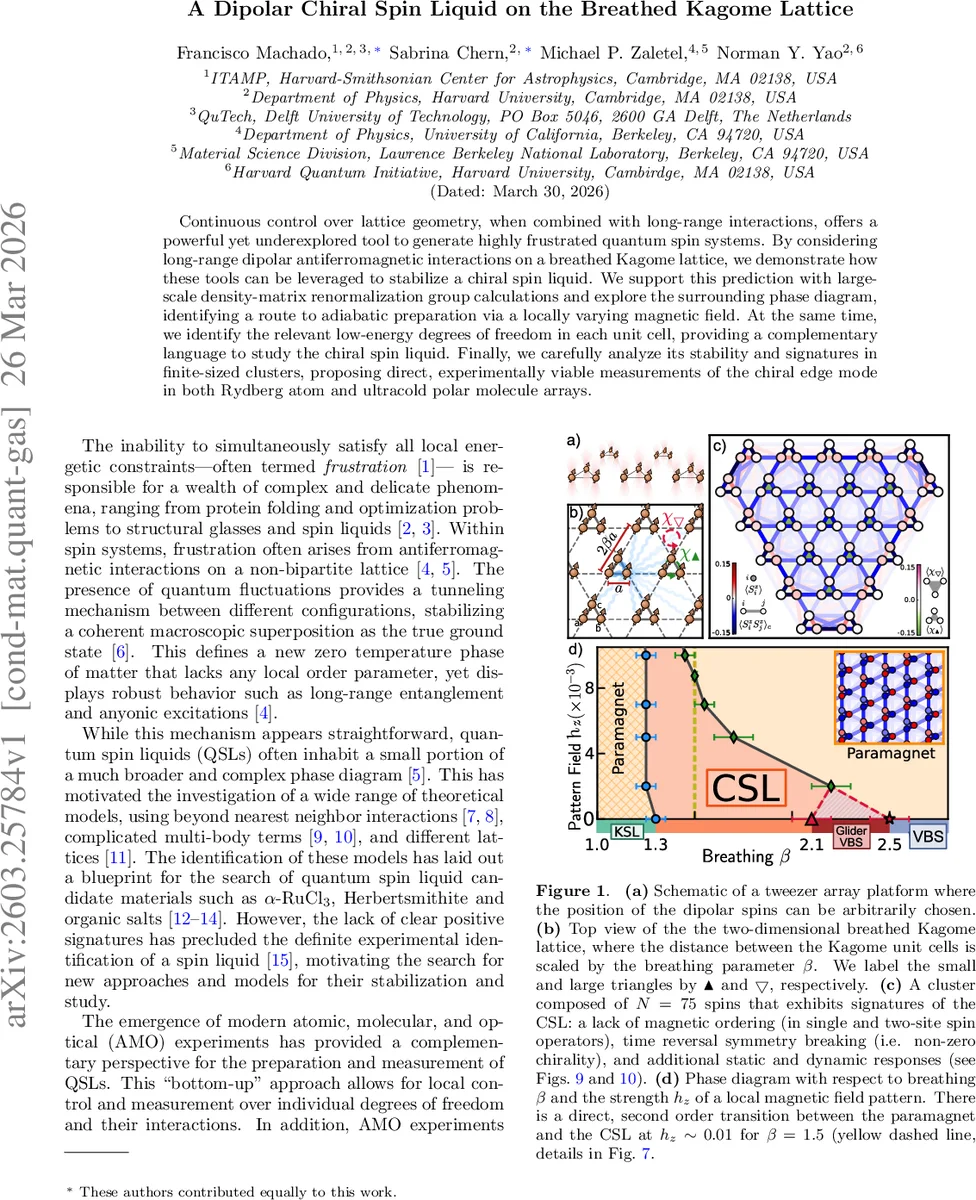
Continuous control over lattice geometry, when combined with long-range interactions, offers a powerful yet underexplored tool to generate highly frustrated quantum spin systems. By considering long-range dipolar antiferromagnetic interactions on a breathed Kagome lattice, we demonstrate how these tools can be leveraged to stabilize a chiral spin liquid. We support this prediction with large-scale density-matrix renormalization group calculations and explore the surrounding phase diagram, identifying a route to adiabatic preparation via a locally varying magnetic field. At the same time, we identify the relevant low-energy degrees of freedom in each unit cell, providing a complementary language to study the chiral spin liquid. Finally, we carefully analyze its stability and signatures in finite-sized clusters, proposing direct, experimentally viable measurements of the chiral edge mode in both Rydberg atom and ultracold polar molecule arrays.
💡 Research Summary
This paper presents a novel pathway to stabilize a Chiral Spin Liquid (CSL) by engineering a highly frustrated quantum spin system through the synergistic combination of two key ingredients: continuous control over lattice geometry and long-range interactions.
The authors study spin-1/2 particles with antiferromagnetic dipolar XY interactions placed on a “breathed” Kagome lattice. The breathing parameter β continuously tunes the relative size of the small and large triangles that constitute the Kagome lattice. This geometric deformation, when coupled with the power-law decay of dipolar interactions, effectively reshapes the entire profile of spin-spin couplings, creating a highly tunable frustrated system without the need for complex multi-body terms.
Using large-scale infinite Density Matrix Renormalization Group (DMRG) calculations on cylindrical geometries, the authors thoroughly characterize the ground state at a breathing parameter of β=1.5. They demonstrate the absence of magnetic long-range order and the presence of spontaneous time-reversal symmetry (TRS) breaking, evidenced by a non-zero and long-range-ordered scalar chirality on the lattice triangles. Crucially, they provide strong evidence for topological order by observing half-integer spin pumping upon adiabatic flux insertion and by identifying the characteristic chiral edge mode spectrum consistent with the SU1(2) Wess-Zumino-Witten conformal field theory, hallmarks of a CSL with semionic excitations.
The study further maps out the phase diagram as a function of β, revealing a robust CSL phase across a surprisingly broad region (approximately β from 1.3 to 2.0). To gain analytical insight, the authors develop an effective low-energy description valid in the large-β limit, where the lattice resembles a collection of weakly coupled triangular clusters. This effective model, mapping each triangle to an effective spin-1/2, successfully captures the emergence of the CSL and quantitatively agrees with numerical results.
Finally, the paper addresses experimental feasibility. It identifies a second-order phase transition between the CSL and a paramagnet induced by a locally varying magnetic field pattern, suggesting a viable adiabatic preparation protocol. Moreover, it shows that key signatures of the CSL—including TRS breaking and edge modes—persist in finite-sized clusters of realistic scales (e.g., 75 spins), which are within reach of current platforms like Rydberg atom arrays or ultracold polar molecule ensembles. This work thus bridges theoretical model-building with experimental capabilities, offering a concrete blueprint for the quantum simulation and detection of a chiral spin liquid.
Comments & Academic Discussion
Loading comments...
Leave a Comment