Bounded Independence Edge Sampling for Combinatorial Graph Properties
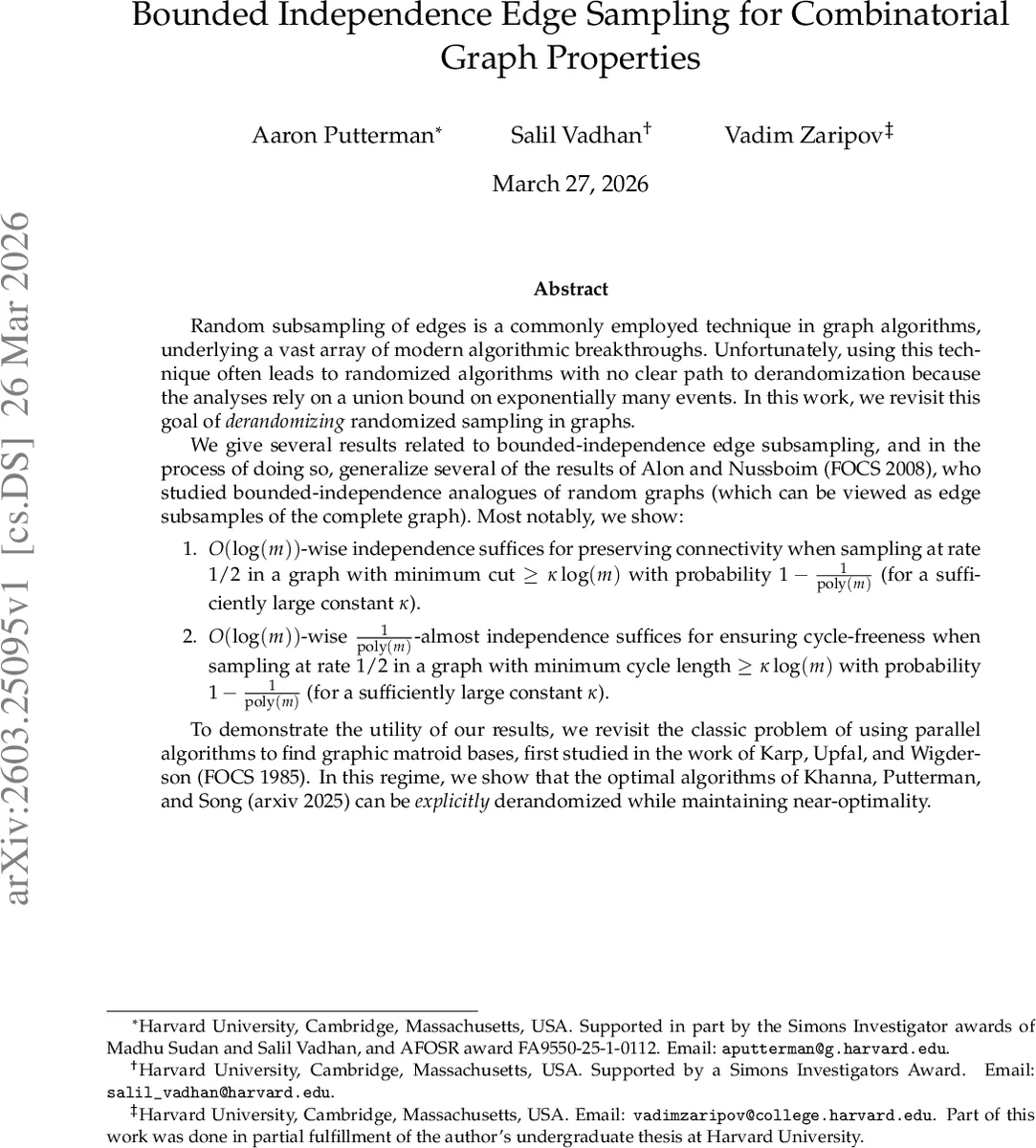
Random subsampling of edges is a commonly employed technique in graph algorithms, underlying a vast array of modern algorithmic breakthroughs. Unfortunately, using this technique often leads to randomized algorithms with no clear path to derandomization because the analyses rely on a union bound on exponentially many events. In this work, we revisit this goal of derandomizing randomized sampling in graphs. We give several results related to bounded-independence edge subsampling, and in the process of doing so, generalize several of the results of Alon and Nussboim (FOCS 2008), who studied bounded-independence analogues of random graphs (which can be viewed as edge subsamples of the complete graph). Most notably, we show: 1. $O(\log(m))$-wise independence suffices for preserving connectivity when sampling at rate $1/2$ in a graph with minimum cut $\geq κ\log(m)$ with probability $1 - \frac{1}{\mathrm{poly}(m)}$ (for a sufficiently large constant $κ$). 2. $O(\log(m))$-wise $\frac{1}{\mathrm{poly}(m)}$-almost independence suffices for ensuring cycle-freeness when sampling at rate $1/2$ in a graph with minimum cycle length $\geq κ\log(m)$ with probability $1 - \frac{1}{\mathrm{poly}(m)}$ (for a sufficiently large constant $κ$). To demonstrate the utility of our results, we revisit the classic problem of using parallel algorithms to find graphic matroid bases, first studied in the work of Karp, Upfal, and Wigderson (FOCS 1985). In this regime, we show that the optimal algorithms of Khanna, Putterman, and Song (arxiv 2025) can be explicitly derandomized while maintaining near-optimality.
💡 Research Summary
The paper investigates the power of bounded‑independence edge sampling for preserving fundamental combinatorial properties of arbitrary graphs and leverages these results to derandomize parallel algorithms for finding bases in graphic and cographic matroids.
The authors begin by recalling that many modern graph algorithms rely on independently sampling each edge with some probability (often 1/2) to obtain a sparser subgraph. While this technique yields strong guarantees under full independence (e.g., connectivity, cycle‑freeness, spectral sparsification), it is notoriously difficult to replace the fully random process with a pseudorandom one because the standard analyses use a union bound over an exponential number of cuts or cycles.
To overcome this obstacle, the paper proves two main theorems. The first theorem shows that for any graph G with m edges and minimum cut size λ ≥ κ·log m (for a sufficiently large constant κ), sampling each edge with probability 1/2 using a 2κ·log m‑wise independent distribution preserves connectivity with probability at least 1 − 1/poly(m). The proof combines Karger’s cut‑counting bound (which limits the number of cuts of size ≤ α·λ to n^{2α}) with a refined tail bound for k‑wise independent random variables (originally due to Schmidt‑Siegel‑Srinivasan). By setting k = O(log m), the authors obtain a failure probability per cut that is small enough to survive a union bound over all cuts, despite the lack of full independence.
The second theorem addresses cycle‑freeness. If the graph’s girth (shortest cycle length) is at least λ ≥ κ·log m, then sampling with marginals 1/2 using a (1/m^{200})‑almost 2κ·log m‑wise independent distribution yields a cycle‑free subgraph with probability 1 − 1/poly(m). Here the authors use a counting argument due to Subramaniam that bounds the number of short cycles, and they adapt the almost‑independence framework to tolerate a tiny deviation from perfect k‑wise independence while still keeping the overall failure probability negligible.
Having established that O(log m)‑wise (or almost‑wise) independence suffices for these two basic properties, the paper turns to applications in parallel matroid algorithms. In the Karp‑Upfal‑Wigderson model, a matroid is accessed only through an independence oracle, and the goal is to find a basis using as few adaptive rounds of queries as possible. Prior work gave randomized algorithms for graphic matroids that run in O(log m) rounds with poly(m) queries per round, but derandomization was only non‑explicit (via Adleman’s technique).
The authors show how to replace the random sampling steps in the recent KPS25 algorithms with explicit bounded‑independence generators that require only O(log m) random bits. For graphic matroids, they first use bounded‑independence sampling to obtain a large independent set (a forest) and then iteratively remove short cycles using the cycle‑freeness theorem. This yields a deterministic algorithm that finds a spanning forest in O(log m·log log m) rounds, each using polynomially many oracle queries (Theorem 1.4).
For cographic matroids, the situation is dual: an independent set is a set of edges that does not contain any cut. By applying the connectivity theorem, the authors construct a bounded‑independence sampler that preserves all cuts larger than κ·log m, then iteratively eliminate small cuts. The resulting deterministic algorithm finds a basis of a cographic matroid in O(log m·log log m) rounds with 2^{O(log² m)} ≈ poly(m) queries per round (Theorem 1.5). This is the first non‑trivial uniform deterministic algorithm for cographic matroids, improving over the generic O(√m)‑round bound for arbitrary matroids.
Technically, the paper introduces several new tools: (i) a “unique cut/unique cycle survival” analysis that shows a particular cut or cycle survives the sampling with high probability; (ii) a leverage‑score framework based on effective resistance that allows the authors to assign non‑uniform sampling probabilities while still using bounded independence; and (iii) a careful combination of combinatorial counting (cut and cycle bounds) with probabilistic tail bounds for limited independence.
Overall, the work makes two significant contributions. First, it demonstrates that bounded‑independence edge sampling is sufficient for preserving key combinatorial properties even in non‑expanding graphs, extending the scope of previous results that were limited to expanders or complete graphs. Second, it translates these probabilistic insights into explicit, efficient deterministic parallel algorithms for finding bases in graphic and cographic matroids, thereby bridging a gap between theory (existence of low‑round algorithms) and practice (implementable derandomized algorithms). The techniques introduced are likely to be useful for further derandomization efforts in sublinear graph algorithms, streaming, and distributed settings where random edge sampling is a core primitive.
Comments & Academic Discussion
Loading comments...
Leave a Comment