Cone-Induced Geometry and Sampling for Determinantal PSD-Weighted Graph Models
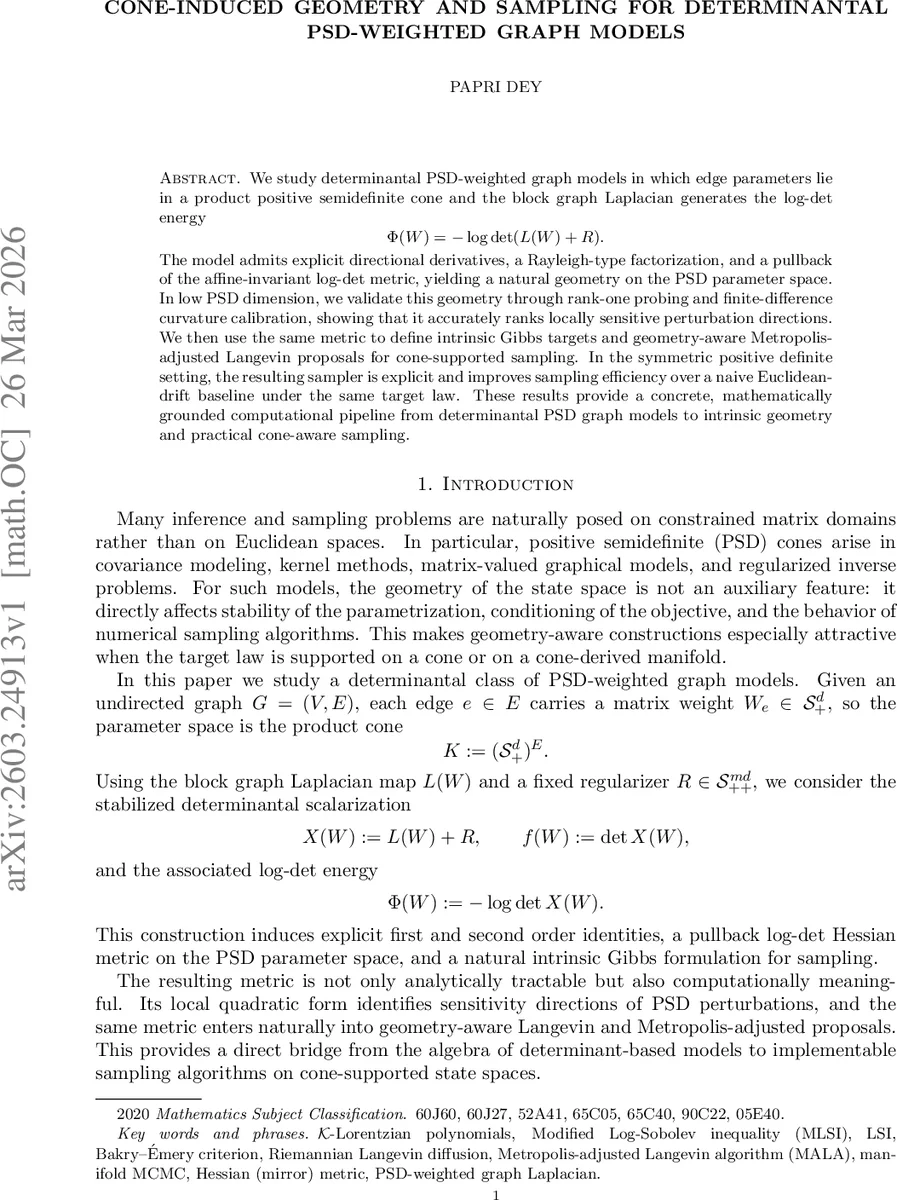
We study determinantal PSD-weighted graph models in which edge parameters lie in a product positive semidefinite cone and the block graph Laplacian generates the log-det energy [ Φ(W)=-\log\det(L(W)+R). ] The model admits explicit directional derivatives, a Rayleigh-type factorization, and a pullback of the affine-invariant log-det metric, yielding a natural geometry on the PSD parameter space. In low PSD dimension, we validate this geometry through rank-one probing and finite-difference curvature calibration, showing that it accurately ranks locally sensitive perturbation directions. We then use the same metric to define intrinsic Gibbs targets and geometry-aware Metropolis-adjusted Langevin proposals for cone-supported sampling. In the symmetric positive definite setting, the resulting sampler is explicit and improves sampling efficiency over a naive Euclidean-drift baseline under the same target law. These results provide a concrete, mathematically grounded computational pipeline from determinantal PSD graph models to intrinsic geometry and practical cone-aware sampling.
💡 Research Summary
The paper investigates a class of determinantal graph models in which each edge of an undirected graph carries a positive semidefinite (PSD) matrix weight. The parameter space is the product cone K = (S⁺d)^E, where d is the matrix dimension and E the edge set. A block graph Laplacian map L : K → S⁺{md} is defined by L(W) = (B ⊗ I_d) diag(W_e) (Bᵀ ⊗ I_d), with B the oriented incidence matrix. Adding a fixed regularizer R ∈ S⁺⁺_{md} yields X(W) = L(W)+R, which is always strictly positive definite. The central energy function is the stabilized log‑det potential Φ(W) = −log det X(W).
Because L(W) depends linearly on the edge matrices, the first and second directional derivatives of Φ admit closed‑form expressions via Jacobi’s matrix‑determinant identity: D_U Φ(W) = −tr
Comments & Academic Discussion
Loading comments...
Leave a Comment