Universality of shocks in conserved driven single-file motions with bottlenecks
Driven single-file motion, in which particles move unidirectionally along one-dimensional channels, sets the paradigm for wide variety of one-dimensional directed movements, ranging from intracellular transport and urban traffic to ant trails and controlled robot swarms. Motivated by the phenomenologies of these systems in closed geometries, regulated by number conservation and bottlenecks, we explore the domain walls (DWs) or shocks in a conceptual one-dimensional cellular automaton with a fixed particle number and a bottleneck. For high entry and exit rates of the cellular automaton, and with sufficiently large particle numbers, the DWs formed are independent of the associated rate parameters, revealing a {\em hitherto unknown universality} in their {\em shapes}, which are however enclosed by nonuniversal boundary layers. In contrast, the DWs do depend upon these parameters, if small, and hence have nonuniversal shapes, but without boundary layers. Nonuniversal delocalized DWs can be formed by additional tuning of the control parameters. Our predictions on the DWs are testable in model experiments.
💡 Research Summary
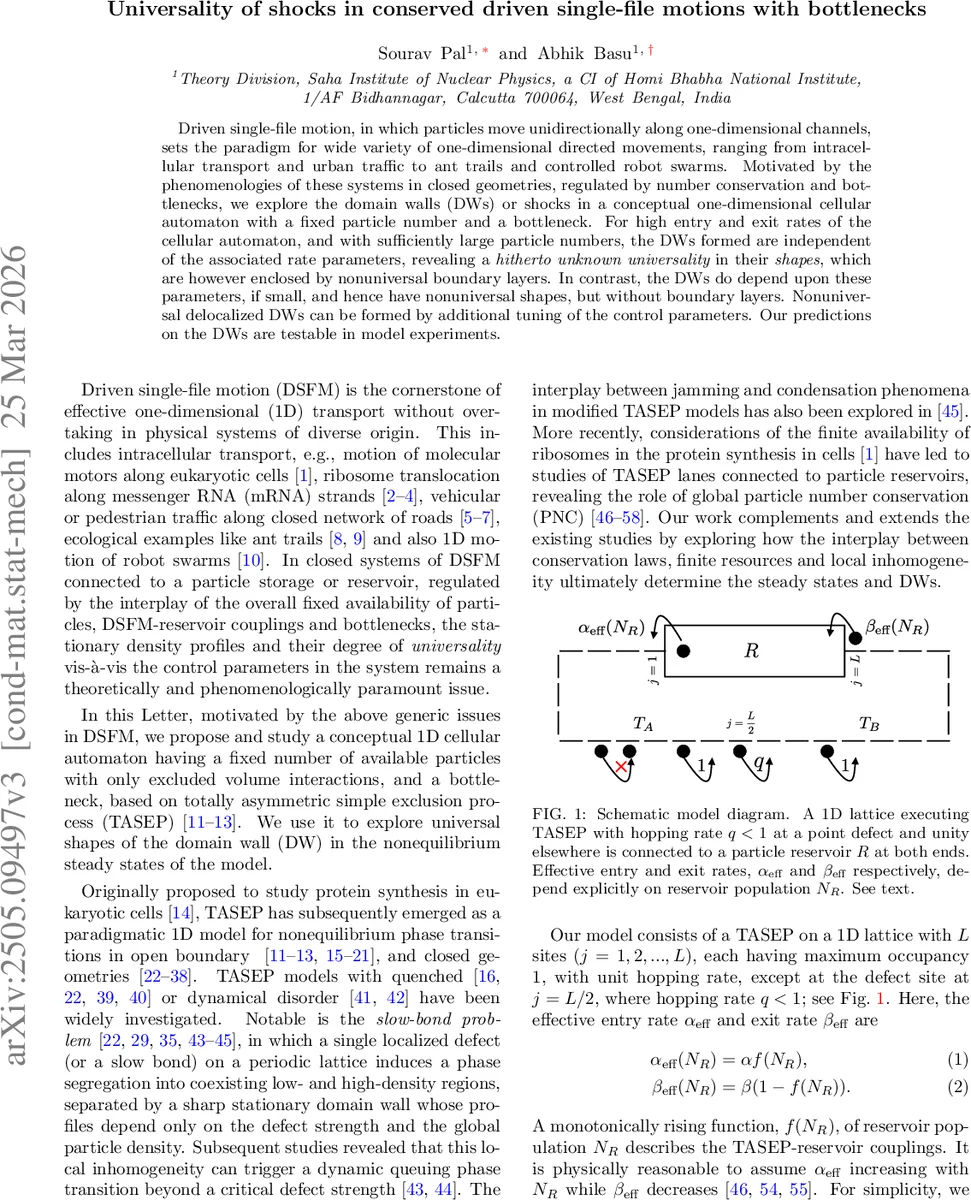
The authors introduce a novel one‑dimensional cellular automaton based on the totally asymmetric simple exclusion process (TASEP) that incorporates three essential ingredients of many real‑world driven single‑file systems: (i) a fixed total number of particles (global particle‑number conservation), (ii) a localized defect or bottleneck that reduces the hopping rate at the midpoint of the lattice, and (iii) coupling of the lattice ends to a finite reservoir that determines effective entry (α_eff) and exit (β_eff) rates through a monotonic function f(N_R) of the reservoir occupation. Two normalization schemes are considered, N* = L (finite reservoir capacity) and N* = N₀ (unrestricted capacity), allowing the study of particle‑hole symmetry and its breaking.
Using mean‑field theory (MFT) the lattice is split into two sub‑segments (T_A and T_B) meeting at the defect. Current conservation at the defect yields relations β_A = q(1 − ρ_{L/2+1}) and α_B = q ρ_{L/2}, where q < 1 is the reduced hopping rate. The bulk densities in each segment satisfy either ρ_A = ρ_B (homogeneous phases) or ρ_A + ρ_B = 1 (phase‑segregated states). Depending on the values of the entry/exit parameters (α, β), the filling factor μ = N₀/L, and the defect strength q, the system exhibits eight distinct stationary phases: low‑density (LD‑LD), high‑density (HD‑HD), several localized domain‑wall (DW) phases (LD‑DW, DW‑LD, LD‑HD, DW‑HD, HD‑DW), and a novel universal domain‑wall (UDW) phase.
The central discovery is the existence of a “universal domain wall” (UDW) that appears when α, β, and μ are sufficiently large. In this regime the DW is pinned exactly at the midpoint (x = ½) of the lattice, its height Δρ = ρ_HD − ρ_LD = (1 − q)/(1 + q) depends only on the defect strength q, and it is completely independent of the entry/exit rates, the total particle number, or the functional form of f(N_R). This mirrors critical phenomena where a single relevant operator (here q) controls the macroscopic profile while all other microscopic details become irrelevant. However, the UDW is accompanied by non‑universal boundary layers (BLs) at the two ends of the lattice. The BL densities are given analytically (e.g., ρ₁ =
Comments & Academic Discussion
Loading comments...
Leave a Comment