Quantum-informed learning of genuine network nonlocality beyond idealized resources
We address the characterization of genuine network nonlocal correlations, which remain highly challenging due to the non-convex nature of local correlations even in the distinct triangle scenario with three sources and three observers implementing one four-outcome measurement. We introduce a scalable causally inferred Bayesian learning framework called the Layered Local Hidden Variable Neural Network (Layered LHV-Net) to learn the local statistics in network Bell tests. Using this framework, we identify a new class of measurement settings that exhibit the most robust nonlocality compared to previously known measurements. Remarkably, our study shows that the nonlocality measure becomes non-zero only when the visibility of the shared Bell state exceeds 0.94, surpassing previously reported noise robustness thresholds. Further, we examine correlations where shared states originate from dissimilar sources, finding that nonlocality is observed only if all the involved states are sufficiently entangled. Finally, we analyze a scenario in which the sources are allowed to share classical randomness. We find that nonlocal correlations persist even when the sources share up to 3 units of randomness, whereas a local model reproducing the quantum correlations only becomes possible when 4 units of shared randomness are available. Apart from the results, the work succeeds in showing that quantum-informed machine learning approaches as foundational frameworks can greatly benefit the field of quantum information.
💡 Research Summary
The paper tackles the long‑standing problem of characterizing genuine network nonlocality (GNN) in the triangle configuration when realistic imperfections such as mixed states, noise, and shared classical randomness are present. Traditional studies have focused on idealized scenarios where each of the three independent sources distributes an identical maximally entangled Bell pair and the three parties perform a fixed, symmetric four‑outcome measurement (the RGB4 family). In those settings, nonlocality can be demonstrated analytically, but the robustness to Werner‑type noise has never been quantified beyond a vague range (approximately 0.78–0.85 visibility). Moreover, existing machine‑learning approaches, notably the single‑layer LHV‑Net, fail to capture the richer structure of mixed‑state distributions because the response functions lack sufficient degrees of freedom.
To overcome these limitations, the authors introduce a scalable, causally‑inferred Bayesian learning framework called Layered LHV‑Net. The core idea is to embed the causal DAG of the triangle network into a Bayesian network where each source emits a continuous hidden variable λ₁, λ₂, λ₃ drawn from a uniform distribution. Each observer’s response function is modeled by a multi‑layer feed‑forward neural network rather than a single perceptron. This multilayer architecture provides the expressive power needed to approximate the conditional probability distributions that arise from mixed quantum states. Bayesian inference is employed to update prior distributions over network parameters using the observed joint statistics P(a,b,c), thereby ensuring that learning respects the underlying causal constraints and avoids over‑fitting.
Using this framework, the authors obtain three major results:
-
New measurement settings and noise robustness – By allowing asymmetric measurement operators (parameterized by u and v) the method discovers a class of measurements that outperform the previously known RGB4 family. When Werner noise is added to each source, the nonlocality indicator becomes positive only for visibility v > 0.94. This threshold is substantially higher than the earlier, loosely reported range and sets a concrete experimental target for observing GNN in noisy conditions.
-
Requirement of entanglement across all sources – The study extends to heterogeneous sources, where each source may emit a different mixed state (different Werner parameters or classically correlated states). The results show that genuine network nonlocality survives only if all three sources are sufficiently entangled; a single weakly entangled source can destroy the nonlocal correlations even if the other two are nearly pure. This introduces a new “all‑sources‑must‑be‑entangled” condition for GNN.
-
Robustness to shared classical randomness – The authors model shared randomness as an additional classical variable that can be distributed among the sources. By varying the amount of shared randomness (measured in “units” of entropy), they find that GNN persists up to 3 units, but when the shared randomness reaches 4 units a local hidden‑variable model can exactly reproduce the quantum statistics. This quantifies the resilience of network nonlocality against classical correlations and provides a clear boundary between quantum‑only and classically‑simulable regimes.
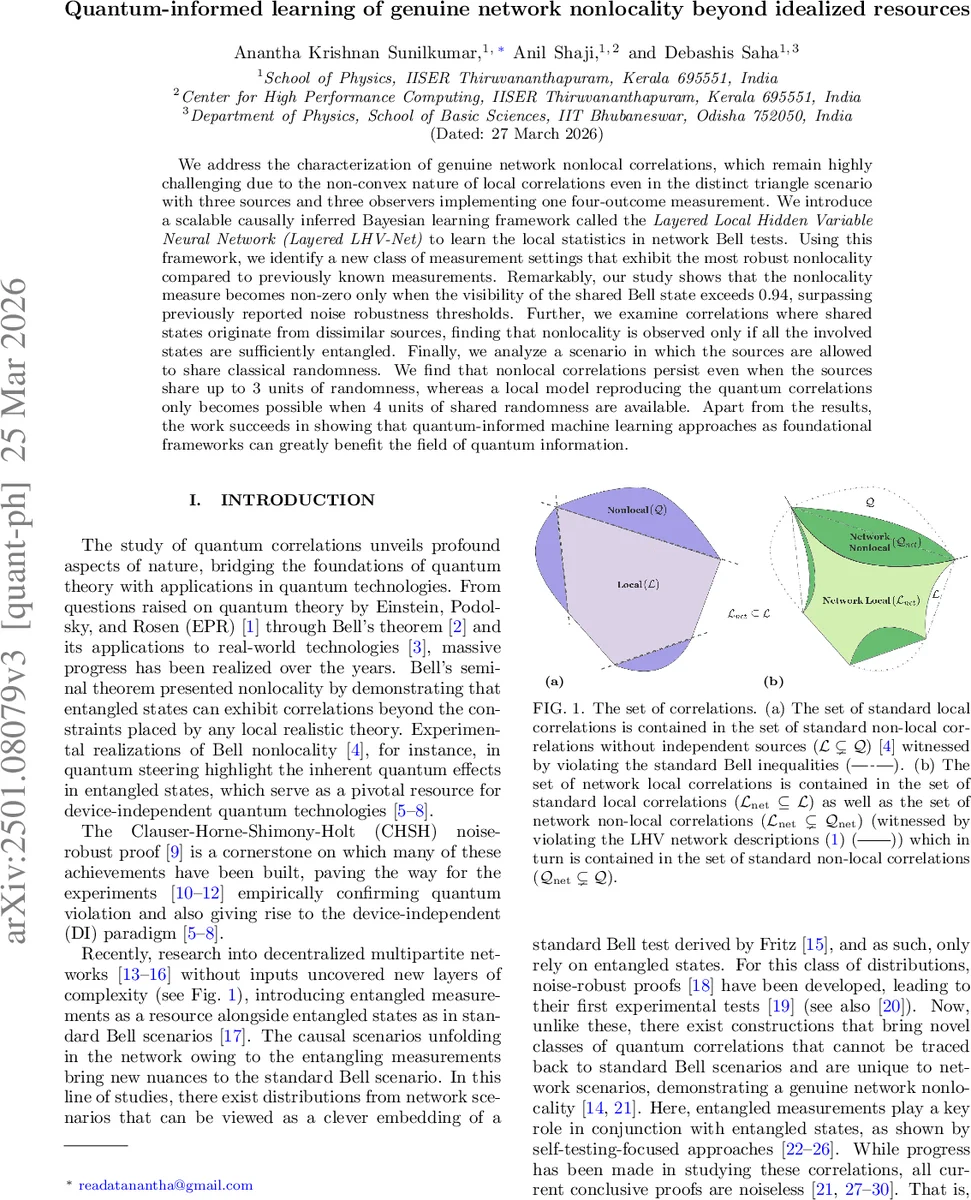
In addition to these quantitative findings, the paper demonstrates that the learned posterior distributions of the Layered LHV‑Net can be visualized to map the non‑convex boundary between local and non‑local sets in the probability simplex. The multilayer approach successfully resolves ambiguities that plagued earlier single‑layer models, especially when dealing with mixed states that are close to the local boundary.
The authors also discuss the scalability of their method. Because the causal DAG remains fixed while only the conditional functions are learned, the same architecture can be applied to more complex networks (e.g., star, square, or larger multipartite graphs) with modest modifications. The Bayesian updating scheme ensures that the parameter space grows only polynomially with the number of layers, making the approach computationally tractable for realistic experimental data sizes.
Finally, the paper outlines practical implications for upcoming experiments. The identified visibility threshold (v > 0.94), the necessity for uniformly high entanglement across sources, and the tolerance of up to three units of shared randomness together define a realistic “operational window” for observing genuine network nonlocality with current photonic or superconducting platforms. Moreover, the work positions quantum‑informed machine learning as a foundational tool rather than a mere predictive model, bridging the gap between abstract quantum foundations and concrete experimental verification.
In summary, this study provides the first rigorous, noise‑robust certification of genuine network nonlocality beyond idealized resources, introduces a powerful causal‑Bayesian neural‑network framework, and opens new avenues for both theoretical exploration and experimental realization of complex quantum networks.
Comments & Academic Discussion
Loading comments...
Leave a Comment