Energy-Morawetz estimates for the wave equation in perturbations of Kerr
In this paper, we prove energy and Morawetz estimates for solutions to the scalar wave equation in spacetimes with metrics that are perturbations, compatible with nonlinear applications, of Kerr metrics in the full subextremal range. Central to our approach is the proof of a global in time energy-Morawetz estimate conditional on a low frequency control of the solution using microlocal multipliers adapted to the $r$-foliation of the spacetime. This result constitutes a first step towards extending the current proof of Kerr stability in \cite{GCM1} \cite{GCM2} \cite{KS:Kerr} \cite{GKS} \cite{Shen}, valid in the slowly rotating case, to a complete resolution of the black hole stability conjecture, i.e., the statement that the Kerr family of spacetimes is nonlinearly stable for all subextremal angular momenta.
💡 Research Summary
The paper “Energy‑Morawetz estimates for the wave equation in perturbations of Kerr” establishes global-in‑time energy‑Morawetz‑flux estimates for solutions of the scalar wave equation □_g ψ = F on a class of spacetimes that are small, smooth perturbations of sub‑extremal Kerr metrics (|a| < m). The authors’ motivation is the Kerr stability conjecture, which predicts nonlinear stability of the entire Kerr family of black holes. Existing proofs of this conjecture are limited to the slowly rotating regime (|a|/m ≪ 1) because the crucial energy‑Morawetz estimates have only been derived under that restriction. This work removes the small‑rotation assumption and provides the first step toward a full‑range proof.
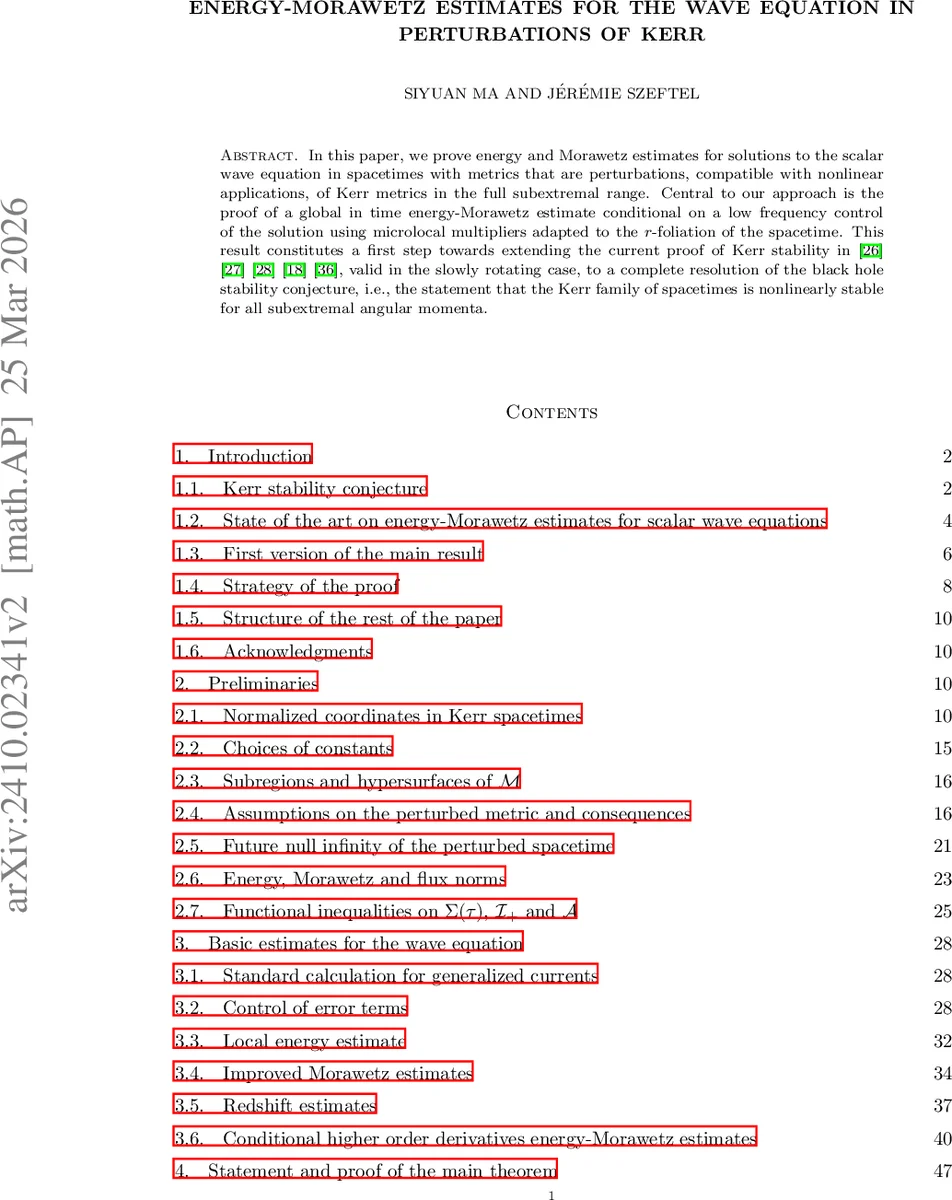
The paper is organized as follows. Section 1 introduces the conjecture, reviews the state of the art on energy‑Morawetz estimates for scalar waves on Schwarzschild, Kerr, and perturbations thereof, and outlines the main result. Section 2 sets up the geometric framework: normalized Boyer–Lindquist coordinates, the definition of the r‑foliation, the precise smallness assumptions on the perturbed metric g, and the functional spaces (energy, Morawetz, and flux norms) used throughout. Section 3 develops the basic analytic tools: the standard current‑divergence identities, control of error terms arising from the metric perturbation, a local energy estimate, improved Morawetz inequalities, and red‑shift estimates near the event horizon. These are proved first for the unperturbed Kerr background and then shown to persist under the small‑perturbation hypothesis.
The core of the paper is Sections 4–7. In Section 4 the authors state the main theorem (Theorem 4.1) which asserts that for any solution ψ of the inhomogeneous wave equation on the perturbed spacetime, one has \
Comments & Academic Discussion
Loading comments...
Leave a Comment