Spectral Structure of the Mixed Hessian of the Dispersionless Toda $τ$-Function
We analyze the mixed Hessian of the dispersionless Toda $τ$-function for the $s$-fold symmetric one-harmonic polynomial conformal map. The inverse branch exhibits two distinct thresholds: an analytic threshold $ζ_c$, where the dominant square-root si…
Authors: Oleg Alekseev
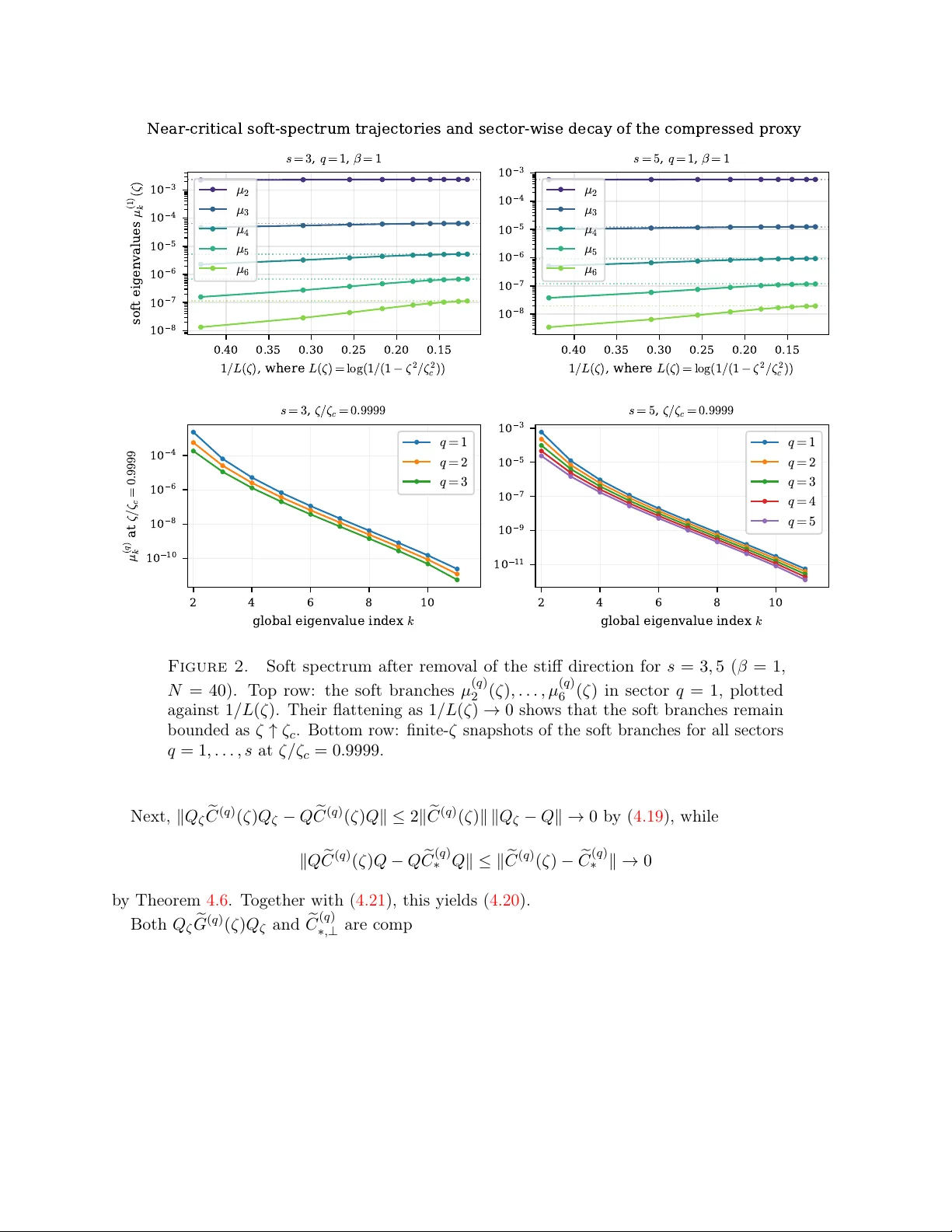
SPECTRAL STR UCTURE OF THE MIXED HESSIAN OF THE DISPERSIONLESS TOD A τ -FUNCTION OLEG ALEKSEEV Abstra ct. W e analyze the mixed Hessian of the dispersionless T o da τ -function for the s -fold symmetric one-harmonic p olynomial conformal map. The inv erse branc h exhibits tw o distinct thresholds: an analytic threshold ζ c , where the dominan t square-ro ot singularit y reac hes the circle of con vergence, and a later geometric threshold ζ univ > ζ c , where the map ceases to b e univ alent. W e pro v e that the first sp ectral instability occurs already at ζ c . In each symmetry sector, the w eighted sub critical realization has exactly one logarithmically diverging eigenv alue, whereas the remaining sp ectrum stays b ounded and, after remov al of the singular direction, conv erges to that of a compact limiting remainder. W e further contin ue the corresp onding scalar Gram functions b ey ond ζ c , showing that they admit a generalized hypergeometric description, a Cauch y–Stieltjes represen tation, and, for 1 ≤ p ≤ s , a realization as W eyl functions of b ounded Jacobi op erators. In particular, these scalar quantities remain finite at ζ univ . Th is iden tifies analytic criticality , rather than loss of univ alence, as the first sp ectral threshold of the T o da Hessian. 1. Intr oduction Planar domains, conformal maps, and harmonic momen ts play a cen tral role in sev eral closely related sub jects, including Laplacian growth, disp ersionless integrable hierarc hies, Green-function and Bergman-kernel theory , and planar matrix mo dels [ 1 – 7 ]. A common feature of these theories is that the geometry of a simply connected domain may be enco ded b y its conformal map and by the harmonic moments of its complemen t. This mak es it natural to ask not only ho w the domain itself degenerates near criticality , but also how the associated second-order response ob jects b eha v e. The present pap er studies one suc h ob ject: the mixed Hessian of the disp ersionless T o da free energy , equiv alently the co efficien t matrix of a mixed logarithmic kernel attac hed to the in verse conformal map. Let D ⊂ C b e a b ounded simply connected domain with rectifiable b oundary , and let f : {| w | > 1 } → C \ D , f ( w ) = r w + a 0 + a 1 w − 1 + · · · , b e the unique exterior conformal map normalized by f ( w ) /w → r as w → ∞ . The parameter r > 0 is the conformal radius of D , while the remaining co efficients encode the shap e of the b oundary . Let w = w ( z ) denote the inv erse branc h near infinit y , normalized by w ( z ) = z /r + O ( z − 1 ) . T wo bilinear kernels are naturally attached to f . The first is the holomorphic F ab er–Grunsky k ernel log f ( w ) − f ( w ′ ) r ( w − w ′ ) whose co efficien ts control univ alence through the classical Grunsky inequalities [ 8 , 9 ]. By con trast, the present pap er is concerned with the mixed holomorphic–an tiholomorphic logarithmic kernel (1.1) log 1 − 1 w ( z ) w ( z ′ ) ! = − X m,n ≥ 1 H mn ( z /r ) − m m ( ¯ z ′ /r ) − n n , v alid for | z | and | z ′ | sufficien tly large. It is obtained by pulling bac k the canonical mixed logarithmic k ernel of the exterior disk under the inv erse conformal map. The co efficien ts H mn are the main ob ject of the present pap er. In the geometric realization of the disp ersionless 2 D T o da hierarch y , the exterior conformal map ev olv es under comm uting flows whose times ( t 0 , t 1 , t 2 , . . . ; ¯ t 1 , ¯ t 2 , . . . ) are identified with the harmonic 1 2 OLEG ALEKSEEV momen ts of C \ D . In a standard normalization, t 0 = (1 /π ) R D d 2 z is the area of D divided by π , while for n ≥ 1 the v ariables t n and ¯ t n are the holomorphic and an tiholomorphic harmonic momen ts of C \ D . The hierarc h y p ossesses a disp ersionless τ -function whose logarithm F = log τ pla ys the role of a free energy , and in a standard normalization one has H mn = r m + n ∂ 2 F ∂ t m ∂ ¯ t n . Th us ( H mn ) is the scale-inv ariant mixed Hessian of the disp ersionless free energy . The same co efficien ts may b e interpreted in sev eral equiv alen t languages. In Laplacian growth and Hele–Sha w dynamics, ( H mn ) records the second-order coupling b et w een moment deformations. In the disp ersionless T o da hierarc hy , it is the matrix of mixed second deriv ativ es of log τ . In Bergman-k ernel language, one has, with our normalization, (1.2) π B C \ D ( z , z ′ ) = − ∂ z ∂ ¯ z ′ log 1 − 1 w ( z ) w ( z ′ ) ! , so the same data ma y b e recov ered from the exterior Bergman kernel in conformal co ordinates [ 10 , 11 ]. In the normal matrix mo del, F is the planar free energy , or equiv alen tly the logarithmic energy of the equilibrium measure on D [ 6 , 7 ], and ( H mn ) may be view ed as a mixed susc eptibility matrix with resp ect to momen t deformations. The main contribution of the pap er is to determine the sp ectral structure of ( H mn ) near criticality in a family for which the in v erse map can b e con trolled explicitly . The question is which part of the sp ectrum b ecomes singular near criticality , and whether that transition is gov erned by analytic criticalit y of the inv erse branch or b y the later geometric loss of univ alence. This question is genuinely differen t from the classical holomorphic Grunsky theory , whose op erator b ounds are tied directly to univ alence and quasiconformal extension [ 8 , 9 ]. In the mixed sector studied here, the first instabilit y is triggered already at the analytic threshold and concentrates in to one logarithmically div erging stiff mo de per symmetry sector, that is, an eigen-direction whose eigenv alue diverges logarithmically , while the remaining sectorial sp ectrum stays bounded. The resulting separation b et w een analytic and geometric criticality is invisible in a purely holomorphic framework. R elation to prior work. The present problem should also b e distinguished from spectral and determinan tal questions for the classical Grunsky op erator and matrix, including F redholm-eigenv alue problems for quasicircles and recent asymptotics for truncated Grunsky op erators [ 12 – 14 ]. Those w orks concern the holomorphic Grunsky data, or F redholm determinants built from them. Here the basic ob ject is instead the mixed Hessian ( H mn ) , equiv alently the mixed logarithmic kernel ( 1.1 ) ; the relev an t transition is therefore not the saturation of a b ounded holomorphic op erator norm or a truncated determinant asymptotic, but a logarithmic rank-one spike in the mixed sector at the earlier analytic threshold ζ c . With this motiv ation in hand, we no w restrict to a family in whic h the analysis can b e carried out explicitly . W e study the s -fold symmetric one-harmonic family (1.3) f ( w ) = r w + aw 1 − s , s ≥ 2 , r > 0 , a ∈ R , whic h is the simplest family in which the analytic singularit y of the inv erse map and the geometric loss of univ alence separate. Maps of the form ( 1.3 ) are standard in Laplacian growth and related free-b oundary problems [ 5 ]; they already exhibit nontrivial geometric transitions, including loss of univ alence and, for s ≥ 3 , b oundary cusps at the geometric threshold. Because they dep end on a single dimensionless shap e parameter ζ := a/r > 0 , they pro vide a minimal and fully explicit mo del in which the sp ectral b eha vior of the mixed Hessian can b e analyzed in detail. All rigorous results pro v ed b elow concern the family ( 1.3 ) ; the corresp onding extension to general p olynomial conformal maps, under an isolated dominant square-ro ot orbit hypothesis, is developed in the companion pap er [ 15 ]. SPECTRAL STRUCTURE OF THE MIXED HESSIAN OF THE DISPERSIONLESS TODA τ -FUNCTION 3 W riting x := r /z and w ( z ) − 1 = x U ( x ; ζ ) , one finds that the in v erse branch is gov erned by the algebraic equation (1.4) U = 1 + ζ x s U s . This elementary relation already contains the tw o thresholds that con trol the problem. The first is the analytic thr eshold ζ c = ( s − 1) s − 1 s s , at which the dominan t square-ro ot singularit y of the inv erse branc h reaches the unit circle in the x -plane. The second is the ge ometric thr eshold ζ univ = 1 s − 1 , at which the conformal map ceases to b e univ alent and the b oundary dev elops its first geometric singularit y: for s ≥ 3 , semicubical cusps, and for s = 2 , the degenerate Jouko wski segment. The problem is to determine whic h of these thresholds go v erns the first sp ectral instability of the mixed Hessian. Our answer is that the relev an t threshold is ζ c . The s -fold symmetry of ( 1.3 ) implies H mn = 0 unless m ≡ n ( mo d s ) , so the Hessian decomposes into s indep enden t blo c ks. These blo c ks admit an exact p ositiv e Gram factorization in terms of Raney co efficien ts generated b y ( 1.4 ) . After passing to a suitable w eigh ted realization, each symmetry blo c k dev elops one logarithmically div erging eigen v alue, while the remaining sectorial sp ectrum sta ys b ounded. Equiv alen tly , there is one stiff mo de p er symmetry sector, so at most s logarithmically diverging eigenv alues globally . The first sp ectral transition is therefore an analytic phenomenon of the in v erse branch rather than a manifestation of geometric non-univ alence. A second theme of the pap er concerns the intermediate regime ζ c < ζ < ζ univ , where the conformal map remains univ alent although the w eighted compact op erator realization used in the sub critical regime is no longer av ailable. In this region the blo c k-op erator picture breaks do wn, but its scalar Gram building blo c ks remain well defined and contin ue analytically . More precisely , the blo c k Gram weigh ts in the sub critical op erator theory are obtained from generating functions built from the squared Raney co efficien ts, and these scalar functions still admit analytic con tin uation b ey ond ζ c . W e iden tify these con tin ued functions as generalized hypergeometric ob jects, derive their resonant branc h-p oin t expansion, prov e a Cauch y–Stieltjes representation, and, in the p ositiv e range 1 ≤ p ≤ s , obtain a Jacobi-matrix realization. Th us the con tinuation of these scalar Gram data captures the same analytic branc h-p oin t mec hanism that pro duces the sub critical logarithmic instabilit y , even after the weigh ted compact realization has ceased to exist. In particular, the singularit y at ζ c is not the onset of geometric breakdo wn: the t wo lateral b oundary v alues of the con tin ued scalar data remain finite at the univ alence threshold. 1.1. Main results. The results of the pap er fall into three groups. Theorem A gives the op erator- theoretic description of the analytic threshold ζ c : for a fixed weigh t parameter β > 0 , eac h symmetry blo c k splits into one logarithmically stiff direction and a b ounded soft remainder. Theorem B iden tifies the scalar Gram data that survive b ey ond the w eigh ted compact regime and con tinues them across the cut as generalized h yp ergeometric/Stieltjes ob jects. Finally , Prop osition C shows that this analytic transition o ccurs strictly b efore the geometric loss of univ alence at ζ univ . Fix a symmetry sector q ∈ { 1 , . . . , s } and a w eigh t parameter β > 0 . Let H ( q ) denote the in trinsic co efficien t matrix of the q -th Hessian blo c k, and let e G ( q ) ( ζ ) b e the corresp onding weigh ted blo c k Gram operator. The sp ectral analysis in this pap er is carried out for these weigh ted realizations on the fixed Hilb ert space ℓ 2 ( N 0 ) , where N 0 := { 0 , 1 , 2 , . . . } . The w eigh ting is only an auxiliary 4 OLEG ALEKSEEV Hilb ert-space device: it does not alter the co efficien t data and do es not remov e the critical instability . The weigh ted Gram and weigh ted Hessian blo cks ha v e the same nonzero sp ectrum, so the sp ectral conclusions may be stated equiv alen tly for e G ( q ) ( ζ ) or e H ( q ) ( ζ ) . Theorem (A: Rank-one logarithmic instability) . Fix q ∈ { 1 , . . . , s } and β > 0 . The weighte d blo ck Gr am op er ator admits, as ζ ↑ ζ c , a r ank-one lo garithmic de c omp osition e G ( q ) ( ζ ) = L ( ζ ) e d ( q ) ⊗ e d ( q ) ∗ + e C ( q ) ( ζ ) , L ( ζ ) := log 1 1 − ζ 2 /ζ 2 c → + ∞ , wher e e d ( q ) = 0 is indep endent of ζ , while e C ( q ) ( ζ ) r emains uniformly b ounde d and c onver ges in op er ator norm to a c omp act limit. In p articular, exactly one eigenvalue in the q -th se ctor diver ges lo garithmic al ly, µ ( q ) 1 ( ζ ) = ∥ e d ( q ) ∥ 2 ℓ 2 L ( ζ ) + O (1) . A l l r emaining se ctorial eigenvalues stay b ounde d; mor e pr e cisely, after r emoving the spike dir e ction, e ach fixe d soft eigenvalue c onver ges to the c orr esp onding eigenvalue of the c ompr esse d c omp act limit describ e d in Pr op osition 4.8 . Theorem A is prov ed b y combining the square-ro ot singularity analysis of the in v erse branch with the blo c kwise Gram representation of the Hessian. The logarithmic term is first isolated at the lev el of matrix entries, and the weigh ted realization for fixed β > 0 then yields a compact op erator framew ork in whic h the rank-one singular part separates from the b ounded soft sector. R emark 1.1 (Contrast with the Grunsky op erator) . The classical Grunsky op erator b elongs to the holomorphic sector and is gov erned by the sharp b ound ∥ B ∥ ≤ 1 , which is equiv alen t to univ alence of the underlying map [ 9 ]. Accordingly , in the present one-parameter family , the holomorphic-sector transition is go v erned by the geometric threshold ζ univ . By con trast, the mixed Hessian studied here transitions earlier, at the analytic threshold ζ c , and the nature of the transition is different: instead of the saturation of a b ounded op erator norm, one eigenv alue div erges logarithmically while the remaining sp ectrum stays bounded. This distinction b et w een the holomorphic and mixed sectors is gen uinely op erator-theoretic and is not visible at the level of individual matrix entries. The second principal result concerns the scalar quan tities that underlie the blo c k Gram construction itself and therefore remain meaningful b ey ond the weigh ted op erator regime. F or each p ≥ 1 , consider the generating function (1.5) G p ( u ) := X m ≥ 0 R s,p ( m ) 2 u m , u = ζ 2 . Belo w ζ c , the scalar Gram weigh ts en tering the blo c k op erators are obtained from these functions b y explicit Euler-t yp e differential op erators. Th e imp ortance of G p is therefore that they enco de, in scalar form, the same branc h-point mec hanism that driv es the logarithmic sp ectral instabilit y . These functions contin ue analytically b ey ond the radius of conv ergence u = ζ 2 c , even though the weigh ted compact op erator picture no longer p ersists there. Theorem (B: Analytic contin uation of the scalar Gram data) . F or e ach inte ger p ≥ 1 , the function G p extends fr om its disk of c onver genc e to a single-value d holomorphic function on C \ [ ζ 2 c , ∞ ) . It is a gener alize d hyp er ge ometric function, and ne ar the br anch p oint u = ζ 2 c it admits a r esonant exp ansion of the form (1.6) G p ( u ) = A ( u ) + B ( u ) 1 − u ζ 2 c 2 log 1 − u ζ 2 c , with A and B analytic ne ar ζ 2 c . The sc alar Gr am weights ar e r e c over e d fr om G p by explicit Euler-typ e differ ential op er ators; these r emove the quadr atic pr efactor and pr o duc e the lo garithmic diver genc e at u = ζ 2 c . SPECTRAL STRUCTURE OF THE MIXED HESSIAN OF THE DISPERSIONLESS TODA τ -FUNCTION 5 Theorem B is obtained from the explicit co efficien t ratio of R s,p ( m ) 2 , which identifies G p with a generalized hy p ergeometric function. The lo cal expansion ( 1.6 ) is then derived by F rob enius analysis at the regular singular p oin t u = ζ 2 c . Moreov er, the b oundary v alues across the cut define a discontin uit y density , and G p admits a Cauc hy–Stieltjes represen tation. In the p ositiv e range 1 ≤ p ≤ s , the corresp onding Stieltjes measure is p ositiv e, which yields a Jacobi-matrix realization of G p as a W eyl m -function. The third principal result clarifies the relation b etw een analytic and geometric criticality . Prop osition (C: Separation of thresholds) . F or every s ≥ 2 , (1.7) ζ c < ζ univ . Henc e the lo garithmic sp e ctr al instability of The or em 1.1 o c curs while the c onformal map is stil l univalent and the b oundary is stil l smo oth. Mor e over, the analytic al ly c ontinue d sc alar data r emain finite at ζ = ζ univ (Prop ositions 6.3 and 6.5 ) . Th us the singularity of the Hessian at ζ c is not a consequence of cusp formation. It is already enco ded in the branch-point structure of the in verse map and therefore precedes geometric breakdown. 1.2. Organization of the pap er. Section 2 analyzes the inv erse conformal map, derives the Raney- n um b er form ulas, and identifies the square-ro ot singularity at the analytic threshold. Section 3 in tro duces the scale-inv ariant T o da Hessian, prov es the blo c kwise Gram factorization, and records the scalar Gram quantities that will later b e contin ued across the threshold. Section 4 develops the weigh ted sp ectral theory in the sub critical regime 0 < ζ < ζ c and prov es Theorem A. Section 5 studies the scalar contin uation problem b ey ond ζ c , including the h yp ergeometric represen tation, the resonan t expansion, the Cauch y–Stieltjes formula, and the Jacobi realization. Finally , Section 6 treats the geometric threshold ζ univ , prov es the strict separation ( 1.7 ) , and shows that the contin ued scalar data remain finite at the univ alence b oundary . The app endices con tain the uniform Raney asymptotics, the en trywise rank-one extraction, the h yp ergeometric con tinuation argumen t, and the computation of the branc h-p oin t co efficien t. 2. Inversion of the conformal map This section analyzes the in v erse conformal map and extracts the information needed for the sp ectral analysis of the Hessian. It provides three inputs for later use: the functional equation for the in v erse branc h (Prop osition 2.1 ), the explicit T aylor co efficien ts in terms of Raney num bers (Prop osition 2.4 ), and the lo cation and square-ro ot nature of the dominan t singularity (Lemma 2.2 ). The last point generates the universal m − 3 / 2 co efficien t deca y resp onsible for the logarithmic sp ectral div ergence established in Section 4 . Throughout this manuscript we in troduce the scale-free v ariable (2.1) x := r z . 2.1. The generating function and its functional equation. W e enco de the in verse branc h w ( z ) ∼ z /r as z → ∞ b y factoring out the leading linear growth: (2.2) w ( z ) = z r U ( x ; ζ ) − 1 , where U is a scalar function to b e determined. The normalization w ( z ) ∼ z /r corresp onds to U (0; ζ ) = 1 . Prop osition 2.1 (F unctional equation for the in v erse map) . L et f ( w ) = r w + aw 1 − s with ζ = a/r , and let w ( z ) b e the inverse br anch normalize d by w ( z ) ∼ z /r at infinity. Define U ( x ; ζ ) by ( 2.2 ) . Then U satisfies the algebr aic functional e quation (2.3) U ( x ; ζ ) = 1 + ζ x s U ( x ; ζ ) s , U (0; ζ ) = 1 . 6 OLEG ALEKSEEV Pr o of. Substituting ( 2.2 ) into the defining relation z = r w + aw 1 − s and using x = r /z giv es 1 = U − 1 + ζ x s U s − 1 . Multiplying by U yields ( 2.3 ). □ Throughout w e restrict to the one-parameter family with ζ := a/r > 0 . F or the present one- parameter family , c hanging the sign of a amoun ts to a rigid rotation of the image domain by π /s . 2.2. Square-root criticality. W e now determine the lo cal b eha vior of U ( x ; ζ ) at its dominant singularit y . This is the k ey analytic input for the sp ectral analysis: the square-ro ot nature of the singularit y pro duces the universal m − 3 / 2 co efficien t asymptotics that drive the logarithmic div ergence of the Hessian. Lemma 2.2 (Critical p oin t and lo cal expansion) . The function U ( x ; ζ ) define d by U = 1 + ζ x s U s is a p ower series in the c ombination ζ x s , with r adius of c onver genc e ζ c = ( s − 1) s − 1 /s s in that variable. Equivalently, for fixe d ζ > 0 its r adius of c onver genc e in x is ( ζ c /ζ ) 1 /s . Its only singularity on | ζ x s | = ζ c is at ζ x s = ζ c . At this p oint the function has a squar e-r o ot br anch p oint with the lo c al exp ansion (2.4) U ( x ; ζ ) = s s − 1 − κ s 1 − ζ x s ζ c + O 1 − ζ x s ζ c , ζ x s → ζ c , wher e κ = p 2 s/ ( s − 1) 3 > 0 . Pr o of. Consider the implicit function F ( y , x ; ζ ) := y − 1 − ζ x s y s . The T a ylor branch U ( x ; ζ ) is defined by F ( U, x ; ζ ) = 0 with U (0; ζ ) = 1 . A singularity of this branch occurs where the implicit function theorem fails, i.e., where ∂ y F = 0 : F ( U, x ; ζ ) = 0 , ∂ y F ( U, x ; ζ ) = 1 − sζ x s U s − 1 = 0 . F rom the second equation, ζ x s U s − 1 = 1 /s . Substituting into the first equation: U = 1 + ζ x s U s = 1 + U s , whic h gives U c := s/ ( s − 1) . Substituting back: ζ c = 1 s U s − 1 c = 1 s s − 1 s s − 1 = ( s − 1) s − 1 s s . Since U is algebraic, its singularities o ccur only at discriminan t p oin ts of the p olynomial F ( y , x ; ζ ) = y − 1 − ζ x s y s in the v ariable y . Equiv alen tly , they o ccur exactly when the system F ( y , x ; ζ ) = 0 , ∂ y F ( y , x ; ζ ) = 0 has a common ro ot. The computation ab o v e sho ws that the only nonzero critical v alue of the pro duct ζ x s is ζ c . T o determine the lo cal b eha vior, we verify that the singularit y is simple (i.e., ∂ y y F = 0 at the critical p oin t): ∂ y y F = − s ( s − 1) ζ x s U s − 2 = − ( s − 1) U c = − ( s − 1) 2 s = 0 . Moreo v er, near any critical p oint with ζ x s = ζ c and y = U c , the T aylor expansion of F has the form F ( y , x ; ζ ) = 1 2 ∂ y y F ( U c , x ; ζ ) ( y − U c ) 2 − U s c ( ζ x s − ζ c ) + O | y − U c | 3 + | ζ x s − ζ c | | y − U c | , SPECTRAL STRUCTURE OF THE MIXED HESSIAN OF THE DISPERSIONLESS TODA τ -FUNCTION 7 b ecause ∂ y F ( U c , x ; ζ ) = 0 at criticalit y and the co efficient of ( ζ x s − ζ c ) is − U s c . Since ∂ y y F ( U c , x ; ζ ) = 0 , the W eierstrass preparation theorem gives a square-root branch point, hence ( 2.4 ) . Matching the leading co efficien ts yields 1 2 ∂ y y F ( U c , x ; ζ ) κ 2 + U s c ζ c = 0 . Using ∂ y y F ( U c , x ; ζ ) = − ( s − 1) 2 /s and U s c ζ c = 1 / ( s − 1) , we obtain κ 2 = 2 s ( s − 1) 3 , as claimed. □ R emark 2.3 (Geometry in the z -plane) . Returning to the original v ariable z via x = r /z , the condition | ζ x s | = ζ c b ecomes | z | = r ( ζ /ζ c ) 1 /s . Thus the s branc h p oin ts of the inv erse map w ( z ) lie on a circle whose radius shrinks tow ard r as ζ ↑ ζ c . When ζ = ζ c , the branc h points reach the circle | z | = r , which is the image of the unit circle under the leading term z = r w of the conformal map. This is the geometric manifestation of the analytic threshold. 2.3. Raney num b ers and co efficien t formulas. The T aylor coefficients of p o w ers of U admit a classical closed form. W e define these co efficien ts directly and then identify them with the Raney n um b ers. F or any p ∈ Z , write (2.5) U ( x ; ζ ) p = ∞ X n =0 R s,p ( n ) ( ζ x s ) n . Prop osition 2.4 (Raney num b ers) . F or al l inte gers s ≥ 2 , p ≥ 1 , and n ≥ 0 , (2.6) R s,p ( n ) = p sn + p sn + p n . F or p ≥ 1 , these ar e the classic al R aney numb ers; the c ase p = 1 gives the F uss–Catalan numb ers [ 16 , 17 ]. Pr o of. Set U ( t ) = 1 + V ( t ) with V (0) = 0 . Then V = t (1 + V ) s , which is the Lagrange form V = t Φ( V ) with Φ( v ) = (1 + v ) s . W e apply the Lagrange–Bürmann inv ersion formula to the comp osite function F ( V ) = (1 + V ) p = U p . The standard co efficien t extraction [ 18 , 19 ] gives, for n ≥ 1 , [ t n ] F ( V ( t )) = 1 n [ v n − 1 ] F ′ ( v )Φ( v ) n . Since F ′ ( v ) = p (1 + v ) p − 1 and Φ( v ) n = (1 + v ) sn , we obtain [ t n ] U ( t ) p = p n [ v n − 1 ](1 + v ) sn + p − 1 = p n sn + p − 1 n − 1 . The iden tit y p n sn + p − 1 n − 1 = p sn + p sn + p n yields ( 2.6 ) for n ≥ 1 . F or n = 0 , w e ha v e R s,p (0) = U (0) p = 1 (when p = 0 ), which agrees with ( 2.6 ). □ R emark 2.5 (Extension to p ≤ 0 ) . The generating function U ( x ; ζ ) p is well-defined for all p ∈ Z . F or p = 0 , we ha ve U 0 ≡ 1 , so R s, 0 ( n ) = δ n, 0 . F or p < 0 , the form ula ( 2.6 ) can b e extended using the generalized binomial coefficient, but requires separate treatment at v alues of n where sn + p = 0 . Since all applications in this pap er inv olv e p ≥ 1 (the index p in the Hessian expansion), w e restrict to p ositiv e p in the main statemen t. 8 OLEG ALEKSEEV Corollary 2.6 (Con volution property) . F or any inte gers k ≥ 1 and p 1 , . . . , p k ∈ Z , and any m ≥ 0 , (2.7) X n 1 + ··· + n k = m n i ≥ 0 k Y i =1 R s,p i ( n i ) = R s,p 1 + ··· + p k ( m ) . Pr o of. Multiply the generating series ( 2.5 ) and extract the co efficien t of ( ζ x s ) m . □ W e no w record the expansions needed for the Hessian k ernel in Section 3 . The k ernel inv olv es the logarithm log (1 − ( w ¯ w ′ ) − 1 ) , which w e will expand in p o w ers of w − 1 ; hence we need the follo wing. Lemma 2.7 (Po w ers of the in v erse map) . F or e ach inte ger p ≥ 1 , (2.8) w ( z ) − p = r z p ∞ X m =0 R s,p ( m ) ( ζ x s ) m = ∞ X m =0 R s,p ( m ) ζ m x p + ms . In p articular, the exp onents of x app e aring in the exp ansion of w ( z ) − p ar e exactly { p + ms : m ≥ 0 } . Pr o of. F rom ( 2.2 ), w − 1 = ( r /z ) U = xU , so w − p = x p U p . Expanding U p via ( 2.5 ) gives ( 2.8 ). □ R emark 2.8 (Co efficien t asymptotics) . The square-ro ot singularity ( 2.4 ) implies, via standard transfer theorems [ 20 ], the univ ersal large- n asymptotics (2.9) R s,p ( n ) = A s,p n − 3 / 2 ζ − n c 1 + O ( n − 1 ) , n → ∞ , with an explicit amplitude A s,p > 0 dep ending on s and p . The exp onen t − 3 / 2 is universal for simple algebraic singularities of square-ro ot t yp e. This is the only asymptotic information ab out the inv erse map that enters the Hessian estimates in Section 4 ; the detailed deriv ation is giv en in App endix A . 3. The Hessian of the τ -function This section constructs the main ob ject of the pap er: the mixed Hessian of log τ with resp ect to the disp ersionless T o da times. W e w ork throughout in the scale-free v ariables in tro duced in Section 2 , which remov es the trivial dep endence on the conformal radius and yields a Hessian that dep ends only on the shap e parameter ζ = a/r . The section is organized as follo ws. W e first recall the kernel represen tation due to Wiegmann– Zabro din and use it to define the scale-inv ariant Hessian (Subsection 3.1 ). W e then expand the k ernel using the Raney mac hinery from Section 2 , obtaining an exact Gram representation as a sum of rank-one op erators (Subsection 3.3 ). Finally , w e analyze the Gram weigh ts and identify the analytic threshold ζ c at which the naive unw eighted Gram realization breaks do wn (Subsection 3.4 ). 3.1. Kernel representation and scale-inv ariant form ulation. The disp ersionless T o da hierarch y asso ciates to a simply connected domain D ⊂ C a τ -function whose logarithm F = log τ serv es as a generating function for the harmonic moments. In the presen t paper, ho w ever, w e use this framework only for the p olynomial family ( 1.3 ) . The general discussion from Section 1 is included only to place the problem in its geometric and integrable con text. F or the maps ( 1.3 ) with 0 < ζ < ζ univ , the b oundary is real-analytic and the Wiegmann–Zabro din k ernel identit y applies. The mixed second deriv atives of F with resp ect to the T o da times ( t m , ¯ t n ) are then expressed via the in v erse conformal map w ( z ) as follows [ 4 ]: (3.1) ∂ 2 F ∂ t m ∂ ¯ t n = − mn [ z − m ][ ¯ z ′− n ] log 1 − 1 w ( z ) w ( z ′ ) ! , where z and z ′ are treated as indep enden t complex v ariables and the co efficien t extraction [ z − m ] refers to the Laurent expansion at infinity . SPECTRAL STRUCTURE OF THE MIXED HESSIAN OF THE DISPERSIONLESS TODA τ -FUNCTION 9 The right-hand side of ( 3.1 ) dep ends on the conformal radius r through the norm alization w ( z ) ∼ z /r at infinity . This dep endence is inessen tial for sp ectral questions: it can b e absorb ed b y passing to the scale-free v ariable x = r /z in tro duced in Section 2 . In terms of x , we ha ve w ( z ) − 1 = x U ( x ; ζ ) by ( 2.2 ), and the kernel becomes (3.2) K ( x, ¯ x ′ ) := − log 1 − x ¯ x ′ U ( x ; ζ ) U ( x ′ ; ζ ) . This expression dep ends on ( x, ¯ x ′ , ζ ) alone, with no residual r -dependence. Definition 3.1 (Scale-in v ariant Hessian) . The sc ale-invariant Hessian is the infinite matrix H = ( H mn ) m,n ≥ 1 defined by (3.3) H mn := mn [ x m ][ ¯ x ′ n ] K ( x, ¯ x ′ ) . The prefactor mn arises from the coefficient extraction in ( 3.1 ) and ensures that H has the correct homogeneit y to act on mo de sequences. Concretely , H is the natural scale-in v ariant v ersion of the T o da Hessian. R emark 3.2 (Op erator viewp oin t and role of renormalization) . The scale-inv ariant Hessian H = ( H mn ) m,n ≥ 1 is naturally a p ositiv e semidefinite quadratic form on finitely supp orted sequences. Sp ectral statemen ts require a compatible Hilb ert realization, and the standard ℓ 2 ( N ) top ology is not stable at analytic criticality . The appropriate framew ork is the weigh ted Gram realization introduced later in Definition 4.1 ; all sp ectral statemen ts in Sections 4 – 5 refer to these renormalized operators. 3.2. Expansion of the k ernel and blo c k structure. W e no w expand the kernel ( 3.2 ) using the Raney formalism from Section 2 . The logarithm expands as (3.4) K ( x, ¯ x ′ ) = ∞ X p =1 1 p x ¯ x ′ U ( x ; ζ ) U ( x ′ ; ζ ) p = ∞ X p =1 1 p x p ¯ x ′ p U ( x ; ζ ) p U ( x ′ ; ζ ) p . By Lemma 2.7 , each pow er U ( x ; ζ ) p has the expansion U ( x ; ζ ) p = ∞ X m =0 R s,p ( m ) ( ζ x s ) m = ∞ X m =0 R s,p ( m ) ζ m x sm , and similarly for the conjugate factor. Substituting in to ( 3.4 ) and collecting p o w ers of x m ¯ x ′ n yields: Prop osition 3.3 (Kernel co efficien ts) . The c o efficient [ x m ][ ¯ x ′ n ] K vanishes unless m ≡ n ( mo d s ) . When this c ongruenc e holds, (3.5) [ x m ][ ¯ x ′ n ] K = X p ≥ 1 p ≡ m (mo d s ) 1 p R s,p ( k ) R s,p ( l ) ζ k + l wher e k = ( m − p ) /s and l = ( n − p ) /s . Pr o of. The monomial x m ¯ x ′ n arises from the p -th term in ( 3.4 ) when m = p + sk and n = p + sl for some k , l ≥ 0 . This requires m ≡ p ≡ n ( mo d s ) . Summing ov er all contributing v alues of p giv es ( 3.5 ). □ The selection rule has an immediate structural consequence for the Hessian. Corollary 3.4 (Block decomp osition) . The sc ale-invariant Hessian de c omp oses as (3.6) H = s M q =1 H ( q ) , 10 OLEG ALEKSEEV wher e H ( q ) is the r estriction of H to indic es m, n ≡ q ( mo d s ) . Explicitly, identifying the q -th blo ck with an op er ator on ℓ 2 ( N 0 ) via the c orr esp ondenc e m = q + j s ↔ j , the matrix elements ar e (3.7) H ( q ) j 1 j 2 = H q + j 1 s, q + j 2 s , j 1 , j 2 ≥ 0 . All sp ectral statements in this pap er are formulated and prov ed blo c kwise. The s -fold rotational symmetry of the conformal map th us reduces the sp ectral problem to s indep enden t comp onen ts. 3.3. Gram representation. The factorized structure of ( 3.5 ) , namely , a pro duct of Raney co ef- ficien ts, one dep ending on m and one on n , suggests rewriting the Hessian as a sum of rank-one op erators. This Gr am r epr esentation is the key algebraic structure underlying the spectral analysis. Prop osition 3.5 (Gram representation) . Define ve ctors v ( p ) = ( v ( p ) m ) m ≥ 1 by (3.8) v ( p ) m := m √ p R s,p ( k ) ζ k , if m = p + k s for some k ≥ 0 , 0 , otherwise . Then the sc ale-invariant Hessian admits the exact r epr esentation (3.9) H = ∞ X p =1 v ( p ) ⊗ v ( p ) ∗ , wher e v ⊗ v ∗ denotes the r ank-one op er ator ( v ⊗ v ∗ ) mn = v m v n . Pr o of. Com bining Definition 3.1 with Prop osition 3.3 , w e hav e for m = p + k s and n = p + l s : H mn = mn X p ′ ≡ m 1 p ′ R s,p ′ ( k ′ ) R s,p ′ ( l ′ ) ζ k ′ + l ′ , where k ′ = ( m − p ′ ) /s and l ′ = ( n − p ′ ) /s . On the other hand, ∞ X p =1 v ( p ) m v ( p ) n = X p ≡ m ≡ n mn p R s,p ( k ) R s,p ( l ) ζ k + l , with k = ( m − p ) /s and l = ( n − p ) /s . These expressions coincide. Finally , for each fixed ( m, n ) only finitely many p con tribute (b ecause v ( p ) m = 0 unless p ≤ m and p ≡ m ( mo d s ) ), so ( 3.9 ) holds as an en trywise identit y , equiv alen tly as a quadratic-form identit y on the vector space of finitely supp orted sequences on N . □ R emark 3.6 (Structure of the Gram representation) . The Gram form ( 3.9 ) mak es p ositivit y of H manifest: it is a sum of p ositive semidefinite rank-one op erators. More imp ortan tly , it separates t wo sources of complexity: (i) The individual contribution of eac h logarithmic mo de p , enco ded in the v ector v ( p ) , and (ii) the c ol le ctive mixing of mo des within eac h symmetry sector, which determines the eigenv alue distribution. The sp ectral b eha vior of H is controlled b y the in terpla y b et w een these t wo effects. As we sho w next, the critical phenomenon at ζ = ζ c arises from the b orderline summabilit y of the Gram data, and not from any individual term b ecoming singular. 3.4. Gram w eigh ts and the analytic threshold. The Gram represen tation expresses H as a sup erposition of rank-one contributions. Whether this sum defines a b ounded op erator on the naive un w eighted ℓ 2 -space dep ends on the size of the individual terms, measured b y their squared norms. Definition 3.7 (Gram weigh ts) . F or p ≥ 1 , the p -th Gr am weight is (3.10) σ p ( ζ ) := ∥ v ( p ) ∥ 2 ℓ 2 = ∞ X m =0 ( p + ms ) 2 p R s,p ( m ) 2 ζ 2 m . SPECTRAL STRUCTURE OF THE MIXED HESSIAN OF THE DISPERSIONLESS TODA τ -FUNCTION 11 The Gram w eigh ts are the natural quan tities controlling op erator b ounds for the Hessian. Their b eha vior as ζ v aries reve als the analytic threshold. Prop osition 3.8 (Threshold for Gram w eigh ts) . F or e ach fixe d p ≥ 1 , one has σ p ( ζ ) < ∞ if and only if ζ < ζ c . In p articular, the analytic thr eshold for the sc alar Gr am weights is exactly ζ c . Pr o of. By Prop osition A.1 , the Raney co efficien ts satisfy R s,p ( m ) ∼ A s,p m − 3 / 2 ζ − m c as m → ∞ . Hence the summand in ( 3.10 ) has the b orderline form ( p + ms ) 2 p R s,p ( m ) 2 ζ 2 m ∼ s 2 A 2 s,p p m − 1 ζ ζ c 2 m . The factor m − 1 is summable exactly when ζ < ζ c , and not summable at ζ = ζ c . This prov es the claim. □ R emark 3.9 (Nature of the threshold) . Prop osition 3.8 shows that ζ c is exactly the threshold at which the v ectors v ( p ) cease to b elong to ℓ 2 . Hence the elementary Gram realization of this subsection is v alid only for ζ < ζ c . The co efficien t matrix H , how ever, remains w ell defined throughout the geometric regime ζ < ζ univ , and the weigh ted framew ork of Section 4 is introduced to study the singular b eha vior near ζ c on a fixed Hilb ert scale. The strict inequality ζ c < ζ univ , prov ed later in Prop osition 6.3 , pro duces the intermediate regime ζ c < ζ < ζ univ in which spectral criticalit y precedes geometric breakdown. The detailed analysis of these tw o regimes is carried out in Sections 4 and 5 . 4. Subcritical phase ( 0 < ζ < ζ c ) This section develops the op erator-theoretic picture in the analytic sub critical regime. Prop o- sition 3.5 gives a canonical Gram factorization of each symmetry block of the Hessian. Although the unrenormalized Gram weigh ts σ p ( ζ ) diverge as ζ ↑ ζ c (Prop osition 3.8 ), one can renormalize the column mo des b y an explicit diagonal w eigh t. The resulting compact p ositiv e op erators exhibit a single logarithmically diverging eigen v alue, while the remaining soft sp ectrum sta ys b ounded and admits a well-defined limiting description after compression. 4.1. Op erator setting, blo c k factorization, and w eigh ted renormalization. Fix a symmetry sector q ∈ { 1 , . . . , s } , and write p j := q + j s, j ∈ N 0 , for the indices b elonging to that blo c k; see Corollary 3.4 . Restricting the Gram vectors v ( p ) from ( 3.8 ) to the q -th blo c k, we obtain a syn thesis map V ( ζ ) , initially defined on finitely supp orted sequences, whose j -th column is the restriction of v ( p j ) . The blo c k Hessian and blo c k Gram op erators are then (4.1) H ( q ) ( ζ ) = V ( ζ ) V ( ζ ) ∗ , G ( q ) ( ζ ) = V ( ζ ) ∗ V ( ζ ) . A t this stage, V ( ζ ) is used only on finitely supp orted sequences, and ( 4.1 ) is an identit y of matrix co efficien ts (equiv alently , of quadratic forms on finitely supp orted v ectors). The difficulty is that the unw eigh ted realization is not stable as ζ ↑ ζ c . Indeed, Prop osition A.2 sho ws that the Raney co efficien ts satisfy R s,p ( m ) ≤ C s p M p ζ − m c m − 3 / 2 , M := s s − 1 . A ccordingly , the j -th column of V ( ζ ) carries the noncritical bac kground growth p j M p j in the blo c k index j , together with the b orderline transfer tail m − 3 / 2 in the summation v ariable m . T o obtain a compact op erator on a fixed Hilb ert space, one therefore rescales the columns by an explicit diagonal weigh t that remo v es this background gro wth but leav es the gen uine logarithmic singularity un touc hed. 12 OLEG ALEKSEEV Definition 4.1 (W eighted realization) . Fix β > 0 , set M := s s − 1 , and define (4.2) w j := p 3 2 + β j M p j , j ∈ N 0 . Let (4.3) H β := n x = ( x j ) j ≥ 0 : ∥ x ∥ 2 H β = X j ≥ 0 | x j | 2 w 2 j < ∞ o , with inner pro duct ⟨ x, y ⟩ H β := X j ≥ 0 x j y j w 2 j . Let W : H β → ℓ 2 ( N 0 ) b e the unitary map ( W x ) j = w j x j . The renormalized synthesis op erator is e V ( ζ ) := V ( ζ ) W − 1 : ℓ 2 ( N 0 ) → ℓ 2 ( N 0 ) , initially defined on finitely supp orted sequences and extended by con tin uit y . Its asso ciated w eigh ted Gram and Hessian op erators are (4.4) e G ( q ) ( ζ ) := e V ( ζ ) ∗ e V ( ζ ) , e H ( q ) ( ζ ) := e V ( ζ ) e V ( ζ ) ∗ . The structure of the w eigh ts in ( 4.2 ) is dictated by the Raney asymptotics. The factor M p j comp ensates the exp onen tial dep endence on the blo c k index. The exp onen t 3 / 2 matc hes the b orderline tail m − 3 / 2 , and the additional parameter β > 0 provides a small margin that turns the residual p − 2 j b eha vior in to an absolutely summable sequence. In particular, the w eigh ted realization is ζ -indep enden t. R emark 4.2 (In trinsic ob ject versus weigh ted realization) . The co efficien t matrix of the Hessian blo c k is the intrinsic ob ject. The w eigh ts ( 4.2 ) do not mo dify these coefficients and do not remov e the critical instability; they only realize the same co efficien t data in a fixed, ζ -indep enden t Hilb ert scale in which the singular part b ecomes visible as a compact-plus-rank-one op erator. The singular direction is already present at the co efficien t lev el and is enco ded b y the intrinsic amplitudes d ( q ) j ; see ( B.4 ). The vector e d ( q ) = d ( q ) j /w j j ≥ 0 ∈ ℓ 2 ( N 0 ) is simply its realization in the weigh ted scale. V arying β > 0 changes this realization, but not the underlying one-dimensional singular direction. Th us Theorems 4.6 and 4.7 are statements ab out the weigh ted realization for fixed β > 0 , whereas their in trinsic conten t is the existence of a single dominan t singular direction in each symmetry sector. The first consequence of this construction is compactness for every fixed sub critical parameter. Prop osition 4.3 (Sub critical compactness) . Fix q ∈ { 1 , . . . , s } and β > 0 . F or every 0 < ζ < ζ c , the op er ator e V ( ζ ) : ℓ 2 ( N 0 ) → ℓ 2 ( N 0 ) is Hilb ert–Schmidt. Conse quently, e G ( q ) ( ζ ) and e H ( q ) ( ζ ) ar e tr ac e class, henc e c omp act. Pr o of. By construction, the j -th column of e V ( ζ ) is e V ( ζ ) e j = v ( p j ) w j , SPECTRAL STRUCTURE OF THE MIXED HESSIAN OF THE DISPERSIONLESS TODA τ -FUNCTION 13 restricted to the q -blo c k. Therefore (4.5) ∥ e V ( ζ ) ∥ 2 HS = X j ≥ 0 ∥ e V ( ζ ) e j ∥ 2 ℓ 2 = X j ≥ 0 ∥ v ( p j ) ∥ 2 ℓ 2 w 2 j = X j ≥ 0 σ p j ( ζ ) w 2 j . It is thus enough to b ound σ p ( ζ ) uniformly in p . Using the closed form for R s,p ( m ) from Prop osition 2.4 , the Gram w eigh ts may b e written as (4.6) σ p ( ζ ) = p X m ≥ 0 sm + p m 2 ζ 2 m , p ≥ 1 . W e claim that there exists C s > 0 suc h that, for all p ≥ 1 and m ≥ 1 , (4.7) sm + p m ≤ C s M p ζ − m c m − 1 / 2 . Indeed, set N := sm + p , and K := N − m = ( s − 1) m + p . A t wo-sided Stirling b ound giv es N m ≤ C N N + 1 2 m m + 1 2 K K + 1 2 = C 1 √ m r N K exp N log N − m log m − K log K , with an absolute constant C > 0 . W riting t := p/m ≥ 0 , so that N = m ( s + t ) and K = m ( s − 1 + t ) , the exp onen t b ecomes m (( s + t ) log ( s + t ) − ( s − 1 + t ) log ( s − 1 + t )) . By the conv exit y estimate used in Prop osition A.2 , ( s + t ) log ( s + t ) − ( s − 1 + t ) log ( s − 1 + t ) ≤ log ( ζ − 1 c ) + t log M , hence exp N log N − m log m − K log K ≤ ζ − m c M p . Moreo v er, r N K = r s + t s − 1 + t ≤ r s s − 1 , uniformly in t ≥ 0 . This prov es ( 4.7 ). No w fix 0 < ζ < ζ c and set η := ζ /ζ c ∈ (0 , 1) . Combining ( 4.6 ) with ( 4.7 ) , and separating the term m = 0 , we obtain σ p ( ζ ) = p + p X m ≥ 1 sm + p m 2 ζ 2 m ≤ p + p C 2 s M 2 p X m ≥ 1 m − 1 η 2 m . Since P m ≥ 1 m − 1 η 2 m = − log (1 − η 2 ) < ∞ , this yields (4.8) σ p ( ζ ) ≤ C ′ s ( ζ ) p M 2 p , for some finite constan t C ′ s ( ζ ) dep ending on ζ , but not on p . Finally , using w 2 j = p 3+2 β j M 2 p j and ( 4.5 ), σ p j ( ζ ) w 2 j ≤ C ′ s ( ζ ) p j M 2 p j p 3+2 β j M 2 p j = C ′ s ( ζ ) p − 2 − 2 β j . Because p j = q + j s ∼ sj and β > 0 , the series P j ≥ 0 p − 2 − 2 β j con v erges. Hence e V ( ζ ) is Hilb ert– Sc hmidt. Therefore e G ( q ) ( ζ ) = e V ( ζ ) ∗ e V ( ζ ) , e H ( q ) ( ζ ) = e V ( ζ ) e V ( ζ ) ∗ , are trace class, and in particular compact. □ Lemma 4.4 (Isosp ectralit y of the weigh ted blo c k realizations) . F or e ach 0 < ζ < ζ c , the c omp act p ositive op er ators e H ( q ) ( ζ ) and e G ( q ) ( ζ ) have the same nonzer o eigenvalues, c ounte d with multiplicities. 14 OLEG ALEKSEEV Pr o of. By Prop osition 4.3 , the op erator e V ( ζ ) : ℓ 2 ( N 0 ) → ℓ 2 ( N 0 ) is b ounded. Therefore the standard relation b et w een e V e V ∗ and e V ∗ e V applies. If e G ( q ) ( ζ ) x = µ x with µ > 0 , then e V ( ζ ) x = 0 and e H ( q ) ( ζ ) e V ( ζ ) x = e V ( ζ ) e V ( ζ ) ∗ e V ( ζ ) x = e V ( ζ ) e G ( q ) ( ζ ) x = µ e V ( ζ ) x. The conv erse implication is identic al, with e V ( ζ ) ∗ in place of e V ( ζ ) . Multiplicities are preserved b y the same corresp ondence. □ Corollary 4.5 (T ransfer from the w eighted Gram blo c k to the weigh ted Hessian blo c k) . Fix q ∈ { 1 , . . . , s } , β > 0 , and 0 < ζ < ζ c . Then e G ( q ) ( ζ ) and e H ( q ) ( ζ ) have the same nonzer o eigenvalues, c ounte d with multiplicities. In p articular, every nonzer o-eigenvalue statement pr ove d b elow for e G ( q ) ( ζ ) holds verb atim for e H ( q ) ( ζ ) . Pr o of. The first statement is exactly Lemma 4.4 . The remaining assertion follo ws b ecause all sp ectral conclusions in Sections 4.2 – 4.3 are form ulated only in terms of the nonzero eigen v alues and their m ultiplicities. □ 4.2. Rank-one logarithmic spik e at ζ c . W e now isolate the singular part of the weigh ted blo c k Gram op erator as ζ ↑ ζ c . The p oin t is that, after the weigh ted realization of Section 4.1 , the b orderline div ergence is carried by a single vector e d ( q ) , whereas the remaining part stays compact and conv erges in norm. This is the op erator-theoretic core of Theorem A. Theorem 4.6 (Rank-one decomp osition) . Fix q ∈ { 1 , . . . , s } and β > 0 . Ther e exist a nonzer o ve ctor e d ( q ) ∈ ℓ 2 ( N 0 ) , indep endent of ζ , and a family of c omp act op er ators e C ( q ) ( ζ ) on ℓ 2 ( N 0 ) such that, for every 0 < ζ < ζ c , (4.9) e G ( q ) ( ζ ) = L ( ζ ) e d ( q ) ⊗ e d ( q ) ∗ + e C ( q ) ( ζ ) , L ( ζ ) := log 1 1 − ζ 2 /ζ 2 c . Mor e over, sup 0 <ζ <ζ c ∥ e C ( q ) ( ζ ) ∥ < ∞ , e C ( q ) ( ζ ) → e C ( q ) ∗ in op er ator norm as ζ ↑ ζ c , for some c omp act limit op er ator e C ( q ) ∗ . The ve ctor e d ( q ) is describ e d explicitly in App endix B . Its intrinsic, weight-indep endent amplitudes d ( q ) ar e define d in ( B.4 ) , and e d ( q ) j = d ( q ) j w j is their r e alization in the weighte d sc ale. Pr o of. The detailed co efficien t analysis is contained in App endix B ; here we only record the reduction that pro duces ( 4.9 ). Entrywise extr action of the lo garithmic term. By Lemma B.1 , eac h matrix element of e G ( q ) ( ζ ) is given by a single series in the summation index m . Lemma B.3 applies the uniform Raney expansion of Lemma A.3 to the tail of this series and con trols the initial range b y the global b ound of Prop osition A.2 . As a result, if η := ζ ζ c ∈ (0 , 1) , and ( K η ) j 1 j 2 := η | j 1 − j 2 | e d ( q ) j 1 e d ( q ) j 2 , j 1 , j 2 ∈ N 0 , then (4.10) e G ( q ) ( ζ ) = L ( ζ ) K η + R ( q ) ( ζ ) , SPECTRAL STRUCTURE OF THE MIXED HESSIAN OF THE DISPERSIONLESS TODA τ -FUNCTION 15 where R ( q ) ( ζ ) is Hilb ert–Sc hmidt, sup 0 <ζ <ζ c ∥ R ( q ) ( ζ ) ∥ HS < ∞ , and R ( q ) ( ζ ) → e C ( q ) ∗ in Hilb ert–Sc hmidt norm as ζ ↑ ζ c . In particular, R ( q ) ( ζ ) is compact for eac h ζ , and the con v ergence also holds in op erator norm. W e denote this op erator-norm limit by e C ( q ) ∗ ; thus the R ( q ) ∗ of App endix B and the e C ( q ) ∗ used in the main text are the same op erator. R emoval of the r esidual T o eplitz factor. Set K 1 := e d ( q ) ⊗ e d ( q ) ∗ . The kernel K η differs from K 1 only by the T o eplitz damping factor η | j 1 − j 2 | . By Lemma B.4 , (4.11) L ( ζ ) ∥ K η − K 1 ∥ − → 0 , ζ ↑ ζ c . Therefore L ( ζ ) K η = L ( ζ ) K 1 + L ( ζ ) ( K η − K 1 ) , and the second term is negligible at the op erator lev el. Final de c omp osition. Combining ( 4.10 ) with ( 4.11 ), we obtain e G ( q ) ( ζ ) = L ( ζ ) K 1 + R ( q ) ( ζ ) + L ( ζ )( K η − K 1 ) . Define e C ( q ) ( ζ ) := R ( q ) ( ζ ) + L ( ζ )( K η − K 1 ) . Eac h e C ( q ) ( ζ ) is compact, since R ( q ) ( ζ ) is Hilb ert–Sc hmidt and K η − K 1 is Hilb ert–Sc hmidt by Lemma B.4 . Moreov er, sup 0 <ζ <ζ c ∥ e C ( q ) ( ζ ) ∥ ≤ sup 0 <ζ <ζ c ∥ R ( q ) ( ζ ) ∥ + sup 0 <ζ <ζ c L ( ζ ) ∥ K η − K 1 ∥ < ∞ , and e C ( q ) ( ζ ) → e C ( q ) ∗ in op erator norm as ζ ↑ ζ c , b ecause R ( q ) ( ζ ) → e C ( q ) ∗ in Hilb ert–Sc hmidt norm and L ( ζ )( K η − K 1 ) → 0 in op erator norm. Since K 1 = e d ( q ) ⊗ e d ( q ) ∗ , this is exactly ( 4.9 ). □ 4.3. Spectral asymptotics. W e now conv ert the rank-one decomp osition of Theorem 4.6 into sp ectral information. The conclusion is that the singular part pro duces one stiff eigen v alue in each symmetry blo c k, while the remaining sp ectrum sta ys b ounded and con v erges to the compressed limit op erator. Theorem 4.7 (Sp ectral asymptotics at the threshold) . Fix q ∈ { 1 , . . . , s } and β > 0 . L et µ ( q ) 1 ( ζ ) ≥ µ ( q ) 2 ( ζ ) ≥ · · · ≥ 0 denote the eigenvalues of e G ( q ) ( ζ ) , c ounte d with multiplicity, and let e d ( q ) = 0 b e the spike ve ctor fr om The or em 4.6 . Set Γ ( q ) := ∥ e d ( q ) ∥ 2 ℓ 2 . Then, as ζ ↑ ζ c , (4.12) µ ( q ) 1 ( ζ ) = Γ ( q ) L ( ζ ) + O (1) , sup 0 <ζ <ζ c µ ( q ) k ( ζ ) < ∞ ( k ≥ 2) . In p articular, in the q -th symmetry blo ck exactly one eigenvalue diver ges lo garithmic al ly, and this eigenvalue is simple for ζ sufficiently close to ζ c . 16 OLEG ALEKSEEV Mor e over, if ψ 1 ( ζ ) is a unit eigenve ctor asso ciate d with µ ( q ) 1 ( ζ ) , then after fixing its phase one has (4.13) ψ 1 ( ζ ) − → e d ( q ) ∥ e d ( q ) ∥ ℓ 2 in ℓ 2 as ζ ↑ ζ c . Final ly, (4.14) µ ( q ) 1 ( ζ ) = Γ ( q ) L ( ζ ) + Λ ( q ) fin + o (1) , ζ ↑ ζ c , wher e Λ ( q ) fin := ⟨ e d ( q ) , e C ( q ) ∗ e d ( q ) ⟩ ∥ e d ( q ) ∥ 2 ℓ 2 . Theorem 4.7 has a clear numerical signature: after weigh ted renormalization, exactly one eigenv alue in each symmetry blo c k gro ws on the logarithmic scale L ( ζ ) , while the remaining eigenv alues sta y b ounded. Figure 1 illustrates this separation for the blo ck operator e G ( q ) ( ζ ) in the sector q = 1 for s = 3 and s = 5 . The top ro w shows that the leading branc h µ ( q ) 1 ( ζ ) is asymptotically affine in L ( ζ ) , whereas the b ottom row confirms that after division by L ( ζ ) only the stiff branc h survives and all soft branches tend to zero. Pr o of. W rite e d := e d ( q ) , b d := e d / ∥ e d ∥ ℓ 2 , P := b d ⊗ b d ∗ . By Theorem 4.6 , (4.15) e G ( q ) ( ζ ) = Γ ( q ) L ( ζ ) P + e C ( q ) ( ζ ) , where each e C ( q ) ( ζ ) is compact self-adjoin t, K q := sup 0 <ζ <ζ c ∥ e C ( q ) ( ζ ) ∥ < ∞ , and e C ( q ) ( ζ ) → e C ( q ) ∗ in op erator norm as ζ ↑ ζ c . Only one eigenvalue c an diver ge. If x ⊥ e d and ∥ x ∥ = 1 , then P x = 0 , hence ⟨ x, e G ( q ) ( ζ ) x ⟩ = ⟨ x, e C ( q ) ( ζ ) x ⟩ . Using the one-dimensional trial space Span { e d } in the min–max characterization of µ ( q ) 2 ( ζ ) , w e obtain (4.16) µ ( q ) 2 ( ζ ) ≤ sup ∥ x ∥ =1 x ⊥ e d ⟨ x, e G ( q ) ( ζ ) x ⟩ ≤ ∥ e C ( q ) ( ζ ) ∥ ≤ K q . Therefore every eigen v alue with index k ≥ 2 remains uniformly b ounded. On the other hand, the Ra yleigh quotient of b d gives µ ( q ) 1 ( ζ ) ≥ ⟨ b d , e G ( q ) ( ζ ) b d ⟩ = Γ ( q ) L ( ζ ) + ⟨ b d , e C ( q ) ( ζ ) b d ⟩ ≥ Γ ( q ) L ( ζ ) − K q . Since L ( ζ ) → + ∞ , it follo ws that µ ( q ) 1 ( ζ ) → + ∞ while µ ( q ) k ( ζ ) , k ≥ 2 , stay b ounded. This pro v es ( 4.12 ), and the simplicit y of µ ( q ) 1 ( ζ ) for ζ close to ζ c follo ws from the sp ectral gap µ ( q ) 1 ( ζ ) − µ ( q ) 2 ( ζ ) → + ∞ . The top eigenve ctor aligns with the spike dir e ction. Let ψ 1 ( ζ ) b e a unit eigen v ector corresp onding to µ ( q ) 1 ( ζ ) . Applying I − P to the eigenv alue equation e G ( q ) ( ζ ) ψ 1 ( ζ ) = µ ( q ) 1 ( ζ ) ψ 1 ( ζ ) and using ( I − P ) P = 0 , w e obtain ( I − P ) e C ( q ) ( ζ ) ψ 1 ( ζ ) = µ ( q ) 1 ( ζ )( I − P ) ψ 1 ( ζ ) . SPECTRAL STRUCTURE OF THE MIXED HESSIAN OF THE DISPERSIONLESS TODA τ -FUNCTION 17 2 4 6 8 10 L ( ζ ) = l o g ( 1 / δ ) 0.5 1.0 1.5 2.0 2.5 l e a d i n g e i g e n v a l u e µ 1 ( ζ ) s = 3 , q = 1 , β = 1 µ 1 t a i l f i t : 0 . 2 4 0 L + 0 . 2 3 8 2 4 6 8 10 L ( ζ ) = l o g ( 1 / δ ) 1.0 1.5 2.0 2.5 s = 5 , q = 1 , β = 1 µ 1 t a i l f i t : 0 . 1 9 9 L + 0 . 5 1 9 1 0 4 1 0 3 1 0 2 1 0 1 δ = 1 − ζ 2 / ζ 2 c 1 0 9 1 0 7 1 0 5 1 0 3 1 0 1 n o r m a l i z e d e i g e n v a l u e s µ k / L ( ζ ) (logarithmic y-scale) µ 1 / L µ 2 / L µ 3 / L µ 4 / L 1 0 4 1 0 3 1 0 2 1 0 1 δ = 1 − ζ 2 / ζ 2 c 1 0 9 1 0 7 1 0 5 1 0 3 1 0 1 µ 1 / L µ 2 / L µ 3 / L µ 4 / L E x p l i c i t l o g a r i t h m i c d i v e r g e n c e o f t h e s t i f f m o d e : µ 1 ∼ c L ( ζ ) a n d µ k ≥ 2 / L ( ζ ) → 0 Figure 1. Logarithmic sp ectral asymptotics of the weigh ted Gram block e G ( q ) ( ζ ) for s = 3 , 5 in sector q = 1 ( β = 1 , N = 30 ). T op row: the leading eigenv alue µ ( q ) 1 ( ζ ) plot- ted against L ( ζ ) , sho wing the asymptotically affine law µ ( q ) 1 ( ζ ) = Γ ( q ) L ( ζ ) + O (1) ; the dashed line is a tail linear fit. Bottom ro w: the normalized eigenv alues µ ( q ) k ( ζ ) /L ( ζ ) . The ratio µ ( q ) 1 ( ζ ) /L ( ζ ) approaches a positive constant, whereas µ ( q ) k ( ζ ) /L ( ζ ) → 0 for k ≥ 2 . Hence (4.17) ∥ ( I − P ) ψ 1 ( ζ ) ∥ ≤ ∥ e C ( q ) ( ζ ) ∥ µ ( q ) 1 ( ζ ) ≤ K q µ ( q ) 1 ( ζ ) = O L ( ζ ) − 1 . If a ( ζ ) := ⟨ ψ 1 ( ζ ) , b d ⟩ , then | a ( ζ ) | 2 = 1 − ∥ ( I − P ) ψ 1 ( ζ ) ∥ 2 = 1 + O L ( ζ ) − 2 . After fixing the phase so that a ( ζ ) ≥ 0 , we obtain ( 4.13 ). Asymptotics of the diver ging eigenvalue. Since ψ 1 ( ζ ) is normalized, µ ( q ) 1 ( ζ ) = ⟨ ψ 1 ( ζ ) , e G ( q ) ( ζ ) ψ 1 ( ζ ) ⟩ = Γ ( q ) L ( ζ ) | a ( ζ ) | 2 + ⟨ ψ 1 ( ζ ) , e C ( q ) ( ζ ) ψ 1 ( ζ ) ⟩ . 18 OLEG ALEKSEEV By ( 4.17 ) , Γ ( q ) L ( ζ ) | a ( ζ ) | 2 = Γ ( q ) L ( ζ ) + o (1) , while ( 4.13 ) and the op erator-norm conv ergence of e C ( q ) ( ζ ) imply ⟨ ψ 1 ( ζ ) , e C ( q ) ( ζ ) ψ 1 ( ζ ) ⟩ → ⟨ b d , e C ( q ) ∗ b d ⟩ = ⟨ e d , e C ( q ) ∗ e d ⟩ ∥ e d ∥ 2 ℓ 2 . This is exactly ( 4.14 ). □ The remaining sp ectral data are gov erned by the compression of the limiting remainder to the orthogonal complement of the spike direction. Prop osition 4.8 (Con v ergence of the soft sp ectrum) . Fix q ∈ { 1 , . . . , s } and β > 0 . Define b d ( q ) := e d ( q ) ∥ e d ( q ) ∥ ℓ 2 , P := b d ( q ) ⊗ b d ( q ) ∗ , Q := I − P , and let e C ( q ) ∗ , ⊥ := Q e C ( q ) ∗ Q ( e d ( q ) ) ⊥ . L et µ ( q ) 2 , ∗ ≥ µ ( q ) 3 , ∗ ≥ · · · ≥ 0 b e the eigenvalues of e C ( q ) ∗ , ⊥ , liste d in nonincr e asing or der and c ounte d with multiplicity. Then, for e ach fixe d n ≥ 2 , (4.18) µ ( q ) n ( ζ ) − → µ ( q ) n, ∗ as ζ ↑ ζ c . Prop osition 4.8 identifies the limiting b ounded sp ectrum that remains after the stiff direction is remo v ed. This b ounded part is naturally seen at the level of the compressed op erator, not in the full diverging spectrum. Figure 2 illustrates this soft regime for s = 3 and s = 5 : the upp er panels sho w the con vergence of the first soft branc hes as ζ ↑ ζ c , while the low er panels display near-critical finite- ζ soft sp ectral profiles across the symmetry sectors. T ogether with Figure 1 , this mak es the stiff/soft decomp osition visually explicit. Pr o of. W rite e d := e d ( q ) , b d := e d / ∥ e d ∥ ℓ 2 , P := b d ⊗ b d ∗ , and Q := I − P . Let ψ 1 ( ζ ) b e a normalized eigen v ector corresp onding to the simple eigenv alue µ ( q ) 1 ( ζ ) , and define P ζ := ψ 1 ( ζ ) ⊗ ψ 1 ( ζ ) ∗ , Q ζ := I − P ζ . By ( 4.13 ), ∥ P ζ − P ∥ ≤ 2 ∥ ψ 1 ( ζ ) − b d ∥ ℓ 2 → 0 , and therefore (4.19) ∥ P ζ − P ∥ → 0 , ∥ Q ζ − Q ∥ → 0 as ζ ↑ ζ c . Since P ζ is the sp ectral pro jection of the simple top eigenv alue, the restriction of e G ( q ) ( ζ ) to Ran Q ζ has eigenv alues precisely µ ( q ) 2 ( ζ ) ≥ µ ( q ) 3 ( ζ ) ≥ · · · . It is therefore enough to prov e norm conv ergence of the compressed op erators: (4.20) Q ζ e G ( q ) ( ζ ) Q ζ − Q e C ( q ) ∗ Q − → 0 . Using ( 4.15 ), we ha v e Q ζ e G ( q ) ( ζ ) Q ζ = Γ ( q ) L ( ζ ) Q ζ P Q ζ + Q ζ e C ( q ) ( ζ ) Q ζ . Because P = b d ⊗ b d ∗ is rank one and Q ζ = I − P ζ , one has the exact iden tit y Q ζ P Q ζ = ( Q ζ b d ) ⊗ ( Q ζ b d ) ∗ , hence ∥ Q ζ P Q ζ ∥ = ∥ Q ζ b d ∥ 2 = 1 − |⟨ ψ 1 ( ζ ) , b d ⟩| 2 = ∥ ( I − P ) ψ 1 ( ζ ) ∥ 2 . Therefore ( 4.17 ) implies (4.21) L ( ζ ) ∥ Q ζ P Q ζ ∥ = L ( ζ ) ∥ ( I − P ) ψ 1 ( ζ ) ∥ 2 = O L ( ζ ) − 1 − → 0 . SPECTRAL STRUCTURE OF THE MIXED HESSIAN OF THE DISPERSIONLESS TODA τ -FUNCTION 19 0.15 0.20 0.25 0.30 0.35 0.40 1 / L ( ζ ) , w h e r e L ( ζ ) = l o g ( 1 / ( 1 − ζ 2 / ζ 2 c ) ) 1 0 8 1 0 7 1 0 6 1 0 5 1 0 4 1 0 3 s o f t e i g e n v a l u e s µ ( 1 ) k ( ζ ) s = 3 , q = 1 , β = 1 µ 2 µ 3 µ 4 µ 5 µ 6 0.15 0.20 0.25 0.30 0.35 0.40 1 / L ( ζ ) , w h e r e L ( ζ ) = l o g ( 1 / ( 1 − ζ 2 / ζ 2 c ) ) 1 0 8 1 0 7 1 0 6 1 0 5 1 0 4 1 0 3 s = 5 , q = 1 , β = 1 µ 2 µ 3 µ 4 µ 5 µ 6 2 4 6 8 10 g l o b a l e i g e n v a l u e i n d e x k 1 0 1 0 1 0 8 1 0 6 1 0 4 µ ( q ) k a t ζ / ζ c = 0 . 9 9 9 9 s = 3 , ζ / ζ c = 0 . 9 9 9 9 q = 1 q = 2 q = 3 2 4 6 8 10 g l o b a l e i g e n v a l u e i n d e x k 1 0 1 1 1 0 9 1 0 7 1 0 5 1 0 3 s = 5 , ζ / ζ c = 0 . 9 9 9 9 q = 1 q = 2 q = 3 q = 4 q = 5 Near-critical soft-spectrum trajectories and sector-wise decay of the compressed proxy Figure 2. Soft sp ectrum after remo v al of the stiff direction for s = 3 , 5 ( β = 1 , N = 40 ). T op row: the soft branches µ ( q ) 2 ( ζ ) , . . . , µ ( q ) 6 ( ζ ) in sector q = 1 , plotted against 1 /L ( ζ ) . Their flattening as 1 /L ( ζ ) → 0 shows that the soft branches remain b ounded as ζ ↑ ζ c . Bottom ro w: finite- ζ snapshots of the soft branc hes for all sectors q = 1 , . . . , s at ζ /ζ c = 0 . 9999 . Next, ∥ Q ζ e C ( q ) ( ζ ) Q ζ − Q e C ( q ) ( ζ ) Q ∥ ≤ 2 ∥ e C ( q ) ( ζ ) ∥ ∥ Q ζ − Q ∥ → 0 by ( 4.19 ), while ∥ Q e C ( q ) ( ζ ) Q − Q e C ( q ) ∗ Q ∥ ≤ ∥ e C ( q ) ( ζ ) − e C ( q ) ∗ ∥ → 0 b y Theorem 4.6 . T ogether with ( 4.21 ), this yields ( 4.20 ). Both Q ζ e G ( q ) ( ζ ) Q ζ and e C ( q ) ∗ , ⊥ are compact self-adjoint op erators. Hence ( 4.20 ) and the min–max principle imply conv ergence of every fixed ordered eigen v alue, whic h is exactly ( 4.18 ). □ R emark 4.9 (Soft mo des) . Prop osition 4.8 shows that, after the unique stiff direction e d ( q ) is remo v ed, the remaining sp ectrum has a finite limit as ζ ↑ ζ c . Thus the b ounded eigen v alues µ ( q ) 2 ( ζ ) , µ ( q ) 3 ( ζ ) , . . . are gov erned at leading order by the compressed limit op erator e C ( q ) ∗ , ⊥ . In particular, the logarithmic div ergence of Theorem 4.7 is en tirely carried b y the rank-one spike. 20 OLEG ALEKSEEV 5. Continua tion of scalar Gram da t a beyond the anal ytic threshold 5.1. In trinsic Hessian, w eigh ted realization, and con tinued scalar data. Three related ob jects m ust b e kept distinct b eyond the analytic threshold. First, the intrinsic Hessian co efficien ts H mn and the corresp onding unw eigh ted blo c k co efficien ts are attached to the conformal map itself and therefore remain meaningful as long as the geometric map exists. Second, the weigh ted blo c k op erators e G ( q ) ( ζ ) from Section 4 , constructed for a fixed choice of β > 0 , are a fixed-space Hilb ert realization of the sub critical theory . Their role is to separate the logarithmically singular rank-one part from the b ounded soft remainder. Third, the scalar quantities G p , σ p , and ρ p enco de the same branc h-p oin t information at the co efficien t lev el and are the ob jects that can b e contin ued b ey ond the weigh ted op erator regime. The weigh ted compact-op erator framew ork of Section 4 is inheren tly sub critical. As ζ ↑ ζ c , the scalar Gram weigh ts σ p ( ζ ) acquire the b orderline logarithmic div ergence isolated in Theorem 4.6 . A ccordingly , the fixed-space w eigh ted blo c k realization used in Section 4 is not con tin ued past ζ c : no b ounded con tin uation of the compact op erators e G ( q ) ( ζ ) on the same weigh ted Hilb ert space is asserted here. What do es contin ue is the scalar data built from the squared Raney co efficien ts. The purp ose of this section is to isolate those scalar quan tities, contin ue them analytically b ey ond the radius of conv ergence, and sho w that they still enco de the branch-point mechanism resp onsible for the sub critical sp ectral instability . Th us this is a scalar contin uation theory , not an extension of the w eigh ted op erator picture b ey ond ζ c . Since the geometric map remains univ alen t up to the larger threshold ζ univ ; see Prop osition 6.1 , the interv al ζ c < ζ < ζ univ should b e understoo d as a regime in which the fixed-space w eigh ted sp ectral realization breaks do wn b efore geometric univ alence is lost. The argument has three parts. First, w e introduce the scalar functions G p ( u ) , where u = ζ 2 , and sho w that they are generalized hypergeometric functions 2 s F 2 s − 1 with parametric excess γ = 2 ; see Prop osition 5.4 and Corollary 5.5 . This yields a canonical analytic contin uation to the slit plane C \ [ ζ 2 c , ∞ ) . Second, we analyze the singular p oin t u = ζ 2 c and prov e the resonant local expansion G p ( u ) = A ( u ) + B ( u ) 1 − u ζ 2 c 2 log 1 − u ζ 2 c , with A and B analytic and B ( ζ 2 c ) < 0 ; see Theorem 5.9 . The Euler op erator that reconstructs the scalar Gram w eights from G p remo v es the quadratic prefactor and thereb y conv erts this mild resonan t singularity in to the logarithmic divergence found in Section 4 ; see Corollary 5.10 . Third, the branch-cut discon tin uity of G p giv es a Cauc h y–Stieltjes representation; see Prop osition 5.16 . In the range 1 ≤ p ≤ s , the representing measure is p ositiv e, and G p b ecomes the W eyl m -function of a b ounded Jacobi op erator J p ; see Prop osition 5.19 and Theorem 5.21 . Throughout this section w e work with the con tin uation v ariable u = ζ 2 . Later, in the Stielt- jes/Jacobi interpretation, we shall also use the recipro cal sp ectral v ariable t = u − 1 . T o av oid confusion, we reserv e ρ p ( u ) for the jump densit y of the contin ued scalar Gram w eigh t and ϱ p ( t ) for the density of the representing measure of G p . F or a function f defined on the slit plane, w e write Disc f ( u ) := f ( u + i 0) − f ( u − i 0) , u ∈ ( ζ 2 c , ∞ ) , for the discontin uit y across the branch cut. SPECTRAL STRUCTURE OF THE MIXED HESSIAN OF THE DISPERSIONLESS TODA τ -FUNCTION 21 5.2. F rom Gram weigh ts to scalar generating functions. W e b egin b y separating the genuinely analytic part of the Gram weigh ts from the p olynomial prefactor coming from the blo c k index. Recall from Definition 3.7 that (5.1) σ p ( ζ ) = ∥ v ( p ) ∥ 2 = ∞ X m =0 ( p + ms ) 2 p R s,p ( m ) 2 ζ 2 m . F or ζ < ζ c this series con v erges, while for ζ ≥ ζ c it div erges. The divergen t b ehavior is entirely enco ded in the squared Raney co efficients, and it is therefore natural to strip a w ay the explicit p olynomial factor ( p + ms ) 2 /p . Definition 5.1 (Squared Raney generating function) . F or p ≥ 1 , define (5.2) G p ( u ) := ∞ X m =0 R s,p ( m ) 2 u m , u ∈ C , initially in the disk | u | < ζ 2 c . The point of Definition 5.1 is that the original Gram w eigh t is reco v ered from G p b y a fixed second-order Euler op erator. Thus the contin uation problem for σ p reduces to the con tin uation problem for G p . Lemma 5.2 (Euler op erator identit y) . F or | u | < ζ 2 c , (5.3) σ p ( ζ ) = 1 p p + s u d du 2 G p ( u ) u = ζ 2 . Pr o of. F or each monomial u m one has p + s u d du u m = ( p + sm ) u m , hence 1 p p + s u d du 2 u m = ( p + sm ) 2 p u m . Applying this term wise to the absolutely con v ergen t series ( 5.2 ) in the disk | u | < ζ 2 c , and then setting u = ζ 2 , gives ( 5.3 ). □ F ormula ( 5.3 ) is the basic bridge b et ween the subcritical op erator theory and the con tin uation theory developed b elo w. The op erator picture detects the singularit y through the logarithmic gro wth of σ p ( ζ ) , while the scalar contin uation problem is gov erned by the analytic structure of G p ( u ) at the branc h p oin t u = ζ 2 c . 5.3. Hypergeometric structure and analytic con tin uation. W e next identify the analytic structure of the scalar generating function G p from Definition 5.1 . The first p oin t is that its radius of con vergence is exactly the analytic threshold u = ζ 2 c , which is already enco ded in the large- m asymptotics of the Raney co efficien ts. Prop osition 5.3 (Radius of conv ergence) . The series ( 5.2 ) has r adius of c onver genc e ζ 2 c . Mor e pr e cisely, as m → ∞ , (5.4) R s,p ( m ) 2 = C s,p m 3 ζ − 2 m c 1 + o (1) , wher e C s,p > 0 dep ends only on ( s, p ) . Pr o of. By Prop osition A.1 , equiv alen tly by the squared asymptotic form ula ( A.2 ) from App endix A , one has R s,p ( m ) 2 ∼ C s,p m − 3 ζ − 2 m c . This is exactly ( 5.4 ), and the radius of conv ergence is therefore ζ 2 c . □ 22 OLEG ALEKSEEV The represen tation ( 5.2 ) is lo cal in u . T o contin ue G p b ey ond | u | < ζ 2 c , one needs a closed analytic mo del. This is pro vided by a generalized hypergeometric expression, whose existence ultimately reflects the fact that the co efficien t ratio R s,p ( m + 1) 2 /R s,p ( m ) 2 is rational in m . Prop osition 5.4 (Hypergeometric represen tation) . F or | u | < ζ 2 c , one has (5.5) G p ( u ) = 2 s F 2 s − 1 α 1 , . . . , α 2 s β 1 , . . . , β 2 s − 1 ζ − 2 c u , wher e the p ar ameter multisets ar e (5.6) { α i } = 2 × p + k s : k = 0 , . . . , s − 1 , { β j } = { 1 } ∪ 2 × p + l s − 1 : l = 1 , . . . , s − 1 . Pr o of. See App endix C . □ Corollary 5.5 (P arametric excess) . F or the hyp er ge ometric data ( 5.5 ) – ( 5.6 ) , γ := X j β j − X i α i = 2 for every s ≥ 2 and p ≥ 1 . Pr o of. A direct computation gives X i α i = 2 s − 1 X k =0 p + k s = 2 p + ( s − 1) , while X j β j = 1 + 2 s − 1 X l =1 p + l s − 1 = 1 + 2 p + s. Hence γ = 2 . □ The p ositivit y of the parametric excess has t w o immediate consequences. First, the branch p oin t of G p o ccurs at ξ := ζ − 2 c u = 1 , that is, at u = ζ 2 c . Second, the h yp ergeometric differen tial equation is of resonant type there. In particular, γ = 2 forces a logarithmic term with prefactor (1 − ξ ) 2 , rather than a pure algebraic singularity . Lemma 5.6 (Reduced hypergeometric data after cancellation) . L et c p denote the numb er of c anc el le d c ommon upp er and lower p ar ameters in ( 5.5 ) , c ounte d with multiplicity, and set q p := 2 s − 1 − c p . After those c anc el lations, the germ of G p at u = 0 is r epr esente d by a r e duc e d gener alize d hyp er- ge ometric function of typ e q p +1 F q p with the same p ar ametric exc ess 2 . In p articular, the r e duc e d e quation is nontrivial and has finite singular p oints only at ξ = 0 and ξ = 1 , wher e ξ = ζ − 2 c u . Pr o of. Cancelling a common upp er and low er parameter remo v es the same quan tit y from P i α i and P j β j , so the parametric excess is unchanged. Since Corollary 5.5 gives excess 2 b efore cancellation, the reduced equation also has excess 2 . If the reduction w ere of type 1 F 0 , its unique upp er parameter would hav e to equal − 2 in order to ha v e excess 2 , whic h is imp ossible b ecause every surviving upp er parameter comes from the p ositive list ( 5.6 ) . Th us q p ≥ 1 , so the reduced form is genuinely of t yp e q p +1 F q p . F or such equations the only finite singular p oin ts are 0 and 1 in the v ariable ξ ; see [ 21 , §16.8, §16.11]. □ Corollary 5.7 (Analytic con tin uation) . The function G p extends to a single-value d holomorphic function on the slit plane C \ [ ζ 2 c , ∞ ) . SPECTRAL STRUCTURE OF THE MIXED HESSIAN OF THE DISPERSIONLESS TODA τ -FUNCTION 23 Pr o of. By Lemma 5.6 , after cancellation of common upp er and low er parameters the germ at u = 0 is represented by a reduced generalized hypergeometric function of type q p +1 F q p with the same parametric excess 2 . F or that reduced hypergeometric differen tial equation, the only finite singular p oin ts in the v ariable ξ = ζ − 2 c u are ξ = 0 and ξ = 1 ; equiv alen tly , the only finite singular points in the v ariable u are u = 0 and u = ζ 2 c ; see [ 21 , §16.8, §16.11]. Hence the germ at the origin contin ues uniquely along every path in C \ [ ζ 2 c , ∞ ) , which is simply connected. This yields a single-v alued holomorphic contin uation of G p to the slit plane. □ 5.4. Resonan t expansion at the branch p oin t. W e no w analyze the singularit y of G p at the endp oin t u = ζ 2 c of the disk of conv ergence. Because the parametric excess is the integer γ = 2 , the local F rob enius basis at the branc h p oin t is resonant, and the singular term is of the form (1 − u/ζ 2 c ) 2 log(1 − u/ζ 2 c ) . Lemma 5.8 (Reduced lo cal mo del at the branc h p oin t) . L et ξ = ζ − 2 c u , and write the germ of G p at ξ = 0 in its r e duc e d hyp er ge ometric form q p +1 F q p , obtaine d by c anc el ling any c ommon upp er and lower p ar ameters in ( 5.5 ) . Then ξ = 1 is a r e gular singular p oint of the r e duc e d differ ential e quation. Its lo c al exp onents ar e { 0 , 2 } if q p = 1 , 0 , 1 , . . . , q p − 1 , 2 if q p ≥ 2 . In p articular, the exp onent 0 is simple, while the exp onent 1 is either absent or simple. Henc e no terms of the form log (1 − ξ ) or (1 − ξ ) log (1 − ξ ) c an o c cur in the lo c al c ontinuation of the germ. Pr o of. By Lemma 5.6 , after cancellation G p satisfies a reduced generalized h yp ergeometric equation of type q p +1 F q p with parametric excess γ = 2 . F or suc h an equation, the lo cal exponents at ξ = 1 are 0 , 1 , . . . , q p − 1 , γ ; see [ 21 , §16.8]. Substituting γ = 2 giv es the stated list. The exp onen t 0 is therefore simple, and the exp onen t 1 is either absent or simple. Consequently , the lo cal contin uation of the germ selected b y the T aylor series at ξ = 0 cannot con tain logarithmic terms of order (1 − ξ ) 0 or (1 − ξ ) 1 . The first order at whic h a logarithmic sector may o ccur is thus (1 − ξ ) 2 . □ Theorem 5.9 (Resonant expansion) . Ther e exist functions A ( u ) and B ( u ) , analytic in a neighb orho o d of u = ζ 2 c , such that (5.7) G p ( u ) = A ( u ) + B ( u ) 1 − u ζ 2 c 2 log 1 − u ζ 2 c , as u → ζ 2 c in C \ [ ζ 2 c , ∞ ) . Mor e over, B ( ζ 2 c ) < 0 for al l s ≥ 2 and p ≥ 1 . Pr o of. Set ξ := u/ζ 2 c . By Corollary 5.7 , the germ defined b y the T aylor series at ξ = 0 extends holomorphically to the slit plane C \ [1 , ∞ ) . By Lemma 5.6 , after cancellation of any common upper and low er parameters in ( 5.5 ) , this germ is a reduced generalized h yp ergeometric function of type q p +1 F q p with parametric excess γ = 2 . By Lemma 5.8 , the lo cal exp onen ts at ξ = 1 are 0 and 1 with no m ultiplicity , so logarithmic terms of order (1 − ξ ) 0 and (1 − ξ ) 1 are excluded. F or a reduced generalized hypergeometric equation of t yp e q p +1 F q p with p ositiv e integer parametric excess m , the connection formulas at ξ = 1 on the slit plane imply that the contin ued germ has a lo cal represen tation consisting of an analytic part plus one resonant term of the form (1 − ξ ) m log (1 − ξ ) with analytic co efficien t; see [ 21 , §16.8(ii), §16.11]. Since here m = γ = 2 , it follo ws that G p ( ζ 2 c ξ ) = A 0 ( ξ ) + B 0 ( ξ )(1 − ξ ) 2 log(1 − ξ ) , where A 0 and B 0 are analytic near ξ = 1 . The exp onen t analysis from Lemma 5.8 shows that no lo w er-order logarithmic terms o ccur. 24 OLEG ALEKSEEV Returning to the v ariable u = ζ 2 c ξ , we obtain ( 5.7 ) with A ( u ) := A 0 ( u/ζ 2 c ) , B ( u ) := B 0 ( u/ζ 2 c ) . The co efficient B ( ζ 2 c ) is computed explicitly in Appendix D . More precisely , Prop osition D.1 yields B ( ζ 2 c ) < 0 for all s ≥ 2 and p ≥ 1 . Hence the logarithmic sector is nontrivial and starts precisely at order (1 − ξ ) 2 log(1 − ξ ) . □ The singularity in ( 5.7 ) is mild: the function G p ( u ) itself stays finite at u = ζ 2 c . The logarithmic div ergence app ears only after one returns to the Gram w eigh ts via the Euler op erator from Lemma 5.2 . In this sense, the scalar con tin uation problem is strictly softer than the op erator-theoretic one. Corollary 5.10 (Mechanism of Gram-w eight div ergence) . As ζ ↑ ζ c , e quivalently u = ζ 2 ↑ ζ 2 c , the Gr am weights satisfy σ p ( ζ ) = e A p + 2 s 2 p B ( ζ 2 c ) log 1 − ζ 2 ζ 2 c + o (1) , wher e e A p ∈ R , and B ( ζ 2 c ) < 0 is the c o efficient fr om The or em 5.9 . In p articular, σ p ( ζ ) → + ∞ lo garithmic al ly, in agr e ement with Pr op osition 3.8 . Pr o of. Apply Lemma 5.2 to the expansion ( 5.7 ) , with u = ζ 2 , and write w := 1 − u/ζ 2 c . Since A ( u ) and B ( u ) are analytic at u = ζ 2 c , one has G p ( u ) = A ( u ) + B ( ζ 2 c ) w 2 log w + O ( w 3 log w ) . The Euler op erator p + s u d du 2 preserv es analyticity , so the con tribution of A ( u ) is a constant plus o (1) , while O ( w 3 log w ) con tributes only o (1) . F or the singular term, (5.8) p + s u d du 2 w 2 log w = 2 s 2 log w + 3 s 2 + O w log w , w ↓ 0 . Hence σ p ( ζ ) = e A p + 2 s 2 p B ( ζ 2 c ) log w + o (1) , for some e A p ∈ R . Since w = 1 − ζ 2 /ζ 2 c , this is the claimed expansion. Finally , B ( ζ 2 c ) < 0 and log(1 − ζ 2 /ζ 2 c ) → −∞ , hence σ p ( ζ ) → + ∞ . □ 5.5. Contin ued Gram weigh ts and edge densit y. The Euler identit y from Lemma 5.2 contin ues to make sense on the slit plane once G p has b een analytically contin ued. This giv es a canonical con tin uation of the scalar Gram weigh ts. Definition 5.11 (Contin ued scalar Gram weigh ts) . F or u ∈ C \ [ ζ 2 c , ∞ ) , define (5.9) σ cont p ( u ) := 1 p p + s u d du 2 G p ( u ) . F or | u | < ζ 2 c , this agrees with the original Gram weigh t σ p ( ζ ) under the substitution u = ζ 2 , b y Lemma 5.2 . The function σ cont p inherits the branch cut [ ζ 2 c , ∞ ) from G p . Its jump across the cut is the natural sup ercritical analogue of the logarithmic divergence on the sub critical side. Definition 5.12 (Discontin uit y densit y) . F or u > ζ 2 c , define (5.10) ρ p ( u ) := − 1 2 π i Disc σ cont p ( u ) = − 1 2 π i σ cont p ( u + i 0) − σ cont p ( u − i 0) . SPECTRAL STRUCTURE OF THE MIXED HESSIAN OF THE DISPERSIONLESS TODA τ -FUNCTION 25 The sign conv en tion in ( 5.10 ) is chosen so that the edge v alue is p ositiv e when B ( ζ 2 c ) < 0 , in agreemen t with the standard resolven t orientation. Theorem 5.13 (Nonv anishing edge density) . The limit ρ p ( ζ 2 c ) := lim u ↓ ζ 2 c ρ p ( u ) exists and is nonzer o for al l s ≥ 2 and p ≥ 1 . Mor e pr e cisely, (5.11) ρ p ( ζ 2 c ) = − 2 s 2 p B ( ζ 2 c ) . Pr o of. Let u > ζ 2 c and set w := 1 − u/ζ 2 c ∈ ( −∞ , 0) . By Theorem 5.9 , in a punctured neigh b orhoo d of u = ζ 2 c one has G p ( u ) = A ( u ) + B ( u ) w 2 log w , with A and B analytic near ζ 2 c . Since A and B are single-v alued across the cut, only the logarithm con tributes to the jump. On the principal branch, Disc log w = 2 π i , u > ζ 2 c , hence (5.12) Disc G p ( u ) = 2 π i B ( u ) w 2 , u > ζ 2 c close to ζ 2 c . Because the Euler operator has analytic co efficien ts aw a y from the endp oin t, it may b e applied separately to the upp er and low er holomorphic b oundary v alues on the cut. Subtracting the t w o resulting expressions shows that it comm utes with the discontin uity op eration. Therefore, Disc σ cont p ( u ) = 1 p p + s u d du 2 Disc G p ( u ) = 2 π i p p + s u d du 2 B ( u ) w 2 . No w u = ζ 2 c (1 − w ) , so u ( d/du ) = − (1 − w )( d/dw ) . Since B ( u ) = B ( ζ 2 c ) + O ( w ) , one finds p + s u d du B ( u ) w 2 = − 2 s B ( ζ 2 c ) w + O ( w 2 ) , and applying the same op erator once more yields (5.13) p + s u d du 2 B ( u ) w 2 = 2 s 2 B ( ζ 2 c ) + O ( w ) , u → ζ 2 c . Substituting into ( 5.10 ) gives ρ p ( u ) = − 1 p 2 s 2 B ( ζ 2 c ) + O ( w ) , and letting u ↓ ζ 2 c pro v es ( 5.11 ). □ R emark 5.14 (Matching across the analytic threshold) . Corollary 5.10 and Theorem 5.13 describ e the same resonan t singularity from opp osite sides of the threshold. On the sub critical side ( u ↑ ζ 2 c ) , the Euler op erator conv erts the term B ( u ) 1 − u ζ 2 c 2 log 1 − u ζ 2 c in to a bare logarithm, pro ducing the div ergence σ p ( ζ ) → + ∞ . On the sup ercritical side ( u > ζ 2 c ) , the same logarithm acquires the jump Disc log 1 − u ζ 2 c = 2 π i, and this yields the nonzero edge v alue ρ p ( ζ 2 c ) . Thus the subcritical blo w-up and the sup ercritical edge density are tw o b oundary manifestations of one and the same branch-point coefficient B ( ζ 2 c ) . 26 OLEG ALEKSEEV 0.0 0.2 0.4 0.6 0.8 1.0 u / ζ 2 c 0 50 100 150 200 f σ p ( u ) ( a ) s = 3 : f σ p ( u ) p = 1 p = 2 p = 3 p = 4 p = 5 0.0 0.2 0.4 0.6 0.8 1.0 u / ζ 2 c 0 20 40 60 80 100 120 ( b ) s = 5 : f σ p ( u ) p = 1 p = 2 p = 3 p = 4 p = 7 1 2 3 4 5 6 u / ζ 2 c 0 20 40 60 ρ p ( u ) ( c ) s = 3 : ρ p ( u ) p = 1 p = 2 p = 3 p = 4 p = 5 1 2 3 4 5 6 u / ζ 2 c 0 10 20 30 ( d ) s = 5 : ρ p ( u ) p = 1 p = 2 p = 3 p = 4 p = 7 C o n t i n u e d G r a m w e i g h t f σ p ( u ) a n d d i s c o n t i n u i t y d e n s i t y ρ p ( u ) Figure 3. Con tin ued Gram weigh t σ cont p ( u ) and discontin uit y density ρ p ( u ) for s = 3 , 5 . T op ro w: the analytically contin ued Gram w eigh t σ cont p ( u ) on the subcritical side 0 < u < ζ 2 c . Bottom row: the discontin uit y density ρ p ( u ) on the sup ercritical side u > ζ 2 c . The op en circles at u = ζ 2 c mark the edge v alues ρ p ( ζ 2 c ) > 0 . F or larger v alues of p , the densit y becomes negative aw a y from the edge, sho wing that positivity at u = ζ 2 c do es not p ersist on the en tire sup ercritical branch. T o illustrate the contin uation across the critical point, w e plot in Figure 3 the con tin ued scalar Gram weigh t σ cont p ( u ) , which agrees with the sub critical Gram w eigh t for u < ζ 2 c , together with the sup ercritical discon tin uit y density ρ p ( u ) for sev eral v alues of p . The lo w er panels show that the edge v alue ρ p ( ζ 2 c ) = − 2 s 2 p B ( ζ 2 c ) is p ositiv e, in agreement with the lo cal expansion at the branc h p oin t. At the same time, the additional curves with larger p sho w that ρ p ( u ) need not remain p ositiv e for all u > ζ 2 c : after starting from a p ositiv e edge v alue, the density ma y cross zero and b ecome negativ e further along the sup ercritical branc h. Thus the sign of ρ p is controlled locally near u = ζ 2 c , but is not globally fixed on the whole contin uation domain. This n umerical b eha vior is consisten t with the edge asymptotics prov ed abov e, while showin g that the p ositivit y statement is lo cal in u and do es not extend to the full sup ercritical branc h. SPECTRAL STRUCTURE OF THE MIXED HESSIAN OF THE DISPERSIONLESS TODA τ -FUNCTION 27 5.6. Cauc h y–Stieltjes represen tation. The hypergeometric con tinuation of G p on the slit plane pro duces canonical b oundary v alues across the cut and therefore a Cauc h y–Stieltjes representation. This representation does not require an y p ositivit y assumption and is v alid for every p ≥ 1 . Lemma 5.15 (Growth at infinity) . Fix p ≥ 1 . As | u | → ∞ in C \ [ ζ 2 c , ∞ ) , (5.14) G p ( u ) = O | u | − p/s (1 + log | u | ) . Conse quently, for F p ( η ) := η − 1 G p (1 /η ) , one has (5.15) F p ( η ) = O | η | p/s − 1 (1 + log(1 / | η | )) , η → 0 , η / ∈ [0 , 1 /ζ 2 c ] . Pr o of. By Prop osition 5.4 , G p ( u ) is a generalized hypergeometric function in the v ariable ξ = u/ζ 2 c , with numerator parameters α k = p + k s , k = 0 , . . . , s − 1 , eac h o ccurring with multiplicit y 2 . The generalized h yp ergeometric differen tial equation has regular singular p oin ts at ξ = 0 , 1 , ∞ , and the lo cal exp onen ts at ξ = ∞ are precisely the numerator parameters; see [ 21 , §16.11]. Because each exp onen t app ears with multiplicit y 2 , the asymptotic expansion contains at most one logarithm p er exp onen t: G p ( u ) = s − 1 X k =0 u − α k A k log u + B k + O | u | − ( p +1) /s log | u | , uniformly on every closed subsector of the slit plane. The smallest exp onen t is α 0 = p/s , which yields ( 5.14 ). Substituting u = 1 /η gives ( 5.15 ). □ Prop osition 5.16 (Stieltjes represen tation) . Ther e exists a finite r e al signe d Bor el me asur e ν p of b ounde d total variation, supp orte d on [0 , 1 /ζ 2 c ] , such that (5.16) G p ( u ) = Z 1 /ζ 2 c 0 dν p ( t ) 1 − ut , u ∈ C \ [ ζ 2 c , ∞ ) . Mor e over, ν p [0 , 1 /ζ 2 c ] = G p (0) = 1 , and ν p is absolutely c ontinuous on the op en interval (0 , 1 /ζ 2 c ) , with density (5.17) dν p dt ( t ) = 1 2 π i t Disc G p 1 t , 0 < t < 1 /ζ 2 c . Pr o of. Set F p ( η ) := η − 1 G p (1 /η ) . Since G p is holomorphic on C \ [ ζ 2 c , ∞ ) , the function F p is holomorphic on C \ [0 , 1 /ζ 2 c ] . F rom the T aylor expansion G p ( u ) = 1 + O ( u ) at u = 0 , one obtains F p ( η ) = η − 1 + O ( η − 2 ) , | η | → ∞ . On the other hand, Lemma 5.15 gives F p ( η ) = o ( | η | − 1 ) , η → 0 , a w ay from the cut. Let η ∈ C \ [0 , 1 /ζ 2 c ] , and apply Cauch y’s theorem to a k eyhole contour around the interv al [0 , 1 /ζ 2 c ] , with outer radius R and inner radius ε . The contribution of the outer circle v anishes as R → ∞ 28 OLEG ALEKSEEV b ecause F p ( ξ ) = O ( ξ − 1 ) , while the inner-circle contribution v anishes as ε → 0 by the b ound ( 5.15 ) . P assing to the limit yields (5.18) F p ( η ) = 1 2 π i Z 1 /ζ 2 c 0 Disc F p ( t ) t − η dt. Define a signed Borel measure on [0 , 1 /ζ 2 c ] by dν p ( t ) := 1 2 π i Disc F p ( t ) dt. Its total v ariation is finite, and this is exactly where the endp oin t estimates enter. If 0 < t < 1 /ζ 2 c is close to the right endpoint and u = 1 /t , then u > ζ 2 c and Theorem 5.9 give s Disc G p ( u ) = 2 π i B ( u ) 1 − u ζ 2 c 2 . Hence Disc F p ( t ) = t − 1 Disc G p (1 /t ) = O 1 ζ 2 c − t 2 , t ↑ 1 ζ 2 c , so the density is integrable at the righ t endp oin t. Near t = 0 , ( 5.15 ) gives Disc F p ( t ) = O t p/s − 1 (1 + | log t | ) , whic h is integrable b ecause p/s > 0 . Therefore | Disc F p ( t ) | is integrable on [0 , 1 /ζ 2 c ] , and the resulting measure ν p has b ounded total v ariation. Th us ( 5.18 ) b ecomes F p ( η ) = Z 1 /ζ 2 c 0 dν p ( t ) t − η . Substituting η = 1 /u and m ultiplying by u gives ( 5.16 ). Next, Disc F p ( t ) = t − 1 Disc G p (1 /t ) , whic h yields the jump formula ( 5.17 ). Ev aluating ( 5.16 ) at u = 0 gives ν p [0 , 1 /ζ 2 c ] = G p (0) = 1 . Finally , ν p is real b ecause G p has real T aylor co efficien ts and therefore satisfies Sch warz reflection on the slit plane. □ R emark 5.17 . F or general p , the represen tation ( 5.16 ) – ( 5.17 ) is used only as an analytic description of the contin ued scalar Gram data. Positivit y is not required at this stage. The op erator-theoretic in terpretation enters only later, in the range 1 ≤ p ≤ s , where ν p b ecomes a p ositiv e measure and one can pass to the Jacobi/OPRL framework. 5.7. Jacobi realization in the p ositive range. F or general p , Prop osition 5.16 yields only a signed representing measure for G p . F rom this p oin t on ward w e restrict to the p ositiv e-measure range 1 ≤ p ≤ s . In that range, p ositivit y is supplied by an external Hausdorff-momen t theorem for Raney num b ers. W e record exactly the part of that input used here, in the normalization relev an t for the present pap er, b efore passing to the Jacobi/OPRL framework. Lemma 5.18 (External Hausdorff-momen t input in the presen t normalization) . Assume s ≥ 2 and 0 ≤ p ≤ s . Then ther e exists a pr ob ability me asur e ν s,p supp orte d on [0 , τ s ] , τ s := s s ( s − 1) s − 1 = ζ − 1 c , such that R s,p ( n ) = Z τ s 0 x n dν s,p ( x ) , n ≥ 0 . SPECTRAL STRUCTURE OF THE MIXED HESSIAN OF THE DISPERSIONLESS TODA τ -FUNCTION 29 Equivalently, the r esc ale d se quenc e { R s,p ( n ) ζ n c } n ≥ 0 is a Hausdorff moment se quenc e on [0 , 1] . This lemma is the only plac e wher e the external R aney-moment p ositivity input is use d. In what fol lows, we use only the existenc e of the p ositive me asur e and the supp ort endp oint τ s = ζ − 1 c ; no explicit formula for the density is ne e de d. These facts ar e supplie d by [ 22 , Thm. 5] to gether with [ 23 ]. F or b ackgr ound on the c orr esp onding R aney distributions, se e also [ 24 ]. Pr o of. By Prop osition 2.4 , R s,p ( n ) = p sn + p sn + p n . In the notation of [ 22 ], this is exactly the Raney sequence A n ( s, p ) . Therefore [ 22 , Thm. 5], as corrected in [ 23 ], applies with the parameter pair ( p, r ) = ( s, p ) : the hypotheses are satisfied b ecause s ≥ 1 and 0 ≤ p ≤ s . It follows that { R s,p ( n ) } n ≥ 0 is represen ted b y a probability measure supp orted on [0 , τ s ] , with τ s = s s ( s − 1) s − 1 . In the normalization of the presen t pap er, τ s = ζ − 1 c , whic h gives exactly the stated momen t represen tation. After the rescaling x = τ s y , this is equiv alen t to the Hausdorff momen t statement for { R s,p ( n ) ζ n c } n ≥ 0 on [0 , 1] . □ Prop osition 5.19 (P ositivit y for 1 ≤ p ≤ s ) . Assume 1 ≤ p ≤ s . Then the me asur e ν p in Pr op osition 5.16 c an b e chosen to b e a p ositive pr ob ability me asur e supp orte d on [0 , 1 /ζ 2 c ] . Equivalently, after the r esc aling t 7→ t ζ 2 c , the se quenc e { R s,p ( n ) 2 ζ 2 n c } n ≥ 0 is a Hausdorff moment se quenc e. Pr o of. By Lemma 5.18 , for 1 ≤ p ≤ s there exists a probability measure ν s,p supp orted on [0 , τ s ] = [0 , ζ − 1 c ] such that R s,p ( n ) = Z τ s 0 x n dν s,p ( x ) , n ≥ 0 . Let e ν p b e the pushforward of ν s,p ⊗ ν s,p under the multiplication map ( x, y ) 7→ xy . Then e ν p is a probability measure supp orted on [0 , τ 2 s ] = [0 , ζ − 2 c ] , and for every n ≥ 0 , Z 1 /ζ 2 c 0 t n d e ν p ( t ) = Z Z ( xy ) n dν s,p ( x ) dν s,p ( y ) = Z τ s 0 x n dν s,p ( x ) 2 = R s,p ( n ) 2 . Th us the rescaled sequence { R s,p ( n ) 2 ζ 2 n c } n ≥ 0 is a Hausdorff moment sequence on [0 , 1] . Consequen tly , Z 1 /ζ 2 c 0 d e ν p ( t ) 1 − ut = X n ≥ 0 R s,p ( n ) 2 u n = G p ( u ) , | u | < ζ 2 c . Since b oth sides are holomorphic on C \ [ ζ 2 c , ∞ ) , the identit y theorem extends this representation to the whole slit plane. On the other hand, Prop osition 5.16 already provides a finite signed measure ν p on [0 , 1 /ζ 2 c ] with the same Stieltjes transform: G p ( u ) = Z 1 /ζ 2 c 0 dν p ( t ) 1 − ut , u ∈ C \ [ ζ 2 c , ∞ ) . Hence Z 1 /ζ 2 c 0 d ( ν p − e ν p )( t ) 1 − ut = 0 30 OLEG ALEKSEEV on the slit plane. By uniqueness of the Cauch y–Stieltjes transform of a finite compactly supp orted measure, one has ν p = e ν p . Therefore the measure in Prop osition 5.16 is in fact p ositiv e, and b eing a probabilit y measure it has total mass 1 . □ Once p ositivity is av ailable, the standard orthogonal-p olynomial machinery pro duces a Jacobi op erator with sp ectral measure ν p . Definition 5.20 (Jacobi op erator asso ciated with G p ) . Assume 1 ≤ p ≤ s , and let { P ( p ) n } n ≥ 0 b e the monic orthogonal p olynomials with resp ect to the p ositiv e measure ν p from Prop osition 5.19 . Then there exist co efficients a ( p ) n > 0 , b ( p ) n ∈ R , suc h that (5.19) tP ( p ) n ( t ) = P ( p ) n +1 ( t ) + b ( p ) n P ( p ) n ( t ) + ( a ( p ) n ) 2 P ( p ) n − 1 ( t ) , with P ( p ) − 1 ≡ 0 . The asso ciated Jacobi op erator J p is the b ounded self-adjoin t op erator on ℓ 2 ( N 0 ) with tridiagonal matrix J p = b ( p ) 0 a ( p ) 1 0 · · · a ( p ) 1 b ( p ) 1 a ( p ) 2 . . . 0 a ( p ) 2 b ( p ) 2 . . . . . . . . . . . . . . . . Since supp ( ν p ) ⊂ [0 , 1 /ζ 2 c ] , one has σ ( J p ) ⊂ [0 , 1 /ζ 2 c ] . Theorem 5.21 (W eyl function identit y) . Assume 1 ≤ p ≤ s . Then G p is the W eyl m -function of J p in the r e cipr o c al sp e ctr al p ar ameter: (5.20) G p ( u ) = ⟨ e 0 , ( I − uJ p ) − 1 e 0 ⟩ , u ∈ C \ [ ζ 2 c , ∞ ) , wher e e 0 = (1 , 0 , 0 , . . . ) T . Equivalently, for u = 0 , the formula holds whenever u − 1 ∈ ρ ( J p ) . Pr o of. By the sp ectral theorem, ⟨ e 0 , ( I − uJ p ) − 1 e 0 ⟩ = Z 1 /ζ 2 c 0 dν p ( t ) 1 − ut , u ∈ C \ [ ζ 2 c , ∞ ) , where ν p is the sp ectral measure of J p at e 0 . By Prop osition 5.19 , this is precisely the p ositiv e represen ting measure of G p , and the right-hand side equals G p ( u ) by ( 5.16 ) . This pro v es ( 5.20 ) ; see, for example, [ 25 , Ch. I I I]. □ Theorem 5.22 (Stieltjes–Perron inv ersion) . Assume 1 ≤ p ≤ s . Then the p ositive me asur e ν p fr om Pr op osition 5.19 is absolutely c ontinuous on (0 , 1 /ζ 2 c ) , and its density is (5.21) ϱ p ( t ) = 1 π t ℑ G p 1 t + i 0 = 1 2 π i t Disc G p 1 t , 0 < t < 1 /ζ 2 c . Pr o of. Prop osition 5.16 constructs a representing measure ν p that is absolutely contin uous on the op en interv al (0 , 1 /ζ 2 c ) , with density given b y the jump formula ( 5.17 ) . In the range 1 ≤ p ≤ s , Prop osition 5.19 shows that the same function G p also admits a p ositiv e represen ting measure. By uniqueness of the Stieltjes transform of a finite compactly supp orted measure, this p ositiv e measure coincides with the ν p from Prop osition 5.16 . Hence ν p is p ositiv e and its density in the sp ectral v ariable t can therefore b e written in the Stieltjes–Perron form displa y ed in ( 5.21 ) ; see, for example, [ 25 , Ch. I I I]. □ SPECTRAL STRUCTURE OF THE MIXED HESSIAN OF THE DISPERSIONLESS TODA τ -FUNCTION 31 20 40 60 80 100 m o d e i n d e x p j = q + j s 0.25 0.00 0.25 0.50 0.75 s i g n e d c o m p o n e n t s φ k ( j ) ( a ) s = 3 , q = 1 , β = 1 : s i g n e d s o f t m o d e s φ 2 φ 3 φ 4 φ 5 25 50 75 100 125 150 175 m o d e i n d e x p j = q + j s 0.25 0.00 0.25 0.50 0.75 ( b ) s = 5 , q = 1 , β = 1 : s i g n e d s o f t m o d e s φ 2 φ 3 φ 4 φ 5 S t r u c t u r e o f t h e s o f t m o d e s o f Q d f G ( q ) ( ζ ) Q d | d Figure 4. Structure of the first soft mo des of e C ( q ) ∗ , ⊥ for s = 3 , 5 , with q = 1 , β = 1 , and N = 40 . The curves sho w the signed comp onen ts of the eigenv ectors ϕ ( q ) 2 , ϕ ( q ) 3 , ϕ ( q ) 4 , ϕ ( q ) 5 , corresp onding to the soft eigenv alues µ ( q ) 2 , ∗ , µ ( q ) 3 , ∗ , µ ( q ) 4 , ∗ , µ ( q ) 5 , ∗ . As the mo de index increases, the eigenv ectors b ecome more oscillatory while remaining concen trated near lo w v alues of the lattice index p j = q + j s . R emark 5.23 (No dal structure of the soft eigenv ectors) . The Jacobi realization suggests a further structural prop ert y of the compact remainder e C ( q ) ∗ in tro duced in Theorem 4.6 . Let ϕ ( q ) 2 , ϕ ( q ) 3 , . . . denote the eigenv ectors of e C ( q ) ∗ , ⊥ , ordered by decreasing eigenv alue µ ( q ) 2 , ∗ ≥ µ ( q ) 3 , ∗ ≥ · · · , and view eac h ϕ ( q ) k as a function on the lattice { p j = q + j s } j ≥ 0 . Numerically , ϕ ( q ) k exhibits exactly k − 1 sign c hanges in the index j (Figure 4 ), a pattern stable across all v alues of s , q , and β tested. This oscillation coun t is the hallmark of classical Sturm oscillation for self-adjoint Jacobi matrices [ 25 , Ch. I II]. F or the range 1 ≤ p ≤ s , each scalar factor G p j admits such a Jacobi realization b y Theorem 5.21 . The observ ed no dal prop ert y of the full matrix e C ( q ) ∗ is therefore consisten t with, though not a direct corollary of, the scalar Jacobi framew ork, since the Gram en tries mix contributions from differen t Jacobi op erators J p j . W e lea ve a rigorous no dal theorem for e C ( q ) ∗ as an op en problem. The results of this section pro vide the analytic framew ork for the intermediate regime ζ c < ζ < ζ univ . The generating functions G p ( u ) extend to the slit plane via their hypergeometric structure, hav e a resonant singularit y of parametric excess γ = 2 at the branc h p oin t, and admit a nonv anishing edge density; for 1 ≤ p ≤ s , G p also has a Jacobi–W eyl realization. Thus the scalar sp ectral data p ersist b ey ond the loss of the weigh ted compact op erator picture. Geometric singularity on the domain b oundary o ccurs only at ζ = ζ univ : for s ≥ 3 this is cusp formation, whereas for s = 2 the critical map degenerates to the classical Jouk owski segmen t. W e treat this geometric threshold next in Section 6 . 6. The geometric threshold ζ univ W e now return to the geometric side of the problem. F or the p olynomial map f ( w ) = r w + aw 1 − s , ζ := a r > 0 , the parameter ζ univ = 1 s − 1 32 OLEG ALEKSEEV marks the loss of univ alence of the exterior conformal map. This threshold is indep endent of the w eigh ted sp ectral theory developed in Section 4 and of the scalar contin uation theory developed in Section 5 . The purp ose of the present section is to compare these t wo notions of criticality . W e first c haracterize the geometric transition itself. Below ζ univ the b oundary is a smo oth Jordan curv e. At ζ univ , the critical geometry dep ends on s : for s ≥ 3 the b oundary develops semicubical cusps, whereas for s = 2 the Jouko wski trace degenerates to a line segment. Ab o v e ζ univ , the map is no longer injectiv e; for s ≥ 3 the b oundary self-intersects, while for s = 2 the unit-circle trace remains an ellipse although the exterior map ceases to b e one-to-one. W e then sho w that ζ c < ζ univ , so the logarithmic sp ectral instability from Theorems 4.6 and 4.7 o ccurs while the conformal map is still univ alen t. Finally , we pro ve that the analytically contin ued scalar Gram data remain finite at u = ζ 2 univ . Thus the sp ectral singularit y at ζ c and the geometric singularit y at ζ univ are genuinely distinct. 6.1. Geometric threshold. F or the comparison with the analytic threshold ζ c , we only need the lo cation of the geometric threshold at which the exterior map ceases to b e univ alen t. The finer lo cal description of the b oundary singularit y at the threshold is classical and will not b e used b elo w. Prop osition 6.1 (Geometric threshold) . L et f ( w ) = r w + aw 1 − s = r w + ζ w 1 − s , s ≥ 2 , ζ := a/r > 0 . Then the univalenc e thr eshold on the exterior disk is ζ univ = 1 s − 1 . Mor e pr e cisely: (1) if ζ < ζ univ , then f is univalent on {| w | > 1 } and extends inje ctively to | w | = 1 ; (2) if ζ > ζ univ , then f is not univalent on {| w | > 1 } ; (3) if ζ = ζ univ , then f ′ ( w ) = r 1 − ( s − 1) ζ w − s vanishes exactly at the s p oints w s = 1 on the unit cir cle. Pr o of. F or w = e iθ , write z ( θ ) := f ( e iθ ) = r e iθ + ζ e − i ( s − 1) θ . Supp ose z ( θ ) = z ( ϕ ) . Then e iθ − e iϕ = ζ ( e − i ( s − 1) ϕ − e − i ( s − 1) θ ) . T aking absolute v alues and setting δ = ( θ − ϕ ) / 2 , we obtain | sin δ | = ζ | sin(( s − 1) δ ) | ≤ ( s − 1) ζ | sin δ | . Hence, if ( s − 1) ζ < 1 , then sin δ = 0 , so θ ≡ ϕ ( mo d 2 π ) . Th us the b oundary trace is injective. Moreo v er, f ′ ( w ) = r 1 − ( s − 1) ζ w − s , so for ( s − 1) ζ < 1 all critical p oin ts satisfy | w | s = ( s − 1) ζ < 1 . Therefore f ′ ( w ) = 0 on | w | ≥ 1 , so f is a holomorphic lo cal biholomorphism on {| w | > 1 } . Since f ( w ) = r w + O (1) as w → ∞ , the map is prop er as a map from the exterior disk to its image. Hence f is a cov ering map of finite degree onto its image. The normalization at infinit y shows that this degree is 1 : for | z | sufficien tly large, the equation f ( w ) = z has exactly one solution in | w | > 1 , namely the branc h with w = z /r + O (1) . Therefore the cov ering is trivial, so f is univ alent on {| w | > 1 } and extends injectiv ely to | w | = 1 . If ( s − 1) ζ > 1 , then the equation f ′ ( w ) = 0 has solutions with | w | s = ( s − 1) ζ > 1 , SPECTRAL STRUCTURE OF THE MIXED HESSIAN OF THE DISPERSIONLESS TODA τ -FUNCTION 33 so f ′ v anishes inside the exterior domain. Since a holomorphic injectiv e map cannot hav e a critical p oin t, f is not univ alent on {| w | > 1 } . Finally , if ( s − 1) ζ = 1 , then f ′ ( w ) = 0 is equiv alent to w s = 1 , so the critical p oin ts lie exactly on the unit circle. □ R emark 6.2 . A t the critical v alue ζ = ζ univ , the b oundary singularity is standard. F or s ≥ 3 , the image of | w | = 1 develops s semicubical cusps; for s = 2 , the Jouk o wski trace degenerates to a line segmen t. These local descriptions are classical and are not needed for the sp ectral analysis b elo w. 6.2. Separation of the analytic and geometric thresholds. With the geometric threshold iden tified, we no w compare it with the analytic threshold ζ c = ( s − 1) s − 1 /s s . Prop osition 6.3 (Separation of thresholds) . F or every s ≥ 2 , ζ c < ζ univ . Equivalently, (6.1) ζ c ζ univ = s − 1 s s < 1 . In p articular, the lo garithmic sp e ctr al tr ansition describ e d by The or ems 4.6 and 4.7 takes plac e while the c onformal map is stil l univalent and the b oundary is stil l smo oth. Pr o of. The iden tit y ( 6.1 ) is immediate: ζ c ζ univ = ( s − 1) ( s − 1) s − 1 s s = s − 1 s s . Since ( s − 1) /s < 1 , the righ t-hand side is strictly less than 1 . □ 6.3. Regularit y of the contin ued scalar data at ζ univ . W e finally sho w that the contin ued scalar data do not develop an y new singularit y at the geometric threshold. This is the final step in separating analytic and geometric criticality . Since ζ univ > ζ c , the p oint u univ := ζ 2 univ lies on the branch cut [ ζ 2 c , ∞ ) of the analytically con tinued functions G p ( u ) . How ever, u univ is an in terior p oin t of the cut, not its endp oin t. The only singular endp oin t pro duced by the h yp ergeometric con tin uation is u = ζ 2 c . Thus one exp ects finite lateral v alues at u = u univ , and the next prop osition confirms this. The key p oin t is that every in terior p oin t of the cut is an ordinary p oin t of the h yp ergeometric differen tial equation. Lemma 6.4 (Interior points of the cut are ordinary p oin ts) . Fix p ≥ 1 and u 0 > ζ 2 c . L et G p, + and G p, − denote the analytic c ontinuations of the germ of G p fr om u = 0 to a neighb orho o d of u 0 thr ough the upp er and lower half-planes, r esp e ctively. Then e ach br anch extends holomorphic al ly to a ful l disk c enter e d at u 0 . In p articular, G p, ± ( u 0 ) , G ′ p, ± ( u 0 ) , G ′′ p, ± ( u 0 ) ar e finite. Pr o of. By Prop osition 5.4 , G p satisfies the generalized hypergeometric differen tial equation in the v ariable ξ = ζ − 2 c u . This equation is F uchsian, and its only finite singular p oin ts are ξ = 0 and ξ = 1 ; equiv alen tly , in the v ariable u the only finite singular p oin ts are u = 0 and u = ζ 2 c ; see [ 21 , §16.8,§16.11]. Hence every u 0 > ζ 2 c with u 0 = ζ 2 c is an ordinary p oin t of the differen tial equation. Cho ose r > 0 so small that the closed disk D ( u 0 , r ) a v oids { 0 , ζ 2 c } . On D ( u 0 , r ) , the differential equation has analytic co efficien ts. Standard lo cal ODE theory therefore implies that any solution defined on a connected op en subset of D ( u 0 , r ) extends uniquely to a holomorphic solution on the whole disk. Applying this to the branc hes G p, + and G p, − , initially defined on the upp er and lo w er 34 OLEG ALEKSEEV half-disks, gives the claimed holomorphic extensions. Their v alues and first t w o deriv ativ es at u 0 are therefore finite. □ Prop osition 6.5 (Regularit y at the geometric threshold) . F or every p ≥ 1 , the later al values G p ( u ± i 0) , σ cont p ( u ± i 0) , ar e finite for every u > ζ 2 c . In p articular, they ar e finite at u = ζ 2 univ , and the disc ontinuity density satisfies ρ p ( ζ 2 univ ) < ∞ . Pr o of. Fix u 0 > ζ 2 c . By Lemma 6.4 , eac h lateral branc h of G p extends holomorphically to a neigh b orhoo d of u 0 . Hence the limits G p ( u 0 ± i 0) exist and are finite, and so do the first tw o lateral deriv ativ es. No w σ cont p is obtained from G p b y the Euler op erator σ cont p ( u ) = 1 p p + s u d du 2 G p ( u ) , whose co efficien ts are analytic at every finite u . Therefore σ cont p ( u 0 ± i 0) is finite for every u 0 > ζ 2 c , and in particular at u 0 = ζ 2 univ . Finally , Definition 5.12 gives ρ p ( u 0 ) = − 1 2 π i σ cont p ( u 0 + i 0) − σ cont p ( u 0 − i 0) , whic h is therefore finite as w ell. □ The three regimes of the problem ma y now be summarized as follows: (i) F or 0 < ζ < ζ c , each symmetry sector is describ ed by a compact weigh ted Gram op erator with one stiff eigenv alue diverging logarithmically as ζ ↑ ζ c , while the remaining sectorial sp ectrum stays bounded. Equiv alen tly , there are at most s logarithmically diverging eigenv alues globally . (ii) F or ζ c < ζ < ζ univ , the weigh ted op erator realization breaks down, but the scalar data G p , σ cont p , and ρ p admit a canonical analytic con tin uation, with Jacobi–W eyl interpretation for 1 ≤ p ≤ s . (iii) At ζ = ζ univ , the conformal map loses univ alence; for s ≥ 3 the b oundary develops cusp singularities, whereas for s = 2 the critical map degenerates to the Jouko wski segmen t. In b oth cases, the contin ued scalar data remain finite. This completes the pro of that analytic criticalit y and geometric criticality are distinct in the symmetric one-harmonic family . Conclusion W e hav e shown that for the s -fold symmetric one-harmonic p olynomial family the first sp ectral instabilit y of the mixed Hessian of the disp ersionless T o da τ -function is g ov erned b y analytic criticalit y of the in verse map, not by the later geometric loss of univ alence of the conformal map. The square-ro ot singularit y of the in v erse branch pro duces the borderline co efficien t decay that driv es the transition. On the sub critical side, for any fixed β > 0 , the weigh ted Hilb ert realization of Definition 4.1 separates this mec hanism into one stiff direction and a b ounded soft sector in each symmetry block. A ccordingly , in eac h such weigh ted realization eac h sector contains exactly one logarithmically div erging eigenv alue, while the remaining sectorial spectrum sta ys b ounded; after removing the spik e direction, each fixed soft eigenv alue conv erges to the corresp onding eigenv alue of a compact limiting remainder. The in trinsic co efficien t-lev el conten t is the existence of a single dominant singular direction in each sector from whic h these w eigh ted spikes are realized. Beyond the analytic SPECTRAL STRUCTURE OF THE MIXED HESSIAN OF THE DISPERSIONLESS TODA τ -FUNCTION 35 threshold, the weigh ted compact realization ceases to apply , but the scalar Gram data remain well defined after analytic contin uation. They are described by generalized h yp ergeometric functions, admit a Cauc h y–Stieltjes represen tation, and in the p ositiv e range fit naturally in to the Jacobi/W eyl framew ork. The geometric threshold lies strictly b ey ond the analytic one. Consequen tly , the T o da Hessian b ecomes sp ectrally singular while the conformal map is still univ alen t and the b oundary is still smo oth, and the con tinued scalar data ha ve finite upper and lo wer lateral b oundary v alues at the univ alence threshold. In this sense, analytic and geometric criticalit y are genuinely distinct in the presen t family . The results also admit a natural heuristic in terpretation in adjacent frameworks. In the Laplacian- gro wth language, the rank-one logarithmic spike singles out a distinguished stiff deformation mo de b efore an y geometric singularit y app ears. In the matrix-mo del or p oten tial-theoretic language, the pro v ed statement is that the mixed second-order resp onse concen trates on to a single dominant sectorial direction at criticality . These interpretiv e remarks are not used in the pro ofs and are included only to indicate the structural scop e of the result. The argument isolates a structural mec hanism that should persist beyond the one-harmonic leaf: a dominan t branc h p oin t, borderline co efficient decay , and p ositiv e Gram structure. Several extensions therefore suggest themselves. F or more general p olynomial conformal maps one exp ects several comp eting dominan t orbits and hence a finite-rank version of the present instabilit y mechanism. It w ould also b e natural to understand the b ounded soft sector more conceptually , p ossibly through hidden Jacobi or total-p ositivit y structure, and to sharp en the leading-order theory by deriving asymptotics for sp ectral gaps, sector dep endence, and soft eigen v alues. A ckno wledgments The study w as implemented in the framew ork of the Basic Research Program at HSE Universit y in 2026. Appendix A. Asymptotics of Raney numbers This app endix provides explicit Stirling–type asymptotics for the Raney n um b ers in ( 2.6 ) . These form ulas are used in the Gram estimates and in App endix D . Prop osition A.1 (Explicit m − 3 / 2 asymptotics) . Fix inte gers s ≥ 2 , p ≥ 1 , and set ζ c := ( s − 1) s − 1 s s , M := s s − 1 . As m → ∞ , (A.1) R s,p ( m ) = A s,p ζ − m c m − 3 / 2 1 + O ( m − 1 ) , A s,p = p √ 2 π s p − 1 2 ( s − 1) p + 1 2 = p M p p 2 π s ( s − 1) . Conse quently, (A.2) R s,p ( m ) 2 = p 2 2 π s 2 p − 1 ( s − 1) 2 p +1 ζ − 2 m c m − 3 1 + O ( m − 1 ) . Pr o of. Starting from ( 2.6 ) and writing factorials via Gamma functions, R s,p ( m ) = p sm + p Γ( sm + p + 1) Γ( m + 1) Γ(( s − 1) m + p + 1) = p Γ( sm + p ) Γ( m + 1) Γ(( s − 1) m + p + 1) . F or fixed s, p w e apply Stirling’s formula Γ( z ) = √ 2 π z z − 1 2 e − z 1 + O ( z − 1 ) , z → + ∞ , 36 OLEG ALEKSEEV to the three Gamma factors with arguments sm + p , m + 1 , and ( s − 1) m + p + 1 . The exp onen tial terms e − sm e m e ( s − 1) m cancel, while the p o w er terms pro duce ( sm ) sm + p − 1 2 m m + 1 2 (( s − 1) m ) ( s − 1) m + p + 1 2 = s s ( s − 1) s − 1 m m − 3 / 2 s p − 1 2 ( s − 1) p + 1 2 1 + O ( m − 1 ) . Since ζ − 1 c = s s / ( s − 1) s − 1 , this gives ( A.1 ); squaring yields ( A.2 ). □ Prop osition A.2 (Uniform upp er b ound) . Ther e exists a c onstant C s > 0 such that for al l inte gers p ≥ 1 and m ≥ 1 , (A.3) R s,p ( m ) ≤ C s p M p ζ − m c m − 3 / 2 . Mor e over, the same b ound holds with m − 3 / 2 r eplac e d by (1 + m ) − 3 / 2 for al l m ≥ 0 . Pr o of. W e start from the closed form ( 2.6 ): R s,p ( m ) = p sm + p sm + p m , m ≥ 1 . Set N := sm + p and K := N − m = ( s − 1) m + p . Using a standard t wo-sided Stirling b ound (e.g. Robbins’ b ound), there is an absolute constan t C > 0 such that N m ≤ C N N + 1 2 m m + 1 2 K K + 1 2 = C 1 √ m r N K exp N log N − m log m − K log K . W rite t := p/m ≥ 0 , so that N = m ( s + t ) and K = m ( s − 1 + t ) . The exp onen t simplifies to N log N − m log m − K log K = m h ( s + t ) log ( s + t ) − ( s − 1 + t ) log ( s − 1 + t ) i . Define Φ( t ) := log s s ( s − 1) s − 1 + t log s s − 1 − h ( s + t ) log ( s + t ) − ( s − 1 + t ) log ( s − 1 + t ) i . A direct computation giv es Φ(0) = Φ ′ (0) = 0 and Φ ′′ ( t ) = 1 ( s + t )( s − 1 + t ) > 0 , so Φ is conv ex with a global minimum at t = 0 . Hence Φ( t ) ≥ 0 for all t ≥ 0 , i.e. ( s + t ) log ( s + t ) − ( s − 1 + t ) log ( s − 1 + t ) ≤ log ( ζ − 1 c ) + t log ( M ) . Substituting back yields exp N log N − m log m − K log K ≤ ζ − m c M p . Also p N /K ≤ p s/ ( s − 1) = √ M and p sm + p ≤ p sm . Combining these b ounds giv es R s,p ( m ) ≤ p sm · C 1 √ m · √ M · ζ − m c M p ≤ C s p M p ζ − m c m − 3 / 2 , for a constan t C s dep ending only on s . The extension to m = 0 follows by enlarging C s , since R s,p (0) = 1 and (1 + m ) − 3 / 2 = 1 at m = 0 . □ Lemma A.3 (Uniform one-term expansion in the tail region) . Fix s ≥ 2 and 0 < θ < 1 . Ther e exists a c onstant C s,θ > 0 such that for al l inte gers p ≥ 1 and m ≥ 1 satisfying p ≤ θ m , (A.4) R s,p ( m ) = A s,p ζ − m c m − 3 / 2 1 + ε s,p ( m ) , | ε s,p ( m ) | ≤ C s,θ m , wher e A s,p is as in ( A.1 ) . SPECTRAL STRUCTURE OF THE MIXED HESSIAN OF THE DISPERSIONLESS TODA τ -FUNCTION 37 Pr o of. W rite t := p/m , so 0 ≤ t ≤ θ , and write p = tm . Using the Gamma-form expression from the pro of of Prop osition A.1 , consider log R s,p ( m ) A s,p ζ − m c m − 3 / 2 . Applying the logarithmic Stirling expansion log Γ( z ) = z − 1 2 log z − z + 1 2 log(2 π ) + O ( z − 1 ) to the three Gamma factors with arguments m ( s + t ) , m + 1 , and m ( s − 1 + t ) + 1 , one obtains log R s,p ( m ) = − m log ζ c + log A s,p − 3 2 log m + O ( m − 1 ) , uniformly for t ∈ [0 , θ ] . Equiv alen tly , log R s,p ( m ) A s,p ζ − m c m − 3 / 2 = O ( m − 1 ) , uniformly for t ∈ [0 , θ ] . Here the terms of order m , the log m con tribution, and the explicit t - dep enden t prefactor enco ded in A s,p cancel identically; the remainder is uniform b ecause all auxiliary functions of t are smo oth on the compact interv al [0 , θ ] . Exp onentiating yields R s,p ( m ) A s,p ζ − m c m − 3 / 2 = 1 + O ( m − 1 ) , uniformly for p ≤ θ m , which is exactly ( A.4 ). □ Appendix B. Rank–one t ail extra ction in the Gram blocks This app endix records the co efficien t–level structure b ehind the rank–one decomp osition in Theorem 4.6 . Throughout w e fix a symmetry sector q ∈ { 1 , . . . , s } , write p j := q + j s, j ∈ N 0 , and use the Gram v ectors v ( p ) from ( 3.8 ) . Recall the block matrix G ( q ) ( ζ ) determined co efficien t wise b y the Gram representation in ( 4.1 ), and its weigh ted conjugate e G ( q ) ( ζ ) = W − 1 G ( q ) ( ζ ) W − 1 , where W = diag ( w j ) and w j is given b y ( 4.2 ). B.1. En try form ula. Lemma B.1 (Entries of the Gram blo c k) . F or j 1 ≤ j 2 (and ∆ := j 2 − j 1 ≥ 0 ) one has (B.1) G ( q ) j 1 j 2 ( ζ ) = ∞ X m =0 ( p j 2 + sm ) 2 √ p j 1 p j 2 R s,p j 1 ( m + ∆) R s,p j 2 ( m ) ζ 2 m +∆ . Conse quently, (B.2) e G ( q ) j 1 j 2 ( ζ ) = 1 w j 1 w j 2 G ( q ) j 1 j 2 ( ζ ) , j 1 , j 2 ∈ N 0 . Pr o of. By definition, G ( q ) j 1 j 2 ( ζ ) = ⟨ v ( p j 1 ) , v ( p j 2 ) ⟩ in ℓ 2 ( N ) , and v ( p ) is supp orted on indices p + sm . F or j 1 ≤ j 2 , the supp orts o verlap precisely at p j 2 + sm = p j 1 + s ( m + ∆) , m ≥ 0 . Inserting ( 3.8 ) at these indices yields ( B.1 ). The conjugated entry relation ( B.2 ) is immediate from ( 4.4 ). □ 38 OLEG ALEKSEEV B.2. The logarithmic tail and the singular v ector. W rite η := ζ ζ c ∈ (0 , 1) , δ := 1 − η 2 = 1 − ζ 2 ζ 2 c , L ( ζ ) = X m ≥ 1 η 2 m m = log 1 1 − ζ 2 /ζ 2 c . By Remark 2.8 (or App endix A ), for each fixed p ≥ 1 , (B.3) R s,p ( m ) = A s,p ζ − m c m − 3 / 2 1 + O ( m − 1 ) , m → ∞ , with an explicit constan t A s,p > 0 . Define the intrinsic amplitudes and their w eighted realizations by (B.4) d ( q ) j := s A s,p j √ p j , e d ( q ) j := d ( q ) j w j , j ∈ N 0 . Then e d ( q ) := ( e d ( q ) j ) j ≥ 0 ∈ ℓ 2 ( N 0 ) , and it is the v ector app earing in Theorem 4.6 . Lemma B.2 (Uniform exp onen tial gap a w ay from the critical slop e) . Fix s ≥ 2 and θ > 0 . Ther e exist c onstants C s,θ , c s,θ > 0 such that for al l inte gers p, m ≥ 1 satisfying p ≥ θ m , R s,p ( m ) ≤ C s,θ p M p ζ − m c m − 3 / 2 e − c s,θ p . Pr o of. W rite t := p/m ∈ [ θ , ∞ ) . By the Stirling estimate used in the pro of of Proposition A.2 , one has R s,p ( m ) ≤ C s p m − 3 / 2 exp m Ψ s ( t ) , where Ψ s ( t ) := ( s + t ) log ( s + t ) − ( s − 1 + t ) log ( s − 1 + t ) . Equiv alently , R s,p ( m ) ≤ C s p M p ζ − m c m − 3 / 2 exp p Ξ s ( t ) , with Ξ s ( t ) := Ψ s ( t ) − log( ζ − 1 c ) t − log M . The function Ξ s is contin uous on [ θ , ∞ ) . The con v exity argumen t used in Prop osition A.2 yields Ψ s ( t ) − t log M ≤ log ( ζ − 1 c ) , with equality only at t = 0 , so Ξ s ( t ) < 0 for ev ery t > 0 . Moreov er, Ξ s ( t ) → − log M < 0 as t → ∞ . Hence sup t ≥ θ Ξ s ( t ) = − c s,θ < 0 , whic h gives the stated b ound. □ Lemma B.3 (Logarithmic tail with Hilb ert–Sc hmidt remainder) . L et η = ζ /ζ c ∈ (0 , 1) and L ( ζ ) = log 1 1 − η 2 . Define the r ank–one T o eplitz kernel ( K η ) j 1 j 2 := η | j 1 − j 2 | e d ( q ) j 1 e d ( q ) j 2 , j 1 , j 2 ∈ N 0 . Then, for every 0 < ζ < ζ c , the op er ator R ( q ) ( ζ ) := e G ( q ) ( ζ ) − L ( ζ ) K η is Hilb ert–Schmidt on ℓ 2 ( N 0 ) , with sup ζ <ζ c ∥ R ( q ) ( ζ ) ∥ HS < ∞ . Mor e over, as ζ ↑ ζ c , R ( q ) ( ζ ) c onver ges in Hilb ert–Schmidt norm to a limit Hilb ert–Schmidt op er ator R ( q ) ∗ , henc e also in op er ator norm. In p articular, for e ach fixe d ( j 1 , j 2 ) one has the entrywise exp ansion (B.5) e G ( q ) j 1 j 2 ( ζ ) = e d ( q ) j 1 e d ( q ) j 2 η | j 1 − j 2 | L ( ζ ) + ( R ( q ) ∗ ) j 1 j 2 + o (1) , ζ ↑ ζ c , and the err or is o (1) in ℓ 2 –matrix (Hilb ert–Schmidt) sense. SPECTRAL STRUCTURE OF THE MIXED HESSIAN OF THE DISPERSIONLESS TODA τ -FUNCTION 39 Pr o of. By symmetry of the Gram k ernel, it is enough to treat the case j 1 ≤ j 2 . W rite ∆ := j 2 − j 1 ≥ 0 . By Lemma B.1 , e G ( q ) j 1 j 2 ( ζ ) = X m ≥ 0 U m ( j 1 , j 2 ; ζ ) , where U m ( j 1 , j 2 ; ζ ) := 1 w j 1 w j 2 ( p j 2 + sm ) 2 √ p j 1 p j 2 R s,p j 1 ( m + ∆) R s,p j 2 ( m ) ζ 2 m +∆ . Since p j 2 ≥ p j 1 and p j 2 ≥ ∆ , the cutoff M j 1 j 2 := max { 2 p j 1 , 2 p j 2 , 2∆ , 1 } reduces here to M j 1 j 2 = 2 p j 2 . W e split the sum into the initial range 0 ≤ m < 2 p j 2 and the tail m ≥ 2 p j 2 . T ail r e gion. If m ≥ 2 p j 2 , then p j 2 ≤ m/ 2 and p j 1 ≤ ( m + ∆) / 2 , so Lemma A.3 applies to both Raney factors (with θ = 1 2 ). More explicitly , R s,p j 1 ( m + ∆) = A s,p j 1 ζ − m − ∆ c ( m + ∆) − 3 / 2 1 + O (( m + 1) − 1 ) , and R s,p j 2 ( m ) = A s,p j 2 ζ − m c m − 3 / 2 1 + O (( m + 1) − 1 ) , uniformly for m ≥ 2 p j 2 . Since j 1 ≤ j 2 , the quantities p j 1 , p j 2 , ∆ are fixed along the tail sum, while ( p j 2 + sm ) 2 = s 2 m 2 1 + O (( m + 1) − 1 ) and ( m + ∆) − 3 / 2 m − 3 / 2 = m − 3 1 + O (( m + 1) − 1 ) . Hence ( p j 2 + sm ) 2 √ p j 1 p j 2 R s,p j 1 ( m + ∆) R s,p j 2 ( m ) ζ 2 m +∆ = s 2 A s,p j 1 A s,p j 2 √ p j 1 p j 2 η ∆ η 2 m m 1 + O (( m + 1) − 1 ) . Using ( B.4 ) and m − 1 = ( m + 1) − 1 + O (( m + 1) − 2 ) , we obtain (B.6) U m ( j 1 , j 2 ; ζ ) = e d ( q ) j 1 e d ( q ) j 2 η ∆ η 2 m m + 1 + E tail m ( j 1 , j 2 ; ζ ) , with (B.7) | E tail m ( j 1 , j 2 ; ζ ) | ≤ C e d ( q ) j 1 e d ( q ) j 2 η ∆ η 2 m ( m + 1) 2 , m ≥ 2 p j 2 , where C dep ends only on s and β . Summing ov er m ≥ 2 p j 2 sho ws that E tail j 1 j 2 ( ζ ) := X m ≥ 2 p j 2 E tail m ( j 1 , j 2 ; ζ ) defines a uniformly Hilb ert–Sc hmidt k ernel, since | E tail j 1 j 2 ( ζ ) | ≤ C e d ( q ) j 1 e d ( q ) j 2 X m ≥ 0 1 ( m + 1) 2 ≤ C ′ e d ( q ) j 1 e d ( q ) j 2 , and e d ( q ) ∈ ℓ 2 ( N 0 ) . Initial r ange. W rite E init j 1 j 2 ( ζ ) := X 0 ≤ m< 2 p j 2 U m ( j 1 , j 2 ; ζ ) . 40 OLEG ALEKSEEV The term m = 0 is estimated b y Prop osition A.2 : | U 0 ( j 1 , j 2 ; ζ ) | ≤ C M − p j 2 p − 1 − β j 1 p 1 − β j 2 (1 + ∆) − 3 / 2 . F or 1 ≤ m < 2 p j 2 , Prop osition A.2 applies to R s,p j 1 ( m + ∆) , while Lemma B.2 with θ = 1 2 applies to R s,p j 2 ( m ) b ecause p j 2 ≥ m/ 2 . Using ζ 2 m +∆ ≤ ζ 2 m +∆ c , one gets | U m ( j 1 , j 2 ; ζ ) | ≤ C e − cp j 2 p − 1 − β j 1 p − 1 − β j 2 ( p j 2 + sm ) 2 ( m + 1) 3 / 2 ( m + ∆ + 1) 3 / 2 . Since m < 2 p j 2 , we ha v e p j 2 + sm ≤ (1 + 2 s ) p j 2 , and therefore 2 p j 2 − 1 X m =1 | U m ( j 1 , j 2 ; ζ ) | ≤ C e − cp j 2 p − 1 − β j 1 p 1 − β j 2 X m ≥ 1 1 ( m + 1) 3 ≤ C ′ e − cp j 2 p − 1 − β j 1 p 1 − β j 2 . Hence | E init j 1 j 2 ( ζ ) | ≤ C ′′ e − c ′ p j 2 p − 1 − β j 1 p 1 − β j 2 , for constants C ′′ , c ′ > 0 indep enden t of ζ . This b ound is square summable in ( j 1 , j 2 ) , so E init ( ζ ) is uniformly Hilbert–Schmidt. Moreov er, for each fixed ( j 1 , j 2 ) the sum is finite and therefore conv erges term wise as ζ ↑ ζ c . Summing ( B.6 ) ov er m ≥ 2 p j 2 giv es X m ≥ 2 p j 2 U m ( j 1 , j 2 ; ζ ) = e d ( q ) j 1 e d ( q ) j 2 η ∆ X m ≥ 2 p j 2 η 2 m m + 1 + E tail j 1 j 2 ( ζ ) . Reinstating the omitted harmonic terms pro duces the correction E harm j 1 j 2 ( ζ ) := e d ( q ) j 1 e d ( q ) j 2 η ∆ 2 p j 2 − 1 X m =0 η 2 m m + 1 . Since 2 p j 2 − 1 X m =0 η 2 m m + 1 ≤ 1 + log (1 + 2 p j 2 ) , w e obtain | E harm j 1 j 2 ( ζ ) | ≤ C e d ( q ) j 1 e d ( q ) j 2 1 + log(1 + p j 2 ) . Because e d ( q ) j ≍ p − 1 − β j , the kernel on the righ t-hand side is Hilb ert–Sc hmidt: X j 1 ,j 2 ≥ 0 e d ( q ) j 1 2 e d ( q ) j 2 2 1 + log(1 + p j 2 ) 2 < ∞ . Th us e G ( q ) j 1 j 2 ( ζ ) = e d ( q ) j 1 e d ( q ) j 2 η ∆ X m ≥ 0 η 2 m m + 1 + E init j 1 j 2 ( ζ ) + E tail j 1 j 2 ( ζ ) + E harm j 1 j 2 ( ζ ) . Since P m ≥ 0 η 2 m m +1 = η − 2 L ( ζ ) , we write η − 2 L ( ζ ) = L ( ζ ) + η − 2 − 1 L ( ζ ) . The co efficient η − 2 − 1 L ( ζ ) sta ys b ounded as η ↑ 1 , and K η is uniformly Hilb ert–Sc hmidt. Therefore the extra term η − 2 − 1 L ( ζ ) K η is uniformly Hilb ert–Sc hmidt as w ell. Collecting all Hilb ert–Sc hmidt pieces into R ( q ) ( ζ ) yields e G ( q ) ( ζ ) = L ( ζ ) K η + R ( q ) ( ζ ) , with sup ζ <ζ c ∥ R ( q ) ( ζ ) ∥ HS < ∞ . SPECTRAL STRUCTURE OF THE MIXED HESSIAN OF THE DISPERSIONLESS TODA τ -FUNCTION 41 Finally , each constituen t of R ( q ) ( ζ ) has a p oint wise limit as ζ ↑ ζ c , and the dominating Hilb ert– Sc hmidt kernels displa y ed ab o v e are indep enden t of ζ . Dominated con v ergence therefore yields R ( q ) ( ζ ) → R ( q ) ∗ in Hilb ert–Sc hmidt norm as ζ ↑ ζ c , hence also in op erator norm. □ B.3. F rom entrywise asymptotics to a rank–one op erator. The prefactor η | j 1 − j 2 | in ( B.5 ) tends to 1 as ζ ↑ ζ c . The next lemma quantifies that, after weigh ting, it can b e absorb ed in to the b ounded remainder. Lemma B.4 (Remov al of the T o eplitz prefactor) . L et D = ( e d ( q ) j ) j ≥ 0 ∈ ℓ 2 ( N 0 ) and define op er ators K η : ( K η ) j 1 j 2 := η | j 1 − j 2 | D j 1 D j 2 , K 1 := D ⊗ D ∗ , 0 < η ≤ 1 . Then K η − K 1 → 0 in Hilb ert–Schmidt norm as η ↑ 1 . In p articular, ∥ K η − K 1 ∥ → 0 , L ( ζ ) ∥ K η − K 1 ∥ → 0 as ζ ↑ ζ c . Pr o of. By ( B.4 ), ( 4.2 ) and the explicit constant A s,p = p M p √ 2 π s ( s − 1) in ( A.1 ), one has D j = e d ( q ) j = c s p − 1 − β j , c s := r s 2 π ( s − 1) , hence a j := D 2 j ≤ C (1 + j ) − 2 − 2 β and P j ≥ 0 a j < ∞ . Set b d := P j ≥ 0 a j a j + d for d ≥ 0 . By symmetry , ∥ K η − K 1 ∥ 2 HS = X j 1 ,j 2 ≥ 0 (1 − η | j 1 − j 2 | ) 2 a j 1 a j 2 ≍ X d ≥ 0 (1 − η d ) 2 b d , up to an absolute factor. Moreo ver, since a j + d ≤ C (1 + d ) − 2 − 2 β for all j ≥ 0 , b d = X j ≥ 0 a j a j + d ≤ C (1 + d ) − 2 − 2 β X j ≥ 0 a j ≤ C ′ (1 + d ) − 2 − 2 β . Fix N ∈ N . Using 1 − η d ≤ d (1 − η ) for d ≤ N and 1 − η d ≤ 1 for d > N , we get X d ≥ 0 (1 − η d ) 2 b d ≤ (1 − η ) 2 N X d =0 d 2 b d + X d>N b d ≤ C ′ (1 − η ) 2 N X d =1 d − 2 β + C ′ X d>N d − 2 − 2 β . The last tail is O ( N − 1 − 2 β ) . The partial sum satisfies P N d =1 d − 2 β = O ( N 1 − 2 β ) if β < 1 2 , O ( log N ) if β = 1 2 , and O (1) if β > 1 2 . Cho ose N := ⌊ (1 − η ) − 1 ⌋ to balance the tw o terms. This yields O (1 − η ) 1+2 β , 0 < β < 1 2 , O (1 − η ) 2 log 1 1 − η , β = 1 2 , O (1 − η ) 2 , β > 1 2 , η ↑ 1 . In particular, ∥ K η − K 1 ∥ HS = O (1 − η ) min { 1 , 1 2 + β } up to an extra factor q log 1 1 − η when β = 1 2 . Since min { 1 , 1 2 + β } ≥ min { 1 , β } for all β > 0 , this is the required Hilb ert–Schmidt estimate. Finally , ∥ K η − K 1 ∥ ≤ ∥ K η − K 1 ∥ HS and L ( ζ ) ∼ log 1 1 − η with (1 − η ) γ log 1 1 − η → 0 for an y γ > 0 , yield L ( ζ ) ∥ K η − K 1 ∥ → 0 . This prov es the lemma. □ 42 OLEG ALEKSEEV Appendix C. Hypergeometric continua tion of G p W e give a pro of of the hypergeometric representation stated in Prop osition 5.4 . W e keep the notation { α i } 2 s i =1 and { β j } 2 s − 1 j =1 from ( 5.6 ). Pr o of of Pr op osition 5.4 . W rite G p ( u ) = X m ≥ 0 a m u m , a m := R s,p ( m ) 2 , R s,p ( m ) = p sm + p sm + p m . Using R s,p ( m ) = p Γ( sm + p ) Γ( m + 1)Γ(( s − 1) m + p + 1) , one computes R s,p ( m + 1) R s,p ( m ) = Q s − 1 k =0 ( sm + p + k ) ( m + 1) Q s − 1 l =1 (( s − 1) m + p + l ) . Squaring and factorizing the linear terms gives a m +1 a m = ζ − 2 c Q s − 1 k =0 m + p + k s 2 ( m + 1) 2 Q s − 1 l =1 m + p + l s − 1 2 , b ecause s 2 s ( s − 1) 2 s − 2 = ζ − 2 c . No w consider the generalized hypergeometric series H ( u ) := 2 s F 2 s − 1 α 1 , . . . , α 2 s β 1 , . . . , β 2 s − 1 ζ − 2 c u , with parameter multisets { α i } = 2 × p + k s : k = 0 , . . . , s − 1 , { β j } = { 1 } ∪ 2 × p + l s − 1 : l = 1 , . . . , s − 1 . Its co efficien ts b m satisfy b 0 = 1 and the standard ratio form ula b m +1 b m = ζ − 2 c Q 2 s i =1 ( m + α i ) ( m + 1) Q 2 s − 1 j =1 ( m + β j ) . By the chosen parameter sets, this is exactly the ratio display ed ab o ve for a m +1 /a m . Since a 0 = R s,p (0) 2 = 1 = b 0 , the sequences coincide for all m ≥ 0 , and therefore G p ( u ) = H ( u ) . This pro v es ( 5.5 ). □ Appendix D. The logarithmic coefficient a t the branch point This app endix computes the co efficient B ( ζ 2 c ) in the resonan t lo cal expansion ( 5.7 ) of G p at the branc h p oin t u = ζ 2 c . Recall that the radius of conv ergence of G p equals ζ 2 c . Prop osition D.1 (Explicit v alue of B ( ζ 2 c ) ) . F or al l inte gers s ≥ 2 and p ≥ 1 , the c o efficient B ( ζ 2 c ) in ( 5.7 ) satisfies (D.1) B ( ζ 2 c ) = − p 2 4 π s 2 p − 1 ( s − 1) 2 p +1 . In p articular, B ( ζ 2 c ) < 0 . SPECTRAL STRUCTURE OF THE MIXED HESSIAN OF THE DISPERSIONLESS TODA τ -FUNCTION 43 Pr o of. W rite G p ( u ) = P m ≥ 0 R s,p ( m ) 2 u m and introduce the scaled v ariable ξ := u/ζ 2 c , so that G p ( ζ 2 c ξ ) = X m ≥ 0 a m ξ m , a m := R s,p ( m ) 2 ζ 2 m c . By Prop osition A.1 , one has the refined asymptotic (D.2) a m = C s,p m − 3 + O ( m − 4 ) , C s,p := p 2 2 π s 2 p − 1 ( s − 1) 2 p +1 . On the other hand, the p olylogarithm Li 3 ( ξ ) = P m ≥ 1 m − 3 ξ m has the classical singular expansion at ξ = 1 (see, e.g., DLMF §25.12 [ 21 ]) Li 3 ( ξ ) = (analytic at ξ = 1 ) − 1 2 (1 − ξ ) 2 log(1 − ξ ) + O (1 − ξ ) 2 , ξ → 1 . Define the remainder series H ( ξ ) := G p ( ζ 2 c ξ ) − C s,p Li 3 ( ξ ) = X m ≥ 1 a m − C s,p m − 3 ξ m . By ( D.2 ) , the co efficien ts satisfy a m − C s,p m − 3 = O ( m − 4 ) , hence P m ≥ 1 m 2 a m − C s,p m − 3 < ∞ . Therefore the series for H ( ξ ) , H ′ ( ξ ) and H ′′ ( ξ ) conv erge absolutely at ξ = 1 , so H extends to a C 2 -function on [0 , 1] and therefore H ( ξ ) = H (1) + H ′ (1)( ξ − 1) + 1 2 H ′′ (1)( ξ − 1) 2 + o (1 − ξ ) 2 , ξ → 1 . In particular, H con tributes no (1 − ξ ) 2 log(1 − ξ ) term. Consequen tly , the (1 − ξ ) 2 log (1 − ξ ) co efficien t in G p ( ζ 2 c ξ ) is exactly − 1 2 C s,p , coming from C s,p Li 3 ( ξ ) . Comparing with ( 5.7 ) yields B ( ζ 2 c ) = − 1 2 C s,p , which is ( D.1 ). □ Corollary D.2 (Rational–ov er– π structure) . F or al l inte gers s ≥ 2 and p ≥ 1 one has π B ( ζ 2 c ) ∈ Q and π B ( ζ 2 c ) < 0 . Conse quently, the e dge value in The or em 5.13 satisfies ρ p ( ζ 2 c ) ∈ π − 1 Q . References [1] M. Mineev-W einstein, P . B. Wiegmann, and A. Zabro din, “Integrable structure of interface dynamics,” Physic al R eview L etters , v ol. 84, no. 22, pp. 5106–5109, 2000. [2] P . B. Wiegmann and A. Zabro din, “Conformal maps and integrable hierarchies,” Communic ations in Mathematic al Physics , v ol. 213, no. 3, pp. 523–538, 2000. [3] A. Marshako v, P . Wiegmann, and A. Zabro din, “Integrable structure of the Dirichlet b oundary problem in t w o dimensions.,” Communic ations in Mathematic al Physics , vol. 227, pp. 131–153, 2002. [4] I. Kosto v, I. Krichev er, M. Mineev-W einstein, P . Wiegmann, and A. Zabro din, “tau-function for analytic curves,” in R andom Matric es and their Applic ations (P . Bleher and A. Its, eds.), v ol. 40, pp. 285–299, Cambridge, U.K.: Cambridge Univ ersit y Press, 01 2001. [5] B. Gustafsson and Y.-L. Lin, “On the dynamics of roots and p oles for solutions of the P olubarino v a–Galin equation,” Annales F ennici Mathematici , v ol. 38, no. 1, pp. 259–286, 2013. [6] P . B. Wiegmann and A. Zabrodin, “Large N expansion for the 2D Dyson gas,” Journal of Physics A: Mathematic al and Gener al , v ol. 39, no. 28, pp. 8933–8964, 2006. [7] L.-P . T eo, “Conformal mappings and the disp ersionless T o da hierarch y ,” Communic ations in Mathematic al Physics , vol. 292, pp. 391–415, 2009. [8] P . L. Duren, Univalent F unctions , vol. 259 of Grund lehr en der mathematischen Wissenschaften . New Y ork: Springer-V erlag, 1983. [9] C. Pommerenk e, Boundary Behaviour of Conformal Maps , vol. 299 of Grund lehr en der mathe- matischen Wissenschaften . Berlin: Springer-V erlag, 1992. 44 OLEG ALEKSEEV [10] S. R. Bell, The Cauchy T r ansform, Potential The ory, and Conformal Mapping . Bo ca Raton, FL: CRC Press, 1992. [11] M. Jeong, “The b ergman kernel for circular m ultiply connected domains,” Pacific Journal of Mathematics , vol. 233, no. 1, pp. 71–86, 2007. [12] M. Sc hiffer, “F redholm eigenv alues and Grunsky matrices,” Annales Polonici Mathematici , v ol. 39, no. 1, pp. 149–164, 1981. [13] Y. Shen, “F redholm eigenv alue for a quasi-circle and grunsky functionals,” Annales F ennici Mathematici , vol. 35, no. 2, pp. 581–593, 2010. [14] K. Johansson and F. Viklund, “Coulomb gas and the Grunsky op erator on a Jordan domain with corners.” arXiv preprin t, 2023. [15] O. Alekseev, “Univ ersalit y of rank-one logarithmic instabilit y in disp ersionless to da hierarc h y ,” 2025. Preprint. [16] G. N. Raney , “F unctional comp osition patterns and p o w er series reversion,” T r ansactions of the A meric an Mathematic al So ciety , v ol. 94, no. 3, pp. 441–451, 1960. [17] R. L. Graham, D. E. Kn uth, and O. Patashnik, Concr ete Mathematics: A F oundation for Computer Scienc e . Reading, MA: Addison-W esley , 2 ed., 1994. [18] P . Henrici, Applie d and Computational Complex Analysis, V olume 1: Power Series, Inte gr ation, Conformal Mapping, L o c ation of Zer os . New Y ork: John Wiley & Sons, 1974. [19] L. Comtet, A dvanc e d Combinatorics: The Art of Finite and Infinite Exp ansions . Dordrech t: D. Reidel Publishing Company , 1974. [20] P . Fla jolet and R. Sedgewick, Analytic Combinatorics . Cam bridge: Cambridge Universit y Press, 2009. [21] NIST Digital Library of Mathematical F unctions, “ NIST Digital Library of Mathematical F unctions.” https://dlmf.nist.gov/ . Release 1.2.1 (2025-06-15), accessed 2026-01-18. [22] J.-G. Liu and R. L. P ego, “On generating functions of Hausdorff moment sequences,” T r ansactions of the Americ an Mathematic al So ciety , v ol. 368, pp. 8499–8518, Dec. 2016. [23] J.-G. Liu and R. L. Pego, “Corrigendum to “on generating functions of hausdorff moment sequences”,” T r ansactions of the Americ an Mathematic al So ciety , vol. 379, no. 4, 2026. [24] P . J. F orrester and D.-Z. Liu, “Raney distributions and random matrix theory ,” Journal of Statistic al Physics , vol. 158, no. 5, pp. 1051–1082, 2015. [25] N. I. Akhiezer, The Classic al Moment Pr oblem and Some R elate d Questions in A nalysis . Edin burgh: Oliver & Boyd, 1965. T ranslated from the Russian b y N. Kemmer. Dep ar tment of Ma thema tics, HSE University (Na tional Research University Higher School of Economics), Moscow, Russia
Original Paper
Loading high-quality paper...
Comments & Academic Discussion
Loading comments...
Leave a Comment