Unconditional Stability Analysis of N-Port Networks Based on Structured Singular Value Computation
In this paper, a novel approach based on robust stability concepts and tools is introduced to evaluate the unconditional stability of microwave active $\textit{n}$-port devices. An efficient calculation of the Structured Singular Value of the $\textit{n}$x$\textit{n}$ scattering matrix is proposed to obtain the stability characteristics of the device. The presented method is validated in two ways. First, it is applied to a referential 4x4 scattering parameter set for independent verification. Second, the method is applied to a 4-port GaAs FET amplifier fabricated in hybrid technology. The results confirm the validity and computational efficiency of the proposed approach.
💡 Research Summary
The paper introduces a robust‑control‑inspired method for assessing unconditional stability of active microwave N‑port networks, where N ≥ 4. Traditional two‑port stability criteria such as the Rollet K‑factor or µ‑factor cannot be directly extended to multi‑port devices, and analytical unconditional‑stability factors are unavailable for four or more ports. To fill this gap, the authors adopt the Structured Singular Value (μ), a well‑known robustness metric in control theory, and apply it directly to the scattering matrix S(jω) of the microwave network.
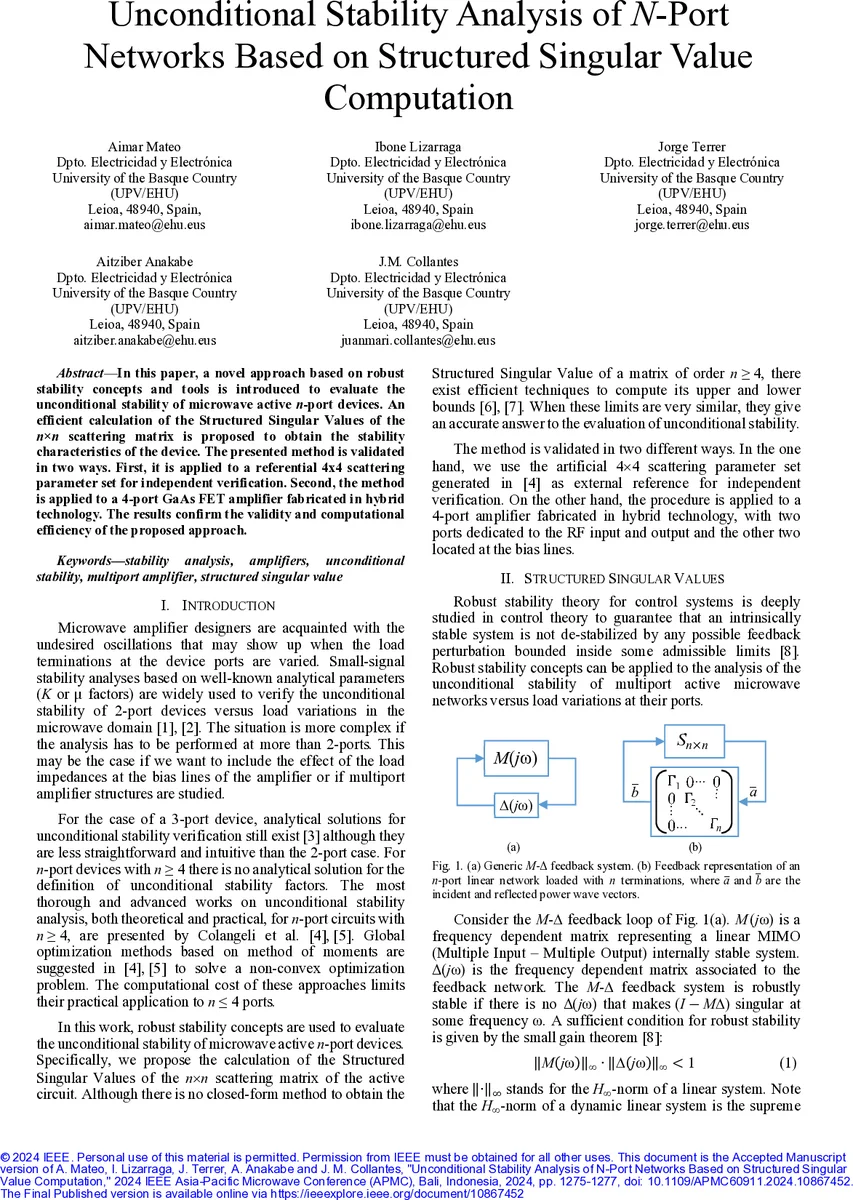
In the μ framework the network is modeled as a feedback loop: the nominal linear system is the S‑matrix, while the feedback uncertainty Δ is a diagonal matrix whose entries are the reflection coefficients Γi of the passive terminations at each port. The system is robustly stable for all passive terminations (|Γi| ≤ 1) if and only if μ(S(jω)) < 1 for every frequency ω. Consequently, μ < 1 constitutes a necessary and sufficient condition for unconditional stability of the N‑port device.
Because a closed‑form expression for μ does not exist when the matrix dimension exceeds three, the authors rely on the MATLAB Robust Control Toolbox function mussv, which computes tight upper and lower bounds on μ at each frequency. The upper bound is obtained via a convex optimization problem, while the lower bound is derived from a power‑method‑type algorithm. When the two bounds coincide, the exact μ value is known; when they differ, the upper bound still provides a conservative sufficient condition for stability.
Two validation cases are presented. First, an artificial 4 × 4 S‑parameter set from Colangeli et al. (2020) is used. The authors vary a scaling factor c that multiplies S11, evaluate μ(c) over 1000 points in the interval 0 ≤ c ≤ 3, and plot the upper and lower bounds. The bounds overlap almost perfectly, yielding an instability threshold at c ≈ 2.03, exactly matching the reference. The entire sweep takes only 2.2 seconds on a standard desktop (Intel i5‑10500, 32 GB RAM), demonstrating computational efficiency.
Second, the method is applied to a real 4‑port GaAs FET power amplifier fabricated in hybrid technology. The device has two RF ports (input, output) and two bias‑line ports (gate, drain). A simulated 4 × 4 S‑matrix is evaluated from 0 to 6 GHz with 1000 frequency points. The μ bounds reveal a region from 703 MHz to 1.1 GHz where μ > 1, indicating potential oscillation. Experimental measurements with highly reflective loads on all four ports indeed show a spontaneous oscillation around 900 MHz, confirming the prediction. Further, by sweeping the gate‑bias voltage VGS from –1.9 V to –2.3 V (with a fixed drain bias of 2.1 V), the authors compute μ for each bias point; the results show that the amplifier becomes unconditionally stable for VGS < –2.1 V, which is also verified experimentally (no oscillation observed).
The paper highlights several advantages of the μ‑based approach:
- Speed – Upper and lower bounds are obtained in a few seconds even for dense frequency sweeps.
- Accuracy – When bounds coincide, the exact μ is known; otherwise the upper bound offers a safe, conservative stability test.
- Quantitative margin – μ directly provides a robustness margin, enabling designers to set explicit safety factors.
- Scalability – The method works for any N‑port size, limited only by the computational resources of the underlying convex optimizer.
In conclusion, the authors demonstrate that structured singular value analysis furnishes a practical, fast, and theoretically sound tool for unconditional stability assessment of multi‑port microwave active circuits. The technique bridges a gap between robust control theory and microwave circuit design, and it can be readily incorporated into existing design flows for power amplifiers, multi‑port matching networks, and other complex RF systems. Future work may extend the framework to non‑diagonal uncertainty structures (e.g., coupled loads), incorporate process and temperature variations, and integrate μ‑based constraints into automated synthesis and optimization tools.
Comments & Academic Discussion
Loading comments...
Leave a Comment