New Anosov flows via bicontact structures
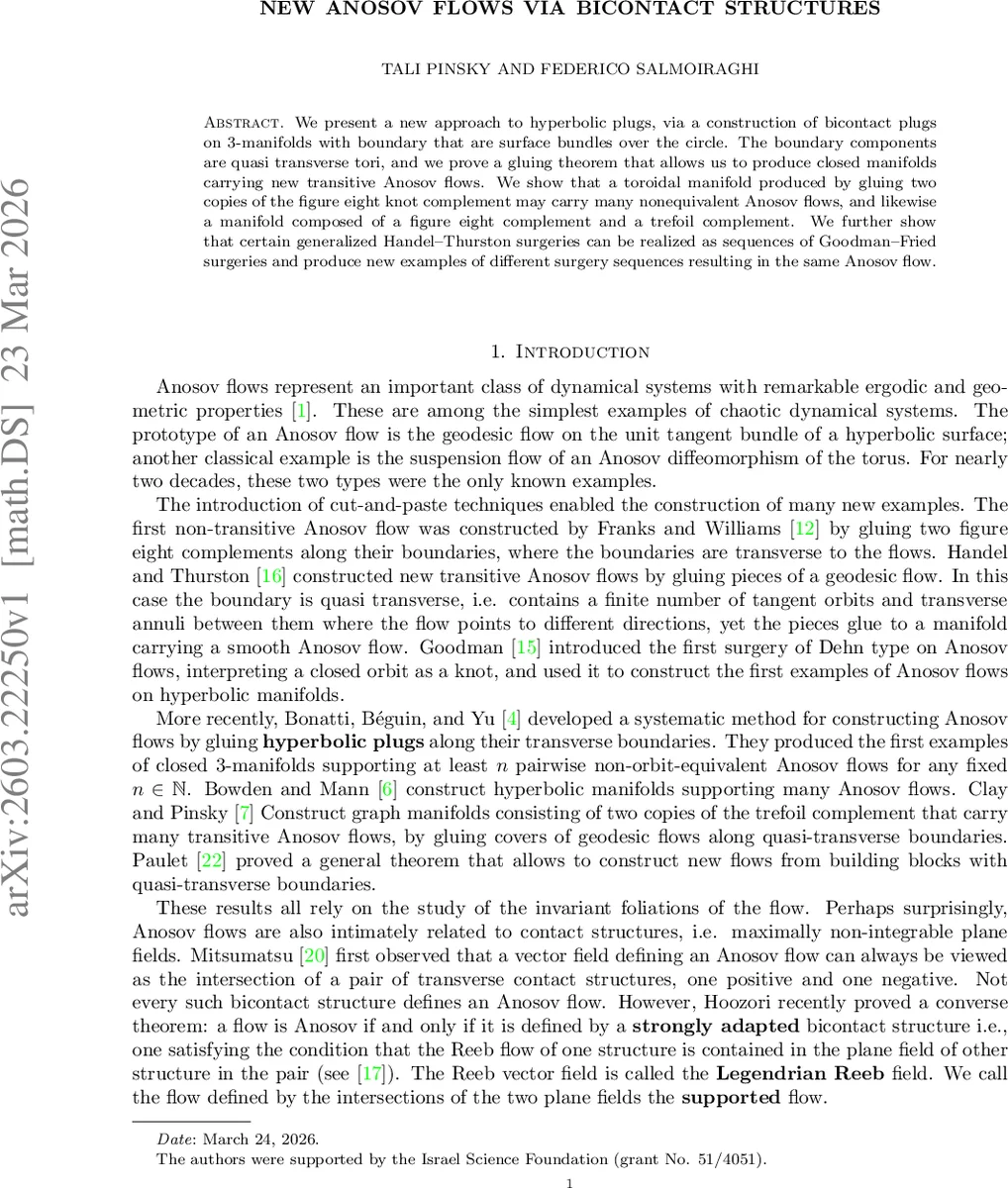
We present a new approach to hyperbolic plugs, via a construction of bicontact plugs on 3-manifolds with boundary that are surface bundles over the circle. The boundary components are quasi transverse tori, and we prove a gluing theorem that allows us to produce closed manifolds carrying new transitive Anosov flows. We show that a toroidal manifold produced by gluing two copies of the figure eight knot complement may carry many nonequivalent Anosov flows, and likewise a manifold composed of a figure eight complement and a trefoil complement. We further show that certain generalized Handel–Thurston surgeries can be realized as sequences of Goodman–Fried surgeries and produce new examples of different surgery sequences resulting in the same Anosov flow.
💡 Research Summary
The paper introduces a novel framework for constructing transitive Anosov flows on closed 3‑manifolds by exploiting the deep relationship between Anosov dynamics and contact geometry. The authors define a “strongly adapted bicontact structure” (a pair of a negative contact form α⁻ and a positive contact structure ξ⁺ such that the Reeb vector field R⁻ of α⁻ lies inside ξ⁺) and show that the intersection of the two contact planes yields a vector field Xₜ that is Anosov precisely when the bicontact pair satisfies this strong adaptation condition (Hozoori’s theorem).
A central object is the “SAB‑plug” (Strongly Adapted Bicontact plug): a compact 3‑manifold with boundary equipped with such a bicontact pair, whose boundary components are “quasi‑transverse periodic (QT‑P) tori”. On a QT‑P torus the flow Xₜ has exactly two periodic orbits and the Reeb field R⁻ is periodic along the boundary.
The main technical result, Theorem 3.5 (the gluing theorem), states that two SAB‑plugs M₁ and M₂ whose QT‑P boundary tori have the same number of periodic orbits can be glued after a small perturbation of the bicontact structures near the boundary. The perturbation aligns the periodic orbits of Xₜ with those of R⁻ so that a diffeomorphism F : ∂M₁ → ∂M₂ identifies the boundaries. The resulting manifold M = M₁ ∪₍F₎ M₂ inherits a globally defined strongly adapted bicontact structure and therefore carries an Anosov flow. Crucially, this construction bypasses the usual cone‑field hyperbolicity criteria; hyperbolicity follows directly from the contact geometry.
To produce concrete examples, the authors consider surface bundles Σ_{g,b} → S¹ with fiber a genus‑g surface having b boundary components. They fix a vector field V on the fiber with b non‑positive index singularities and a finite collection C of non‑separating curves transverse to V. The subgroup Λ_C ⊂ MCG(Σ_{g,b}) generated by Dehn twists along C acts on the mapping torus M_f. For each f ∈ Λ_C, the mapping torus carries a bicontact structure in which f appears as the first return map of the Legendrian Reeb vector field. In the special case of a punctured torus T²_b, a suitable set of curves generates the pure mapping class group, yielding infinitely many distinct bicontact structures (indexed by k ∈ ℕ) on the same torus bundle. Each structure has a distinct positive contact plane ξ⁺_k, while the negative contact form’s Reeb flow remains periodic on each boundary component.
Using these building blocks, the authors glue two copies of the figure‑eight knot complement M₈ (each equipped with a SAB‑plug structure) along compatible QT‑P tori. Because the boundary tori have the same number of periodic orbits, Theorem 3.5 applies, producing a closed toroidal manifold that supports many pairwise non‑orbit‑equivalent transitive Anosov flows. Corollary 1.4 asserts that for any natural number k there exists a closed toroidal 3‑manifold carrying at least k distinct transitive Anosov flows obtained by this gluing. An analogous construction with one figure‑eight complement and one trefoil complement yields further examples.
The paper also reinterprets Goodman–Fried Dehn‑type surgeries within the bicontact setting. A closed orbit γ of Xₜ can be pushed along the negative Reeb flow to obtain a Legendrian‑transverse (L‑t) knot K. Performing a (1,q)‑L‑t surgery on K produces a new strongly adapted bicontact structure; the resulting flow on the surgered manifold is orbit‑equivalent to the flow obtained by a classical Goodman–Fried surgery on K. This shows that bicontact surgery preserves Anosovness more robustly than the original contact‑only viewpoint. Moreover, the authors demonstrate that generalized Handel–Thurston surgeries can be decomposed into sequences of such L‑t surgeries, providing new examples where distinct surgery sequences lead to the same Anosov flow.
Overall, the paper makes three major contributions: (1) it establishes a flexible gluing theorem for bicontact plugs, enabling systematic construction of new Anosov flows without resorting to cone‑field arguments; (2) it produces explicit infinite families of transitive Anosov flows on toroidal manifolds, notably on manifolds built from figure‑eight and trefoil knot complements; and (3) it bridges the gap between contact‑geometric surgeries (Goodman–Fried) and classical topological surgeries (Handel–Thurston), showing they are manifestations of the same bicontact operation. These results significantly broaden the known landscape of Anosov dynamics in dimension three and open new avenues for exploring the interplay between hyperbolic dynamics, contact topology, and 3‑manifold geometry.
Comments & Academic Discussion
Loading comments...
Leave a Comment