Diffraction of deep-water solitons
Solitons are localized nonlinear wave packets that propagate without spreading because nonlinearity balances dispersion. Their robustness is well understood in effectively one-dimensional systems, but introducing additional spatial dimensions is gene…
Authors: Filip Novkoski, Loïc Fache, Félicien Bonnefoy
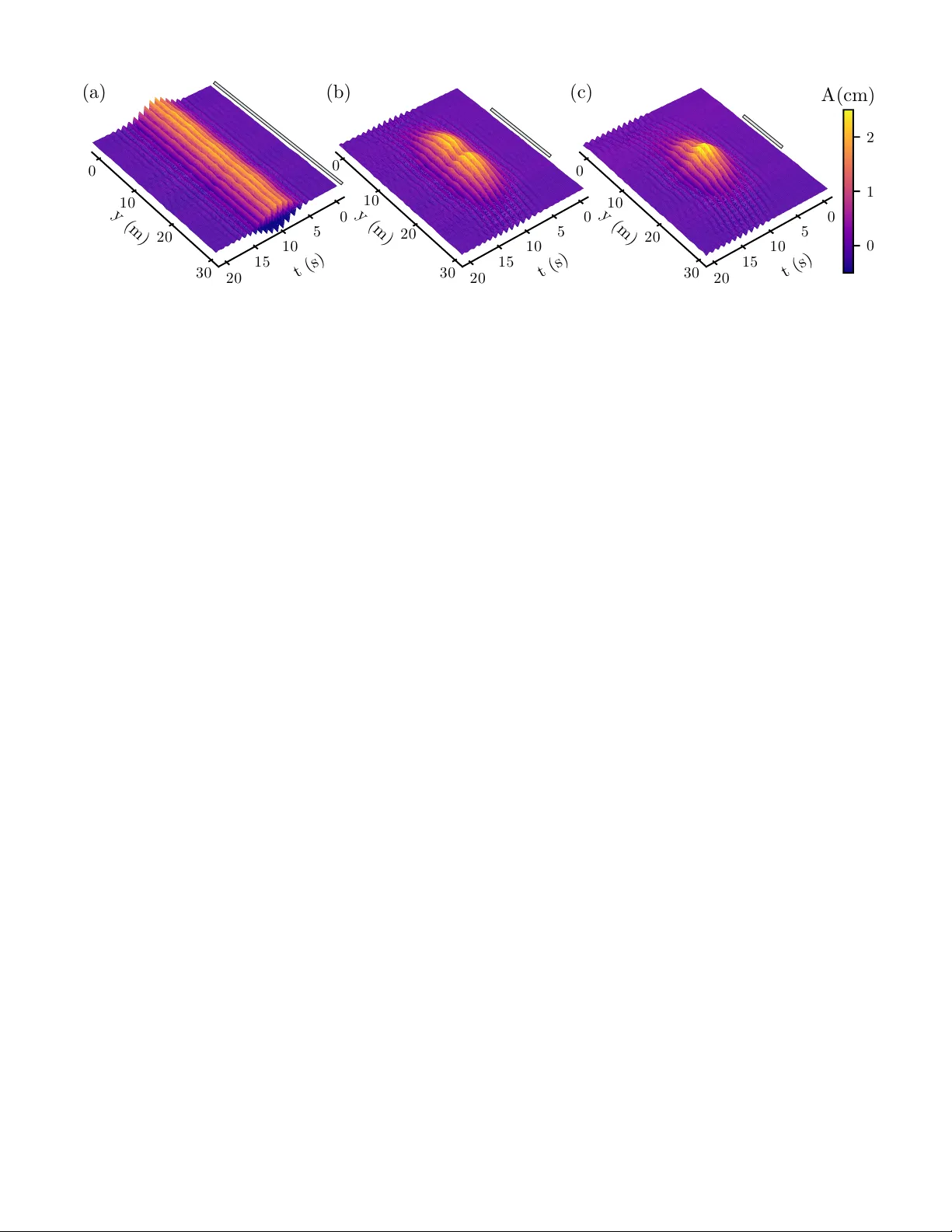
Diffraction of deep-w ater solitons Filip No vkoski, 1, 2 , ∗ Loïc F ac he, 1, 3 , † Félicien Bonnefo y, 4 Guillaume Ducrozet, 4 Jason Barc kick e, 1 F rançois Copie, 3 Pierre Suret, 3 Eric F alcon, 1 and Stéphane Randoux 3 1 Université Paris Cité, CNRS, Matièr e et systèmes c omplexes, F-75013 Paris, F r anc e 2 PULS, Institute for The or etic al Physics, F A U Erlangen-Nürnb er g, 91058, Erlangen, Germany 3 Univ. Lil le, CNRS, UMR 8523 - PhLAM - Physique des L asers Atomes et Molé cules, F-59 000 Lil le, F r anc e 4 Nantes Université, Éc ole Centr ale Nantes, CNRS, LHEEA, UMR 6598, F-44 000 Nantes, F r anc e Solitons are lo calized nonlinear w av e pack ets that propagate without spreading b ecause nonlinear- it y balances dispersion. Their robustness is w ell understoo d in effectiv ely one-dimensional systems, but introducing additional spatial dimensions is generally expected to destabilize them or destroy their coherent c haracter. Here we experimentally inv estigate ho w deep-water gravit y-w a ve solitons b eha v e when a controlled transv erse degree of freedom is introduced through diffraction. Using a large-scale water-w av e facility , we generate solitonic wa ve pac kets whose transv erse structure is im- p osed across a segmented wa vemak er through either a sharp slit or a smooth Gaussian ap odization. The resulting tw o-dimensional wa v e fields are measured with high spatial resolution. Diffraction reshap es the transv erse profile of the wa v e pack et while its longitudinal dynamics retain the char- acteristic features of a soliton. Nonlinear sp ectral analysis confirms that the solitonic conten t is preserv ed along the direction of propagation, whereas the transverse evolution follo ws the linear F resnel la ws of diffraction. These observ ations reveal an unexp ected co existence of nonlinear soliton dynamics and classical wa ve diffraction. Diffraction is a fundamental and universal consequence of w a ve propagation. Its quan titative description was instrumen tal in establishing the wa v e nature of ligh t, most notably through F resnel’s formulation of wa v e the- ory based on Huygens’ principle [ 1 ]. In this framework, diffraction arises whenev er a wa v e encounters spatial v ariations in impedance or boundary conditions, inde- p enden t of the sp ecific ph ysical system. A ccordingly , diffraction is observed not only in optics [ 2 ] but also in other w a ve systems, e.g., acoustic w a ves [ 3 ], elastic w av es [ 4 ], and surface water wa v es [ 5 ]. On the surface of water, diffraction plays a central role in coastal hydrodynamics, particularly in the inter- action of sea w a ves with engineered structures such as breakw aters [ 6 ], which protect shorelines. The effects of edges, ap ertures, and gaps hav e long been in vestigated theoretically [ 6 – 10 ] and exp erimen tally [ 11 , 12 ], but pre- dominan tly within the linear regime. In realistic o cean conditions, how ev er, nonlinear effects become significant, and coheren t structures such as en v elop e solitons and breathers ma y form [ 13 , 14 ], serving as models for the formation of rogue wa v es [ 15 , 16 ]. Solitons are coherent w av e pac kets that are robust under essen tially one-dimensional propagation. Ho w- ev er, they are inheren tly sensitiv e to transverse p er- turbations—an unav oidable feature of natural environ- men ts—so their persistence in tw o dimensions is gener- ally not expected [ 17 – 23 ]. Recen t optical exp erimen ts ha ve demonstrated that nonlinear wa v e pack ets may re- tain robust soliton dynamics in certain t wo-dimensional configurations [ 24 ]. Ho w coherent water-w a ve solitons re- sp ond to the introduction of a transverse spatial degree ∗ filip.novk oski@fau.de † loic-joseph.fache@u-pariscite.fr of freedom, how ev er, remains largely unexplored exp eri- men tally . The comp etition betw een nonlinear self-stabilization and transverse spreading raises a fundamen tal question: ho w do es a soliton b eha v e when it undergo es diffraction in a gen uinely tw o-dimensional setting? In deep water, diffraction, disp ersion, and nonlinearity act sim ultane- ously , and the inclusion of transv erse dynamics funda- men tally modifies wa v e evolution. Whether a soliton loses its coherence or retains a recognizable structure un- der such conditions remains unresolv ed. In this pap er, we inv estigate the diffraction of deep- w ater solitons in tw o dimensions. W e demonstrate ex- p erimen tally that, despite transverse dynamics and the breaking of one-dimensional constraints, solitons closely follo w the predictions of linear F resnel diffraction while preserving their solitonic sp ectral conten t. By combining con trolled lab oratory exp erimen ts with n umerical sim- ulations, we quantify the transverse deformation of the w av efron t and uncov er an unexp ected correspondence b e- t ween linear diffraction laws and nonlinear coherent wa v e dynamics. I. THEORETICAL BACK GR OUND The quantit y of in terest in our study , which w e mea- sure exp erimen tally , is the surface elev ation of water η ( x, y , t ) . In the linear regime, tw o-dimensional surface w av es with harmonic time dep endence reads η ( x, y , t ) = u ( x, y ) e iω t , where ω is the angular frequency and satisfies the Helmholtz equation for the spatial env elope u ( x, y ) as [ 5 , 25 ] ∂ xx + ∂ y y + k 2 u ( x, y ) = 0 , (1) with k = 2 π /λ the wa v enum ber. 2 W a v emak er s Be ach FIG. 1. Exp erimen tal set-up. T op: Schematic representation (not to scale) of the 3 D w ater tank (top view) used in the ex- p erimen ts. The transverse profile of the generated w av es can b e carefully shap ed using 48 computer-controlled segmented w av emak ers placed along the y axis, at x = 0 m. Horizon- tal red bars: 45 wa v e elev ation prob es are placed at discrete propagation distances x = 1 – 25 m and transv erse p ositions y ∈ [0 . 1 , 29 . 64] m with a non-uniform spacing, as indicated b y the probe array . The wa v elength of the carrier wa v e is appro ximately λ c ≃ 1 . 3 m. Bottom: Image of a diffracting w av e with an opening of D = 1 . 2 m (i.e. 2 flaps out of 48 ), see Mo vies S1 and S2. The diffraction of a mono c hromatic wa v e b y an aper- ture lo cated at x = 0 is describ ed by the F res- nel–Kirc hhoff integral, which in tw o dimensions yields the field u ( x, y ) b ey ond the ap erture as [ 25 ] u ( x, y ) = Z ∞ −∞ p ( y 0 ) − k x 2 i r H (1) 1 ( k r ) d y 0 , (2) where r = p x 2 + ( y − y 0 ) 2 and H (1) 1 is the first-order Hank el function of the first kind, and y 0 is the trans- v erse co ordinate along the ap erture plane at x = 0 . The function p ( y 0 ) represen ts the incident field distribution at the ap erture, determined b y the slit geometry and, in our exp erimen ts, will b e imp osed by the num ber of active w av emak ers (see Fig. 1 ). In the numerical ev aluation of the in tegral, we adopt the Kirc hhoff approximation, set- ting p ( y 0 ) = 1 within the ap erture and p ( y 0 ) = 0 outside. Ho wev er, at higher wa v e amplitudes the linear descrip- tion breaks down, as nonlinear effects substan tially mo d- ify wa v e propagation. Under the assumption of parax- ial propagation along the x -direction, the evolution of w eakly nonlinear deep-w ater w av e pack ets is instead gov- erned b y the (2D+1) h yperb olic nonlinear Sc hrödinger equation (HNLSE) [ 26 – 28 ]. This equation describ es the dynamics of the complex en velope A ( x, y , t ) of a car- rier wa v e with wa ven um ber k 0 propagating along the x - direction with carrier frequency ω 0 = √ g k 0 , where g is the gravit y acceleration. ∂ x A + 1 c g ∂ t A = − i 4 k 0 ( ∂ xx A − 2 ∂ y y A ) − ik 3 0 | A | 2 A, (3) where c g = d ω / d k k 0 is the group velocity . The surface elev ation η ( x, y , t ) can b e approximated to the first order b y [ 28 ] η ( x, y , t ) = Re n A ( x, y, t ) e i ( k 0 x − ω 0 t ) o . (4) A t leading order in the weakly nonlinear regime, the en velope propagates at the group velocity c g , so that ∂ t A + c g ∂ x A ≃ 0 [ 28 , 29 ]. This relation is used to rewrite the longitudinal second-order dispersive term, while the transp ort operator ∂ x + c − 1 g ∂ t is kept unc hanged as it defines the env elope evolution. HNLSE thus reads ∂ x A + 1 c g ∂ t A = − i 1 g ∂ tt A − 1 2 k 0 ∂ y y A − ik 3 0 | A | 2 A. (5) While the w av es remain fo cusing in the longitudinal di- rection (as shown b elo w), they are defo cusing trans- v ersely , raising questions ab out their stabilit y in the pres- ence of this additional spatial dimension [ 17 , 21 ]. T o explore this regime and compare with experiments, w e n umerically integrate ( 5 ) (see Metho ds). If the solution is assumed to b e independent of the transv erse direction y , we recov er the (1D+1) fo cusing nonlinear Schrödinger equation (NLSE), corresp onding to purely unidirectional w a v e propagation along the x axis, as ∂ x A + 1 c g ∂ t A = − i g ∂ tt A − ik 3 0 | A | 2 A, (6) whic h, unlik e ( 3 ) and ( 5 ), is integrable and can b e solv ed through the use of the inv erse scattering trans- form (IST) [ 30 – 32 ]. The w ell-known fundamental single- soliton solution of ( 6 ) can b e written as [ 26 , 33 , 34 ], η ( x, t ) = a sech ak 0 ω 0 √ 2 t − x c g × cos ω 0 t + k 0 1 + k 2 0 a 2 4 x , (7) where a is the maximal soliton en velope amplitude. Within the IST framework, a soliton is c haracterized by a discrete complex eigenv alue ζ of the asso ciated scat- tering problem. The imaginary part of this eigen v alue determines the soliton amplitude, while its real part is related to its propagation velocity . The eigenv alue is ob- tained by solving the corresp onding scattering problem (see Metho ds). 3 0 5 1 0 1 5 2 0 t ( s ) 0 1 0 2 0 3 0 y ( m ) (a) 0 5 1 0 1 5 2 0 t ( s ) 0 1 0 2 0 3 0 y ( m ) (b) 0 5 1 0 1 5 2 0 t ( s ) 0 1 0 2 0 3 0 y ( m ) (c) 0 1 2 A (cm) FIG. 2. Measured surface elev ation η ( y , t ) of a soliton of steepness ϵ = k 0 a = . 097 measured by the wa v e prob es at L = 20 m for three different slit op enings (see white rectangles) D = 30 (a),15(b) and 10(c) m. F or the largest op ening, (a), we observe the classical profile of a 1D NLSE soliton [( 7 )]. Decreasing the ap erture width, as seen in (b) and (c) reduces the transv erse ( y ) size of the soliton, how ev er we still observe a coherent structure in the basin center. A dditionally , we observe the app earance of distinct minima and maxima in the transverse profile, consistent with classical w av e diffraction. I I. EXPERIMENT AL SETUP Exp erimen ts were p erformed in the large-scale w a v e basin ( 50 m long × 30 m wide × 5 m deep) of Ecole Cen trale de Nantes, F rance. The exp erimen tal setup is sk etched in Fig. 1 . The w a ve generation mec hanism con- sists of 48 indep enden tly controlled wa v emakers (flaps of width 0.62 m, hinged 2.8 m from the free surface) lo cated at one end of the basin, i.e. at x = 0 . An absorbing, slop- ing b eac h is lo cated at the opp osite end. W e fo cus on tw o types of soliton wa v eforms, either a slit-diffracting soliton or a Gaussian b eam (a soliton with a transv erse Gaussian profile along the y -direction, see Fig. 1 ). Here, the term "slit" will be used in analogy with optical diffraction, as the ap erture is implemented b y selectiv ely driving a finite set of neigh b ouring wa v e- mak ers. T o generate a diffracting soliton, the w av emak- ers are driv en b y a monochromatic carrier of fixed fre- quency f 0 = 1 . 1 Hz [i.e., a fixed carrier wa velength of λ 0 = 2 π /k 0 = g / (2 π f 2 0 ) ≃ 1 . 3 m], amplitude-mo dulated b y a h yp erbolic secant follo wing the 1D NLSE solitonic solution of ( 7 ) at x = 0 . The carrier w a ven um ber k 0 is kept fixed, while the soliton maximal env elop e ampli- tude a is v aried around typical v alues of 0 . 4 − 2 cm and has a t ypical size L x = g T 0 /ω 0 ∈ [5 . 38 , 25] m , where T 0 is the t ypical duration of the soliton. The correspond- ing carrier steepness ϵ ≡ k 0 a is explored ov er the range [0 . 019 , 0 . 044 , 0 . 070 , 0 . 097 , 0 . 127] , allo wing us to prob e regimes from w eak to strong nonlinearit y . If all wa v e- mak ers are driven in phase, a 1D-NLSE soliton with a transv erse extension cov ering the whole width (30 m) of the water tank is generated and propagates tow ards the b eac h. By altering the n umber of working wa v emak ers, w e can change the diffraction aperture, D (see top of Fig. 1 ), to observe its impact on the soliton propagation and its diffraction. The parameter D is v aried from a small 0 . 6 m aperture to the full 30 m width of the basin. T o generate a Gaussian b eam, the carrier wa v e is now amplitude-mo dulated along the wa v emak ers, i.e. in the transv erse y -direction. By weigh ting the driving ampli- tudes of the differen t w av emak ers, we implement a Gaus- sian ap odization of the initial soliton transverse profile, enabling a controlled smo othing of the ap erture edges. The surface elev ation η ( t ) is recorded using an arra y of 45 resistive w av e prob es. Of these, 41 are p ositioned along a straigh t transverse line lo cated at a selectable distance of either L =20 m or L =35 m from the w a ve- mak ers. The prob es are spaced 1 m apart, except for the cen tral 23 probes, whic h are separated by 0.5 m to enhance spatial resolution. The arrangemen t is shown at the top of Fig. 1 . F our additional prob es are lo cated in the main propagation direction. The sensors pro vide a v ertical resolution of 0.1 mm, a frequency bandwidth of 20 Hz, and are sampled at 128 Hz. In order to lo ok for the influence of dispersion, diffraction and nonlinearit y in the present configuration, it is useful to in tro duce the asso ciated characteristic lengths and their range of acces- sible v alues in our experiment. The disp ersiv e term in ( 5 ) defines the dispersive length L disp = g T 2 0 ∈ [141 , 3285] m . The transverse diffraction term yields a diffraction length L diff = 2 k 0 D 2 ∈ [9 . 7 , 3895] m . Finally the nonlinear term defines a nonlinear length L NL = 1 /k 3 0 a 2 ∈ [12 . 7 , 569] m . I II. SLIT DIFFRACTION OF SOLITONS As describ ed ab o ve, w e generate wa v e pac kets whose longitudinal dynamics corresp ond to exact single-soliton solutions ( 7 ) of the (1D+1) NLSE. By v arying the ap er- ture width D , w e in tro duce controlled transverse diffrac- tion. Figure 2 sho ws the resulting w a ve field for three differen t aperture op enings. F or the maximal opening (Fig. 2 a), when all wa v emakers are active, the classical NLSE single soliton described by ( 7 ) is reco vered. As the ap erture width is reduced (Fig. 2 b–c), the wa v e pac ket remains localized while b ecoming transv ersely confined to the cen tral region of the basin, ov er a width consis- ten t with the imp osed op ening. This is complemented 4 (a1) (a2) (a3) (a4) (a5) (b1) (b2) (b3) (b4) (b5) (c1) (c2) (c3) (c4) (c5) FIG. 3. T ransverse structure of diffracting deep-water solitons. Amplitude and IST profiles with comparison with HNLSE and Helmholtz diffraction. The columns corresp ond to different ap erture widths D = 1 , 10 , 15 , 20 , and 30 m (from left to right), measured at a fixed propagation distance L = 20 m . (a1–a5) T ransv erse en velope amplitude | A ( y ) | . Blac k dots: exp erimen tal data ( ϵ = 0 . 097) ; solid blue curves: n umerical simulations of the HNLSE ( 5 ); dashed orange curves ( 2 ): linear Helmholtz diffraction by a rectangular slit of width D ev aluated for the carrier wa ven um b er k 0 . The Helmholtz predictions are rescaled b y a single multiplicativ e factor to match the experimental p eak amplitude in each panel. (b1–b5) IST sp ectra extracted from the longitudinal wa v e field and represented as function of the transverse co ordinate y . Blue p oin ts corresp ond to imaginary part of the discrete eigenv alue, Im( ζ ) , whic h characterizes the soliton amplitude. The presence of discrete eigenv alue across y indicate the solitonic nature of the wa v e pack et. (c1–c5) Steepness-normalized transv erse amplitude | A ( y ) | /ϵ for different soliton amplitudes, a ∈ [0 . 37 , 2 . 61] cm , generated with the same ap erture D . F or eac h run, the exp erimen tal curves (markers) and the asso ciated HNLSE profiles (solid curves) are shown for sev eral steepness v alues ϵ = k 0 a ∈ [0 . 02 , 0 . 13] (the color enco des the soliton steepness, as indicated by the colorbar on the righ t). b y a no w v ery visible curv ed wa v efron t. Additionally , w e can notice the emergence of clear maxima and min- ima in the soliton transverse y -profile, d emonstrating the app earance of a diffraction pattern. These features are more clearly observed in Fig. 3 (a1– a5), where the transverse env elop e amplitude A ( L, y ) at a distance L = 20 m broadens as the ap erture width D increases, while progressiv ely dev eloping the c harac- teristic diffraction pattern with alternating transverse maxima and minima. The measured amplitude pro- files (dots) are compared with numerical solutions of ( 5 ) (solid lines), sho wing excellen t agreemen t and confirm- ing that the HNLSE accurately captures soliton diffrac- tion for v arying apertures. W e further compare the data with the classical F resnel-Kirchhoff prediction for lin- ear monochromatic w av es giv en b y ( 2 ) (dashed orange lines) deriv ed from the Helmholtz equation. Remark- ably , although the soliton is an in trinsically nonlinear w av e pac k et, its diffraction from a slit is quantitativ ely describ ed b y the classical linear theory . T o further elucidate the soliton b eha vior under slit diffraction, the longitudinal measuremen ts are analyzed using the in verse scattering transform (IST), as detailed in Metho ds. This approac h provides a nonlinear sp ectral c haracterization of the (1D+1) NLSE along the longitu- dinal direction at eac h transverse p osition. Unlik e env e- lop e measurements alone, the IST yields direct access to the discrete eigenv alues that quan tify solitonic conten t. The resulting transv erse dep endence of the discrete complex eigenv alue ζ ( y ) is sho wn in Fig. 3 (b1–b5) for the soliton amplitude, i.e. Im [ ζ ( y )] . F or sufficiently large ap erture widths D , well-defined eigenv alues p ersist across the transverse direction, even as the en velope exhibits pronounced diffraction. This indicates that while the finite aperture reshapes the transv erse structure of the w av efron t, the longitudinal dynamics at each transverse p osition remain gov erned by soliton b eha vior. In con trast, for small ap erture widths (see Fig. 3 b1), no discrete eigen v alues are detected, demonstrating the absence of solitonic conten t. This reveals the existence of a threshold aperture size b elo w whic h the wa v e field b ecomes purely disp ersiv e and soliton dynamics are lost. These observ ations demonstrate that transv erse diffraction induced by a finite ap erture reshap es the soliton front without destroying its longitudinal soliton c haracter. W e therefore observe the co existence of one- dimensional integrable soliton dynamics along the prop- agation direction x with transverse linear spreading. The origin of this b eha vior can b e understoo d physically . In a purely disp ersiv e medium, a w av e pack et would broaden along the propagation direction, and diffraction at an ap erture would generate the sup erposition of F resnel pat- 5 FIG. 4. (a) Measured surface elev ation η ( y , t ) of a solitonic Gaussian b eam with ϵ ≈ 0 . 072 and waist W 0 ≈ 6 . 43 m. The b eam is well localized in the transverse direction, and unlike the slit-diffracted soliton, we observe a muc h more regular w av efron t due to the Gaussian ap odization (white bar). (b) T ransverse cut of a reference soliton at x = 20 m , sho wing the measured env elope amplitude | A ( y ) | (blue, solid) together with a Gaussian fit (blac k, dashed), and the corresp onding un wrapp ed transv erse phase profile ϕ ( y ) (green, solid) with a parab olic fit (blac k, dotted), from whic h the wa vefron t radius of curv ature is extracted. The arrow indicates the fitted trans- v erse waist W of the Gaussian env elop e. (c) Measured waist W exp as a function of the theoretical prediction W th (( 8 )) for differen t initial waists W 0 . Inset : Measured radius of cur- v ature R exp v ersus the theoretical radius R G (( 8 )). In panel (c) and its inset, filled sym b ols corresp ond to exp erimen ts and op en sym b ols to HNLSE simulations. Marker shap es en- co de different initial w aists ( W 0 ≈ ⋄ 3 . 87 , △ 5 . 15 , □ 6 . 43 , and ◦ 7 . 73 m ), while the color scale on the right indicates the soli- ton steepness ϵ = k 0 a . terns asso ciated with its sp ectral comp onen ts. Here, ho wev er, the IST analysis sho ws that the w a ve pac k et retains its solitonic con tent: disp ersion along x is con- tin uously balanced by nonlinearity , so that the pack et remains effectively non-disp ersiv e in the longitudinal di- rection. T ransversely , by contrast, the go v erning equa- tion is defo cusing and do es not provide comparable non- linear self-confinement. The lateral ev olution is there- fore dominated by diffraction. Because the longitudinal structure remains intact, the transverse field b eha ves as that of a coherent, non-disp ersiv e ob ject and is accurately describ ed by classical F resnel diffraction theory derived from the Helmholtz equation. Consequen tly , the soliton undergo es essentially linear transv erse diffraction while preserving its nonlinear identit y along the direction of propagation. Finally , we examine the influence of the soliton ampli- tude on the diffraction pattern, as shown in Fig. 3 (c1– c5). The amplitudes | A ( y ) | are normalized b y the wa v e steepness ϵ and compared with numerical simulations of ( 5 ). The resulting diffraction patterns exhibit clear self-similarit y across different prob ed nonlinearities (see righ t colorbar) and ap erture widths D . This inv ariance indicates that, for sufficien tly large D , the longitudinal soliton dynamics remain intact, with transverse diffrac- tion largely indep enden t of the soliton amplitude. IV. SOLITONS WITH A TRANSVERSE GA USSIAN PROFILE In the previous section, diffraction was induced b y im- p osing a sharp transv erse truncation of the w a v emaker motion, corresp onding to the slit geometry . W e now mo ve beyond this configuration b y imp orting concepts from Gaussian beam optics to probe soliton diffraction from a different p erspective. In optics, Gaussian b eams pro vide a fundamental and analytically tractable descrip- tion of diffraction and b eam spreading [ 35 ]. W e repro- duce this geometry exp erimen tally on the surface of deep w ater by imp osing a Gaussian apo dization across the w av emak er array at x = 0 and cen tered on the basin y -axis. The resulting wa v e field constitutes a genuine hy- dro dynamic analogue of an optical Gaussian b eam, with a crucial distinction: its longitudinal dynamics remain go verned b y the NLSE and retain a solitonic character, while the transverse en v elop e is initially Gaussian with w aist W 0 . This construction allows us to test directly whether the well-established propagation laws of Gaus- sian b eams extend to nonlinear soliton wa ve pac k ets. An example of the measured elev ation of a soliton generated this w ay is display ed in Fig. 4 a, showing a clear lo caliza- tion both in the transv erse y -direction, as well as in time, i.e in the x -direction. W e exp ect that the ev olution of the w av efield fol- lo ws the standard paraxial Gaussian-b eam propagation la ws [ 35 ] W ( x ) = W 0 s 1 + xλ 0 π W 2 0 2 , R G ( x ) = x " 1 + π W 2 0 xλ 0 2 # , (8) where W ( x ) is the w aist at x extracted from the soli- ton env elope | A ( x, y ) | , R G ( x ) is the radius of curv ature inferred from the transv erse phase, and λ 0 is the car- rier w av elength. Similar propagation la ws hav e been observ ed exp erimen tally for the manipulation of w ater w av es using electrostriction [ 36 ]. W e show a measured transverse profile of a Gaussian ap odized soliton in Fig. 4 b, demonstrating that it indeed retains extremely well a Gaussian form after propagation, 6 (a) (b) FIG. 5. (a) Absolute v alue of the soliton w av efron t radius of curv ature | R S | , extracted from the carrier-wa v e fron t, as a function of the rescaled v ariable L + D 2 / ( π 2 λ 0 √ ϵ ) , where L is the propagation distance, D the transverse ap erture (slit) width, λ 0 the carrier wa v elength, and ϵ = k 0 a the steep- ness. F ull (op en) symbols denote exp erimen ts (HNLSE simu- lations). T riangles correspond to L = 20 m and diamonds to L = 35 m . The color enco des ϵ . Error bars indicate the standard deviation ov er all fits of the individual carrier- w av e oscillations. The blac k dashed line (slop e 1 ) highlights the empirical collapse of ( 9 ). (b) (log–log axes): Curv a- ture | R | − L versus D . Circles ( L = 20 m ) and squares ( L = 35 m ) show Gaussian-ap odized b eams ( R G ) extracted from quadratic phase fits (full: experiments; op en: HNLSE sim ulations), with D = 2 W 0 √ ln 2 for five different steep- ness v alues. Black dash-dotted line correspond to ( 8 ) with L = 35 m and the blue one to the D 2 scaling expected from ( 9 ) with ϵ = 0 . 1 . Error bars for these p oin ts originate from the uncertain ties of the quadratic phase fits, as estimated from the co v ariance matrix of the fit parameters. b oth in its amplitude and its phase. The curv ature of the w av efron t is directly extracted from the transverse phase of the carrier w av e, which is locally w ell describ ed by a quadratic fit ϕ ( y ) ≃ ϕ 0 + α y 2 (see dotted line), yielding a radius of curv ature R exp ≡ k 0 (2 α ) − 1 . While suc h a char- acterization is standard in the context of Gaussian b eams in optics, it is most often obtained indirectly , either from the evolution of the b eam waist under the Gaussian- b eam assumption [ 35 ], or via dedicated wa vefron t-sensing tec hniques suc h as Shack–Hartmann sensors or T alb ot– effect metho ds [ 37 – 41 ] rather than from a direct mea- suremen t of the carrier phase. In contrast, our h ydro dy- namic system pro vides direct access to the full spatial- temp oral wa v efield, allowing the curv ature of the carrier- w av e fron t to b e measured. By rep eating measurements for different widths as well as nonlinearities, w e confirm in Fig. 4 c that such solitons ob ey p erfectly the relation- ships of ( 8 ), b oth exp erimen tally (full sym b ols) and nu- merically (open symbols), giving the first empirical deep- w ater realization and control of focused Gaussian b eams. V. CUR V A TURE RADIUS OF A DIFFRACTED SOLITON Using the direct a v ailability of the wa vefron t curv a- ture, we use it to further study the slit-diffracted solitons and compare to Gaussian-ap odized solitons. A t fixed L , individual wa v efront oscillations are lo cally well captured b y a quadratic phase profile in y , from which a curv ature radius can b e defined (see the pro cedure illustrated for Gaussian-ap odized solitons in Fig. 4 b). Figure 5 a shows all curv ature measuremen ts for slit- diffracted solitons. Each dataset corresp onds to a given propagation distance ( L = 20 or 35 m), ap erture width D , and steepness ϵ , with colors encoding ϵ and op en sym- b ols denoting HNLSE sim ulations. Remark ably , despite suc h a wide range of parameters, all p oin ts align remark- ably w ell onto a single straight line of slop e 1 , (blac k dashed line) once the abscissa is rescaled according to R S = L + D 2 π 2 λ √ ϵ , (9) whic h, to the b est of our knowledge, is a so far unrep orted relationship. This collapse shows first that the effect of ap erture en ters predominan tly through a quadratic de- p endence, R S − L ∝ D 2 . Second, it rev eals a strong influence of nonlinearity through the factor 1 / √ ϵ , i.e., at fixed L and D , increasing ϵ decreases R S , meaning that the wa v efron t b ecomes more curved. This trend is consis- ten t with an effective nonlinear fo cusing of the diffracting w av efron t [ 42 , 43 ]. In other words, while the transverse spreading remains go verned by the finite ap erture, non- linear effects renormalize the lo cal w av efron t geometry . Figure 5 b places this slit-diffracted b eha viour (dia- mond and triangle sym bols) in p ersp ectiv e by compar- ing it to Gaussian-ap odized solitons (square and circle sym b ols, see Sec. IV ), where the initial transverse pro- file is smooth rather than truncated. In that case, as sho wn in Fig. 4 c b oth the waist and the curv ature follow the standard Gaussian-b eam propagation predictions ( 8 ), leading to a muc h stronger dep endence on the transv erse size, namely R G ∝ D 4 since W 0 = D / (2 √ ln 2) . The co- existence of a D 2 scaling for the slit-diffracted soliton R S and a D 4 scaling for the Gaussian-ap odized soliton R G highligh ts that the initial transverse shaping at x = 0 pla ys a decisive role in setting the wa v efront geometry . A t presen t, a theoretical description of the empirical scaling ( 9 ) remains an op en question. VI. CONCLUSION W e hav e inv estigated how a one-dimensional deep- w ater soliton evolv es when sub jected to tw o-dimensional diffraction. Drawing inspiration from optics, where the transv erse profile of a b eam is commonly shap ed using a slit or Gaussian ap odization, w e extended this idea to wa- ter w av es by in tro ducing a controlled transverse degree of freedom while maintaining the longitudinal coheren t soliton structure near the w av emak ers. Despite the presence of the additional spatial dimen- sion, the w av e pac ket retains its solitonic character. T ransv erse spreading is remark ably well describ ed b y lin- ear F resnel diffraction theory , while nonlinear spectral 7 signatures associated with soliton dynamics p ersist along the propagation direction, as demonstrated clearly by the IST metho d. Linear diffraction and nonlinear coherence therefore co exist within a single w av e structure. The robustness of coheren t structures under dimen- sional extension is a central question across many do- mains, since higher-dimensional effects are known to trig- ger transv erse instabilities [ 17 ] or qualitatively mo dify soliton dynamics [ 19 , 22 , 44 ]. This issue is of direct and applicable interest i n nonlinear optics and Bose– Einstein condensates, as well as plasma physics and o cean w av e dynamics. Our results demonstrate that the transition from integrable one-dimensional dynamics to gen uinely tw o-dimensional b eha vior is rather progressiv e than abrupt. More broadly , this controlled exp erimen tal platform provides a quan titativ e framew ork to explore w eakly non-in tegrable regimes and to test p erturbativ e approac hes that attempt to bridge ideal integrable mod- els and realistic nonlinear w av e systems [ 45 – 49 ]. VI I. METHODS In tegration of the 2D NLSE W e in tegrate numerically the hyperb olic (2D+1) NLSE (( 5 )) written in the retarded-time frame, for the complex env elop e A ( x, t, y ) using a pseudo-spectral sc heme in the ( t, y ) plane. The field is discretized on a rectangular perio dic domain t ∈ [ − L t / 2 , L t / 2] , y ∈ [ − L y / 2 , L y / 2] with uniform grids of size N t × N y ; deriv a- tiv es ∂ tt and ∂ y y are ev aluated in F ourier space using fast F ourier transforms, while the cubic term | A | 2 A is computed in physical space. In the simulations we use, L t = 80 s , and L y = 110 m with N t = 512 and N y = 256 grid points. The resulting system of ordi- nary differen tial equations in the propagation v ariable x is adv anced with an explicit adaptiv e Runge–Kutta inte- grator (DOP853) [ 50 ]. The initial condition repro duces the exp erimen tal forcing as a soliton w a veform, with a transv erse profile (sup er-Gaussian, Gaussian or other) matc hing the exp erimen tal ap erture. Parameters are set b y the exp erimen tal carrier frequency ( k 0 = ω 2 0 /g ) and steepness ϵ = k 0 a . The IST sp ectrum of exp erimen tal data F or a solution of the nonlinear Schrödinge r equation (NLSE) comprising N solitons, the discrete sp ectrum consists of N complex eigenv alues ζ n , each asso ciated with a complex norming c onstan t C n that c haracterizes the corresponding phase. Collectively , these quan tities constitute the complete set of scattering data for the so- lution. The discrete spectrum is determined b y solving the eigen v alue problem asso ciated with the Lax pair formula- tion of the NLSE. Each eigenv alue admits a direct ph ysi- cal interpretation: its real part corresp onds to the soliton v elo cit y , while its imaginary part determines the soliton amplitude. In the fo cusing case of the NLSE, the asso ciated eigen- v alue problem reduces to the Zakharov–Shabat sp ectral problem [ 51 ], ˆ L Φ = ζ Φ , ˆ L = i∂ ξ − iψ − iψ ∗ − i∂ ξ , (10) where Φ( ξ , ζ ) is a v ector wa v e function. ζ ∈ C represent the eigenv alues comp osing the discrete sp ectrum asso ci- ated with the soliton con ten t of the field ψ ( τ , ξ ) that is measured at some given evolution time τ (or propagation distance x in the exp erimen t) and at each y -co ordinate. Connection b et ween the physical en velope A ( x, t ) and the dimensionless v ariables used in the problem of ( 10 ) is giv en b y , τ = xk 3 0 a 2 / 8 , ξ = p k 2 0 ω 2 0 a 2 / 8 t − x c g and ψ ( τ , ξ ) = A ( x, t ) / ( a/ 2) , see [ 52 , 53 ]. W e reconstruct the slowly v arying complex env elop e A ( x ; y ) from the surface elev ation η ( x, t ; y ) by demo du- lating the carrier wa v e at frequency ω 0 and wa v en um- b er k 0 through the use of the Hilbert transform, yield- ing b oth the amplitude and phase of the env elop e. The en velope is then rescaled using the standard deep-w ater NLSE normalization giv en ab o v e. F or each transverse p osition y , the reconstructed env elope A ( x ; y ) is treated as an initial condition of the Zakharov-Shabat sp ectral problem ( 10 ). The Zakharov-Shabat problem is then solv ed n umerically for eac h transv erse p osition y using the F ourier collo cation metho d, following the pro cedure describ ed in [ 32 ] and previously successfully used exp er- imen tally in [ 52 , 53 ]. A CKNOWLEDGMENTS W e thank A. Lev esque, S. Mazo, B. Pettinotti (ECN) for their technical help on the exp erimen tal setup. This w ork w as partially supported b y the Agence Nationale de la Rec herche through the SOGOOD (Grant No. ANR- 21-CE30-0061) pro ject, the Simons F oundation MPS- WT No. 651463 pro ject. F. C., P . S. and S. R. ac- kno wledge the support of the CDP C2EMPI, as w ell as the F rench State under the F rance-2030 programme, the Universit y of Lille, the Initiative of Excellence of the Univ ersity of Lille, the Europ ean Metropolis of Lille for their funding and supp ort of the R-CDP-24-004-C2EMPI pro ject. F.N thanks the Humboldt foundation for a p ost- do ctoral fello wship. 8 [1] A. F resnel, “ Mémoire sur la diffraction de la lumière,” (1821). [2] M. Born and E. W olf, Principles of optics : ele ctr omag- netic the ory of pr op agation, interfer enc e and diffr action of light , 4th ed. (Pergamon Press, Oxford, 1970). [3] G. Bek efi, J. A coust. So c. Am 25 , 205 (1953) . [4] A. N. Guz’, V. D. Kub enk o, and M. A. Cherevko, Sov. Appl. Mec h. 14 , 789 (1978) . [5] J. J. Stamnes, W aves in fo c al r e gions: pr op agation, diffr action and fo cusing of light, sound and water waves (Routledge, 2017). [6] R. A. Dalrymple and P . A. Martin, J. W aterw. Port Coast. Ocean Eng. 116 , 727 (1990) . [7] W. G. Penney and A. T. Price, Phil. T rans. R. So c. Lond. A 244 , 236 (1952) . [8] R. A. Dalrymple and J. T. Kirb y , J. Fluid Mec h. 192 , 33–50 (1988) . [9] Y. Go da, T. T ak a yama, and Y. Suzuki, “ Diffraction di- agrams for directional random wa v es,” in Co astal Engi- ne ering 1978 (1978) pp. 628–650. [10] M. Buccino, S. T uozzo, and M. Calabrese, Coast. Eng. 199 , 104740 (2025) . [11] F. L. B. Jr. and J. W. Johnson, Eos T rans. AGU 30 , 705 (1949) . [12] J. D. Pos and F. A. Kilner, J. W aterw. Port Coast. Ocean Eng. 113 , 1 (1987) . [13] K. Dysthe, H. E. Krogstad, and P . Müller, Annu. Rev. Fluid Mec h. 40 , 287 (2008) . [14] M. Onorato, L. Ca v aleri, S. Randoux, P . Suret, M. I. Ruiz, M. De Alfonso, and A. Benetazzo, Sci. Rep. 11 , 23606 (2021) . [15] M. Onorato, S. Residori, U. Bortolozzo, A. Montina, and F. Arecc hi, Phys. Rep. 528 , 47 (2013) . [16] C. Kharif, E. Pelino vsky , and A. Sluny aev, R o gue waves in the o c e an (Springer Science & Business Media, 2008). [17] V. Zakharo v and A. Rub enc hik, Zh. Eksp. T eor. Fiz 65 , 997 (1973). [18] J. Ghidaglia and J. Saut, J. Nonlinear Sci. 6 , 139 (1996) . [19] Y. S. Kivshar and D. E. P elinovsky , Phys. Rep. 331 , 117 (2000) . [20] D. E. P elinovsky , Math. Comput. Simul. 55 , 585 (2001) . [21] B. Deconinck, D. E. Pelino vsky , and J. D. Carter, Proc. R. Soc. A 462 , 2039 (2006) . [22] C. Sulem and P .-L. Sulem, The nonlinear Schrödinger e quation: self-fo cusing and wave c ol lapse , V ol. 139 (Springer Science & Business Media, 2007). [23] M. J. Ablo witz and J. T. Cole, Ph ys. Rev. Lett. 127 , 104101 (2021) . [24] L. Dieli, D. Pierangeli, F. Baronio, S. T rillo, and C. Con ti, Phys. Rev. Lett. 136 , 053804 (2026) . [25] J. J. Stamnes, J. Opt. So c. Am. 71 , 15 (1981) . [26] V. E. Zakharov, J. Appl. Mech. T ec h. Phys. 9 , 190 (1968). [27] J.-M. Ghidaglia and J.-C. Saut, J. Nonlinear Sci. 3 , 169 (1993) . [28] A. R. Osborne, in Sc attering (Elsevier, 2002) pp. 637– 666. [29] A. Chabchoub, K. Mozumi, N. Hoffmann, A. V. Babanin, A. T offoli, J. N. Steer, T. S. v an den Bremer, N. Akhme- diev, M. Onorato, and T. W aseda, Pro c. Natl. Acad. Sci. U.S.A. 116 , 9759 (2019) . [30] S. Novik o v, S. V. Manak ov, L. P . Pitaevskii, and V. E. Zakharov, The ory of solitons: the inverse sc attering metho d (Springer Science & Business Media, 1984). [31] M. J. Ablo witz, D. J. Kaup, A. C. New ell, and H. Segur, Ph ys. Rev. Lett. 31 , 125 (1973) . [32] J. Y ang, Nonline ar waves in inte gr able and noninte gr able systems (SIAM, 2010). [33] M. Remoissenet, W aves c al le d solitons: c onc epts and ex- p eriments (Springer Science & Business Media, 2013). [34] A. Cazaubiel, G. Michel, S. Lep ot, B. Semin, S. Au- maître, M. Berhanu, F. Bonnefoy , and E. F alcon, Phys- ical Review Fluids 3 , 114802 (2018) . [35] O. Svelto, D. C. Hanna, et al. , Principles of lasers , V ol. 1 (Springer, 2010). [36] V. Mouet, B. Apffel, and E. F ort, Proc. Natl. Acad. Sci. U.S.A. 120 , e2216828120 (2023) . [37] D. R. Neal, W. J. Alford, J. K. Gruetzner, and M. E. W arren, in Thir d International W orkshop on L aser Be am and Optics Char acterization , V ol. 2870 (SPIE, 1996) pp. 72–82. [38] V. Y. Zav alo v a and A. V. Kudryasho v, in High-R esolution W avefr ont Contr ol: Metho ds, Devic es, and Applic ations III , V ol. 4493 (SPIE, 2002) pp. 277–284. [39] D. Thul, M. Richardson, and S. Rostami F airchild, Sci. Rep. 10 , 8920 (2020) . [40] A. Goloboro dk o, J. Opt. Soc. Am. A 40 , B8 (2023) . [41] M. M. K otov, V. P . Dank o, and A. O. Golob orodko, Opt. Lasers Eng. 169 , 107718 (2023) . [42] V. Zakharo v, So v. Phys. JETP 26 , 994 (1968). [43] S. A. Akhmanov, A. P . Sukhoruk ov, and R. V. Khokhlov, So v. Phys. Usp ekhi. 10 , 609 (1968). [44] K. Moll, A. L. Gaeta, and G. Fibic h, Ph ys. Rev. Lett. 90 , 203902 (2003) . [45] D. Kaup, SIAM J. Appl. Math. 31 , 121 (1976). [46] V. Karpman and E. Maslo v, Zh. Eksp. T eor. Fiz 73 , 537 (1977). [47] Y. S. Kivshar and B. A. Malomed, Rev. Mo d. Phys. 61 , 763 (1989) . [48] A. Gelash, S. Dremov, R. Mully adzhanov, and D. Kac hulin, Phys. Rev. Lett. 132 , 133403 (2024) . [49] L. F alsi, A. Villois, F. Coppini, A. J. Agranat, E. DelRe, and S. T rillo, Ph ys. Rev. Lett. 133 , 183804 (2024) . [50] E. Hairer, G. W anner, and S. P . Nørsett, Solving or di- nary differ ential e quations I: Nonstiff pr oblems (Springer, 1993). [51] A. Shabat and V. Zakharo v, So v. Ph ys. JETP 34 , 62 (1972). [52] P . Suret, A. Tik an, F. Bonnefoy , F. m. c. Copie, G. Ducrozet, A. Gelash, G. Prabh udesai, G. Mic hel, A. Cazaubiel, E. F alcon, G. El, and S. Randoux, Phys. Rev. Lett. 125 , 264101 (2020) . [53] L. F ache, F. Bonnefoy , G. Ducrozet, F. m. c. Copie, F. No vkoski, G. Ricard, G. Rob erti, E. F alcon, P . Suret, G. El, and S. Randoux, Phys. Rev. E 109 , 034207 (2024) .
Original Paper
Loading high-quality paper...
Comments & Academic Discussion
Loading comments...
Leave a Comment