Constraining Brown Dwarf Desert Formation Mechanisms Through Bayesian Statistical Comparison of Observed and Simulated Populations
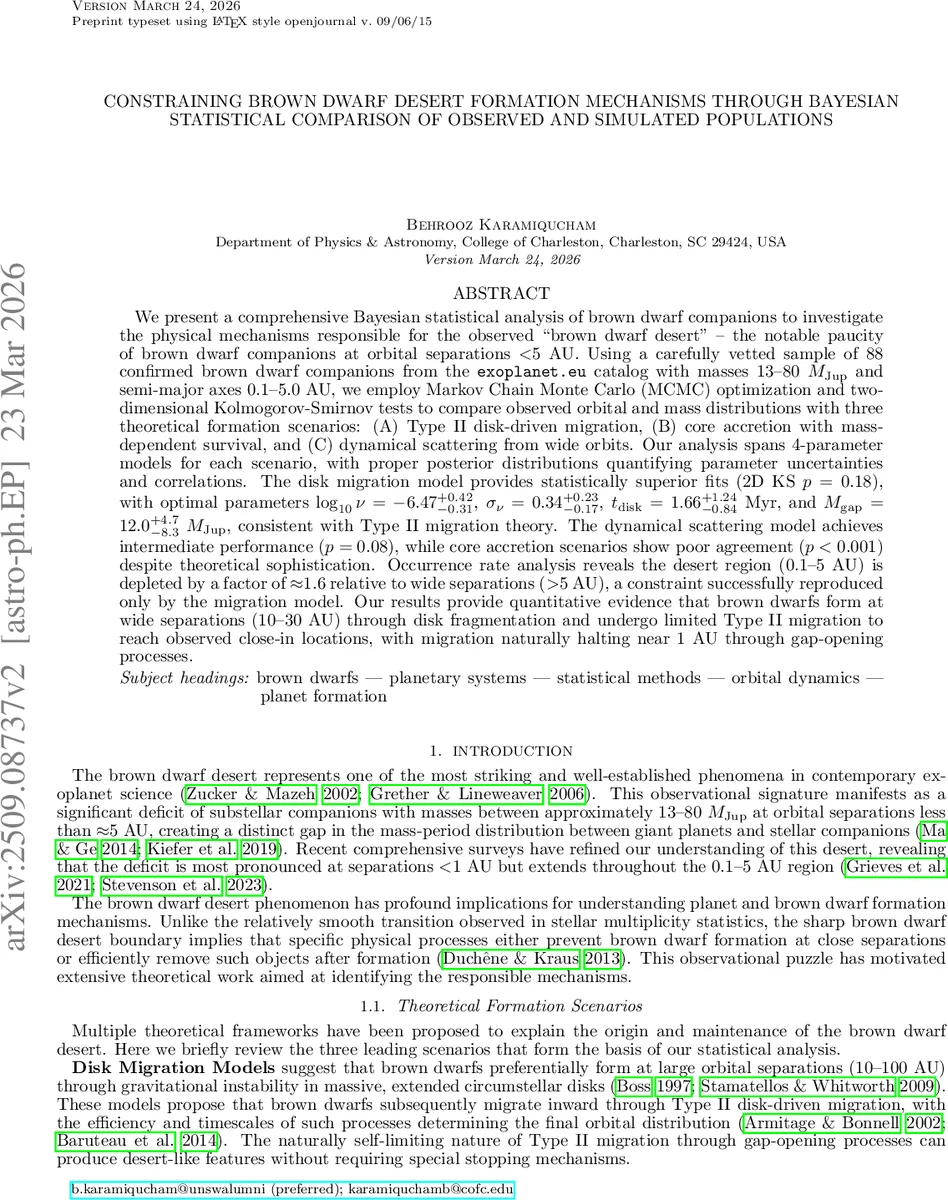
We present a comprehensive Bayesian statistical analysis of brown dwarf companions to investigate the physical mechanisms responsible for the observed ``brown dwarf desert’’ – the notable paucity of brown dwarf companions at orbital separations $<$5AU. Using a carefully vetted sample of 88 confirmed brown dwarf companions from the \texttt{exoplanet.eu} catalog with masses 13–80$\mjup$ and semi-major axes 0.1–5.0AU, we employ Markov Chain Monte Carlo (MCMC) optimization and two-dimensional Kolmogorov-Smirnov tests to compare observed orbital and mass distributions with three theoretical formation scenarios: (A) Type II disk-driven migration, (B) core accretion with mass-dependent survival, and (C) dynamical scattering from wide orbits. Our analysis spans 4-parameter models for each scenario, with proper posterior distributions quantifying parameter uncertainties and correlations. The disk migration model provides statistically superior fits (2D KS $p = 0.18$), with optimal parameters $\log_{10}ν= -6.47^{+0.42}{-0.31}$, $σ_ν= 0.34^{+0.23}{-0.17}$, $t_{\rm disk} = 1.66^{+1.24}{-0.84}$~Myr, and $M{\rm gap} = 12.0^{+4.7}_{-8.3}\mjup$, consistent with Type II migration theory. The dynamical scattering model achieves intermediate performance ($p = 0.08$), while core accretion scenarios show poor agreement ($p < 0.001$) despite theoretical sophistication. Occurrence rate analysis reveals the desert region (0.1–5AU) is depleted by a factor of $\approx$1.6 relative to wide separations ($>$5AU), a constraint successfully reproduced only by the migration model. Our results provide quantitative evidence that brown dwarfs form at wide separations (10–30AU) through disk fragmentation and undergo limited Type II migration to reach observed close-in locations, with migration naturally halting near 1AU through gap-opening processes.
💡 Research Summary
This paper presents the first comprehensive Bayesian statistical comparison between observed brown‑dwarf companions and synthetic populations generated from three leading formation theories. The authors assembled a rigorously vetted sample of 88 confirmed brown‑dwarf companions from the exoplanet.eu catalog, restricting masses to 13–80 M_Jup and semi‑major axes to 0.1–5 AU. To minimize observational bias, they excluded radial‑velocity‑only detections lacking true mass measurements, retained only objects with well‑characterized orbital parameters, and applied identical selection cuts to a complementary wide‑orbit sample (120 objects with a > 5 AU) for occurrence‑rate analysis.
Three theoretical scenarios were implemented: (A) Type II disk‑driven migration, (B) core‑accretion with mass‑dependent survival probability, and (C) dynamical scattering from wide orbits. Each model contains four free parameters. The migration model draws initial semi‑major axes from a log‑uniform distribution (5–30 AU), masses from a bimodal distribution reflecting the observed split at ≈ 42.5 M_Jup, and disk viscosity ν from a log‑normal distribution characterized by a mean µ_ν and dispersion σ_ν. Migration follows the scaling da/dt ≈ −ν (M_BD/M_*) (H/a)² a⁻¹, attenuated exponentially with a disk‑lifetime parameter t_disk. Migration halts either when the disk dissipates or when the companion reaches a minimum radius set by the gap‑opening mass M_gap. The core‑accretion model incorporates a formation‑time scaling t_form ∝ M^{2–3} and a survival probability that declines sharply for masses approaching the brown‑dwarf regime. The scattering model assumes brown dwarfs form at 10–100 AU and are later scattered inward through stellar encounters, with the final distribution derived via Monte‑Carlo sampling.
Parameter inference was performed with the emcee MCMC sampler, generating 200 k samples per model. Posterior distributions reveal correlations between µ_ν and t_disk, and a modest anti‑correlation between ν and M_gap. Model performance was quantified using two‑dimensional Kolmogorov‑Smirnov (2D‑KS) tests that compare the joint mass–semi‑major axis distributions of simulated and observed populations. The Type II migration model achieved the highest 2D‑KS p‑value (p = 0.18), indicating good agreement. Its best‑fit parameters are µ_ν = −6.47^{+0.42}{−0.31}, σ_ν = 0.34^{+0.23}{−0.17}, t_disk = 1.66^{+1.24}{−0.84} Myr, and M_gap = 12.0^{+4.7}{−8.3} M_Jup. The dynamical scattering model performed moderately (p = 0.08), while the core‑accretion scenario was strongly disfavored (p < 0.001).
An independent occurrence‑rate metric, defined as the number of companions per dex in log a, shows a depletion factor of ≈ 1.6 in the desert region (0.1–5 AU) relative to wider separations (> 5 AU). Only the migration model reproduces this depletion, as limited inward migration naturally stalls near 1 AU when the companion exceeds the gap‑opening threshold. The inferred viscosity is consistent with magnetorotational‑instability driven turbulence, and the disk‑lifetime aligns with observed protoplanetary disk dispersal timescales.
The authors conclude that brown dwarfs most likely form via gravitational instability at wide separations (10–30 AU) and subsequently undergo limited Type II migration, halting near 1 AU due to gap opening. Core‑accretion cannot account for the observed desert, and dynamical scattering may contribute but does not dominate the population structure. This work provides quantitative constraints on brown‑dwarf formation mechanisms and demonstrates the power of Bayesian population synthesis combined with rigorous statistical testing.
Comments & Academic Discussion
Loading comments...
Leave a Comment