Neutrino Oscillations in the Three Flavor Paradigm
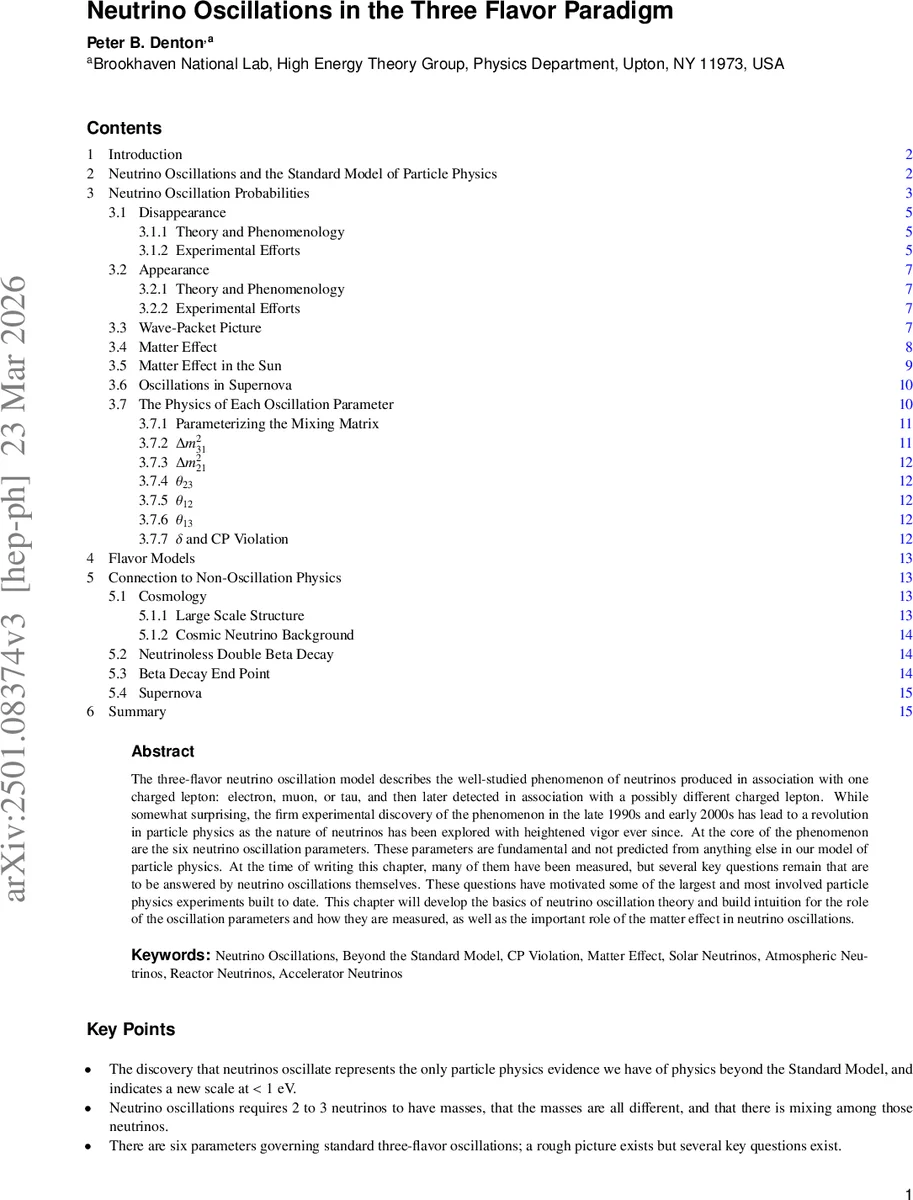
The three-flavor neutrino oscillation model describes the well-studied phenomenon of neutrinos produced in association with one charged lepton: electron, muon, or tau, and then later detected in association with a possibly different charged lepton. While somewhat surprising, the firm experimental discovery of the phenomenon in the late 1990s and early 2000s has lead to a revolution in particle physics as the nature of neutrinos has been explored with heightened vigor ever since. At the core of the phenomenon are the six neutrino oscillation parameters. These parameters are fundamental and not predicted from anything else in our model of particle physics. At the time of writing this chapter, many of them have been measured, but several key questions remain that are to be answered by neutrino oscillations themselves. These questions have motivated some of the largest and most involved particle physics experiments built to date. This chapter will develop the basics of neutrino oscillation theory and build intuition for the role of the oscillation parameters and how they are measured, as well as the important role of the matter effect in neutrino oscillations.
💡 Research Summary
The chapter provides a comprehensive review of three‑flavor neutrino oscillations, beginning with the historical development of the concept and the experimental discoveries that established it as a genuine phenomenon beyond the Standard Model (SM). Early theoretical ideas by Pontecorvo and the Maki‑Nakagawa‑Sakata (MNS) formulation laid the groundwork for describing neutrinos as coherent superpositions of three mass eigenstates. The first compelling evidence came from the Homestake solar neutrino deficit, followed by the decisive atmospheric neutrino results from Super‑Kamiokande in 1998 and the solar neutrino confirmation by SNO in 2001‑2002. These observations demonstrated that neutrinos produced with a given charged‑lepton flavor can be detected with a different flavor after propagating over macroscopic distances.
The SM treats neutrinos as massless, so any non‑zero mass requires physics beyond the SM. Two broad classes of mass‑generation mechanisms are discussed: (i) a Dirac mass generated via the Higgs mechanism, which would require extremely tiny Yukawa couplings (∼10⁻¹²) and the introduction of right‑handed sterile neutrinos; and (ii) a Majorana mass term, which violates lepton number and can arise from seesaw‑type mechanisms. The chapter emphasizes that oscillation experiments alone cannot distinguish Dirac from Majorana nature; complementary non‑oscillation probes such as neutrinoless double‑beta decay, cosmological limits on Σ mν, and direct beta‑decay endpoint measurements are essential.
The core of the theoretical framework is the unitary 3 × 3 Pontecorvo‑Maki‑Nakagawa‑Sakata (PMNS) matrix, parameterized by three mixing angles (θ₁₂, θ₁₃, θ₂₃) and a single CP‑violating phase δ. The transition amplitude for a neutrino of flavor α to be detected as flavor β after traveling a distance L with energy E is A(να→νβ)=∑₁³ U*αi e^{-i Δm²_i L/(2E)} Uβi, and the probability is the squared modulus of this amplitude. By expanding the probability one obtains the familiar expression containing sin²(Δm²_{ij} L/4E) terms and a term proportional to the Jarlskog invariant J = s₁₂c₁₂s₁₃c²₁₃s₂₃c₂₃ sin δ, which governs CP‑odd effects and appears only in appearance channels.
Matter effects are treated using the effective potential V=√2 G_F N_e that electron neutrinos experience when propagating through ordinary matter. In the flavor basis the Hamiltonian acquires an additional diagonal term, leading to modified effective mixing angles and mass‑splittings. This Mikheyev‑Smirnov‑Wolfenstein (MSW) effect explains the energy‑dependent suppression of solar ν_e observed by SNO and Super‑Kamiokande, and it also plays a role in atmospheric neutrinos traversing the Earth. The chapter discusses the adiabatic MSW resonance in the Sun and the more complex, rapidly varying density profiles encountered in core‑collapse supernovae, where collective neutrino‑neutrino interactions can further modify flavor evolution.
The six oscillation parameters are reviewed in detail. The two independent mass‑squared differences, Δm²_21 (solar scale) and |Δm²_31| (atmospheric scale), set the oscillation frequencies. The mixing angles have been measured with increasing precision: θ₁₂≈33°, θ₁₃≈8.5°, and θ₂₃≈45° with an octant ambiguity. The CP phase δ is currently constrained only loosely; recent long‑baseline experiments (T2K, NOvA) hint at maximal CP violation (δ≈−π/2) but statistical significance remains modest. Determining the mass ordering (normal vs inverted) and the precise value of δ are among the most pressing goals.
Flavor model building is briefly surveyed. Various textures, discrete symmetries (e.g., μ‑τ symmetry), and grand‑unified frameworks attempt to relate the observed mixing pattern to underlying symmetries, but present data do not decisively favor any specific construction.
The chapter then connects oscillation physics to non‑oscillation observables. Cosmological surveys constrain the sum of neutrino masses Σ mν to be below ~0.12 eV, providing indirect information on the absolute mass scale. Neutrinoless double‑beta decay experiments (e.g., GERDA, KamLAND‑Zen) probe the Majorana nature and effective electron‑neutrino mass ⟨m_ββ⟩. Direct kinematic measurements such as KATRIN aim to bound the effective electron neutrino mass ⟨m_β⟩ at the sub‑eV level. Supernova neutrino detection (e.g., IceCube, Hyper‑K) would offer a time‑resolved flavor signal sensitive to both mass ordering and collective effects.
In summary, the chapter underscores that while the six oscillation parameters are now largely measured, critical questions remain: the absolute mass scale, the ordering of the mass eigenstates, the size and origin of CP violation, and the underlying mechanism that gives neutrinos mass. Upcoming experiments—DUNE, Hyper‑Kamiokande, JUNO, IceCube‑Upgrade, and next‑generation double‑beta decay searches—are poised to address these issues, potentially opening a new window onto physics beyond the Standard Model.
Comments & Academic Discussion
Loading comments...
Leave a Comment