Complex line fields on almost-complex manifolds
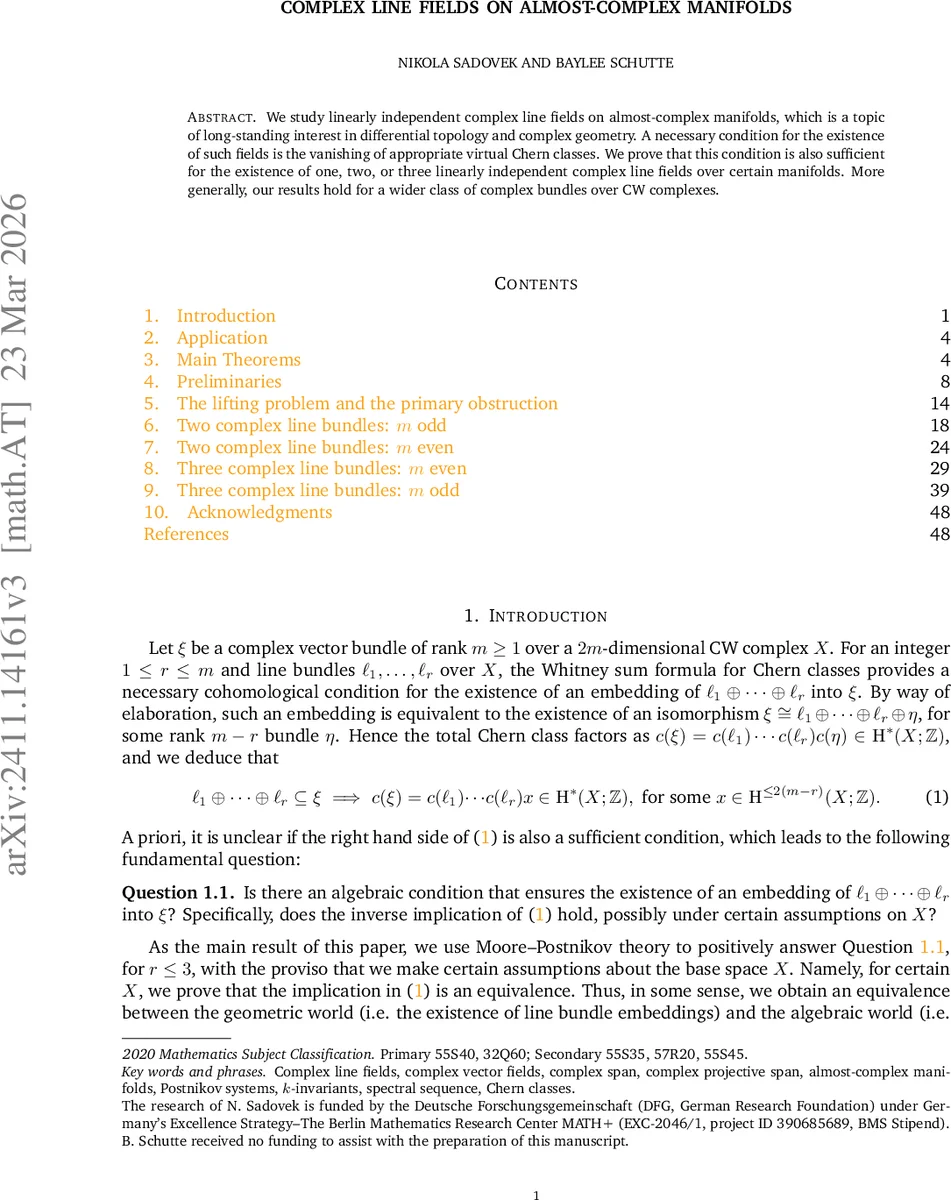
We study linearly independent complex line fields on almost-complex manifolds, which is a topic of long-standing interest in differential topology and complex geometry. A necessary condition for the existence of such fields is the vanishing of appropriate virtual Chern classes. We prove that this condition is also sufficient for the existence of one, two, or three linearly independent complex line fields over certain manifolds. More generally, our results hold for a wider class of complex bundles over CW complexes.
💡 Research Summary
The paper investigates the problem of splitting off linearly independent complex line bundles from a complex vector bundle over an almost‑complex manifold or, more generally, over a finite CW complex. Given a complex m‑plane bundle ξ over a 2m‑dimensional base X, the Whitney sum formula forces the total Chern class to factor as
c(ξ)=c(λ₁)·…·c(λ_r)·x
whenever a direct sum of r line bundles λ₁⊕…⊕λ_r embeds in ξ. The authors ask whether this cohomological factorisation is also sufficient. Using Moore–Postnikov obstruction theory they show that for r≤3 the answer is affirmative under natural hypotheses on X (simply‑connectedness, absence of 2‑torsion in H₂, certain Steenrod‑square relations, and, in the even‑rank case, w₂(M)=0).
The main theorem (Theorem 1.2) has three parts:
-
One line bundle (r=1). For any m≥1, a complex line bundle λ embeds in ξ iff the top virtual Chern class c_m(ξ−λ) vanishes. In the almost‑complex case this reduces to the classical Hopf theorem: a non‑vanishing complex vector field (i.e. span C ≥ 1) exists exactly when the Euler characteristic χ(M) is zero.
-
Two line bundles (r=2).
- If m is odd (m≥3) and the top cohomology satisfies H^{2m}(X;ℤ)=δSq²ρ₂H^{2m‑3}(X;ℤ) (or if H^{2m}(X;ℤ) has no 2‑torsion), then λ₁⊕λ₂ embeds in ξ iff the two highest virtual Chern classes of ξ−λ₁⊕λ₂ vanish.
- If m is even (m≥3) and w₂(M)=0 together with analogous Steenrod‑square conditions hold, the same vanishing criterion is sufficient. These statements recover and extend earlier results of Thomas and Gilmore on complex span ≥2.
-
Three line bundles (r=3). For m≥5, π₁(M)=0, H₂(M;ℤ) free of 2‑torsion, and suitable Sq² relations (automatically satisfied for complex projective spaces), λ₁⊕λ₂⊕λ₃ embeds in ξ iff the three top virtual Chern classes c_{m‑2}, c_{m‑1}, c_m of ξ−λ₁⊕λ₂⊕λ₃ all vanish. This yields a complete cohomological characterisation of complex projective span ≥3, even for non‑spin almost‑complex manifolds.
The authors illustrate the theory on CP^m. Using the Schwarzenberger condition, they show that a total Chern class c=∏_{i=1}^m(1+z_i u) corresponds to a bundle admitting a sum of r≤3 line bundles precisely when the remaining factors satisfy the integer‑valued binomial sum condition (4). Thus the abstract obstruction theory translates into concrete arithmetic constraints on the Chern numbers of bundles over projective space.
Throughout the paper the obstruction to lifting a map into the classifying space BU(m) to a map into the classifying space of a product of line bundles is identified with the primary obstruction in H^{2m}(X;ℤ), which is exactly the top virtual Chern class. The authors compute the relevant k‑invariants of the Postnikov tower, showing that they are given by Bockstein images of Steenrod squares, which explains the appearance of the extra cohomological hypotheses in the even‑rank case.
In addition to recovering known results (Hopf’s theorem, Thomas’s and Gilmore’s criteria for complex span), the paper provides new information: for non‑spin almost‑complex manifolds the condition “c_{m‑1}=c_m=0” is both necessary and sufficient for the existence of a single complex line field, and the vanishing of three consecutive virtual Chern classes is sufficient for three independent line fields. The work also connects to recent developments on complex section cobordism (Nguyen) and to the study of projectivized tangent bundles (Grant–Schutte), suggesting further applications in Kähler geometry and foliation theory.
Overall, the paper delivers a clean, obstruction‑theoretic framework that translates the geometric problem of splitting off complex line bundles into a purely cohomological condition involving virtual Chern classes, and it verifies that this translation is exact for up to three line bundles under reasonably mild topological assumptions.
Comments & Academic Discussion
Loading comments...
Leave a Comment