Cocycles and positive functionals in higher cohomology
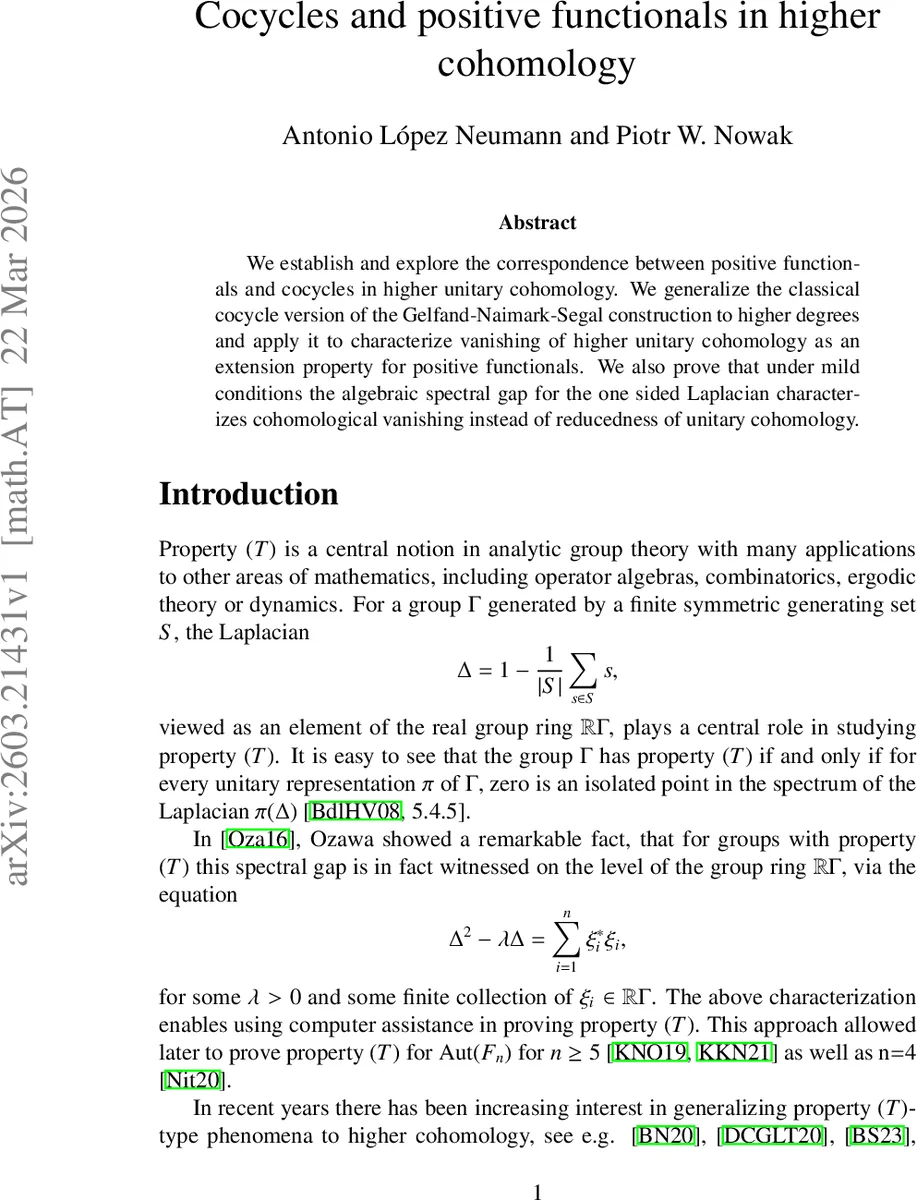
We establish and explore the correspondence between positive functionals and cocycles in higher unitary cohomology. We generalize the classical cocycle version of the Gelfand-Naimark-Segal construction to higher degrees and apply it to characterize vanishing of higher unitary cohomology as an extension property for positive functionals. We also prove that under mild conditions the algebraic spectral gap for the one sided Laplacian characterizes cohomological vanishing instead of reducedness of unitary cohomology
💡 Research Summary
The paper investigates the deep relationship between positive functionals and cocycles in higher unitary cohomology, extending the classical Gelfand‑Naimark‑Segal (GNS) construction beyond degree one. After recalling Ozawa’s algebraic spectral gap characterization of Property (T) for groups, the authors aim to generalize this to higher cohomological degrees. Two central questions drive the work: (i) when can a positive hermitian functional defined only on the space of matricial boundaries be extended to the whole matrix algebra over the group ring, and (ii) does an algebraic spectral gap for the one‑sided Laplacian ∆_{n‑1} guarantee vanishing of Hⁿ(Γ,π) for all unitary representations π?
The first part of the paper sets up the necessary algebraic framework. The real group algebra ℝΓ is equipped with its natural involution, and its matrix algebras M_k(ℝΓ) are shown to be Archimedean *‑algebras. Proposition 1.1 proves that any bounded *‑representation of M_k(ℝΓ) arises from a unitary representation of Γ, and Proposition 1.2 gives the standard GNS representation for positive functionals on M_k(ℝΓ). These results provide the bridge between matrix‑valued functionals and group representations.
Next, the authors introduce a simplicial model for a group of type F_d, obtaining a matrix‑valued cochain complex (d_n) whose differentials are represented by matrices with entries in ℝΓ. Lemma 2.1 establishes that the associated left‑ and right‑multiplication complexes are acyclic in positive degrees, a crucial homological fact used later.
Section 3 defines “split‑conjugation spaces”, a new class of subspaces of matrices that can be written as sums of images of one‑sided differentials. Theorem 3.3 shows that every matricial cycle can be decomposed into such split‑conjugation pieces, using a telescoping argument together with the acyclicity of the underlying group cochain complex. This decomposition yields a concrete description of the space of matricial boundaries im D_{n‑1} as a sum of squares.
The heart of the paper is the higher‑dimensional GNS construction (Theorems 4.2 and 4.3). For any n‑cocycle z∈Zⁿ(Γ,π) of a unitary representation π, the authors associate a positive hermitian functional φ on the matricial boundaries by the formula φ(a)=⟨π(a)z,z⟩ for a∈M_{k^{n‑1}}(ℝΓ). Conversely, any positive functional on im D_{n‑1} arises from some cocycle in this way. The crucial insight is that the ability to extend φ from im D_{n‑1} to the whole matrix algebra is equivalent to the vanishing of Hⁿ(Γ,π). This is formalized in Theorem 4.5 (Theorem B): for groups of type F with n≥(cdim_ℚ(Γ)+1)/2, Hⁿ(Γ,π)=0 for all unitary π if and only if every positive hermitian functional on the boundaries extends positively to M_{k^{n‑1}}(ℝΓ).
Section 5 translates the extension property into an algebraic spectral gap condition. Theorem 5.2 (Theorem A) proves that the existence of λ>0 and finitely many matrices M_i∈M_{k^{n‑1}}(ℝΓ) satisfying (∆{n‑1})²−λ∆{n‑1}=∑i M_i^*M_i is equivalent to the universal vanishing of Hⁿ(Γ,π). Here ∆{n‑1}=d_{n‑1}^*d_{n‑1} is the one‑sided Laplacian. This result generalizes Ozawa’s degree‑one spectral gap characterization to arbitrary degree, showing that the algebraic gap is strong enough to force cohomological vanishing, not merely reducedness.
In Section 6 the authors apply their machinery to a higher‑dimensional analogue of Shalom’s Property HT. They prove that the higher‑HT property can be characterized either by the positive functional extension condition or by the existence of an algebraic spectral gap for the appropriate Laplacian (Theorems 6.3 and 6.4). Thus the paper provides a unified algebraic framework for several higher‑order rigidity properties.
Overall, the work makes three major contributions: (1) a higher‑dimensional GNS correspondence linking n‑cocycles with positive functionals on matricial boundaries; (2) a proof that positive functional extension is equivalent to universal cohomology vanishing; (3) an algebraic spectral gap criterion that guarantees this vanishing, thereby extending Ozawa’s degree‑one results to all higher degrees. These results open new avenues for computer‑assisted proofs of higher‑order rigidity phenomena and deepen the interplay between operator algebraic positivity and group cohomology.
Comments & Academic Discussion
Loading comments...
Leave a Comment