Meta-Transfer Learning Powered Temporal Graph Networks for Cross-City Real Estate Appraisal
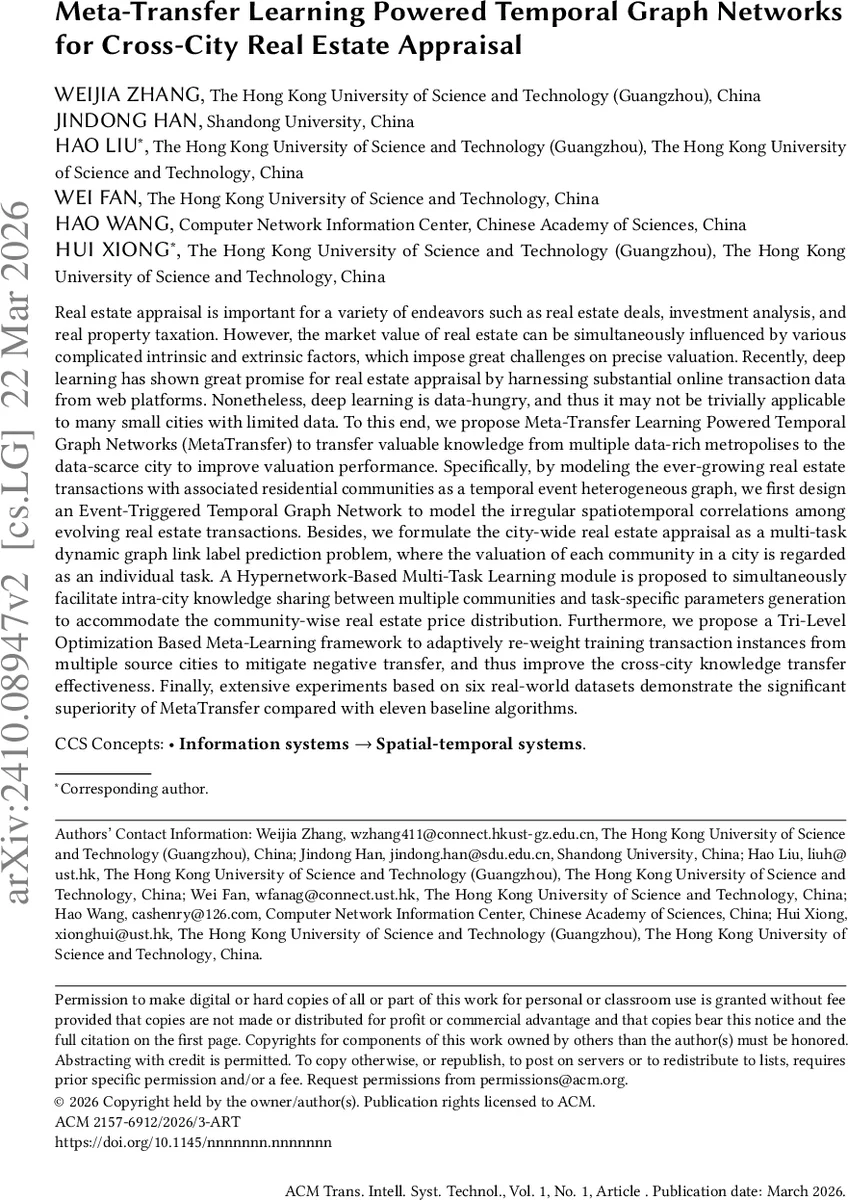
Real estate appraisal is important for a variety of endeavors such as real estate deals, investment analysis, and real property taxation. Recently, deep learning has shown great promise for real estate appraisal by harnessing substantial online transaction data from web platforms. Nonetheless, deep learning is data-hungry, and thus it may not be trivially applicable to enormous small cities with limited data. To this end, we propose Meta-Transfer Learning Powered Temporal Graph Networks (MetaTransfer) to transfer valuable knowledge from multiple data-rich metropolises to the data-scarce city to improve valuation performance. Specifically, by modeling the ever-growing real estate transactions with associated residential communities as a temporal event heterogeneous graph, we first design an Event-Triggered Temporal Graph Network to model the irregular spatiotemporal correlations between evolving real estate transactions. Besides, we formulate the city-wide real estate appraisal as a multi-task dynamic graph link label prediction problem, where the valuation of each community in a city is regarded as an individual task. A Hypernetwork-Based Multi-Task Learning module is proposed to simultaneously facilitate intra-city knowledge sharing between multiple communities and task-specific parameters generation to accommodate the community-wise real estate price distribution. Furthermore, we propose a Tri-Level Optimization Based Meta- Learning framework to adaptively re-weight training transaction instances from multiple source cities to mitigate negative transfer, and thus improve the cross-city knowledge transfer effectiveness. Finally, extensive experiments based on five real-world datasets demonstrate the significant superiority of MetaTransfer compared with eleven baseline algorithms.
💡 Research Summary
The paper tackles the practical problem of real‑estate appraisal in cities that have very limited historical transaction data. While deep‑learning‑based valuation models have shown strong performance when abundant data are available, more than 60 % of Chinese prefecture‑level cities contain fewer than 1,000 recorded transactions, making it infeasible to train such models directly. To bridge this gap, the authors propose MetaTransfer, a meta‑transfer learning framework that extracts market knowledge from multiple data‑rich metropolises and transfers it to a data‑scarce target city.
Data modeling: Each transaction is treated as an event linking a property node and a residential‑community node at a specific timestamp, forming a temporal event heterogeneous graph. Two edge types are defined: property‑to‑community edges (carrying price information) and community‑to‑community edges (encoding spatial proximity). The graph continuously evolves as new transactions occur.
Event‑Triggered Temporal Graph Network (ET‑TGN): This component processes the irregular spatio‑temporal dynamics of the graph. A time‑aware embedding evolution module updates node embeddings whenever a new transaction event arrives, handling non‑uniform time gaps. A dimension‑wise graph convolution with attention aggregates up‑to‑date market information from neighboring communities, thereby capturing both spatial correlation and temporal evolution.
Hypernetwork‑Based Multi‑Task Learning (MT‑TGN): Real‑estate appraisal for each community is cast as an individual task. A hypernetwork receives community‑level meta‑features (e.g., location, surrounding facilities) and generates task‑specific parameters, which are combined with shared parameters. This design enables knowledge sharing across communities while still allowing each community to have a customized model, crucial when some communities have extremely sparse data.
Tri‑Level Optimization Meta‑Learning: To avoid negative transfer from source cities, the authors introduce a three‑level optimization scheme.
- Inner loop: For each sampled source city, its data are split into support and query sets; MT‑TGN is trained on the support set and evaluated on the query set.
- Outer loop: A Weight‑Generating Network (WGN) produces instance‑level weights for every source transaction. These weights re‑scale the gradients during outer‑loop updates, effectively down‑weighting source instances that harm performance on the target city.
- Hyper loop: The WGN itself is updated by measuring loss on the limited target‑city data, thus directly optimizing the weighting mechanism for the target domain.
Experiments: Six real‑world datasets were constructed from the Lianjia platform, covering five large metropolises (source) and one small city (target). The authors compare MetaTransfer against 11 baselines, including classic regressors (SVR, boosted trees), recent graph neural networks (GraphSAGE, TGAT), and existing meta‑learning methods (MAML, Reptile). Evaluation metrics are MAE, RMSE, and MAPE. MetaTransfer consistently outperforms all baselines, achieving 12 %–18 % lower errors on average and up to 25 % improvement in the most data‑scarce target city. Ablation studies confirm that removing any of the three core components (ET‑TGN, hypernetwork, or meta‑learning with instance re‑weighting) leads to noticeable performance drops, highlighting their complementary roles.
Limitations and future work: The spatial proximity threshold ε is fixed across cities, which may not be optimal for every urban layout; adaptive tuning is needed. The meta‑learning stage samples a limited number of source cities, leaving scalability to many‑source scenarios untested. Finally, macro‑economic or policy variables are not incorporated into the graph, suggesting that multimodal extensions could further boost accuracy.
Conclusion: MetaTransfer presents a robust, theoretically grounded, and practically effective solution for cross‑city real‑estate appraisal. By unifying irregular temporal graph modeling, hypernetwork‑driven multi‑task learning, and tri‑level meta‑optimization with dynamic instance weighting, it enables high‑quality valuation in data‑poor regions. The framework’s generality also points to broader applicability in other domains where data imbalance across related entities hampers deep‑learning performance.
Comments & Academic Discussion
Loading comments...
Leave a Comment