Testing for cross-quantilogram change
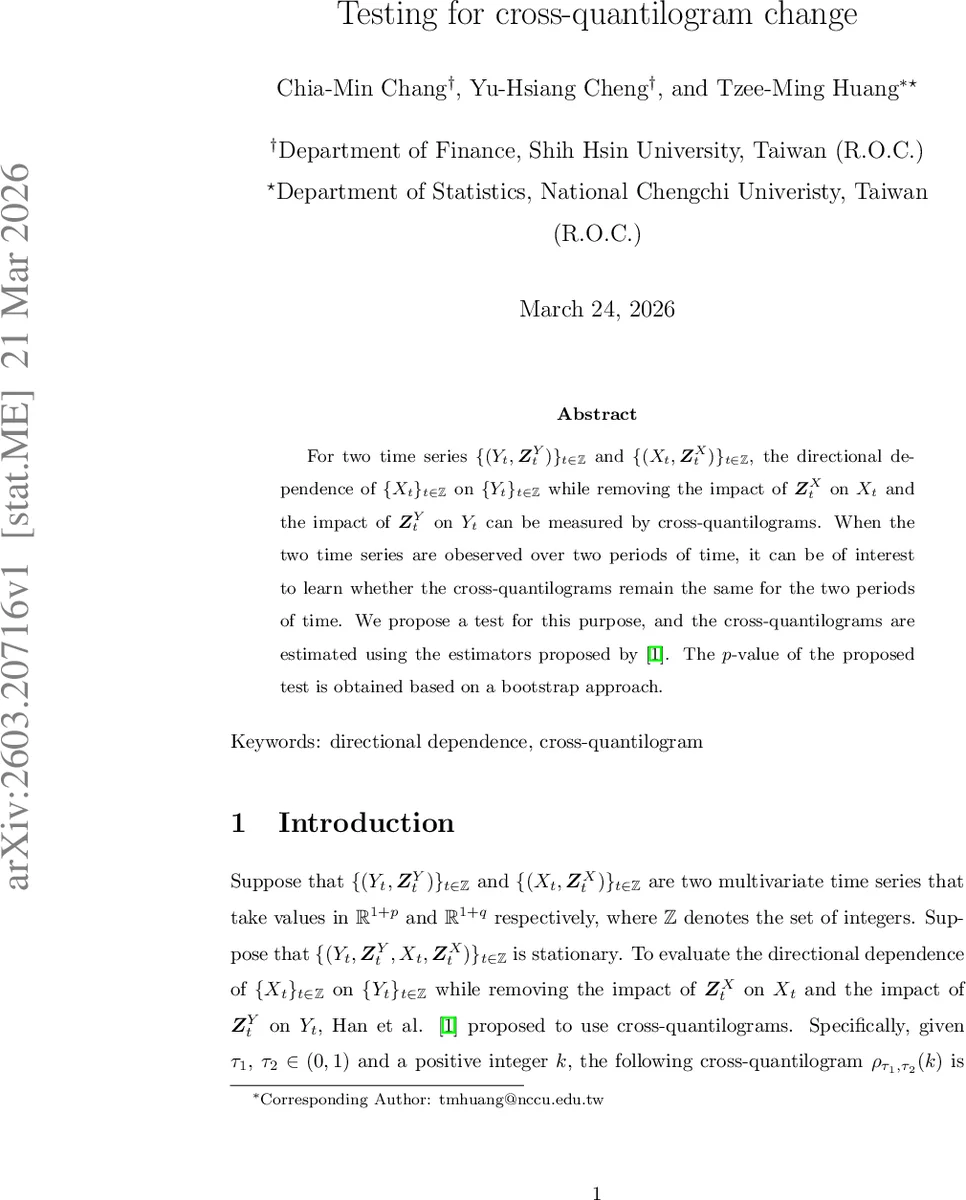
For two time series ${ (Y_t, Z_t^Y) }{t}$ and ${(X_t, Z_t^X)}{t}$, the directional dependence of ${ X_t }{t}$ on ${ Y_t }{t}$ while removing the impact of $Z_t^X$ on $X_t$ and the impact of $Z_t^Y$ on $ Y_t$ can be measured by cross-quantilograms. When the two time series are obeserved over two periods of time, it can be of interest to learn whether the cross-quantilograms remain the same for the two periods of time. We propose a test for this purpose, and the cross-quantilograms are estimated using the estimators proposed by Han (2016). The $p$-value of the proposed test is obtained based on a bootstrap approach.
💡 Research Summary
The paper introduces a statistical test for assessing whether cross‑quantilograms—measures of directional dependence between two multivariate time series after conditioning on auxiliary variables—remain unchanged across two distinct time periods. Building on Han et al. (2016), which defined the cross‑quantilogram (\rho_{\tau_1,\tau_2}(k)) for a single stationary series and provided a test for the null hypothesis (\rho_{\tau_1,\tau_2}(k)=0), the authors extend the framework to compare two independent samples: a “before” sample ({(Y_{b,t},Z^Y_{b,t},X_{b,t},Z^X_{b,t})}{t=1}^{T_1}) and an “after” sample ({(Y{a,t},Z^Y_{a,t},X_{a,t},Z^X_{a,t})}_{t=1}^{T_2}). The null hypothesis is that the entire cross‑quantilogram surface is identical across periods, \
Comments & Academic Discussion
Loading comments...
Leave a Comment