Improved kissing numbers in seventeen through twenty-one dimensions
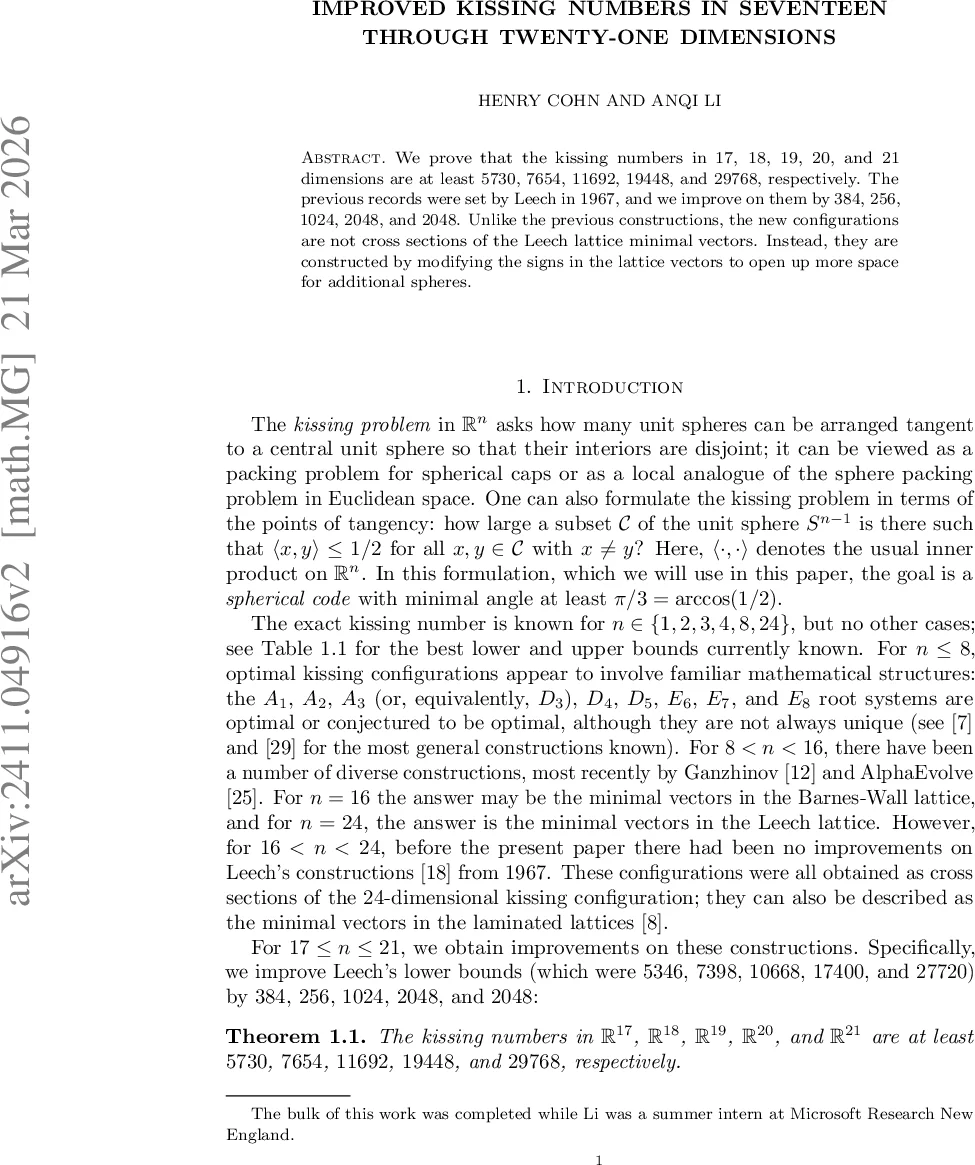
We prove that the kissing numbers in 17, 18, 19, 20, and 21 dimensions are at least 5730, 7654, 11692, 19448, and 29768, respectively. The previous records were set by Leech in 1967, and we improve on them by 384, 256, 1024, 2048, and 2048. Unlike the previous constructions, the new configurations are not cross sections of the Leech lattice minimal vectors. Instead, they are constructed by modifying the signs in the lattice vectors to open up more space for additional spheres.
💡 Research Summary
The paper “Improved kissing numbers in seventeen through twenty‑one dimensions” by Henry Cohn and Anqi Li presents a breakthrough in the classical kissing‑number problem for dimensions 17 to 21. The kissing‑number problem asks for the maximal number of unit spheres that can simultaneously touch a central unit sphere without overlapping interiors. Exact values are known only in dimensions 1, 2, 3, 4, 8 and 24; for all other dimensions only bounds are available.
Historically, the best lower bounds for dimensions 17–21 were obtained by John Leech in 1967 by taking cross‑sections of the 24‑dimensional Leech lattice minimal vectors (or equivalently, the minimal vectors of the laminated lattices Λₙ). Those constructions inherit the inner‑product set {±1, ±½, ±¼, 0} after normalisation and have been believed to be essentially optimal for the given dimensions.
Cohn and Li abandon the cross‑section paradigm and introduce a method based on sign modification of lattice vectors. The essential observation is that the Leech‑lattice vectors can be written as permutations of (±2, ±2, 0,…,0) together with vectors obtained by assigning signs to the coordinates of codewords from a binary error‑correcting code C of length n, weight 8 and minimum distance 8. In the classical Leech construction the signs are chosen so that each such vector contains an even number of minus signs. The authors consider the odd sign variant: the same support but an odd number of minus signs. This yields a configuration of the same cardinality but with a different inner‑product structure, allowing extra vectors to be inserted without violating the kissing condition (inner product ≤ 4 after scaling).
For dimensions 19, 20 and 21 the authors start from the Steiner system S(5, 8, 24), which gives a binary code C of size |C| = 759 when n = 24. By repeatedly shortening the system they obtain the largest known codes for n = 19, 20, 21 (|C| = 130, 78, 46 respectively). The basic configuration has size 2^{⌊n/2⌋}+2⁷|C|, which matches the Leech lower bounds for these dimensions. The key new step is to add vectors of the form
v(c) = ((−1)^{c₁} 2/√n, …, (−1)^{c_n} 2/√n)
where c∈F₂ⁿ is orthogonal to C modulo 2. Because c·w ≡ 0 (mod 2) for every codeword w∈C, the inner product ⟨v(c), w⟩ is at most 4 for n ≥ 18. Moreover, distinct choices of c with Hamming distance at least n/4 also satisfy the kissing condition among themselves. By taking a subcode of the orthogonal complement of C with minimum distance ≥ n/4 (derived from the extended binary Golay code and its puncturings/shortenings), the authors obtain exactly the extra vectors needed to raise the lower bounds to
n = 17: 5730 (increase +384)
n = 18: 7654 (increase +256)
n = 19: 11692 (increase +1024)
n = 20: 19448 (increase +2048)
n = 21: 29768 (increase +2048).
These improvements surpass Leech’s records by the amounts stated in the abstract. The authors also argue that the resulting configurations cannot be obtained as cross‑sections of the Leech lattice because they contain inner products of the form 4 p²/n (or, after normalisation, p²/n) which are irrational and do not belong to the Leech inner‑product set.
The dimensions 17 and 18 require a different treatment because the straightforward odd‑sign construction does not yield enough room. The authors analyse the 16‑dimensional “odd kissing configuration” in detail. They identify the underlying binary code structure as the space F₂^{4×4} of 4×4 binary matrices, with a code C₁₀ consisting of matrices whose rows and columns all have the same parity, and its dual C₆ (size 64). The automorphism group G₀ generated by row/column permutations and transpose has order 1152; the full automorphism group G has order 11520 after adding an extra involution.
The 16‑dimensional odd configuration consists of (i) 480 vectors with two ±2 entries, and (ii) 3840 vectors with entries ±1 supported on the “pair” and “square” matrices of C₆, with an odd number of minus signs. Extending this to 17 dimensions by adding a new coordinate yields 5346 vectors, matching Leech’s 17‑dimensional lower bound. The authors then construct additional vectors of the form
((−1)^{c₁} 2/3, …, (−1)^{c₁₆} 2/3, ±√8/3)
where (c₁,…,c₁₆)∈C₁₀. Because C₁₀ is orthogonal to C₆ modulo 2, these vectors have inner product ≤ 4 with all existing vectors. Compatibility among the new vectors is governed by the Hamming distance of the underlying codewords: vectors with the same sign on the last coordinate are too close if their codewords differ in ≤ 4 positions. Consequently, the maximal number of new vectors equals twice the size of a subcode of C₁₀ with minimum distance ≥ 6. Using linear‑programming bounds and an explicit orbit‑enumeration under G, the authors prove that the largest such subcode has size 192, and that C₁₀ actually contains two disjoint subcodes of this size. Adding both yields 384 extra vectors, raising the count to 5730 in 17 dimensions and, by a similar argument, to 7654 in 18 dimensions.
The paper supplies explicit coordinate files for all constructions (available in the authors’ data repository) and notes that verification can be performed algorithmically, providing an independent check that no overlaps occur. No computer‑assisted search is required for the proofs themselves.
Finally, the authors discuss the prospects of extending the sign‑modification technique to higher dimensions, especially 22, but report that attempts so far have not succeeded. They conjecture that the method may still be fruitful with more sophisticated code choices or hybrid constructions.
In summary, Cohn and Li introduce a novel, purely algebraic method—sign modification combined with careful code selection—to surpass long‑standing lower bounds for kissing numbers in dimensions 17 through 21. Their work not only improves the numerical records but also enriches the theoretical toolbox for high‑dimensional sphere‑packing problems, opening new avenues for future research.
Comments & Academic Discussion
Loading comments...
Leave a Comment