Extremely amenable automorphism groups of countable structures
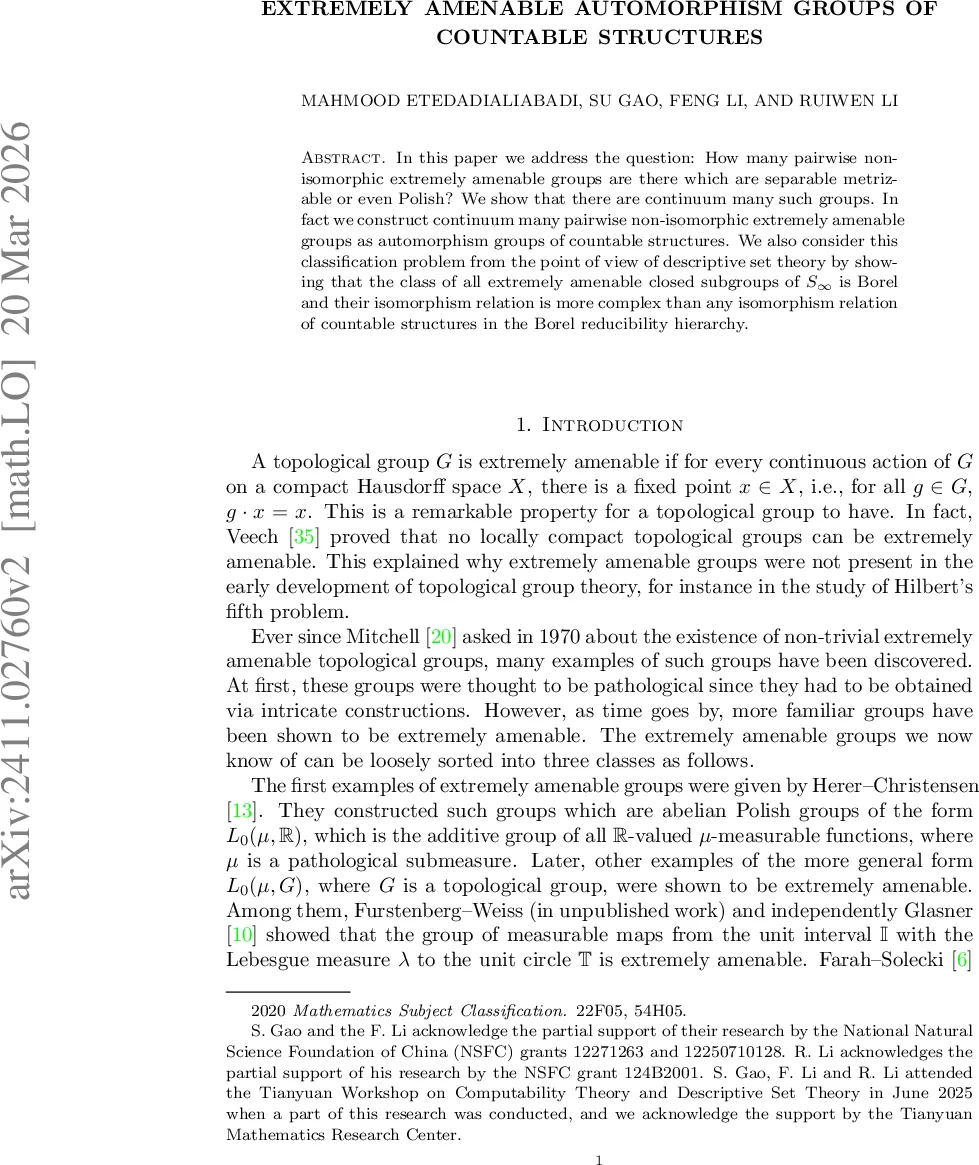
In this paper we address the question: How many pairwise non-isomorphic extremely amenable groups are there which are separable metrizable or even Polish? We show that there are continuum many such groups. In fact we construct continuum many pairwise non-isomorphic extremely amenable groups as automorphism groups of countable structures. We also consider this classification problem from the point of view of descriptive set theory by showing that the class of all extremely amenable closed subgroups of $S_\infty$ is Borel and their isomorphism relation is more complex than any isomorphism relation of countable structures in the Borel reducibility hierarchy.
💡 Research Summary
The paper investigates the abundance of extremely amenable topological groups—those for which every continuous action on a compact space has a fixed point—by constructing continuum many pairwise non‑isomorphic examples that are either separable metrizable or Polish. The authors focus on automorphism groups of countable structures, exploiting the Kechris‑Pestov‑Todorcevic (KPT) correspondence which links extreme amenability to the structural Ramsey property of Fraïssé classes.
The first construction uses countable distance‑value sets Δ ⊂ (0,∞). For each Δ they consider the Δ‑metric Urysohn space U_Δ, the unique separable complete metric space whose set of distances is exactly Δ and which is ultrahomogeneous. The isometry group Iso(U_Δ), equipped with the pointwise convergence topology, is a separable metrizable group. Theorem 1.1 shows that Iso(U_Δ) is extremely amenable precisely when inf Δ = 0; in this case it is not Polish. When inf Δ > 0 the group is Polish but fails to be extremely amenable. Moreover, if inf Δ = 0 then Iso(U_Δ) embeds densely either into Iso(U) (the classical Urysohn space) or into Iso(U₁) (the Urysohn sphere). Theorem 1.2 proves that two such groups are (topologically or abstractly) isomorphic exactly when the underlying distance‑value sets are equivalent (i.e., they generate the same ordered semigroup). Theorem 1.3 exhibits continuum many pairwise inequivalent Δ that are dense in (0,∞), yielding continuum many non‑isomorphic extremely amenable separable metrizable groups. All these groups are dense subgroups of Iso(U) and therefore none is Polish.
For Polish examples the authors turn to ordered Δ‑metric spaces. Let U^{<}_Δ be the Fraïssé limit of the class of all finite ordered Δ‑metric spaces. This structure is countable, ultrahomogeneous, and its automorphism group Aut(U^{<}Δ) is a closed subgroup of S∞, hence Polish. By a theorem of Nešetřil (Theorem 1.4) the class of finite ordered Δ‑metric spaces is a Ramsey class, so by the KPT correspondence Aut(U^{<}_Δ) is extremely amenable. Theorem 1.5 shows that Aut(U^{<}_Δ) and Aut(U^{<}_Λ) are topologically isomorphic iff Δ and Λ are equivalent, and Corollary 1.6 deduces again a continuum of pairwise non‑isomorphic extremely amenable Polish groups.
Beyond counting, the paper analyses the descriptive‑set‑theoretic complexity of the isomorphism relation among these groups. By translating the classification problem into the equivalence relation on countable distance‑value sets, Theorem 1.7 places three natural subclasses into the Borel reducibility hierarchy: (1) when 0 < inf Δ and sup Δ < ∞ the equivalence is Borel‑equivalent to the universal S_∞‑orbit equivalence; (2) when sup Δ = ∞ it is Borel‑equivalent to the equality relation =⁺ on subsets of ℕ; (3) when inf Δ = 0 the relation lies strictly between =⁺ and =⁺⁺, showing a higher level of complexity. This refines recent work of Calderoni, Marker, Motto‑Ros, and Shani.
Finally, the authors prove that the collection of all extremely amenable closed subgroups of S_∞ is a Borel set (Theorem 1.8). Consequently, the isomorphism relation on these groups is analytic but not Borel, and it is strictly more complex than the universal S_∞‑orbit equivalence. This establishes that even within the well‑behaved class of closed subgroups of S_∞, extreme amenability yields a rich and highly non‑classifiable landscape.
In summary, the paper delivers three major contributions: (i) a concrete construction of continuum many non‑isomorphic extremely amenable groups via metric Urysohn spaces and ordered Fraïssé limits; (ii) a precise classification of these groups in terms of the underlying distance‑value sets; and (iii) a thorough descriptive‑set‑theoretic analysis showing that the isomorphism problem for such groups attains maximal complexity among analytic equivalence relations. This work significantly advances our understanding of the diversity and classification difficulty of extremely amenable topological groups.
Comments & Academic Discussion
Loading comments...
Leave a Comment