The Uncertain Policy Price of Scaling Direct Air Capture
Direct air carbon capture and storage (DACCS) is a promising CO2 removal technology, but its deployment at scale remains speculative. Yet, its technological, economic, and policy-related uncertainties have often been overlooked in mitigation pathways…
Authors: Leonardo Chiani, Pietro Andreoni, Laurent Drouet
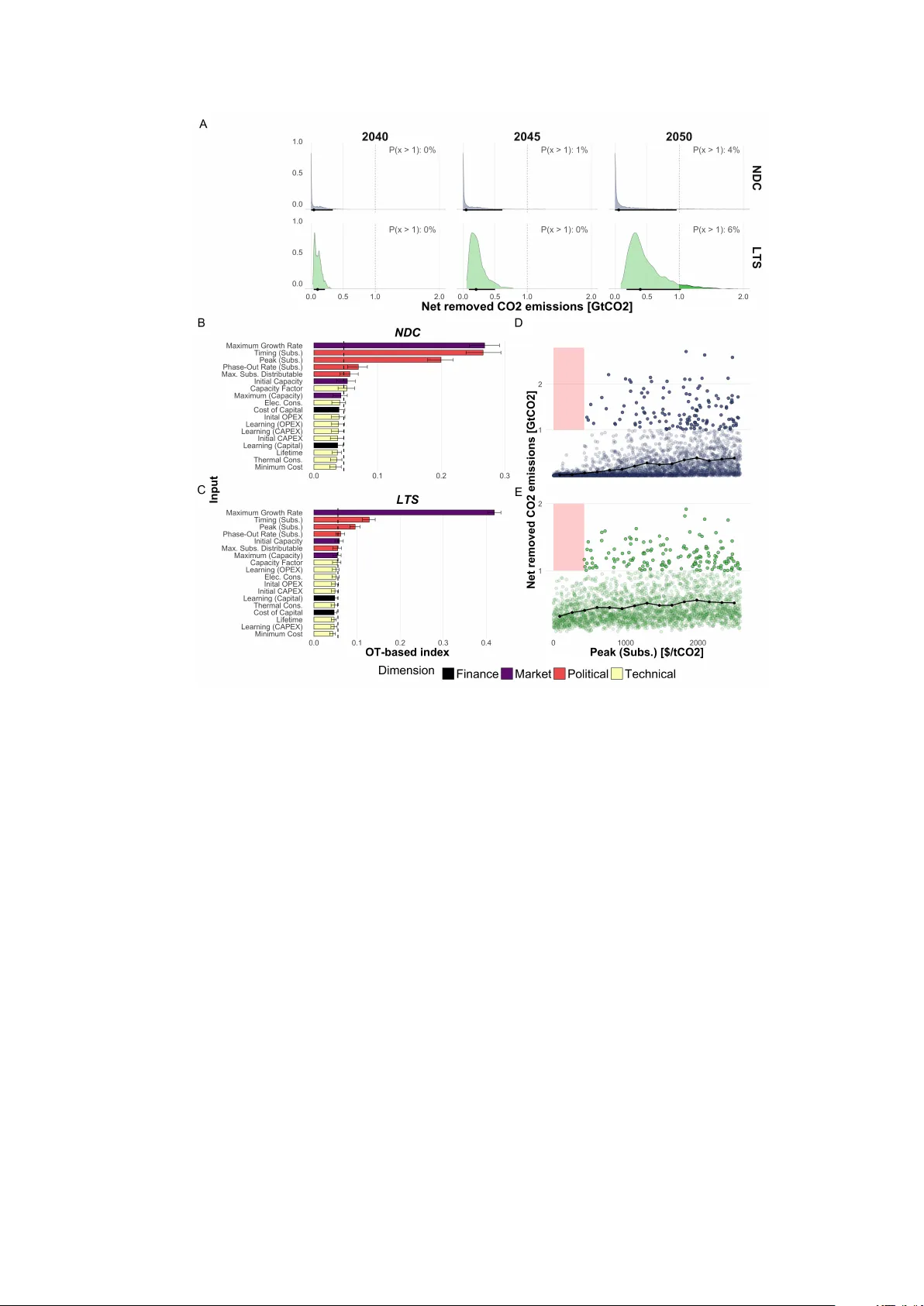
The Uncertain P olicy Price of Scaling Direct Air Capture Leonardo Chiani 1,2,3* , Pietro Andreoni 1,2,3 , Lauren t Drouet 2,3 , T obias Sc hmidt 4 , Katrin Siev ert 4,5 , Bjarne Steffen 4,5,6 , Massimo T a voni 1,2,3 1* Department of Management Engineering, Politecnico di Milano, Italy . 2 CMCC F oundation - Euro-Mediterranean Center on Climate Change, Italy . 3 RFF-CMCC Europ ean Institute on Economics and the Environment, Italy . 4 Energy and T echnology Policy Group, ETH Zurich, Switzerland. 5 Climate Finance and Policy Group, ETH Zurich, Switzerland. 6 Center for Energy and Environmental Policy Research, Massac husetts Institute of T echnology , USA. Con tributing authors: leonardo.c hiani@p olimi.it ; Abstract Direct air carb on capture and storage (DA CCS) is a promising CO 2 remo v al tec hnology , but its deplo yment at scale remains sp eculative. Y et, its tec hnolog- ical, economic, and p olicy-related uncertainties hav e often been ov erlo oked in mitigation pathw ays. This pap er conducts the first uncertain ty quantification and global sensitivity analysis of D ACCS on technological, market, financial and public supp ort drivers, using a detailed-pro cess Integrated Assessment Mo del and newly developed sensitivity algorithms. W e find that D ACCS deploymen t exhibits a fat-tailed distribution: most scenarios sho w mo dest tec hnology uptake, but there is a small but non-zero probability (4–6%) of achieving gigaton-scale remo v als b y mid-cen tury . Scaling D A CCS to gigaton lev els requires subsidies that alw ays exceed 200-330 USD/tCO 2 and are sustained for decades, resulting in a public supp ort programme of 900-3000 USD Billions. Such an effort pays back b y mid-century , but only if accompanied by strong emission reduction p olicies. These findings highlight the critical role of climate p olicies in enabling a robust and economically sustainable CO 2 remo v al strategy . Keyw ords: Direct Air Capture, Uncertaint y Quantification, Global Sensitivity Analsysis, Mitigation 1 In tro duction In the last decade, the Paris Agreemen t and announcemen ts of net-zero pledges by man y countries ha v e increased the interest in deep mitigation pathw ays to limit global w arming to well b elow 2 ° C. These pathw a ys assume a transition to low-carbon energy sources combined with the use of carb on dioxide remov al (CDR) technologies, essential for balancing emissions from ’hard-to-abate’ sectors and absorbing excess CO 2 in the atmosphere [ 1 ]. Ho wev er, CDR remains a sub ject of in tense debate in the general public and the scien tific communit y [ 2 , 3 ]. This debate is cen tred around the deterrence these tec hnologies may p ose to mitigation [ 4 , 5 ], inequality repercussions [ 6 , 7 ], and remo v al costs [ 8 , 9 ]. As of 2024, CDR metho ds are estimated to remov e roughly 2 GtCO 2 p er year, primarily (99.9%) in the land use, land-use change and forestry sector [ 10 ]. Account- ing only for the 0.1%, nov el CDR technologies such as direct air carb on capture and storage (D ACCS) and bio energy with carbon capture and storage (BECCS) are still in their infancy , and the scale of their future deploymen t is largely uncertain [ 10 ]. D ACCS has several adv antages compared to other CDR metho ds: it allows for p er- manen t remov al of CO 2 , is less land-intensiv e, and enables straightforw ard accounting of remo ved emissions [ 11 ]. Relev ant works highlight its p oten tial in stringent mitiga- tion scenarios [ 12 – 15 ]. How ev er, as a new technology , significan t uncertainties exist regarding the barriers to scaling DA CCS at the lev els needed to make a difference, and failing to account for them ma y significan tly dela y the ecological transition and generate stranded assets [ 16 ]. These uncertain ties are both directly and indirectly related to the tec hnology itself. Direct uncertain ties concern the costs and p erformance of different DA CCS tec hnolo- gies [ 8 , 9 , 17 – 19 ], their dep endence on regional climatic conditions [ 20 , 21 ], and the scale of mark et penetration (also called feasible deploymen t) [ 5 , 17 , 18 , 22 ]. Indirect uncertain ties stem mainly from the p olicy en vironment, shap ed b y emissions reduction am bitions, targeted supp ort for DA CCS, and in teractions with other CDR options. This p olicy dep endence is critical [ 23 ]: DA CCS has few co-b enefits compared with alternativ es suc h as BECCS or afforestation, and the curren t need for CO 2 remo v al is limited. No countries currently include no vel CDR metho ds in their nationally deter- mined commitmen ts [ 10 ], and for many sectors, reducing emissions remains c heap er than capturing and storing them with D ACCS [ 11 ]. Differen t computational to ols, suc h as integrated assessment mo dels (IAMs), were dev elop ed or expanded to help policymakers navigate these uncertain ties. Y et, most studies examined them in isolation rather than in an in tegrated fashion. Some ana- lyzed only the uncertaint y in feasible deplo ymen t, without accoun ting for other factors [ 4 , 22 ]. Others explored so cio-economic pathw a ys and p olicy settings while keeping other inputs, such as costs or deplo yment limits, fixed [ 13 , 15 ]. Where sensitivity anal- ysis had b een applied, it often relied on one-at-a-time changes in uncertain inputs [ 12 , 24 ], co vering only a small p ortion of the possible inputs’ space and o verlooking in teractions b etw een v ariables [ 25 ]. A notable exception is a recen t study that imple- men ted multiple CDR technologies in a mixed-integer linear optimization mo del to design robust p ortfolios and assess the relative imp ortance of different inputs using explainable machine learning indices [ 26 ]. Still, this work left – highly critical – policy 2 uncertain ty unaddressed and represen ted tec hnological uncertain ty with only a few parameters. More generally , the existing literature shows a fragmen tation due to the extreme complexity of the problem. Building on previous works, we address this issue by implemen ting three DA CCS tec hnologies in the detailed-pro cess integrated assessment mo del (IAM) WITCH [ 27 ]: liquid solv ent, solid sorbent, and CaO am bient w eathering. W e characterize the uncer- tain ties around DA CCS deploymen t relying on probabilit y distributions that reflect the most up-to-date understanding of the uncertain inputs along all critical dimensions (tec hnological c haracteristics, mark et growth, cost of financing, and public subsidies), and implement t wo scenarios with differen tiated climate ambition. W e then carry out the first global sensitivit y analysis (GSA) of D ACCS using adv anced sensitivity analysis techniques based on Optimal T ransp ort [ 28 , 29 ]. The umbrella term GSA describ es a set of to ols to in vestigate how the v ariation in the output of a mo del can b e attributed to v ariation of its inputs [ 30 , 31 ]. In other words, GSA is a wa y to sys- tematically address the role of n umerical assumptions (the inputs) in supp orting the decision-making pro cess. In the context of climate mitigation research, GSA was used to explore robust abatemen t pathw ays [ 32 ], the importance of so cio-economic assump- tions [ 33 ], and technological characteristics [ 34 ], among others. GSA is a critical to ol for understanding the behaviour of computational mo dels, especially when those mod- els inform high-stakes p olicy decisions [ 35 ]. Deploying nov el Carb on Dioxide Remov al (CDR) tec hnologies such as DA CCS falls within this category . On the one side, these tec hnologies are characterized by substan tial uncertain ties across technical, economic, and p olicy dimensions. On the other side, they hold the p otential for notable so ci- etal gains or losses. Incorp orating CDR in to mo dels without robust, multidimensional uncertain ty analysis p oses significant risks. Figure 1 summarizes the adopted w orkflow. Fig. 1 The study uses a probabilistic approach to explore four key dimensions of uncertaint y: tech- nological characteristics, market penetration, cost of financing, and subsidies (see Supplementary T able 1). These uncertainties are integrated within the WITCH integrated assessment mo del. Sup er- imposed on the probabilistic structure, t wo baseline scenarios are considered: Nationally Determined Contributions and Long-T erm Strategies. The model produces three key outputs: net CO 2 remov als, subsidies, and p olicy economic gains/costs, which are then analysed using Optimal T ransp ort-based sensitivity indices and other statistical metho ds. 3 Sensitivit y Analysis for T ec hnology Deplo ymen t W e use the newly developed Optimal T ransp ort-based sensitivity indices [ 28 , 29 ] (OT- based indices, henceforth) as a GSA to ol. This metho d builds on the mathematical framew ork of Optimal T ransp ort [ 36 , 37 ], a field at the intersection of probabilit y , statistics, and optimization. The OT-based indices offer several adv antages that make them particularly w ell-suited to our application [ 38 ]. First, they are well-defined for m ultiv ariate outputs, lik e v ectors and time-dep endent curv es. This prop erty is prac- tical when studying the deplo yment of new technologies, for which we are often in terested in temp oral dynamics. Second, unlike classical v ariance-based techniques, these indices remain easily interpretable when inputs are statistically dep endent, allo wing us to address realistic correlation structures among uncertain inputs. This prop ert y is essential in optimization mo dels, where unfeasibilities may induce cor- relation structures in the inputs, even if they are indep endent in sampling. Third, their normalized [0 , 1] scale mak es in terpretation in tuitive, and they can b e estimated directly from Monte Carlo samples, a voiding the need for additional mo del runs or surrogate mo delling. Defining the input distributions is a crucial step in the GSA pro cess. In this study , w e examine 36 input v ariables across four key dimensions of uncertaint y (cf. Figure 1 ): technological characteristics, mark et growth, cost of financing, and public subsi- dies. The technological characteristics are technology-specific and calibrated using a probabilistic DA CCS cost mo del [ 8 ]. This category includes inputs such as capital exp enditures, op erational and main tenance costs, and energy requirements. T o rep- resen t market gro wth, we constrain the expansion of DA CCS deplo yment o ver time using a logistic gro wth function. This constraint ensures that in vestmen t decisions in each p erio d are limited by the scale already achiev ed in previous p eriods. Mark et p enetration input distributions are based on data from other technologies [ 22 ] and on ad-ho c assumptions. The cost of financing follo ws a recent implementation [ 39 ], with w eighted av erage cost of capital v alues cen tred on estimates from the literature [ 40 ] and sampled from truncated Gaussian distributions to capture the diversit y of financ- ing costs across tec hnology , country and time. Finally , public subsidies are represen ted as a normative p olicy input, specified through a simple parametric function defining their timing, p eak and phase out rate. Supplementary T able 1 summarises the input distributions, with further implementation details described in Section 6 . W e complement this probabilistic analysis with a traditional scenario-based one to address the deep and unquantifiable uncertain ty in in ternational climate p olicy . W e analyze the deploymen t of DA CCS under tw o baseline scenarios to capture distinct p olicy tra jectories and ambition levels: • Nationally Determined Con tributions (NDC) : This scenario extrap olates the curren t short-term p olicy commitmen ts from coun tries under the Paris Agreement. The NDC scenario assumes the contin uation of existing climate p olicies without significan t additional am bition, reflecting the current heterogeneous and mo derate global p olicy landscape. This scenario is a benchmark of realistic yet unambitious in ternational climate p olicy commitmen ts. 4 • Long-T erm Strategies (L TS) : The L TS scenario represents an ambitious p olicy tra jectory consistent with stringent global climate goals, where all ma jor economies implemen t enhanced p olicies aligned with net-zero targets b y mid-century . It reflects the net-zero commitmen ts announced by several coun tries, leading to significan t emission reductions consistent with the Paris agreement [ 41 ]. W e draw 3000 input samples from the distributions in Supplementary T able 1 and run the mo del for each input sample in each scenario. Thus, our dataset of input-output realizations amoun ts to 6000 samples. All runs are feasible in the NDC scenario, while, in the L TS scenario, 417 runs o ver the 3000 total are infeasible, and we discard them. 5 Fig. 2 A. Y early net CO 2 emissions remo ved b y D ACCS betw een 2040 and 2050 in the t wo scenarios (NDC and L TS). Each plot represents the probability density . T ransparency iden tifies the threshold of 1 GtCO 2 . The blac k bars below the plots represent medians and 5th-95th quantile ranges. B-C. Sensitivity analyses for net remo ved CO 2 emissions in the t wo scenarios. The x-axis represen ts the OT- based sensitivity index. On the y-axis, each bar represents an input. Where inputs are differentiated by tec hnology , we consider the maxim um index among them. Error bars are the 95% b ootstrapp ed confidence interv als. Colours represent the dimension of uncertaint y . Inputs are ranked in descending order. The dashed vertical line represents the irrelev ance threshold. D-E. Partial dependency plots of the peak subsidies against the remo ved emissions in the t wo scenarios. The x-axis represen ts the v alue of the peak subsidies, and the y-axis represen ts the corresponding 2050 net remo ved CO 2 emissions in the t wo scenarios. The transparency is the 1 GtCO 2 threshold, the blac k line represen ts the estimated conditioned mean, and the red shaded area highlights the absence of gigaton-scale deploymen t b elow 425 USD/tCO 2 of p eak subsidies. 6 Determinan ts and b ottlenec ks of Gt-Scale Deplo ymen t W e start b y analysing the patterns of deplo yment of DA CCS ov er time, the scenarios, and their determinants. The CO 2 remo ved through DA CCS gro ws ov er time under b oth scenarios, but with distinct dynamics and only a small likelihoo d of reaching large-scale deploymen t by mid-century (Fig. 2 , panel A). In the less ambitious NDC scenario, median CO 2 remo v als remain mo dest, rising from 0.04 GtCO 2 in 2040 to just 0.06 GtCO 2 b y 2050. Notably , remov als in 21% of the simulations remain b elow 1 MtCO 2 , signalling a significan t probability of near-zero deploymen t. Similarly , the lik e- liho od of achieving gigaton-scale by mid-cen tury is only 4%. Under the more stringent L TS policies, median remov als gro w more rapidly , reac hing 0.10 GtCO 2 in 2040 and 0.39 GtCO 2 b y 2050. Despite these differences and longer tails, the estimated probabil- it y of getting to gigaton-scale by 2050 remains lo w (6%). These findings emphasise the imp ortance of the ambition of climate policy and the challenges of scaling up DA CCS. A t the same time, a long tail of high-remov al outcomes exists in b oth scenarios, indicating that large-scale deploymen t remains a plausible, alb eit unlikely , future. Across b oth scenarios, we iden tify three key factors driving DA CCS deploymen t in 2050 (Figure 2 , panels B and C): the maximum deplo yment growth rate ( Maximum Gr owth R ate ), and the lev el and timing of p eak subsidies ( Pe ak (Subs.) and Timing (Subs.) , respectively). Among these, subsidies play a piv otal role in shaping deplo y- men t tra jectories under the less ambitious NDC scenario (Figure 2 , panel B). In this con text, they are needed to comp ensate for otherwise insufficient p olicy incentiv es. Subsidies remain influen tial even under the more stringent L TS scenario (Figure 2 , panel C), although their relative imp ortance declines as climate targets become more am bitious. This decline indicates that while robust emissions reduction p olicies can lessen the need for subsidies, w ell-designed financial support ma y still b e relev ant to accelerate learning-by-doing and unlo ck gigaton-scale deplo yment. In particular, the level of p eak subsidies has a non-linear effect on the net remov ed CO 2 emissions, acting as a switch. No gigaton -scale deplo yment of D A CCS occurs with subsidies b elo w 425 USD/tCO 2 of p eak v alue in b oth scenarios (Figures 2 , panels D and E). Ab ov e this threshold, the net remov ed CO 2 emissions distribution reaches a plateau in the L TS scenario: further increasing the peak subsidy do es not lead to a pro- p ortionally larger deploymen t nor significant changes in the marginal distribution. This in tuition is confirmed by the lo cal separations, which measure the importance of an input when fixed at a particular v alue (Supplemen tary Figure 1-2). W e also p erformed the sensitivit y analysis b y filtering only peak subsidies b elow 1000 USD/tCO 2 to c heck the robustness of the findings, yielding similar results (Supplementary Figure 3). W e pro vide the partial dep endency plots for the tw o most imp ortant inputs ( Maximum Gr owth R ate and Timing (Subs.) ) in Supplemen tary Figure 4. Most tec hnological c haracteristics, such as capital and operational costs or energy requiremen ts, exert a limited and often insignificant influence on DA CCS deplo yment outcomes in b oth scenarios. This reflects the dominant role of subsidies and market p enetration constrain ts in shaping deploymen t tra jectories, in agreement with previous literature [ 12 , 22 ]. A partial exception is the capacity factor, whic h shows a p ossible 7 influence under the NDC scenario (Figure 2 , panel B). Our results do not suggest that tec hnological features are irrelev ant, but rather that their impact is comparatively small to those of the policy environmen t. T aken together, these findings emphasize that the primary barriers to scaling DA CCS lie not in refining technical specifications but in securing a supp ortive framew ork with stringent climate p olicies, targeted subsidies, and fast diffusion. Economic Implications Fig. 3 Distribution of policy gains measured as v ariation of GDP from baseline in 2040, 2045 and 2050, across scenarios. Each plot represents the probability density . T ransparency identifies the zero threshold. The black bars b elow the plots represent medians and 5th-95th quantile ranges. F rom an economic standp oin t, deploying D ACCS inv olves significant upfront costs and requires sustained supp ort, particularly b efore net b enefits materialize. Under the NDC scenario, global GDP p olicy gains are c haracterized b y a high densit y close to zero and a strongly skew ed distribution, with long tails (Figure 3 ). Median GDP gains range from –3 billion USD in 2040 to –10 billion USD in 2050. In contrast, median gains increase significantly under the more ambitious L TS scenario, from –66 billion USD in 2040 to 173 billion USD b y 2050. Losses are even greater than in the NDC scenario in the short- to mid-term, reflecting higher lev els of DA CCS deploymen t driv en by more substan tial climate commitments. Still, by the mid-century , median economic b enefits w ould b e considerable (173 billion USD). In b oth scenarios, the likelihoo d of p ositive outcomes is non-negligible but significantly driven by the climate ambition. In the NDC scenario, the c hances of positive economic b enefits range from 21% in 2040 to 6% in 2050. In the L TS scenario, they grow from 5% in 2040 to 95% in 2050, meaning that by mid century it is highly likely that the public supp ort to D ACCS has b een 8 pa yed back. These different trends indicate, in line with the previous section, that the economic rational for supp orting DA CCS exist only in the presence of farsighted and ambitious climate goals; under weak p olicy commitments, they at b est lead to transitory expansionary b enefits. So cietal welfare is, how ev er, driv en by consumption more than GDP . Using this metric, we find short- and mid-term so cietal losses across all feasible runs (Supple- men tary Figure 5), comp ensated only in the far distant future and only in the L TS scenario. In some tra jectories, net b enefits exceed 4000 billion USD, highlighting the long-pa yback nature of D ACCS (Supplemen tary Figure 6). Ov erall, these results show that D ACCS deploymen t may increase the burden of mitigation in the short- to mid-term. Moreov er, the divergence b et ween GDP- and consumption-based gains highlights a k ey feature of DA CCS in the mo del: its deploy- men t acts as a stimulus, b o osting ov erall economic activit y . Ho wev er, these gains do not automatically translate into direct w elfare b enefits. The transition from stimulus for the econom y to tangible w elfare impro vemen ts app ears only after mid-cen tury , and only if DA CCS is really needed to ac hieve the emission cuts compatible with net-zero. 9 Fig. 4 A. Relationship b et ween a verage DA CCS subsidies b etw een 2025 and 2050 and installed capacity in 2050. The colored v ertical lines represent the 5th percentile of the distribution of the points above 1 GtCO 2 , and the shaded area is the 95% bo otstrap confidence interv al. The transparency identifies the threshold of 1 GtCO 2 . B. Relationship b etw een net present v alue (3% discount rate) of the DA CCS subsidies distributed b et ween 2025 and 2050 and net present value (3% discount rate) of the consumption-based policy gains between 2025 and 2050. The black line is the smoothing performed using a linear mo del. T ransparency identifies the zero threshold. Ho w muc h p olicy supp ort is needed is key to understanding the financial desir- abilit y of a DA CCS programme at scale. The tw o scenarios show similar minimum thresholds of subsidies to deploy gigaton-scale D ACCS, around 330 USD/tCO 2 (95% CI: [191, 430] USD/tCO 2 ) in NDC scenario and 200 USD/tCO 2 (95% CI: [179, 271] USD/tCO 2 ) in L TS (Figure 4 , panel A). Peak subsidy levels requiremen ts are even higher. How ever, we find a difference b et ween scenarios in the o verall level of sup- p ort required to achiev e gigaton-scale deploymen t (Supplementary Figure 7). In the NDC scenario, scaling DA CCS demands approximately 3000 billion USD in subsidies cum ulatively ov er the next 25 y ears (95% CI: [1630, 3620] billion USD). This is in the 10 same order as the curren t public supp ort for renew able pow er, estimated at 168 bil- lion USD/yr [ 42 ]. In con trast, under the L TS scenario, the required subsidy volume is low er, but still large at around 930 billion USD (95% CI: [560, 1200] billion USD). The smaller amount reflects the presence of pre-existing carb on taxes and climate tar- gets that curb the need for additional supp ort, despite the higher volumes deploy ed. This level of supp ort could b e financed through the reven ues generated by the car- b on tax, absorbing b etw een 1.5% (NDC, 5th-95th quantile range: [0 , 27] %) and 14% (L TS, 5th-95th quantile range: [0 , 113] %) of the fiscal space a v ailable from the climate p olicy , which should b e earmarked for several activities, from tec hnological to so cietal supp ort. It is also worth reminding that global fossil fuel subsidies amounted to 7000 billion USD from 2010 to 2023, with a yearly av erage of 521 billion USD [ 43 , 44 ]. This level of public supp ort comes at so cietal costs. The relationship b et ween the net presen t v alue of the subsidies and consumption losses is significantly negative (Figure 3 , panel B), indicating that increased supp ort to DA CCS reduces ov erall w el- fare (without considering the economic b enefits of low ering carb on concentrations). Notably , the regression intercept is significantly negativ e at –2130 billion USD, imply- ing that, even in the absence of subsidies, the in tro duction of DA CCS is asso ciated with welfare losses by mid-cen tury . The success probability of gigaton-scale deploy ment p ositiv ely resp onds to subsi- dies, but quite slowly and non-linearly (Figure 3 , panel C). Exceeding the tax credit supp ort for DA CCS of the Inflation Reduction Act (180 USD/tCO 2 ) would bring limited b enefits unless gov ernments are willing to go muc h higher (e.g. ab ov e 400 USD/tCO 2 ). Still, even in those cases, c hances of large-scale deplo yment would remain v ery small. Discussion W e ev aluate the role of direct air carb on capture and storage (DA CCS) under v arious uncertain ties, providing insigh ts into the conditions necessary for D ACCS to scale and the economic implications of its deplo yment. W e dra w on an up-to-date understanding of the uncertain inputs and adv anced sensitivity analysis tec hniques, analysing 3000 scenarios of different input v ectors through a climate-energy-econom y mo del. The analysis reveals that gigaton-scale deploymen t is rare but p ossible, primarily mediated by the climate p olicy en vironmen t. Under weak climate goals, diffusion barri- ers and subsidies are critical in enabling deploymen t. How ever, as mitigation am bition increases, mark et p enetration barriers emerge as the dominan t constraint, particularly the sp eed at which D ACCS tec hnologies can scale. On the economic side, our results indicate that p ositive economic returns are achiev able around mid-cen tury follo wing a massive public supp ort programme, but only within ambitious climate mitigation framew orks. These results suggest that DA CCS uptake in less am bitious p olicy en vironments is economically unjustified. In a serious p olicy environmen t, DA CCS deploymen t ma y increase the mitigation burden in the mid-term in fav our of long-term gains, but with significant uncertain ties. Thus, promoting D ACCS with public schemes sufficien t 11 for large-scale deploymen t must b e ev aluated carefully , at least on curren t tec hnolo- gies with limited maximal gro wth rates. Our results suggest that, if w e aim for gigaton-scale, subsidies should b e high for a sustained perio d of time (on a verage 200 USD/tCO 2 ) with a high p eak (at least 425 USD/tCO 2 ). Suc h a programme would b e financially significan t, and should be w ell designed: subsidies exceeding the level of supp ort contained in the US Inflation Reduction Act would bring limited additional c hances of success, besides fueling economic inequalit y [ 7 ]. Besides financial incentiv es, to deploy DA CCS at scale, p olicymakers will hav e to address diffusion barriers, such as markets’ readiness to absorb and deploy carb on remo v al technologies, rather than fo cusing on decreasing the cost of the technology . While costs are more studied, these diffusion barriers are p o orly understo o d, highly region-sp ecific, and c hallenging to quan tify . As a complement/alternativ e, new DA CCS technologies with differen t inher- en t technology characteristics and consequently p oten tially lo wer diffusion barriers should b e considered/supp orted [ 45 ]. F rom a metho dological viewp oint, our study highligh ts that uncertaint y quantifi- cation and global sensitivit y analysis are essen tial to climate c hange researc h. W e hav e demonstrated how recent adv ances in global sensitivity analysis metho ds allow fast and robust sensitivity quantification, with indices that are simple to in terpret and esti- mate and rely on the w ell-studied theoretical framew ork of Optimal T ransp ort. Our results indicate that parametric uncertain ty plays a significant role in shaping mitiga- tion path wa ys. This and the increased computational p ow er indicate that parametric uncertain ty should be systematically explored by models and incorp orated adequately in to in ternational climate science assessments such as the Intergo vernmen tal Panel on Climate Change’s Assessment Rep orts [ 1 ]. Sev eral limitations should be noted. First, while the implemen ted market growth mo del is standard practice in the IAM literature, it is only a high-level represen ta- tion of a complex pro cess. Two crucial, lo w-level factors of suc h a mo del are frictions (bureaucratic delays, en vironmental assessmen ts, time to build infrastructures, and so on) and p olitical acceptabilit y or social resistance to D ACCS deploymen t, whic h may significan tly influence feasibilit y . Second, we do not explore structural mo del uncer- tain ty , and future w ork should assess the robustness of these insights across alternativ e mo delling frameworks. Moreov er, the in terplay b etw een DA CCS uncertainties and other p ermanent CDR technologies, suc h as BECCS and enhanced weathering, has not b een explored, and it is a v aluable direction for future research. Metho ds WITCH Mo del WITCH [ 27 , 46 , 47 ] is a detailed-process Integrated Assessment Mo del that combines the economy , climate, and energy systems in a unified framework. In WITCH, the w orld is partitioned in to 17 regions, denoted with N . An intertemporal optimal growth mo del represents the economy of each region. The represen tation of the energy sector is hard-linked with the rest of the economy so that energy inv estments are chosen optimally , together with the other macro economic v ariables. The temp oral horizon spans from 2020 to 2150, with 5-y ear timesteps. 12 WITCH has tw o relev an t features to analyse emerging technologies: endoge- nous learning and accoun ting for the cost of capital. Each technology is represen ted b y technological characteristics that can change follo wing learning-by-doing and/or learning-b y-researching frameworks. This feature is desirable when mo delling nov el tec hnologies like D ACCS. Moreov er, WITCH has b een recently expanded to account for the cost of capital [ 39 ]. This feature enables the represen tation of how access to affordable finances v aries across technologies, time, and regions. Mo del Equations W e integrate a p ortfolio of three direct air carb on capture and storage (D ACCS) tec hnologies into the WITCH mo del: liquid solv ent (LS), solid sorbent (SS), and calcium oxide ambien t weathering (CaO). These tec hnologies are indexed b y d ∈ { LS, S S, C aO } . In terms of energy inputs, SS and CaO are assumed to b e fully electrified, while LS requires b oth electricity and natural gas. In vestmen ts in DA CCS tec hnology d , at time t in region n , are denoted as I ( d, t, n ). Installed capacity K ( d, t, n ) evolv es according to: K ( d, t + 1 , n ) = (1 − δ d ) K ( d, t, n ) + I ( d, t, n ) C cap ( d, t, n ) ω adj ( d, t, n ) , (1) where δ d is the depreciation rate derived from the lifetime LT d , C cap ( d, t, n ) denotes the capital exp enditure per unit of capacity , and ω adj ( d, t, n ) is the w eighted adjusted cost of capital. The parameter ω adj ( d, t, n ) is calculated by remo ving the endogenous in terest rates ( I R ( t, n )) from the w eighted av erage cost of capital (W ACC) denoted b y ω ( d, t, n ) [ 39 ]: ω adj ( d, t, n ) = P LT d τ =0 (1 + I R ( t + τ , n )) − τ P LT d τ =0 (1 + ω ( d, t + τ , n )) − τ . (2) T o capture market p enetration constraints, w e imp ose a logistic growth b ound on capacit y expansion [ 22 ]: ∆ K ( d, t + 1 , n ) ≤ k K ( d, t, n ) 1 − K ( d, t, n ) L n + K 0 , (3) with ∆ K ( d, t + 1 , n ) = K ( d, t + 1 , n ) − K ( d, t, n ), k as the maxim um growth rate, L n the regional saturation level, and K 0 a constant enabling initial deploymen t in regions with no prior capacity . Op erational exp enditures are captured as: C ( t, n ) = X d C op ( d, t, n ) K ( d, t, n ) + C stor ( t, n ) , (4) where C op ( d, t, n ) includes costs related to lab or, maintenance, and consumables, and C stor ( t, n ) is the endogenous cost of storage. 13 Capital and op erating costs, and the weigh ted adjusted cost of capital decline o ver time through endogenous learning, represented b y: C cap ( d, t, n ) = C cap0 ( d, n ) 1 C np t − 1 X τ =1 I ( d, τ , n ) C cap ( d, τ , n ) ! b cap ,d , (5) where C cap0 ( d, n ) is the initial capital cost, C np is the nameplate capacit y used to calibrate the learning parameters, and b cap ,d is the tec hnology-sp ecific exp erience rate exp onen t. The same equation applies to C op and ω as well with specific initial v alues ( C op0 and ω 0 ) and learning parameters ( b op ,d and b fin ). Subsidies are implemen ted in the mo del as carb on taxes on top of the baseline scenario assumptions. Their functional form is: s ( t ) = ( S t − 2025 T − 2025 , if t ≤ T S e − α ( t − T ) otherwise . (6) The function is parametrized by the p eak S , the timing of the peak T , and the phase- out rate α . W e also constrain t the maximum subsidies distributable to be at most a fraction y frac of the regional GDP . Input Calibration The selection of the input distribution is a delicate task extensively discussed in the risk-assessment literature [ 38 , 48 , 49 ]. W e follo w a standard approach: we use up-to-date distributions found in the literature when p ossible. Otherwise, we assign a plausible distribution, trying to explore the input space. Supplementary T able 1 con tains a summary of the input distributions. The technological c haracteristics are calibrated using a probabilistic DA CCS cost mo del [ 8 ]. This input dimension includes: the initial capital and op erational and main- tenance expenditures ( C cap0 and C op0 ), corresponding learning rates ( b cap ,d and b op ,d ), capacit y factors ( f d ), energy requirements ( ζ and η ), and lifetimes ( LT d ). Financing costs lack probabilistic characterizations in the literature, and no data exist on the weigh ted a verage cost of capital (W ACC) for DA CCS. W e therefore assign to the W A CC for Europ e a truncated Gaussian distribution centred on v alues reported in related studies [ 8 , 40 ], allowing for a broad range of p ossible W ACCs. F or the other 16 regions, we sample from other tec hnologies’ W ACC data and apply the same relativ e regional differences. Finally , we assume a uniform distribution centred on the default v alue for the learning-by-financing input b fin . The mark et penetration constrain t follo ws the logistic growth constraint (Equation ( 3 )). F or the maximum market growth rate ( k ), we base the distribution on techno- logical analogue data [ 22 ], filter out v alues b elow 0.09 to reduce infeasibilities, and generate a contin uous distribution using a k ernel densit y estimator [ 50 ]. W e assume a uniform distribution for the initial capacity K 0 , reflecting the absence of prior kno wl- edge and aligning with GSA practice in IAMs [ 51 ]. The regional saturation lev el L n is derived in three steps. First, we identify areas with a mean annual temp erature 14 ab o ve –15 ° C [ 20 ] using historical data [ 52 ]. Second, w e estimate av ailable land by coun- try suitable for D ACCS siting using F AO land-use data [ 53 , 54 ]. Third, we combine these with DA CCS land-use factors [ 55 ] to determine maxim um installable capacity p er region. These v alues serve as regional capacit y shares, while the global saturation lev el is drawn from a uniform distribution cen tred on the maxim um v alue in the AR6 database [ 22 ]. While simplified, this approach offers a first-order estimate of a criti- cal constraint in DA CCS deploymen t mo delling. Supplementary T able 2 displays the range of the global and regional saturation lev els. Subsidies are mo delled as a simple parametric function gov erned b y four intuitiv e v ariables: timing ( T ), p eak v alue ( S ), phase-out rate ( α ), and maximum subsidies dis- tributable ( y frac ). Since these inputs are normativ e, we design distributions to explore the space thoroughly rather than b e policy-realistic. W e assume a uniform distribution for the T , S , and y frac , while w e assign to α a gamma distribution to address the p os- sibilit y of fast decays in policy supp ort. W e assume that only regions with reasonably am bitious L TS p olicies subsidize DA CCS, defined as an emissions reduction of at least 50% by the end of the century . By using this threshold, we filter out five of the sev- en teen regions: laca (Latin America and Caribb ean), mena (Middle East and North Africa), mexico (Mexico), sasia (South Asia, excluding India), ssa (Sub-Saharan Africa), te (Non-EU Eastern Europ ean countries). Quan tities of Interest W e consider three quan tities of interest: the y early net remov ed CO 2 emissions, the p olicy gains, and the total subsidies. The yearly net remov ed CO 2 emissions are defined as: E ( t ) = X n ∈N X d f d K ( d, t, n ) for t ∈ { 2040 , 2045 , 2050 } , (7) where K is the installed capacity (Equation ( 1 )), and f d is the capacity factor. In the uncertain ty quan tification, w e separately analyse the three quantities of in terest. In the GSA step, we consider the m ultiv ariate output ( E (2040) , E (2045) , E (2050)). The yearly p olicy gains for a scenario s ∈ { N DC , LT S } are defined as: G ( t ) = X n ∈N [ Q ( t, n ) − Q s ( t, n ) ] for t ∈ { 2025 , 2030 , . . . , 2050 } , (8) where Q is either the consumption or the GDP in the sp ecific Monte Carlo run, and Q s is the consumption or GDP in a run for scenario s with small DA CCS deploymen t. When aggregating in time, we consider the net present v alue as: G = 2050 X t =2025 G ( t ) t +4 X τ = t 1 (1 + ρ ) τ − 2025 ! , (9) W e assume a discoun t rate of 3% per year and account for the 5-y ear timesteps through the sum indexed by τ . 15 The total subsidies are the actual subsidies handed out, in the form: T S = 2050 X t =2025 X n ∈N X d f d K ( d, t, n ) s ( t ) t +4 X τ = t 1 (1 + ρ ) τ − 2025 ! . (10) Optimal T ransp ort-based Sensitivit y Indices Here, we present a succinct ov erview of the sub ject. W e refer to more detailed works for an extended discussion on Optimal T ransp ort [ 36 , 37 ], the Optimal T ransp ort- based sensitivit y indices [ 28 , 29 ], and the computational asp ects of indices estimation [ 37 , 56 ]. Let us consider t wo probability distributions, P and P ′ , defined ov er the same space Y ⊆ R m . Let us also define a ground cost k : Y × Y − → [0 , + ∞ ] ov er the space Y . The optimal transp ort (OT) problem can b e expressed as the problem of finding the least-cost coupling betw een P and P ′ giv en the ground cost function. The couplings, also called transp ort plans, are join t probability measures on Y × Y , suc h that their marginals are P and P ′ . When the ground cost is the squared Euclidean distance, the OT problem defines a distance o ver the space of probability measures, called the W asserstein distance, that can b e expressed as: K ( P , P ′ ) = WB( P , P ′ ) + Γ( P , P ′ ) = ∥ m − m ′ ∥ 2 2 + T r Σ + Σ ′ − 2 Σ ′ 1 2 ΣΣ ′ 1 2 1 2 +Γ( P , P ′ ) , (11) where m , m ′ and Σ, Σ ′ are the means and co v ariance matrices of P and P ′ resp ec- tiv ely , and T r is the trace op erator, summing all diagonal entries of a square matrix. W e call K ( P , P ′ ) the OT cost. The sum of the first tw o terms on the second line of Equation ( 11 ) defines the W asserstein–Bures semi-metric, denoted by WB( · , · ). The first term captures the cost of aligning the mean v alues of the distributions P and P ′ , corresp onding to their first-order momen ts. The second term represents the optimal cost of matching their v ariance-cov ariance matrices, i.e., the second-order momen ts. The third term, Γ( · , · ), accoun ts for the differences in higher-order moments. W e refer to it as the residual term, which generally lacks a closed-form expression. As a result, the full W asserstein distance b etw een tw o arbitrary distributions cannot b e derived analytically . Let us consider a mo del f with inputs X = ( X 1 , . . . , X n ) and (p ossibly multiv ari- ate) output Y ∈ Y . Let us further define the unconditioned output distribution as P Y , and the distribution of the output fixed one input X i as P Y | X i . The OT cost K ( P , P ′ ) can b e used to define a measure of statistical asso ciation b etw een the output Y and the input X i as: ξ K ( Y , X i ) = E X i [ K ( P Y , P Y | X i )]. (12) 16 In this case, we call the function γ ( X i ) = K ( P Y , P Y | X i ) lo cal separation measure. W e can derive an upp er b ound for ξ K ( Y , X i ): ξ K ( Y , X i ) ≤ 2 V [ Y ] , (13) where V [ Y ] is the sum of the diagonal elements of the v ariance-co v ariance matrix of the output(s) Y . Since V [ Y ] > 0, w e can further define the Optimal T ransp ort-based sensitivit y index (OT-based index) as: ι K ( Y , X i ) = ξ K ( Y , X i ) 2 V [ Y ] . (14) This index has several desirable prop erties describ ed in [ 57 ]. First, ι K ( Y , X i ) ≥ 0, and ι K ( Y , X i ) = 0 if and only if Y and X i are indep enden t. This is called the zero- indep endence prop erty . Second, ι K ( Y , X i ) ≤ 1 and ι K ( Y , X i ) = 1 if and only if there exists a measurable function g suc h that Y = g ( X i ). This second prop erty is called max-functionalit y . T ogether, these t wo properties enable the indices to giv e synthetic but comprehensive information on the statistical asso ciation b etw een tw o random v ariables. Moreov er, the decomp osition in Equation ( 11 ) enables the decomp osition of the OT-based indices as ι K ( Y , X i ) = ι V ( Y , X i ) + ι Σ ( Y , X i ) + ι Γ ( Y , X i ). Here, ι V ( Y , X i ) estimates the imp ortance of X i on the mean of Y , ι Σ ( Y , X i ) quantifies the imp ortance of X i on the v ariance-cov ariance matrix of Y , and ι Γ ( Y , X i ) identifies the higher order effects. Ev en though the indices p ossess the zero-indep endence prop erty , the numerical estimation may induce some non-zero index v alues even in the case of indep endence. The answ er to the question of whether these inputs are influential depends on under- standing whether the non-null estimates result from n umerical noise. W e address this problem by introducing an auxiliary random v ariable X dummy , indep endent of the out- put Y by construction, and computing its OT-based index ι K ( Y , X dummy ). Giv en the zero-indep endence prop ert y , a non-zero estimate of ι K ( Y , X dummy ) is due to numerical noise. Thus, we can use this v alue as an irrelev ance threshold. Design of exp eriment W e generate 3,000 input vectors dra wing from a joint distribution constructed from the marginal distributions shown in Supplementary T able 1. The data-driven inputs are sampled using the probabilistic mo del accompanying the related work [ 8 ]. The Maximum Gr owth R ate ( k ) is sampled using a k ernel density estimator implemen ted in the ks R pack age [ 58 ]. The remaining parameters are sampled using Latin Hyp ercub e Sampling (LHS). Specifically , we generate 30 LHS designs with 100 p oin ts each using the FME R pack age [ 59 ], transforming the uniformly distributed samples into the target distributions via the inv erse transform metho d. T o lev erage high-performance computing capabilities, the full exp erimental design is partitioned into 100 equally sized clusters to enable parallel execution. Before clus- tering, all inputs are transformed in to quantile space to ensure uniform scaling. Cluster 17 cen troids are generated using a Sob ol’ sequence [ 60 ] to ensure goo d space-filling prop- erties. The clustering is form ulated as a balanced optimal transport problem, assigning eac h design p oin t to its nearest cen troid while preserving uniform cluster sizes. The optimal transp ort problem is solv ed using the simplex metho d implemented by the transport R pack age [ 61 ]. Let { x i } 3000 i =1 , { c j } 100 j =1 ⊂ [0 , 1] 36 b e tw o sets of p oin ts. Defined the cost of assigning a p oint x i to a centroid c j as k ij = ∥ x i − c j ∥ 2 , the mathematical formulation of the problem is: min π ij 3000 X i =1 100 X j =1 k ij π ij s.t. 100 X j =1 π ij = 1 3000 ∀ i = 1 , . . . , 3000 3000 X i =1 π ij = 1 100 ∀ j = 1 , . . . , 100 0 ≤ π ij ≤ 1 ∀ i, j (15) Giv en the non-linear nature of the WITCH mo del, conv ergence sp eed is impro ved b y supplying informed initial v alues. F or each scenario, we first run the mo del using the mean v alues of all inputs. Then, for eac h cluster, a greedy nearest-neigh b our algorithm orders the 30 p oin ts starting from the mean p oin t, minimizing the Euclidean square distance in quantile space. This ordering promotes faster conv ergence during mo del execution. The result is a set of 100 parallelizable and internally ordered clusters, eac h comp osed of 30 design p oints. The model is solv ed using the CONOPT3 solv er on 3rd- generation In tel Xeon Scalable pro cessors. Then, we compute the sensitivit y indices using the gsaot R pack age [ 56 ]. The whole pip eline is implemented using the targets R pack age [ 62 ], enabling repro ducibilit y and in terpretability . Ac knowledgemen ts. L.C. and M.T. ac knowledge support from the Europ ean Union ERC Consolidator Grant under pro ject No. 101044703 (EUNICE). P .A. and L.D. ackno wledge supp ort from the Europ ean Union’s Horizon Europ e programme under gran t agreement No 101081521 (UPT AKE). As part of the PRISMA pro ject, B.S., T.S. and K.S. received funding from the Swiss State Secretariat for Education, Researc h and Inno v ation (SERI, contract no. 22.00541). Declarations Replication co de and data are av ailable at https://zenodo.org/records/17458632. References [1] IPCC. Climate Change 2022 - Mitigation of Climate Change: Working Gr oup III Contribution to the Sixth Assessment R ep ort of the Inter governmental Panel on Climate Change (Cambridge Univ ersity Press, 2023). 18 [2] Cox, E., Sp ence, E. & Pidgeon, N. Public p erceptions of carbon dioxide remov al in the united states and the united kingdom. Natur e Climate Change 10 , 744–749 (2020). [3] Baum, C. M., F ritz, L., Lo w, S. & So v aco ol, B. K. Public p erceptions and supp ort of climate in terven tion technologies across the global north and global south. Natur e Communic ations 15 , 2060 (2024). [4] Grant, N., Hawk es, A., Mittal, S. & Gambhir, A. Confron ting mitigation deter- rence in lo w-carb on scenarios. Envir onmental R ese ar ch L etters 16 , 064099 (2021). [5] Grant, N., Hawk es, A., Mittal, S. & Gambhir, A. The p olicy implications of an uncertain carb on dioxide remov al p otential. Joule 5 , 2593–2605 (2021). [6] Hick el, J. & Slamersak, A. Existing climate mitigation scenarios p erpetuate colonial inequalities. The L anc et Planetary He alth 6 , e628–e631 (2022). [7] Andreoni, P ., Emmerling, J. & T av oni, M. Inequalit y rep ercussions of financing negativ e emissions. Natur e Climate Change 14 , 48–54 (2024). [8] Sievert, K., Sc hmidt, T. S. & Steffen, B. Considering tec hnology characteristics to pro ject future costs of direct air capture. Joule (2024). [9] Y oung, J. et al. The cost of direct air capture and storage can b e reduced via strategic deplo yment but is unlik ely to fall b elow stated cost targets. One Earth 6 , 899–917 (2023). [10] Lamb, W. F. et al. The carb on dioxide remov al gap. Natur e Climate Change 14 , 644–651 (2024). [11] Dufour-D´ ecieux, V., Sievert, K., Steffen, B., Bardow, A. & Schmidt, T. S. (how to) a void the inflationary labeling of emissions as “hard to abate”. Joule 9 (2025). [12] Realmonte, G. et al. An inter-model assessmen t of the role of direct air capture in deep mitigation pathw a ys. Natur e Communic ations 10 , 3277 (2019). [13] F uhrman, J. et al. The role of direct air capture and negative emissions technolo- gies in the shared so cio economic pathw a ys tow ards +1.5 ° c and +2 ° c futures. Envir onmental R ese ar ch L etters 16 , 114012 (2021). [14] Strefler, J. et al. Carb on dio xide remov al technologies are not b orn equal. Envir onmental R ese ar ch L etters 16 , 074021 (2021). [15] F uhrman, J. et al. Diverse carb on dio xide remov al approac hes could reduce impacts on the energy–water–land system. Natur e Climate Change 13 , 341–350 (2023). 19 [16] Bindl, M., Edwards, M. R. & Cui, R. Y. Risks of relying on uncertain carb on dio xide remov al in climate p olicy . Natur e Communic ations 16 , 5958 (2025). [17] Shay egh, S., Bosetti, V. & T a voni, M. F uture Prosp ects of Direct Air Capture T echnologies: Insigh ts F rom an Expert Elicitation Survey. F r ontiers in Climate 3 (2021). [18] Ab egg, M., Clulow, Z., Nav a, L. & Reiner, D. M. Exp ert insights in to future tra jectories: Assessing cost reductions and scalability of carbon dio xide remo v al tec hnologies. F r ontiers in Climate 6 (2024). [19] W ei, Y.-M. et al. Unlo cking the economic p otential of direct air capture tec hnol- ogy: Insights from a comp onent-based learning curv e. T e chnolo gic al F or e c asting and So cial Change 215 , 124109 (2025). [20] Sendi, M., Bui, M., Mac Dow ell, N. & F ennell, P . Geospatial analysis of regional climate impacts to accelerate cost-efficient direct air capture deploymen t. One Earth 5 , 1153–1164 (2022). [21] An, K., F aro o qui, A. & McCoy , S. T. The impact of climate on solven t-based direct air capture systems. Applie d Ener gy 325 , 119895 (2022). [22] Edwards, M. R. et al. Mo deling direct air carb on capture and storage in a 1.5 ° C climate future using historical analogs. Pr o c e e dings of the National A c ademy of Scienc es 121 , e2215679121 (2024). [23] Sov aco ol, B. K., Baum, C. M., Low, S., Rob erts, C. & Steinhauser, J. Cli- mate p olicy for a net-zero future: ten recommendations for direct air capture. Envir onmental R ese ar ch L etters 17 , 074014 (2022). [24] Hanna, R., Ab dulla, A., Xu, Y. & Victor, D. G. Emergency deploymen t of direct air capture as a response to the climate crisis. Natur e c ommunic ations 12 , 368 (2021). [25] Saltelli, A. & Annoni, P . Ho w to av oid a p erfunctory sensitivit y analysis. Envir onmental Mo del ling & Softwar e 25 , 1508–1517 (2010). [26] Mendez, Q. R., Creutzig, F. & F uss, S. Deep uncertaint y in carbon dio xide remo v al p ortfolios. Envir onmental R ese ar ch L etters 20 , 054013 (2025). [27] Emmerling, J. et al. The witc h 2016 mo del-do cumentation and implementation of the shared so cio economic pathw a ys. T ech. Rep., Nota di La voro (2016). [28] Wiesel, J. C. W. Measuring asso ciation with W asserstein distances. Bernoul li 28 , 2816–2832 (2022). [29] Borgonov o, E., Figalli, A., Plisc hke, E. & Sa v ar´ e, G. Global sensitivity analysis via optimal transp ort. Management Scienc e (2024). 20 [30] Saltelli, A. Sensitivit y analysis for imp ortance assessment. Risk analysis 22 , 579–590 (2002). [31] Pianosi, F. et al. Sensitivit y analysis of environmen tal mo dels: A systematic review with practical w orkflo w. Envir onmental Mo del ling & Softwar e 79 , 214–232 (2016). [32] Lamontagne, J., Reed, P ., Marangoni, G., Ke ller, K. & Garner, G. Robust abatemen t pathw ays to tolerable climate futures require immediate global action. Natur e Climate Change 9 , 290–294 (2019). [33] Marangoni, G. et al. Sensitivit y of pro jected long-term co2 emissions across the shared so cio economic pathw ays. Natur e Climate Change 7 , 113–117 (2017). [34] Bosetti, V. et al. Sensitivit y to energy technology costs: A m ulti-mo del comparison analysis. Ener gy Policy 80 , 244–263 (2015). [35] Saltelli, A. et al. Fiv e w ays to ensure that mo dels serv e so ciety: a manifesto. Natur e 582 , 482–484 (2020). [36] Villani, C. Optimal T r ansp ort V ol. 338 of Grund lehr en Der Mathematischen Wissenschaften (Springer, 2009). [37] Peyr ´ e, G., Cuturi, M. et al. Computational optimal transp ort: With applications to data science. F oundations and T r ends ® in Machine L e arning 11 , 355–607 (2019). [38] Chiani, L., Borgonov o, E., Plischk e, E. & T av oni, M. Global sensitivity analysis of integrated assessmen t mo dels with multiv ariate outputs. Risk Analysis (2025). [39] Calcaterra, M. et al. Reducing the cost of capital to finance the energy transition in developing countries. Natur e Ener gy 1–11 (2024). [40] F asihi, M., Efimov a, O. & Breyer, C. T ec hno-economic assessment of CO2 direct air capture plants. Journal of Cle aner Pr o duction 224 , 957–980 (2019). [41] Aleluia Reis, L. & T av oni, M. Glasgow to paris—the impact of the glasgow commitmen ts for the paris climate agreement. iScienc e 26 , 105933 (2023). [42] Laan, T. et al. Public financial supp ort for renewable p ow er generation and in te- gration in the g20 countries. T ech. Rep., International Institute for Sustainable Dev elopment (2024). [43] IEA. F ossil fuel subsidies database. h ttps://www.iea.org/data-and- statistics/data-pro duct/fossil-fuel-subsidies-database (2024). Accessed: 2025-09- 29. 21 [44] Ritchie, H. Ho w muc h in subsidies do fossil fuels receiv e? Our World in Data (2025). Https://ourworldindata.org/ho w-muc h-subsidies-fossil-fuels. [45] Malhotra, A. & Schmidt, T. S. Accelerating lo w-carb on innov ation. Joule 4 , 2259–2267 (2020). [46] Bosetti, V., Carraro, C., Galeotti, M., Massetti, E. & T av oni, M. A W orld Induced T echnical Change Hybrid Mo del. The Ener gy Journal 27 , 13–37 (2006). [47] The witc h model. h ttps://www.witchmodel.org/do cumentation/ (2025). Accessed: 2025-08-06. [48] Ap ostolakis, G. The concept of probability in safet y assessmen ts of tec hnological systems. Scienc e 250 , 1359–1364 (1990). [49] Gao, L. et al. Robust global sensitivity analysis under deep uncertain ty via scenario analysis. Envir onmental mo del ling & softwar e 76 , 154–166 (2016). [50] Duong, T. ks: Kernel densit y estimation and kernel discriminan t analysis for m ultiv ariate data in r. Journal of statistic al softwar e 21 , 1–16 (2007). [51] Anderson, B., Borgono vo, E., Galeotti, M. & Roson, R. Uncertaint y in climate c hange mo deling: can global sensitivity analysis b e of help? Risk analysis 34 , 271–293 (2014). [52] Cop ernicus interactiv e climate atlas. https://atlas.climate.copernicus.eu/atlas/ fR6a6S9S (2024). Accessed: 2025-08-13. [53] F AO. Land statistics 2001–2023 – global, regional and country trends. F AOST A T Anal ytic al Briefs 107 (2025). [54] F aostat data portal. h ttps://www.fao.org/faostat/en/#data/RL (2025). Accessed: 2025-08-14. [55] Motlaghzadeh, K., Sch w eizer, V., Craik, N. & Moreno-Cruz, J. Key uncertain ties b ehind global pro jections of direct air capture deploymen t. Applie d Ener gy 348 , 121485 (2023). [56] Chiani, L., Borgonov o, E., Plischk e, E. & T av oni, M. gsaot: an r pack age for optimal transp ort-based sensitivit y analysis. arXiv pr eprint (2025). [57] M´ ori, T. F. & Sz ´ ekely , G. J. F our simple axioms of dep endence measures. Metrika 82 , 1–16 (2019). [58] Duong, T. ks: Kernel Smo othing (2022). URL h ttps://CRAN.R- pro ject.org/ pac k age=ks . R pack age v ersion 1.13.5. 22 [59] So etaert, K. & Petzoldt, T. Inv erse mo delling, sensitivit y and mon te carlo analysis in r using pack age fme. Journal of statistic al softwar e 33 , 1–28 (2010). [60] Jo e, S. & Kuo, F. Y. Constructing sob ol sequences with b etter tw o-dimensional pro jec tions. SIAM Journal on Scientific Computing 30 , 2635–2654 (2008). [61] Sch uhmacher, D. et al. tr ansp ort: Computation of Optimal T r ansp ort Plans and Wasserstein Distanc es (2024). URL https://cran.r- pro ject.org/pac k age= transp ort . R pack age version 0.15-2. [62] Landau, W. M. The targets r pack age: a dynamic make-lik e function-orien ted pip eline to olkit for repro ducibility and high-p erformance computing. Journal of Op en Sour c e Softwar e 6 , 2959 (2021). 23 Supplemen tary Information The Uncertain P olicy Price of Scaling Direct Air Capture Leonardo Chiani 1,2,3* , Pietro Andreoni 1,2,3 , Lauren t Drouet 2,3 , T obias Sc hmidt 4 , Katrin Siev ert 4,5 , Bjarne Steffen 4,5,6 , Massimo T a voni 1,2,3 1* Department of Management Engineering, P olitecnico di Milano, Italy . 2 CMCC F oundation - Euro-Mediterranean Center on Climate Change, Italy . 3 RFF-CMCC Europ ean Institute on Economics and the Environment, Italy . 4 Energy and T echnology Policy Group, ETH Zurich, Switzerland. 5 Climate Finance and Policy Group, ETH Zurich, Switzerland. 6 Center for Energy and Environmen tal P olicy Research, Massach usetts Institute of T echnology , USA. Con tributing authors: leonardo.c hiani@p olimi.it ; 1 Input Symbol T echnology Distribution Parameters Source Initial CAPEX C cap 0 ( d, n ) LS Uniform [2067 . 01 , 3510 . 25] 2022 U S D/tC O 2 [ 1 ] Initial CAPEX C cap 0 ( d, n ) SS Delta 5698 . 37 2022 U S D /tC O 2 [ 1 ] Initial CAPEX C cap 0 ( d, n ) CaO Uniform [11212 . 50 , 13532 . 06] 2022 U S D /GtC O 2 [ 1 ] Initial OPEX C op 0 ( d, n ) LS Data-driven [182 . 6 , 221 . 3 , 243 . 1 , 247 . 9 , 271 . 8 , 353 . 2] 2022 U S D /tC O 2 [ 1 ], they are f d V O M + F OM Initial OPEX C op 0 ( d, n ) SS Data-driven [468 . 4 , 525 . 8 , 547 . 5 , 547 . 5 , 569 . 3 , 625 . 5] 2022 U S D /tC O 2 [ 1 ], they are f d V O M + F OM Initial OPEX C op 0 ( d, n ) CaO Data-driven [630 . 8 , 722 . 3 , 762 . 5 , 765 . 9 , 808 . 1 , 935 . 1] 2022 U S D /tC O 2 [ 1 ], they are f d V O M + F OM Learning (CAPEX) b cap,d LS Data-driven [ − 0 . 011 , 0 . 076 , 0 . 097 , 0 . 097 , 0 . 118 , 0 . 197] [ 1 ] Learning (CAPEX) b cap,d SS Data-driven [ − 0 . 001 , 0 . 111 , 0 . 125 , 0 . 122 , 0 . 136 , 0 . 171] [ 1 ] Learning (CAPEX) b cap,d CaO Data-driven [ − 0 . 008 , 0 . 119 , 0 . 143 , 0 . 138 , 0 . 162 , 0 . 211] [ 1 ] Learning (OPEX) b op,d LS Data-driven [ − 0 . 109 , 0 . 048 , 0 . 082 , 0 . 080 , 0 . 118 , 0 . 230] [ 1 ] Learning (OPEX) b op,d SS Data-driven [ − 0 . 100 , 0 . 065 , 0 . 080 , 0 . 077 , 0 . 092 , 0 . 137] [ 1 ] Learning (OPEX) b op,d CaO Data-driven [ − 0 . 140 , 0 . 121 , 0 . 146 , 0 . 138 , 0 . 166 , 0 . 225] [ 1 ] Minimum cost C cap,min Unique Uniform [0 , 100] $ /tC O 2 Our Assumption Thermal Cons. ζ d LS T runcated Normal (5 . 3 , 0 . 541 , 2 . 67 , + ∞ ) GJ /tC O 2 Central value from [ 1 ], the distribution is our assumption Thermal Cons. ζ d SS T runcated Normal (9 . 8 , 1 , 4 , + ∞ ) GJ/tC O 2 Cen tral value from [ 1 ], the distribution is our assumption Thermal Cons. ζ d CaO Delta 0 GJ /tC O 2 T echnological characteristic Electric Cons. η d LS T runcated Normal (1 . 32 , 0 . 135 , 0 . 8 , + ∞ ) GJ /tC O 2 Central value from [ 1 ], the distribution is our assumption Electric Cons. η d SS T runcated Normal (0 . 99 , 0 . 101 , 0 . 4 , + ∞ ) GJ/tC O 2 Central value from [ 1 ], the distribution is our assumption Electric Cons. η d CaO T runcated Normal (9 , 0 . 918 , 2 . 4 , + ∞ ) GJ/tC O 2 Central value from [ 1 ], the distribution is our assumption Capacity F actor f d LS Uniform [0 . 5 , 0 . 9] [ 1 ] Capacity F actor f d SS Uniform [0 . 75 , 0 . 9] [ 1 ] Capacity F actor f d CaO Uniform [0 . 5 , 0 . 9] [ 1 ] Lifetime LT d LS Discrete Uniform { 20 , . . . , 25 } years Minimum from [ 2 ], maximum from [ 1 ] Lifetime LT d SS Discrete Uniform { 20 , . . . , 25 } years Minimum from [ 2 ], maximum from [ 1 ] Lifetime LT d CaO Discrete Uniform { 20 , . . . , 25 } years Minimum from [ 2 ], maximum from [ 1 ] Maximum Growth Rate k No Data-driven [0 . 06691 , 0 . 09154 , 0 . 13406 , 0 . 15689 , 0 . 21664 , 0 . 34038] Kernel-density estimation from [ 3 ] Initial Capacity K 0 No Uniform [0 . 8 , 1 . 2] M tC O 2 Arbitrary Maximum Capacity L n No Uniform [0 . 005 , 0 . 03] Land used and mean temperature, chec k T able 2 for regional specifics Peak (Subs.) S No Uniform [0 , 1800] 2005 U S D/tC O 2 Normative Timing (Subs.) T No Discrete Uniform { 2025 , 2030 , . . . , 2050 } Normative Phase-Out Rate (Subs.) α No Gamma (7 , 7) Normative Max. Subs. Distributable y f r ac No Uniform [0 . 005 , 0 . 05]% of regional GDP Normative Cost of Capital ω d LS T runcated Normal (0 . 07 , 0 . 03 , 0 , + ∞ ) Central v alue from [ 1 , 4 ], the distribution is our assumption Cost of Capital ω d SS T runcated Normal (0 . 07 , 0 . 03 , 0 , + ∞ ) Central v alue from [ 1 , 4 ], the distribution is our assumption Cost of Capital ω d CaO T runcated Normal (0 . 07 , 0 . 03 , 0 , + ∞ ) Central value from [ 1 , 4 ], the distribution is our assumption Learning (Capital) b f in No Uniform [0 . 02 , 0 . 08] Central value from [ 5 ], the distribution is our assumption Conv ergence Rate ω conv No Log-Normal (0 , 1) Our assumption Regional Spread ω reg No Discrete Uniform { 1 , . . . , 10 } Our assumption Supplemen tary T able 1 T able with currently implemented inputs and their distribution (not the most en tertaining thing p ossible, howev er). The parameters column has different meanings for the different distributions: ( Uniform ) the parameters are the minimum and maximum of the distribution ( Delta ) the parameter is the single point ( Data-driven ) the parameters are the minimum, 1st quartile, median, mean, 3rd quartile, and maximum values ( Discrete Uniform ) the parameters are representativ e of the set ( Gamma ) the parameters are the shap e and rate ( Normal ) the parameters are the mean and the standard deviation ( L o g-Normal ) the parameters are the mean and standard deviation in log-scale. 2 Region Central V alue Low er Bound Upp er Bound brazil 0.88 0.25 1.52 canada 0.74 0.21 1.27 china 1.14 0.33 1.95 europe 1.00 0.28 1.71 india 0.40 0.12 0.69 indonesia 0.29 0.08 0.50 jpnkor 0.10 0.03 0.18 laca 2.46 0.70 4.21 mena 6.51 1.86 11.16 mexico 0.28 0.08 0.48 oceania 2.32 0.66 3.97 sasia 0.60 0.17 1.03 seasia 0.52 0.15 0.89 southafrica 0.07 0.02 0.12 ssa 6.16 1.76 10.56 te 1.74 0.50 2.98 usa 1.41 0.40 2.42 global 26.62 7.61 45.64 Supplemen tary T able 2 Regional and global maximum market capacities in GtCO2. 1 T able of Input P arameters 2 Additional Sensitivit y Results on Emissions Supplemen tary Figure 1 Lo cal separations of three most imp ortant inputs for net remov ed CO 2 emissions in NDC scenario. In each plot, the x-axis represents the input, and the y-axis represents the estimated OT cost with b o otstrap confidence in terv als. 3 Input DA C T echnology Dimension OT-based Index CI (lo w) CI (high) Maximum Growth Rate Global Market 0.27 0.24 0.29 Timing (Subs.) Global P olitical 0.27 0.24 0.29 Peak (Subs.) Global P olitical 0.20 0.18 0.22 Phase-Out Rate (Subs.) Global Political 0.07 0.05 0.08 Max. Subs. Distributable Global Political 0.06 0.04 0.07 Initial Capacity Global Market 0.05 0.04 0.07 Capacity F actor LS T echnical 0.05 0.04 0.06 Maximum (Capacity) Global Market 0.04 0.03 0.05 Elec. Cons. LS T echnical 0.04 0.03 0.05 Cost of Capital LS Finance 0.04 0.03 0.05 Inital OPEX SS T echnical 0.04 0.03 0.05 Learning (OPEX) LS T echnical 0.04 0.03 0.05 Learning (OPEX) SS T echnical 0.04 0.03 0.05 Learning (CAPEX) CaO T echnical 0.04 0.03 0.05 Capacity F actor CaO T echnical 0.04 0.03 0.05 Initial CAPEX L S T echnical 0.04 0.03 0.05 Learning (Capital) Global Finance 0.04 0.03 0.05 Learning (CAPEX) SS T echnical 0.04 0.03 0.05 Lifetime SS T echnical 0.04 0.03 0.04 Inital OPEX LS T echnical 0.04 0.03 0.05 Inital OPEX CaO T echnical 0.04 0.02 0.04 Lifetime LS T echnical 0.04 0.03 0.04 Thermal Cons. SS T echnical 0.04 0.03 0.04 Cost of Capital SS Finance 0.04 0.02 0.04 Learning (CAPEX) LS T echnical 0.04 0.02 0.04 Capacity F actor SS T echnical 0.04 0.02 0.04 Elec. Cons. SS T echnical 0.03 0.02 0.04 Minimum Cost Global T echnical 0.03 0.02 0.04 Initial CAPEX CaO T echnical 0.03 0.02 0.04 Elec. Cons. CaO T echnical 0.03 0.02 0.04 Cost of Capital CaO Finance 0.03 0.02 0.04 Lifetime CaO T echnical 0.03 0.03 0.04 Learning (OPEX) CaO T echnical 0.03 0.02 0.04 Thermal Cons. LS T echnical 0.03 0.02 0.04 Supplemen tary T able 3 OT-based indices for the net remov ed CO 2 emissions in NDC scenario. Supplemen tary Figure 2 Lo cal separations of three most imp ortant inputs for net remov ed CO 2 emissions in L TS scenario. In each plot, the x-axis represents the input, and the y-axis represents the estimated OT cost with bo otstrap confidence interv als. 4 Input DA C T echnology Dimension OT-based Index CI (lo w) CI (high) Maximum Growth Rate Global Market 0.42 0.40 0.43 Timing (Subs.) Global Political 0.13 0.11 0.14 Peak (Subs.) Global Political 0.10 0.08 0.11 Phase-Out Rate (Subs.) Global Political 0.06 0.05 0.07 Initial Capacity Global Market 0.06 0.05 0.07 Max. Subs. Distributable Global Political 0.06 0.04 0.06 Maximum (Capacity) Global Market 0.05 0.04 0.06 Capacity F actor CaO T echnical 0.05 0.04 0.06 Capacity F actor LS T echnical 0.05 0.04 0.06 Learning (OPEX) CaO T echnical 0.05 0.04 0.06 Elec. Cons. LS T echnical 0.05 0.04 0.06 Inital OPEX CaO T echnical 0.05 0.04 0.06 Elec. Cons. CaO T echnical 0.05 0.04 0.06 Initial CAPEX LS T echnical 0.05 0.04 0.06 Learning (Capital) Global Finance 0.05 0.04 0.06 Capacity F actor SS T echnical 0.05 0.04 0.06 Learning (OPEX) SS T echnical 0.05 0.04 0.06 Thermal Cons. SS T echnical 0.05 0.04 0.05 Elec. Cons. SS T echnical 0.05 0.04 0.06 Learning (OPEX) LS T echnical 0.05 0.04 0.05 Cost of Capital LS Finance 0.05 0.04 0.05 Inital OPEX SS T echnical 0.05 0.04 0.05 Lifetime SS T echnical 0.05 0.04 0.05 Learning (CAPEX) CaO T echnical 0.05 0.04 0.05 Inital OPEX LS T echnical 0.05 0.04 0.05 Cost of Capital CaO Finance 0.05 0.04 0.05 Lifetime LS T echnical 0.05 0.04 0.05 Learning (CAPEX) SS T echnical 0.05 0.04 0.05 Cost of Capital SS Finance 0.05 0.04 0.05 Initial CAPEX CaO T echnical 0.04 0.04 0.05 Lifetime CaO T echnical 0.04 0.04 0.05 Learning (CAPEX) LS T echnical 0.04 0.04 0.05 Minimum Cost Global T echnical 0.04 0.04 0.05 Thermal Cons. LS T echnical 0.04 0.03 0.05 Supplemen tary T able 4 OT-based indices for the net remov ed CO 2 emissions in L TS scenario. Supplemen tary Figure 3 Sensitivity analyses for net remo ved CO 2 emissions in the t wo scenarios. The x-axis represen ts the OT-based index. On y-axis, each bar represents the input. Error bars are the 95% bo otstrapp ed confidence in terv als. Colours represen t the dimension of uncertain ty . Inputs are ranked in descending order. Where inputs are differen tiated by technology , we consider the maxim um OT-based index among them. 5 Supplemen tary Figure 4 Partial dep endency plots in the NDC scenario of the three most rel- ev an t inputs. The x-axis represents the v alue of one sp ecific input, and the y-axis represents the corresponding net remov ed CO 2 emissions in 2050. The transparency is the 1 GtCO 2 threshold, and the black line represents the estimated conditioned mean. 3 Additional Results on P olicy Gains Supplemen tary Figure 5 Distribution of yearly policy gains as v ariation of consumption from baseline. Each plot represents the empirical probability density . T ransparency identifies the zero threshold. The black bars b elow the plots represent medians and 5th-95th quantile ranges. 6 Supplemen tary Figure 6 Policy gains in 2075 as v ariation of consumption (first row) and GDP (second row) from baseline in each scenario. Supplemen tary Figure 7 Relationship b etw een net present v alue (3% discount rate) of the sub- sidies distributed b etw een 2025 and 2050 and installed capacity in 2050. The colored vertical lines represent the 5th percentile of the distribution of the p oints abov e 1GtCO 2 , and the shaded area is the 95% b o otstrap confidence interv al. The transparency iden tifies the threshold of 1 GtCO 2 . References [1] Sievert, K., Schmidt, T. S. & Steffen, B. Considering tec hnology characteristics to pro ject future costs of direct air capture. Joule (2024). 7 [2] Madhu, K., P auliuk, S., Dhathri, S. & Creutzig, F. Understanding en vironmen- tal trade-offs and resource demand of direct air capture tec hnologies through comparativ e life-cycle assessmen t. Natur e Ener gy 6 , 1035–1044 (2021). [3] Edwards, M. R. et al. Mo deling direct air carb on capture and storage in a 1.5 ° C climate future using historical analogs. Pr o c e e dings of the National A c ademy of Scienc es 121 , e2215679121 (2024). [4] F asihi, M., Efimov a, O. & Breyer, C. T ec hno-economic assessment of CO2 direct air capture plants. Journal of Cle aner Pr o duction 224 , 957–980 (2019). [5] Calcaterra, M. et al. Reducing the cost of capital to finance the energy transition in developing countries. Natur e Ener gy 1–11 (2024). 8
Original Paper
Loading high-quality paper...
Comments & Academic Discussion
Loading comments...
Leave a Comment