Representation theorems for dynamic convex risk measures
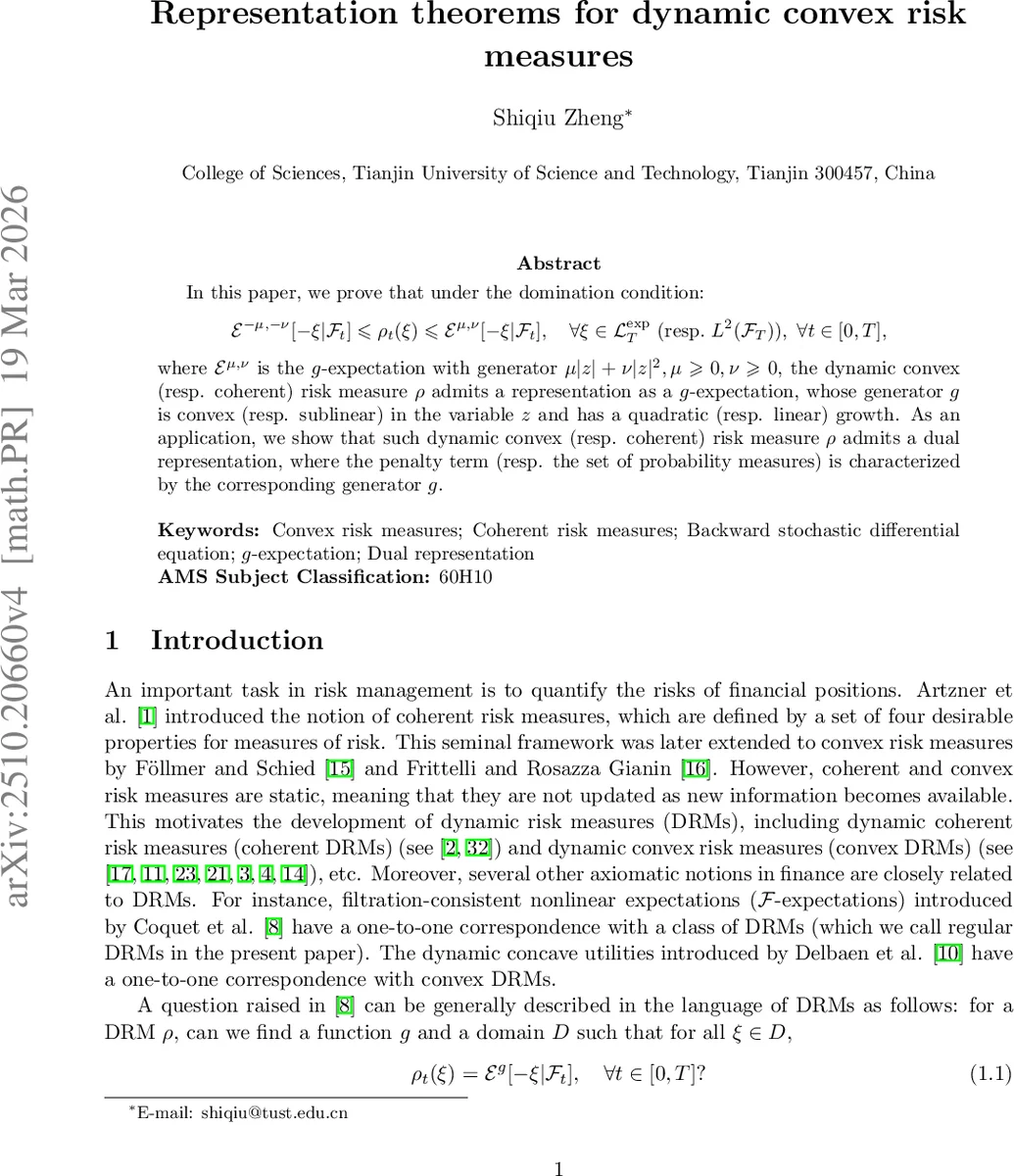
In this paper, we prove that under the domination condition: \begin{equation*} {\cal{E}}^{-μ,-ν}[-ξ|{\cal{F}}_t]\leqρ_t(ξ)\leq{\cal{E}}^{μ,ν}[-ξ|{\cal{F}}_t],\quad \forallξ\in \mathcal{L}^{\exp}_T\ (\text{resp.}\ L^2(\mathcal{F}_T)),\ \forall t\in[0,T], \end{equation*} where ${\cal{E}}^{μ,ν}$ is the $g$-expectation with generator $μ|z|+ν|z|^2, μ\geq0, ν\geq0$, the dynamic convex (resp. coherent) risk measure $ρ$ admits a representation as a $g$-expectation, whose generator $g$ is convex (resp. sublinear) in the variable $z$ and has a quadratic (resp. linear) growth. As an application, we show that such dynamic convex (resp. coherent) risk measure $ρ$ admits a dual representation, where the penalty term (resp. the set of probability measures) is characterized by the corresponding generator $g$.
💡 Research Summary
The paper addresses the fundamental “representation problem” for dynamic risk measures (DRMs), focusing on dynamic convex and coherent risk measures. Classical static risk measures, introduced by Artzner et al., were later extended to convex settings, but they remain static and do not adapt to new information. Dynamic risk measures, which evolve with the filtration, have been studied extensively, yet a general representation of a DRM as a g‑expectation—i.e., a solution of a backward stochastic differential equation (BSDE) with a suitable generator—has remained elusive, especially when the terminal payoff is unbounded or the generator exhibits quadratic growth.
The authors propose a new domination condition: for non‑negative constants μ and ν, the DRM ρ satisfies
\
Comments & Academic Discussion
Loading comments...
Leave a Comment